
CMSC 202 Lesson 21 Exceptions II double quotientint
CMSC 202 Lesson 21 Exceptions II
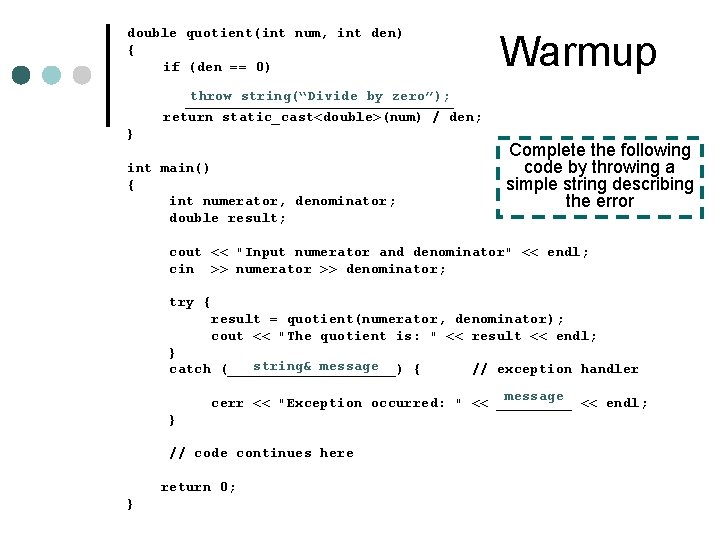
double quotient(int num, int den) { if (den == 0) Warmup throw string(“Divide by zero”); ________________ return static_cast<double>(num) / den; } int main() { int numerator, denominator; double result; Complete the following code by throwing a simple string describing the error cout << "Input numerator and denominator" << endl; cin >> numerator >> denominator; try { result = quotient(numerator, denominator); cout << "The quotient is: " << result << endl; } string& message catch (__________) { // exception handler message cerr << "Exception occurred: " << _____ << endl; } // code continues here return 0; }
Review ¢ Purpose of Exceptions l ¢ Handle Errors Three Key Components Try l Catch l Throw l ¢ Handle Multiple Exceptions? l Absolutely
Exception Classes ¢ Name? l ¢ Reflects error, not code that throws error Data? l Basic information or a message • Parameter value • Name of function that detected error • Description of error ¢ Methods? l l Constructor (one or more) Accessor (one or more)
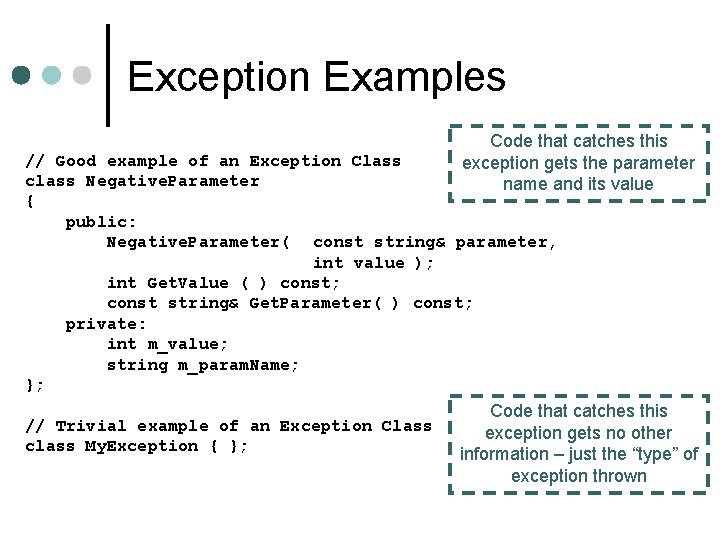
Exception Examples Code that catches this exception gets the parameter name and its value // Good example of an Exception Class class Negative. Parameter { public: Negative. Parameter( const string& parameter, int value ); int Get. Value ( ) const; const string& Get. Parameter( ) const; private: int m_value; string m_param. Name; }; // Trivial example of an Exception Class class My. Exception { }; Code that catches this exception gets no other information – just the “type” of exception thrown
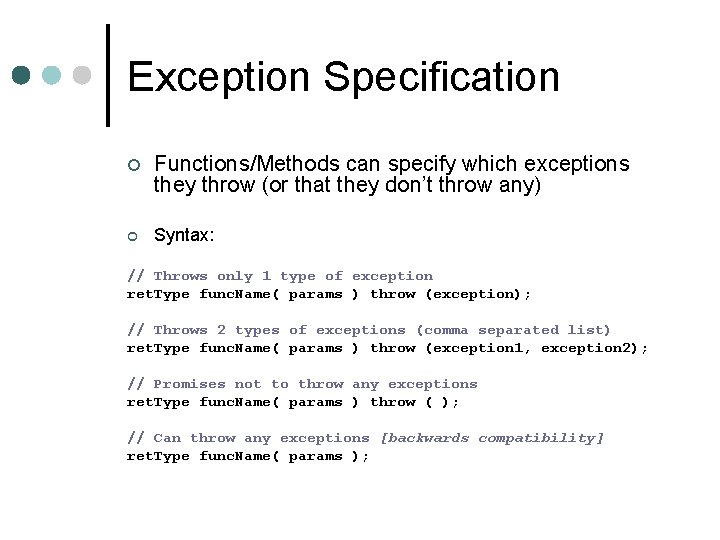
Exception Specification ¢ Functions/Methods can specify which exceptions they throw (or that they don’t throw any) ¢ Syntax: // Throws only 1 type of exception ret. Type func. Name( params ) throw (exception); // Throws 2 types of exceptions (comma separated list) ret. Type func. Name( params ) throw (exception 1, exception 2); // Promises not to throw any exceptions ret. Type func. Name( params ) throw ( ); // Can throw any exceptions [backwards compatibility] ret. Type func. Name( params );
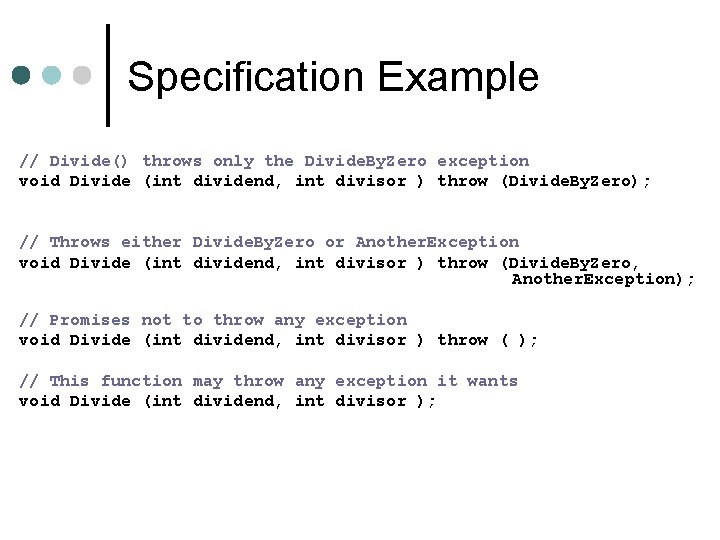
Specification Example // Divide() throws only the Divide. By. Zero exception void Divide (int dividend, int divisor ) throw (Divide. By. Zero); // Throws either Divide. By. Zero or Another. Exception void Divide (int dividend, int divisor ) throw (Divide. By. Zero, Another. Exception); // Promises not to throw any exception void Divide (int dividend, int divisor ) throw ( ); // This function may throw any exception it wants void Divide (int dividend, int divisor );
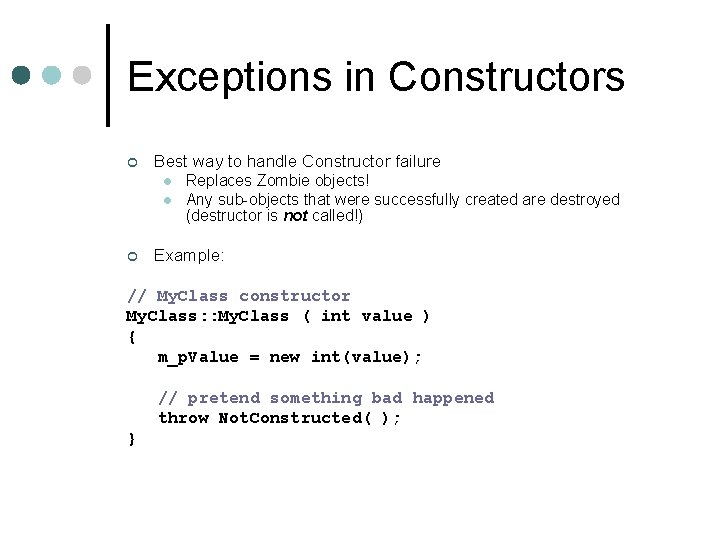
Exceptions in Constructors ¢ Best way to handle Constructor failure l l ¢ Replaces Zombie objects! Any sub-objects that were successfully created are destroyed (destructor is not called!) Example: // My. Class constructor My. Class: : My. Class ( int value ) { m_p. Value = new int(value); // pretend something bad happened throw Not. Constructed( ); }
Exceptions in Destructors ¢ Bad, bad idea… l What if your object is being destroyed in response to another exception? • Should runtime start handling your exception or the previous one? ¢ General Rule… l Do not throw exceptions in destructor
Standard Library Exceptions ¢ #include <stdexcept> l bad_alloc • Thrown by new when a memory allocation error occurs l out_of_range • Thrown by vector's at( ) function for an bad index parameter. l invalid_argument • Thrown when the value of an argument (as in vector< int > int. Vector(-30); ) is invalid ¢ Derive from std: : exception l Define own classes that derive…
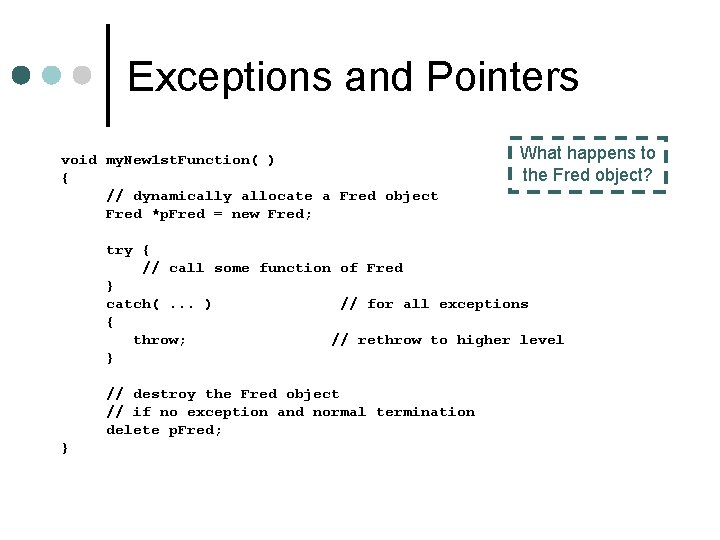
Exceptions and Pointers void my. New 1 st. Function( ) { // dynamically allocate a Fred object Fred *p. Fred = new Fred; What happens to the Fred object? try { // call some function of Fred } catch(. . . ) // for all exceptions { throw; // rethrow to higher level } // destroy the Fred object // if no exception and normal termination delete p. Fred; }
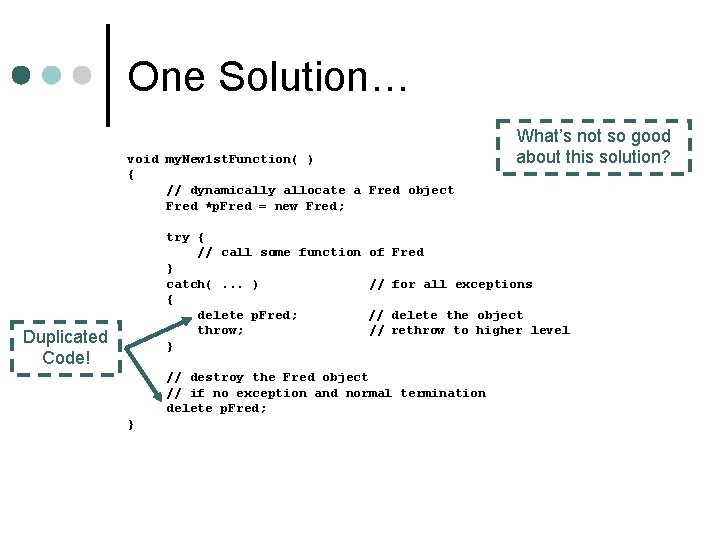
One Solution… void my. New 1 st. Function( ) { // dynamically allocate a Fred object Fred *p. Fred = new Fred; try { // call some function } catch(. . . ) { delete p. Fred; throw; } Duplicated Code! of Fred // for all exceptions // delete the object // rethrow to higher level // destroy the Fred object // if no exception and normal termination delete p. Fred; } What’s not so good about this solution?
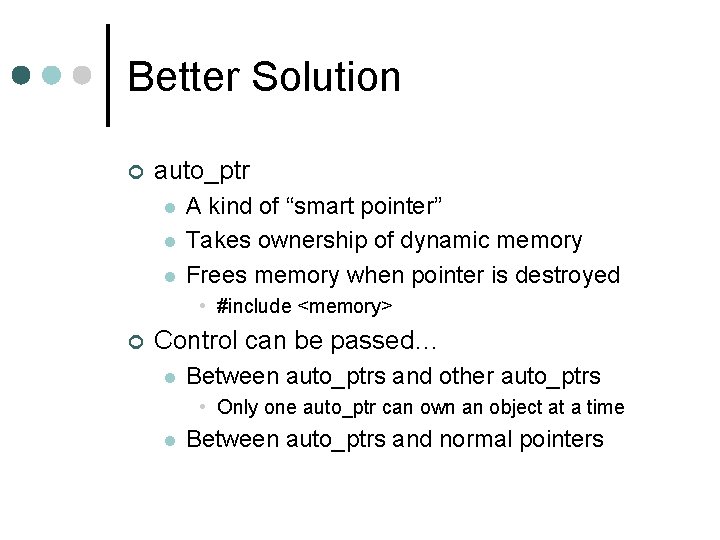
Better Solution ¢ auto_ptr l l l A kind of “smart pointer” Takes ownership of dynamic memory Frees memory when pointer is destroyed • #include <memory> ¢ Control can be passed… l Between auto_ptrs and other auto_ptrs • Only one auto_ptr can own an object at a time l Between auto_ptrs and normal pointers
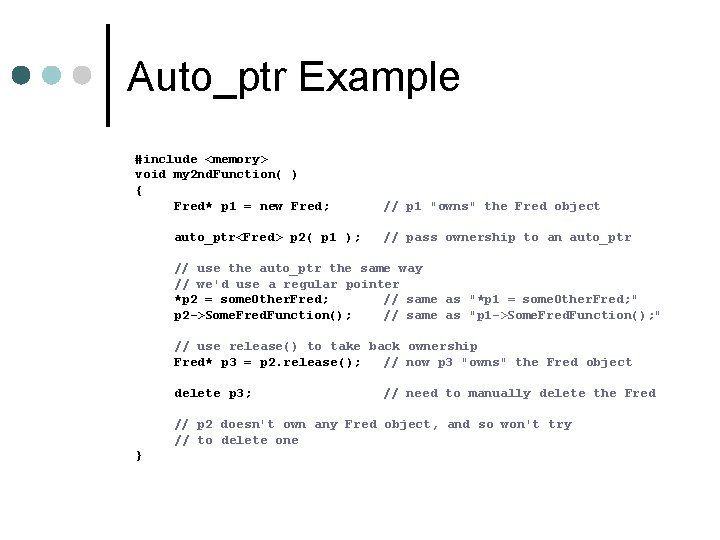
Auto_ptr Example #include <memory> void my 2 nd. Function( ) { Fred* p 1 = new Fred; auto_ptr<Fred> p 2( p 1 ); // p 1 "owns" the Fred object // pass ownership to an auto_ptr // use the auto_ptr the same way // we'd use a regular pointer *p 2 = some. Other. Fred; // same as "*p 1 = some. Other. Fred; " p 2 ->Some. Fred. Function(); // same as "p 1 ->Some. Fred. Function(); " // use release() to take back ownership Fred* p 3 = p 2. release(); // now p 3 "owns" the Fred object delete p 3; // need to manually delete the Fred // p 2 doesn't own any Fred object, and so won't try // to delete one }
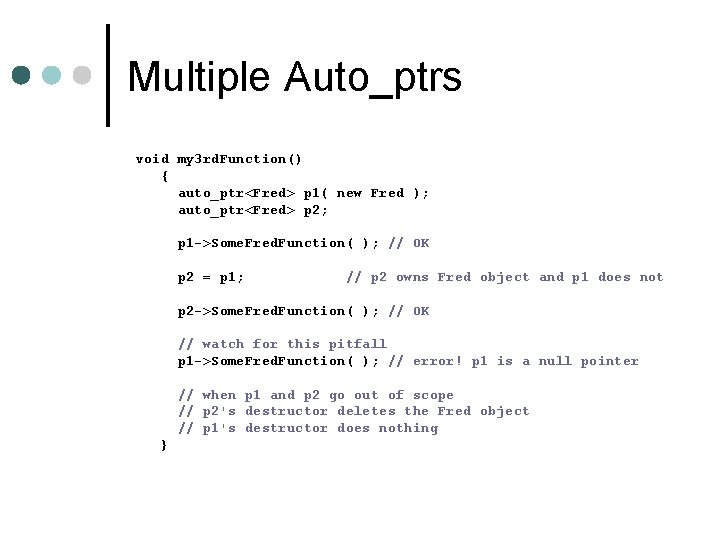
Multiple Auto_ptrs void my 3 rd. Function() { auto_ptr<Fred> p 1( new Fred ); auto_ptr<Fred> p 2; p 1 ->Some. Fred. Function( ); // OK p 2 = p 1; // p 2 owns Fred object and p 1 does not p 2 ->Some. Fred. Function( ); // OK // watch for this pitfall p 1 ->Some. Fred. Function( ); // error! p 1 is a null pointer // when p 1 and p 2 go out of scope // p 2's destructor deletes the Fred object // p 1's destructor does nothing }
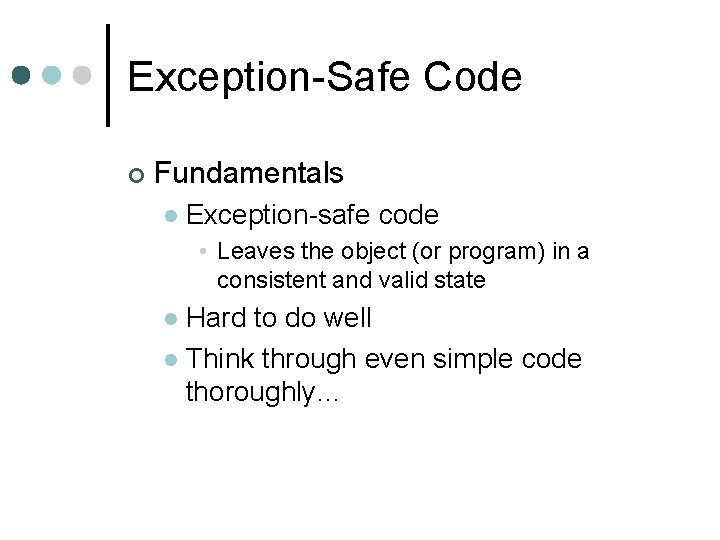
Exception-Safe Code ¢ Fundamentals l Exception-safe code • Leaves the object (or program) in a consistent and valid state Hard to do well l Think through even simple code thoroughly… l
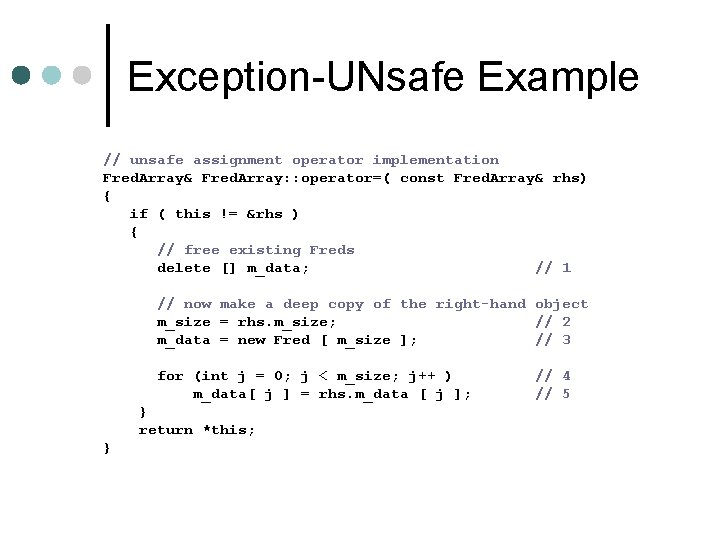
Exception-UNsafe Example // unsafe assignment operator implementation Fred. Array& Fred. Array: : operator=( const Fred. Array& rhs) { if ( this != &rhs ) { // free existing Freds delete [] m_data; // 1 // now make a deep copy of the right-hand object m_size = rhs. m_size; // 2 m_data = new Fred [ m_size ]; // 3 for (int j = 0; j < m_size; j++ ) m_data[ j ] = rhs. m_data [ j ]; } return *this; } // 4 // 5
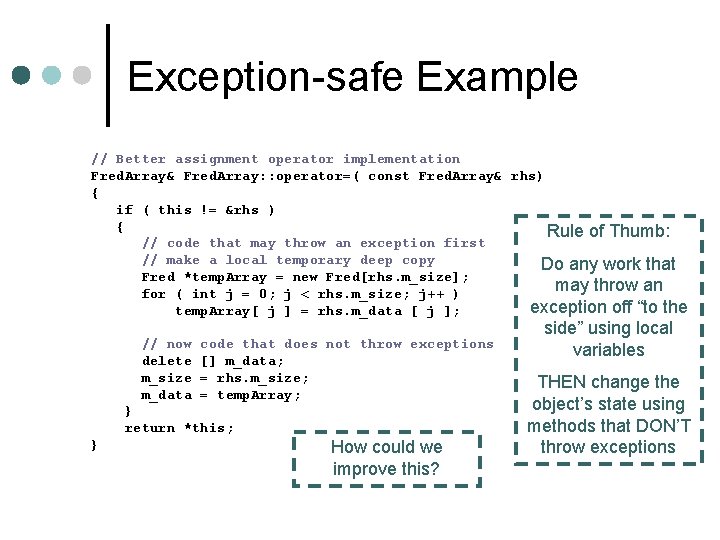
Exception-safe Example // Better assignment operator implementation Fred. Array& Fred. Array: : operator=( const Fred. Array& rhs) { if ( this != &rhs ) { Rule of Thumb: // code that may throw an exception first // make a local temporary deep copy Do any work that Fred *temp. Array = new Fred[rhs. m_size]; may throw an for ( int j = 0; j < rhs. m_size; j++ ) exception off “to the temp. Array[ j ] = rhs. m_data [ j ]; // now delete m_size m_data code that does not throw exceptions [] m_data; = rhs. m_size; = temp. Array; } return *this; } How could we improve this? side” using local variables THEN change the object’s state using methods that DON’T throw exceptions
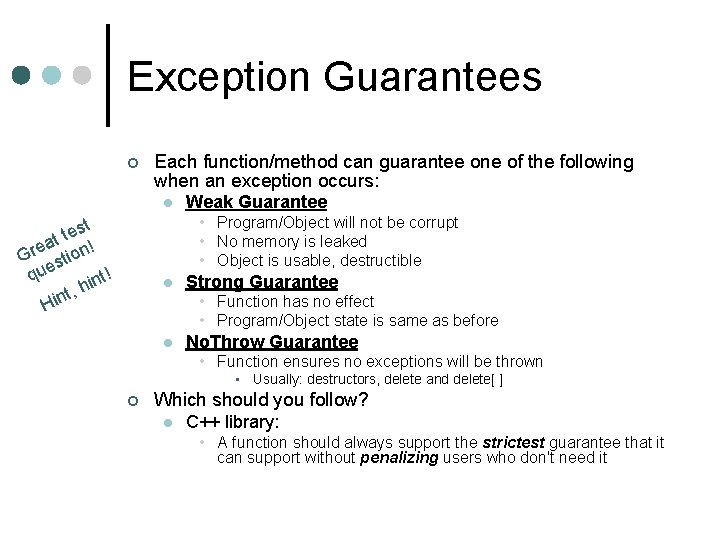
Exception Guarantees ¢ Each function/method can guarantee one of the following when an exception occurs: l Weak Guarantee • Program/Object will not be corrupt • No memory is leaked • Object is usable, destructible st e t at n! e r G stio que nt! i h t, Hin l Strong Guarantee • Function has no effect • Program/Object state is same as before l No. Throw Guarantee • Function ensures no exceptions will be thrown • Usually: destructors, delete and delete[ ] ¢ Which should you follow? l C++ library: • A function should always support the strictest guarantee that it can support without penalizing users who don't need it
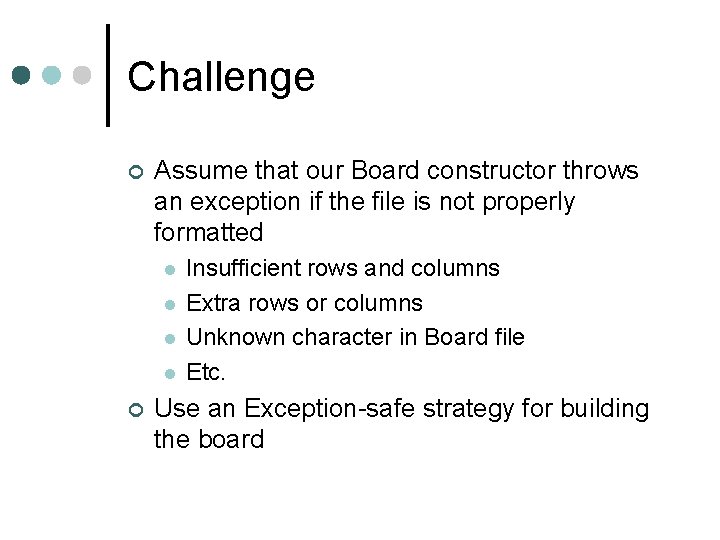
Challenge ¢ Assume that our Board constructor throws an exception if the file is not properly formatted l l ¢ Insufficient rows and columns Extra rows or columns Unknown character in Board file Etc. Use an Exception-safe strategy for building the board
- Slides: 20