
CMSC 202 Classes and Objects 4 th Lecture
CMSC 202 Classes and Objects 4 th Lecture February 2008
Topics • Composition • Person class example • Class invariant • Copy constructor • Privacy leaks February 2008 2
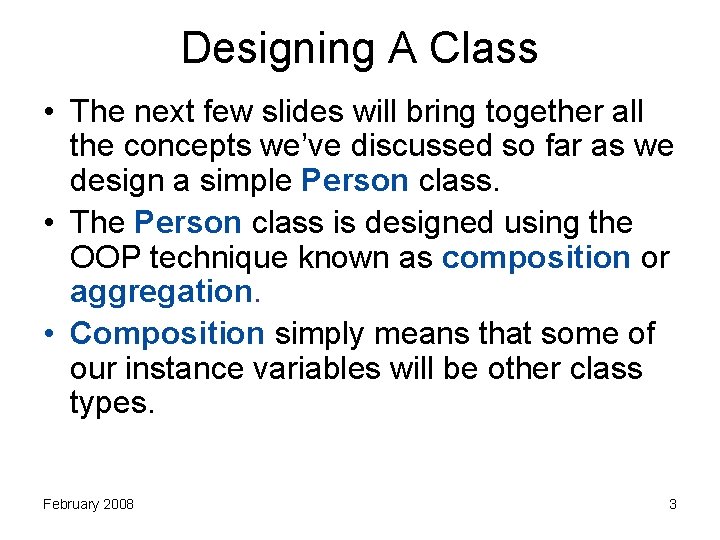
Designing A Class • The next few slides will bring together all the concepts we’ve discussed so far as we design a simple Person class. • The Person class is designed using the OOP technique known as composition or aggregation. • Composition simply means that some of our instance variables will be other class types. February 2008 3
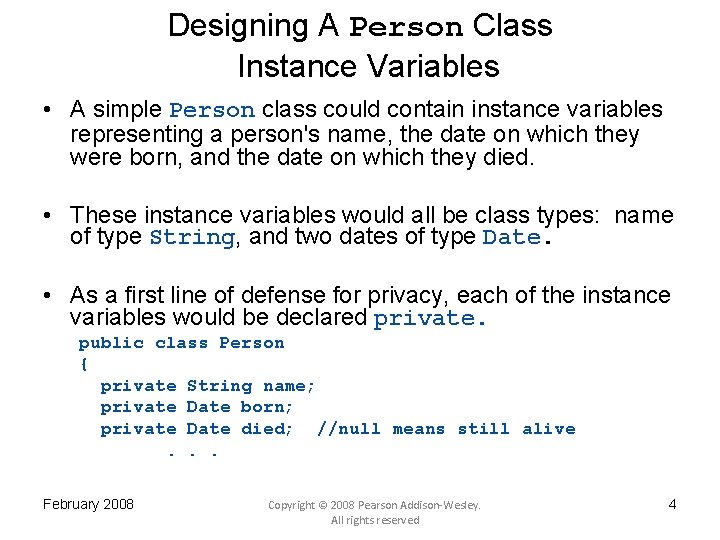
Designing A Person Class Instance Variables • A simple Person class could contain instance variables representing a person's name, the date on which they were born, and the date on which they died. • These instance variables would all be class types: name of type String, and two dates of type Date. • As a first line of defense for privacy, each of the instance variables would be declared private. public class Person { private String name; private Date born; private Date died; //null means still alive. . . February 2008 Copyright © 2008 Pearson Addison-Wesley. All rights reserved 4
Composition • Unlike the Date class, the Person class contains three class type instance variables. private String name; private Date born; private Date died; • The use of classes as instance variables is a design method known as aggregation or composition. • Composition is a fundamental way to reuse code, but there are coding considerations when composition is used. February 2008 5
Designing a Person Class: Constructor • In order to exist, a person must have (at least) a name and a birth date. – Therefore, it would make no sense to have a noargument Person class constructor. • A person who is still alive does not yet have a date of death. – Therefore, the Person class constructor will need to be able to deal with a null value for date of death. • A person who has died must have had a birth date that preceded his or her date of death. – Therefore, when both dates are provided, they will need to be checked for consistency. February 2008 Copyright © 2008 Pearson Addison-Wesley. All rights reserved 6
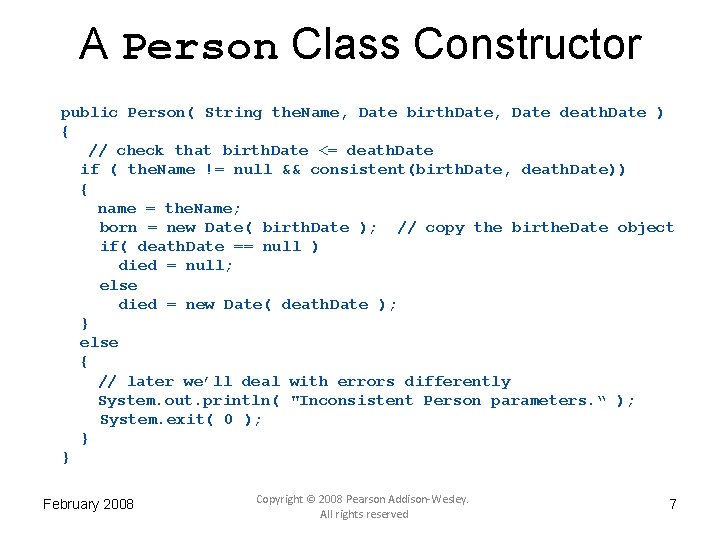
A Person Class Constructor public Person( String the. Name, Date birth. Date, Date death. Date ) { // check that birth. Date <= death. Date if ( the. Name != null && consistent(birth. Date, death. Date)) { name = the. Name; born = new Date( birth. Date ); // copy the birthe. Date object if( death. Date == null ) died = null; else died = new Date( death. Date ); } else { // later we’ll deal with errors differently System. out. println( "Inconsistent Person parameters. “ ); System. exit( 0 ); } } February 2008 Copyright © 2008 Pearson Addison-Wesley. All rights reserved 7
Designing a Person Class the Class Invariant • A statement that is always true for every object of the class is called a class invariant. – A class invariant can help to define a class in a consistent and organized way. • For the Person class, the following should always be true: – An object of the class Person has a name, a date of birth (which is not null), and if the object has a date of death, then the date of death is equal to or later than the date of birth • Checking the Person class confirms that this is true of every object created by a constructor, and all the other methods (e. g. , the private method consistent) preserve the truth of this statement. • Methods of the Person class which do not change the Person’s state may assume the class invariant holds. February 2008 Copyright © 2008 Pearson Addison-Wesley. All rights reserved 8
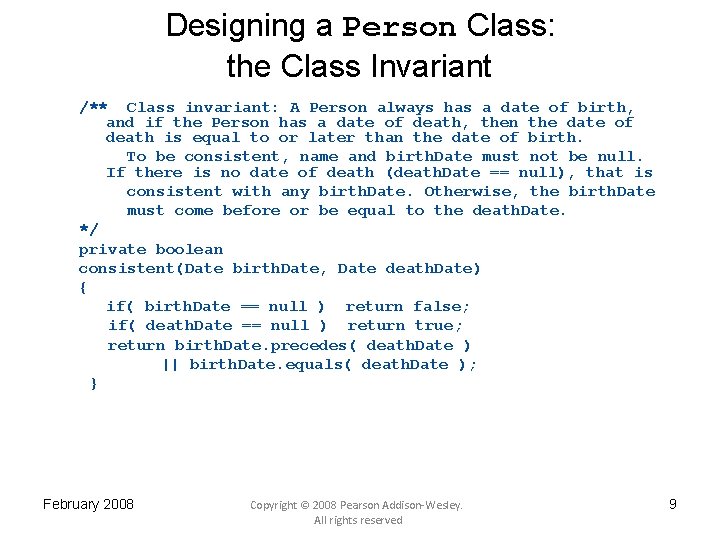
Designing a Person Class: the Class Invariant /** Class invariant: A Person always has a date of birth, and if the Person has a date of death, then the date of death is equal to or later than the date of birth. To be consistent, name and birth. Date must not be null. If there is no date of death (death. Date == null), that is consistent with any birth. Date. Otherwise, the birth. Date must come before or be equal to the death. Date. */ private boolean consistent(Date birth. Date, Date death. Date) { if( birth. Date == null ) return false; if( death. Date == null ) return true; return birth. Date. precedes( death. Date ) || birth. Date. equals( death. Date ); } February 2008 Copyright © 2008 Pearson Addison-Wesley. All rights reserved 9
Designing a Person Class: the equals and dates. Match Methods • The definition of equals for the class Person includes an invocation of equals for the class String, and an invocation of the method equals for the class Date. • The Person class passes responsibility for determining equality to the String and Date classes invoking their equals methods. – This is an important example of code reuse. • Java determines which equals method is being invoked from the type of its calling object. February 2008 Copyright © 2008 Pearson Addison-Wesley. All rights reserved 10
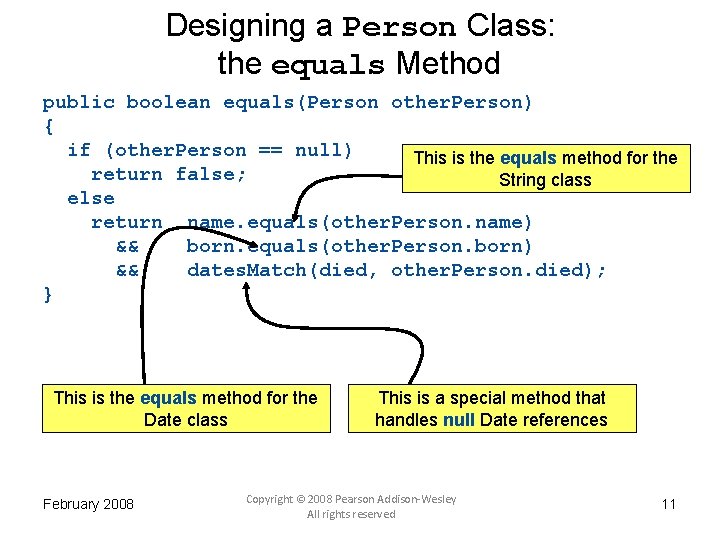
Designing a Person Class: the equals Method public boolean equals(Person other. Person) { if (other. Person == null) This is the equals method for the return false; String class else return name. equals(other. Person. name) && born. equals(other. Person. born) && dates. Match(died, other. Person. died); } This is the equals method for the Date class February 2008 This is a special method that handles null Date references Copyright © 2008 Pearson Addison-Wesley All rights reserved 11
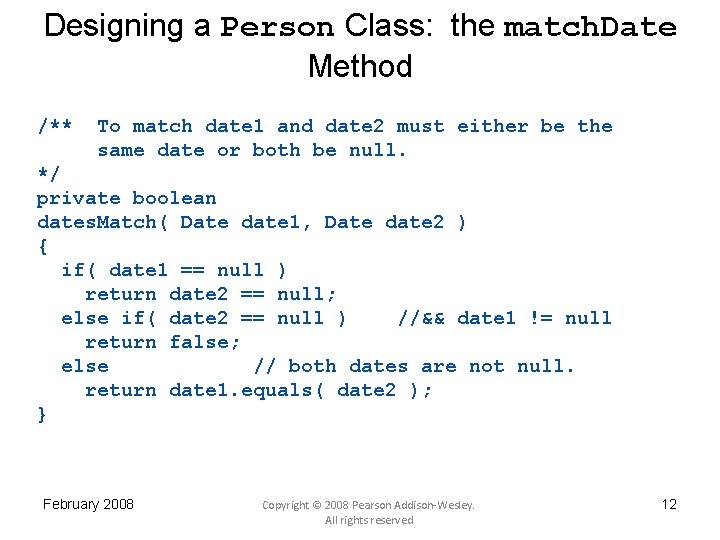
Designing a Person Class: the match. Date Method /** To match date 1 and date 2 must either be the same date or both be null. */ private boolean dates. Match( Date date 1, Date date 2 ) { if( date 1 == null ) return date 2 == null; else if( date 2 == null ) //&& date 1 != null return false; else // both dates are not null. return date 1. equals( date 2 ); } February 2008 Copyright © 2008 Pearson Addison-Wesley. All rights reserved 12
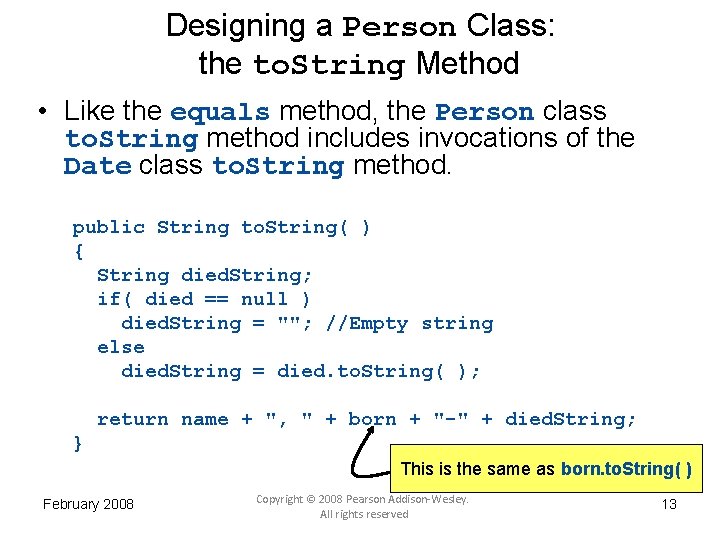
Designing a Person Class: the to. String Method • Like the equals method, the Person class to. String method includes invocations of the Date class to. String method. public String to. String( ) { String died. String; if( died == null ) died. String = ""; //Empty string else died. String = died. to. String( ); return name + ", " + born + "-" + died. String; } This is the same as born. to. String( ) February 2008 Copyright © 2008 Pearson Addison-Wesley. All rights reserved 13
Copy Constructors • A copy constructor is a constructor with a single argument of the same type as the class. • The copy constructor should create an object that is a separate, independent object, but with the instance variables set so that it is an exact copy of the argument object. • In the Date copy constructor, the values of all of the primitive type private instance variables are merely copied. • When a class uses other classes as instance variables (composition), care must be taken to insure that copying is done correctly. February 2008 Copyright © 2008 Pearson Addison-Wesley. All rights reserved 14
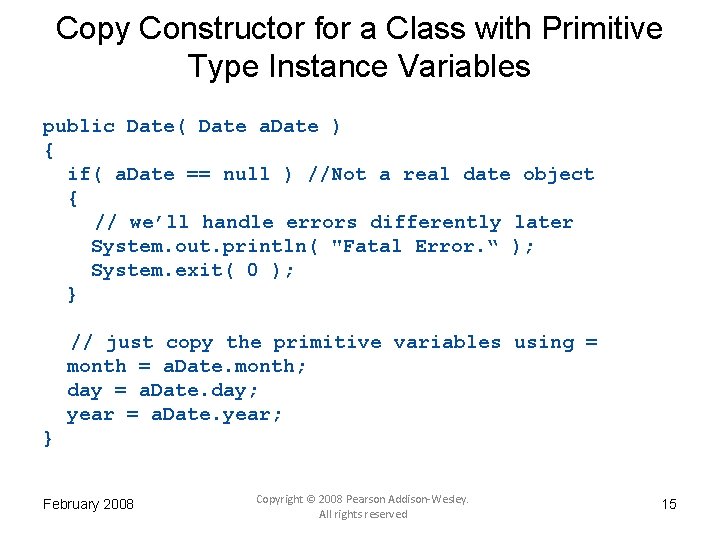
Copy Constructor for a Class with Primitive Type Instance Variables public Date( Date a. Date ) { if( a. Date == null ) //Not a real date object { // we’ll handle errors differently later System. out. println( "Fatal Error. “ ); System. exit( 0 ); } // just copy the primitive variables using = month = a. Date. month; day = a. Date. day; year = a. Date. year; } February 2008 Copyright © 2008 Pearson Addison-Wesley. All rights reserved 15
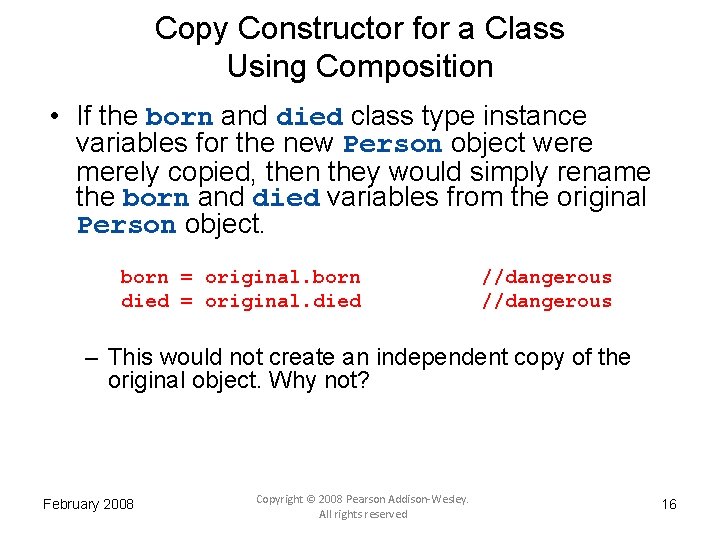
Copy Constructor for a Class Using Composition • If the born and died class type instance variables for the new Person object were merely copied, then they would simply rename the born and died variables from the original Person object. born = original. born died = original. died //dangerous – This would not create an independent copy of the original object. Why not? February 2008 Copyright © 2008 Pearson Addison-Wesley. All rights reserved 16
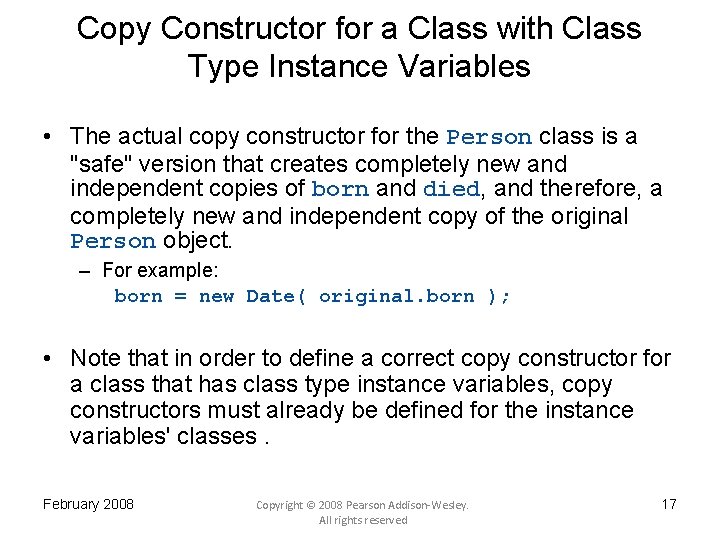
Copy Constructor for a Class with Class Type Instance Variables • The actual copy constructor for the Person class is a "safe" version that creates completely new and independent copies of born and died, and therefore, a completely new and independent copy of the original Person object. – For example: born = new Date( original. born ); • Note that in order to define a correct copy constructor for a class that has class type instance variables, copy constructors must already be defined for the instance variables' classes. February 2008 Copyright © 2008 Pearson Addison-Wesley. All rights reserved 17
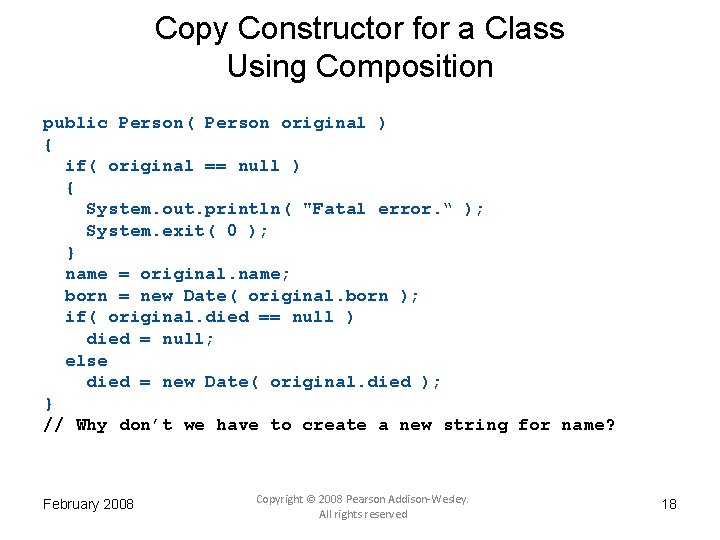
Copy Constructor for a Class Using Composition public Person( Person original ) { if( original == null ) { System. out. println( "Fatal error. “ ); System. exit( 0 ); } name = original. name; born = new Date( original. born ); if( original. died == null ) died = null; else died = new Date( original. died ); } // Why don’t we have to create a new string for name? February 2008 Copyright © 2008 Pearson Addison-Wesley. All rights reserved 18

Using and Misusing References • When writing a program, it is very important to insure that private instance variables remain truly private. • For a primitive type instance variable, just adding the private modifier to its declaration should insure that there will be no privacy leaks. • For a class type instance variable, adding the private modifier alone is not sufficient. February 2008 Copyright © 2008 Pearson Addison-Wesley. All rights reserved 19

Pitfall: Privacy Leaks • The previously illustrated examples from the Person class show an incorrect definition of a copy constructor can result in a privacy leak. • A similar problem can occur with incorrectly defined mutator or accessor methods. – For example: public Date get. Birth. Date( ) { return born; //dangerous – why? ? } – Instead of: public Date get. Birth. Date( ) { return new Date( born ); } February 2008 //correct Copyright © 2008 Pearson Addison-Wesley. All rights reserved 20
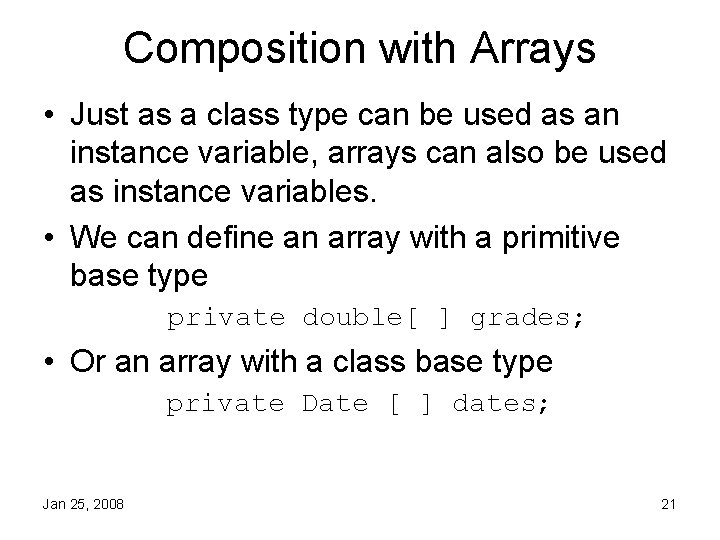
Composition with Arrays • Just as a class type can be used as an instance variable, arrays can also be used as instance variables. • We can define an array with a primitive base type private double[ ] grades; • Or an array with a class base type private Date [ ] dates; Jan 25, 2008 21
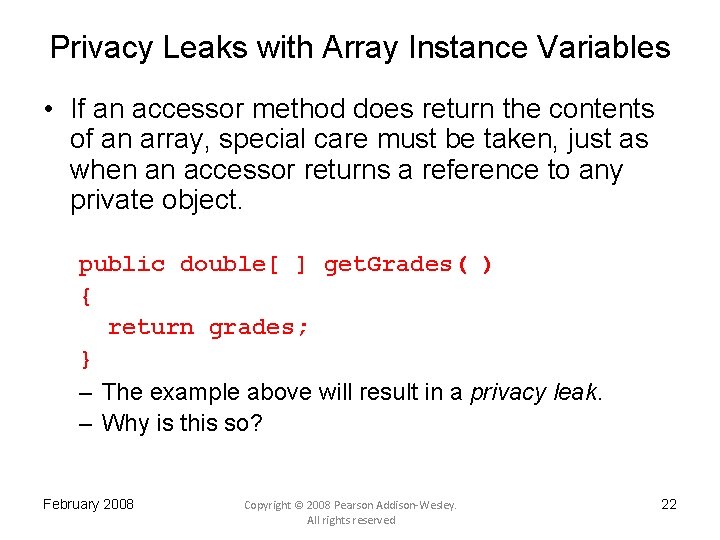
Privacy Leaks with Array Instance Variables • If an accessor method does return the contents of an array, special care must be taken, just as when an accessor returns a reference to any private object. public double[ ] get. Grades( ) { return grades; } – The example above will result in a privacy leak. – Why is this so? February 2008 Copyright © 2008 Pearson Addison-Wesley. All rights reserved 22
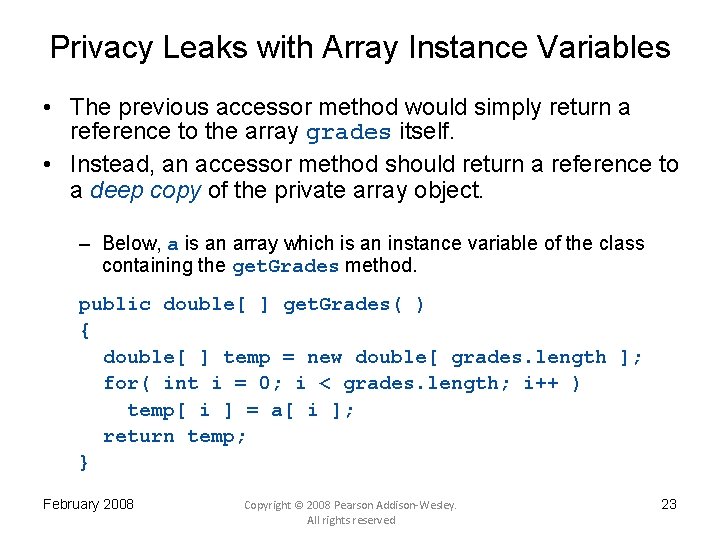
Privacy Leaks with Array Instance Variables • The previous accessor method would simply return a reference to the array grades itself. • Instead, an accessor method should return a reference to a deep copy of the private array object. – Below, a is an array which is an instance variable of the class containing the get. Grades method. public double[ ] get. Grades( ) { double[ ] temp = new double[ grades. length ]; for( int i = 0; i < grades. length; i++ ) temp[ i ] = a[ i ]; return temp; } February 2008 Copyright © 2008 Pearson Addison-Wesley. All rights reserved 23
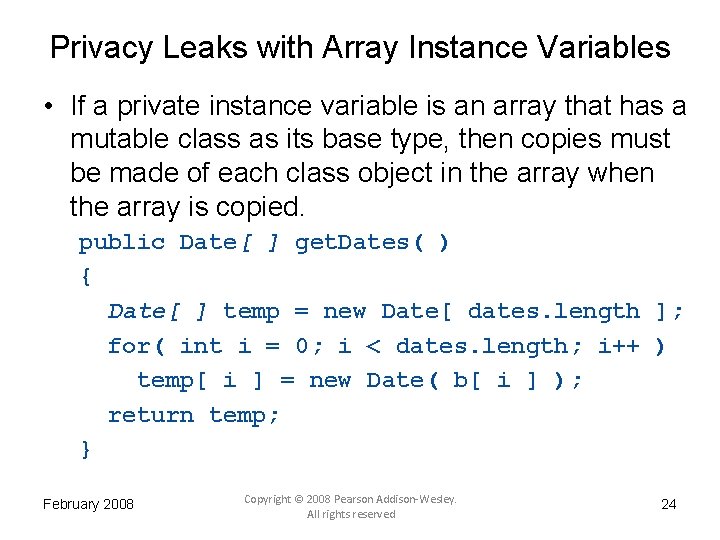
Privacy Leaks with Array Instance Variables • If a private instance variable is an array that has a mutable class as its base type, then copies must be made of each class object in the array when the array is copied. public Date[ ] get. Dates( ) { Date[ ] temp = new Date[ dates. length ]; for( int i = 0; i < dates. length; i++ ) temp[ i ] = new Date( b[ i ] ); return temp; } February 2008 Copyright © 2008 Pearson Addison-Wesley. All rights reserved 24
- Slides: 24