
CMSC 201 Computer Science I for Majors Lecture
- Slides: 39
CMSC 201 Computer Science I for Majors Lecture 01 – Introduction All materials copyright UMBC and Dr. Katherine Gibson unless otherwise noted www. umbc. edu
Course Overview 6 All materials copyright UMBC and Dr. Katherine Gibson unless otherwise noted www. umbc. edu
Course Information • First course in the CMSC intro sequence – Followed by CMSC 202 • CMSC majors must get a B or better • CMPE majors must get a B or better – Unless you entered UMBC prior to Fall 2016 • No prior programming experience needed – Some may have it 7 All materials copyright UMBC and Dr. Katherine Gibson unless otherwise noted www. umbc. edu
What the Course is About • Introduction to Computer Science – Problem solving and computer programming • We’re going to come up with algorithmic solutions to problems – What is an algorithm? • We will communicate our algorithms to computers using the Python language 8 All materials copyright UMBC and Dr. Katherine Gibson unless otherwise noted www. umbc. edu
Class Objectives • By the end of this class, you will be able to: – Use an algorithmic approach to solve computational problems – Break down complex problems into simpler ones – Write and debug programs in the Python programming language – Be comfortable with the UNIX environment 9 All materials copyright UMBC and Dr. Katherine Gibson unless otherwise noted www. umbc. edu
CMSC 201 for non-CS, non. Engineering Disciplines • Same computing content (Python) as other sections – Same labs, same lecture notes/slides • Key difference: Emphasis on programming projects applicable to the social and biological sciences and humanities • Open to all non-CS, non-engineering majors (closed to PHYS, MATH, CHEM) • Fulfills any major’s requirement for CMSC 201 • Small class size! • Lecture: Section 36 -LEC, #7838, Mon/Wed 2: 30 -3: 45 • Lab: Section 37 -DIS, #7839, M 11: 00 -11: 50 OR Section 38 -DIS, 7840, W 11: 00 -11: 50 • Questions: Dr. Susan Mitchell (smitchel@umbc. edu) 10 All materials copyright UMBC and Dr. Katherine Gibson unless otherwise noted www. umbc. edu
Why Learn to Program? • Programming skills are useful across a wide range of fields and applications – Many scientific professions utilize programming – Programming skills allow you to understand exploit “big data” – Logical thinking learned from programming transfers to many other domains 11 All materials copyright UMBC and Dr. Katherine Gibson unless otherwise noted www. umbc. edu
Grading Scheme • This class has: – 6 Homeworks (40 points each) • Small programming assignments – 3 Projects (80 points each) • Larger programming assignments – 13 lab assignments (10 points each, drop 3 lowest) – 4 mandatory surveys (5 points each) – Two midterm exams (75 + 125 = 200 points) – A comprehensive final exam (200 points) 12 All materials copyright UMBC and Dr. Katherine Gibson unless otherwise noted www. umbc. edu
A Note on Labs • Your “discussion” section is actually a lab – In the Engineer building (ENG) • Labs are worth 10% of your grade • You must attend your assigned section – No credit for attending other sections 13 All materials copyright UMBC and Dr. Katherine Gibson unless otherwise noted www. umbc. edu
Submission and Late Policy • Homeworks and projects will be submitted via the GL server with the submit command • Homeworks will always be due at 8: 59 pm • Late homeworks will receive a zero • (In other words, there are no late homeworks) 14 All materials copyright UMBC and Dr. Katherine Gibson unless otherwise noted www. umbc. edu
Submission and Late Policy • It is not recommended that you submit close to the deadline – Developing programs can be tricky and unpredictable – Sometimes the server gets overloaded with everyone trying to submit • Start early and submit early (and often!) 15 All materials copyright UMBC and Dr. Katherine Gibson unless otherwise noted www. umbc. edu
Academic Integrity 16 All materials copyright UMBC and Dr. Katherine Gibson unless otherwise noted www. umbc. edu
Academic Integrity • We have homeworks and projects in this class • You should never, ever submit work done by someone else as your own • If you submit someone else’s code, both students will get a 0 on the assignment 17 All materials copyright UMBC and Dr. Katherine Gibson unless otherwise noted www. umbc. edu
Things to Avoid • Downloading or obtaining anyone else’s work • Copying and pasting another person’s code • Leaving your computer logged in where another student can access it • Giving your code to another student – Or explaining it in explicit detail to another student • Attempting to buy code online – This will result in an immediate F in the class 18 All materials copyright UMBC and Dr. Katherine Gibson unless otherwise noted www. umbc. edu
Things that are Always Okay • And encouraged! • • • 19 Talking to a classmate about a concept Getting help from a TA or instructor Comparing program output Discussing how to test your program Working on practice problems together All materials copyright UMBC and Dr. Katherine Gibson unless otherwise noted www. umbc. edu
Collaboration Policy • We want you to learn all these things: – The course material – How to work independently – How to work collaboratively • Some assignments will be “individual work” while others will be “collaboration allowed” – These will be clearly marked on each assignment – You may only collaborate with current 201 students 20 All materials copyright UMBC and Dr. Katherine Gibson unless otherwise noted www. umbc. edu
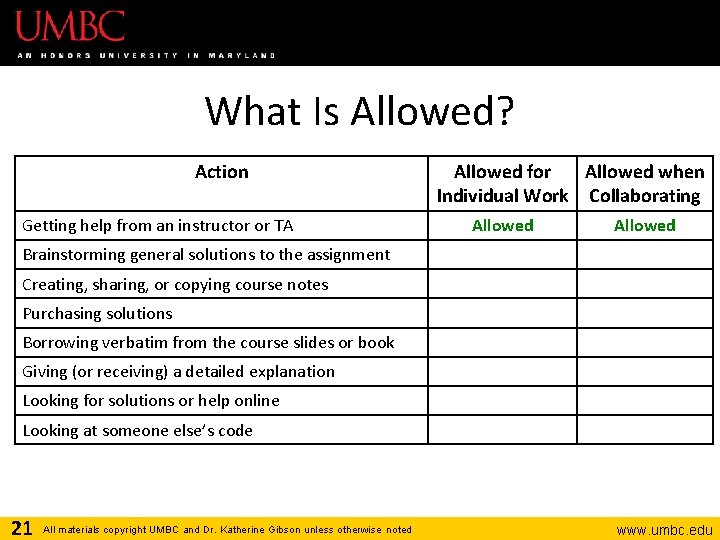
What Is Allowed? Action Getting help from an instructor or TA Allowed for Allowed when Individual Work Collaborating Allowed Not Allowed Allowed Giving (or receiving) a detailed explanation Not Allowed Looking for solutions or help online Not Allowed Looking at someone else’s code It Depends Brainstorming general solutions to the assignment Creating, sharing, or copying course notes Purchasing solutions Borrowing verbatim from the course slides or book 21 All materials copyright UMBC and Dr. Katherine Gibson unless otherwise noted www. umbc. edu
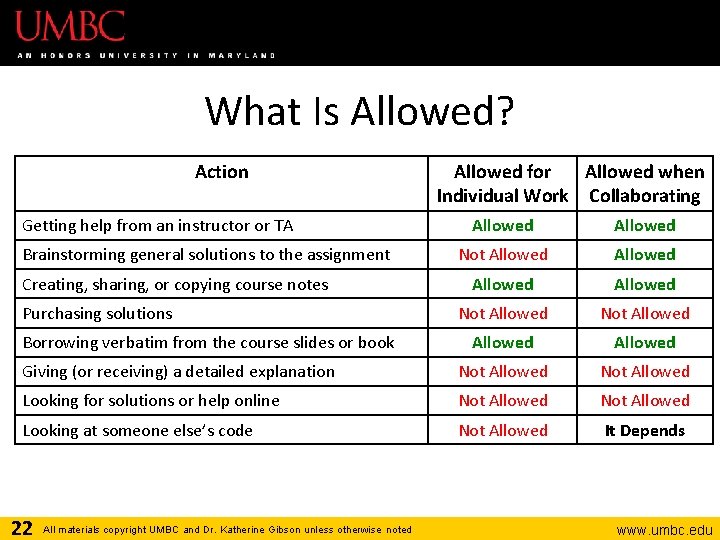
What Is Allowed? Action Getting help from an instructor or TA Allowed for Allowed when Individual Work Collaborating Allowed Not Allowed Allowed Giving (or receiving) a detailed explanation Not Allowed Looking for solutions or help online Not Allowed Looking at someone else’s code Not Allowed It Depends Brainstorming general solutions to the assignment Creating, sharing, or copying course notes Purchasing solutions Borrowing verbatim from the course slides or book 22 All materials copyright UMBC and Dr. Katherine Gibson unless otherwise noted www. umbc. edu
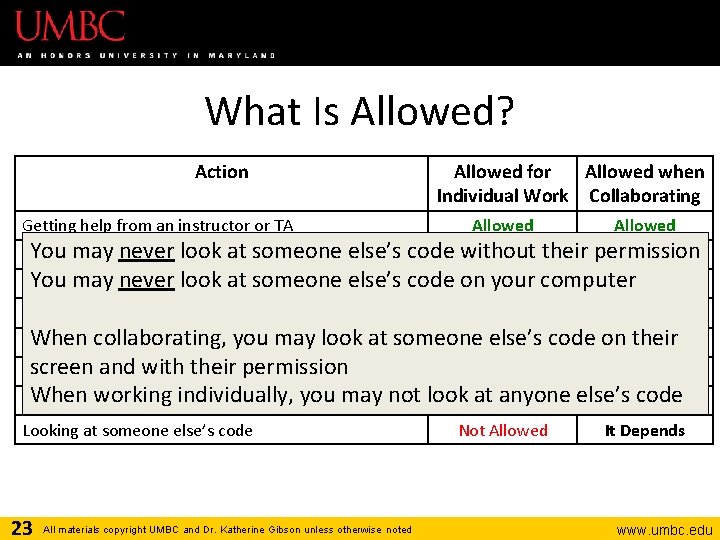
What Is Allowed? Action Getting help from an instructor or TA Allowed for Allowed when Individual Work Collaborating Allowed You may never look at someone else’s code without their permission Brainstorming general solutions to the assignment Not Allowed You may never look at someone else’s code on your computer Creating, sharing, or copying course notes Allowed Purchasing solutions Not Allowed screen and with their permission Giving (or receiving) a detailed explanation Not Allowed Looking at someone else’s code Not Allowed It Depends When collaborating, you may look at someone else’s code on their Borrowing verbatim from the course slides or book Allowed When working individually, you may not look at anyone else’s code Looking for solutions or help online Not Allowed 23 All materials copyright UMBC and Dr. Katherine Gibson unless otherwise noted www. umbc. edu
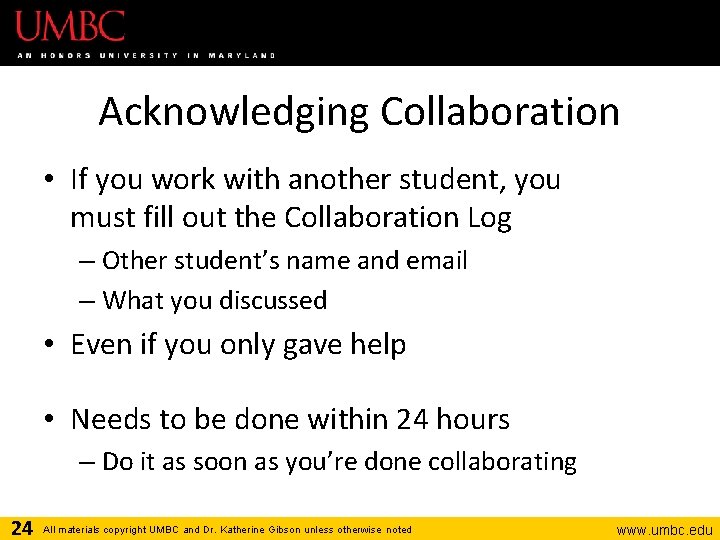
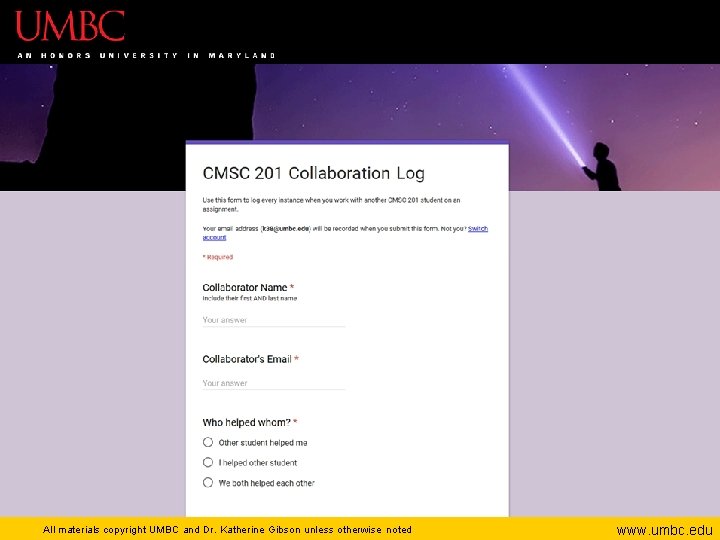
Acknowledging Collaboration • If you work with another student, you must fill out the Collaboration Log – Other student’s name and email – What you discussed • Even if you only gave help • Needs to be done within 24 hours – Do it as soon as you’re done collaborating 24 All materials copyright UMBC and Dr. Katherine Gibson unless otherwise noted www. umbc. edu
All materials copyright UMBC and Dr. Katherine Gibson unless otherwise noted www. umbc. edu
Why So Much About Cheating? • Every semester, a large number of students get caught for sharing code – They’re often friends – One student is trying to help the other out – Or two students working to solve one problem • They both endanger their entire academic career when they get caught – And the friend gets a zero for helping them 26 All materials copyright UMBC and Dr. Katherine Gibson unless otherwise noted www. umbc. edu
Alternatives to Cheating • Turn in a partially done assignment – Still get partial points – (Better than a zero for cheating) • Discuss concepts with other students, but not assignment details • Come get help in office hours! 27 All materials copyright UMBC and Dr. Katherine Gibson unless otherwise noted www. umbc. edu
Becoming a Good Programmer • We are strict about academic integrity because we want everyone to succeed in this class 28 • Understanding the assignment solutions means you will do better on the exams • Learning the course material means you will do better in your future courses and career • Seeking help when you need it will help you grow as a student and as a computer scientist All materials copyright UMBC and Dr. Katherine Gibson unless otherwise noted www. umbc. edu
Getting Help 29 All materials copyright UMBC and Dr. Katherine Gibson unless otherwise noted www. umbc. edu
Where to Go for Help • There a number of places you can go if you are struggling! – All of the TAs happy to help – If the TAs aren't working out, come by the instructors’ office hours (this should not be your first resort for help) • Office hours will be posted on the website 30 All materials copyright UMBC and Dr. Katherine Gibson unless otherwise noted www. umbc. edu
CMSC 201 TAs • You are welcome to go to any TA for help – If you need help with an assignment – If you have a question about course content • Final schedule will be posted on the website • Over 50 hours total each week where a TA is available in ITE 240 – ITE 240 will be busy on the due date 31 All materials copyright UMBC and Dr. Katherine Gibson unless otherwise noted www. umbc. edu
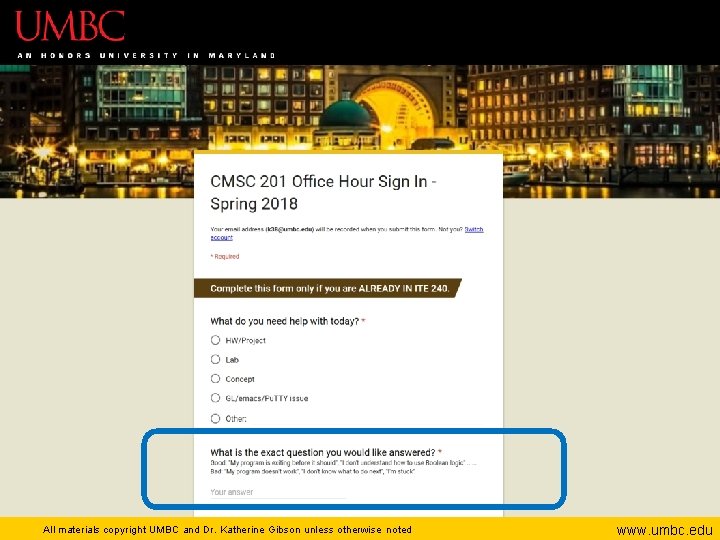
ITE 240 • This is a computer lab in the ITE building used to hold 201, 202, and 341 office hours • The 201 TAs will… – Be wearing bright yellow lanyards • Sign in happens via a Google form, to ensure everyone is helped in a timely manner 32 All materials copyright UMBC and Dr. Katherine Gibson unless otherwise noted www. umbc. edu
All materials copyright UMBC and Dr. Katherine Gibson unless otherwise noted www. umbc. edu
Additional Help • Tutoring from the Learning Resources Center – By appointment • Computer help from Do. IT – By phone or in person • See the syllabus for more info 34 All materials copyright UMBC and Dr. Katherine Gibson unless otherwise noted www. umbc. edu
Announcement: Note Taker Needed A peer note taker has been requested for this class. A peer note taker is a volunteer student who provides a copy of his or her notes for each class session to another member of the class who has been deemed eligible for this service based on a disability. Peer note takers will be paid a stipend for their service. Peer note taking is not a part time job but rather a volunteer service for which enrolled students can earn a stipend for sharing the notes they are already taking for themselves. If you are interested in serving in this important role, please fill out a note taker application on the Student Disability Services website or in person in the SDS office in Math/Psychology 212. 35 All materials copyright UMBC and Dr. Katherine Gibson unless otherwise noted www. umbc. edu
Programming Mindset 36 All materials copyright UMBC and Dr. Katherine Gibson unless otherwise noted www. umbc. edu
Taking Time • For every credit hour, you should spend at least 1 - 4 hours studying each week – For CMSC 201, that means 4 - 16 hours • Amount of time spent depends on assignment load and course difficulty • You won’t pass this class by spending an hour a week on the material and assignments 37 All materials copyright UMBC and Dr. Katherine Gibson unless otherwise noted www. umbc. edu
Time Spent In Class • In class, we’ll mostly focus on – Concepts – Ways of thinking – Common mistakes – More concepts • We’ll only spend a small amount of time on – Writing programs – Actual coding 38 All materials copyright UMBC and Dr. Katherine Gibson unless otherwise noted www. umbc. edu
Time Spent Out of Class • Learning to code and think like a programmer is like learning any new skill – You only get better if you practice a lot! • Assignments are designed to be practice for the skills you need – Spend the time to really understand them! – Experiment! (“What happens if I do …? ”) 39 All materials copyright UMBC and Dr. Katherine Gibson unless otherwise noted www. umbc. edu
“Failure” • No one gets everything right on the first try – Especially in programming • Everyone makes mistakes when coding – Including you – Including the TAs – Including the professors • You’ll see me do it almost every time we code in class 40 All materials copyright UMBC and Dr. Katherine Gibson unless otherwise noted www. umbc. edu
Making Mistakes • A mistake is not a failure! • Don’t give up after one error or setback – Learn from your mistakes, and get better • Don’t underestimate yourself – You’re learning an entirely new skill set, it would be weird if you “got it” right off the bat 41 All materials copyright UMBC and Dr. Katherine Gibson unless otherwise noted www. umbc. edu
Upcoming Assignments • Homework 0 will be released soon, and will walk you through “how” to do 201 homework – How to log onto the GL servers – How to write and run Python code – How to submit an assignment – How to check submission was done correctly • Lab 1 will be an online lab – Most other labs will be done during discussion 42 All materials copyright UMBC and Dr. Katherine Gibson unless otherwise noted www. umbc. edu
Announcements • Lab 1 will be an online lab – Released online over the weekend • In-person labs won’t begin until September 10 th • Make sure to log into the course Blackboard – Let Do. IT know if you have any problems • http: //doit. umbc. edu/request-tracker-rt/doit-myumbc-blackboard/ – (Students on the waitlist may not have access yet) 43 All materials copyright UMBC and Dr. Katherine Gibson unless otherwise noted www. umbc. edu