
CMSC 201 Computer Science I for Majors Lecture

- Slides: 25
CMSC 201 Computer Science I for Majors Lecture 19 – Modules and “Random” Numbers All materials copyright UMBC unless otherwise noted www. umbc. edu
Last Class We Covered • What makes “good code” good – Commenting guidelines • Top down design • Code implementation – Bottom up – Top down – Incremental development 2 www. umbc. edu
Any Questions from Last Time? 3 www. umbc. edu
Today’s Objectives • To learn about Python’s Standard Library • To understand modules and importing – Syntax – Purpose • To learn about “random” numbers – Pseudo randomness 4 www. umbc. edu
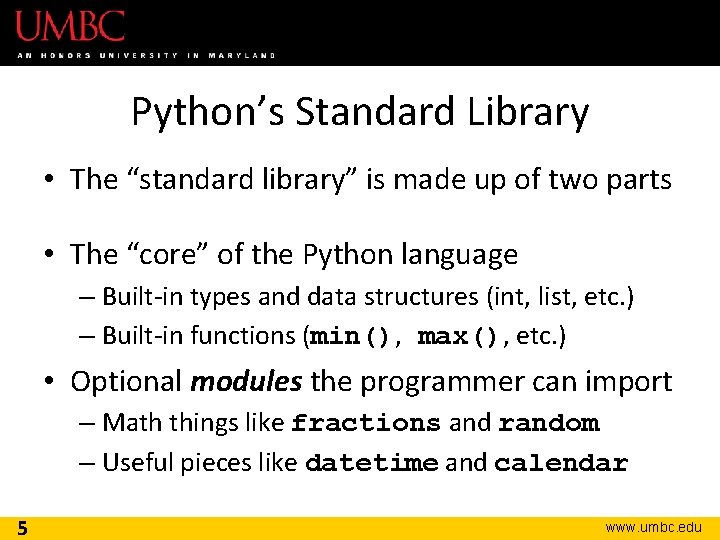
Python’s Standard Library • The “standard library” is made up of two parts • The “core” of the Python language – Built-in types and data structures (int, list, etc. ) – Built-in functions (min(), max(), etc. ) • Optional modules the programmer can import – Math things like fractions and random – Useful pieces like datetime and calendar 5 www. umbc. edu
Modules 6 www. umbc. edu
Modules • A module is a Python file that contains function definitions and other statements – Named just like a regular Python file: my. Module. py • Python provides many useful modules for us • We can also create our own if we want 7 www. umbc. edu
Importing Modules • To use a module, we must first import it • Where does Python look for module files? • In the current directory • In a list of pre-defined directories – These directories are where libraries like random and calendar are stored 8 www. umbc. edu
Importing 9 www. umbc. edu
Importing Modules • To import modules, use this command: import module. Name • This imports the entire module of that name – Every single thing in the file is now available – This includes functions, data types, constants, etc. 10 www. umbc. edu
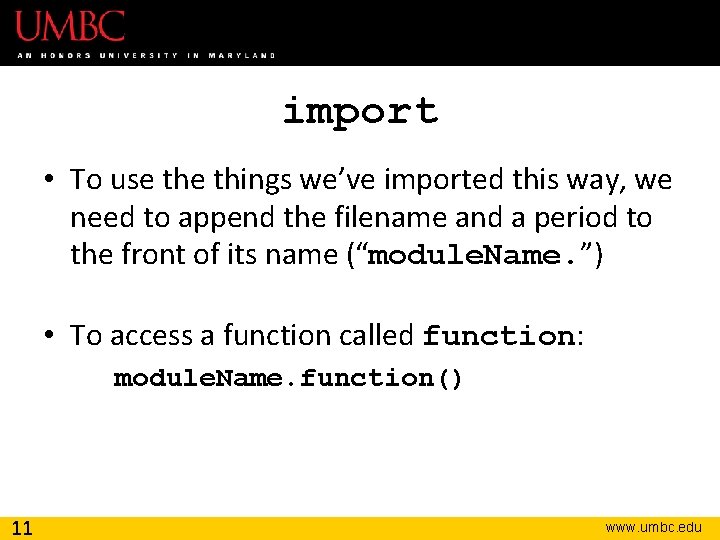
import • To use things we’ve imported this way, we need to append the filename and a period to the front of its name (“module. Name. ”) • To access a function called function: module. Name. function() 11 www. umbc. edu
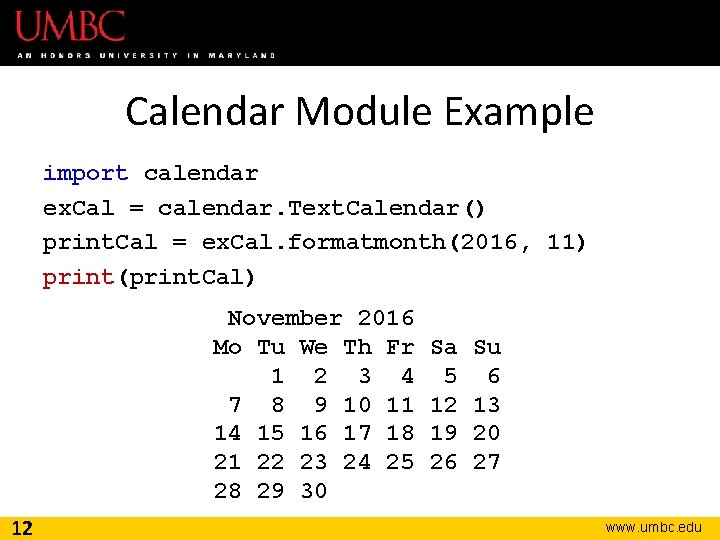
Calendar Module Example import calendar ex. Cal = calendar. Text. Calendar() print. Cal = ex. Cal. formatmonth(2016, 11) print(print. Cal) November 2016 Mo Tu We Th Fr 1 2 3 4 7 8 9 10 11 14 15 16 17 18 21 22 23 24 25 28 29 30 12 Sa 5 12 19 26 Su 6 13 20 27 www. umbc. edu
“Random” Numbers 13 www. umbc. edu
Random Numbers • Random numbers are useful for many things – Like what? – Cryptography – Games of chance – Procedural generation • Minecraft levels, snowflakes in Frozen • Random numbers generated by computers can only be pseudo random 14 www. umbc. edu
Pseudo Randomness • “Anyone who considers arithmetical methods of producing random digits is, of course, in a state of sin. ” – John von Neumann • Pseudorandom appears to be random, but isn’t – Mathematically generated, so it can’t be – Called a Random Number Generator (RNG) 15 www. umbc. edu
Seeding for Randomness • The RNG isn’t truly random – The computer uses a “seed” in an attempt to be as random as possible • By default, the seed is the system time – Changes every time the program is run • We can set our own seed – Use the random. seed() function 16 www. umbc. edu
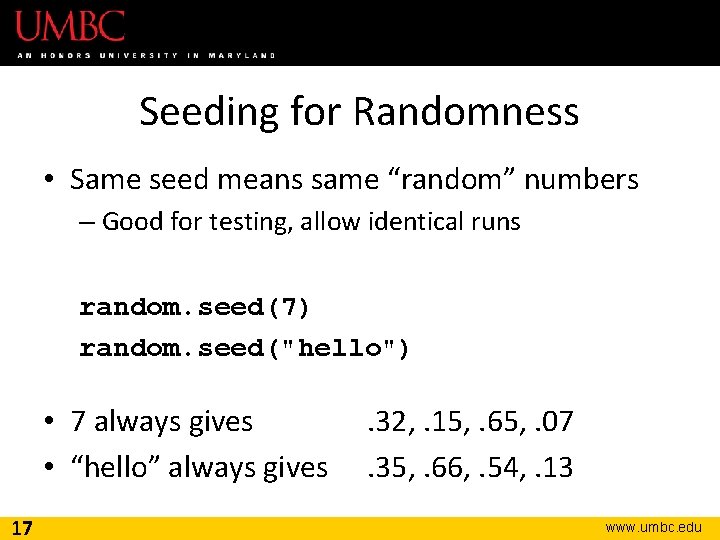
Seeding for Randomness • Same seed means same “random” numbers – Good for testing, allow identical runs random. seed(7) random. seed("hello") • 7 always gives • “hello” always gives 17 . 32, . 15, . 65, . 07. 35, . 66, . 54, . 13 www. umbc. edu
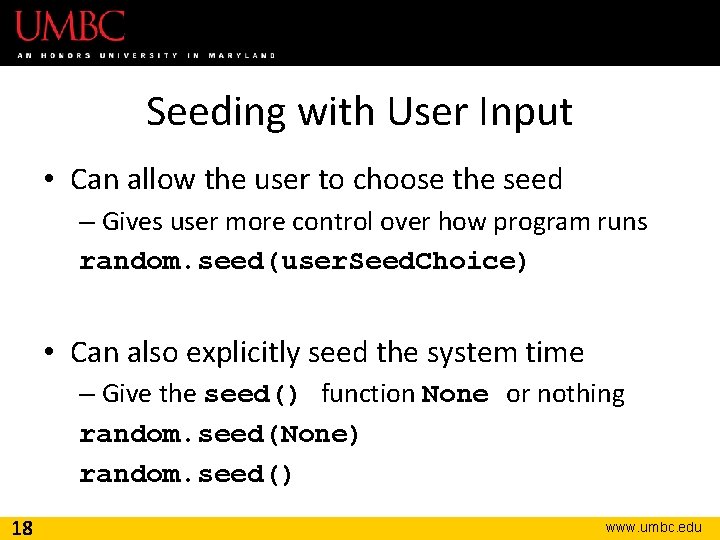
Seeding with User Input • Can allow the user to choose the seed – Gives user more control over how program runs random. seed(user. Seed. Choice) • Can also explicitly seed the system time – Give the seed() function None or nothing random. seed(None) random. seed() 18 www. umbc. edu
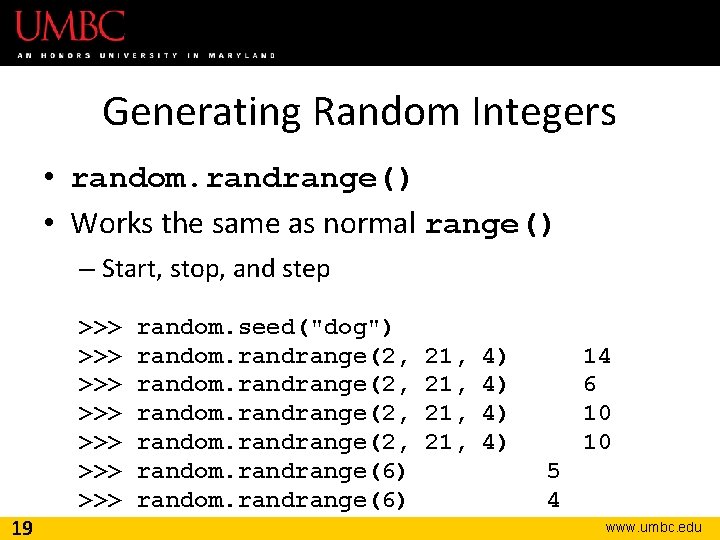
Generating Random Integers • random. randrange() • Works the same as normal range() – Start, stop, and step >>> >>> 19 random. seed("dog") random. randrange(2, random. randrange(6) 21, 21, 4) 4) 14 6 10 10 5 4 www. umbc. edu
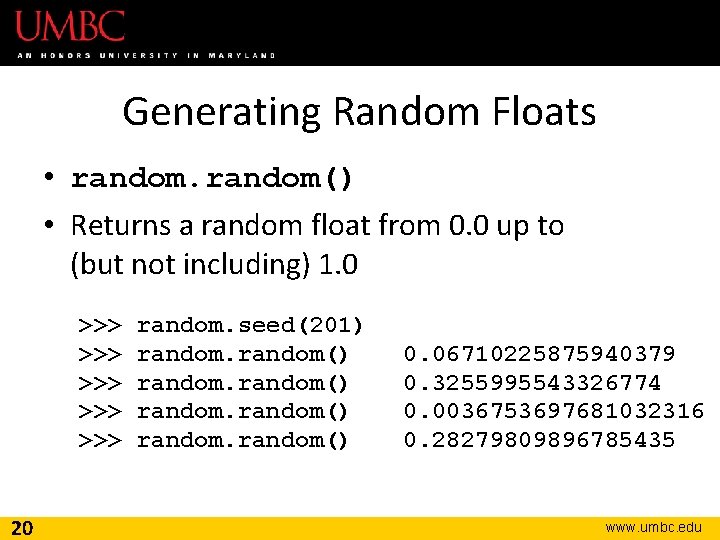
Generating Random Floats • random() • Returns a random float from 0. 0 up to (but not including) 1. 0 >>> >>> >>> 20 random. seed(201) random() 0. 06710225875940379 0. 3255995543326774 0. 0036753697681032316 0. 28279809896785435 www. umbc. edu
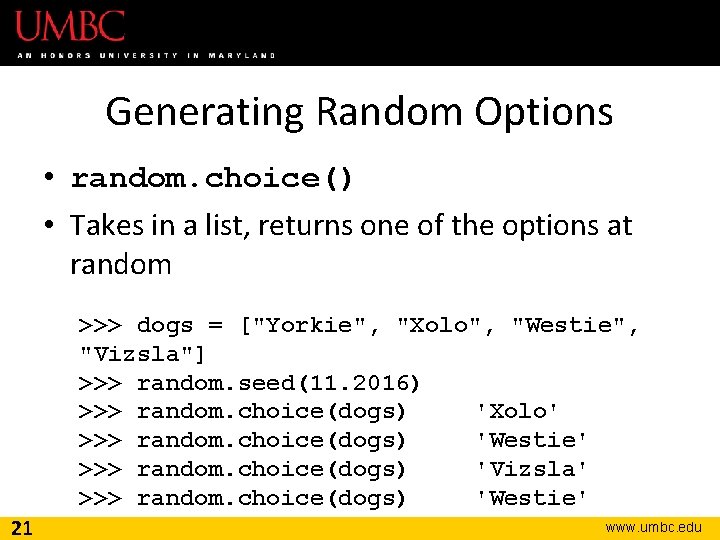
Generating Random Options • random. choice() • Takes in a list, returns one of the options at random >>> dogs = ["Yorkie", "Xolo", "Westie", "Vizsla"] >>> random. seed(11. 2016) >>> random. choice(dogs) 'Xolo' >>> random. choice(dogs) 'Westie' >>> random. choice(dogs) 'Vizsla' >>> random. choice(dogs) 'Westie' 21 www. umbc. edu
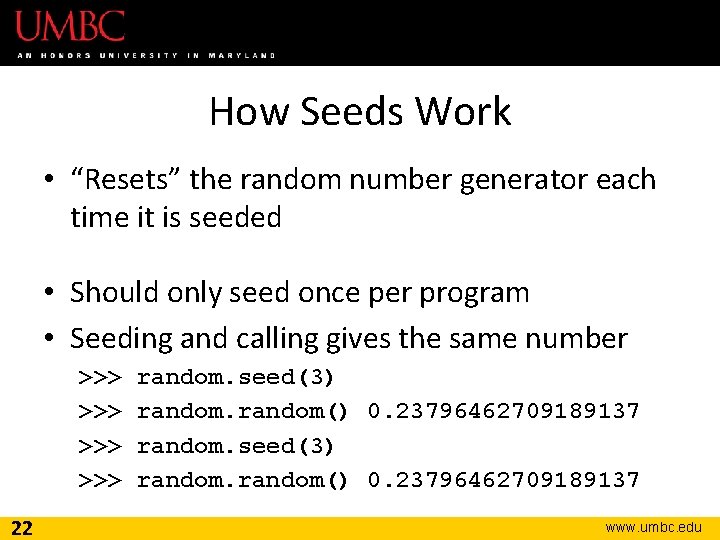
How Seeds Work • “Resets” the random number generator each time it is seeded • Should only seed once per program • Seeding and calling gives the same number >>> >>> 22 random. seed(3) random() 0. 23796462709189137 www. umbc. edu
Time for LIVECODING!!! 23 www. umbc. edu
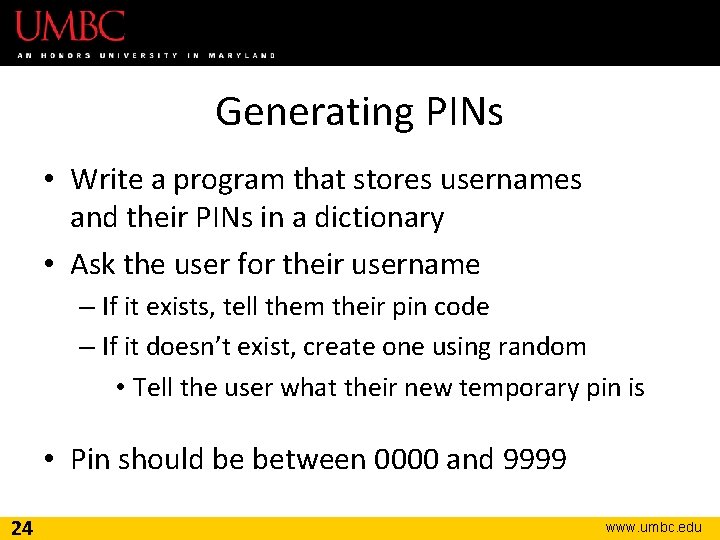
Generating PINs • Write a program that stores usernames and their PINs in a dictionary • Ask the user for their username – If it exists, tell them their pin code – If it doesn’t exist, create one using random • Tell the user what their new temporary pin is • Pin should be between 0000 and 9999 24 www. umbc. edu
Announcements • Project 1 is due Wednesday – It is much harder than the homeworks – No collaboration allowed – Start early – Think before you code – Come to office hours 25 www. umbc. edu