
CMSC 201 Computer Science I for Majors Lecture
- Slides: 23
CMSC 201 Computer Science I for Majors Lecture 12 – Tuples All materials copyright UMBC and Dr. Katherine Gibson unless otherwise noted www. umbc. edu
Last Class We Covered • Modularity – Meaning – Benefits • Program design – Top Down Design – Top Down Implementation – Bottom Up Implementation 2 www. umbc. edu
Any Questions from Last Time? 3 www. umbc. edu
Today’s Objectives • To learn about the tuple data structure in Python • To be able to perform basic operations with tuples including: – Creation, conversion, slicing, traversing • To discuss casting in detail • To discuss the membership “in” operator 4 www. umbc. edu
Tuples 5 www. umbc. edu
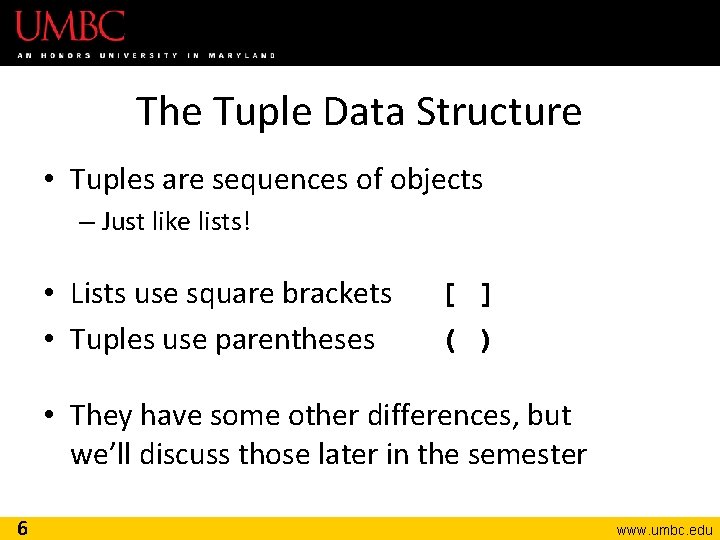
The Tuple Data Structure • Tuples are sequences of objects – Just like lists! • Lists use square brackets • Tuples use parentheses [ ] ( ) • They have some other differences, but we’ll discuss those later in the semester 6 www. umbc. edu
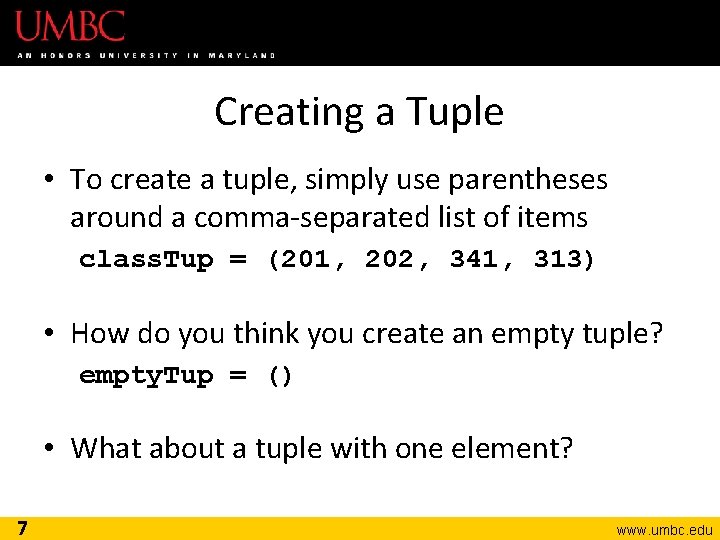
Creating a Tuple • To create a tuple, simply use parentheses around a comma-separated list of items class. Tup = (201, 202, 341, 313) • How do you think you create an empty tuple? empty. Tup = () • What about a tuple with one element? 7 www. umbc. edu
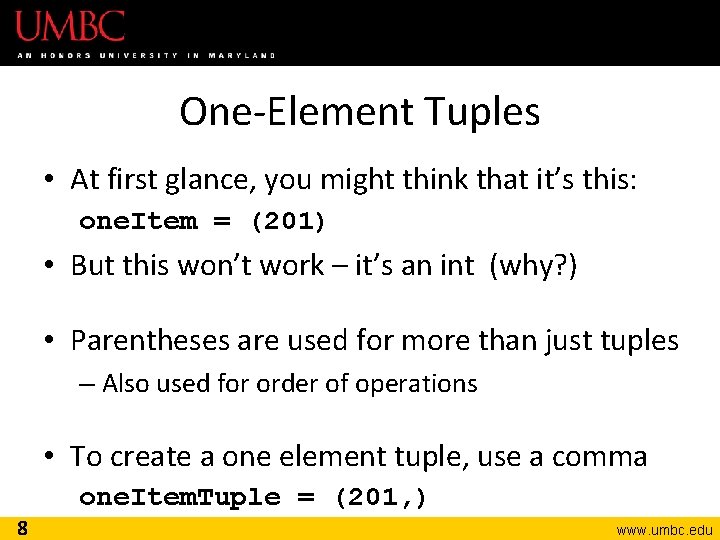
One-Element Tuples • At first glance, you might think that it’s this: one. Item = (201) • But this won’t work – it’s an int (why? ) • Parentheses are used for more than just tuples – Also used for order of operations • To create a one element tuple, use a comma one. Item. Tuple = (201, ) 8 www. umbc. edu
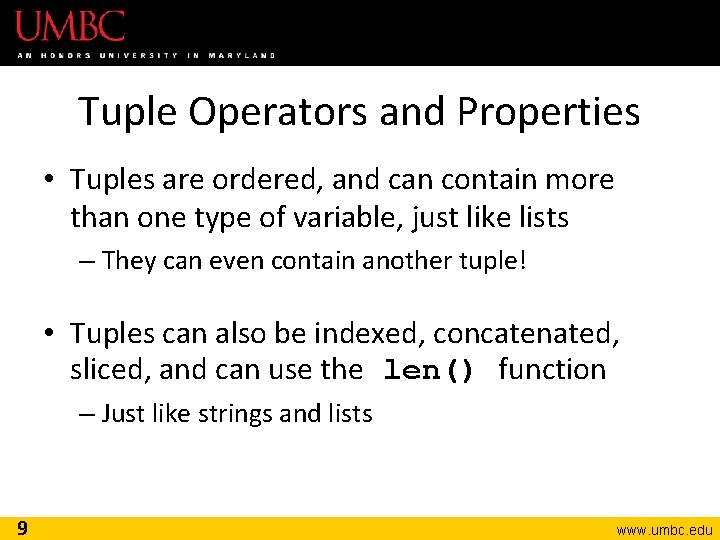
Tuple Operators and Properties • Tuples are ordered, and can contain more than one type of variable, just like lists – They can even contain another tuple! • Tuples can also be indexed, concatenated, sliced, and can use the len() function – Just like strings and lists 9 www. umbc. edu
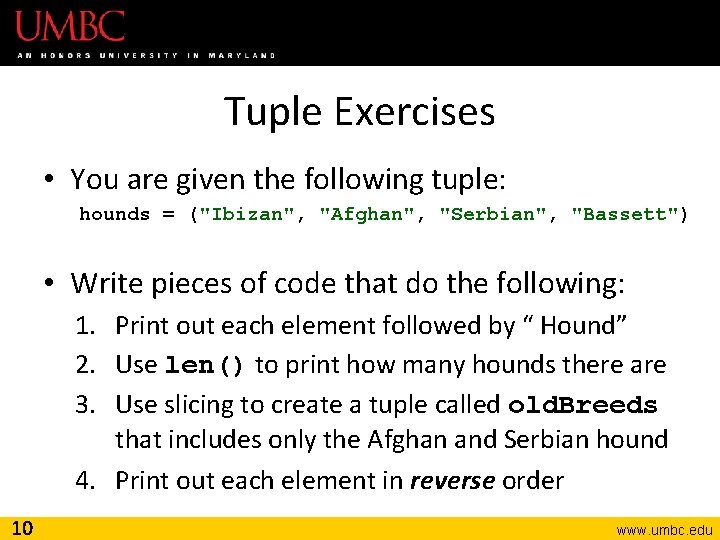
Tuple Exercises • You are given the following tuple: hounds = ("Ibizan", "Afghan", "Serbian", "Bassett") • Write pieces of code that do the following: 1. Print out each element followed by “ Hound” 2. Use len() to print how many hounds there are 3. Use slicing to create a tuple called old. Breeds that includes only the Afghan and Serbian hound 4. Print out each element in reverse order 10 www. umbc. edu
Types and Casting 11 www. umbc. edu
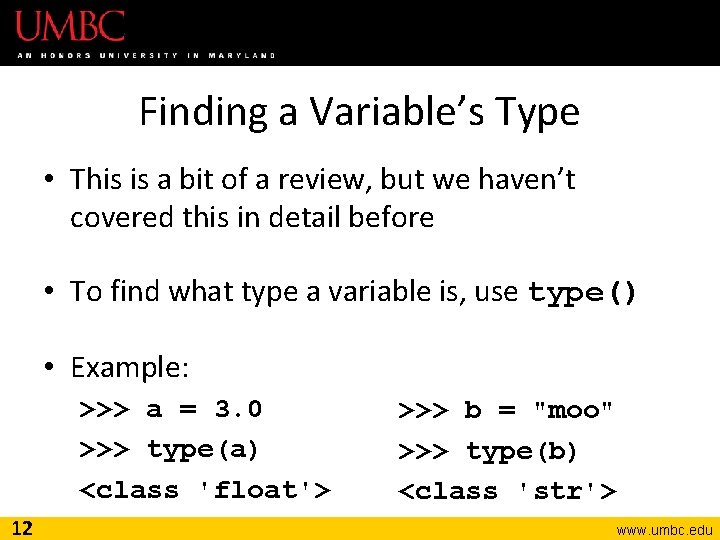
Finding a Variable’s Type • This is a bit of a review, but we haven’t covered this in detail before • To find what type a variable is, use type() • Example: >>> a = 3. 0 >>> type(a) <class 'float'> 12 >>> b = "moo" >>> type(b) <class 'str'> www. umbc. edu
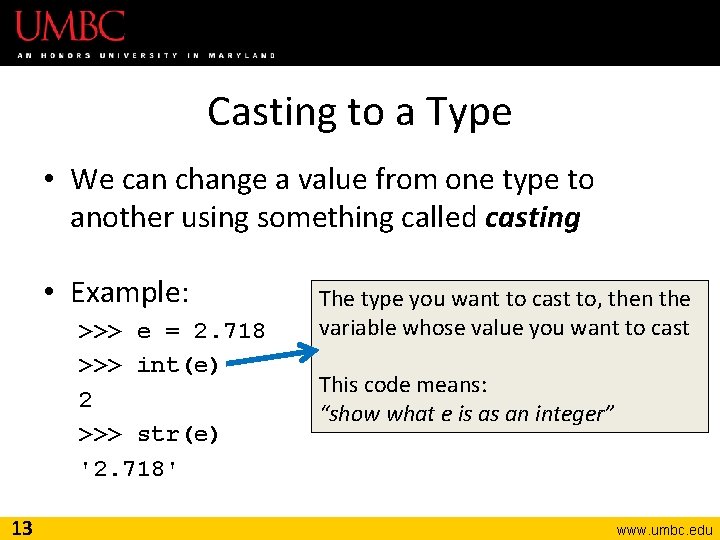
Casting to a Type • We can change a value from one type to another using something called casting • Example: >>> e = 2. 718 >>> int(e) 2 >>> str(e) '2. 718' 13 The type you want to cast to, then the variable whose value you want to cast This code means: “show what e is as an integer” www. umbc. edu
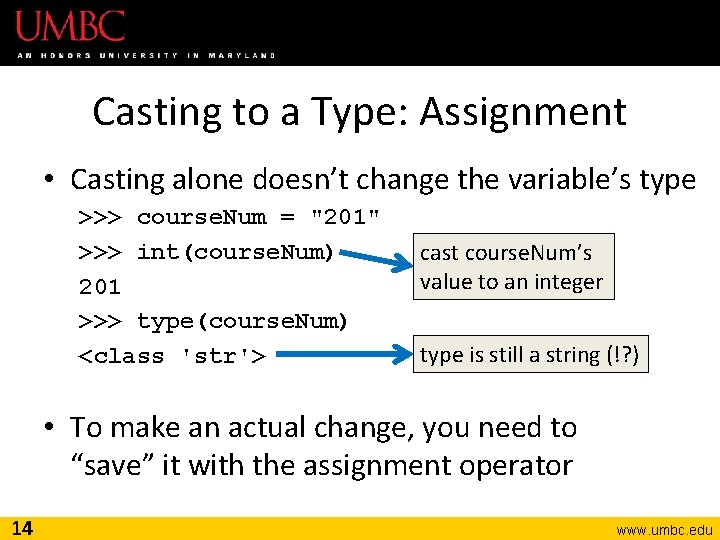
Casting to a Type: Assignment • Casting alone doesn’t change the variable’s type >>> course. Num = "201" >>> int(course. Num) 201 >>> type(course. Num) <class 'str'> cast course. Num’s value to an integer type is still a string (!? ) • To make an actual change, you need to “save” it with the assignment operator 14 www. umbc. edu
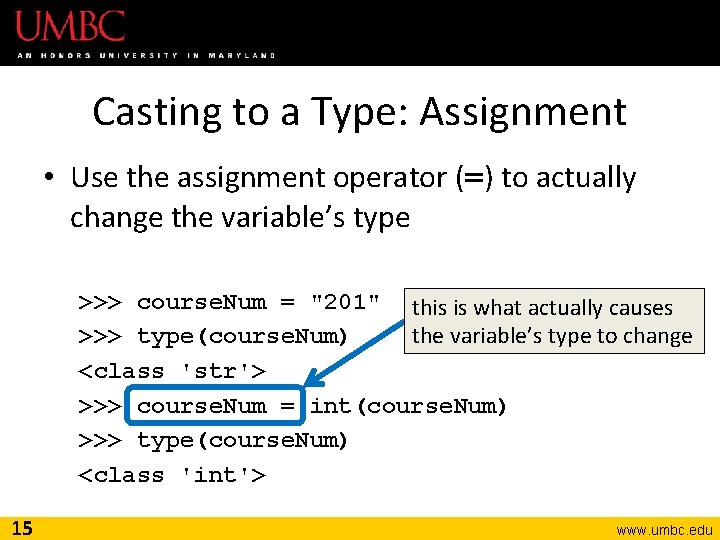
Casting to a Type: Assignment • Use the assignment operator (=) to actually change the variable’s type >>> course. Num = "201" this is what actually causes the variable’s type to change >>> type(course. Num) <class 'str'> >>> course. Num = int(course. Num) >>> type(course. Num) <class 'int'> 15 www. umbc. edu
Membership Operator 16 www. umbc. edu
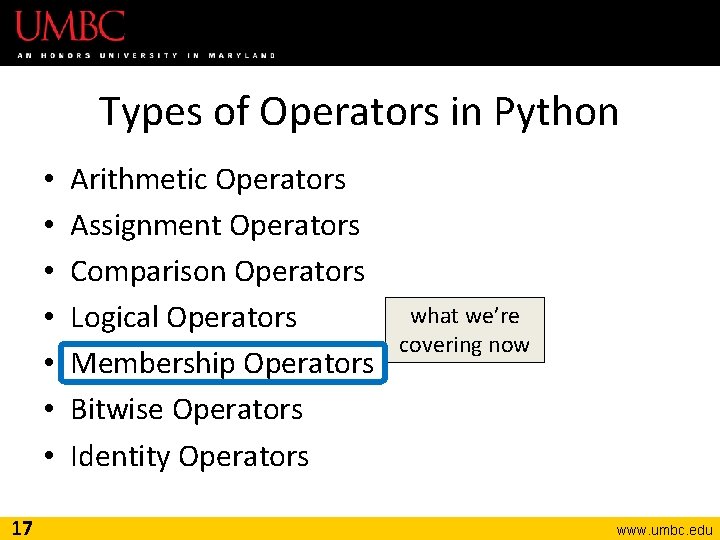
Types of Operators in Python • • 17 Arithmetic Operators Assignment Operators Comparison Operators Logical Operators Membership Operators Bitwise Operators Identity Operators what we’re covering now www. umbc. edu
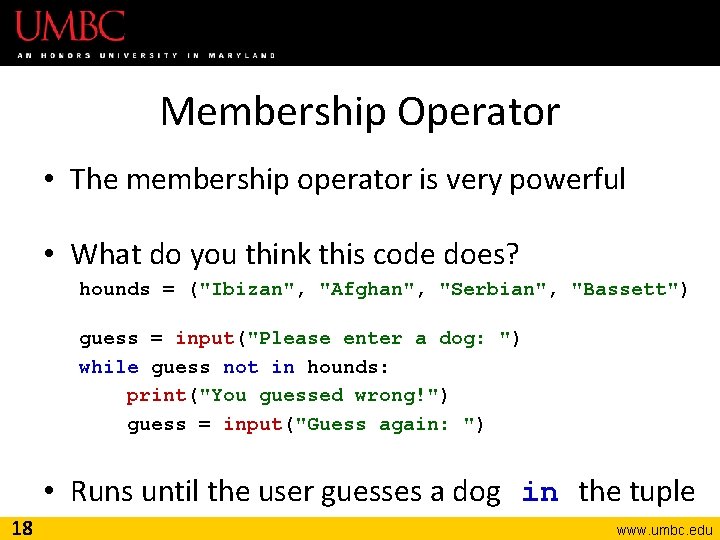
Membership Operator • The membership operator is very powerful • What do you think this code does? hounds = ("Ibizan", "Afghan", "Serbian", "Bassett") guess = input("Please enter a dog: ") while guess not in hounds: print("You guessed wrong!") guess = input("Guess again: ") • Runs until the user guesses a dog in the tuple 18 www. umbc. edu
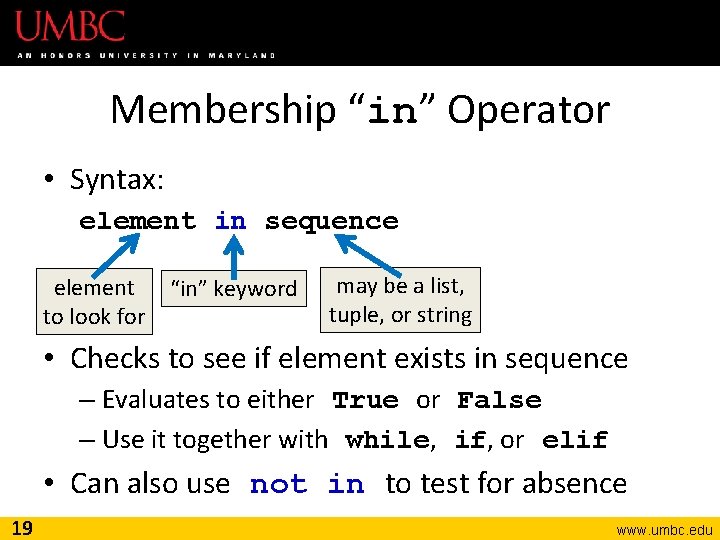
Membership “in” Operator • Syntax: element in sequence element to look for “in” keyword may be a list, tuple, or string • Checks to see if element exists in sequence – Evaluates to either True or False – Use it together with while, if, or elif • Can also use not in to test for absence 19 www. umbc. edu
It’s Time For… 20 www. umbc. edu
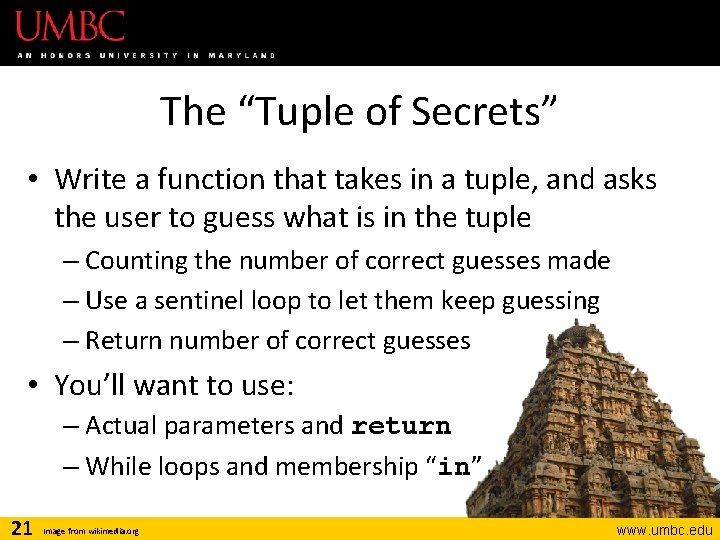
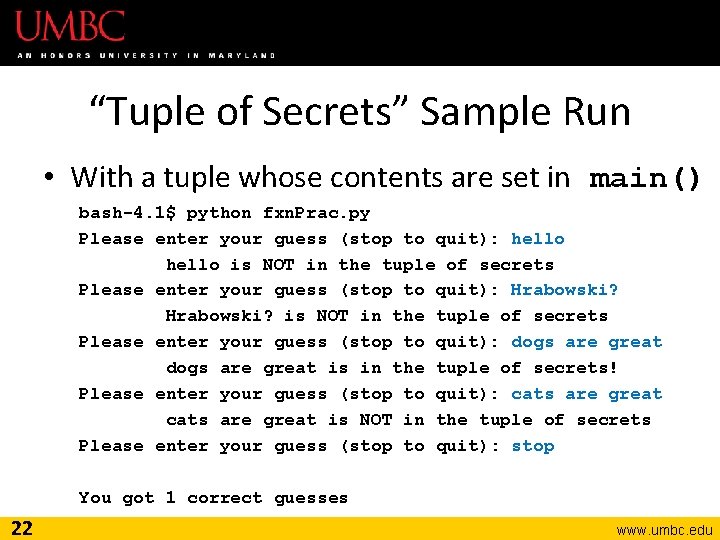
The “Tuple of Secrets” • Write a function that takes in a tuple, and asks the user to guess what is in the tuple – Counting the number of correct guesses made – Use a sentinel loop to let them keep guessing – Return number of correct guesses • You’ll want to use: – Actual parameters and return – While loops and membership “in” 21 Image from wikimedia. org www. umbc. edu
“Tuple of Secrets” Sample Run • With a tuple whose contents are set in main() bash-4. 1$ python fxn. Prac. py Please enter your guess (stop to quit): hello is NOT in the tuple of secrets Please enter your guess (stop to quit): Hrabowski? is NOT in the tuple of secrets Please enter your guess (stop to quit): dogs are great is in the tuple of secrets! Please enter your guess (stop to quit): cats are great is NOT in the tuple of secrets Please enter your guess (stop to quit): stop You got 1 correct guesses 22 www. umbc. edu
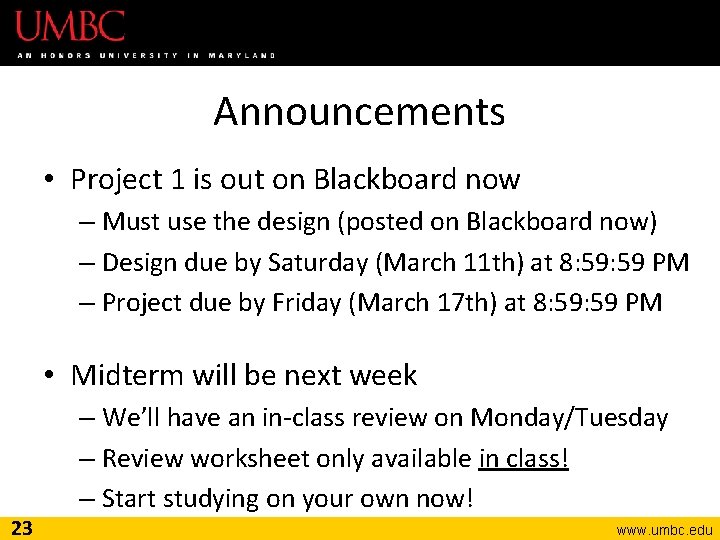
Announcements • Project 1 is out on Blackboard now – Must use the design (posted on Blackboard now) – Design due by Saturday (March 11 th) at 8: 59 PM – Project due by Friday (March 17 th) at 8: 59 PM • Midterm will be next week – We’ll have an in-class review on Monday/Tuesday – Review worksheet only available in class! – Start studying on your own now! 23 www. umbc. edu