
CMS Target Life Cycle TLC Introduction to the

- Slides: 30
CMS Target Life Cycle (TLC) Introduction to the TLC Initiate Phase INFORMATION NOT RELEASABLE TO THE PUBLIC UNLESS AUTHORIZED BY LAW: This information has not been publicly disclosed and may be privileged and confidential. It is for internal government use only and must not be disseminated, distributed, or copied to persons not authorized to receive the information. Unauthorized disclosure may result in prosecution to the full extent of the law. 1
Target Life Cycle – Initiate Phase Ø Section I: TLC Overview Ø Section II: Initiate Phase Overview Ø Section III: Business Case Ø Section IV: Governance Review Team Ø Section V: Governance Review Board Ø Section VI: Acquisition Planning 2
TLC Overview Section I: TLC Overview 3
Target Life Cycle The Target Life Cycle (TLC) is CMS’ IT system development life cycle governance framework. It provides: Ø CIO oversight of IT budget and acquisition activities Ø Capital Planning and Investment Control (CPIC) and technical governance Ø Structured processes from system planning to retirement Ø Project assistance and resources to ensure success Ø Supports strategic goals and smart portfolio decisionmaking 4
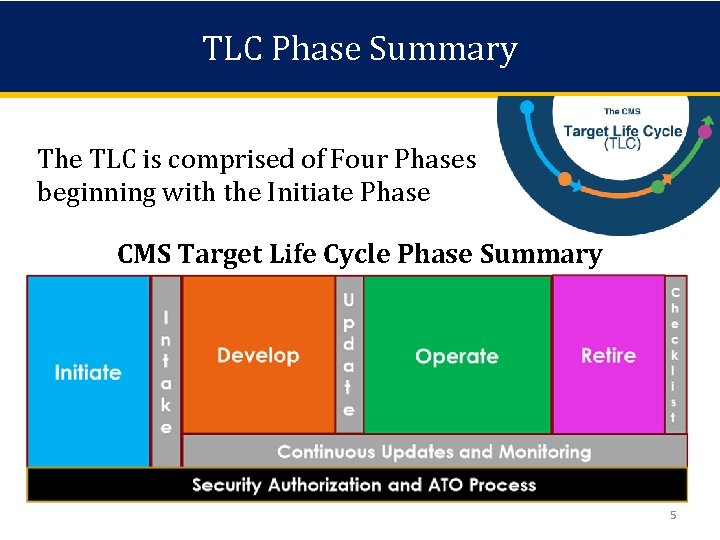
TLC Phase Summary The TLC is comprised of Four Phases beginning with the Initiate Phase CMS Target Life Cycle Phase Summary 5
Initiate Phase Overview Section II: Initiate Phase Overview 6
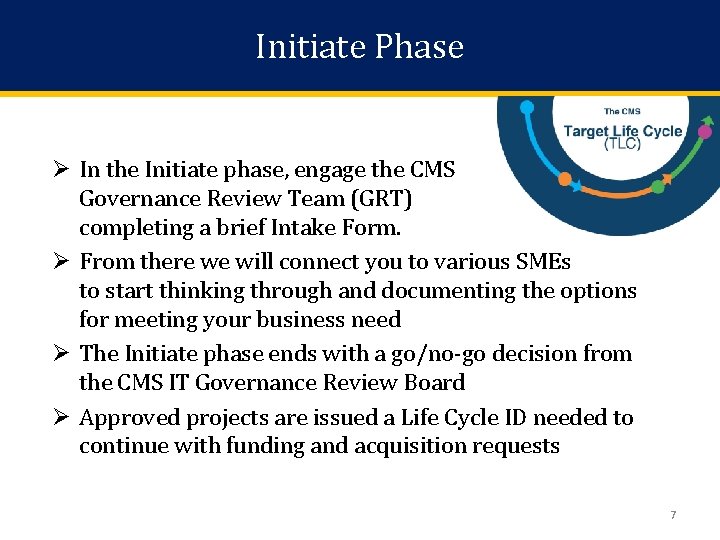
Initiate Phase Ø In the Initiate phase, engage the CMS IT Governance Review Team (GRT) by by completing a brief Intake Form. Ø From there we will connect you to various SMEs to start thinking through and documenting the options for meeting your business need Ø The Initiate phase ends with a go/no-go decision from the CMS IT Governance Review Board Ø Approved projects are issued a Life Cycle ID needed to continue with funding and acquisition requests 7
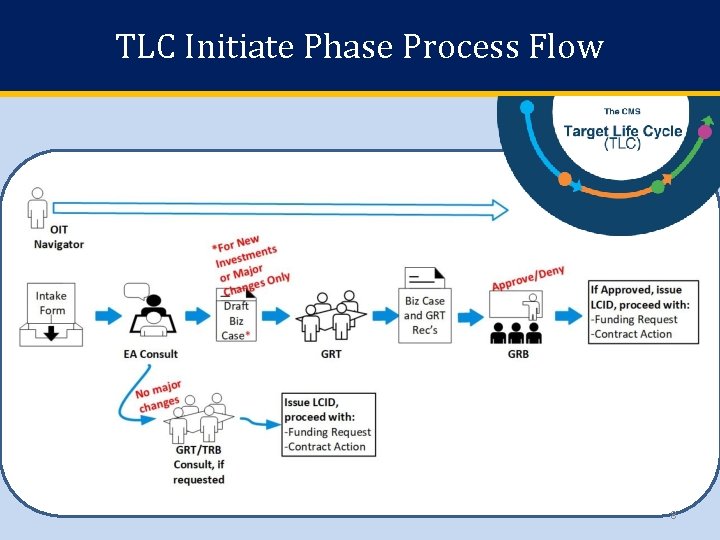
TLC Initiate Phase Process Flow 8
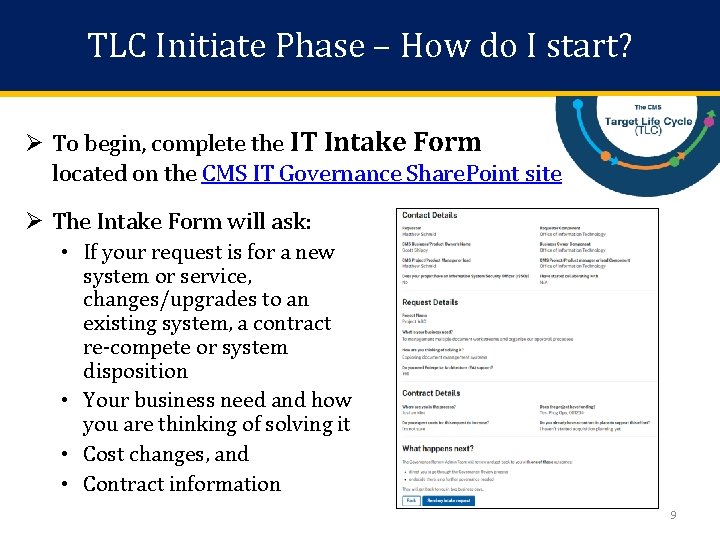
TLC Initiate Phase – How do I start? Ø To begin, complete the IT Intake Form located on the CMS IT Governance Share. Point site Ø The Intake Form will ask: • If your request is for a new system or service, changes/upgrades to an existing system, a contract re-compete or system disposition • Your business need and how you are thinking of solving it • Cost changes, and • Contract information 9
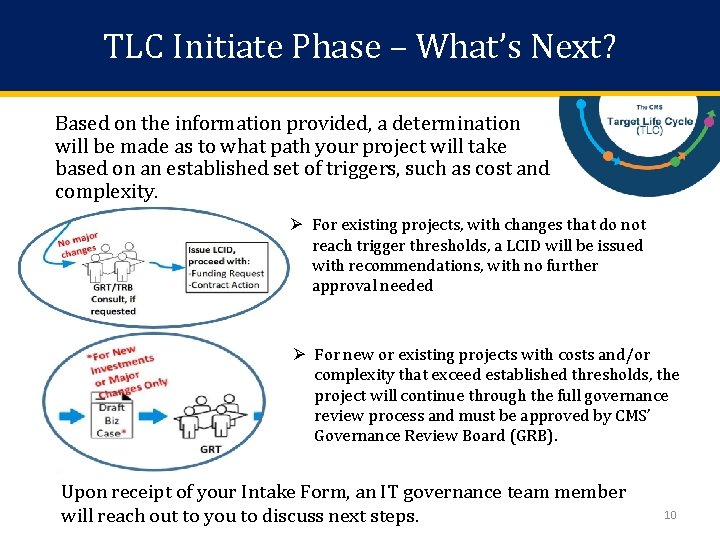
TLC Initiate Phase – What’s Next? Based on the information provided, a determination will be made as to what path your project will take based on an established set of triggers, such as cost and complexity. Ø For existing projects, with changes that do not reach trigger thresholds, a LCID will be issued with recommendations, with no further approval needed Ø For new or existing projects with costs and/or complexity that exceed established thresholds, the project will continue through the full governance review process and must be approved by CMS’ Governance Review Board (GRB). Upon receipt of your Intake Form, an IT governance team member will reach out to you to discuss next steps. 10
Business Case Section III: Business Case 11
Business Need Ø The TLC focuses external oversight up front with an emphasis on planning and documenting your business need. Ø This insures due diligence and sound IT planning before funding and acquisition approvals. Ø The Business Case, including alternatives analysis, is the key document and focus of the Initiate Phase GRB review and approval. Ø An early meeting with Enterprise Architecture will provide some initial guidance and may be able to provide information and options for existing CMS products or services that could meet your business need. 12
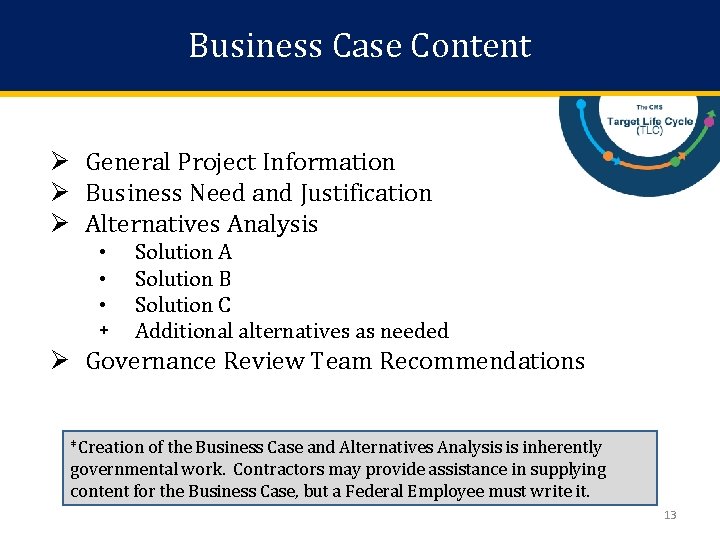
Business Case Content Ø General Project Information Ø Business Need and Justification Ø Alternatives Analysis • • • ˖ Solution A Solution B Solution C Additional alternatives as needed Ø Governance Review Team Recommendations *Creation of the Business Case and Alternatives Analysis is inherently governmental work. Contractors may provide assistance in supplying content for the Business Case, but a Federal Employee must write it. 13
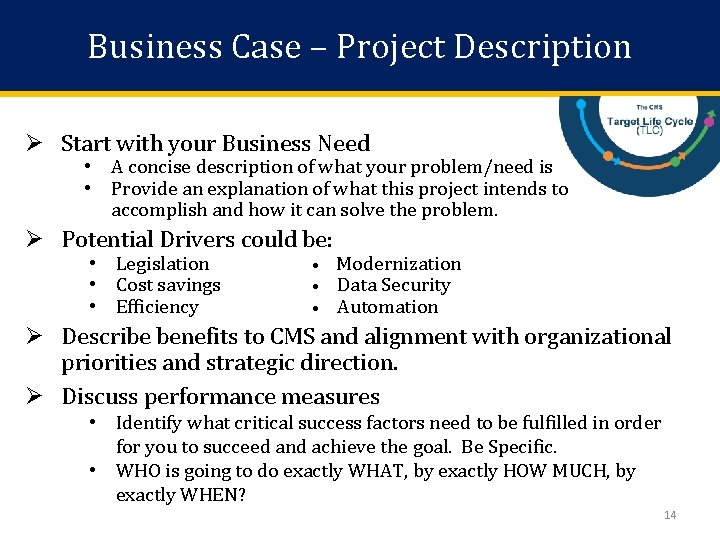
Business Case – Project Description Ø Start with your Business Need • A concise description of what your problem/need is • Provide an explanation of what this project intends to accomplish and how it can solve the problem. Ø Potential Drivers could be: • Legislation • Cost savings • Efficiency Modernization Data Security Automation Ø Describe benefits to CMS and alignment with organizational priorities and strategic direction. Ø Discuss performance measures • Identify what critical success factors need to be fulfilled in order for you to succeed and achieve the goal. Be Specific. • WHO is going to do exactly WHAT, by exactly HOW MUCH, by exactly WHEN? 14
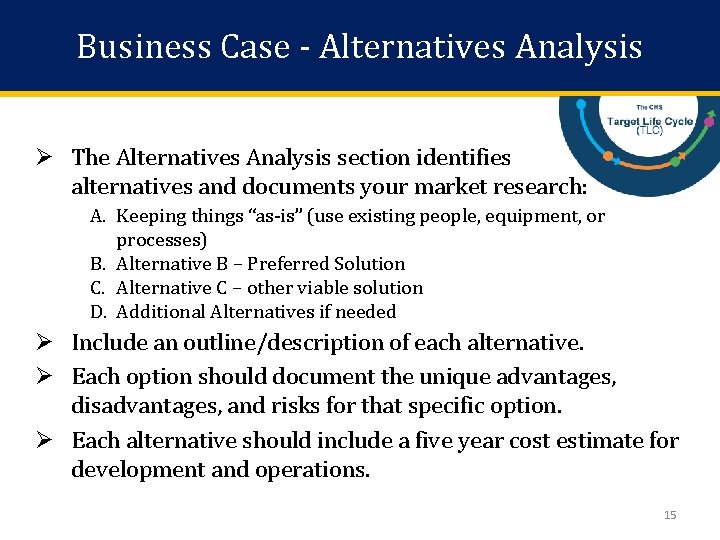
Business Case - Alternatives Analysis Ø The Alternatives Analysis section identifies alternatives and documents your market research: A. Keeping things “as-is” (use existing people, equipment, or processes) B. Alternative B – Preferred Solution C. Alternative C – other viable solution D. Additional Alternatives if needed Ø Include an outline/description of each alternative. Ø Each option should document the unique advantages, disadvantages, and risks for that specific option. Ø Each alternative should include a five year cost estimate for development and operations. 15
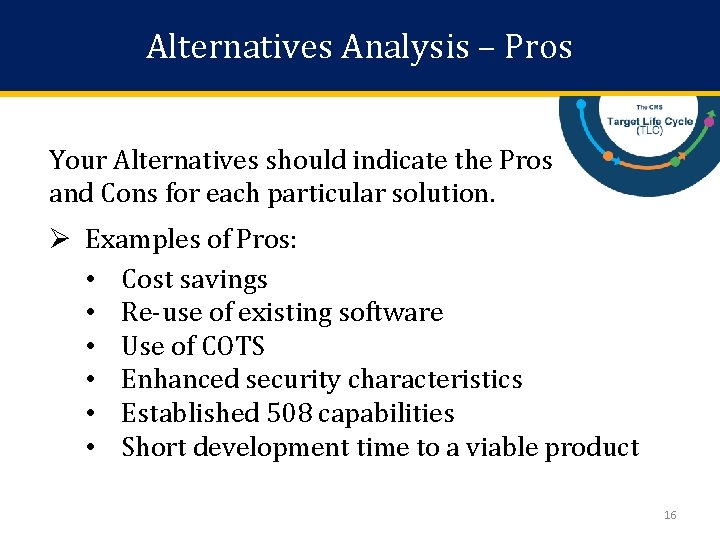
Alternatives Analysis – Pros Your Alternatives should indicate the Pros and Cons for each particular solution. Ø Examples of Pros: • Cost savings • Re-use of existing software • Use of COTS • Enhanced security characteristics • Established 508 capabilities • Short development time to a viable product 16
Alternatives Analysis – Cons Ø Examples of Cons: • Need for extensive customization • Use of old technology • High costs • Lack of skilled Contractor support for software • Need for specific hardware • Manual entry (time consuming and error prone) • Incompatible file formatting 17
Business Case - Other Considerations Ø The GRB may consider factors such as: • • • Cost vs Benefit Potential Risk Alignment with CMS’ Mission & Strategy Re-use of existing assets and solutions Use of COTS Use of Open Source Ø Keep these in mind as you develop your business case. 18
Business Case - Other Considerations Ø Your Information System Security Officer (ISSO) for the project should be designated by now. They can meet with the OIT Cyber Risk Advisor to document any potential Security and Privacy concerns that may impact your solutions. Ø A CPIC representative will be on the GRT to help with Investment Management and OMB Reporting, and can explain what the Business Case fields are looking for, per OMB guidance. 19
Governance Review Team Section IV: Governance Review Team 20
CMS IT Governance Review Team Ø The GRT is a group of subject matter experts that will meet with you one or more times as necessary to review your Business Case in preparation for the GRB. Governance Review Team Ø The GRT will provide: Technical guidance Advice to hone your business case and alternatives analysis Recommendations that will help your project be successful Direction through the IT Governance process and how to adhere to required governance oversight • Resources available to you • Recommendations to the GRB • • 21
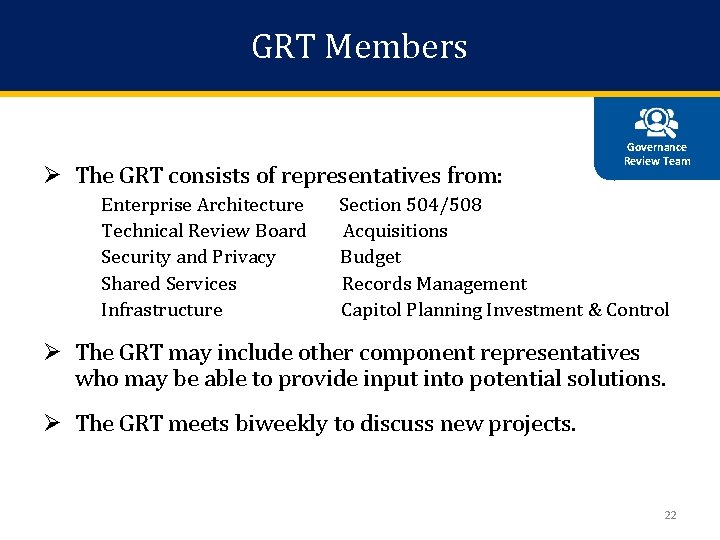
GRT Members Ø The GRT consists of representatives from: Enterprise Architecture Technical Review Board Security and Privacy Shared Services Infrastructure Governance Review Team Section 504/508 Acquisitions Budget Records Management Capitol Planning Investment & Control Ø The GRT may include other component representatives who may be able to provide input into potential solutions. Ø The GRT meets biweekly to discuss new projects. 22
Governance Review Board Section V: Governance Review Board 23
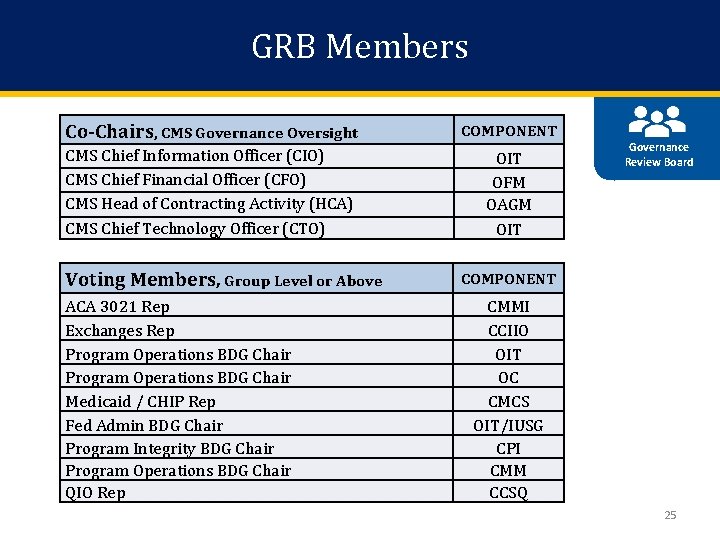
Governance Review Board Ø When you have incorporated the feedback from the GRT and completed your Final Business Case, the governance team will schedule your presentation with the GRB. Governance Review Board Ø You’ll get the best result if your Business Case is clear, and your business need has strong justification. Ø The GRB will evaluate your Business Case and Alternatives Analysis and determine: • • Approval on the merits of the project and business need Approval/Disapproval of the preferred solution Ø The GRB does not approve funding for a project, but is a prerequisite for funding and acquisitions. 24
GRB Members Co-Chairs, CMS Governance Oversight COMPONENT CMS Chief Information Officer (CIO) CMS Chief Financial Officer (CFO) CMS Head of Contracting Activity (HCA) CMS Chief Technology Officer (CTO) OIT OFM OAGM OIT Voting Members, Group Level or Above ACA 3021 Rep Exchanges Rep Program Operations BDG Chair Medicaid / CHIP Rep Fed Admin BDG Chair Program Integrity BDG Chair Program Operations BDG Chair QIO Rep Governance Review Board COMPONENT CMMI CCIIO OIT OC CMCS OIT/IUSG CPI CMM CCSQ 25
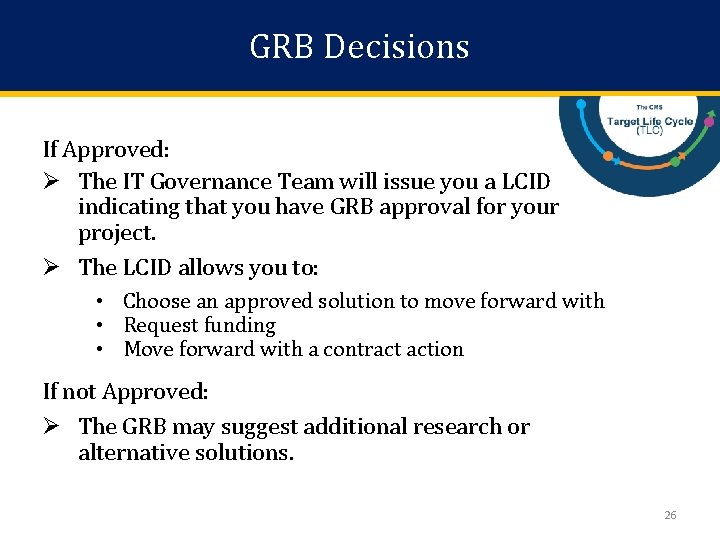
GRB Decisions If Approved: Ø The IT Governance Team will issue you a LCID indicating that you have GRB approval for your project. Ø The LCID allows you to: • Choose an approved solution to move forward with • Request funding • Move forward with a contract action If not Approved: Ø The GRB may suggest additional research or alternative solutions. 26
Acquisition Planning Section VI: Acquisition Planning 27
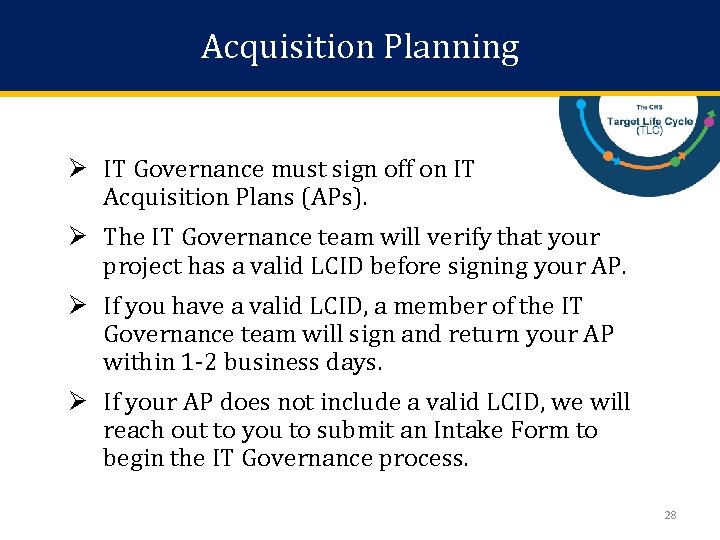
Acquisition Planning Ø IT Governance must sign off on IT Acquisition Plans (APs). Ø The IT Governance team will verify that your project has a valid LCID before signing your AP. Ø If you have a valid LCID, a member of the IT Governance team will sign and return your AP within 1 -2 business days. Ø If your AP does not include a valid LCID, we will reach out to you to submit an Intake Form to begin the IT Governance process. 28
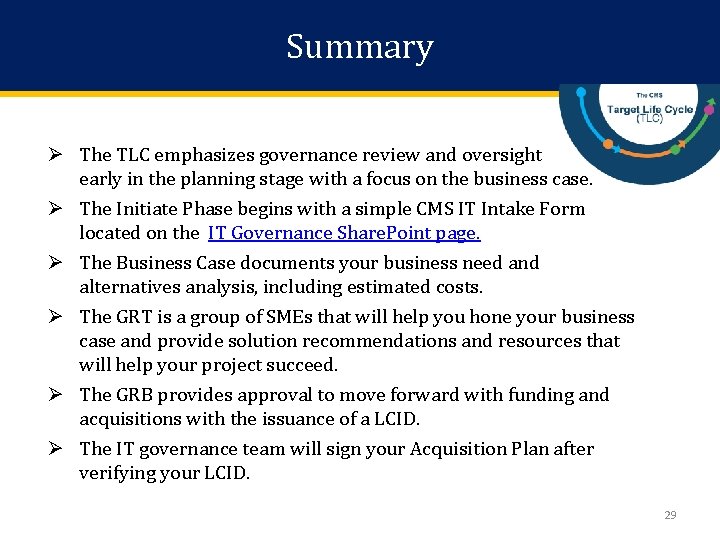
Summary Ø The TLC emphasizes governance review and oversight early in the planning stage with a focus on the business case. Ø The Initiate Phase begins with a simple CMS IT Intake Form located on the IT Governance Share. Point page. Ø The Business Case documents your business need and alternatives analysis, including estimated costs. Ø The GRT is a group of SMEs that will help you hone your business case and provide solution recommendations and resources that will help your project succeed. Ø The GRB provides approval to move forward with funding and acquisitions with the issuance of a LCID. Ø The IT governance team will sign your Acquisition Plan after verifying your LCID. 29
Questions ? For more information, contact us at: IT_Governance@cms. hhs. gov or visit our Share. Point site at: CIO Library - ITGovernance 30