
CMS Measures Management System MMS Assessing Feasibility of
CMS Measures Management System (MMS) Assessing Feasibility of e. CQMs Brenna Rabel, MPH Battelle June 28, 2018
Overview • Feasibility assessments for electronic clinical quality measures (e. CQMs) – Overview – Opportunities to assess feasibility – Data collection activities – Deep dive: National Quality Forum (NQF) e. CQM Feasibility Scorecard 2
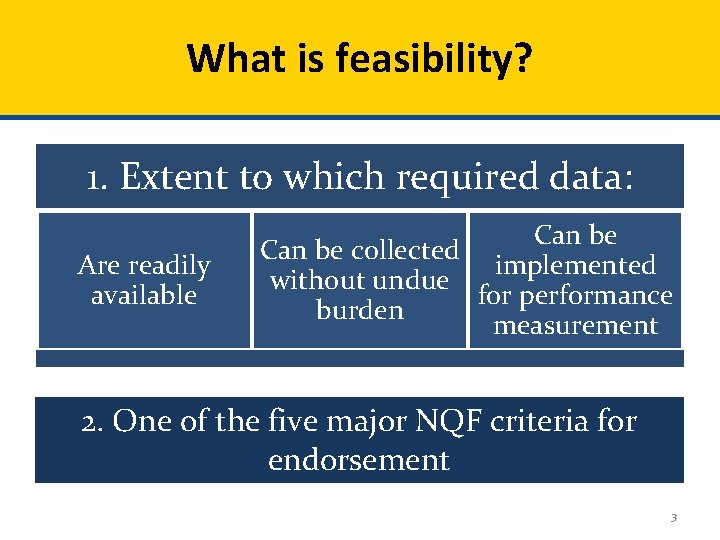
What is feasibility? 1. Extent to which required data: Are readily available Can be collected implemented without undue for performance burden measurement 2. One of the five major NQF criteria for endorsement 3
e. CQMs vs. non-e. CQMs • Feasibility assessments are required for all measures, including e. CQMs • e. CQMs share the same feasibility requirements as other measures, but with increased emphasis on how data are stored – Structured, extractable data fields – Coded to a standard terminology, e. g. , SNOMED CT 4
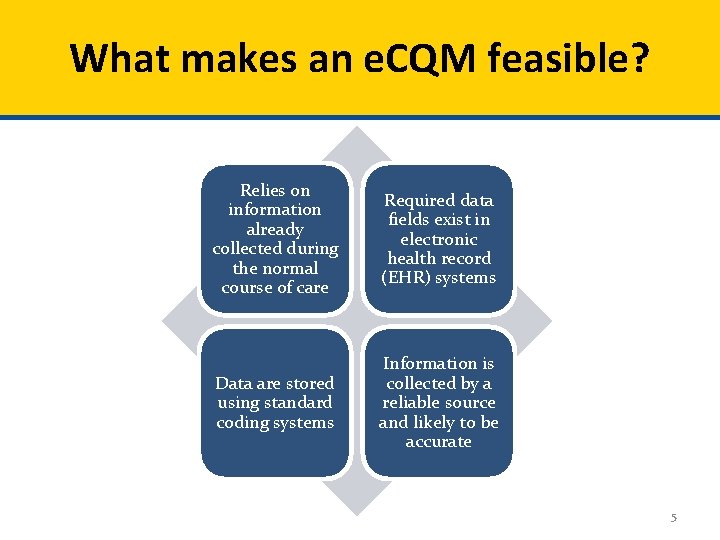
What makes an e. CQM feasible? Relies on information already collected during the normal course of care Required data fields exist in electronic health record (EHR) systems Data are stored using standard coding systems Information is collected by a reliable source and likely to be accurate 5
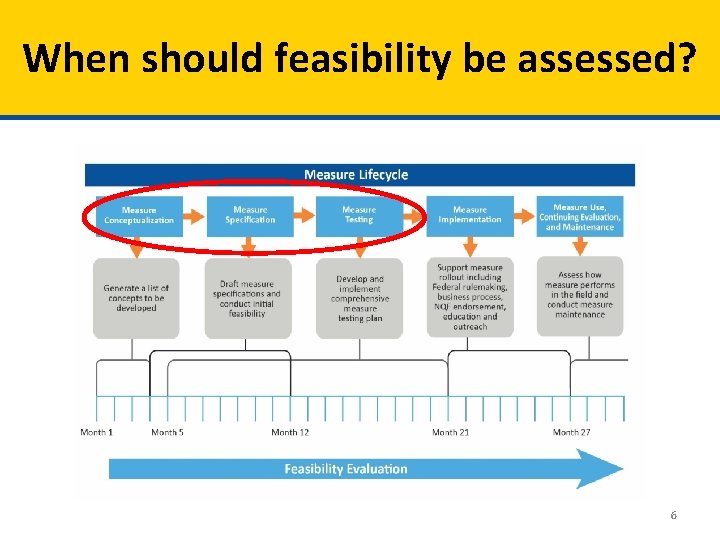
When should feasibility be assessed? 6
When to assess feasibility: Conceptualization • When narrowing the list of potential measure concepts, developers should consider the following: – Will the measure rely on data elements that are technically feasible in EHR systems? – Are the required data elements likely to be widely available across hospitals/practices? – Will the measure require the creation of check boxes or other data fields that would not otherwise be used during the normal course of care delivery? 7
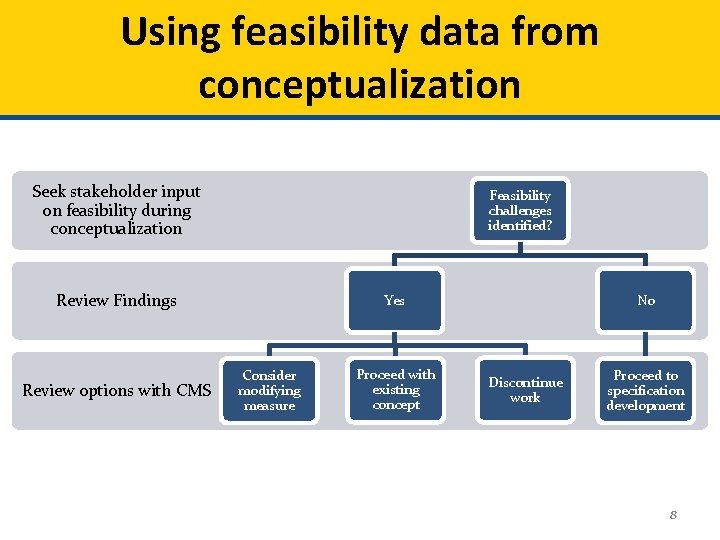
Using feasibility data from conceptualization Seek stakeholder input on feasibility during conceptualization Feasibility challenges identified? Review Findings Review options with CMS Yes Consider modifying measure Proceed with existing concept No Discontinue work Proceed to specification development 8
When to assess feasibility: Alpha testing • Alpha (formative) testing often occurs before detailed specifications are fully developed • Should include methods to determine if individual data elements are available and if the form in which they exist is consistent with the intent of the measure • Findings can impact decisions about what is included in the specifications 9
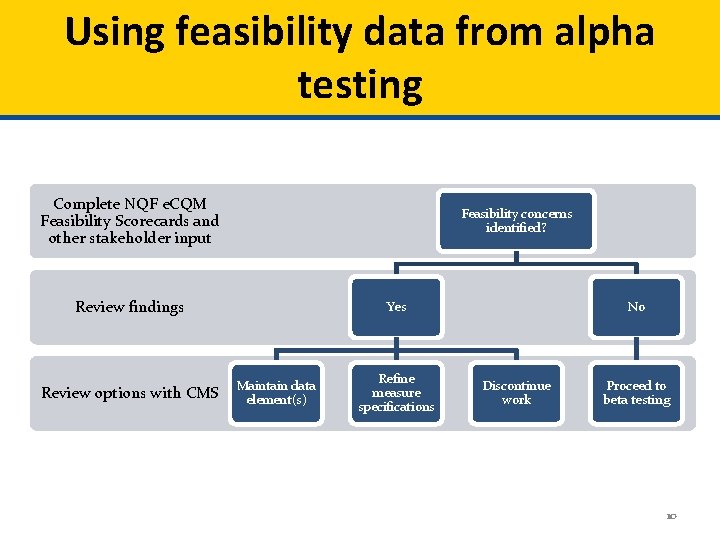
Using feasibility data from alpha testing Complete NQF e. CQM Feasibility Scorecards and other stakeholder input Feasibility concerns identified? Review findings Review options with CMS Yes Maintain data element(s) Refine measure specifications No Discontinue work Proceed to beta testing 10
When to assess feasibility: Beta testing • Beta (field) testing occurs after the initial technical specifications have been developed • Involves collection of data from test sites to assess scientific acceptability (validity and reliability) – Data collection process can yield important information about feasibility – Can identify key feasibility barriers or challenges that implementers might encounter 11
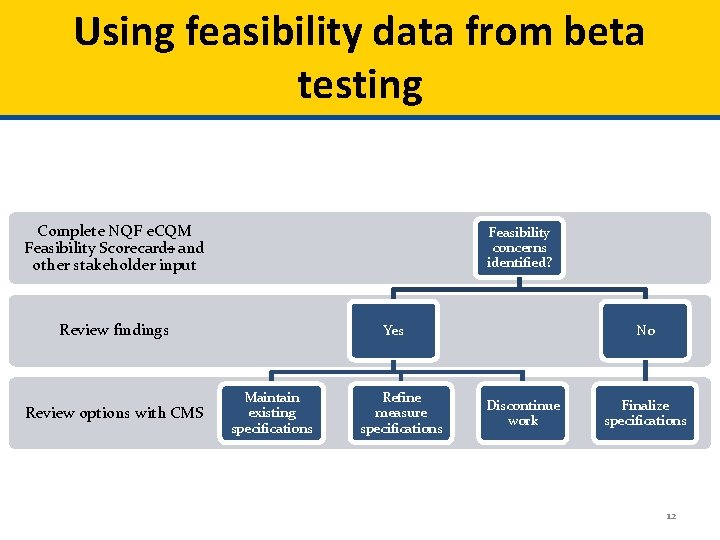
Using feasibility data from beta testing Complete NQF e. CQM Feasibility Scorecards and other stakeholder input Feasibility concerns identified? Review findings Review options with CMS Yes Maintain existing specifications Refine measure specifications No Discontinue work Finalize specifications 12
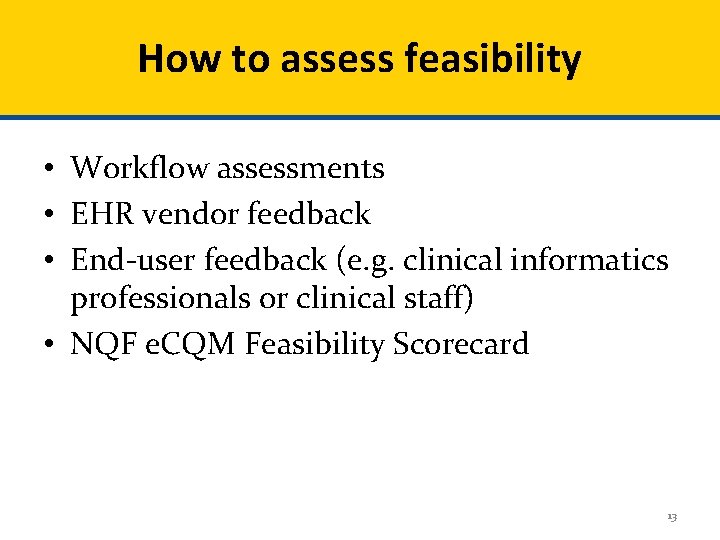
How to assess feasibility • Workflow assessments • EHR vendor feedback • End-user feedback (e. g. clinical informatics professionals or clinical staff) • NQF e. CQM Feasibility Scorecard 13
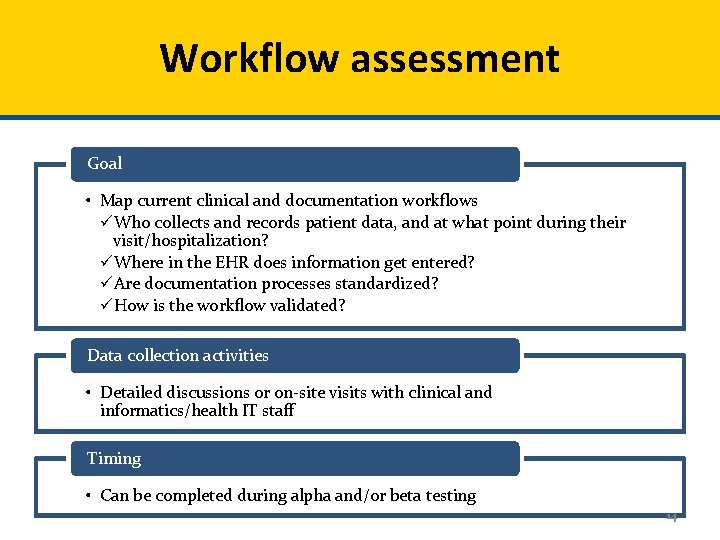
Workflow assessment Goal • Map current clinical and documentation workflows üWho collects and records patient data, and at what point during their visit/hospitalization? üWhere in the EHR does information get entered? üAre documentation processes standardized? üHow is the workflow validated? Data collection activities • Detailed discussions or on-site visits with clinical and informatics/health IT staff Timing • Can be completed during alpha and/or beta testing 14
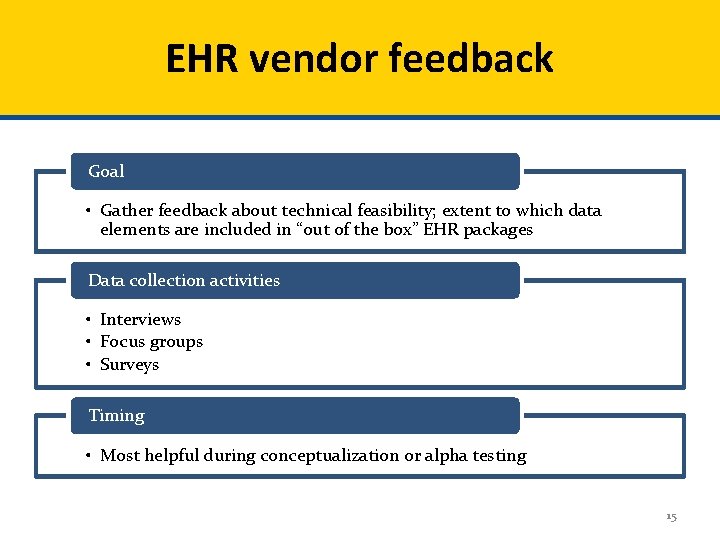
EHR vendor feedback Goal • Gather feedback about technical feasibility; extent to which data elements are included in “out of the box” EHR packages Data collection activities • Interviews • Focus groups • Surveys Timing • Most helpful during conceptualization or alpha testing 15
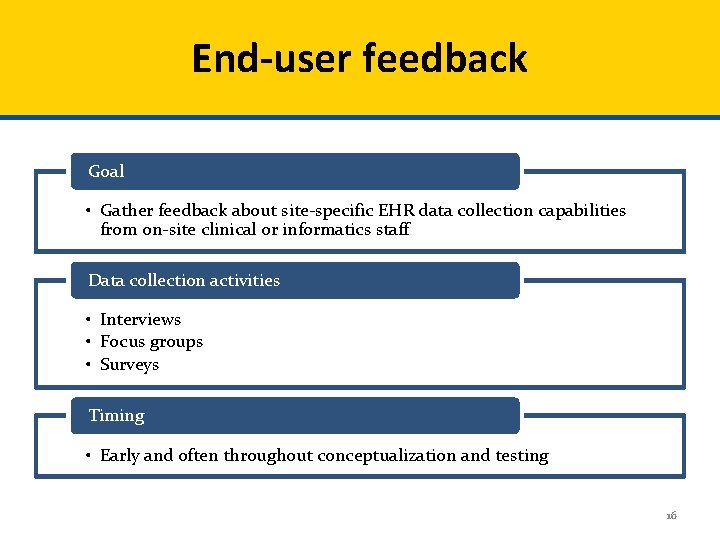
End-user feedback Goal • Gather feedback about site-specific EHR data collection capabilities from on-site clinical or informatics staff Data collection activities • Interviews • Focus groups • Surveys Timing • Early and often throughout conceptualization and testing 16
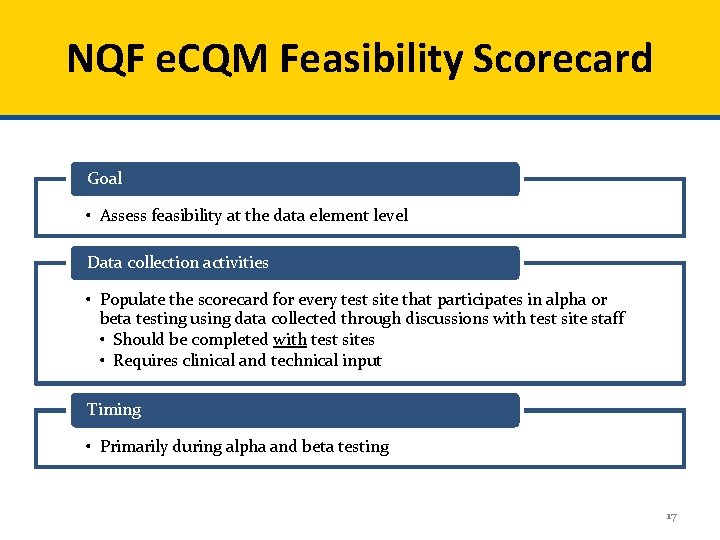
NQF e. CQM Feasibility Scorecard Goal • Assess feasibility at the data element level Data collection activities • Populate the scorecard for every test site that participates in alpha or beta testing using data collected through discussions with test site staff • Should be completed with test sites • Requires clinical and technical input Timing • Primarily during alpha and beta testing 17
Discussion 18
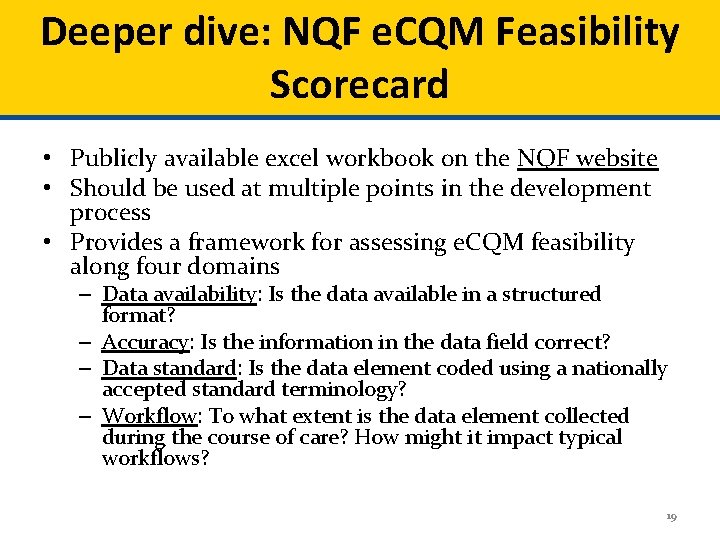
Deeper dive: NQF e. CQM Feasibility Scorecard • Publicly available excel workbook on the NQF website • Should be used at multiple points in the development process • Provides a framework for assessing e. CQM feasibility along four domains – Data availability: Is the data available in a structured format? – Accuracy: Is the information in the data field correct? – Data standard: Is the data element coded using a nationally accepted standard terminology? – Workflow: To what extent is the data element collected during the course of care? How might it impact typical workflows? 19
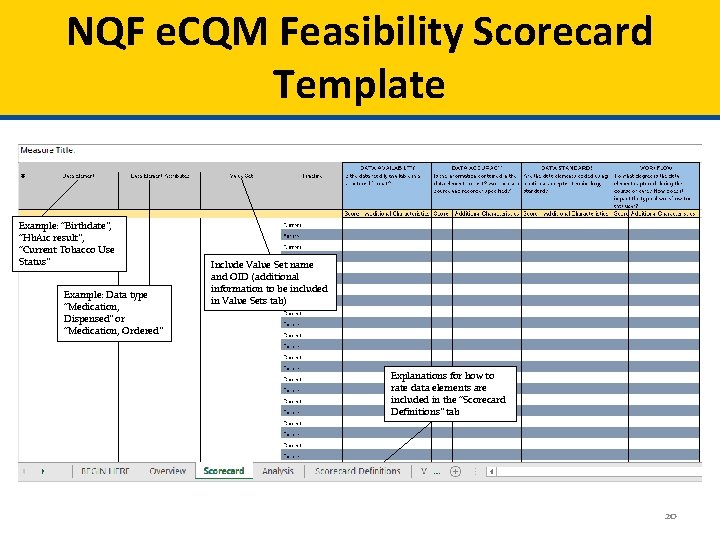
NQF e. CQM Feasibility Scorecard Template Example: “Birthdate”, “Hb. A 1 c result”, “Current Tobacco Use Status” Example: Data type “Medication, Dispensed” or “Medication, Ordered” Include Value Set name and OID (additional information to be included in Value Sets tab) Explanations for how to rate data elements are included in the “Scorecard Definitions” tab 20
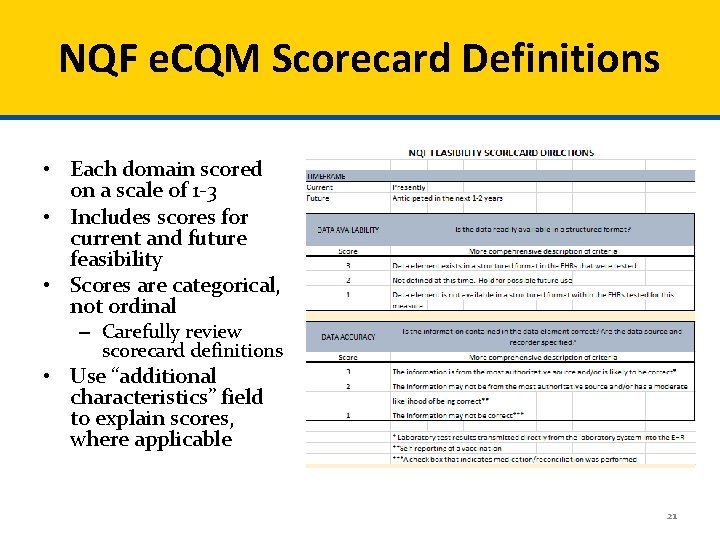
NQF e. CQM Scorecard Definitions • Each domain scored on a scale of 1 -3 • Includes scores for current and future feasibility • Scores are categorical, not ordinal – Carefully review scorecard definitions • Use “additional characteristics” field to explain scores, where applicable 21
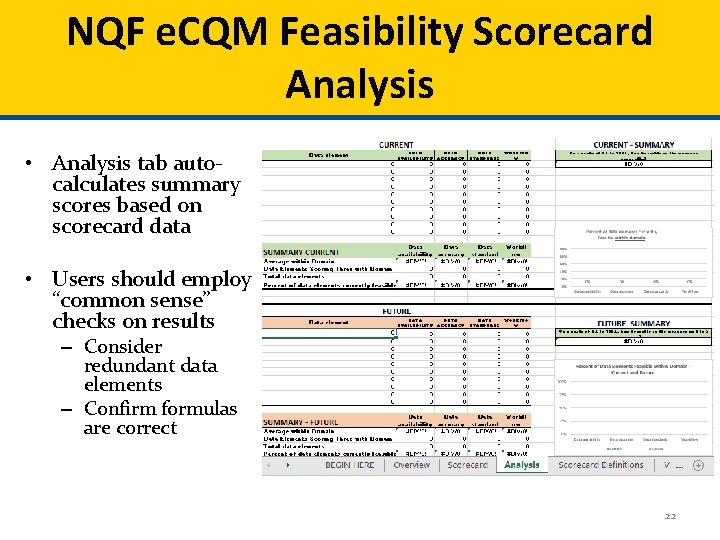
NQF e. CQM Feasibility Scorecard Analysis • Analysis tab autocalculates summary scores based on scorecard data • Users should employ “common sense” checks on results – Consider redundant data elements – Confirm formulas are correct 22
Feasibility scorecard: things to consider • The scorecard should be completed as part of an iterative process – EHR data extraction and analysis may yield new information about feasibility that should be reflected in the scorecard • Test sites may require varying levels of support to complete the scorecard 23
NQF e. CQM Feasibility Scorecard Interpretation Scorecard provides a snapshot of current and future feasibility May require additional information to fully explain feasibility findings Developers should explain any domain or data element scores < 3 24
Interpretation Considerations • Were all required data elements able to be extracted for testing, even if they were not scored a 3? • Which data elements were the most difficult for each site to extract? Were they difficult across sites? • What workflow changes or EHR upgrades would be required before this measure would be ready for implementation? 25
Resources • NQF e. CQM Feasibility Scorecard: http: //www. qualityforum. org/Electronic_Qual ity_Measures. aspx • Electronic Clinical Quality Improvement Resource Center: https: //ecqi. healthit. gov/ • Measures Management System Blueprint: https: //www. cms. gov/Medicare/Quality. Initiatives-Patient-Assessment. Instruments/MMS-Blueprint. html 26
Discussion 27
Upcoming Webinars Planned Upcoming Webinars: • July 26, Scientific acceptability testing • August 23, Technical Expert Panels • September 27, Blueprint 14. 0 Suggestions for future topics? Email: MMSsupport@battelle. org 28
- Slides: 28