
CMS HOSPITAL CONDITIONS OF PARTICIPATION COPS QAPI Standards


- Slides: 180
CMS HOSPITAL CONDITIONS OF PARTICIPATION (COPS) QAPI Standards and QAPI Worksheet
Speaker § Sue Dill Calloway RN, Esq. CPHRM, CCMSCP, CCMSP § AD, BA, BSN, MSN, JD § President of Patient Safety and Education Consulting § 5447 Fawnbrook Lane § Dublin, Ohio 43017 § 614 791 -1468 (Call with questions, No emails) § sdill 1@columbus. rr. com § CMS Email hospitalscg@cms. hhs. gov or cahscg@cms. hhs. gov 2
You Don’t Want One of These 3
Introduction
The Conditions of Participation (Co. Ps) § Regulations first published in 1986 § Manual updated more frequently now § Tag number 0001 through 1164 and 1500 -1576 for swing beds and CAH (Critical Access Hospital) tag 150 -410 § PI starts at tag 263 § Questions to CMS at hospitalscg@cms. hhs. gov and cahscg@cms. hhs. gov § First regulations are published in the Federal Register then CMS publishes the Interpretive Guidelines and some have Survey Procedures 2 § Hospitals should check this website once a month for changes 1 www. gpoaccess. gov/fr/index. html 2 www. cms. hhs. gov/Survey. Certification. Gen. Info/PMSR/list. asp 5
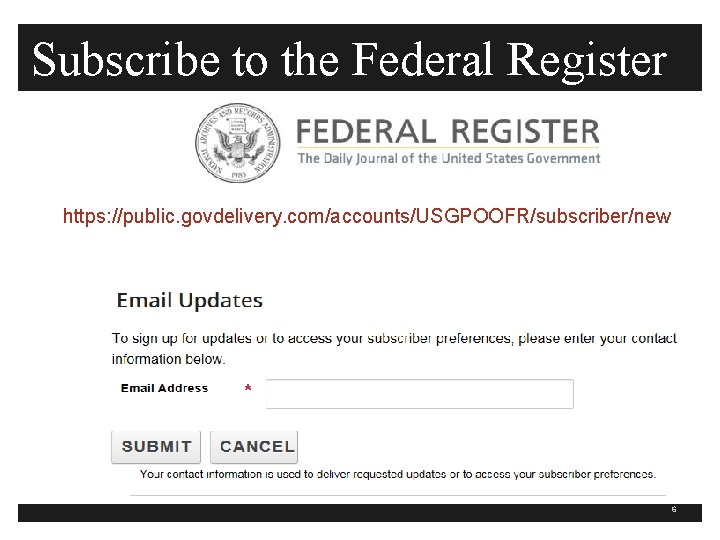
Subscribe to the Federal Register https: //public. govdelivery. com/accounts/USGPOOFR/subscriber/new 6
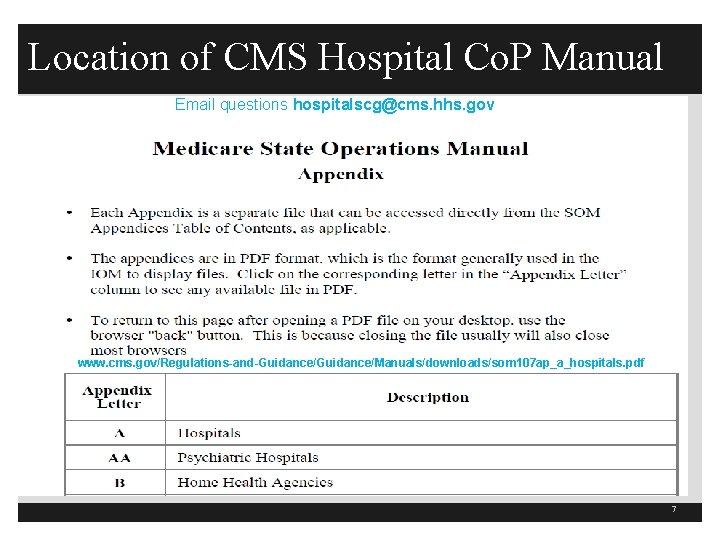
Location of CMS Hospital Co. P Manual Email questions hospitalscg@cms. hhs. gov www. cms. gov/Regulations-and-Guidance/Manuals/downloads/som 107 ap_a_hospitals. pdf 7
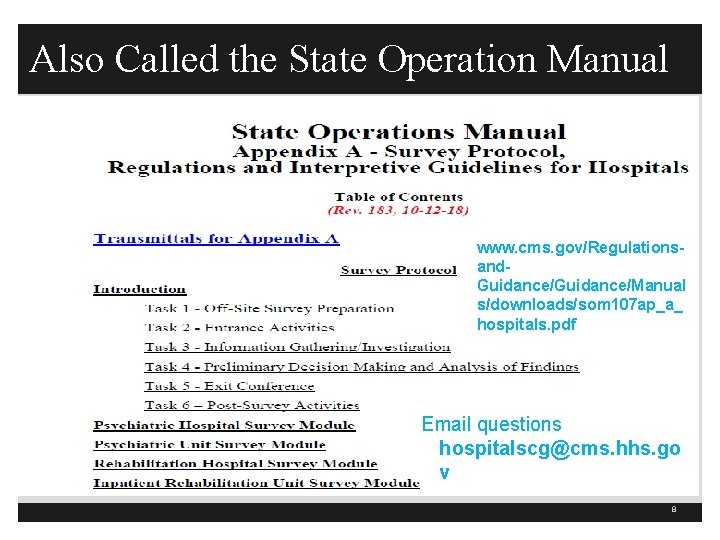
Also Called the State Operation Manual www. cms. gov/Regulationsand. Guidance/Manual s/downloads/som 107 ap_a_ hospitals. pdf Email questions hospitalscg@cms. hhs. go v 8
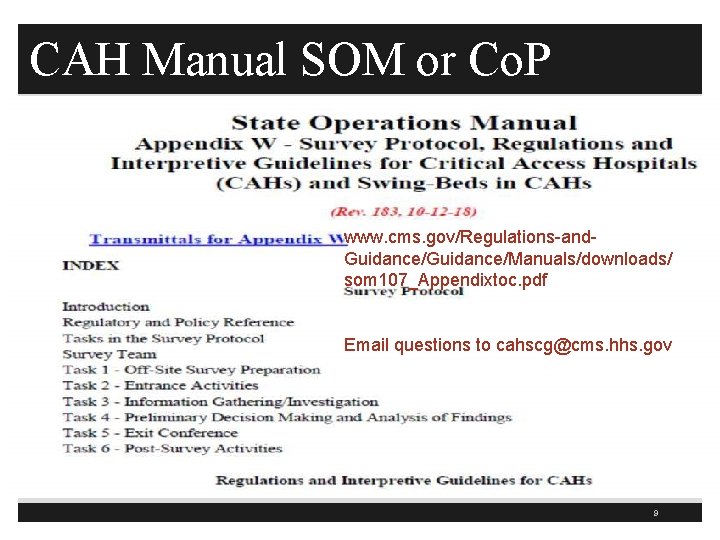
CAH Manual SOM or Co. P www. cms. gov/Regulations-and. Guidance/Manuals/downloads/ som 107_Appendixtoc. pdf Email questions to cahscg@cms. hhs. gov 9
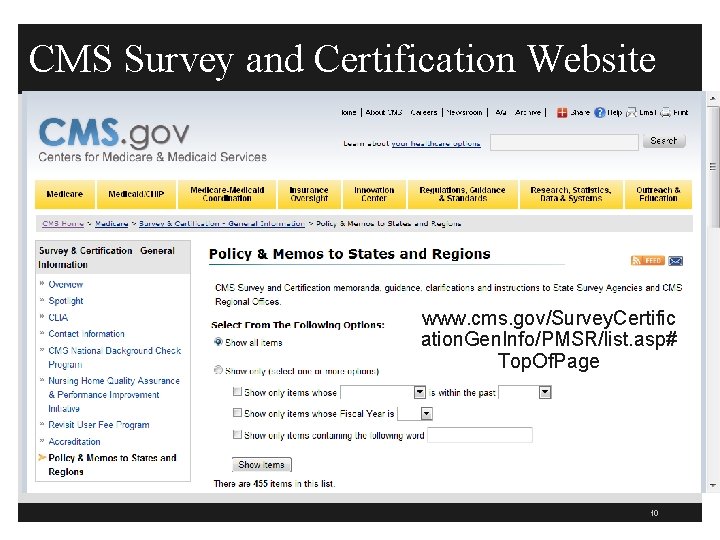
CMS Survey and Certification Website www. cms. gov/Survey. Certific ation. Gen. Info/PMSR/list. asp# Top. Of. Page 10
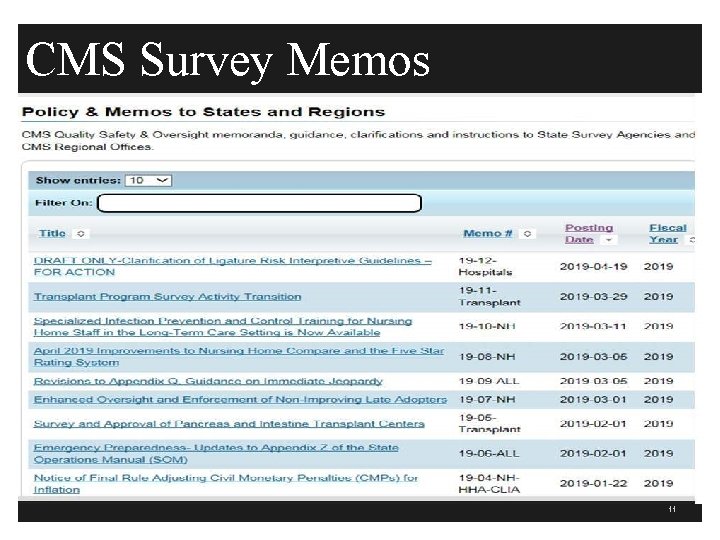
CMS Survey Memos www. cms. gov/Medicare/Provider-Enrollment-and-Certification/Survey. Certification. Gen. Info/Policyand-Memos-to-States-and-Regions. html 11
CMS Deficiency Data on QAPI
Access to Hospital Complaint Data § CMS issued Survey and Certification memo on March 22, 2013 regarding access to hospital complaint data § Includes acute care and CAH hospitals § Does not include the plan of correction but can request § Questions to bettercare@cms. hhs. com § This is the CMS 2567 deficiency data and lists the tag numbers § Updating quarterly § Available under downloads on the hospital website at www. cms. gov 13
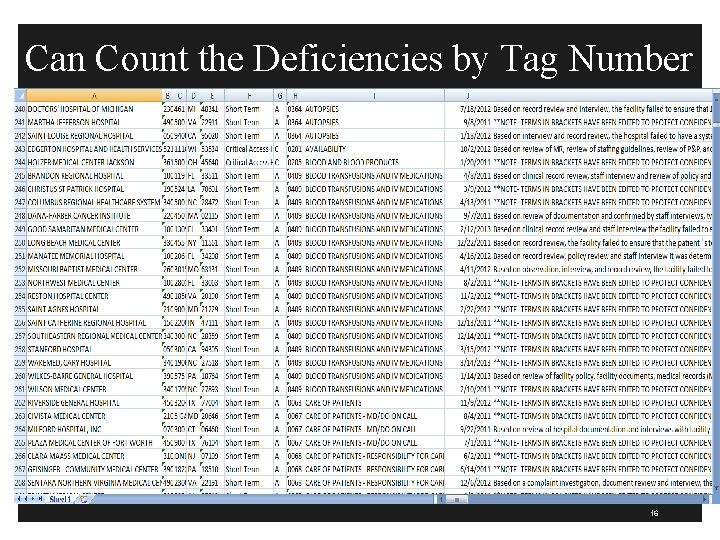
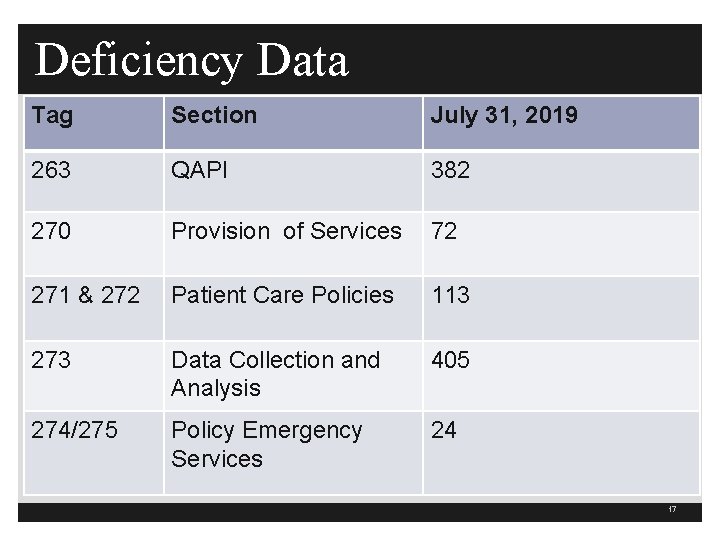
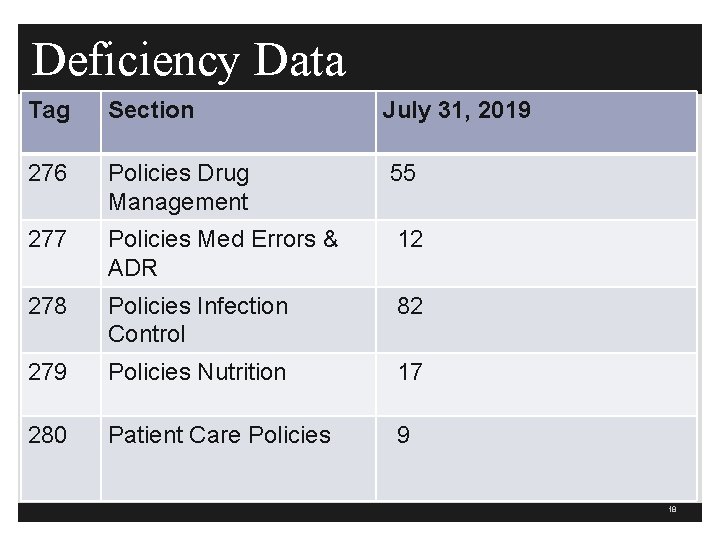
Number of Deficiencies for QAPI § CMS deficiency reports show many deficiencies in QAPI § CMS is updating quarterly § PI standards were rewritten March 21, 2014 and many changed tag numbers § Reports lists the name and address of all hospitals receiving deficiencies § Can read the deficiencies for each one to get an idea of what surveyors are hitting hard 14
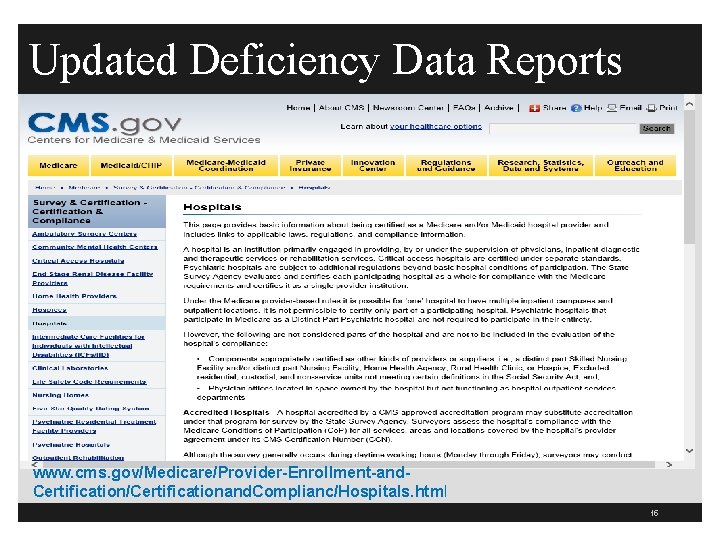
Updated Deficiency Data Reports www. cms. gov/Medicare/Provider-Enrollment-and. Certification/Certificationand. Complianc/Hospitals. html 15
Can Count the Deficiencies by Tag Number 16
Deficiency Data Tag Section July 31, 2019 263 QAPI 382 270 Provision of Services 72 271 & 272 Patient Care Policies 113 273 Data Collection and Analysis 405 274/275 Policy Emergency Services 24 17
Deficiency Data Tag Section July 31, 2019 276 Policies Drug Management 55 277 Policies Med Errors & ADR 12 278 Policies Infection Control 82 279 Policies Nutrition 17 280 Patient Care Policies 9 18
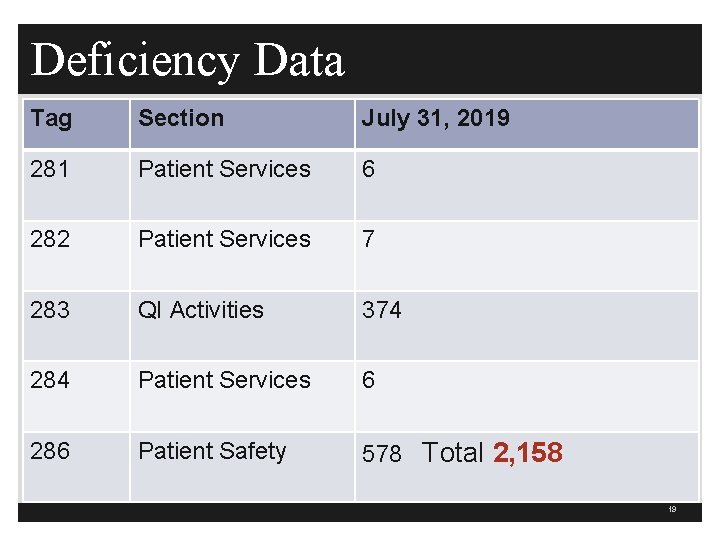
Deficiency Data Tag Section July 31, 2019 281 Patient Services 6 282 Patient Services 7 283 QI Activities 374 284 Patient Services 6 286 Patient Safety 578 Total 2, 158 19
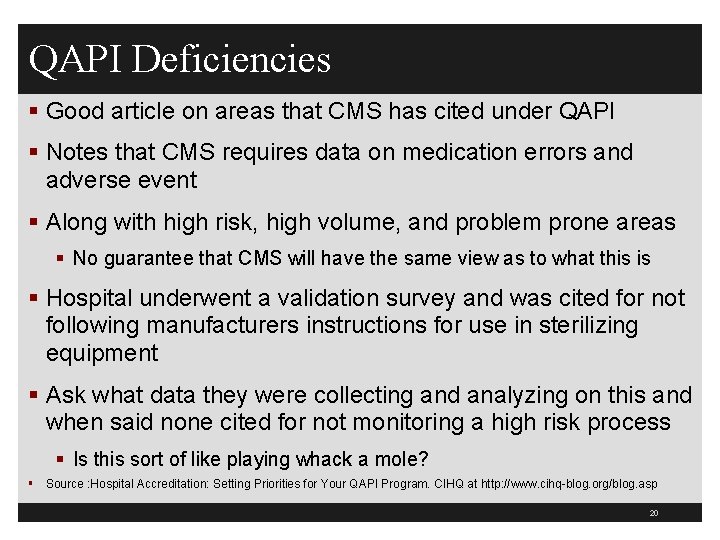
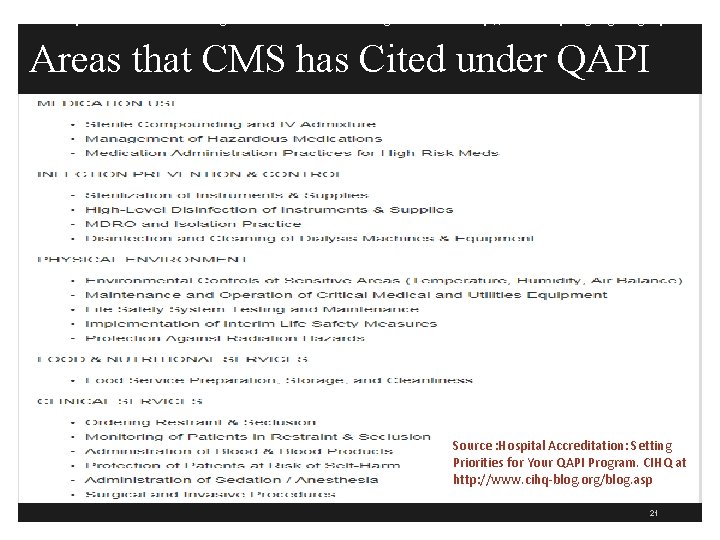
QAPI Deficiencies § Good article on areas that CMS has cited under QAPI § Notes that CMS requires data on medication errors and adverse event § Along with high risk, high volume, and problem prone areas § No guarantee that CMS will have the same view as to what this is § Hospital underwent a validation survey and was cited for not following manufacturers instructions for use in sterilizing equipment § Ask what data they were collecting and analyzing on this and when said none cited for not monitoring a high risk process § Is this sort of like playing whack a mole? § Source : Hospital Accreditation: Setting Priorities for Your QAPI Program. CIHQ at http: //www. cihq-blog. org/blog. asp 20
Source : Hospital Accreditation: Setting Priorities for Your QAPI Program. CIHQ at http: //www. cihq-blog. org/blog. asp Areas that CMS has Cited under QAPI Source : Hospital Accreditation: Setting Priorities for Your QAPI Program. CIHQ at http: //www. cihq-blog. org/blog. asp 21
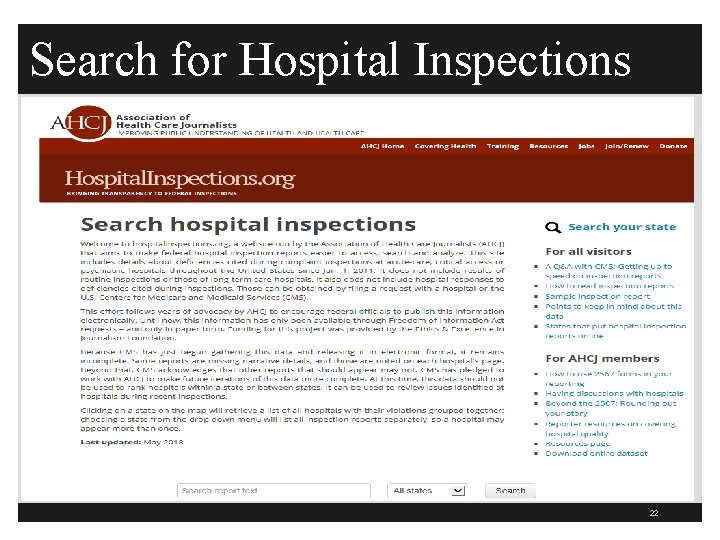
Search for Hospital Inspections 22
CMS Survey Memo on QAPI
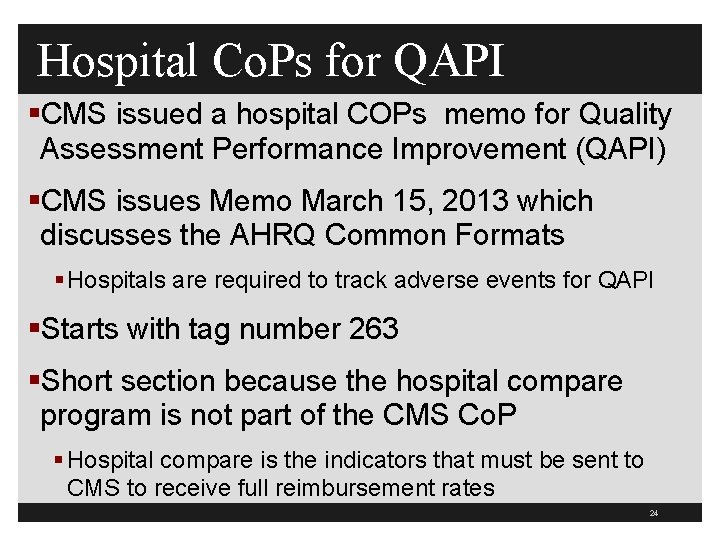
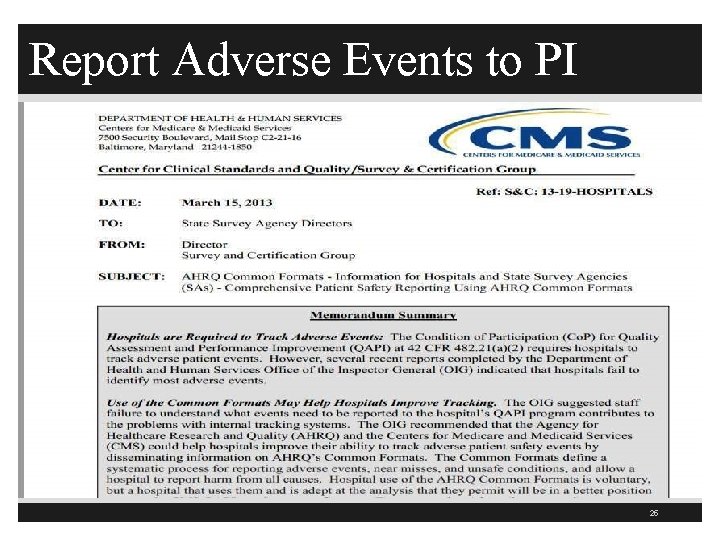
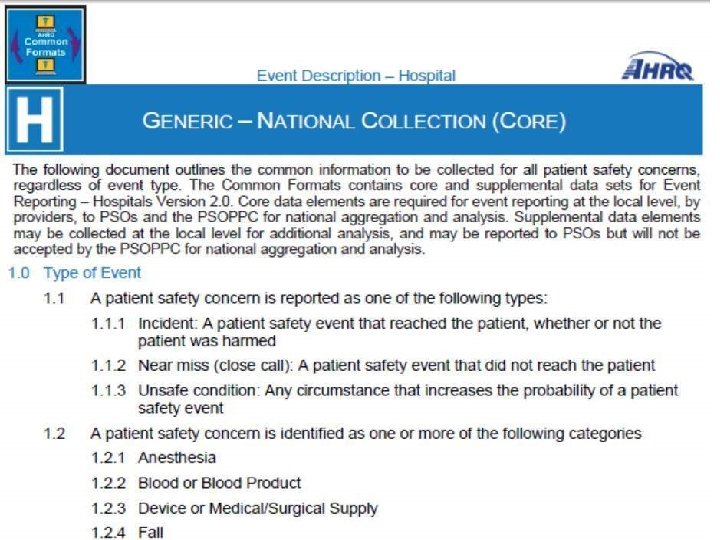
Hospital Co. Ps for QAPI §CMS issued a hospital COPs memo for Quality Assessment Performance Improvement (QAPI) §CMS issues Memo March 15, 2013 which discusses the AHRQ Common Formats § Hospitals are required to track adverse events for QAPI §Starts with tag number 263 §Short section because the hospital compare program is not part of the CMS Co. P § Hospital compare is the indicators that must be sent to CMS to receive full reimbursement rates 24
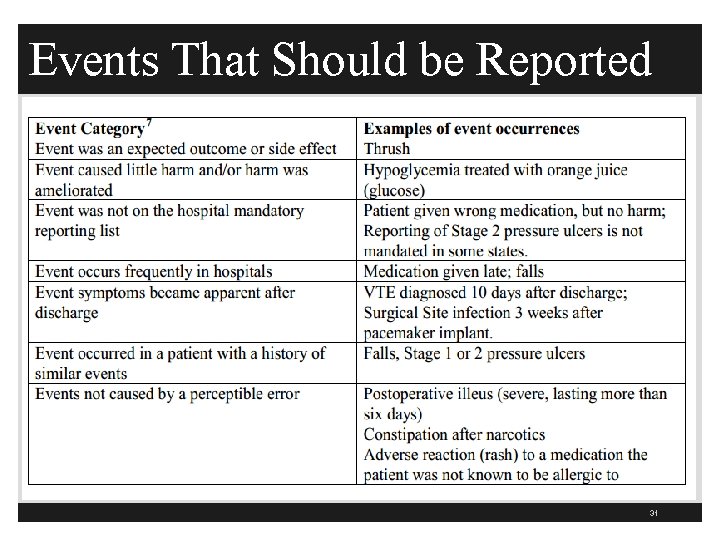
Report Adverse Events to PI 25
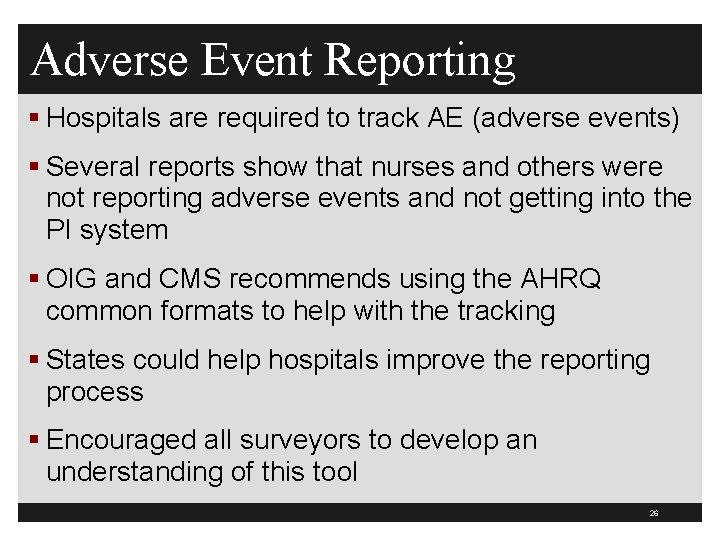
Adverse Event Reporting § Hospitals are required to track AE (adverse events) § Several reports show that nurses and others were not reporting adverse events and not getting into the PI system § OIG and CMS recommends using the AHRQ common formats to help with the tracking § States could help hospitals improve the reporting process § Encouraged all surveyors to develop an understanding of this tool 26
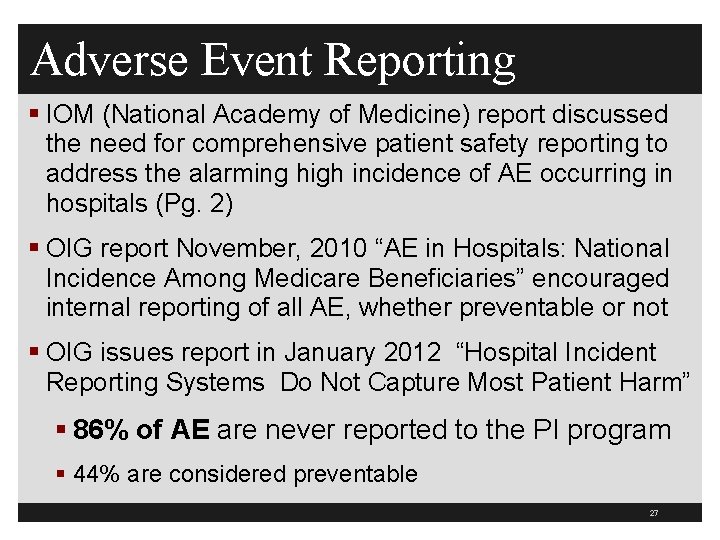
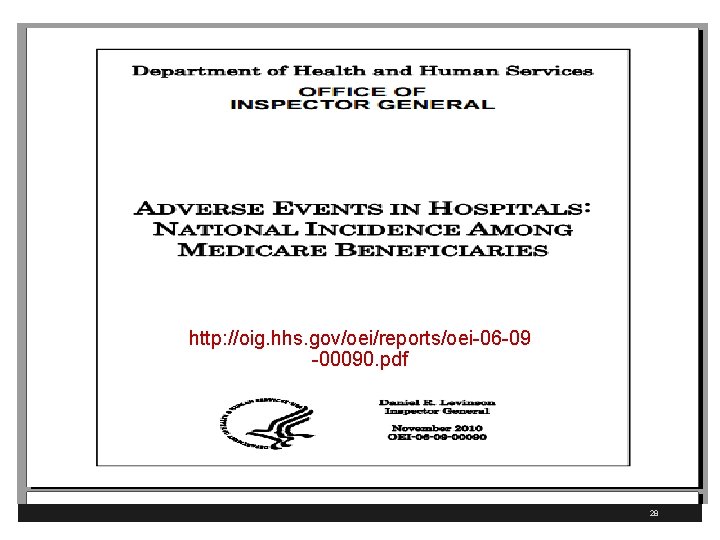
Adverse Event Reporting § IOM (National Academy of Medicine) report discussed the need for comprehensive patient safety reporting to address the alarming high incidence of AE occurring in hospitals (Pg. 2) § OIG report November, 2010 “AE in Hospitals: National Incidence Among Medicare Beneficiaries” encouraged internal reporting of all AE, whether preventable or not § OIG issues report in January 2012 “Hospital Incident Reporting Systems Do Not Capture Most Patient Harm” § 86% of AE are never reported to the PI program § 44% are considered preventable 27
http: //oig. hhs. gov/oei/reports/oei-06 -09 -00090. pdf 28
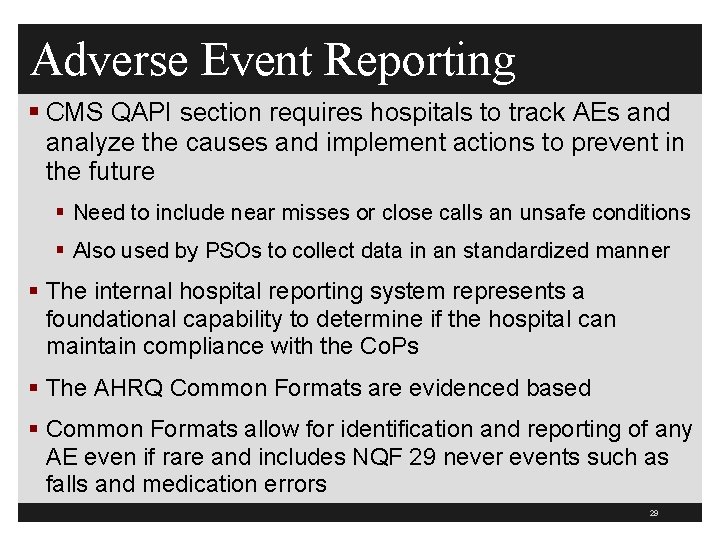
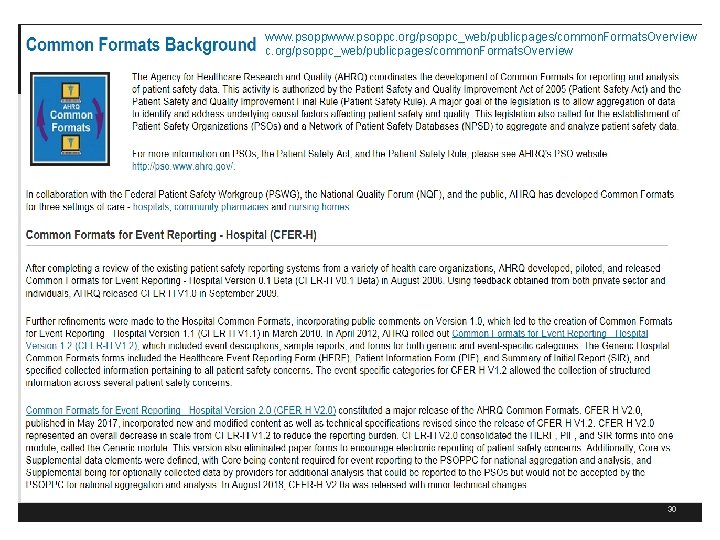
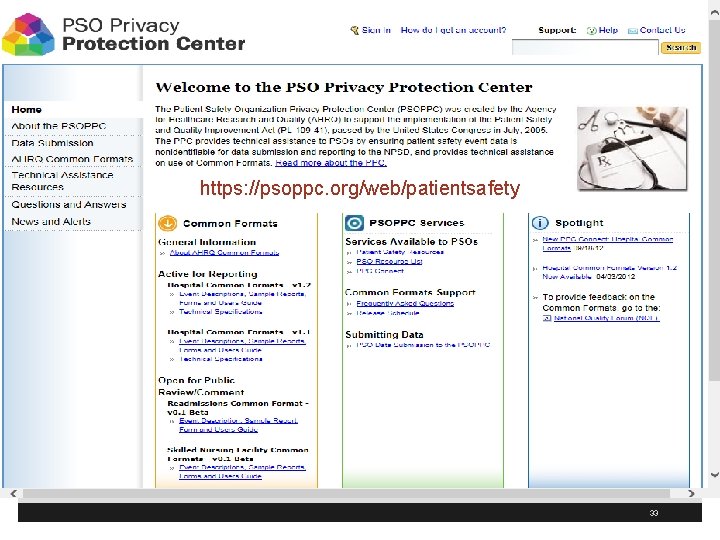
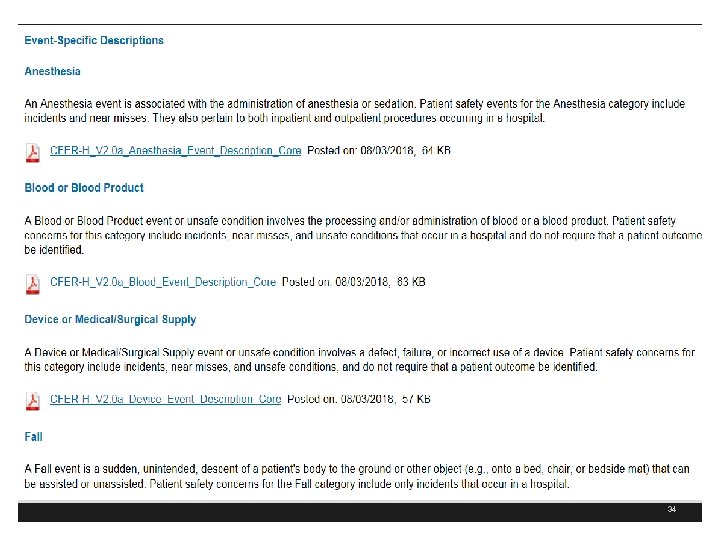
Adverse Event Reporting § CMS QAPI section requires hospitals to track AEs and analyze the causes and implement actions to prevent in the future § Need to include near misses or close calls an unsafe conditions § Also used by PSOs to collect data in an standardized manner § The internal hospital reporting system represents a foundational capability to determine if the hospital can maintain compliance with the Co. Ps § The AHRQ Common Formats are evidenced based § Common Formats allow for identification and reporting of any AE even if rare and includes NQF 29 never events such as falls and medication errors 29
www. psoppc. org/psoppc_web/publicpages/common. Formats. Overview 30
Events That Should be Reported 31
32
https: //psoppc. org/web/patientsafety 33
34
CMS Final Changes The Hospital Improvement Rule
Introduction § CMS published the final regulations on September 30, 2019 with an effective date of November 29, 2019 § Regulations are effective 60 days after publication in the Federal Register except CAH has 18 months to implement the QAPI requirements since all new § CMS will publish interpretive guidelines and survey procedures to match the revised regulations so the surveyors and the hospitals will know what it means § Monitor the survey memo website § CMS reserves the right to tinker with the language when the survey memo is issued 36
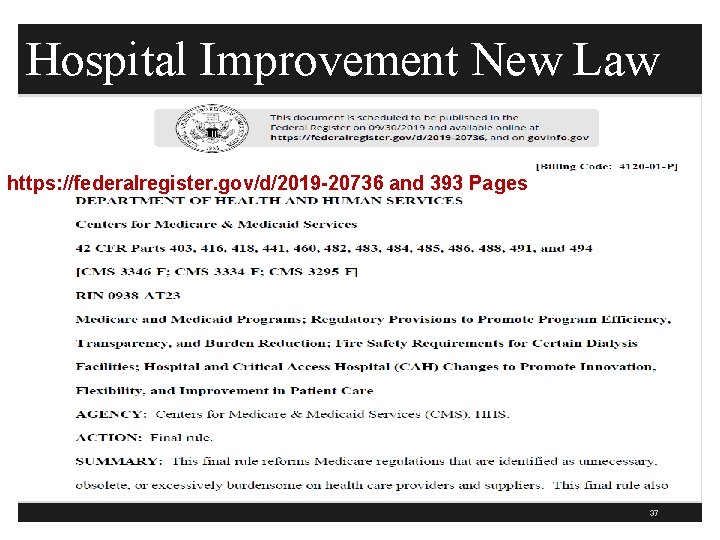
Hospital Improvement New Law https: //federalregister. gov/d/2019 -20736 and 393 Pages 37
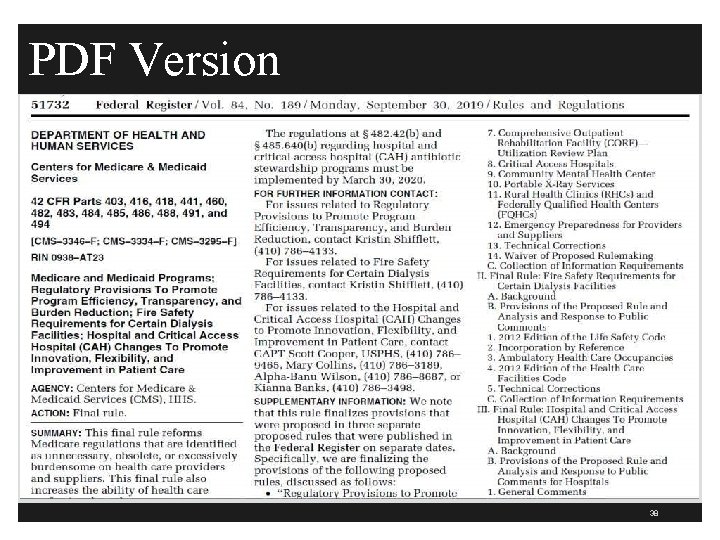
PDF Version 38
Introduction § CMS will publish it in a transmittal and then that day CMS will update the CMS hospital Co. P manual § Hospitals will then need to review and implement the requirements § Hospitals can do a gap analysis where they go through it line by line and document how they meet compliance § Hospitals can get a complaint survey, validation survey or certification survey § In 2019, CMS announced will do observations of the 4 AO surveys instead of the traditional validation survey § If out of compliance CMS may issue a statement of deficiency and will have to do a plan of correction 39
QAPI § CMS will also update the QAPI worksheet § Current Co. Ps require hospitals to examine the quality of its services and implement specific improvement projects on an ongoing basis § This has resulted in hospitals making progress in delivering safer, high quality care § CMS is making a minor change to the program data requirements § Currently hospitals must incorporate patient care data into their QAPI such as data submitted to or from the QIO 40
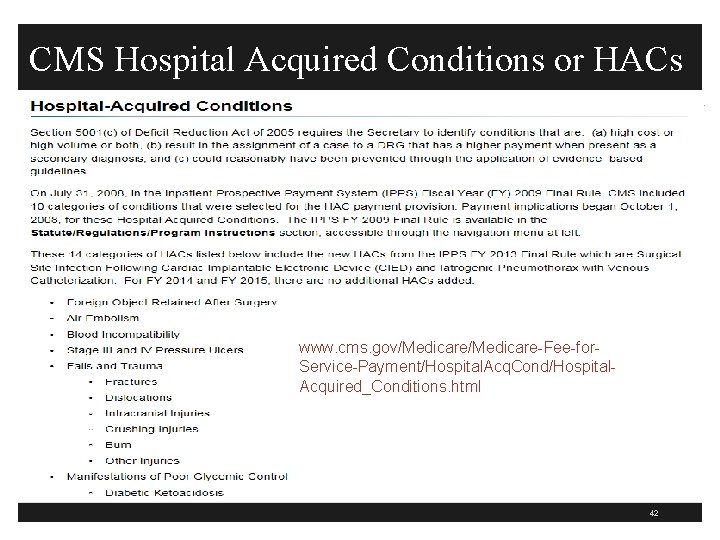
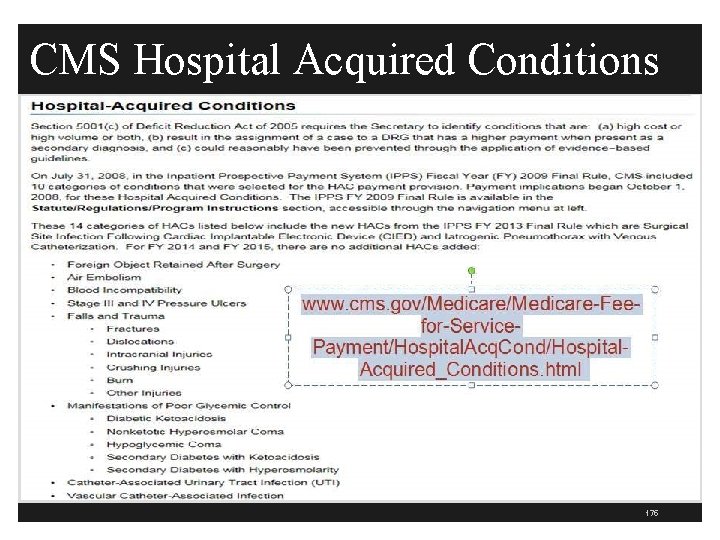
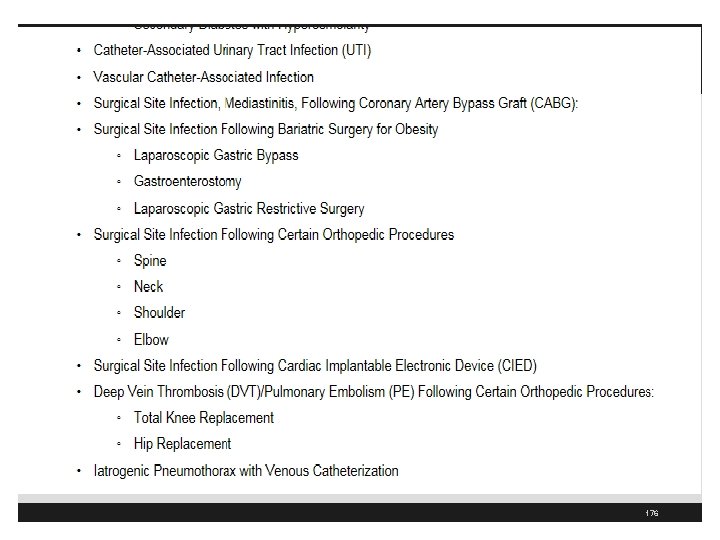
QAPI § Will require that the hospital QAPI program to incorporate quality indicator data, including patient care data, submitted to or received from Medicare quality reporting and quality performance programs § This would include data on readmissions and hospital acquired conditions (HACs) § Hospitals are already collecting and reporting on a lot of this data so efficient to include some of this data in the QAPI program § Like HAC Reduction Program, Hospital VBP Program, Inpatient and Outpatient Quality Reporting Program 41
CMS Hospital Acquired Conditions or HACs h www. cms. gov/Medicare-Fee-for. Service-Payment/Hospital. Acq. Cond/Hospital. Acquired_Conditions. html 42
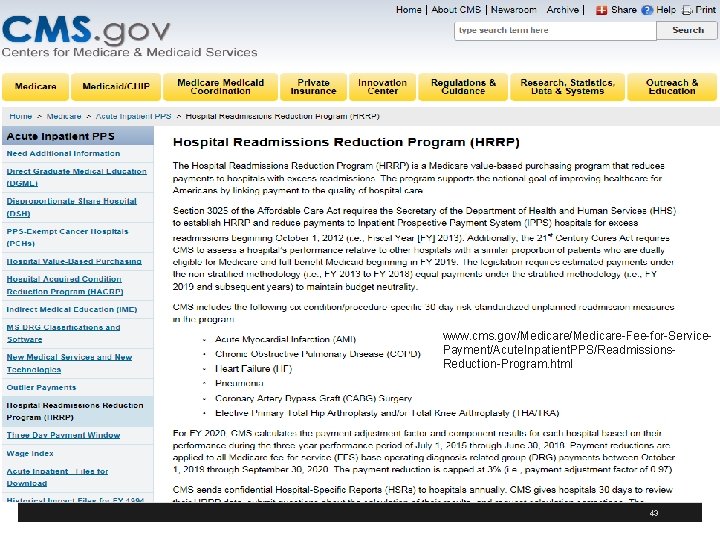
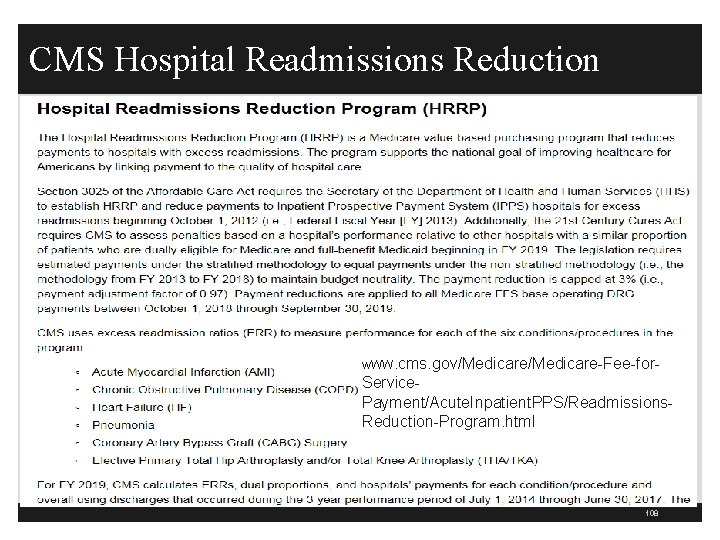
www. cms. gov/Medicare-Fee-for-Service. Payment/Acute. Inpatient. PPS/Readmissions. Reduction-Program. html 43
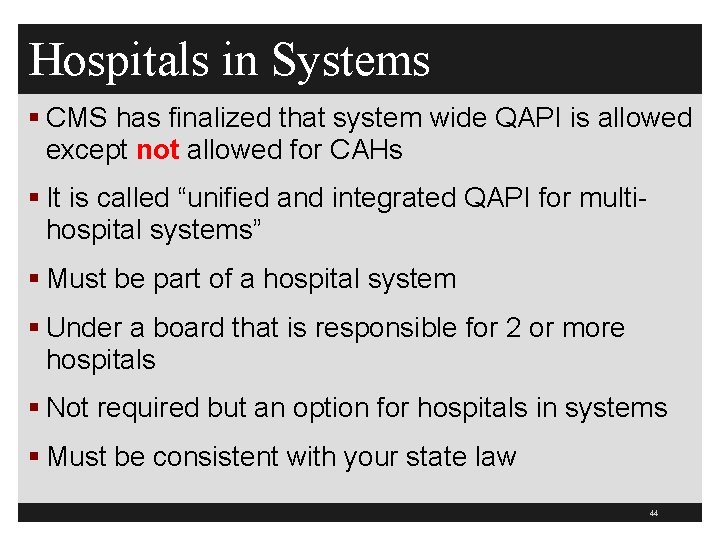
Hospitals in Systems § CMS has finalized that system wide QAPI is allowed except not allowed for CAHs § It is called “unified and integrated QAPI for multihospital systems” § Must be part of a hospital system § Under a board that is responsible for 2 or more hospitals § Not required but an option for hospitals in systems § Must be consistent with your state law 44
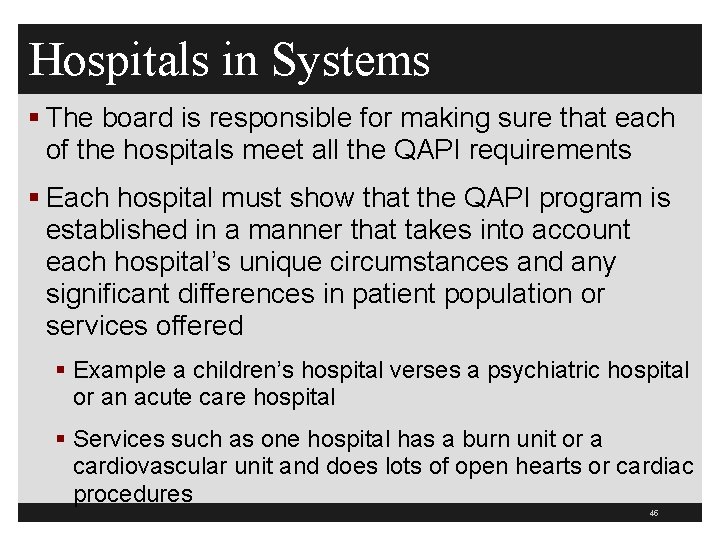
Hospitals in Systems § The board is responsible for making sure that each of the hospitals meet all the QAPI requirements § Each hospital must show that the QAPI program is established in a manner that takes into account each hospital’s unique circumstances and any significant differences in patient population or services offered § Example a children’s hospital verses a psychiatric hospital or an acute care hospital § Services such as one hospital has a burn unit or a cardiovascular unit and does lots of open hearts or cardiac procedures 45
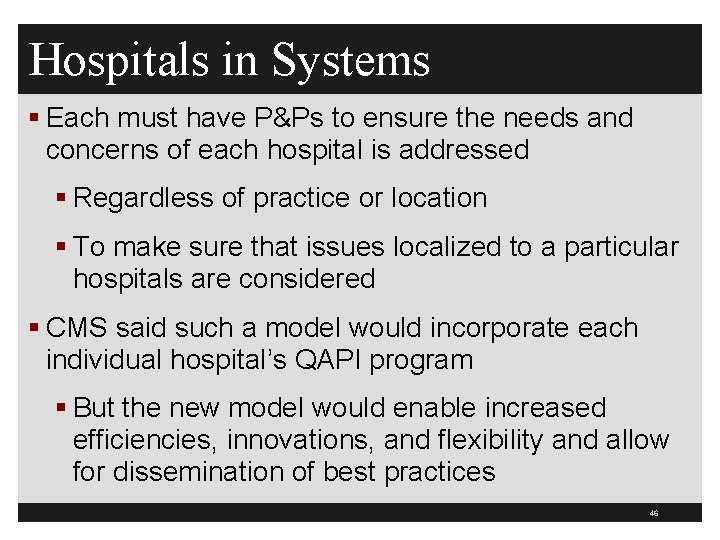
Hospitals in Systems § Each must have P&Ps to ensure the needs and concerns of each hospital is addressed § Regardless of practice or location § To make sure that issues localized to a particular hospitals are considered § CMS said such a model would incorporate each individual hospital’s QAPI program § But the new model would enable increased efficiencies, innovations, and flexibility and allow for dissemination of best practices 46
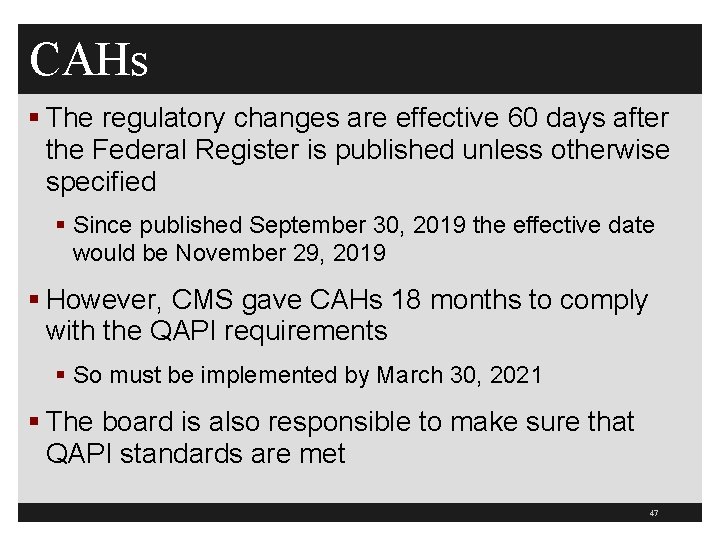
CAHs § The regulatory changes are effective 60 days after the Federal Register is published unless otherwise specified § Since published September 30, 2019 the effective date would be November 29, 2019 § However, CMS gave CAHs 18 months to comply with the QAPI requirements § So must be implemented by March 30, 2021 § The board is also responsible to make sure that QAPI standards are met 47
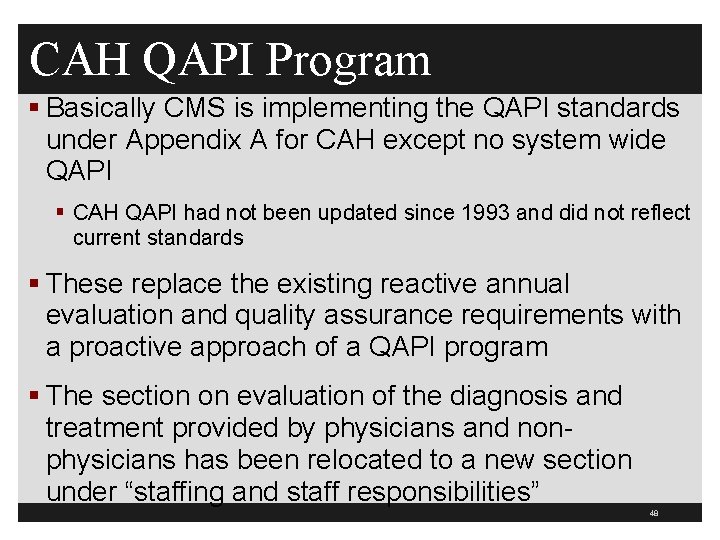
CAH QAPI Program § Basically CMS is implementing the QAPI standards under Appendix A for CAH except no system wide QAPI § CAH QAPI had not been updated since 1993 and did not reflect current standards § These replace the existing reactive annual evaluation and quality assurance requirements with a proactive approach of a QAPI program § The section on evaluation of the diagnosis and treatment provided by physicians and nonphysicians has been relocated to a new section under “staffing and staff responsibilities” 48
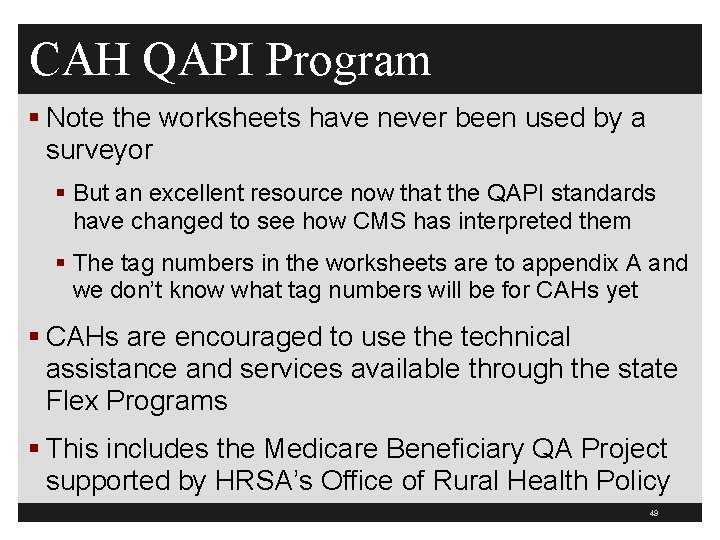
CAH QAPI Program § Note the worksheets have never been used by a surveyor § But an excellent resource now that the QAPI standards have changed to see how CMS has interpreted them § The tag numbers in the worksheets are to appendix A and we don’t know what tag numbers will be for CAHs yet § CAHs are encouraged to use the technical assistance and services available through the state Flex Programs § This includes the Medicare Beneficiary QA Project supported by HRSA’s Office of Rural Health Policy 49
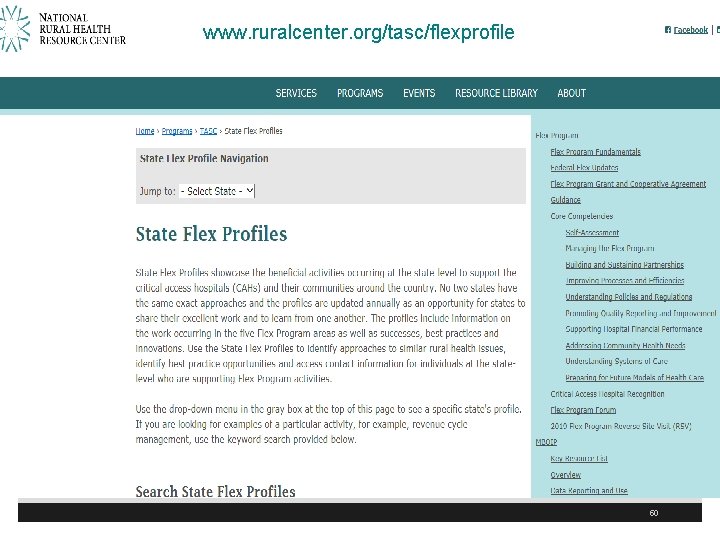
www. ruralcenter. org/tasc/flexprofile 50
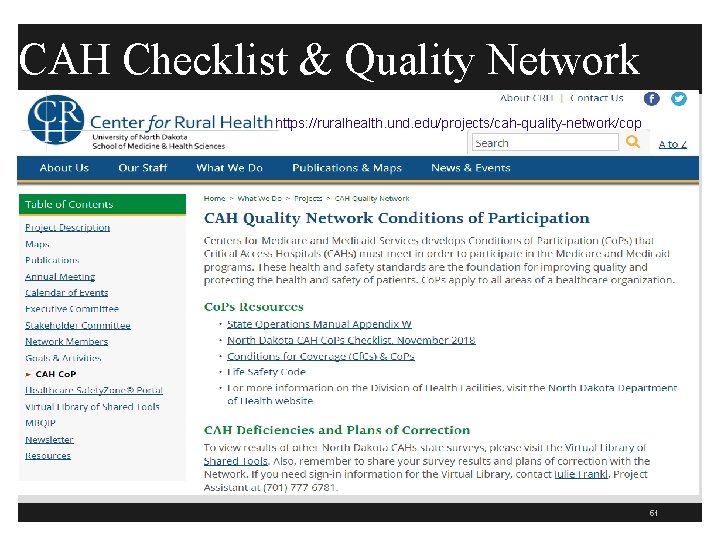
CAH Checklist & Quality Network https: //ruralhealth. und. edu/projects/cah-quality-network/cop 51
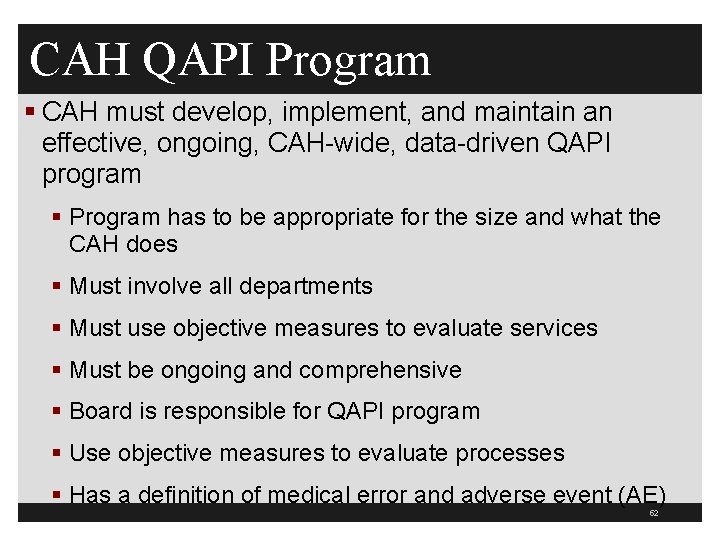
CAH QAPI Program § CAH must develop, implement, and maintain an effective, ongoing, CAH-wide, data-driven QAPI program § Program has to be appropriate for the size and what the CAH does § Must involve all departments § Must use objective measures to evaluate services § Must be ongoing and comprehensive § Board is responsible for QAPI program § Use objective measures to evaluate processes § Has a definition of medical error and adverse event (AE) 52
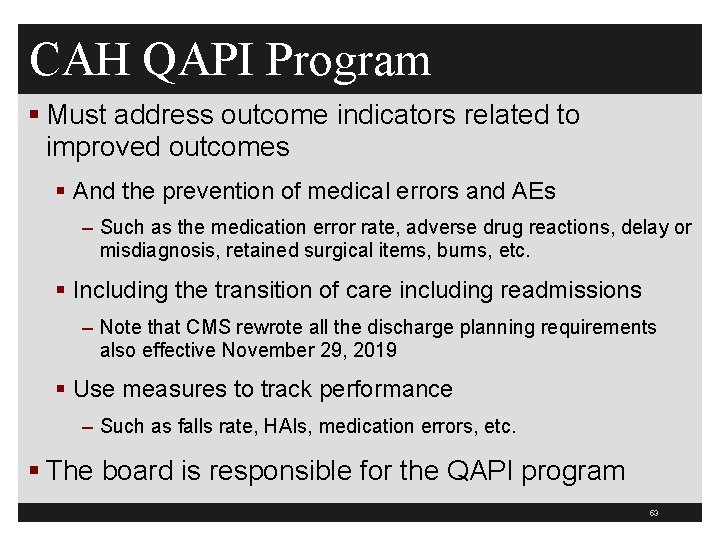
CAH QAPI Program § Must address outcome indicators related to improved outcomes § And the prevention of medical errors and AEs – Such as the medication error rate, adverse drug reactions, delay or misdiagnosis, retained surgical items, burns, etc. § Including the transition of care including readmissions – Note that CMS rewrote all the discharge planning requirements also effective November 29, 2019 § Use measures to track performance – Such as falls rate, HAIs, medication errors, etc. § The board is responsible for the QAPI program 53
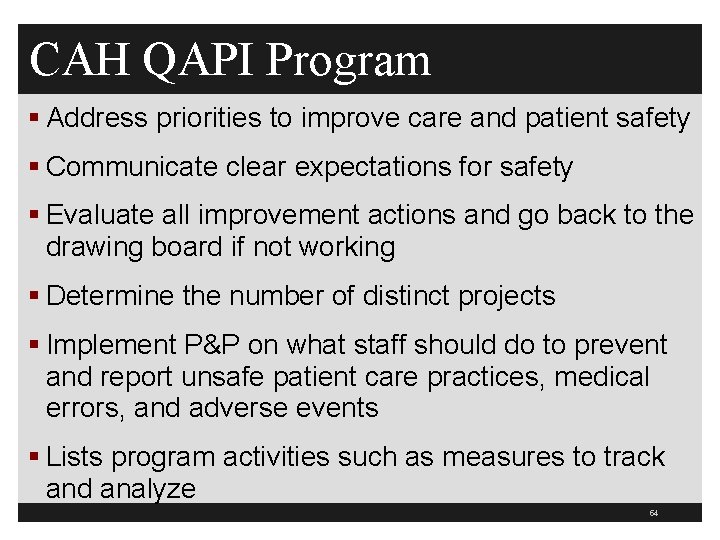
CAH QAPI Program § Address priorities to improve care and patient safety § Communicate clear expectations for safety § Evaluate all improvement actions and go back to the drawing board if not working § Determine the number of distinct projects § Implement P&P on what staff should do to prevent and report unsafe patient care practices, medical errors, and adverse events § Lists program activities such as measures to track and analyze 54
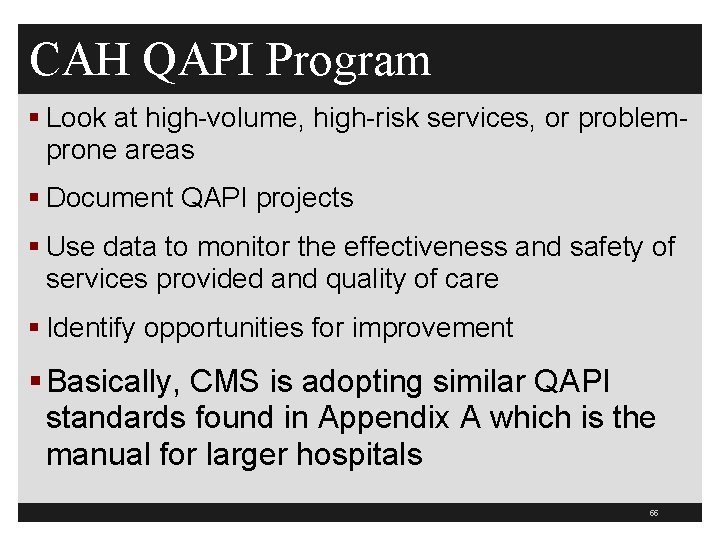
CAH QAPI Program § Look at high-volume, high-risk services, or problemprone areas § Document QAPI projects § Use data to monitor the effectiveness and safety of services provided and quality of care § Identify opportunities for improvement § Basically, CMS is adopting similar QAPI standards found in Appendix A which is the manual for larger hospitals 55
CMS Worksheets Infection Control, Discharge Planning and QAPI
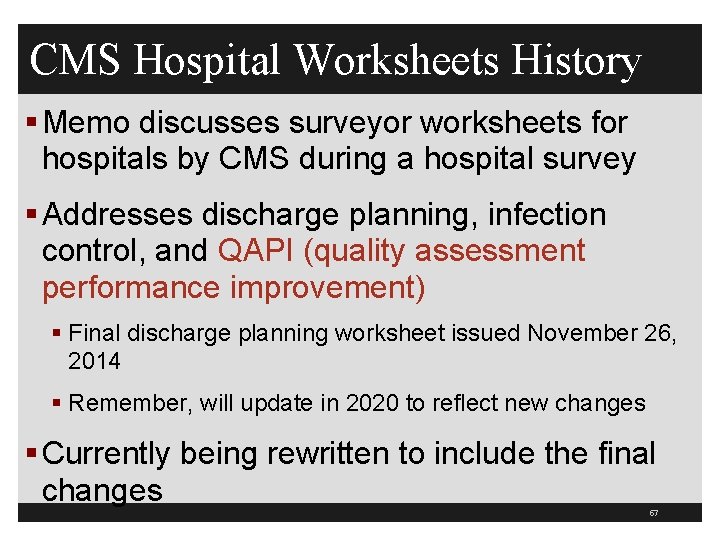
CMS Hospital Worksheets History § Memo discusses surveyor worksheets for hospitals by CMS during a hospital survey § Addresses discharge planning, infection control, and QAPI (quality assessment performance improvement) § Final discharge planning worksheet issued November 26, 2014 § Remember, will update in 2020 to reflect new changes § Currently being rewritten to include the final changes 57
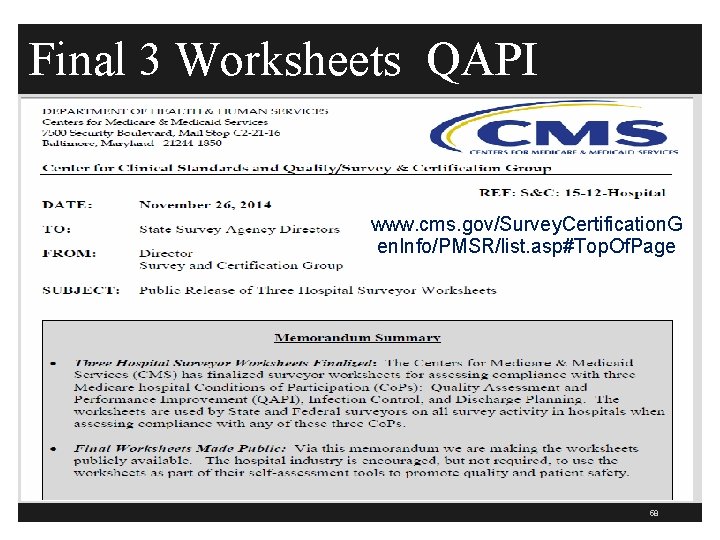
Final 3 Worksheets QAPI www. cms. gov/Survey. Certification. G en. Info/PMSR/list. asp#Top. Of. Page 58
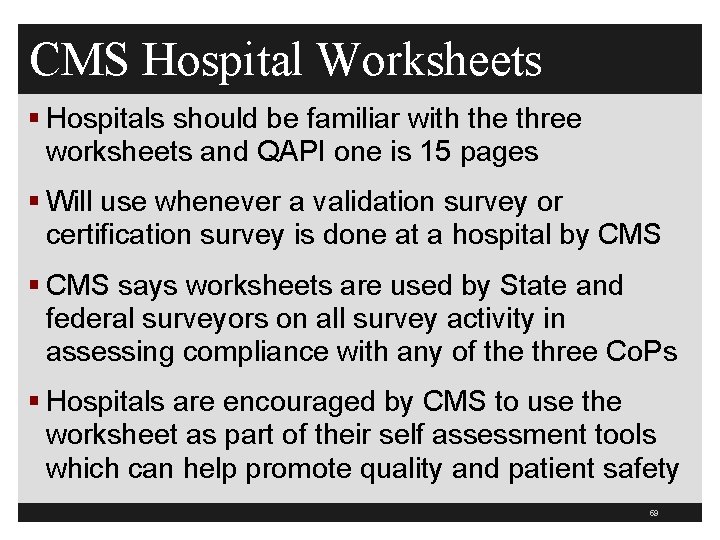
CMS Hospital Worksheets § Hospitals should be familiar with the three worksheets and QAPI one is 15 pages § Will use whenever a validation survey or certification survey is done at a hospital by CMS § CMS says worksheets are used by State and federal surveyors on all survey activity in assessing compliance with any of the three Co. Ps § Hospitals are encouraged by CMS to use the worksheet as part of their self assessment tools which can help promote quality and patient safety 59
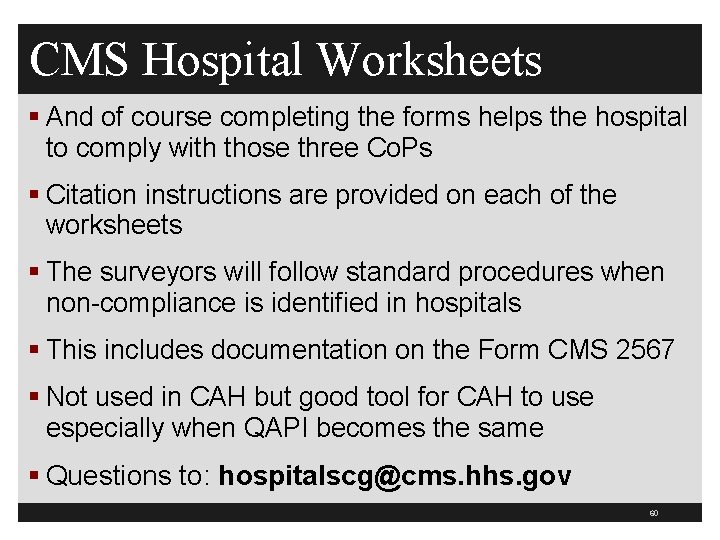
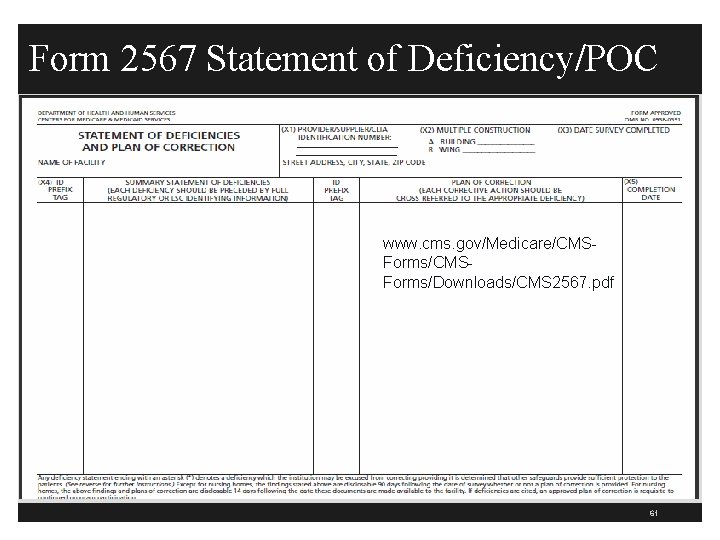
CMS Hospital Worksheets § And of course completing the forms helps the hospital to comply with those three Co. Ps § Citation instructions are provided on each of the worksheets § The surveyors will follow standard procedures when non-compliance is identified in hospitals § This includes documentation on the Form CMS 2567 § Not used in CAH but good tool for CAH to use especially when QAPI becomes the same § Questions to: hospitalscg@cms. hhs. gov 60
Form 2567 Statement of Deficiency/POC www. cms. gov/Medicare/CMSForms/Downloads/CMS 2567. pdf 61
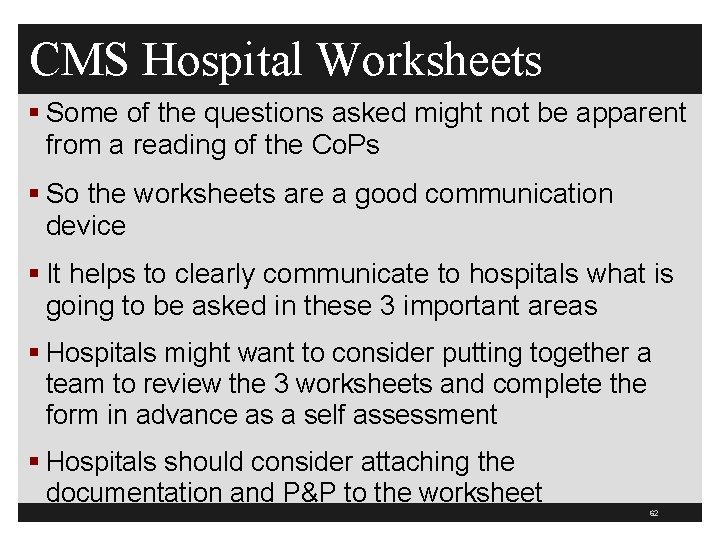
CMS Hospital Worksheets § Some of the questions asked might not be apparent from a reading of the Co. Ps § So the worksheets are a good communication device § It helps to clearly communicate to hospitals what is going to be asked in these 3 important areas § Hospitals might want to consider putting together a team to review the 3 worksheets and complete the form in advance as a self assessment § Hospitals should consider attaching the documentation and P&P to the worksheet 62
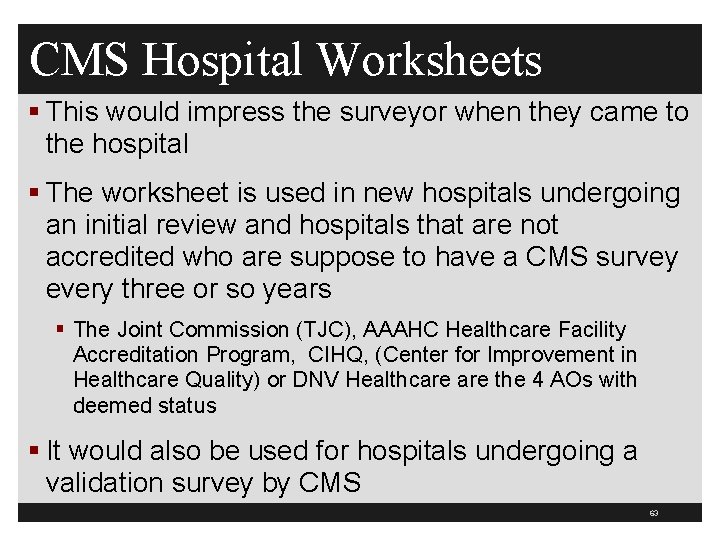
CMS Hospital Worksheets § This would impress the surveyor when they came to the hospital § The worksheet is used in new hospitals undergoing an initial review and hospitals that are not accredited who are suppose to have a CMS survey every three or so years § The Joint Commission (TJC), AAAHC Healthcare Facility Accreditation Program, CIHQ, (Center for Improvement in Healthcare Quality) or DNV Healthcare the 4 AOs with deemed status § It would also be used for hospitals undergoing a validation survey by CMS 63
64
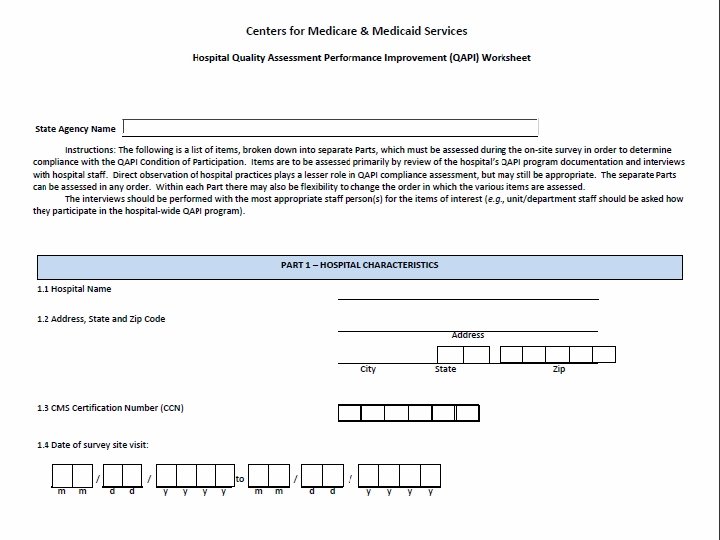
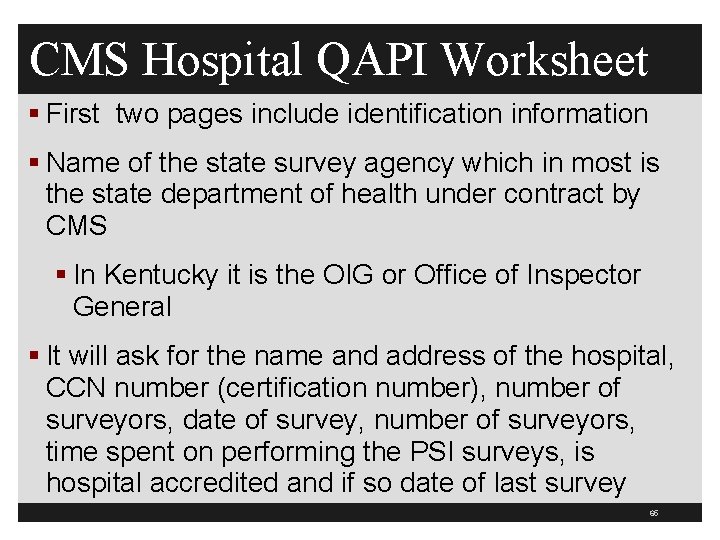
CMS Hospital QAPI Worksheet § First two pages include identification information § Name of the state survey agency which in most is the state department of health under contract by CMS § In Kentucky it is the OIG or Office of Inspector General § It will ask for the name and address of the hospital, CCN number (certification number), number of surveyors, date of survey, number of surveyors, time spent on performing the PSI surveys, is hospital accredited and if so date of last survey 65
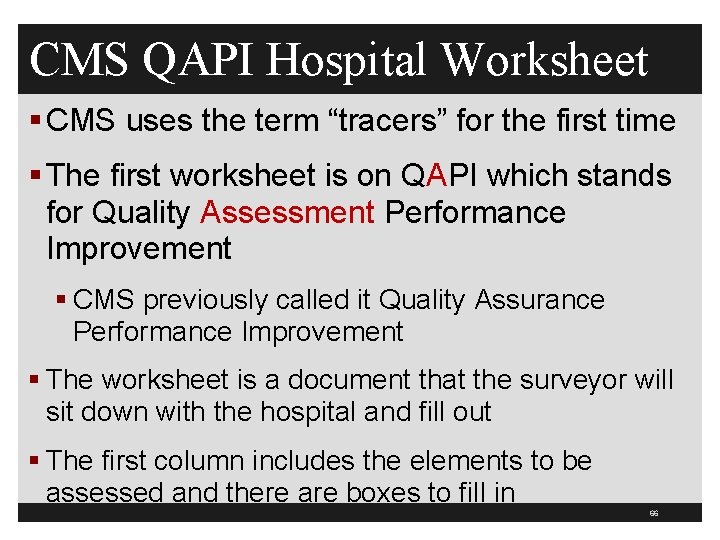
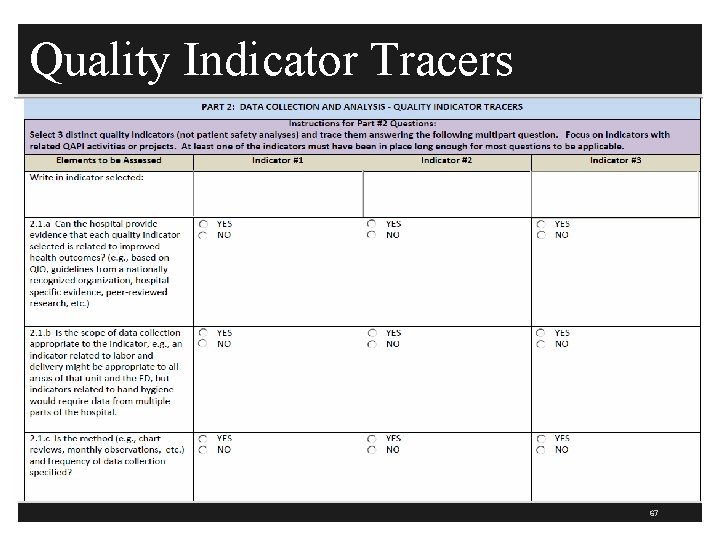
CMS QAPI Hospital Worksheet § CMS uses the term “tracers” for the first time § The first worksheet is on QAPI which stands for Quality Assessment Performance Improvement § CMS previously called it Quality Assurance Performance Improvement § The worksheet is a document that the surveyor will sit down with the hospital and fill out § The first column includes the elements to be assessed and there are boxes to fill in 66
Quality Indicator Tracers 67
QAPI Tracer Data Collection & Analysis § This section is 15 pages long § First select three quality indicators related to PI activities or projects § An example might be the timing of medications and PI data to show medication was given on time and number of medication errors or missed or omitted doses or the number of falls § Number of catheter associated UTIs § Write the quality indicator at the top and answer the following questions for each one 68
QAPI Tracer Data Collection & Analysis § Hospitals collect all kind of data § TJC requires data to be collected in a number of areas § Data on medication management (ADR, medication errors), FMEA, patient flow, staff compliance with employee health screening requirements, patient satisfaction, pediatric asthma, ED measures, infection control surveillance data § Data on R&S use, patient perception of care, organ donation, blood transfusion reactions, ORYX data, medical record deficiency data, staffing, data on how patient communication needs are met, race and ethnicity etc. 69
QAPI Tracer Data Collection & Analysis § CMS has hospital compare with data § Measure patient experience or patient satisfaction data § Measure some or all of the AHRQ patient safety indicators § National Quality Forum includes lists of quality indicators that are evidence based that hospital may measure 70
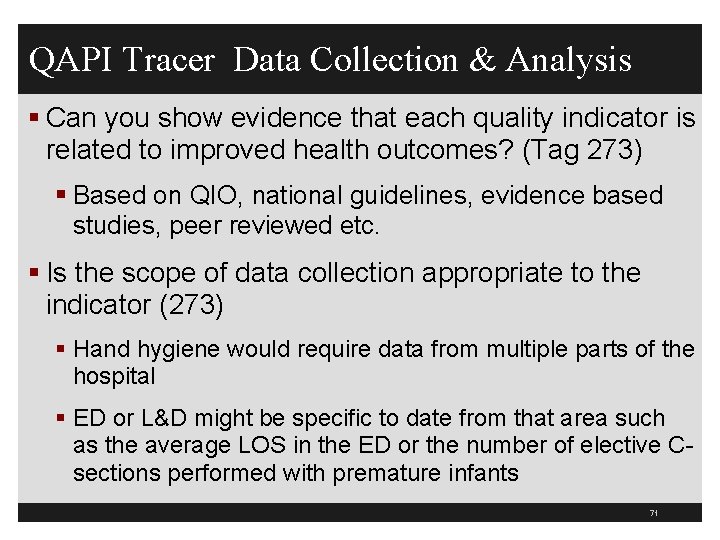
QAPI Tracer Data Collection & Analysis § Can you show evidence that each quality indicator is related to improved health outcomes? (Tag 273) § Based on QIO, national guidelines, evidence based studies, peer reviewed etc. § Is the scope of data collection appropriate to the indicator (273) § Hand hygiene would require data from multiple parts of the hospital § ED or L&D might be specific to date from that area such as the average LOS in the ED or the number of elective Csections performed with premature infants 71
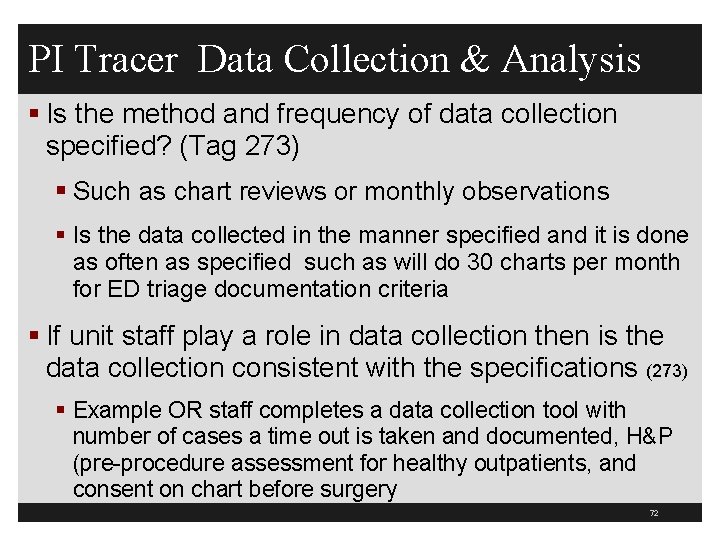
PI Tracer Data Collection & Analysis § Is the method and frequency of data collection specified? (Tag 273) § Such as chart reviews or monthly observations § Is the data collected in the manner specified and it is done as often as specified such as will do 30 charts per month for ED triage documentation criteria § If unit staff play a role in data collection then is the data collection consistent with the specifications (273) § Example OR staff completes a data collection tool with number of cases a time out is taken and documented, H&P (pre-procedure assessment for healthy outpatients, and consent on chart before surgery 72
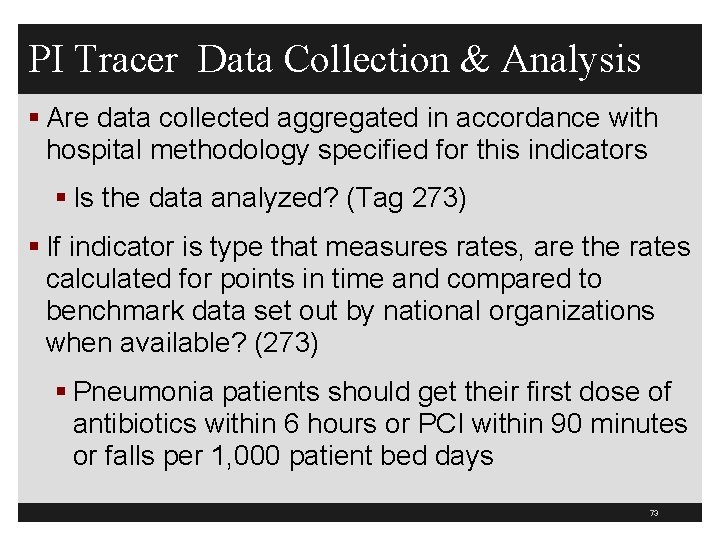
PI Tracer Data Collection & Analysis § Are data collected aggregated in accordance with hospital methodology specified for this indicators § Is the data analyzed? (Tag 273) § If indicator is type that measures rates, are the rates calculated for points in time and compared to benchmark data set out by national organizations when available? (273) § Pneumonia patients should get their first dose of antibiotics within 6 hours or PCI within 90 minutes or falls per 1, 000 patient bed days 73
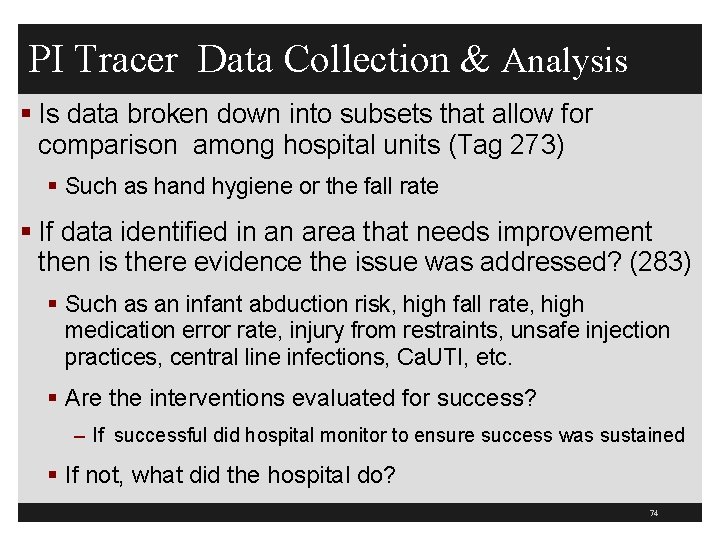
PI Tracer Data Collection & Analysis § Is data broken down into subsets that allow for comparison among hospital units (Tag 273) § Such as hand hygiene or the fall rate § If data identified in an area that needs improvement then is there evidence the issue was addressed? (283) § Such as an infant abduction risk, high fall rate, high medication error rate, injury from restraints, unsafe injection practices, central line infections, Ca. UTI, etc. § Are the interventions evaluated for success? – If successful did hospital monitor to ensure success was sustained § If not, what did the hospital do? 74
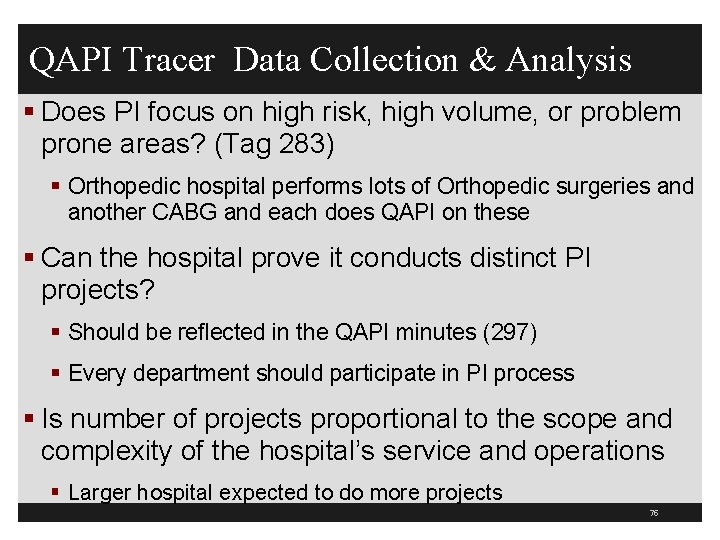
QAPI Tracer Data Collection & Analysis § Does PI focus on high risk, high volume, or problem prone areas? (Tag 283) § Orthopedic hospital performs lots of Orthopedic surgeries and another CABG and each does QAPI on these § Can the hospital prove it conducts distinct PI projects? § Should be reflected in the QAPI minutes (297) § Every department should participate in PI process § Is number of projects proportional to the scope and complexity of the hospital’s service and operations § Larger hospital expected to do more projects 75
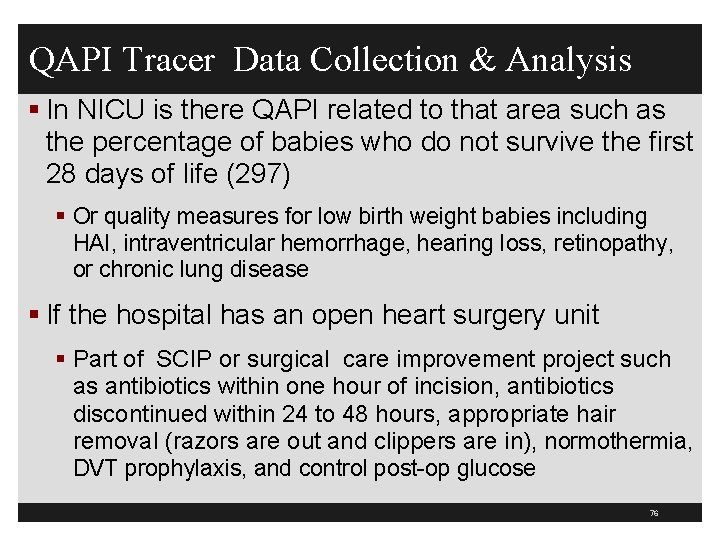
QAPI Tracer Data Collection & Analysis § In NICU is there QAPI related to that area such as the percentage of babies who do not survive the first 28 days of life (297) § Or quality measures for low birth weight babies including HAI, intraventricular hemorrhage, hearing loss, retinopathy, or chronic lung disease § If the hospital has an open heart surgery unit § Part of SCIP or surgical care improvement project such as antibiotics within one hour of incision, antibiotics discontinued within 24 to 48 hours, appropriate hair removal (razors are out and clippers are in), normothermia, DVT prophylaxis, and control post-op glucose 76
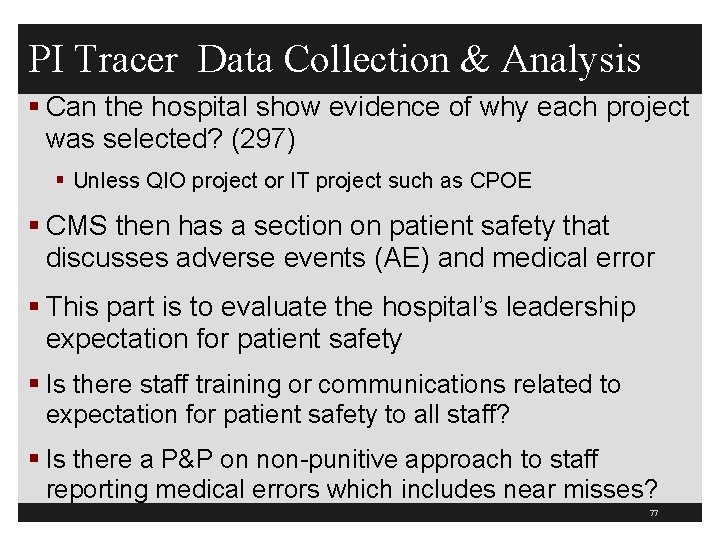
PI Tracer Data Collection & Analysis § Can the hospital show evidence of why each project was selected? (297) § Unless QIO project or IT project such as CPOE § CMS then has a section on patient safety that discusses adverse events (AE) and medical error § This part is to evaluate the hospital’s leadership expectation for patient safety § Is there staff training or communications related to expectation for patient safety to all staff? § Is there a P&P on non-punitive approach to staff reporting medical errors which includes near misses? 77
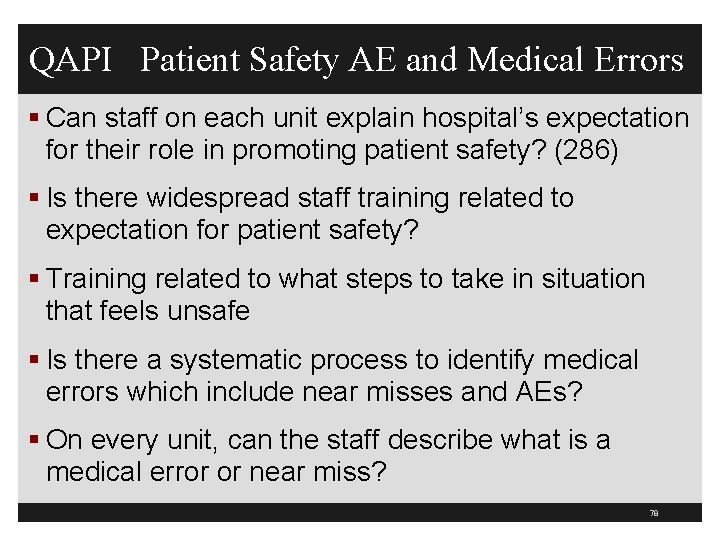
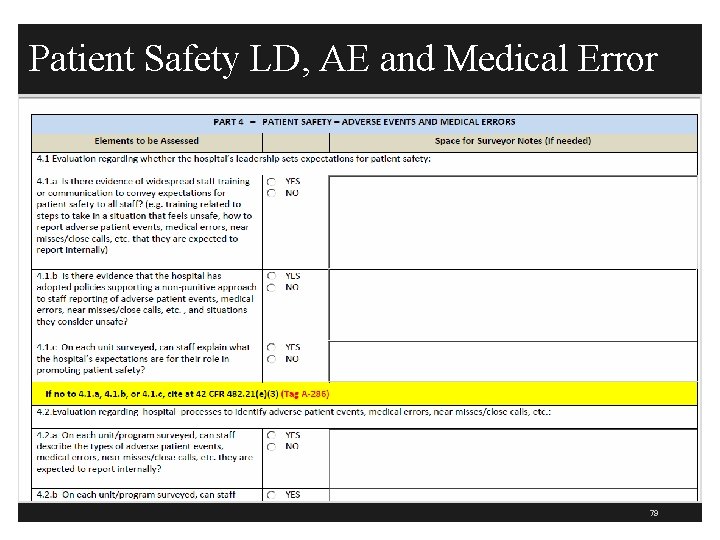
QAPI Patient Safety AE and Medical Errors § Can staff on each unit explain hospital’s expectation for their role in promoting patient safety? (286) § Is there widespread staff training related to expectation for patient safety? § Training related to what steps to take in situation that feels unsafe § Is there a systematic process to identify medical errors which include near misses and AEs? § On every unit, can the staff describe what is a medical error or near miss? 78
Patient Safety LD, AE and Medical Error 79
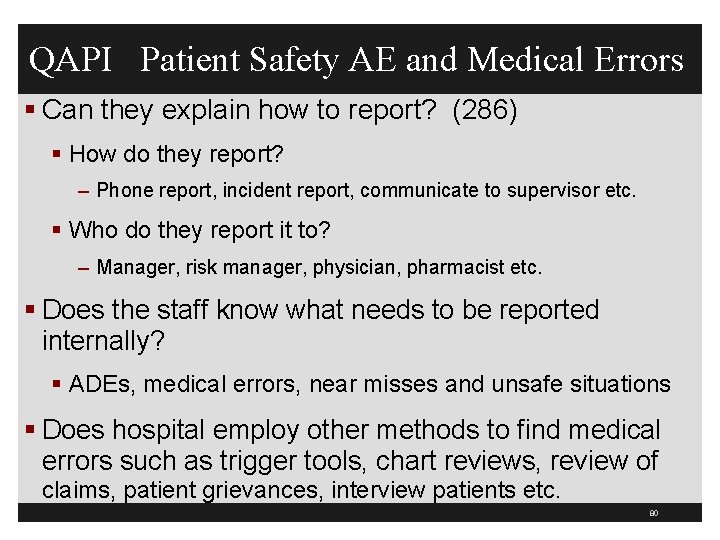
QAPI Patient Safety AE and Medical Errors § Can they explain how to report? (286) § How do they report? – Phone report, incident report, communicate to supervisor etc. § Who do they report it to? – Manager, risk manager, physician, pharmacist etc. § Does the staff know what needs to be reported internally? § ADEs, medical errors, near misses and unsafe situations § Does hospital employ other methods to find medical errors such as trigger tools, chart reviews, review of claims, patient grievances, interview patients etc. 80
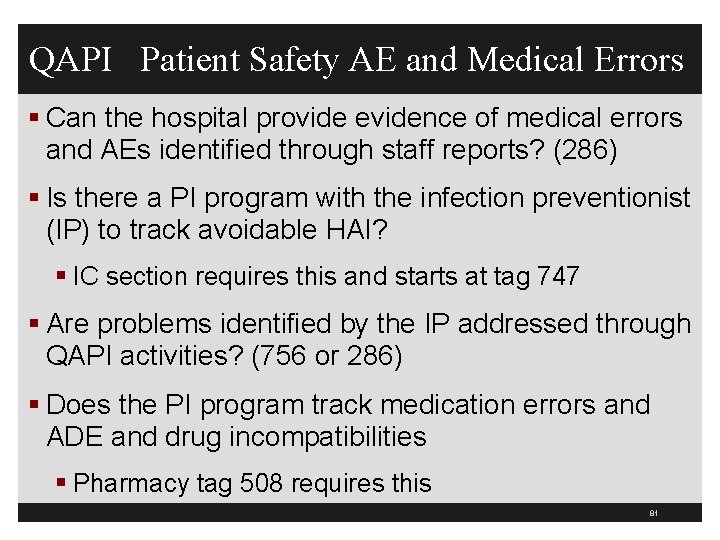
QAPI Patient Safety AE and Medical Errors § Can the hospital provide evidence of medical errors and AEs identified through staff reports? (286) § Is there a PI program with the infection preventionist (IP) to track avoidable HAI? § IC section requires this and starts at tag 747 § Are problems identified by the IP addressed through QAPI activities? (756 or 286) § Does the PI program track medication errors and ADE and drug incompatibilities § Pharmacy tag 508 requires this 81
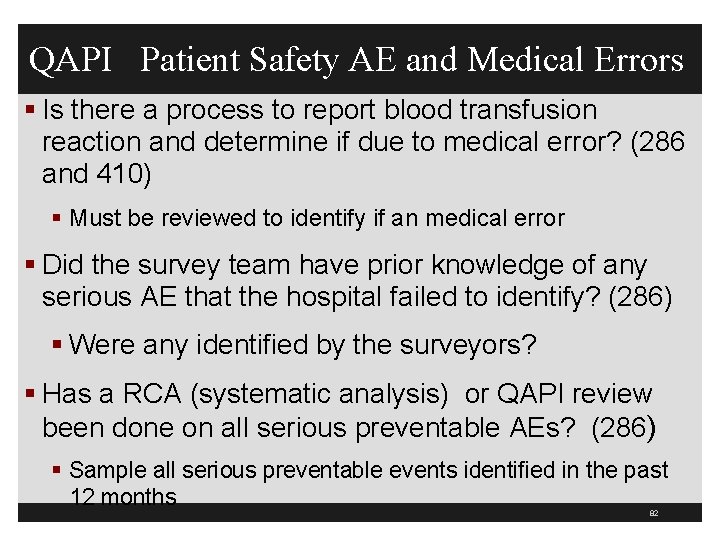
QAPI Patient Safety AE and Medical Errors § Is there a process to report blood transfusion reaction and determine if due to medical error? (286 and 410) § Must be reviewed to identify if an medical error § Did the survey team have prior knowledge of any serious AE that the hospital failed to identify? (286) § Were any identified by the surveyors? § Has a RCA (systematic analysis) or QAPI review been done on all serious preventable AEs? (286) § Sample all serious preventable events identified in the past 12 months 82
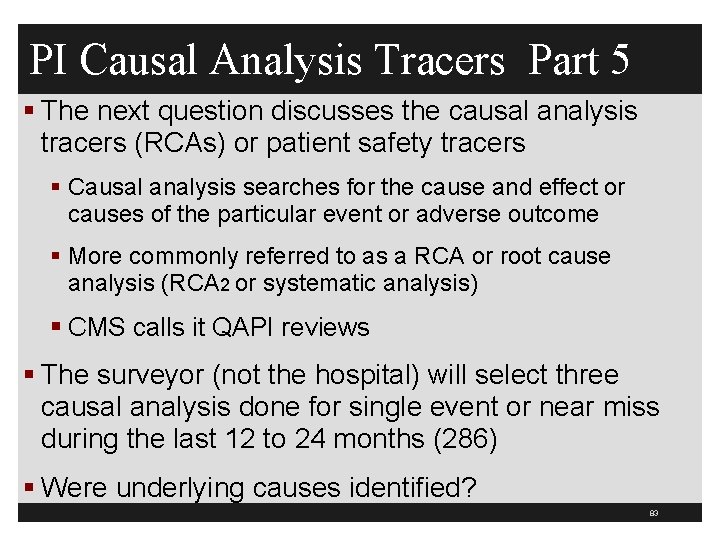
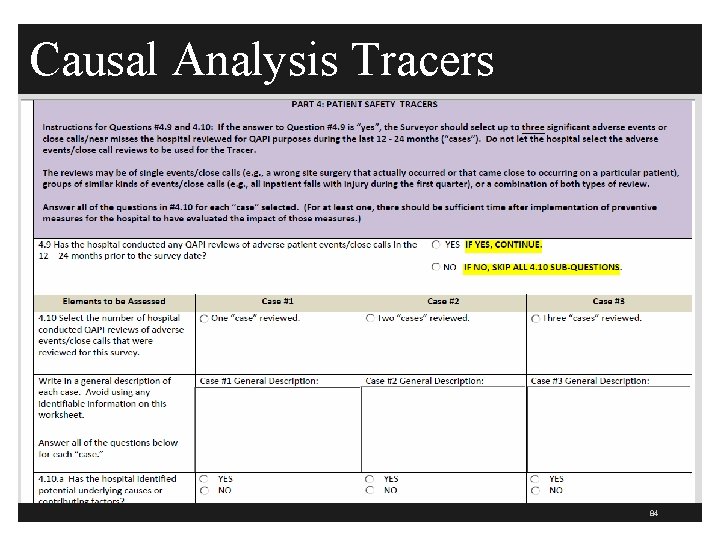
PI Causal Analysis Tracers Part 5 § The next question discusses the causal analysis tracers (RCAs) or patient safety tracers § Causal analysis searches for the cause and effect or causes of the particular event or adverse outcome § More commonly referred to as a RCA or root cause analysis (RCA 2 or systematic analysis) § CMS calls it QAPI reviews § The surveyor (not the hospital) will select three causal analysis done for single event or near miss during the last 12 to 24 months (286) § Were underlying causes identified? 83
Causal Analysis Tracers 84
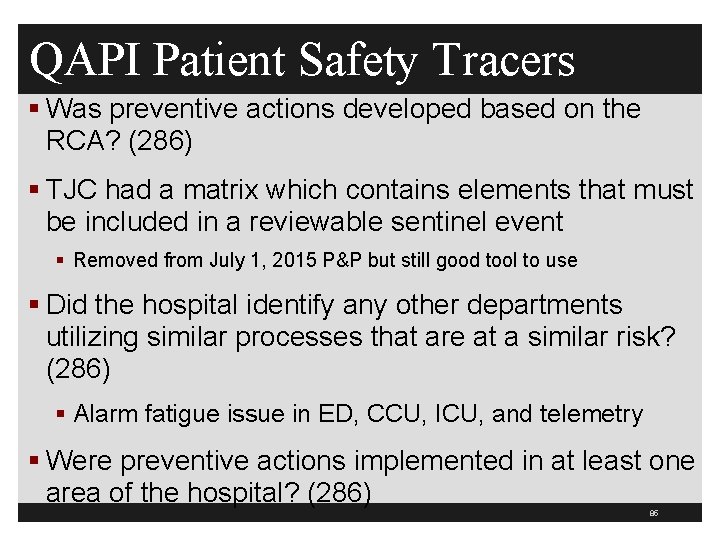
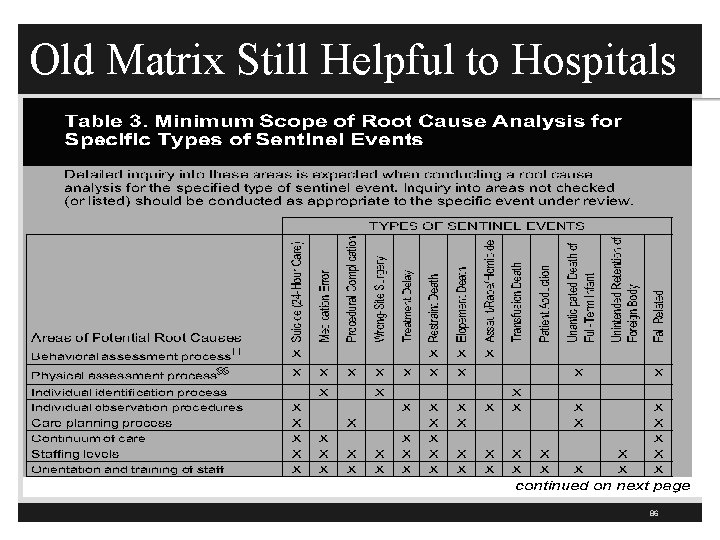
QAPI Patient Safety Tracers § Was preventive actions developed based on the RCA? (286) § TJC had a matrix which contains elements that must be included in a reviewable sentinel event § Removed from July 1, 2015 P&P but still good tool to use § Did the hospital identify any other departments utilizing similar processes that are at a similar risk? (286) § Alarm fatigue issue in ED, CCU, ICU, and telemetry § Were preventive actions implemented in at least one area of the hospital? (286) 85
Old Matrix Still Helpful to Hospitals 86
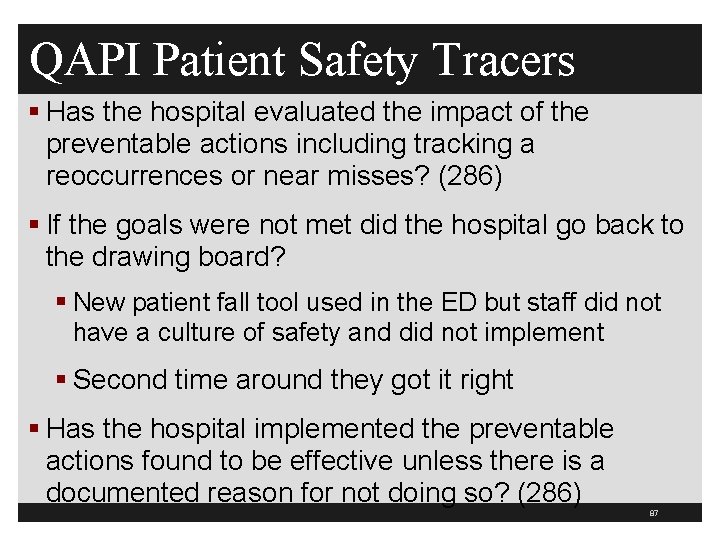
QAPI Patient Safety Tracers § Has the hospital evaluated the impact of the preventable actions including tracking a reoccurrences or near misses? (286) § If the goals were not met did the hospital go back to the drawing board? § New patient fall tool used in the ED but staff did not have a culture of safety and did not implement § Second time around they got it right § Has the hospital implemented the preventable actions found to be effective unless there is a documented reason for not doing so? (286) 87
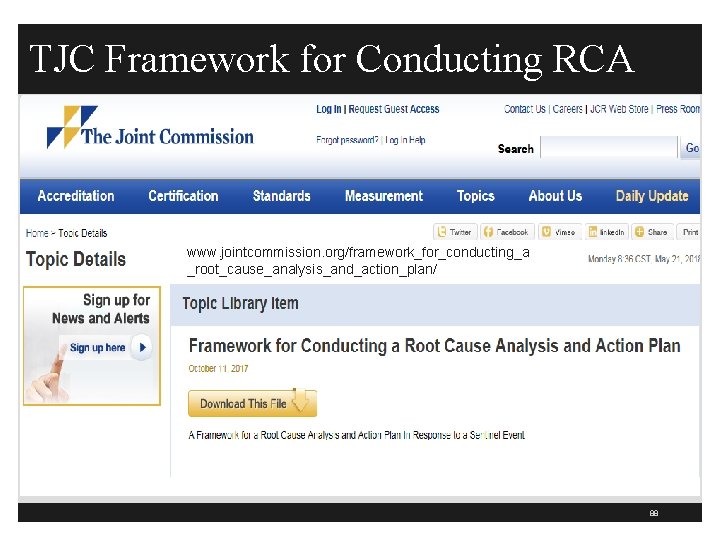
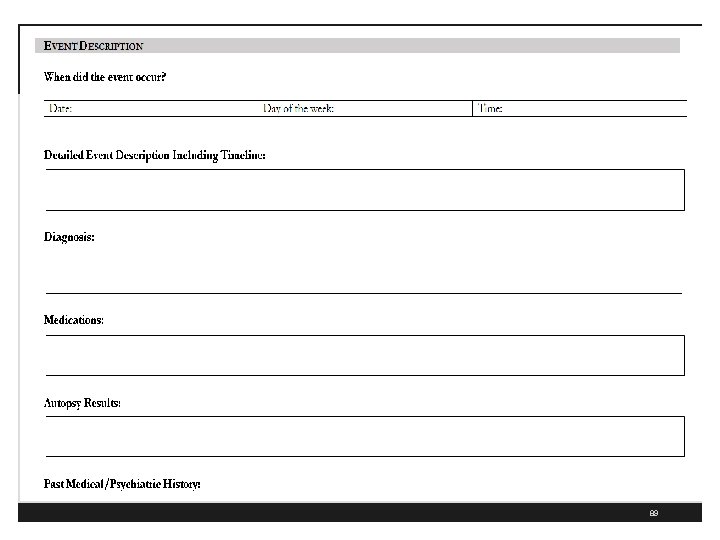
TJC Framework for Conducting RCA www. jointcommission. org/framework_for_conducting_a _root_cause_analysis_and_action_plan/ 88
89
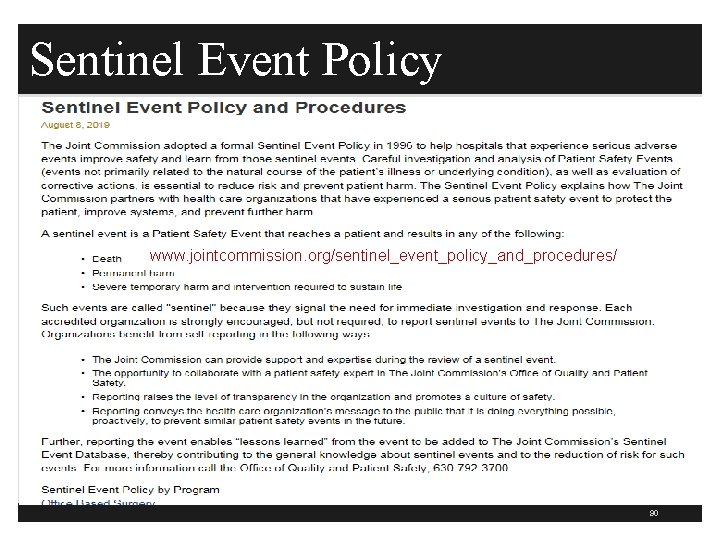
Sentinel Event Policy www. jointcommission. org/sentinel_event_policy_and_procedures/ www. jointcommission. org/sentinel_eve nt_policy_and_procedures/ 90
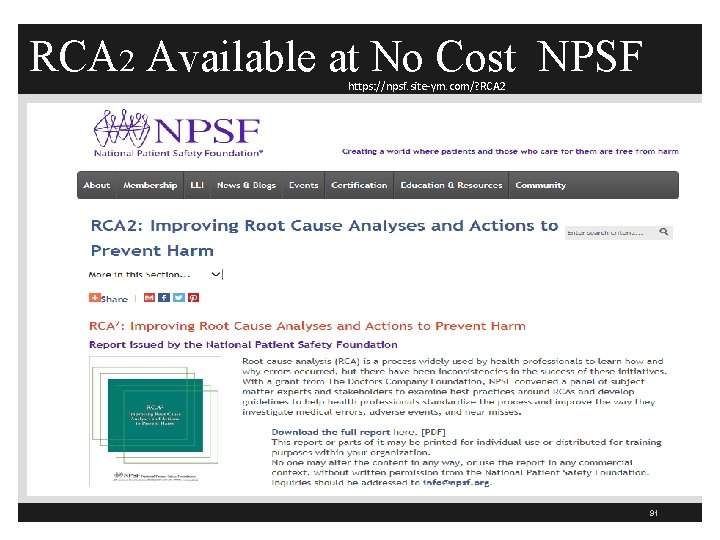
RCA 2 Available at No Cost NPSF https: //npsf. site-ym. com/? RCA 2 91
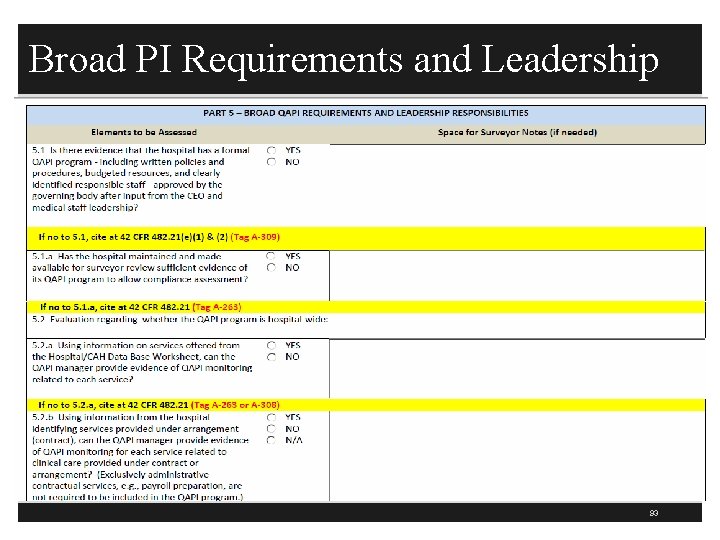
Broad PI Requirements & Leadership § Part 5 addresses broad QAPI requirements and leadership responsibilities (309) § Does the hospital have a formal PI program? § Most hospitals have a PI plan that discusses the PI program § Is there a written P&P on the PI program? § Is there budgeted resources so staff can attend education programs and data can be collected? § Is there responsible staff to do PI § Is the PI program approved by MS, CEO, and the board? 92
Broad PI Requirements and Leadership 93
Broad PI Requirements and Leadership § Has the hospital maintained and made available to the surveyor sufficient evidence of its QAPI program to allow compliance assessment? (263) § Is the QAPI hospital-wide? § Can the QAPI manager provide evidence of QAPI monitoring related to each service? (263 or 308) § Surveyor to use information in the data base worksheet to determine what services are offered by the hospital § Every department should be involved in the QAPI process § Is there evidence of PI review for contracted services for clinical care? (83, 263, or 308) 94
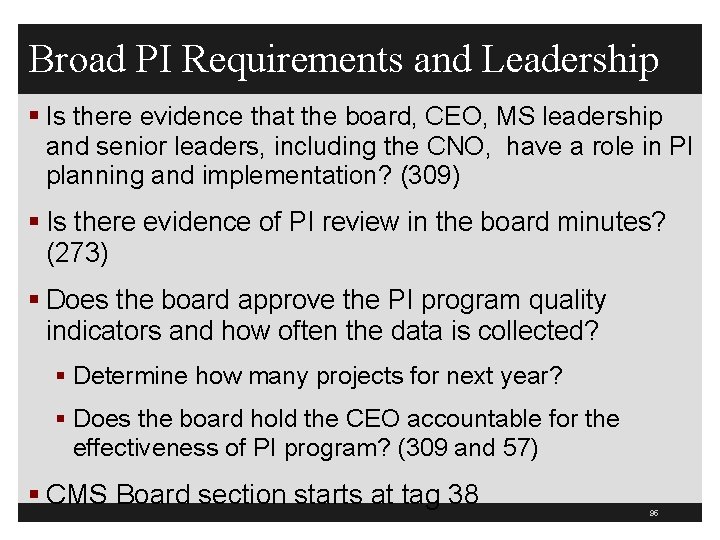
Broad PI Requirements and Leadership § Is there evidence that the board, CEO, MS leadership and senior leaders, including the CNO, have a role in PI planning and implementation? (309) § Is there evidence of PI review in the board minutes? (273) § Does the board approve the PI program quality indicators and how often the data is collected? § Determine how many projects for next year? § Does the board hold the CEO accountable for the effectiveness of PI program? (309 and 57) § CMS Board section starts at tag 38 95
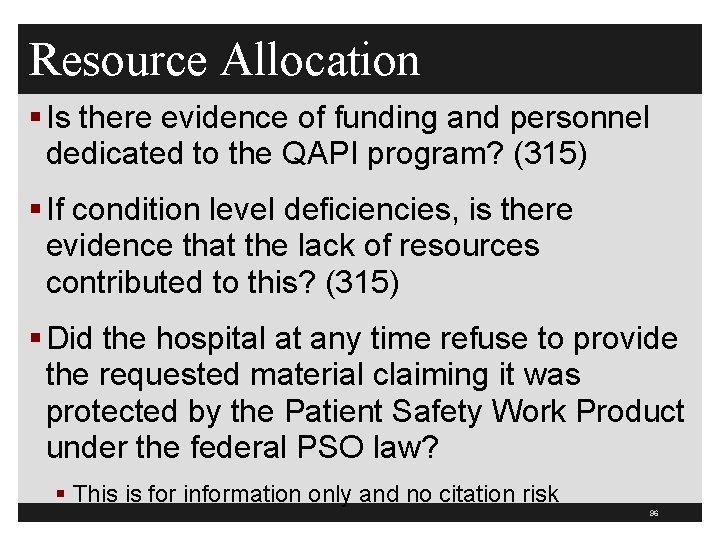
Resource Allocation § Is there evidence of funding and personnel dedicated to the QAPI program? (315) § If condition level deficiencies, is there evidence that the lack of resources contributed to this? (315) § Did the hospital at any time refuse to provide the requested material claiming it was protected by the Patient Safety Work Product under the federal PSO law? § This is for information only and no citation risk 96
CMS HOSPITAL CONDITIONS OF PARTICIPATION (COPS) What Hospitals Need to Know About the QAPI Section
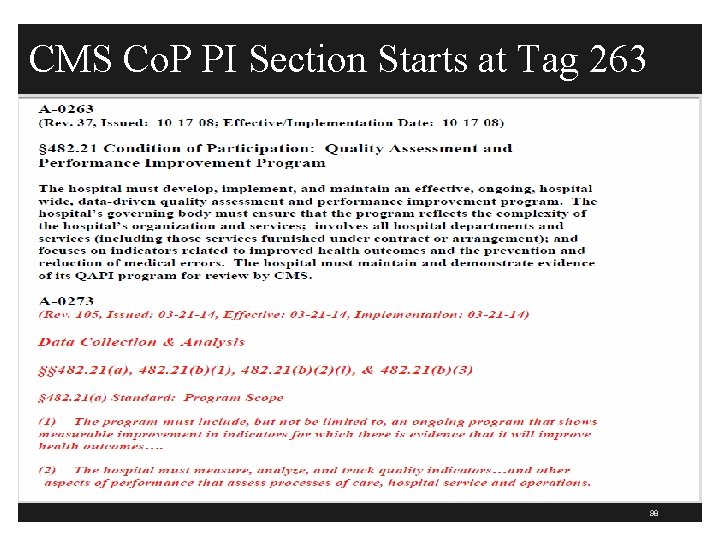
CMS Co. P PI Section Starts at Tag 263 98
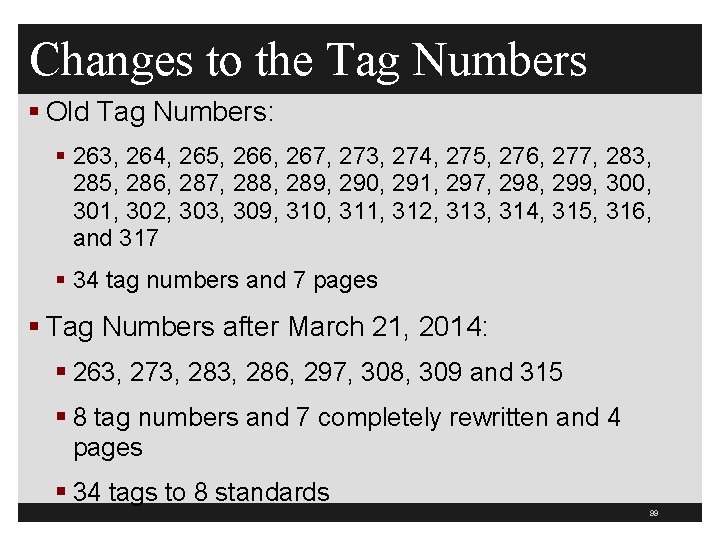
Changes to the Tag Numbers § Old Tag Numbers: § 263, 264, 265, 266, 267, 273, 274, 275, 276, 277, 283, 285, 286, 287, 288, 289, 290, 291, 297, 298, 299, 300, 301, 302, 303, 309, 310, 311, 312, 313, 314, 315, 316, and 317 § 34 tag numbers and 7 pages § Tag Numbers after March 21, 2014: § 263, 273, 286, 297, 308, 309 and 315 § 8 tag numbers and 7 completely rewritten and 4 pages § 34 tags to 8 standards 99
Final Regulations § Remember, CMS will revise the interpretive guidelines and survey procedures to match the revised regulation § Then we will know what the tag numbers will be § Two ways to find out when these are out § Monitor the survey memo website § Check to see when the manual is update § Will revise both the hospital and the CAH manual § CAH will have new tag numbers 100
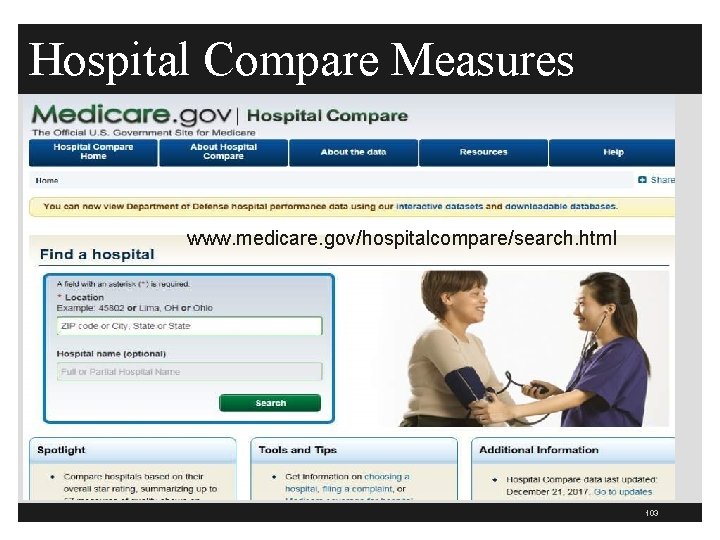
Hospital Co. Ps for PI 263 §QAPI stands for quality assessment and performance improvement §Use to stand for Quality Assurance and Performance Improvement (QAPI) but changed to Quality Assessment §Referred to in short as PI §In each section, such as nursing and pharmacy, CMS says every department has a role in QAPI §Also CMS Hospital Compare is important and has information about the hospital’s quality of care 101
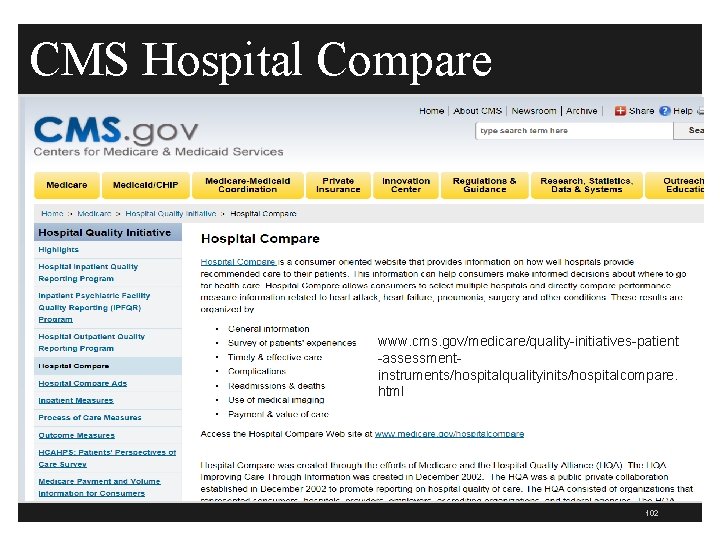
CMS Hospital Compare www. cms. gov/medicare/quality-initiatives-patient -assessmentinstruments/hospitalqualityinits/hospitalcompare. html 102
Hospital Compare Measures www. medicare. gov/hospitalcompare/search. html 103
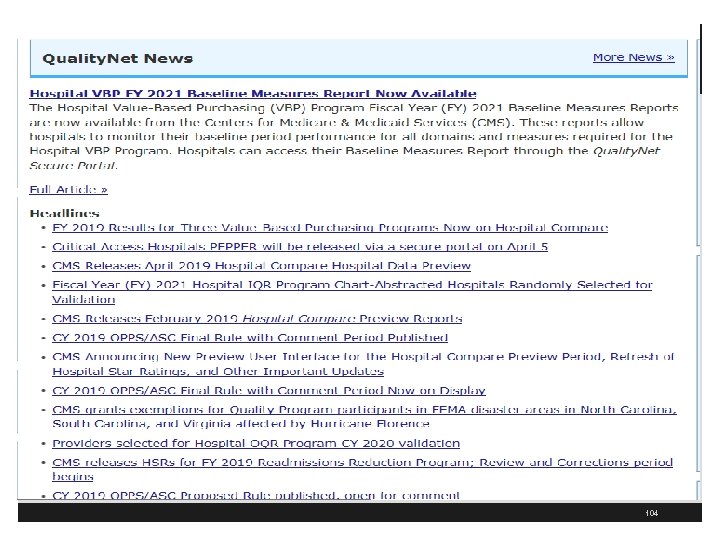
104
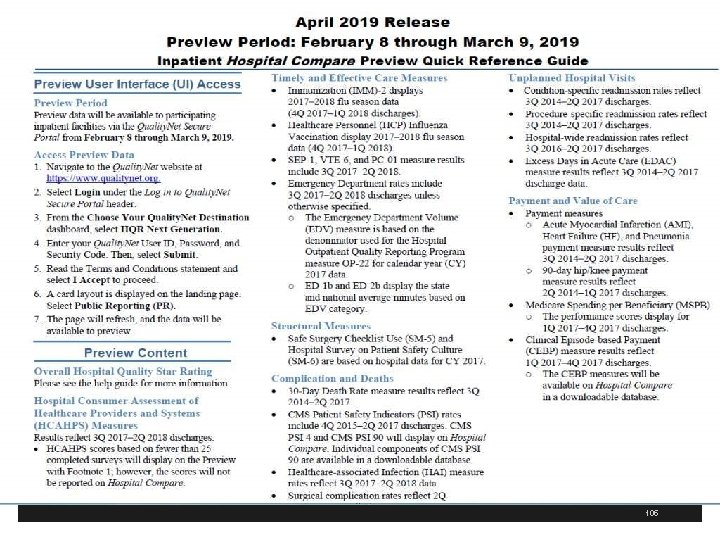
105
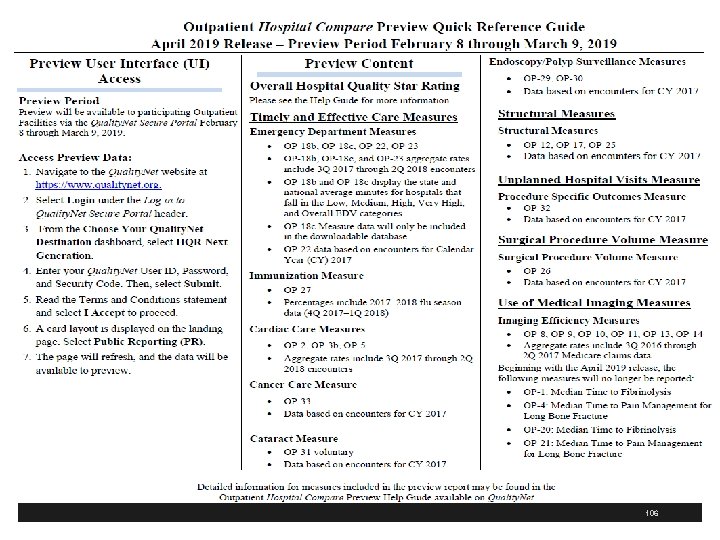
106
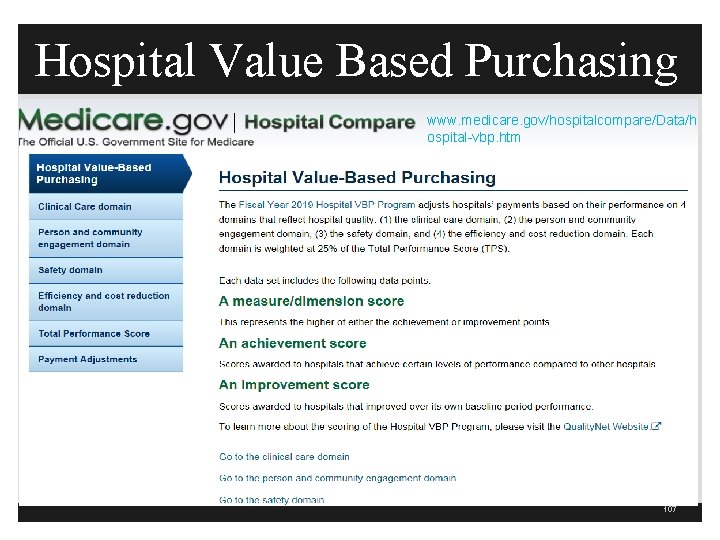
Hospital Value Based Purchasing www. medicare. gov/hospitalcompare/Data/h ospital-vbp. htm www. medicare. gov/hospitalcompare/Data/hospital-vbp. html 107
CMS Hospital Readmissions Reduction www. cms. gov/Medicare-Fee-for- Service. Payment/Acute. Inpatient. PPS/Readmissions. Reduction-Program. html 108
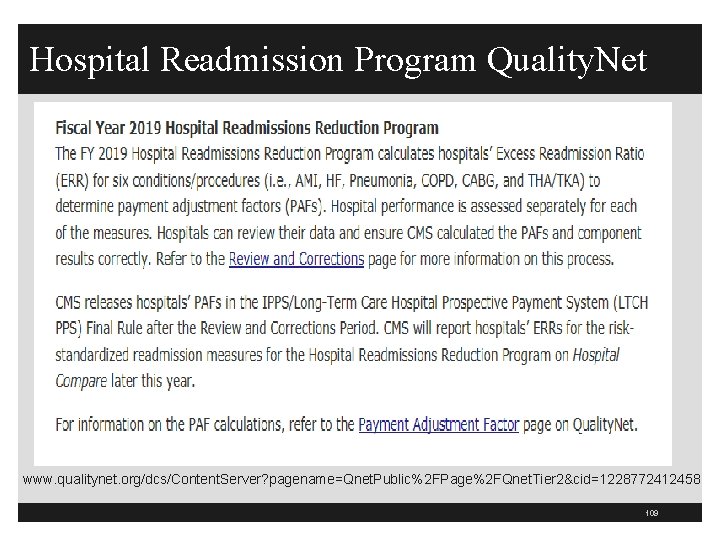
Hospital Readmission Program Quality. Net www. qualitynet. org/dcs/Content. Server? pagename=Qnet. Public%2 FPage%2 FQnet. Tier 2&cid=1228772412458 109
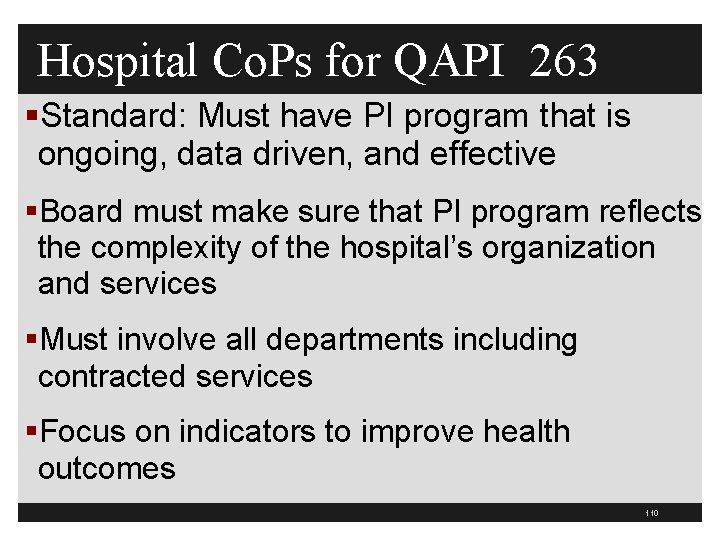
Hospital Co. Ps for QAPI 263 §Standard: Must have PI program that is ongoing, data driven, and effective §Board must make sure that PI program reflects the complexity of the hospital’s organization and services §Must involve all departments including contracted services §Focus on indicators to improve health outcomes 110
Hospital Co. Ps for PI § Includes all departments even if contracted services § Must focus on indicators related to improve health outcomes § How do you improve outcomes in the patient with hyponatremia, sepsis, or delirium? § How to improve outcomes in the diabetic patient admitted with hyperosmolar syndrome? § Must focus on the prevention and reduction of medical errors § What do you do to prevent medical errors such as medication errors which is the most common type? 111
Program Scope 273 § Standard: PI program needs to be ongoing and show measurable improvements to improve health outcomes § Must measure, analyze and track the quality indicators § Must track other areas of performance that assess processes of care, hospital service and operations § MI patients get their thrombolytics timely which helps to dissolve the clot to increase blood though the coronary artery which increases their survival 112
Ongoing Program § Hospitals has improved patient flow and admitted patients now get to their bed in four hours or less § Patients get their antibiotics timely in the OR now § Patients with pneumonia now get their antibiotics within the six hour window § Use of the sepsis bundle has improved survival rate 113
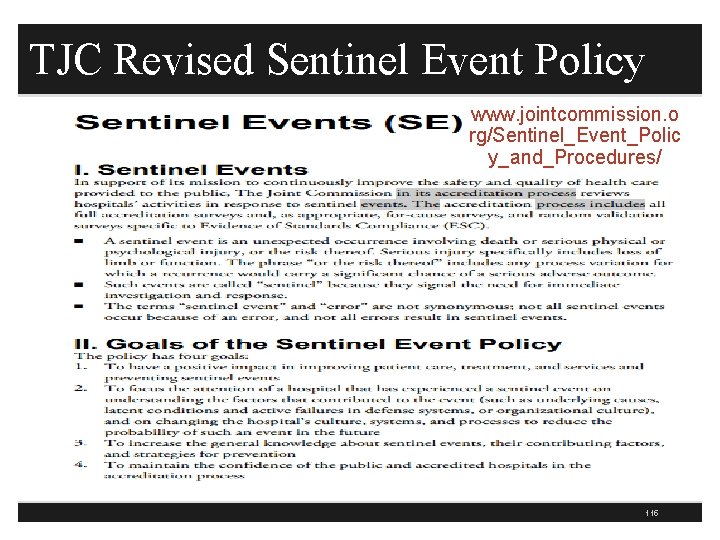
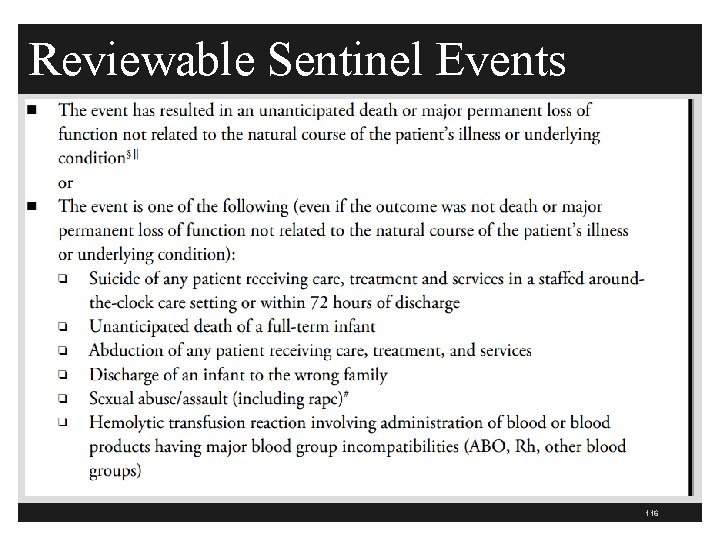
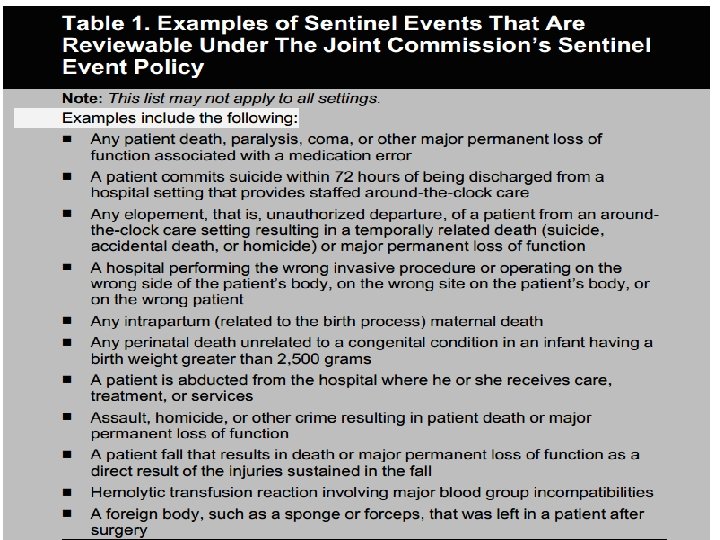
Track Quality Indicators §The hospital must measure, analyze, and track quality indicators which would include adverse events §Want to focus on aspects and processes that relate to the health and safety of patient care services §Look at what could result in a sentinel event if not properly managed §TJC has a sentinel event policy and lists reviewable SE 114
TJC Revised Sentinel Event Policy www. jointcommission. o rg/Sentinel_Event_Polic y_and_Procedures/ 115
Reviewable Sentinel Events 116
117
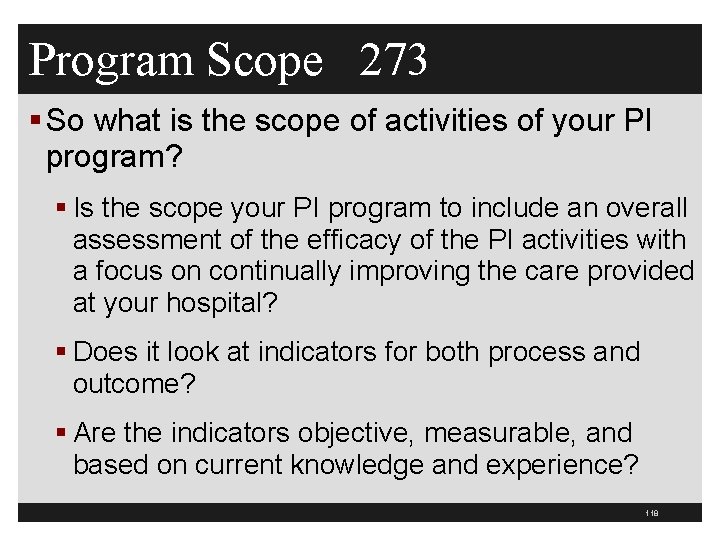
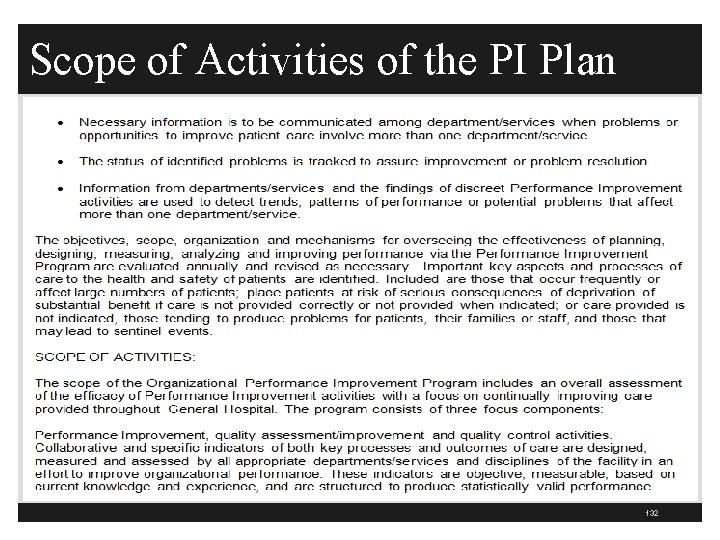
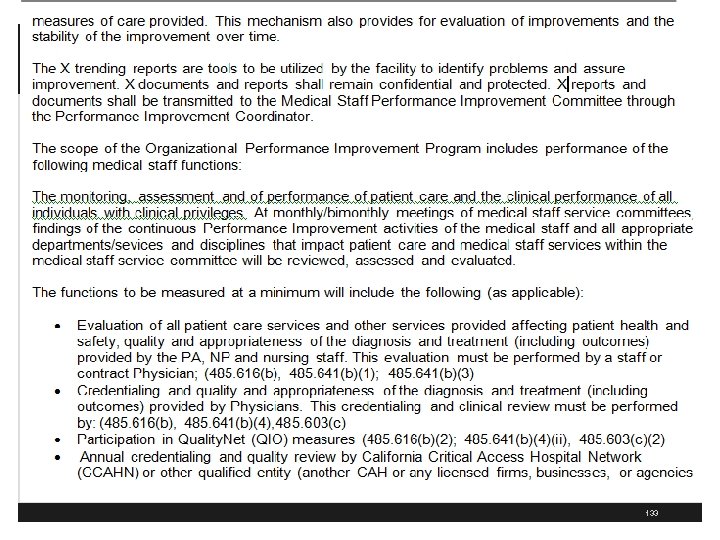
Program Scope 273 § So what is the scope of activities of your PI program? § Is the scope your PI program to include an overall assessment of the efficacy of the PI activities with a focus on continually improving the care provided at your hospital? § Does it look at indicators for both process and outcome? § Are the indicators objective, measurable, and based on current knowledge and experience? 118
119
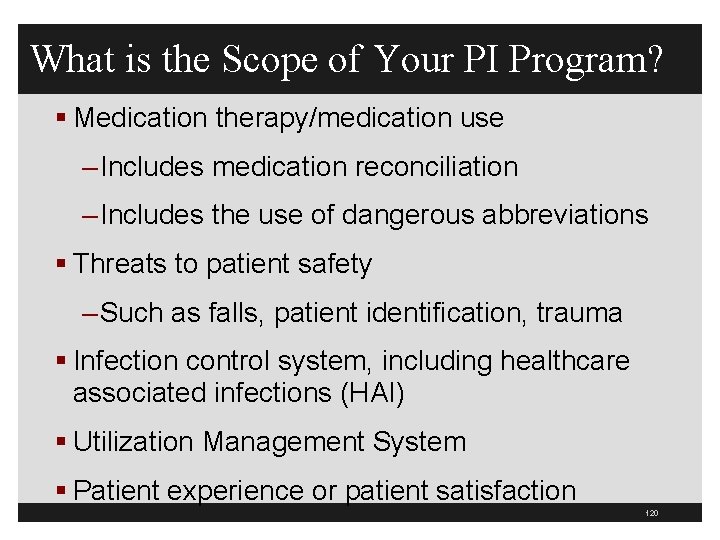
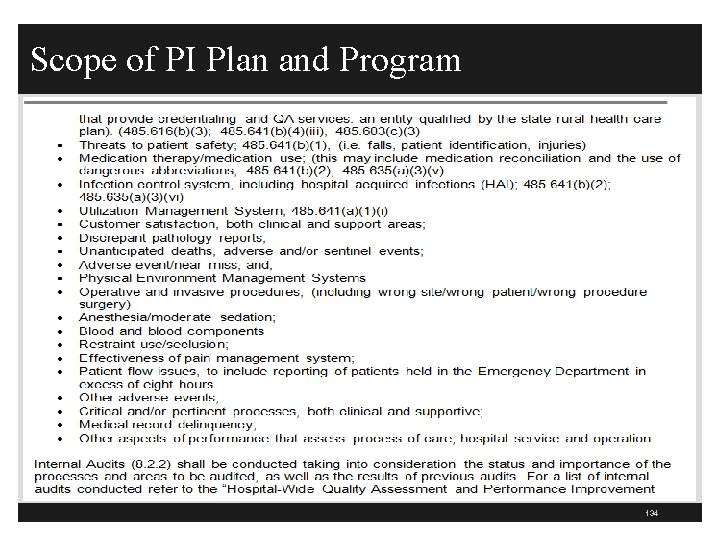
What is the Scope of Your PI Program? § Medication therapy/medication use – Includes medication reconciliation – Includes the use of dangerous abbreviations § Threats to patient safety – Such as falls, patient identification, trauma § Infection control system, including healthcare associated infections (HAI) § Utilization Management System § Patient experience or patient satisfaction 120
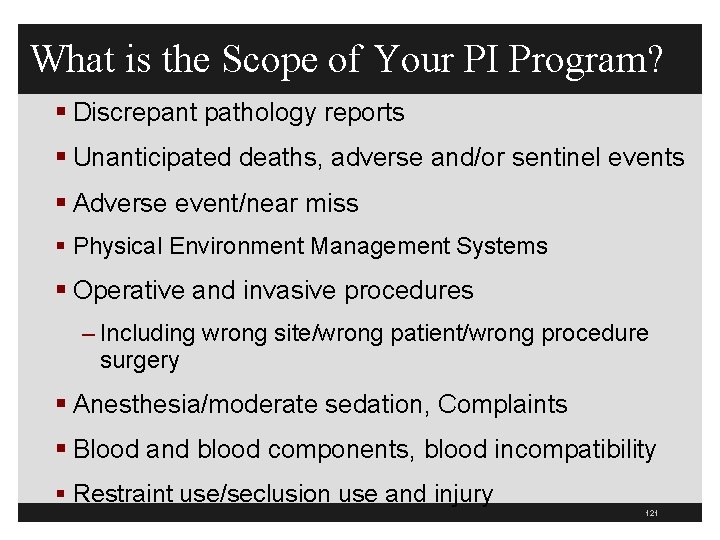
What is the Scope of Your PI Program? § Discrepant pathology reports § Unanticipated deaths, adverse and/or sentinel events § Adverse event/near miss § Physical Environment Management Systems § Operative and invasive procedures – Including wrong site/wrong patient/wrong procedure surgery § Anesthesia/moderate sedation, Complaints § Blood and blood components, blood incompatibility § Restraint use/seclusion use and injury 121
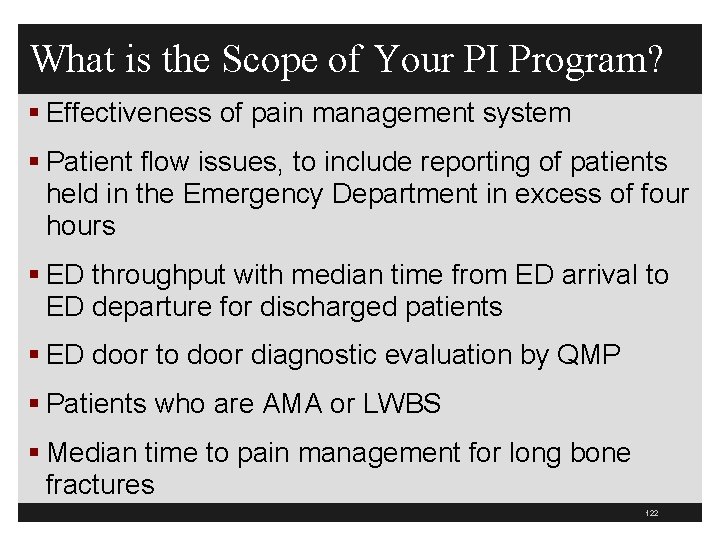
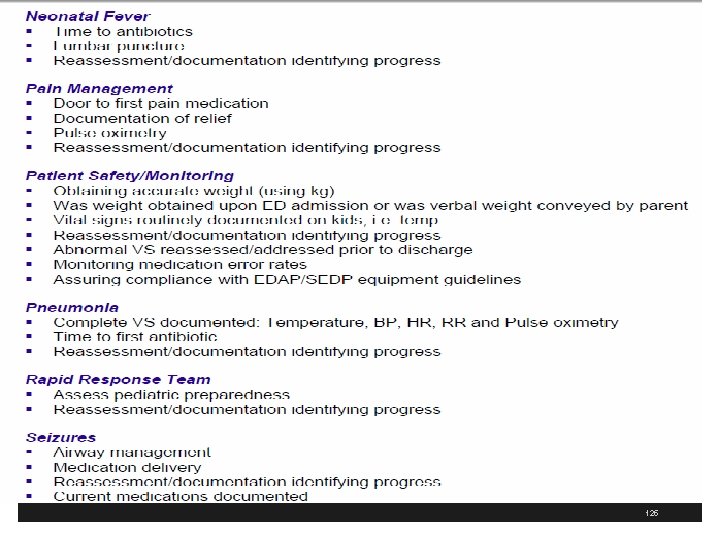
What is the Scope of Your PI Program? § Effectiveness of pain management system § Patient flow issues, to include reporting of patients held in the Emergency Department in excess of four hours § ED throughput with median time from ED arrival to ED departure for discharged patients § ED door to door diagnostic evaluation by QMP § Patients who are AMA or LWBS § Median time to pain management for long bone fractures 122
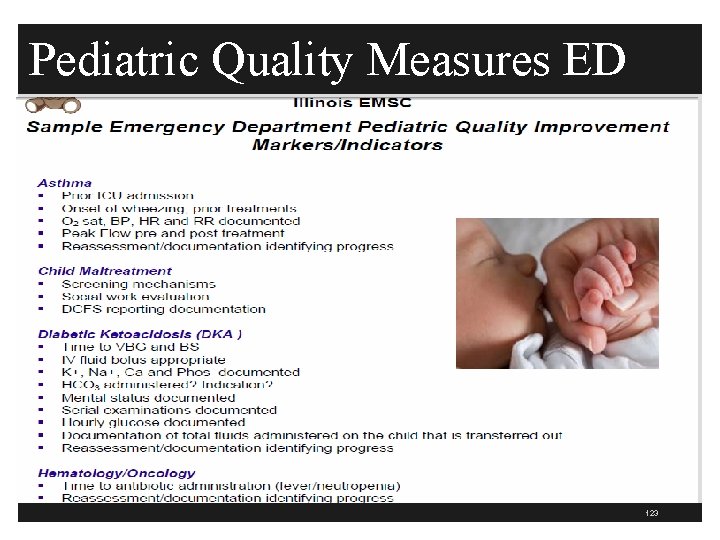
Pediatric Quality Measures ED 123
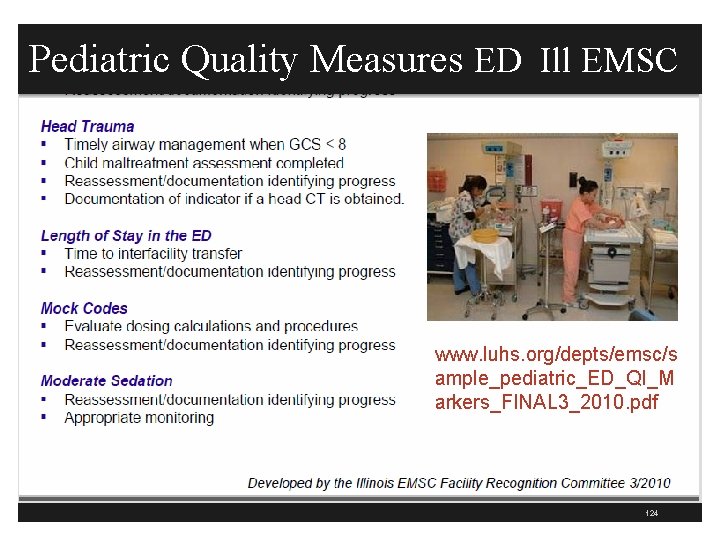
Pediatric Quality Measures ED Ill EMSC www. luhs. org/depts/emsc/s ample_pediatric_ED_QI_M arkers_FINAL 3_2010. pdf 124
125
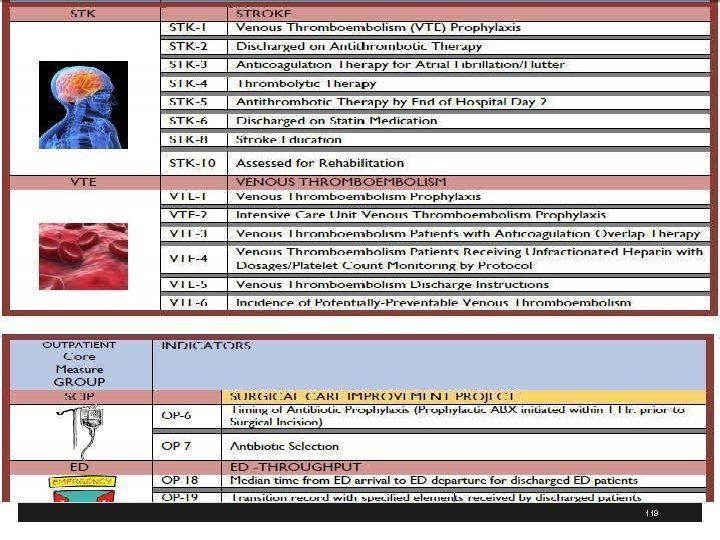
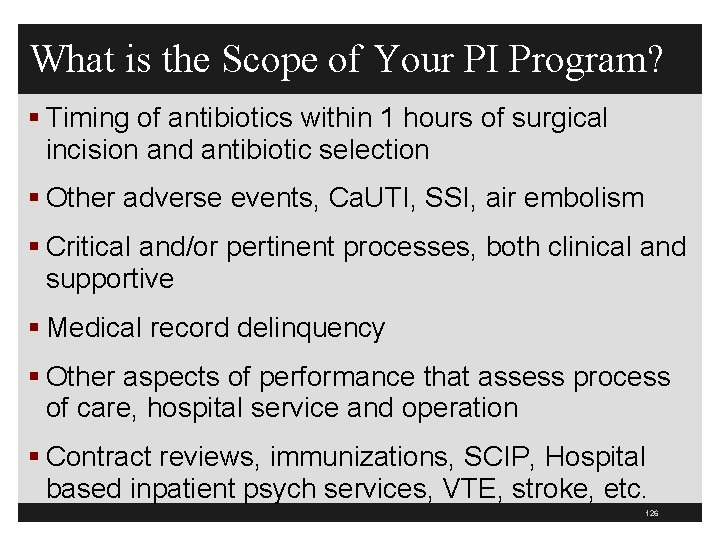
What is the Scope of Your PI Program? § Timing of antibiotics within 1 hours of surgical incision and antibiotic selection § Other adverse events, Ca. UTI, SSI, air embolism § Critical and/or pertinent processes, both clinical and supportive § Medical record delinquency § Other aspects of performance that assess process of care, hospital service and operation § Contract reviews, immunizations, SCIP, Hospital based inpatient psych services, VTE, stroke, etc. 126
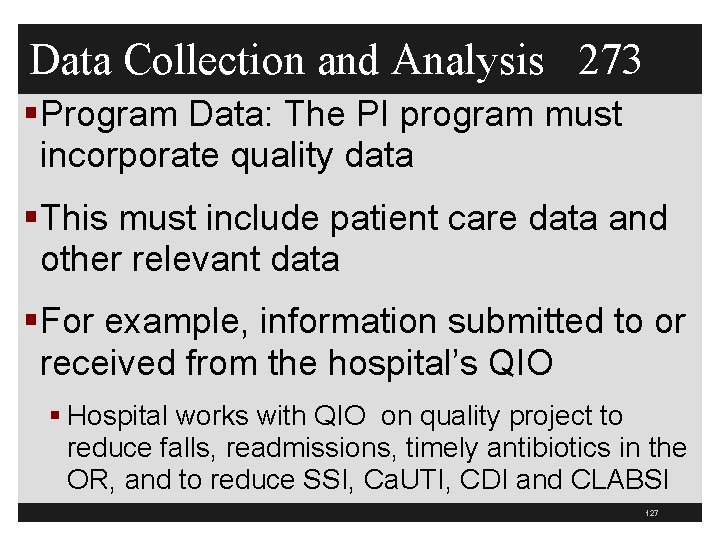
Data Collection and Analysis 273 §Program Data: The PI program must incorporate quality data §This must include patient care data and other relevant data §For example, information submitted to or received from the hospital’s QIO § Hospital works with QIO on quality project to reduce falls, readmissions, timely antibiotics in the OR, and to reduce SSI, Ca. UTI, CDI and CLABSI 127
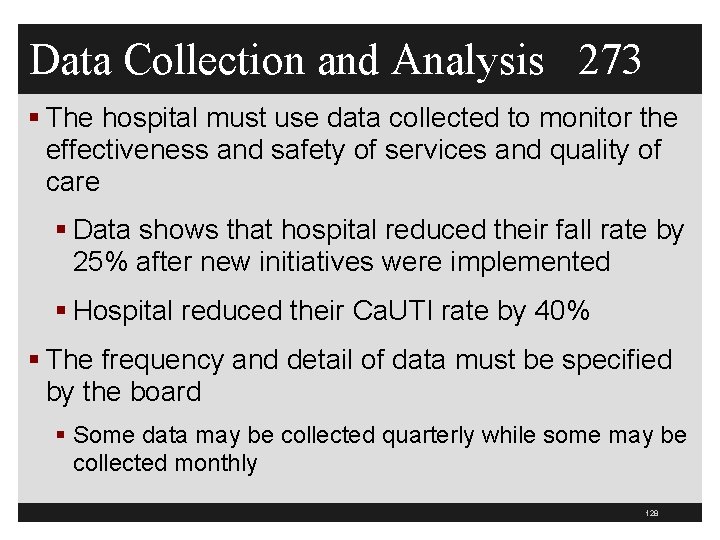
Data Collection and Analysis 273 § The hospital must use data collected to monitor the effectiveness and safety of services and quality of care § Data shows that hospital reduced their fall rate by 25% after new initiatives were implemented § Hospital reduced their Ca. UTI rate by 40% § The frequency and detail of data must be specified by the board § Some data may be collected quarterly while some may be collected monthly 128
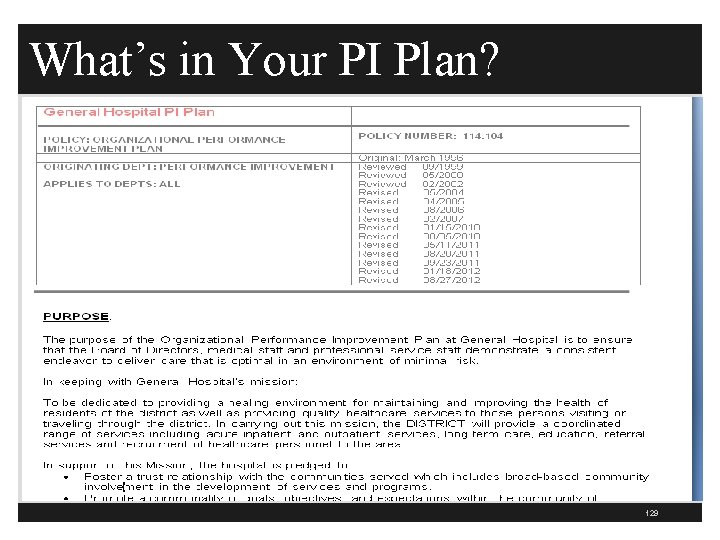
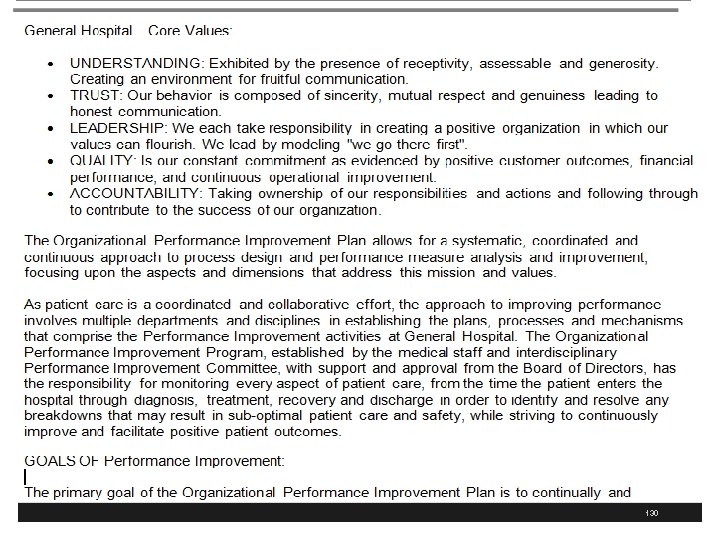
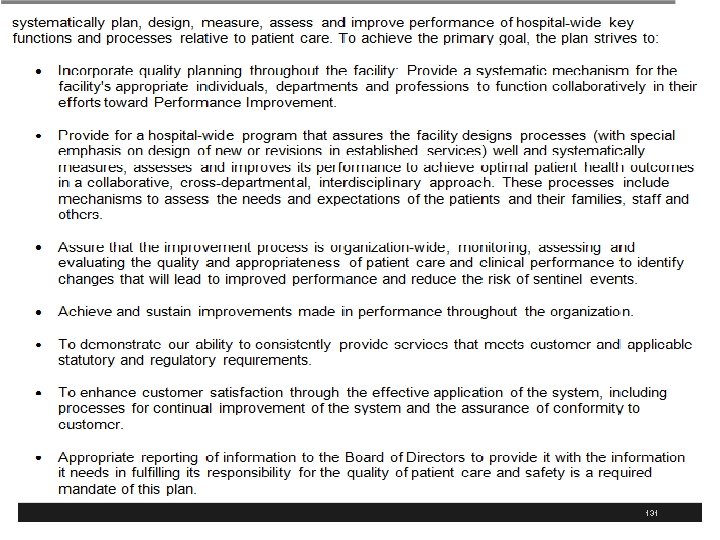
What’s in Your PI Plan? 129
130
131
Scope of Activities of the PI Plan 132
133
Scope of PI Plan and Program 134
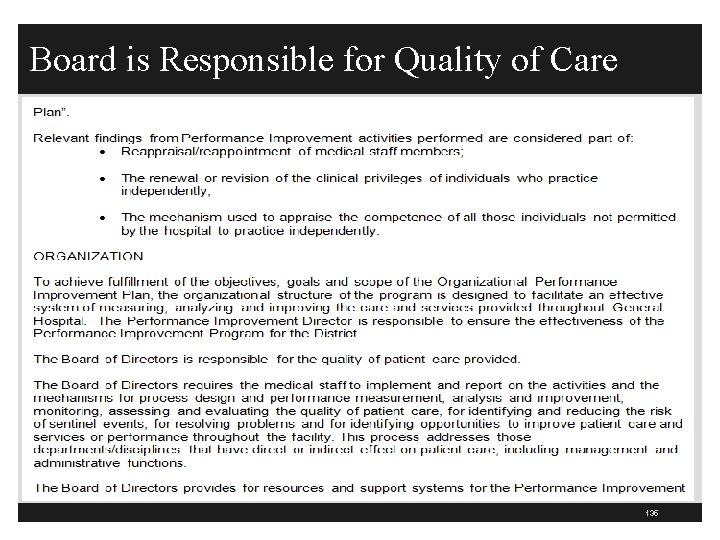
Board is Responsible for Quality of Care 135
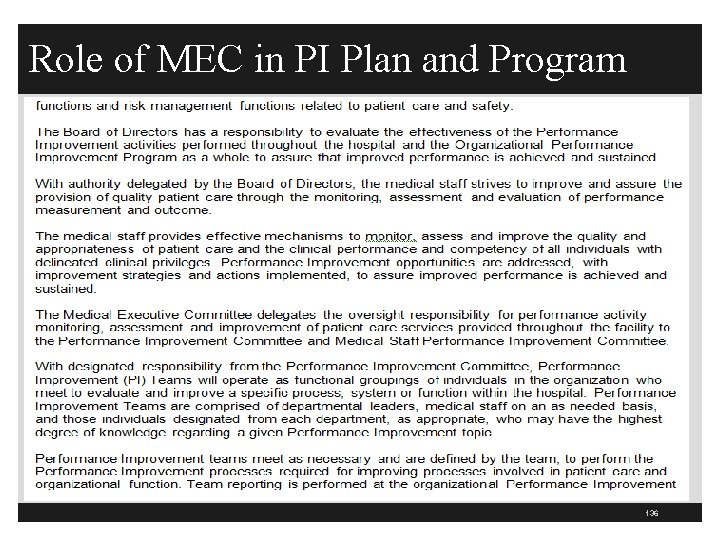
Role of MEC in PI Plan and Program 136
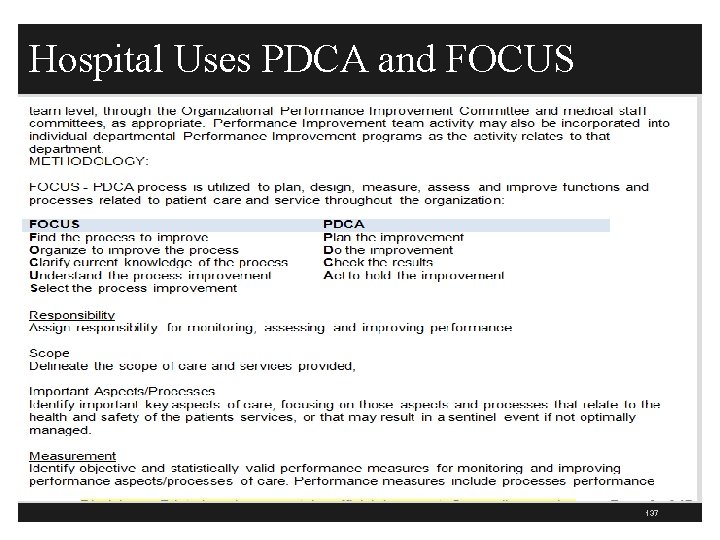
Hospital Uses PDCA and FOCUS 137
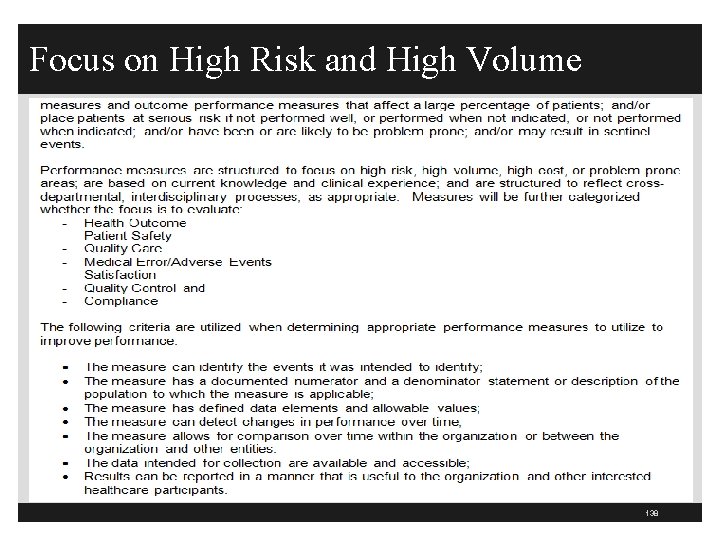
Focus on High Risk and High Volume 138
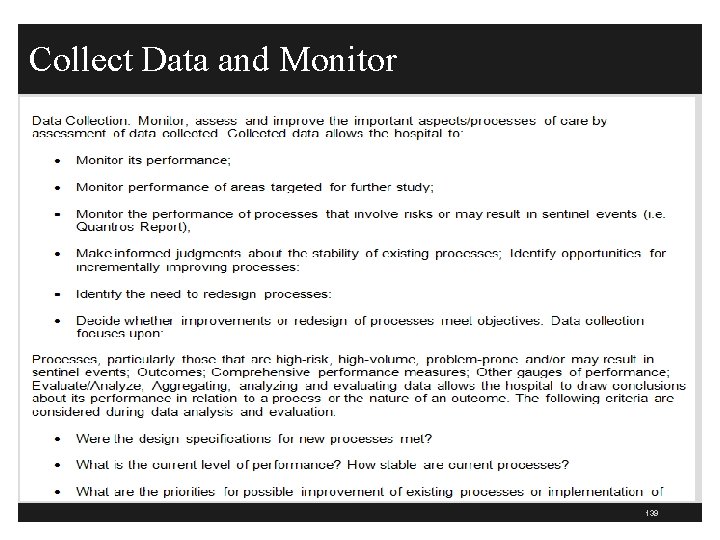
Collect Data and Monitor 139
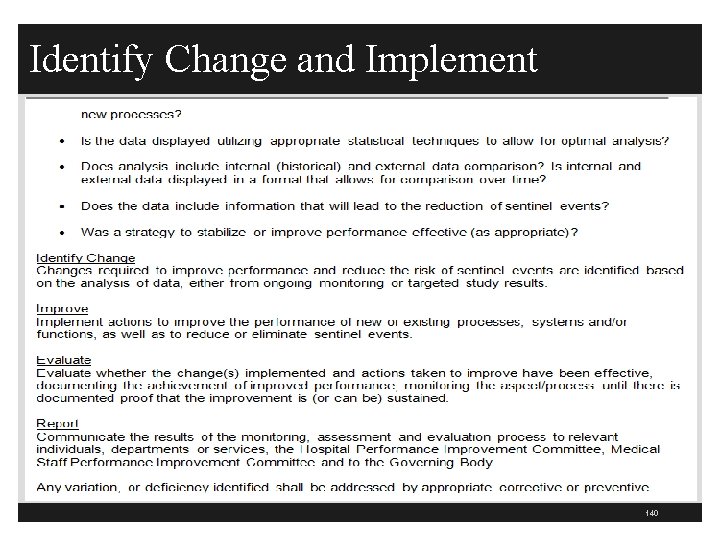
Identify Change and Implement 140
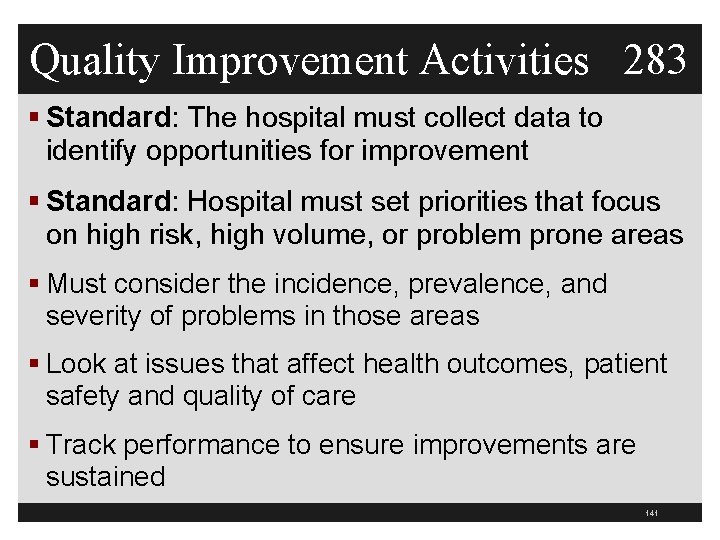
Quality Improvement Activities 283 § Standard: The hospital must collect data to identify opportunities for improvement § Standard: Hospital must set priorities that focus on high risk, high volume, or problem prone areas § Must consider the incidence, prevalence, and severity of problems in those areas § Look at issues that affect health outcomes, patient safety and quality of care § Track performance to ensure improvements are sustained 141
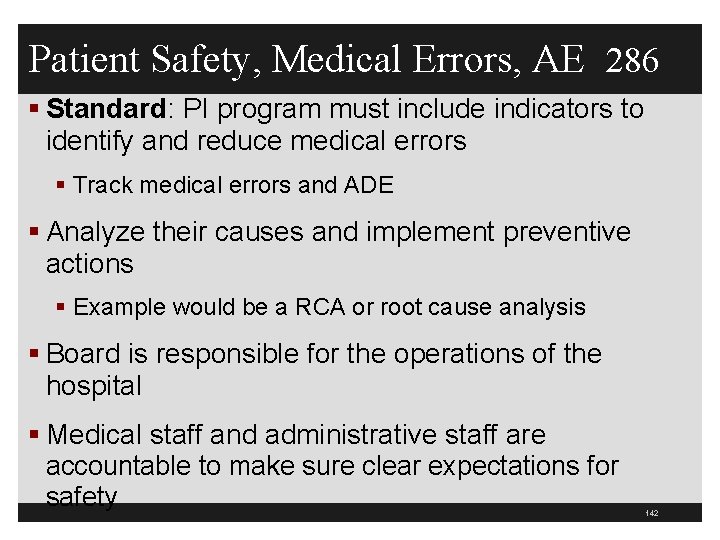
Patient Safety, Medical Errors, AE 286 § Standard: PI program must include indicators to identify and reduce medical errors § Track medical errors and ADE § Analyze their causes and implement preventive actions § Example would be a RCA or root cause analysis § Board is responsible for the operations of the hospital § Medical staff and administrative staff are accountable to make sure clear expectations for safety 142
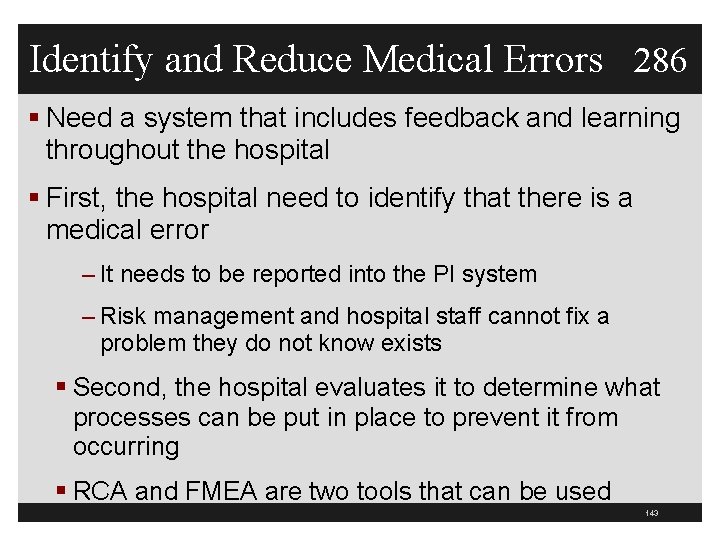
Identify and Reduce Medical Errors 286 § Need a system that includes feedback and learning throughout the hospital § First, the hospital need to identify that there is a medical error – It needs to be reported into the PI system – Risk management and hospital staff cannot fix a problem they do not know exists § Second, the hospital evaluates it to determine what processes can be put in place to prevent it from occurring § RCA and FMEA are two tools that can be used 143
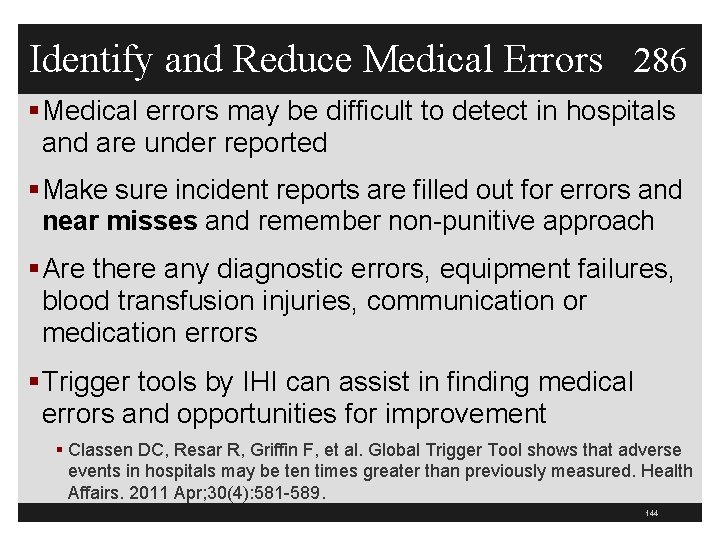
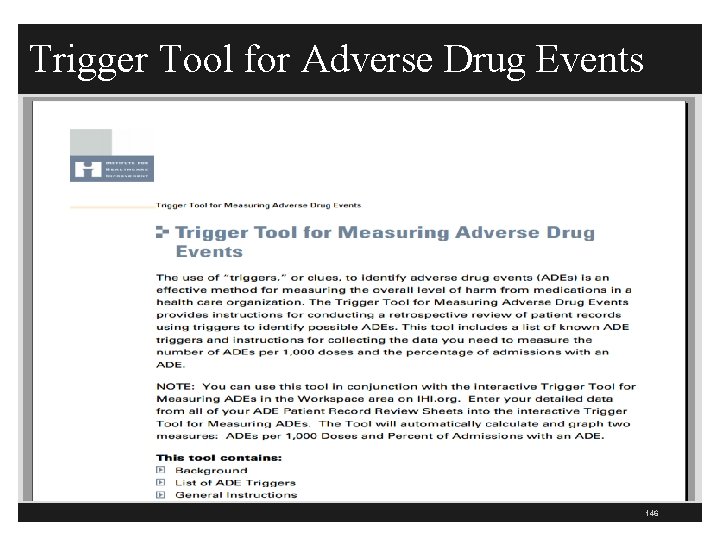
Identify and Reduce Medical Errors 286 §Medical errors may be difficult to detect in hospitals and are under reported § Make sure incident reports are filled out for errors and near misses and remember non-punitive approach §Are there any diagnostic errors, equipment failures, blood transfusion injuries, communication or medication errors §Trigger tools by IHI can assist in finding medical errors and opportunities for improvement § Classen DC, Resar R, Griffin F, et al. Global Trigger Tool shows that adverse events in hospitals may be ten times greater than previously measured. Health Affairs. 2011 Apr; 30(4): 581 -589. 144
IHI Global Trigger Tool wwww. ihi. org 145
Trigger Tool for Adverse Drug Events 146
Resources § Griffin FA, Classen DC. Detection of adverse events in surgical patients using the Trigger Tool approach. Quality and Safety in Health Care. 2008 Aug; 17(4): 253258. § Classen DC, Lloyd RC, Provost L, Griffin FA, Resar R. Development and evaluation of the Institute for Healthcare Improvement Global Trigger Tool. Journal of Patient Safety. 2008 Sep; 4(3): 169 -177. § Resar RK, Rozich JD, Simmonds T, Haraden CR. A trigger tool to identify adverse events in the intensive care unit. Joint Commission Journal on Quality and Patient Safety. Oct 2006; 32(10): 585 -590. 147
PI Projects 297 § Standard: Hospital must conduct PI projects § How many the hospital does depends on how big they are and what types of services are provided § May develop and use information technology system to improve patient safety and quality § Document the projects and reasons for doing § Can participate in a QIO project or do one that is of comparable effort 148
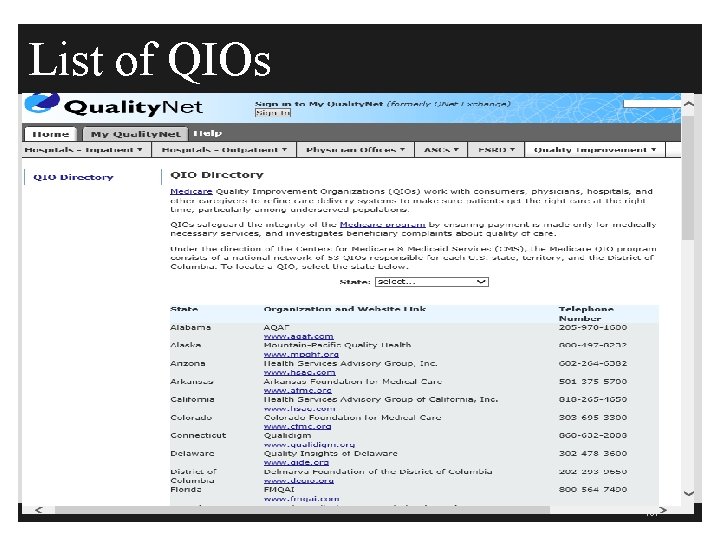
CMS Hospital Co. Ps QAPI §QIO to advance quality of care for Medicare patients §Every state has a QIO or Quality Improvement Organization under contract by CMS § Also 2 BFCC QIOs Livanta and Ke. Pro §Sign up with your state QIO to get newsletters and other information §CMS has a website on information about QIOs §CMS has the mission to improve services provided to Medicare patients 149
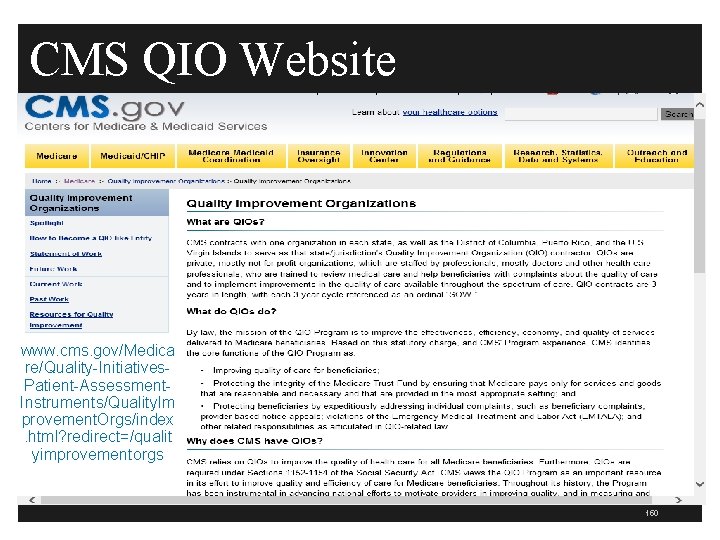
CMS QIO Website www. cms. gov/Medica re/Quality-Initiatives. Patient-Assessment. Instruments/Quality. Im provement. Orgs/index. html? redirect=/qualit yimprovementorgs 150
List of QIOs http: //www. qualitynet. org/dcs/Content. S erver? c=Page&pagename=Qnet. Public %2 FPage%2 FQnet. Tier 2&cid=114476 7874793 151
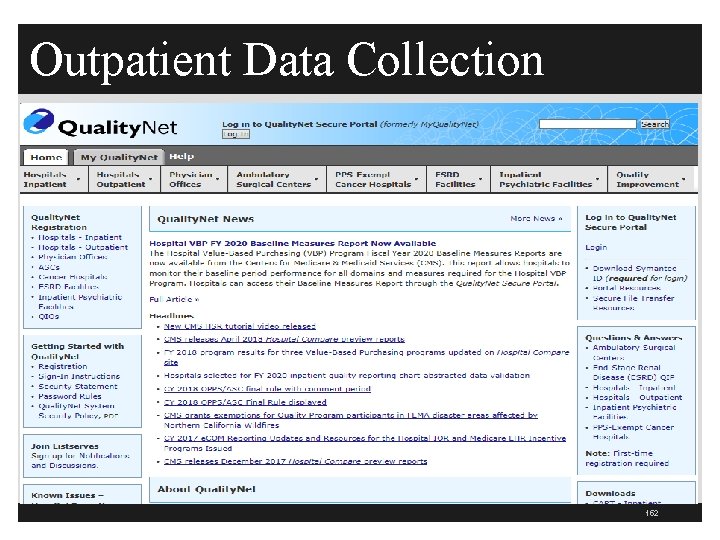
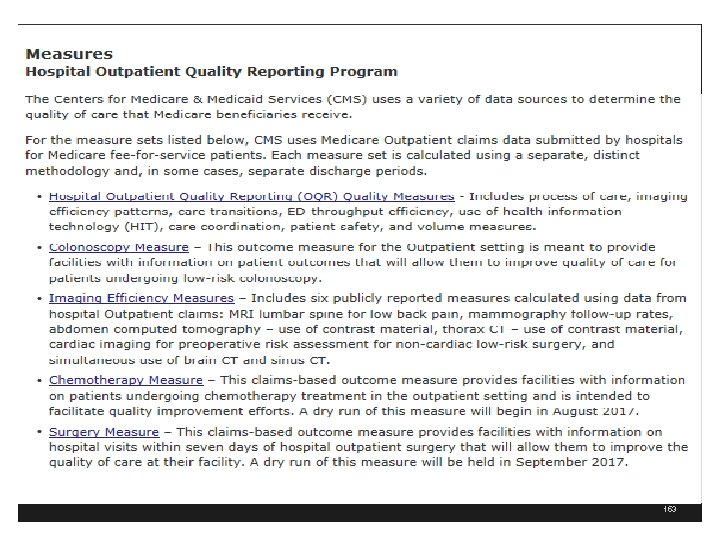
Outpatient Data Collection 152
153
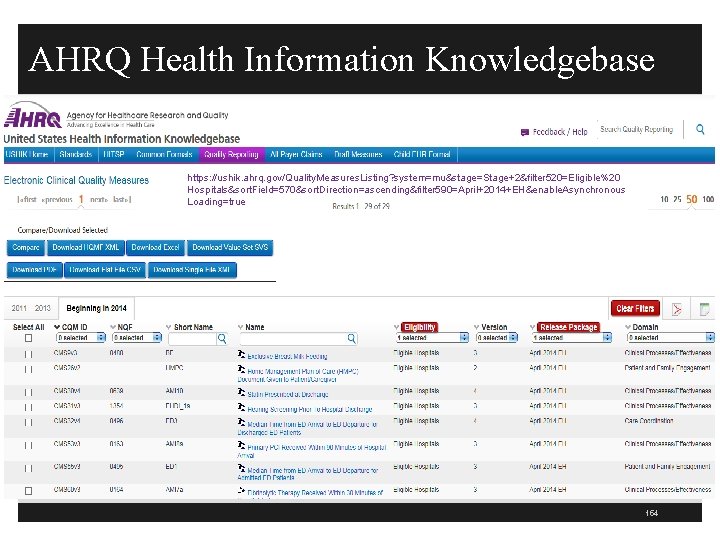
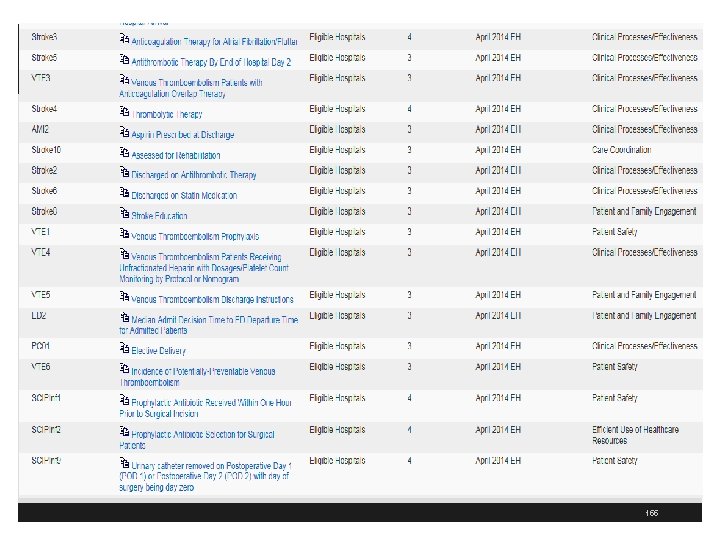
AHRQ Health Information Knowledgebase https: //ushik. ahrq. gov/Quality. Measures. Listing? system=mu&stage=Stage+2&filter 520=Eligible%20 Hospitals&sort. Field=570&sort. Direction=ascending&filter 590=April+2014+EH&enable. Asynchronous Hospitals&sort. Field=570&sort. Direction=ascendin Loading=true g&filter 590=April+2014+EH&enable. Asynchronou s. Loading=true 154
155
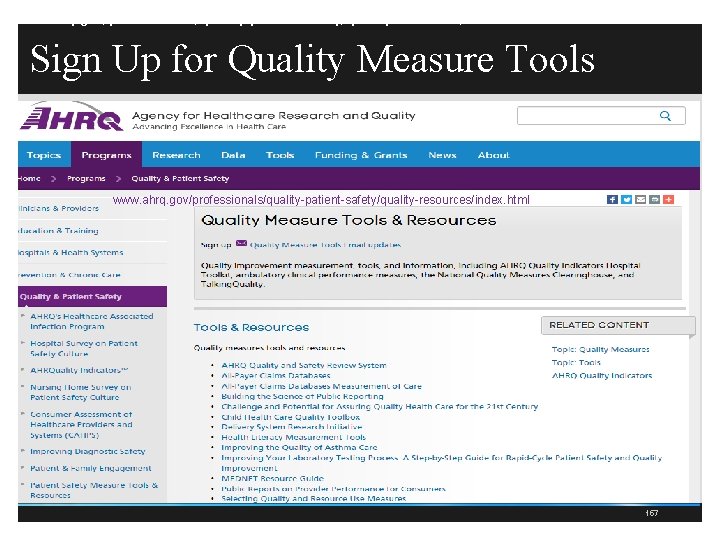
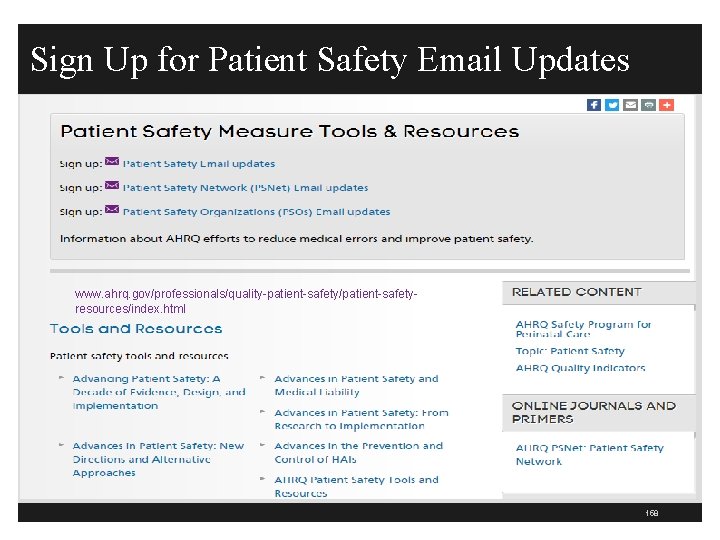
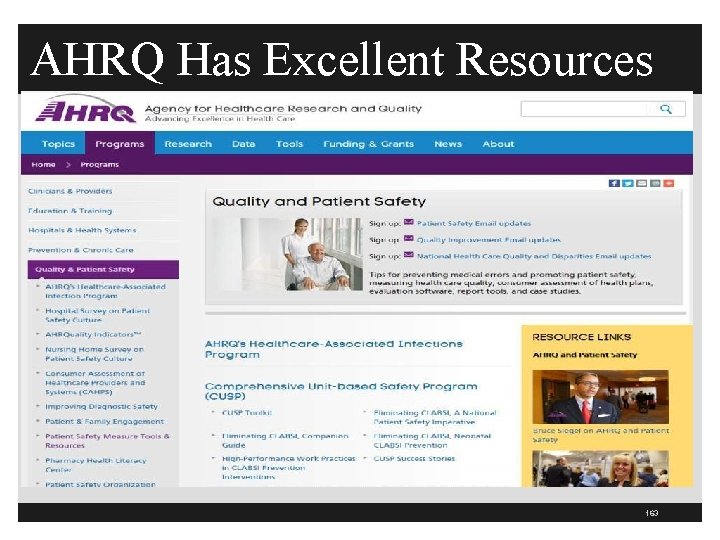
AHRQ Quality Measure Tools & Resources § AHRQ has many resources on quality measurement and patient safety § Can sign up for quality measure tools and resources at www. ahrq. gov/professionals/quality-patientsafety/quality-resources/index. html § Has toolbox, child health measures, pediatric quality measures, emerging measures, patient safety indicators § Can sign up for patient safety emails at http: //www. ahrq. gov/professionals/quality-patientsafety/patient-safety-resources/index. html 156
www. ahrq. gov/professionals/quality-patient-safety/quality-resources/index. html Sign Up for Quality Measure Tools www. ahrq. gov/professionals/quality-patient-safety/quality-resources/index. html http: //www. ahrq. gov/professionals/qual ity-patient-safety/qualityresources/index. html 157
Sign Up for Patient Safety Email Updates www. ahrq. gov/professionals/quality-patient-safety/patient-safetyresources/index. html 158
Executive Responsibilities 309 § Standard: Board assumes full legal authority and responsibility for the operations of the hospital § Medical Staff and Administrative officials are responsible and accountable for the following: § Ongoing PI program that includes patient safety including reducing medical errors § Hospital wide PI and patient safety program or revised regulations allow system wide § A determination of the number of PI projects that is conducted annually 159
Adequate Resources 315 § Standard: The board, Medical Staff, and Administrative Officials are accountable for measuring, assessing, improving and sustaining the hospital’s performance § This also requires reducing risk to patients § Example; hospitals created a process to ensure MI patients got their thrombolytics timely, that PCI was done before 90 minutes and pneumonia patients got their antibiotics and blood culture timely § Process to make sure the improvements continue 160
QAPI Patient Safety §This means people who can attend meetings, data so analysis can be made and other resources §Safer IV pumps, anticoagulant program, implement central line bundle, sepsis and VAP bundle, preventing inpatient suicides, wrong site surgery, retained FB, revised processes for neuromuscular blocker agents, implement policy on Phenergan administration and Fentanyl patches §So what’s in your PI and Safety Plans? 161
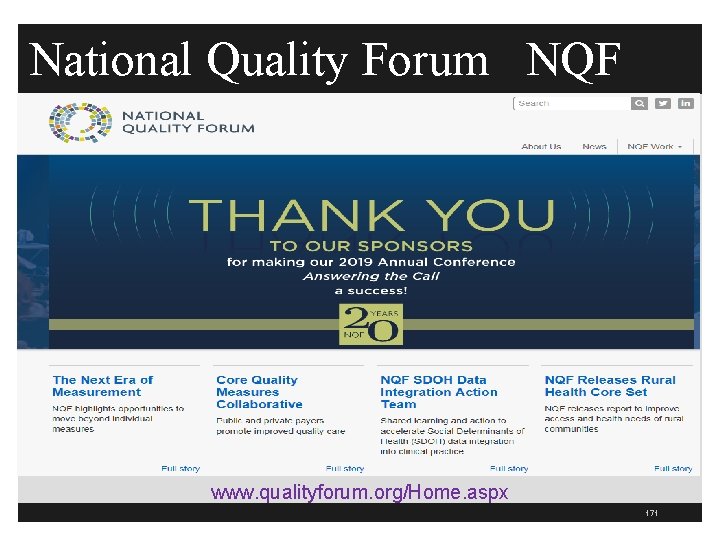
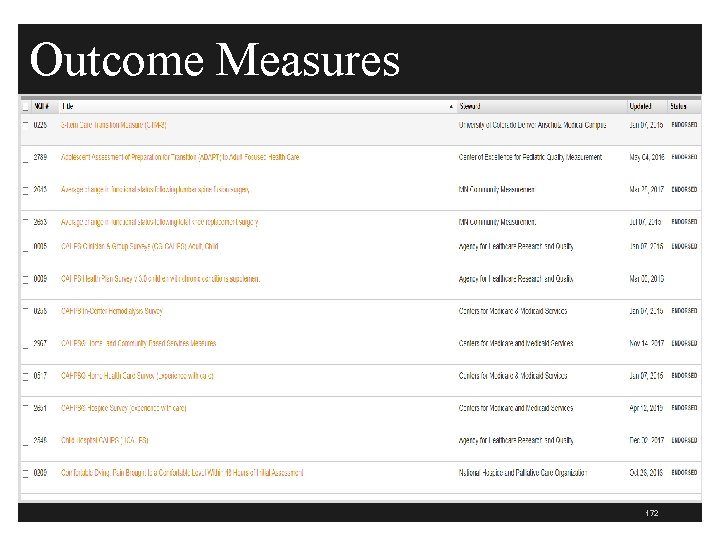
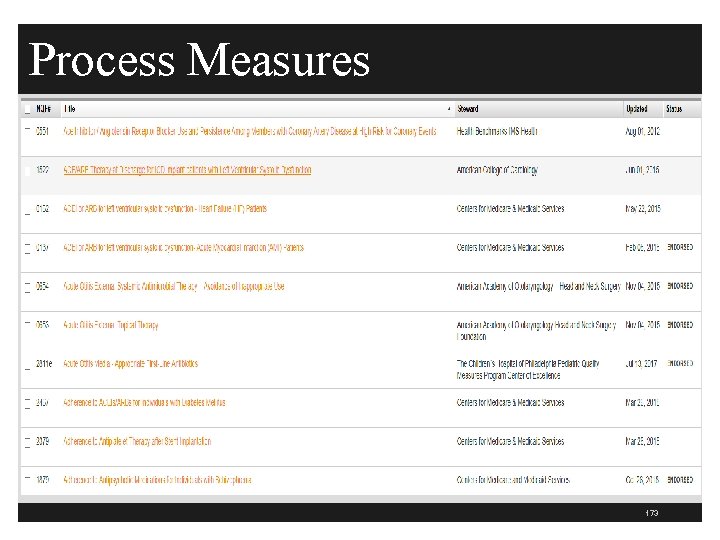
National Quality Forum NQF § NQF is an excellent resource § Has the ABCs of measurement § A list of NQF endorsed standards § A list of consensus projects § Resources § Can do a search of measures such as AAA repair mortality rate, accidental puncture or laceration rate, 30 day post hospital MI discharge care transition rate, stroke mortality rate, adherence to medication for diabetic patients, etc. 162
AHRQ Has Excellent Resources 163
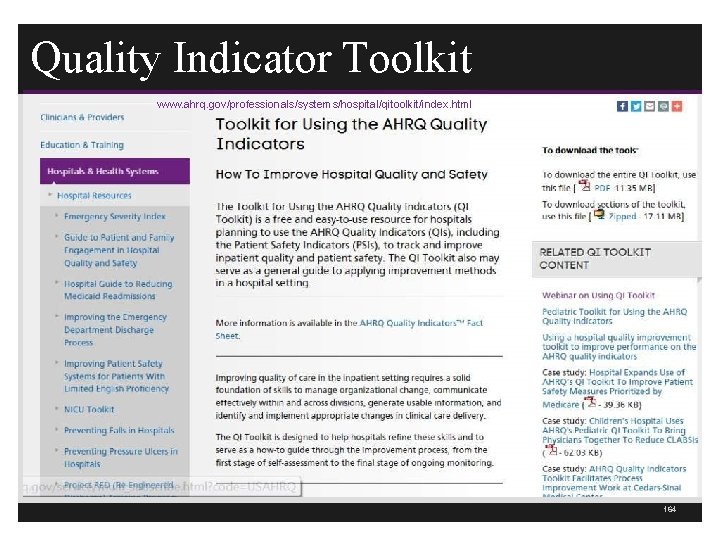
Quality Indicator Toolkit www. ahrq. gov/professionals/systems/hospital/qitoolkit/index. html www. ahrq. gov/legacy/qual/qitoolkit/ 164
Sign Up to Get Quality Related Email Updates https: //subscriptions. ahrq. gov/accounts/USAHRQ/subscriber/ne w? topic_id=USAHRQ_40 165
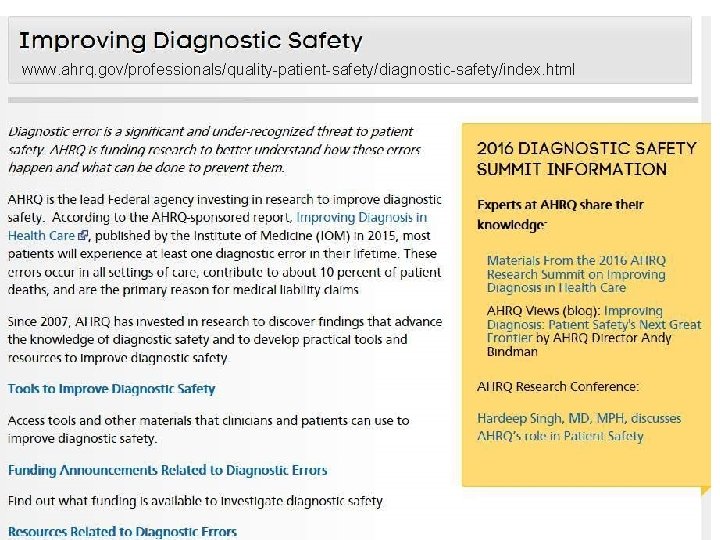
www. ahrq. gov/professionals/quality-patient-safety/diagnostic-safety/index. html 166
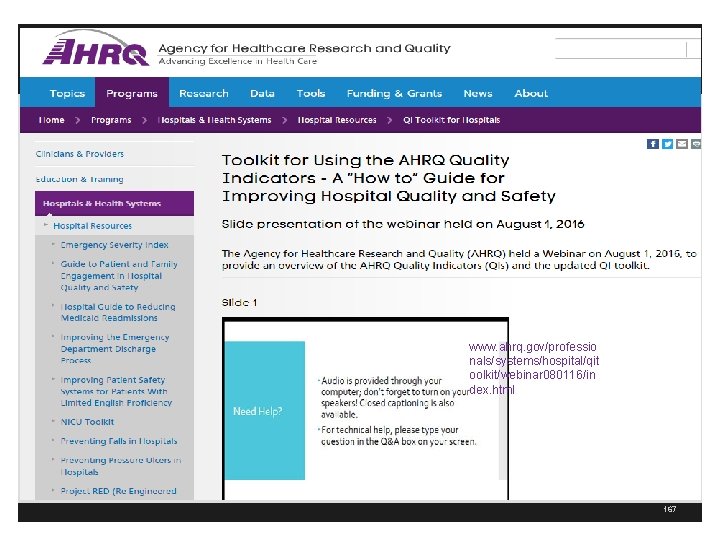
www. ahrq. gov/professio nals/systems/hospital/qit oolkit/webinar 080116/in dex. html 167
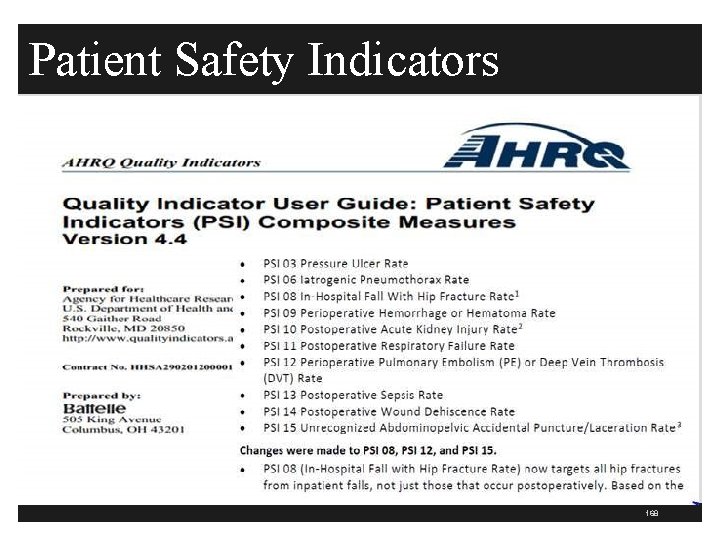
Patient Safety Indicators 168
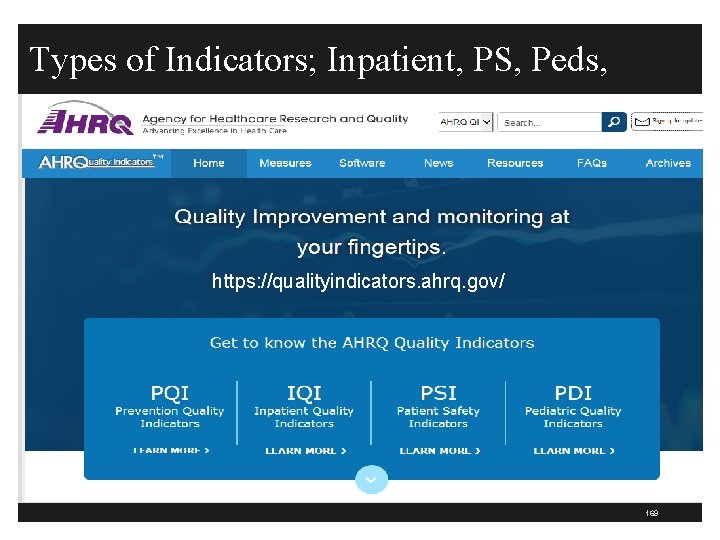
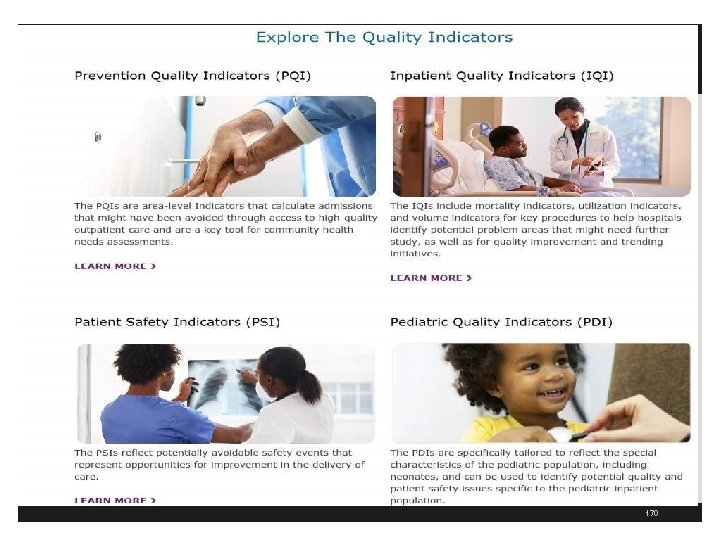
Types of Indicators; Inpatient, PS, Peds, https: //qualityindicators. ahrq. gov/ 169
170
National Quality Forum NQF www. qualityforum. org/Home. aspx 171
Outcome Measures 172
Process Measures 173
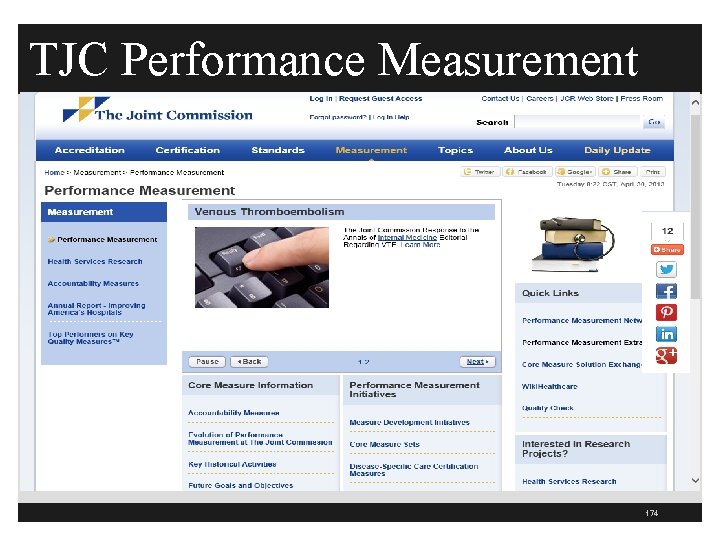
TJC Performance Measurement www. jointcommission. org/performance http: //www. jointcommission. org/perfor mance_measurement. aspx 174
CMS Hospital Acquired Conditions 175
176
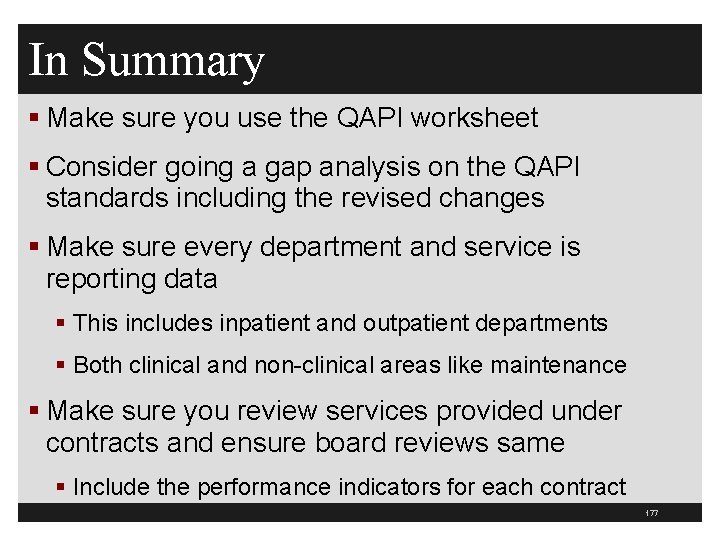
In Summary § Make sure you use the QAPI worksheet § Consider going a gap analysis on the QAPI standards including the revised changes § Make sure every department and service is reporting data § This includes inpatient and outpatient departments § Both clinical and non-clinical areas like maintenance § Make sure you review services provided under contracts and ensure board reviews same § Include the performance indicators for each contract 177
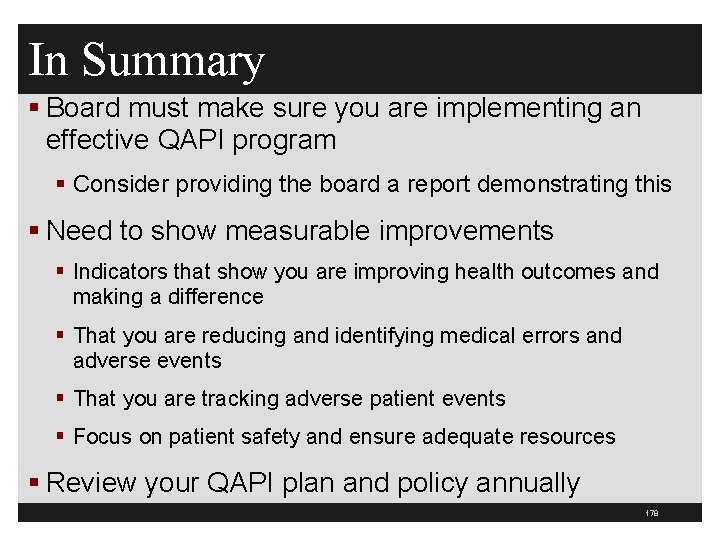
In Summary § Board must make sure you are implementing an effective QAPI program § Consider providing the board a report demonstrating this § Need to show measurable improvements § Indicators that show you are improving health outcomes and making a difference § That you are reducing and identifying medical errors and adverse events § That you are tracking adverse patient events § Focus on patient safety and ensure adequate resources § Review your QAPI plan and policy annually 178
In Summary § The data that you collect should be relevant, aggregated, analyzed, and acted upon to identify opportunities for improvement § Train your staff that collect data so it done correctly § Focus on high volume, high risk, and problem prone areas § Clearly document the actions you take to improve performance § Document how you will make sure these actions to improve are sustained 179
The End! Questions? ? § Sue Dill Calloway RN, Esq. CPHRM, CCMSCP, CCMSP § AD, BA, BSN, MSN, JD § President of Patient Safety and Education Consulting § 5447 Fawnbrook Lane § Dublin, Ohio 43017 § 614 791 -1468 § sdill 1@columbus. rr. com § Call with questions, No emails, Thanks 180