
CMS HCAL phase 1 upgrade Ulrich Heintz Brown
CMS HCAL phase 1 upgrade Ulrich Heintz Brown University for the CMS HCAL group 3/20/2014 Ulrich Heintz - ACES 2014 1
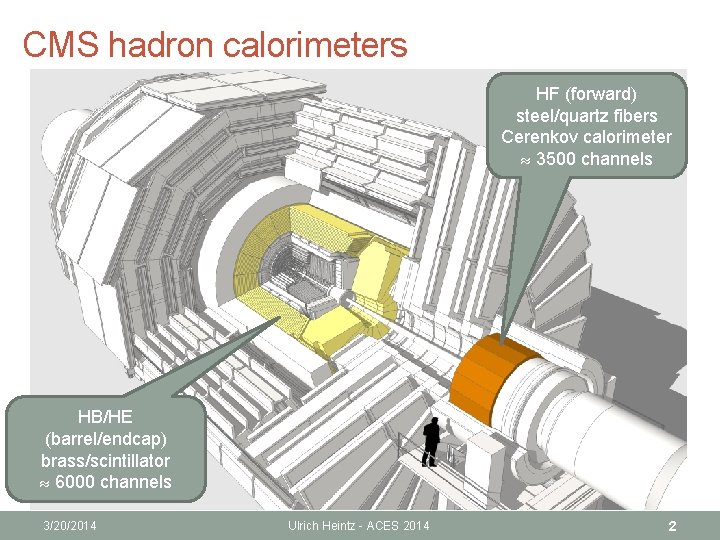
CMS hadron calorimeters HF (forward) steel/quartz fibers Cerenkov calorimeter 3500 channels HB/HE (barrel/endcap) brass/scintillator 6000 channels 3/20/2014 Ulrich Heintz - ACES 2014 2
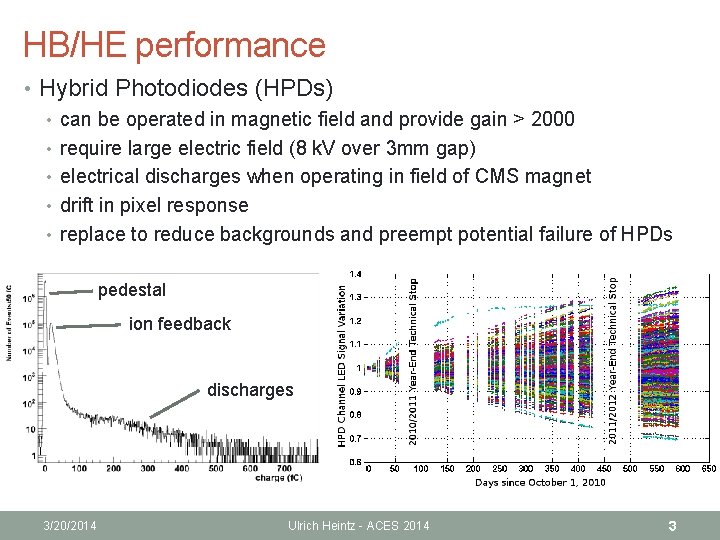
HB/HE performance • Hybrid Photodiodes (HPDs) • can be operated in magnetic field and provide gain > 2000 • require large electric field (8 k. V over 3 mm gap) • electrical discharges when operating in field of CMS magnet • drift in pixel response • replace to reduce backgrounds and preempt potential failure of HPDs pedestal ion feedback discharges 3/20/2014 Ulrich Heintz - ACES 2014 3

HF performance • spurious signals • direct hits of particles from showers, in flight decays on PMTs • arrive 5 ns earlier than Cerenkov signal from showers • during 50 ns operation mitigated by phasing HF integration clock to move spurious hits into “empty” 25 ns integration window between crossings • during 25 ns operation all signals will be integrated with real signals 3/20/2014 Ulrich Heintz - ACES 2014 4
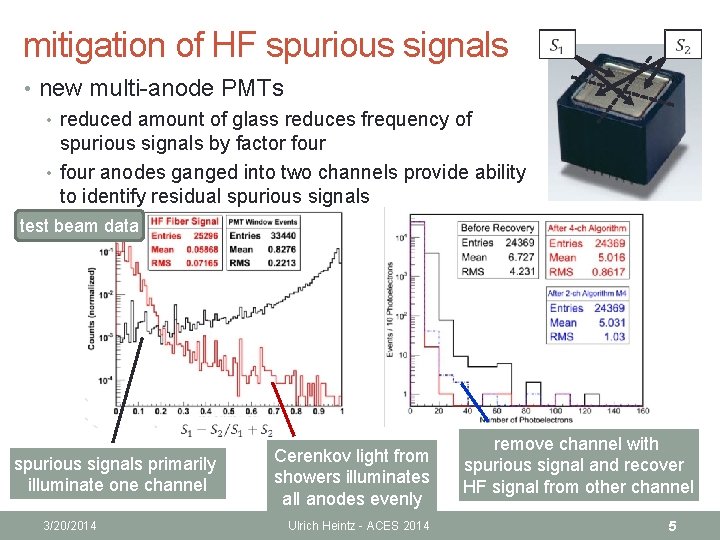
mitigation of HF spurious signals • new multi-anode PMTs • reduced amount of glass reduces frequency of spurious signals by factor four • four anodes ganged into two channels provide ability to identify residual spurious signals test beam data spurious signals primarily illuminate one channel 3/20/2014 Cerenkov light from showers illuminates all anodes evenly Ulrich Heintz - ACES 2014 remove channel with spurious signal and recover HF signal from other channel 5
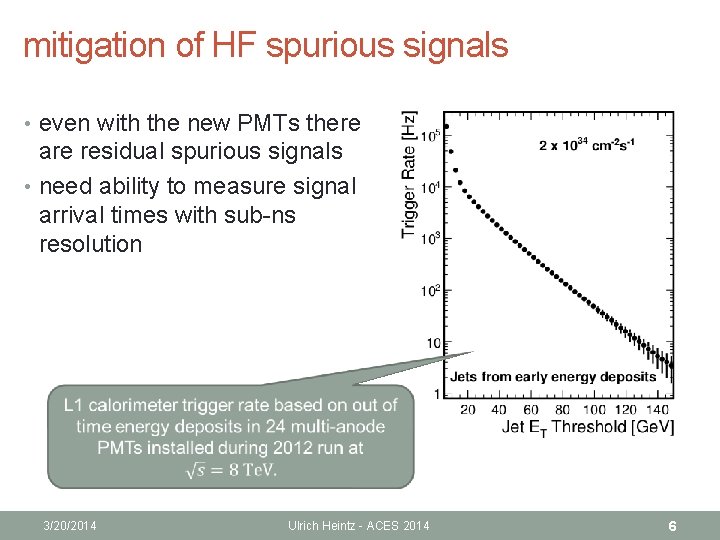
mitigation of HF spurious signals • even with the new PMTs there are residual spurious signals • need ability to measure signal arrival times with sub-ns resolution 3/20/2014 Ulrich Heintz - ACES 2014 6
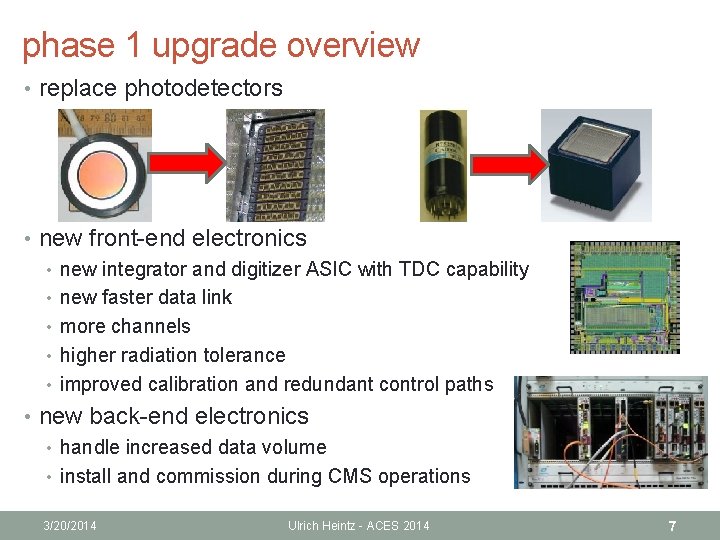
phase 1 upgrade overview • replace photodetectors • new front-end electronics • new integrator and digitizer ASIC with TDC capability • new faster data link • more channels • higher radiation tolerance • improved calibration and redundant control paths • new back-end electronics • handle increased data volume • install and commission during CMS operations 3/20/2014 Ulrich Heintz - ACES 2014 7
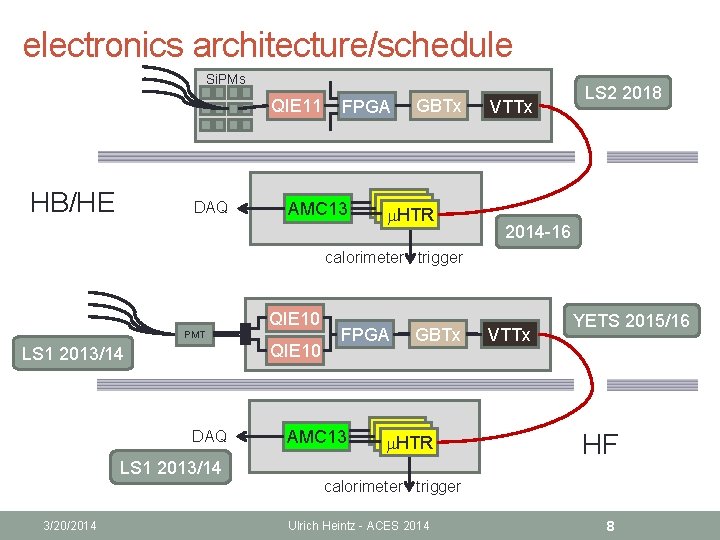
electronics architecture/schedule Si. PMs QIE 11 HB/HE DAQ FPGA AMC 13 GBTx HTR HTR VTTx LS 2 2018 2014 -16 calorimeter trigger QIE 10 PMT QIE 10 LS 1 2013/14 DAQ LS 1 2013/14 3/20/2014 FPGA AMC 13 GBTx HTR HTR VTTx YETS 2015/16 HF calorimeter trigger Ulrich Heintz - ACES 2014 8
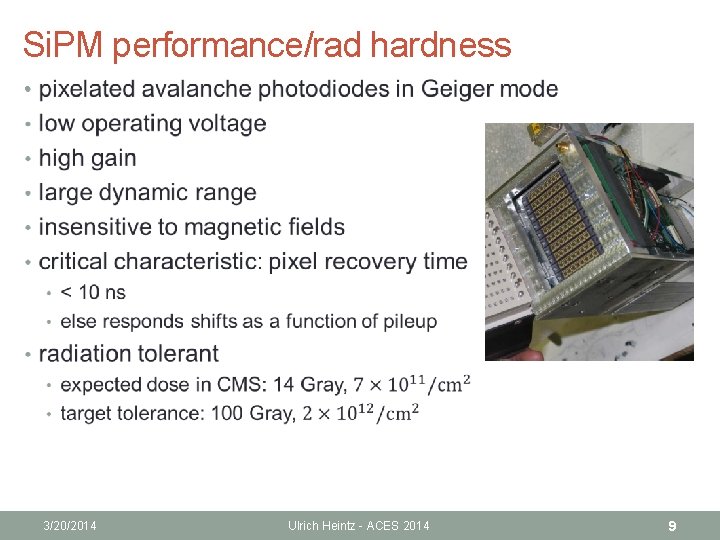
Si. PM performance/rad hardness • 3/20/2014 Ulrich Heintz - ACES 2014 9
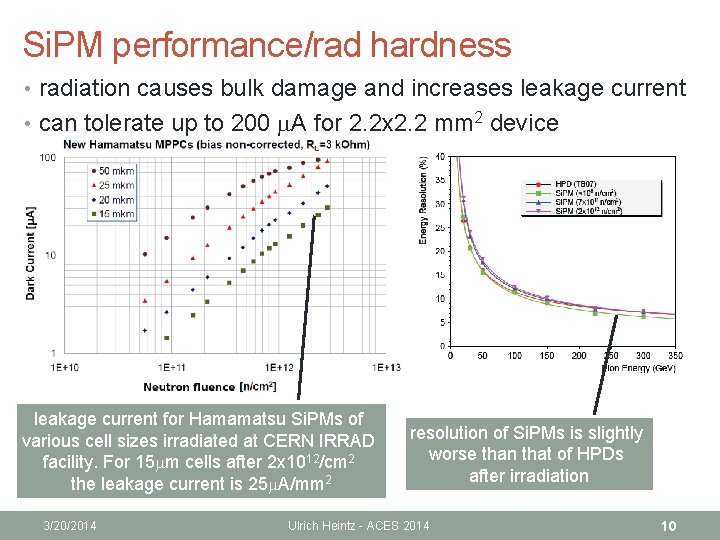
Si. PM performance/rad hardness • radiation causes bulk damage and increases leakage current • can tolerate up to 200 A for 2. 2 x 2. 2 mm 2 device leakage current for Hamamatsu Si. PMs of various cell sizes irradiated at CERN IRRAD facility. For 15 m cells after 2 x 10¹²/cm 2 the leakage current is 25 A/mm 2 3/20/2014 resolution of Si. PMs is slightly worse than that of HPDs after irradiation Ulrich Heintz - ACES 2014 10
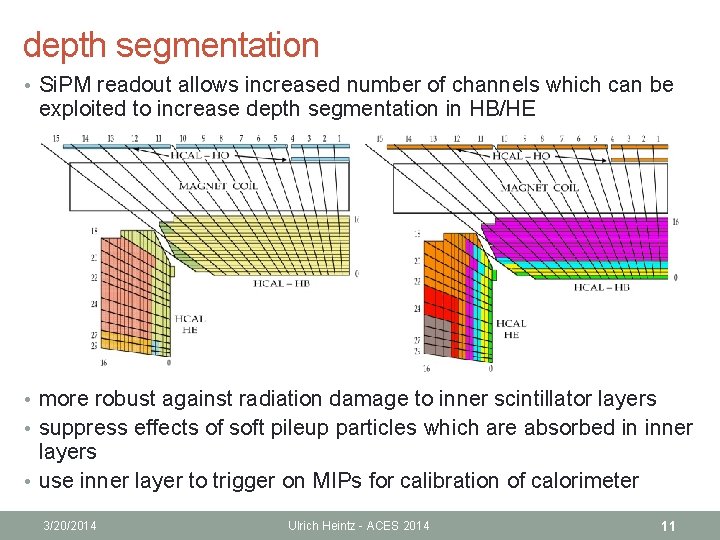
depth segmentation • Si. PM readout allows increased number of channels which can be exploited to increase depth segmentation in HB/HE • more robust against radiation damage to inner scintillator layers • suppress effects of soft pileup particles which are absorbed in inner layers • use inner layer to trigger on MIPs for calibration of calorimeter 3/20/2014 Ulrich Heintz - ACES 2014 11
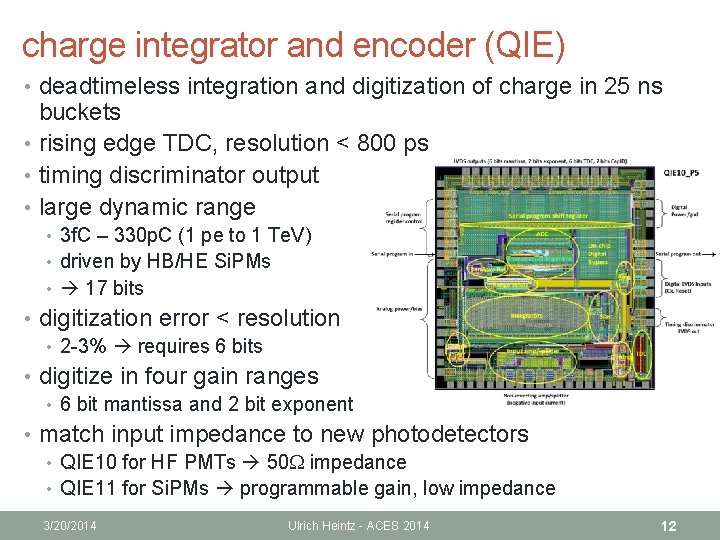
charge integrator and encoder (QIE) • deadtimeless integration and digitization of charge in 25 ns buckets • rising edge TDC, resolution < 800 ps • timing discriminator output • large dynamic range • 3 f. C – 330 p. C (1 pe to 1 Te. V) • driven by HB/HE Si. PMs • 17 bits • digitization error < resolution • 2 -3% requires 6 bits • digitize in four gain ranges • 6 bit mantissa and 2 bit exponent • match input impedance to new photodetectors • QIE 10 for HF PMTs 50 impedance • QIE 11 for Si. PMs programmable gain, low impedance 3/20/2014 Ulrich Heintz - ACES 2014 12
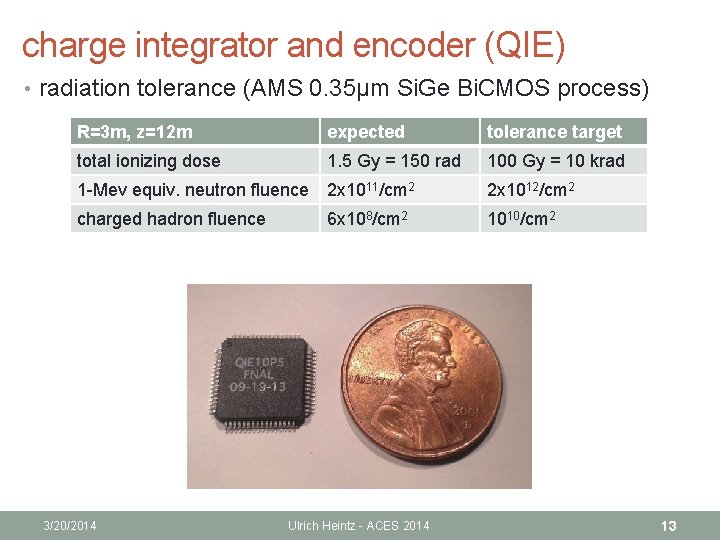
charge integrator and encoder (QIE) • radiation tolerance (AMS 0. 35μm Si. Ge Bi. CMOS process) R=3 m, z=12 m expected tolerance target total ionizing dose 1. 5 Gy = 150 rad 100 Gy = 10 krad 1 -Mev equiv. neutron fluence 2 x 10¹¹/cm 2 2 x 10¹²/cm 2 charged hadron fluence 6 x 10⁸/cm 2 1010/cm 2 3/20/2014 Ulrich Heintz - ACES 2014 13
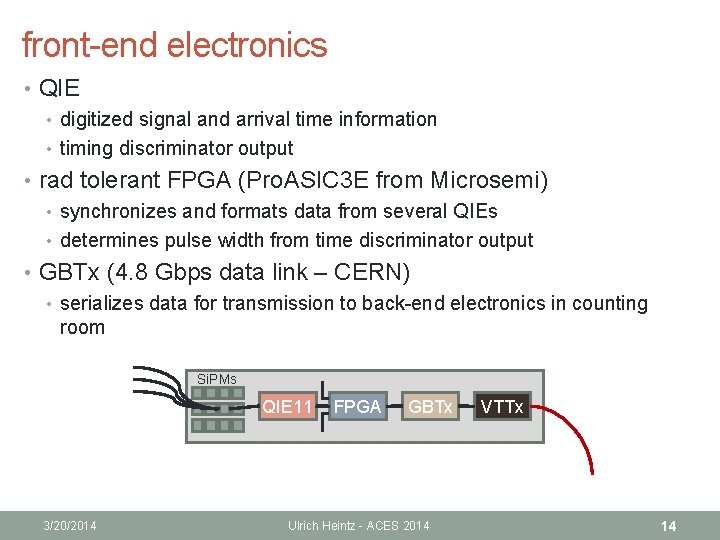
front-end electronics • QIE • digitized signal and arrival time information • timing discriminator output • rad tolerant FPGA (Pro. ASIC 3 E from Microsemi) • synchronizes and formats data from several QIEs • determines pulse width from time discriminator output • GBTx (4. 8 Gbps data link – CERN) • serializes data for transmission to back-end electronics in counting room Si. PMs QIE 11 3/20/2014 FPGA GBTx Ulrich Heintz - ACES 2014 VTTx 14
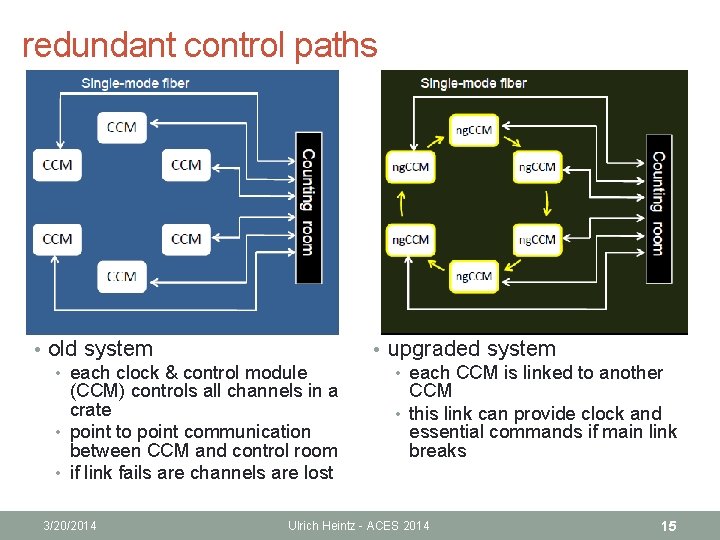
redundant control paths • old system • each clock & control module (CCM) controls all channels in a crate • point to point communication between CCM and control room • if link fails are channels are lost 3/20/2014 • upgraded system • each CCM is linked to another CCM • this link can provide clock and essential commands if main link breaks Ulrich Heintz - ACES 2014 15
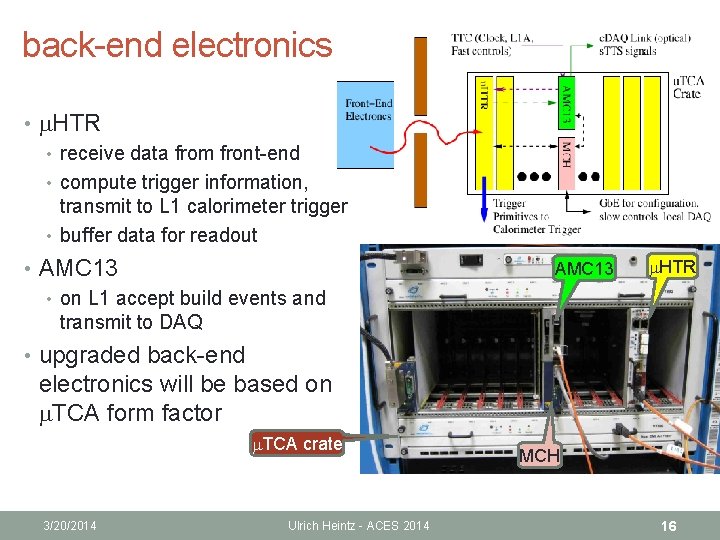
back-end electronics • HTR • receive data from front-end • compute trigger information, transmit to L 1 calorimeter trigger • buffer data for readout • AMC 13 • on L 1 accept build events and transmit to DAQ AMC 13 HTR • upgraded back-end electronics will be based on TCA form factor TCA crate 3/20/2014 Ulrich Heintz - ACES 2014 MCH 16
summary • CMS HCAL phase 1 upgrade will improve performance of HCAL to cope with luminosity expected in Run 2 • new photodetectors • reduce spurious signals and improve reliability • new front-end electronics • provide signal timing to further reduce spurious signals • new back-end electronics • handle increased data load • phased installation • HF PMTs and backend in LS 1 2013/2014 • HF front-end in YETS 2015/2016 • HBHE backend during operation in 2014 -2016 • HBHE Si. PMs and frontend in LS 2 2018 3/20/2014 Ulrich Heintz - ACES 2014 17
- Slides: 17