
CMS Grid operations Andrea Sciab CERN Grid Operations
CMS Grid operations Andrea Sciabà CERN Grid Operations Workshop 13 -15 June, 2007 Stockholm
Outline n Service operations and support n n Activity operations n n n Data challenge planning An example: Monte Carlo production operations User support n n CMS services Support channels Support for Grid problems Current system Future evolution Monitoring and other tools Conclusions
Services for the CMS computing n The CMS computing depends on lots of different types of services n CMS-specific services n n n Grid services n n n Central: calibration/alignment database (Fro. Ntier), data catalogues (DBS), production tools, Ph. EDEx transfer database Sites: Ph. EDEx agents, Squid server, site local configuration files Central: VOMS/VOMRS, FTS, BDII, LCG RB, LCG WMS, Myproxy Sites: CEs, SRM servers, site BDIIs Other auxiliary services n CMS Central web server, build machines, Hyper. News, AFS, Savannah, etc.

Support channels n CMS service support n Mostly done via Hypernews (“community support”) n n n Savannah is used for problem tracking and bugs CMS support at remote sites n n CMS is active only at sites directly involved in it, which routinely participate to discussions about computing issues CMS sites have a "CMS site contact" n n n Satisfies most needs Acts as interface between the experiment and the site Manages local CMS services Grid middleware and services n n n "Grid experts" in CMS or in EIS team CMS site contacts via GGUS, or via OSG support

Dealing with Grid problems n Workload management issues n n Mostly encountered by “end users” who submit analysis jobs Normally go though CMS “grid experts” n Harder to debug because n n n more components are involved these are more mature, hence problems are subtle Data Management issues n n Most problems are obvious site/storage issues Normally go through via CMS site contacts, which follow up with site managers
WLCG coordination n Communication channels n n Sites for resource negotiation/allocation CMS-WLCG task force meetings to discuss technical details n n E. g. SLC 4 WNs, production shares, FTS deployment, etc. Experiment Coordination Meeting (ECM) for more general discussions about planning with WLCG and the other experiments
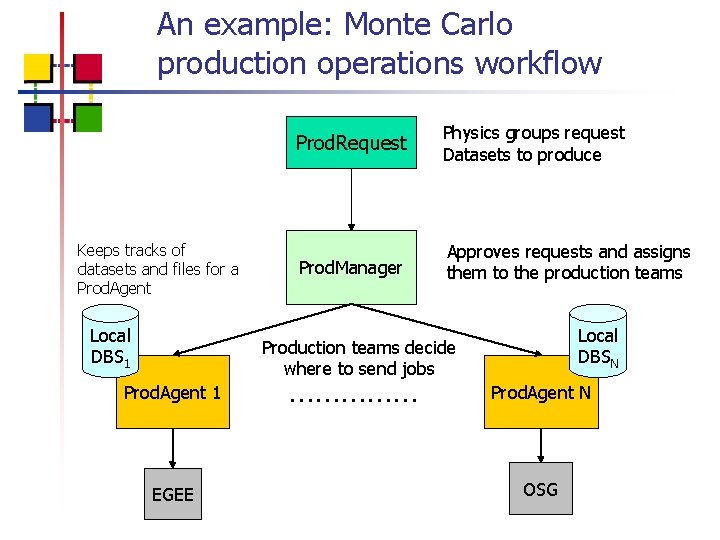
An example: Monte Carlo production operations workflow Keeps tracks of datasets and files for a Prod. Agent Local DBS 1 Prod. Request Physics groups request Datasets to produce Prod. Manager Approves requests and assigns them to the production teams Local DBSN Production teams decide where to send jobs Prod. Agent 1 EGEE …………… Prod. Agent N OSG
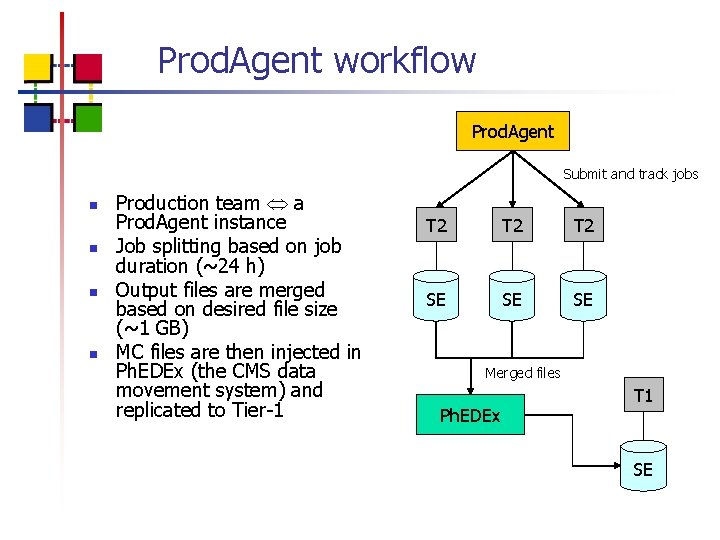
Prod. Agent workflow Prod. Agent Submit and track jobs n n Production team a Prod. Agent instance Job splitting based on job duration (~24 h) Output files are merged based on desired file size (~1 GB) MC files are then injected in Ph. EDEx (the CMS data movement system) and replicated to Tier-1 T 2 T 2 SE SE SE Merged files Ph. EDEx T 1 SE
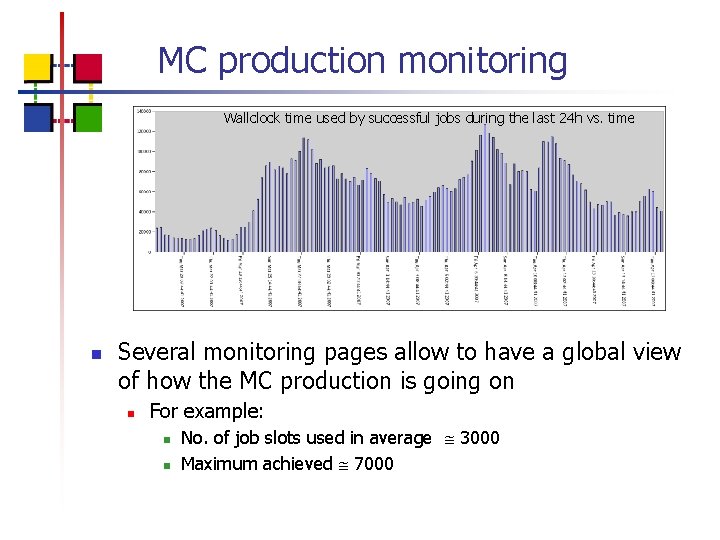
MC production monitoring Wallclock time used by successful jobs during the last 24 h vs. time n Several monitoring pages allow to have a global view of how the MC production is going on n For example: n n No. of job slots used in average 3000 Maximum achieved 7000
MC production operational issues n n n Problems are taken care of by the production teams Interaction with sites goes through local CMS contact persons The CMS contact person chooses his preferred communication channel with the site n n n Typically direct interaction with site managers Might also be GGUS Current issues n CMS problems n n Site problems n n Bugs in CMSSW, limitations in Prod. Agent or DBS, … SE, CMS software deployment, data transfers, … "Grid" problems n n workload management problems, as usual, are harder to debug Often jobs are just resubmitted…
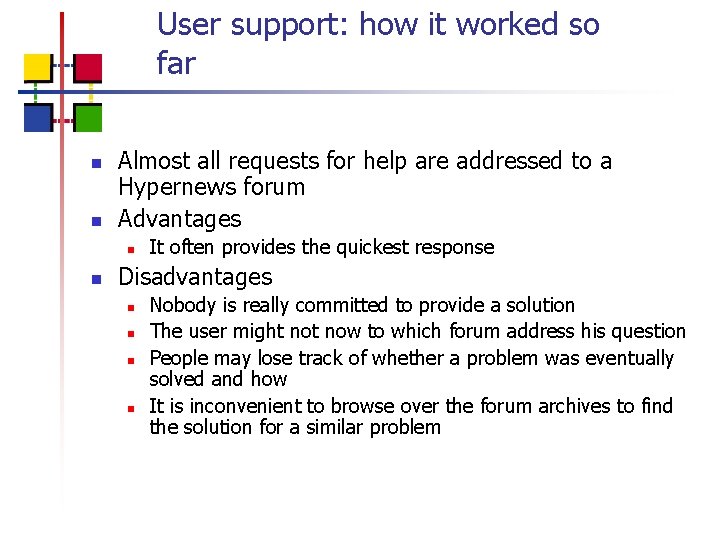
User support: how it worked so far n n Almost all requests for help are addressed to a Hypernews forum Advantages n n It often provides the quickest response Disadvantages n n Nobody is really committed to provide a solution The user might now to which forum address his question People may lose track of whether a problem was eventually solved and how It is inconvenient to browse over the forum archives to find the solution for a similar problem
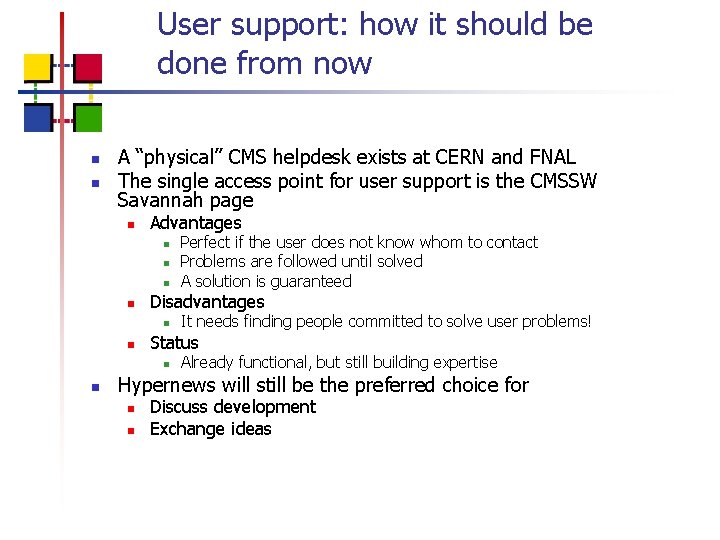
User support: how it should be done from now n n A “physical” CMS helpdesk exists at CERN and FNAL The single access point for user support is the CMSSW Savannah page n Advantages n n Disadvantages n n It needs finding people committed to solve user problems! Status n n Perfect if the user does not know whom to contact Problems are followed until solved A solution is guaranteed Already functional, but still building expertise Hypernews will still be the preferred choice for n n Discuss development Exchange ideas
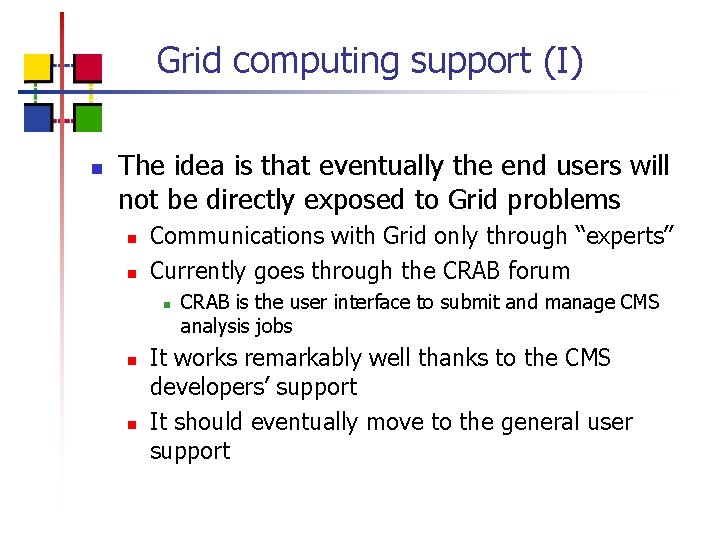
Grid computing support (I) n The idea is that eventually the end users will not be directly exposed to Grid problems n n Communications with Grid only through “experts” Currently goes through the CRAB forum n n n CRAB is the user interface to submit and manage CMS analysis jobs It works remarkably well thanks to the CMS developers’ support It should eventually move to the general user support
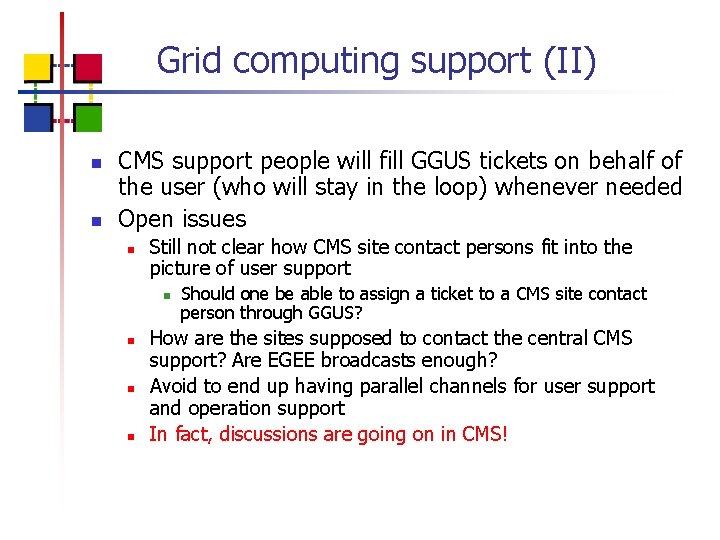
Grid computing support (II) n n CMS support people will fill GGUS tickets on behalf of the user (who will stay in the loop) whenever needed Open issues n Still not clear how CMS site contact persons fit into the picture of user support n n Should one be able to assign a ticket to a CMS site contact person through GGUS? How are the sites supposed to contact the central CMS support? Are EGEE broadcasts enough? Avoid to end up having parallel channels for user support and operation support In fact, discussions are going on in CMS!
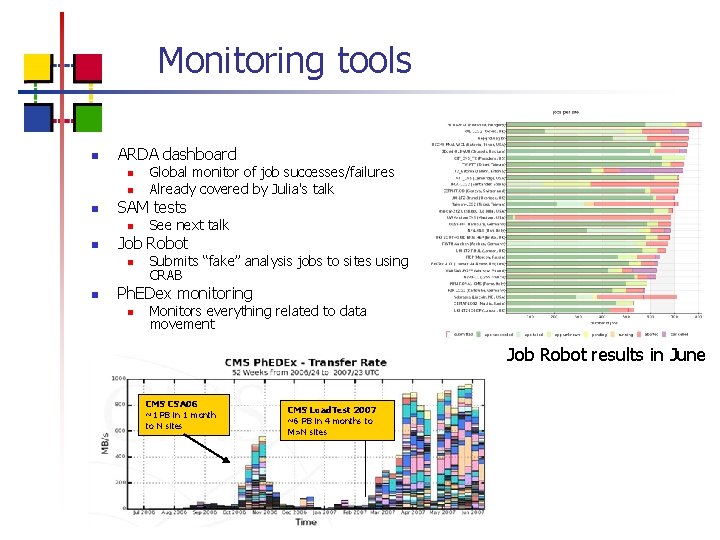
Monitoring tools n ARDA dashboard n n n SAM tests n n See next talk Job Robot n n Global monitor of job successes/failures Already covered by Julia's talk Submits “fake” analysis jobs to sites using CRAB Ph. EDex monitoring n Monitors everything related to data movement Job Robot results in June CMS CSA 06 ~1 PB in 1 month to N sites CMS Load. Test 2007 ~6 PB in 4 months to M>N sites
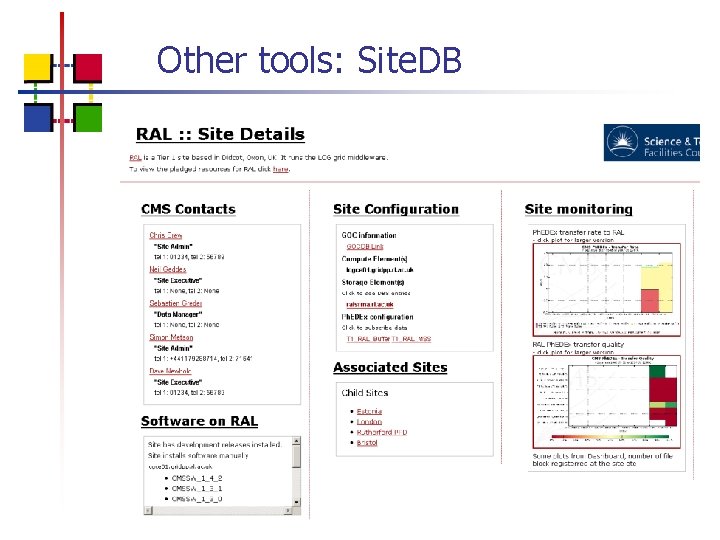
Other tools: Site. DB
Conclusions n Operational support in CMS goes through several channels n n n User support is already making a significant progress from a simple “community support” model n n But procedures are often not clear The communications flow needs to evolve towards a more mature model GGUS is seen as a fundamental component of the system Several monitoring systems n Increasingly effective in helping to bring sites in good shape
- Slides: 17