
CMS Electromagnetic Calorimeter US CMS JTERM III 12


- Slides: 42
CMS Electromagnetic Calorimeter US CMS JTERM III 12 January 2009 Toyoko Orimoto California Institute of Technology Toyoko Orimoto, Caltech
Outline • • Physics & Design Requirements Technology Choice ECAL Design & Readout Calibration & Monitoring Results with Cosmics Data Results with First Beam Data Conclusions Toyoko Orimoto, Caltech
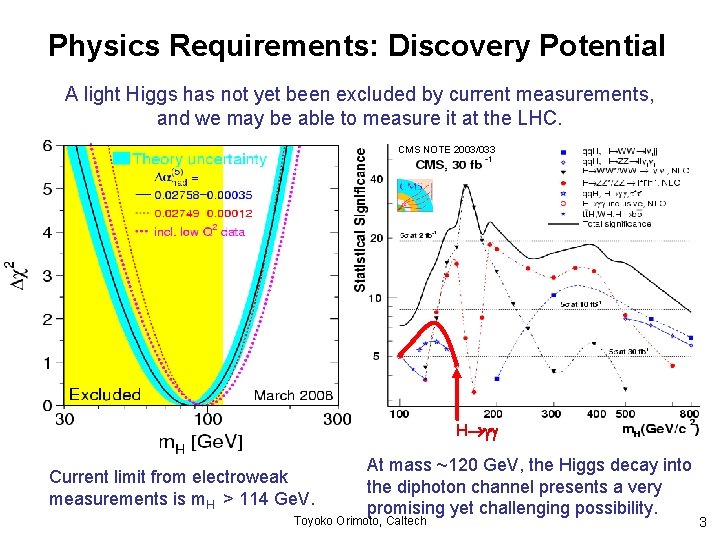
Physics Requirements: Discovery Potential A light Higgs has not yet been excluded by current measurements, and we may be able to measure it at the LHC. CMS NOTE 2003/033 H Current limit from electroweak measurements is m. H > 114 Ge. V. At mass ~120 Ge. V, the Higgs decay into the diphoton channel presents a very promising yet challenging possibility. Toyoko Orimoto, Caltech 3
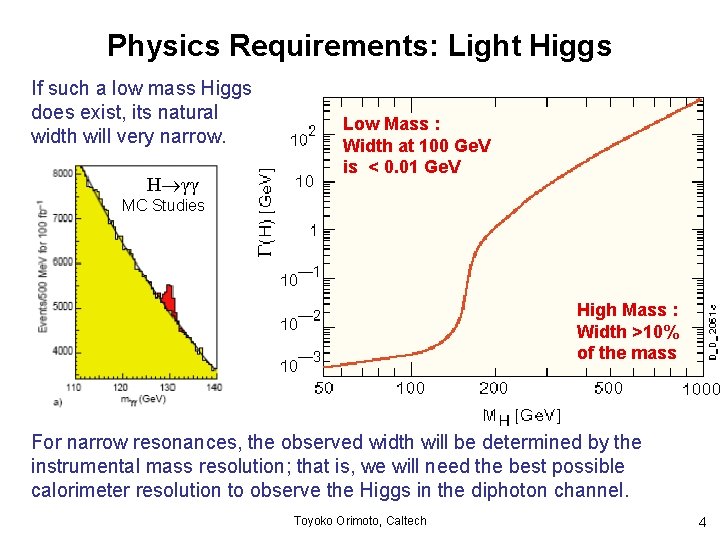
Physics Requirements: Light Higgs If such a low mass Higgs does exist, its natural width will very narrow. H γγ Low Mass : Width at 100 Ge. V is < 0. 01 Ge. V MC Studies High Mass : Width >10% of the mass For narrow resonances, the observed width will be determined by the instrumental mass resolution; that is, we will need the best possible calorimeter resolution to observe the Higgs in the diphoton channel. Toyoko Orimoto, Caltech 4
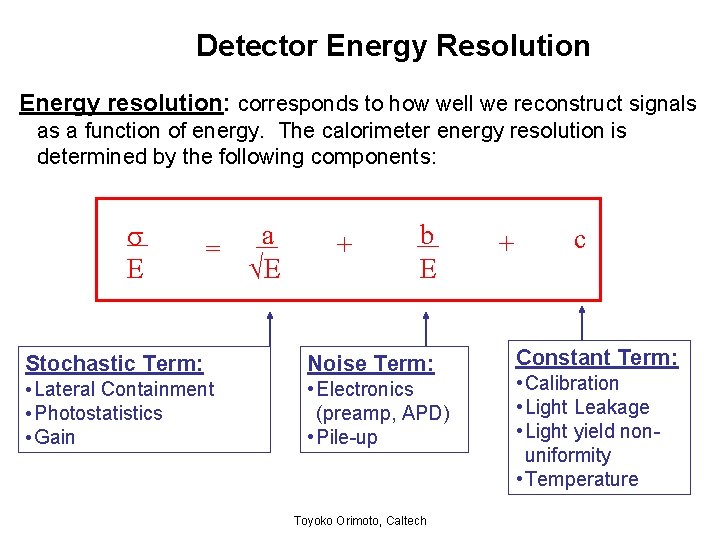
Detector Energy Resolution Energy resolution: corresponds to how well we reconstruct signals as a function of energy. The calorimeter energy resolution is determined by the following components: E = a √E + b E Stochastic Term: Noise Term: • Lateral Containment • Photostatistics • Gain • Electronics (preamp, APD) • Pile-up Toyoko Orimoto, Caltech + c Constant Term: • Calibration • Light Leakage • Light yield nonuniformity • Temperature
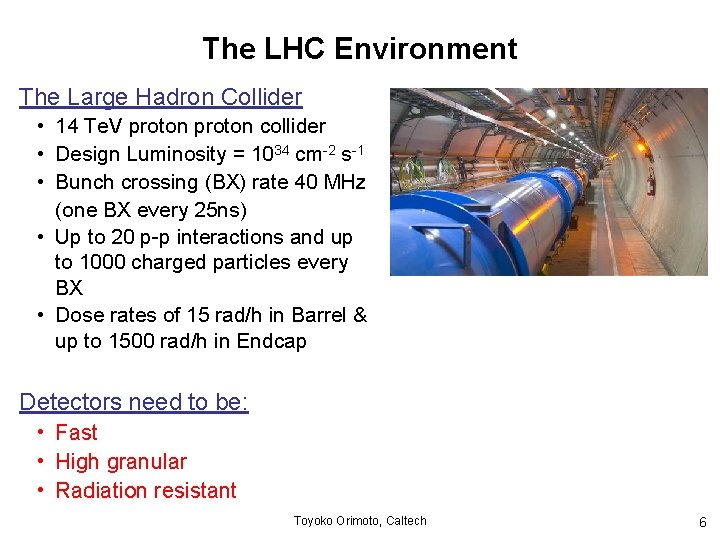
The LHC Environment The Large Hadron Collider • 14 Te. V proton collider • Design Luminosity = 1034 cm-2 s-1 • Bunch crossing (BX) rate 40 MHz (one BX every 25 ns) • Up to 20 p-p interactions and up to 1000 charged particles every BX • Dose rates of 15 rad/h in Barrel & up to 1500 rad/h in Endcap Detectors need to be: • Fast • High granular • Radiation resistant Toyoko Orimoto, Caltech 6
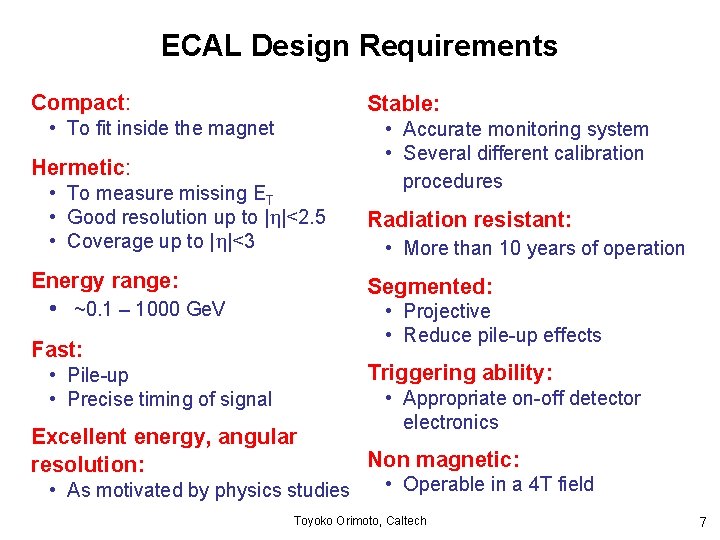
ECAL Design Requirements Compact: Stable: • To fit inside the magnet Hermetic: • To measure missing ET • Good resolution up to | |<2. 5 • Coverage up to | |<3 Energy range: • Accurate monitoring system • Several different calibration procedures Radiation resistant: • More than 10 years of operation Segmented: • ~0. 1 – 1000 Ge. V • Projective • Reduce pile-up effects Fast: Triggering ability: • Pile-up • Precise timing of signal Excellent energy, angular resolution: • As motivated by physics studies • Appropriate on-off detector electronics Non magnetic: • Operable in a 4 T field Toyoko Orimoto, Caltech 7
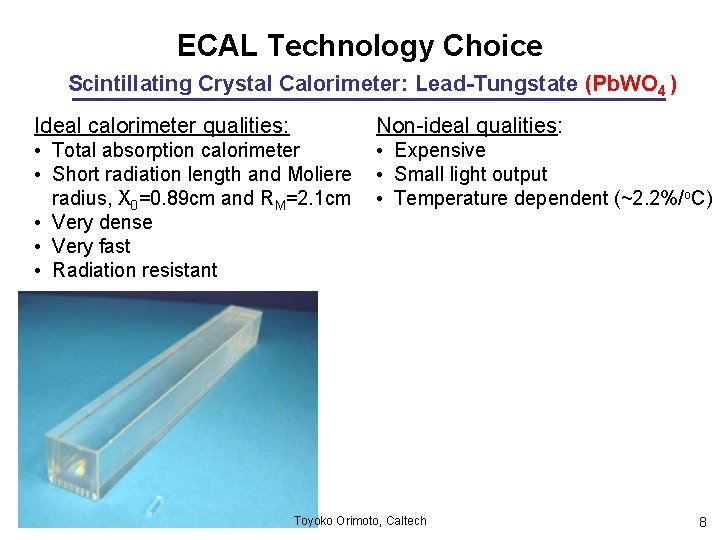
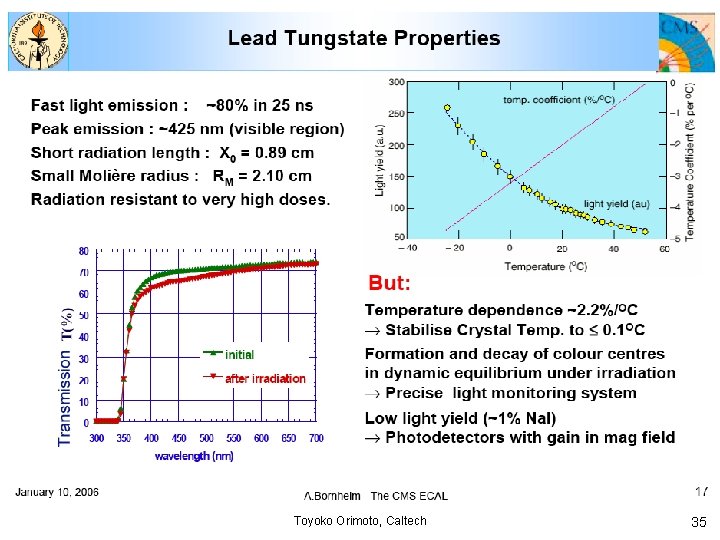
ECAL Technology Choice Scintillating Crystal Calorimeter: Lead-Tungstate (Pb. WO 4 ) Ideal calorimeter qualities: Non-ideal qualities: • Total absorption calorimeter • Short radiation length and Moliere radius, X 0=0. 89 cm and RM=2. 1 cm • Very dense • Very fast • Radiation resistant • Expensive • Small light output • Temperature dependent (~2. 2%/o. C) Toyoko Orimoto, Caltech 8
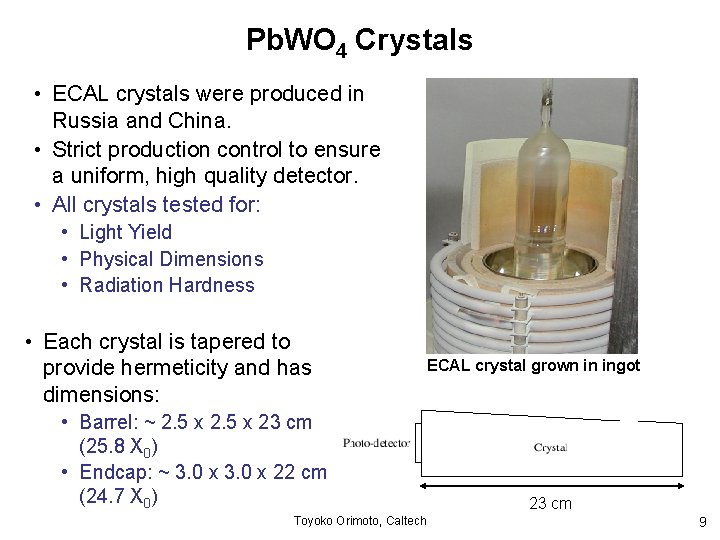
Pb. WO 4 Crystals • ECAL crystals were produced in Russia and China. • Strict production control to ensure a uniform, high quality detector. • All crystals tested for: • Light Yield • Physical Dimensions • Radiation Hardness • Each crystal is tapered to provide hermeticity and has dimensions: • Barrel: ~ 2. 5 x 23 cm (25. 8 X 0) • Endcap: ~ 3. 0 x 22 cm (24. 7 X 0) Toyoko Orimoto, Caltech ECAL crystal grown in ingot 23 cm 9
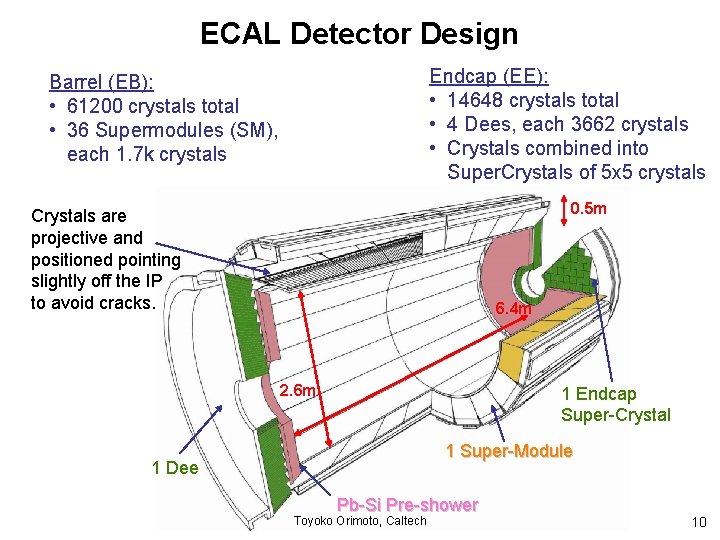
ECAL Detector Design Endcap (EE): • 14648 crystals total • 4 Dees, each 3662 crystals • Crystals combined into Super. Crystals of 5 x 5 crystals Barrel (EB): • 61200 crystals total • 36 Supermodules (SM), each 1. 7 k crystals 0. 5 m Crystals are projective and positioned pointing slightly off the IP to avoid cracks. 6. 4 m 2. 6 m 1 Endcap Super-Crystal 1 Super-Module 1 Dee Pb-Si Pre-shower Toyoko Orimoto, Caltech 10
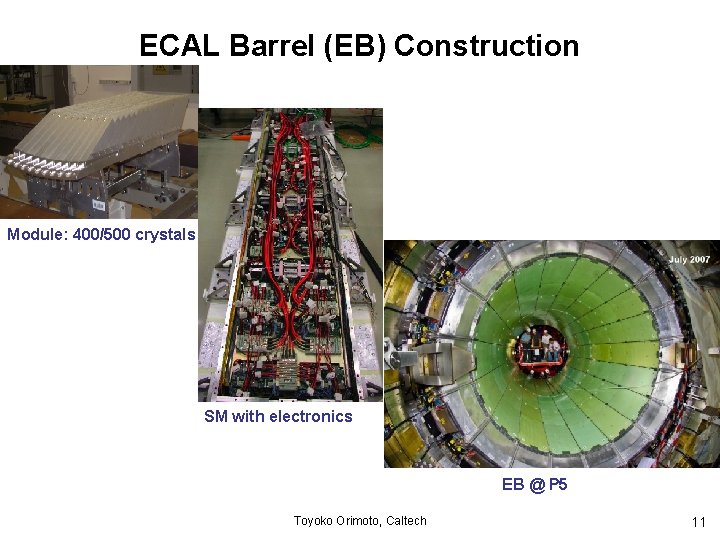
ECAL Barrel (EB) Construction Module: 400/500 crystals SM with electronics EB @ P 5 Toyoko Orimoto, Caltech 11
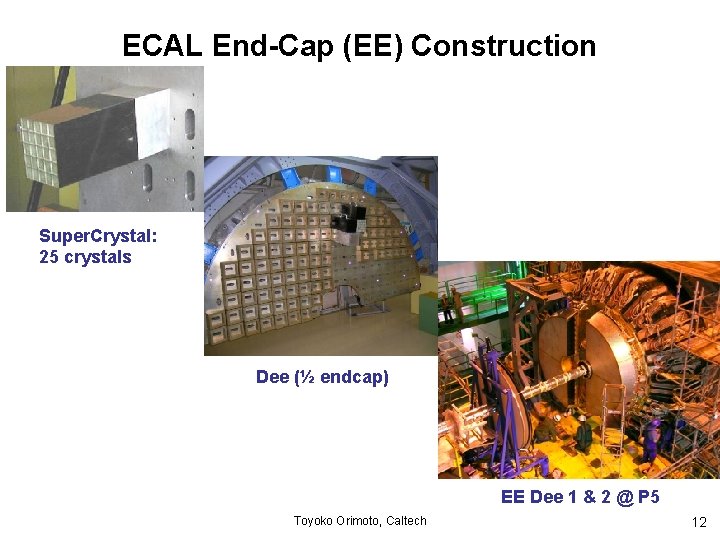
ECAL End-Cap (EE) Construction Super. Crystal: 25 crystals Dee (½ endcap) EE Dee 1 & 2 @ P 5 Toyoko Orimoto, Caltech 12
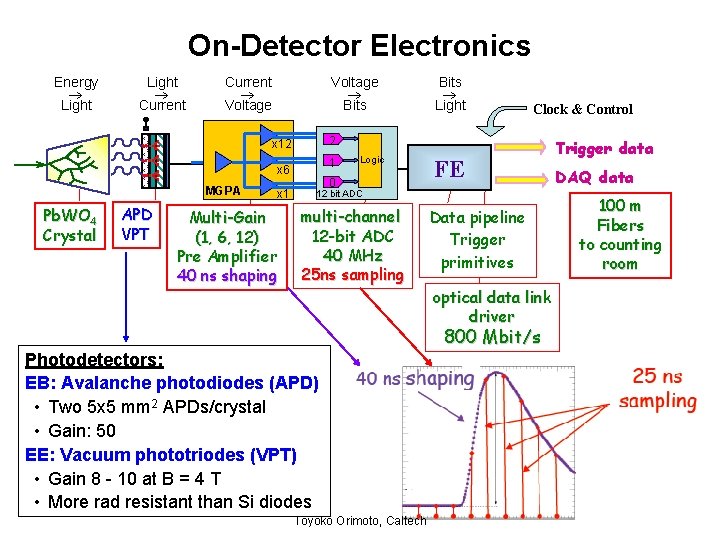
On-Detector Electronics Energy Light Current Voltage Bits 1 x 6 Pb. WO 4 Crystal APD VPT x 1 Multi-Gain (1, 6, 12) Pre Amplifier 40 ns shaping Clock & Control 2 x 12 MGPA Bits Light Logic 0 FE 12 bit ADC multi-channel 12 -bit ADC 40 MHz 25 ns sampling Data pipeline Trigger primitives optical data link driver 800 Mbit/s Photodetectors: EB: Avalanche photodiodes (APD) • Two 5 x 5 mm 2 APDs/crystal • Gain: 50 EE: Vacuum phototriodes (VPT) • Gain 8 - 10 at B = 4 T • More rad resistant than Si diodes Toyoko Orimoto, Caltech Trigger data DAQ data 100 m Fibers to counting room
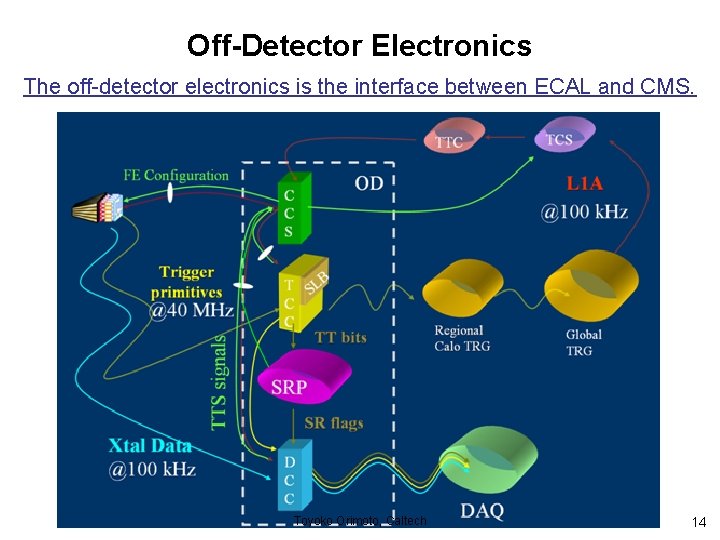
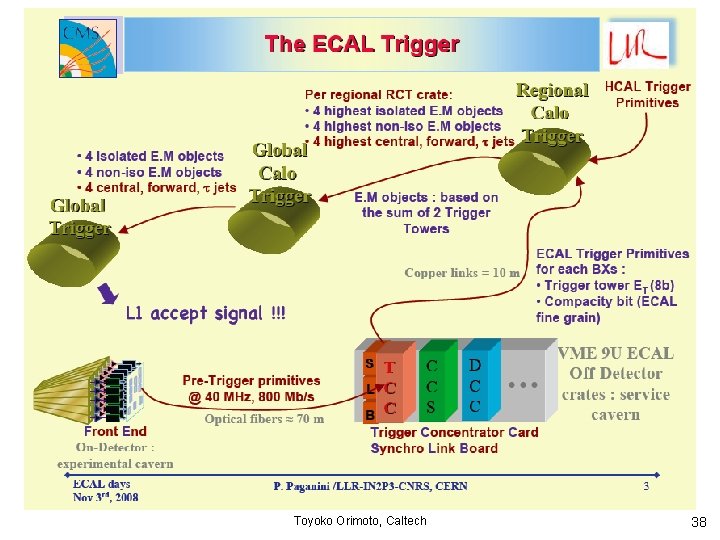
Off-Detector Electronics The off-detector electronics is the interface between ECAL and CMS. Toyoko Orimoto, Caltech 14
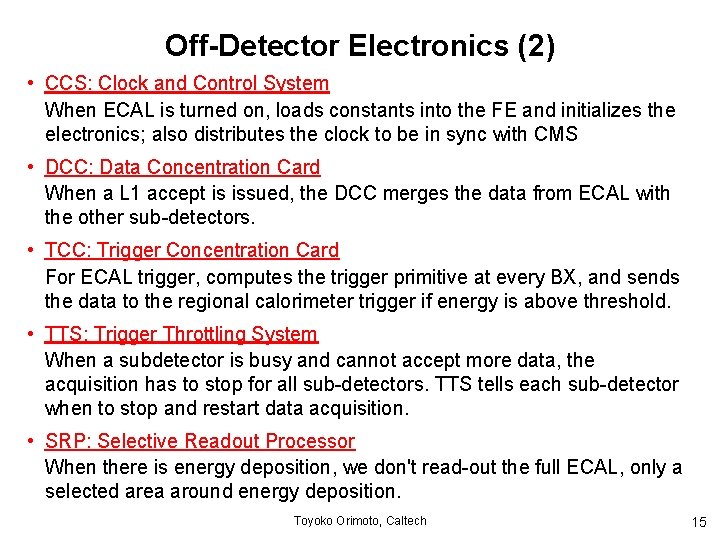
Off-Detector Electronics (2) • CCS: Clock and Control System When ECAL is turned on, loads constants into the FE and initializes the electronics; also distributes the clock to be in sync with CMS • DCC: Data Concentration Card When a L 1 accept is issued, the DCC merges the data from ECAL with the other sub-detectors. • TCC: Trigger Concentration Card For ECAL trigger, computes the trigger primitive at every BX, and sends the data to the regional calorimeter trigger if energy is above threshold. • TTS: Trigger Throttling System When a subdetector is busy and cannot accept more data, the acquisition has to stop for all sub-detectors. TTS tells each sub-detector when to stop and restart data acquisition. • SRP: Selective Readout Processor When there is energy deposition, we don't read-out the full ECAL, only a selected area around energy deposition. Toyoko Orimoto, Caltech 15
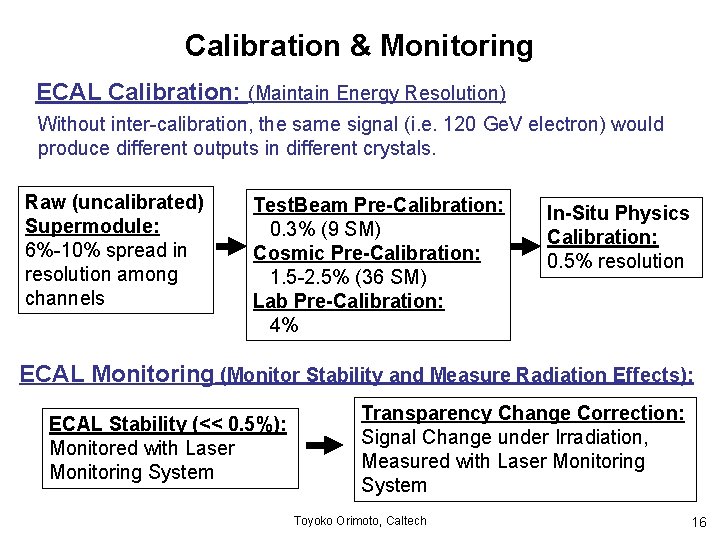
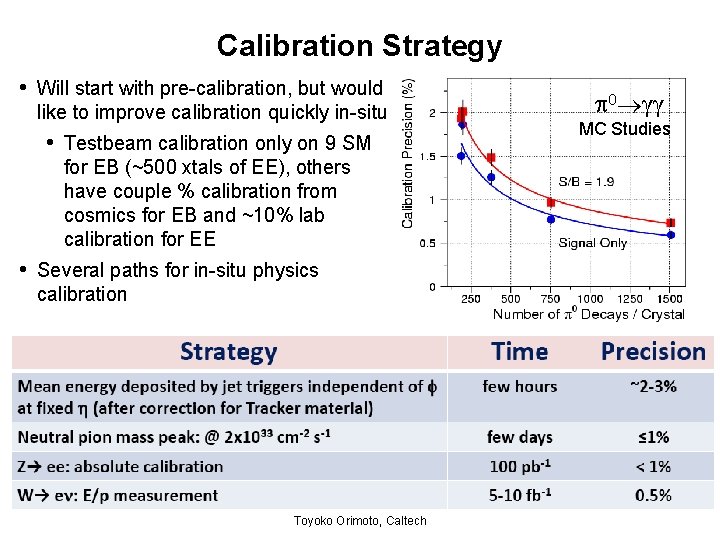
Calibration & Monitoring ECAL Calibration: (Maintain Energy Resolution) Without inter-calibration, the same signal (i. e. 120 Ge. V electron) would produce different outputs in different crystals. Raw (uncalibrated) Supermodule: 6%-10% spread in resolution among channels Test. Beam Pre-Calibration: 0. 3% (9 SM) Cosmic Pre-Calibration: 1. 5 -2. 5% (36 SM) Lab Pre-Calibration: 4% In-Situ Physics Calibration: 0. 5% resolution ECAL Monitoring (Monitor Stability and Measure Radiation Effects): ECAL Stability (<< 0. 5%): Monitored with Laser Monitoring System Transparency Change Correction: Signal Change under Irradiation, Measured with Laser Monitoring System Toyoko Orimoto, Caltech 16
Calibration Strategy • Will start with pre-calibration, but would like to improve calibration quickly in-situ • Testbeam calibration only on 9 SM for EB (~500 xtals of EE), others have couple % calibration from cosmics for EB and ~10% lab calibration for EE • Several paths for in-situ physics calibration Toyoko Orimoto, Caltech γγ MC Studies
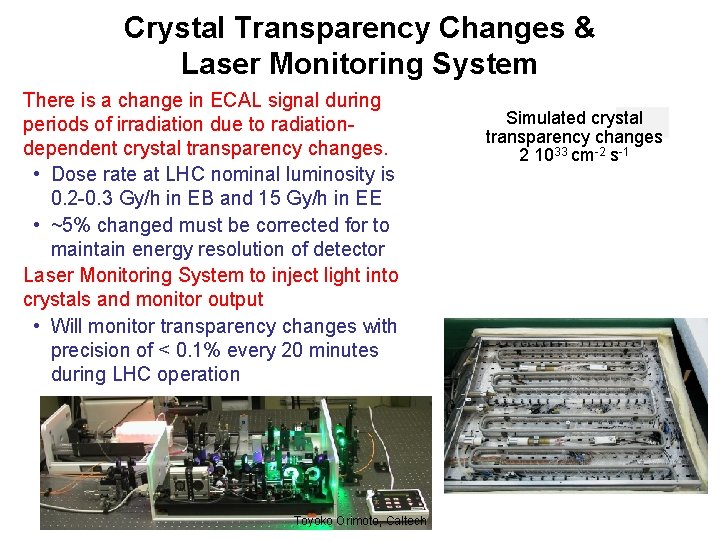
Crystal Transparency Changes & Laser Monitoring System There is a change in ECAL signal during periods of irradiation due to radiationdependent crystal transparency changes. • Dose rate at LHC nominal luminosity is 0. 2 -0. 3 Gy/h in EB and 15 Gy/h in EE • ~5% changed must be corrected for to maintain energy resolution of detector Laser Monitoring System to inject light into crystals and monitor output • Will monitor transparency changes with precision of < 0. 1% every 20 minutes during LHC operation Toyoko Orimoto, Caltech Simulated crystal transparency changes 2 1033 cm-2 s-1
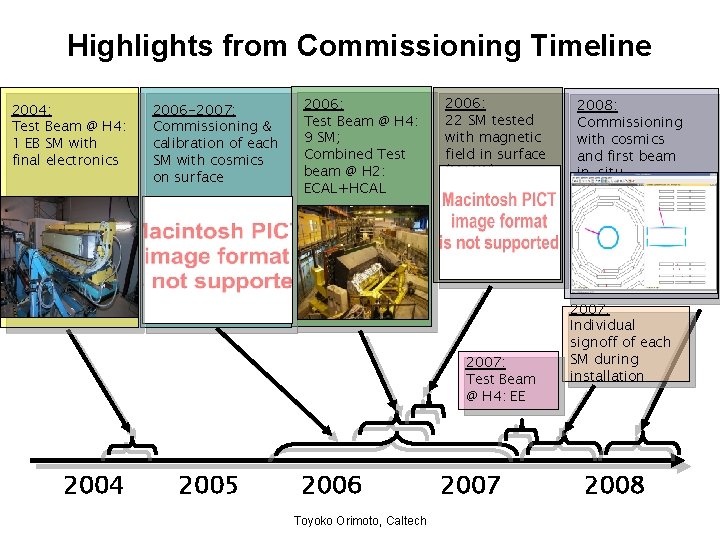
Highlights from Commissioning Timeline 2004: Test Beam @ H 4: 1 EB SM with final electronics 2006 -2007: Commissioning & calibration of each SM with cosmics on surface 2006: Test Beam @ H 4: 9 SM; Combined Test beam @ H 2: ECAL+HCAL 2006: 22 SM tested with magnetic field in surface (MTCC) 2007: Test Beam @ H 4: EE 2004 2005 2006 Toyoko Orimoto, Caltech 2007 2008: Commissioning with cosmics and first beam in-situ 2007: Individual signoff of each SM during installation 2008
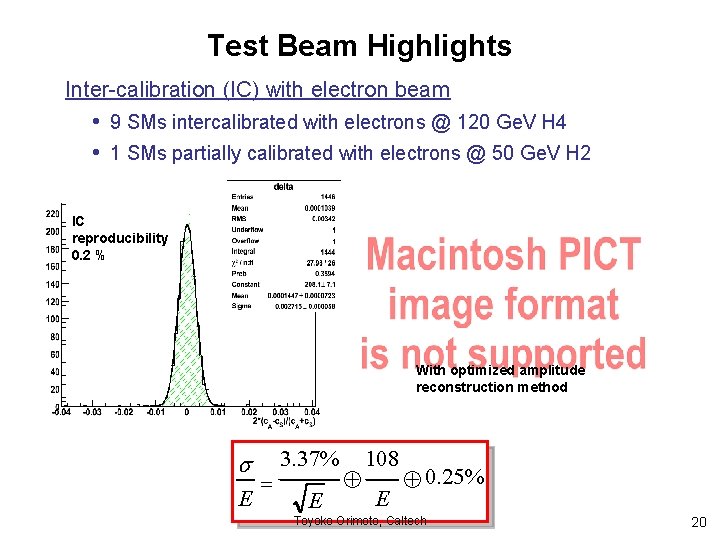
Test Beam Highlights Inter-calibration (IC) with electron beam • 9 SMs intercalibrated with electrons @ 120 Ge. V H 4 • 1 SMs partially calibrated with electrons @ 50 Ge. V H 2 IC reproducibility 0. 2 % With optimized amplitude reconstruction method s E = 3. 37% E 108 E 0. 25% Toyoko Orimoto, Caltech 20
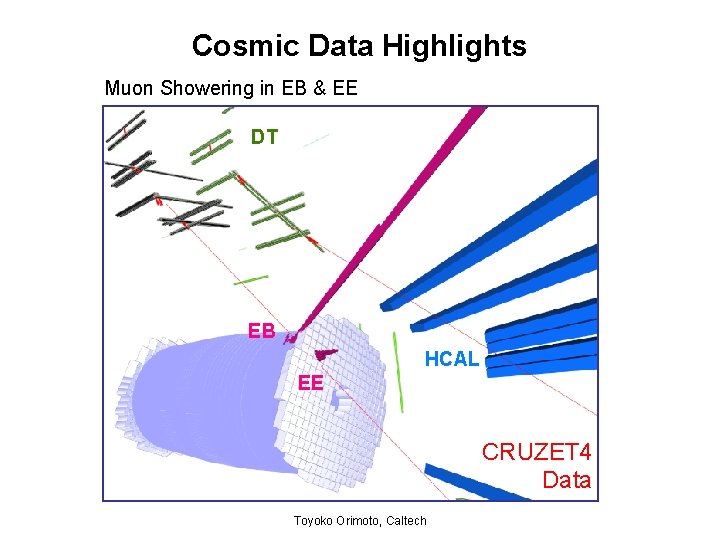
Cosmic Data Highlights Muon Showering in EB & EE DT EB HCAL EE CRUZET 4 Data Toyoko Orimoto, Caltech
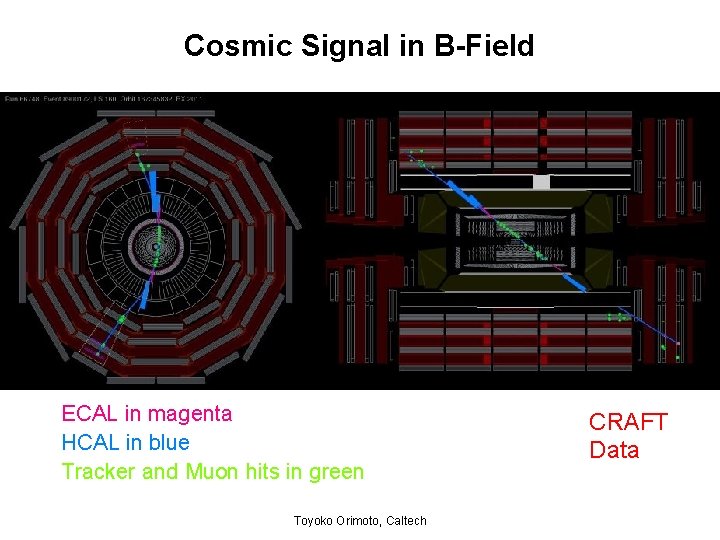
Cosmic Signal in B-Field ECAL in magenta HCAL in blue Tracker and Muon hits in green Toyoko Orimoto, Caltech CRAFT Data
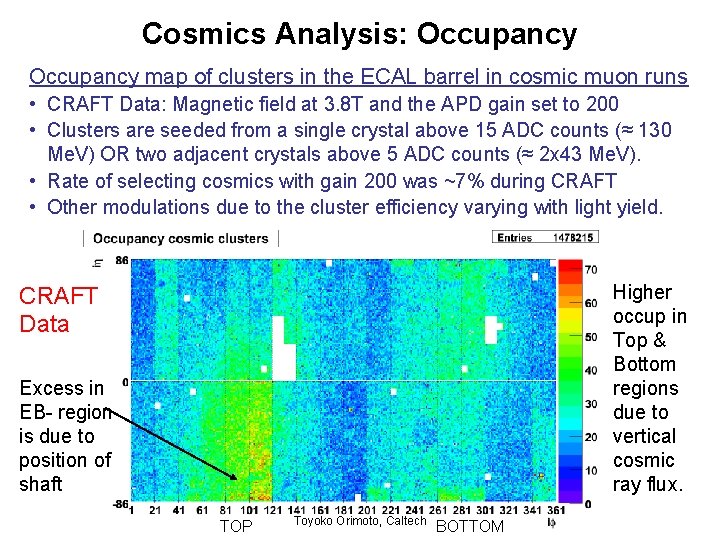
Cosmics Analysis: Occupancy map of clusters in the ECAL barrel in cosmic muon runs • CRAFT Data: Magnetic field at 3. 8 T and the APD gain set to 200 • Clusters are seeded from a single crystal above 15 ADC counts (≈ 130 Me. V) OR two adjacent crystals above 5 ADC counts (≈ 2 x 43 Me. V). • Rate of selecting cosmics with gain 200 was ~7% during CRAFT • Other modulations due to the cluster efficiency varying with light yield. Higher occup in Top & Bottom regions due to vertical cosmic ray flux. CRAFT Data Excess in EB- region is due to position of shaft TOP Toyoko Orimoto, Caltech BOTTOM
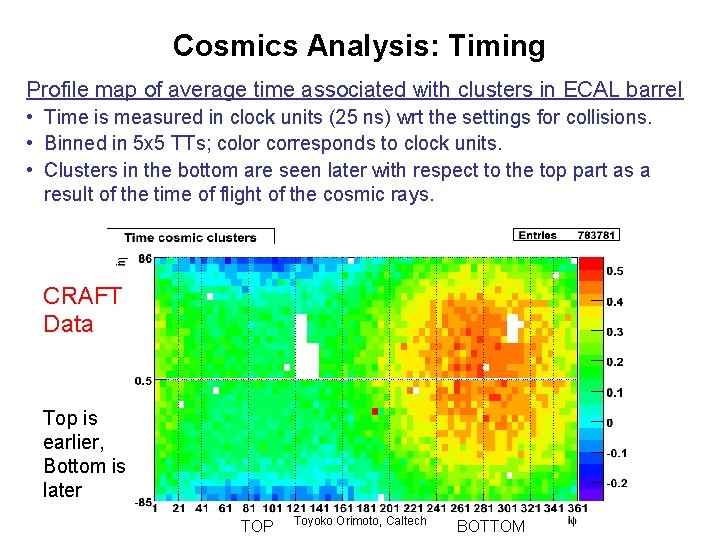
Cosmics Analysis: Timing Profile map of average time associated with clusters in ECAL barrel • Time is measured in clock units (25 ns) wrt the settings for collisions. • Binned in 5 x 5 TTs; color corresponds to clock units. • Clusters in the bottom are seen later with respect to the top part as a result of the time of flight of the cosmic rays. CRAFT Data Top is earlier, Bottom is later TOP Toyoko Orimoto, Caltech BOTTOM
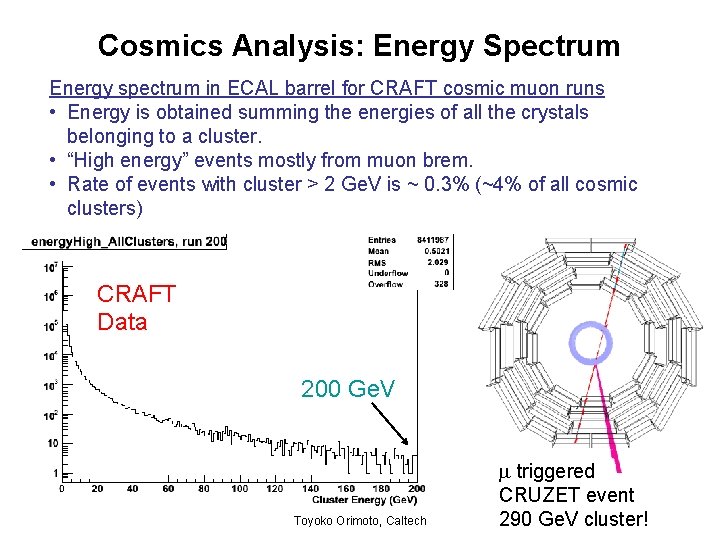
Cosmics Analysis: Energy Spectrum Energy spectrum in ECAL barrel for CRAFT cosmic muon runs • Energy is obtained summing the energies of all the crystals belonging to a cluster. • “High energy” events mostly from muon brem. • Rate of events with cluster > 2 Ge. V is ~ 0. 3% (~4% of all cosmic clusters) CRAFT Data 200 Ge. V Toyoko Orimoto, Caltech m triggered CRUZET event 290 Ge. V cluster!
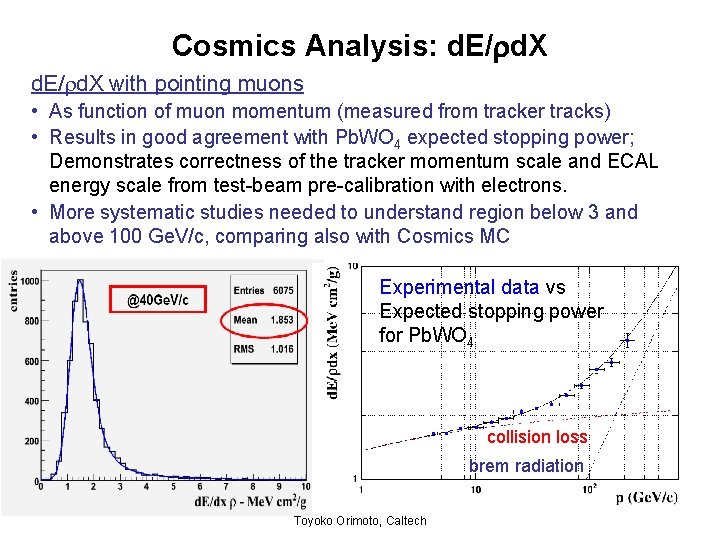
Cosmics Analysis: d. E/ d. X with pointing muons • As function of muon momentum (measured from tracker tracks) • Results in good agreement with Pb. WO 4 expected stopping power; Demonstrates correctness of the tracker momentum scale and ECAL energy scale from test-beam pre-calibration with electrons. • More systematic studies needed to understand region below 3 and above 100 Ge. V/c, comparing also with Cosmics MC Experimental data vs Expected stopping power for Pb. WO 4 collision loss brem radiation Toyoko Orimoto, Caltech
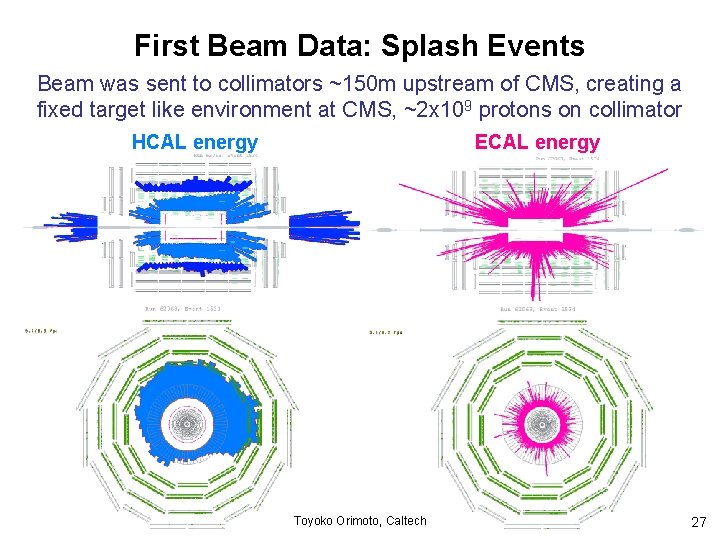
First Beam Data: Splash Events Beam was sent to collimators ~150 m upstream of CMS, creating a fixed target like environment at CMS, ~2 x 10⁹ protons on collimator HCAL energy ECAL energy Toyoko Orimoto, Caltech 27
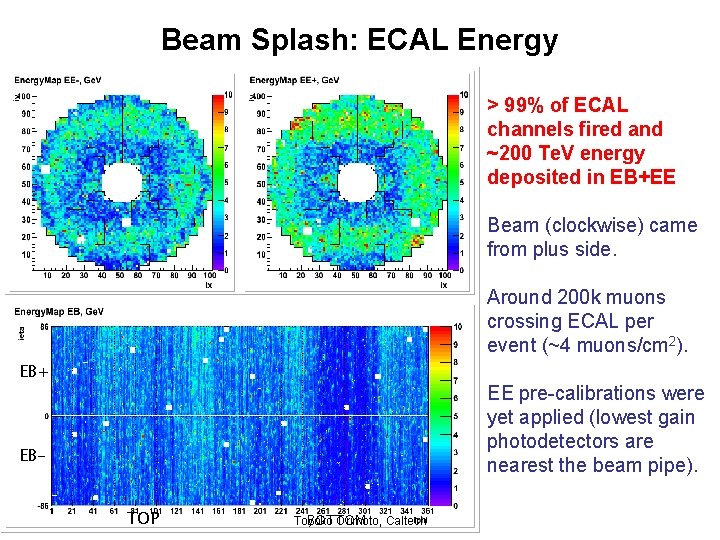
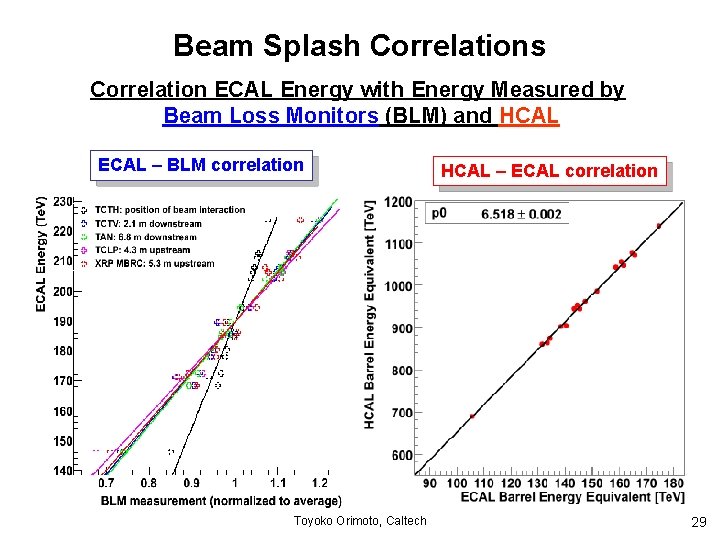
Beam Splash: ECAL Energy > 99% of ECAL channels fired and ~200 Te. V energy deposited in EB+EE Beam (clockwise) came from plus side. Around 200 k muons crossing ECAL per event (~4 muons/cm 2). EB+ EE pre-calibrations were yet applied (lowest gain photodetectors are nearest the beam pipe). EBTOP BOTTOM Toyoko Orimoto, Caltech
Beam Splash Correlations Correlation ECAL Energy with Energy Measured by Beam Loss Monitors (BLM) and HCAL ECAL – BLM correlation Toyoko Orimoto, Caltech HCAL – ECAL correlation 29
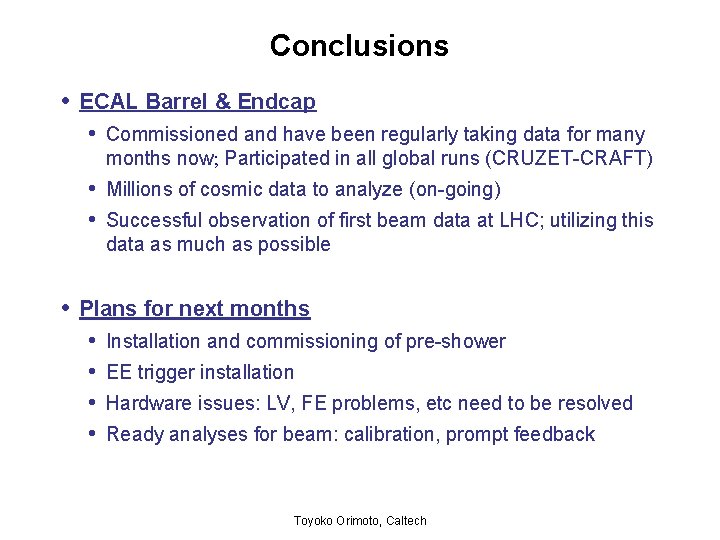
Conclusions • ECAL Barrel & Endcap • Commissioned and have been regularly taking data for many months now; Participated in all global runs (CRUZET-CRAFT) • Millions of cosmic data to analyze (on-going) • Successful observation of first beam data at LHC; utilizing this data as much as possible • Plans for next months • • Installation and commissioning of pre-shower EE trigger installation Hardware issues: LV, FE problems, etc need to be resolved Ready analyses for beam: calibration, prompt feedback Toyoko Orimoto, Caltech
Interested in Joining the ECAL PFG? ECAL Prompt Feedback Group (PFG) • Great place for newcomers to start; many young students have started • • • their work on CMS with our group. Great way to gain ECAL expertise, but also to learn how to access and analyze data quickly, trouble shoot problems, etc… Most of the results shown today have been produced by the PFG Prerequisites are a basic knowledge of CMSSW and ECAL, availability to take on-duty shifts and attend PFG meetings; also, your institution should be a part of ECAL Group. Toyoko Orimoto, Caltech
Reference Links • CMS 101 Workshop (very nice ECAL intro): • • http: //indico. cern. ch/conference. Display. py? conf. Id=35545 LPC Run Plan Workshop (ECAL Talk, a bit outdated): http: //indico. cern. ch/get. File. py/access? res. Id=0&mater ial. Id=slides&contrib. Id=44&session. Id=7&sub. Cont. Id=2&conf Id=30825 ECAL Cosmics Analysis Tutorial (also a bit outdated but still interesting and informative): http: //indico. cern. ch/contribution. Display. py? contrib. Id= 4&conf. Id=32360 ECAL CRAFT Results: http: //indico. cern. ch/conference. Display. py? conf. Id=46 935 ECAL TDR: http: //cmsdoc. cern. ch/ftp/TDR/ECAL/ecal. html Toyoko Orimoto, Caltech
Extra Slides Toyoko Orimoto, Caltech
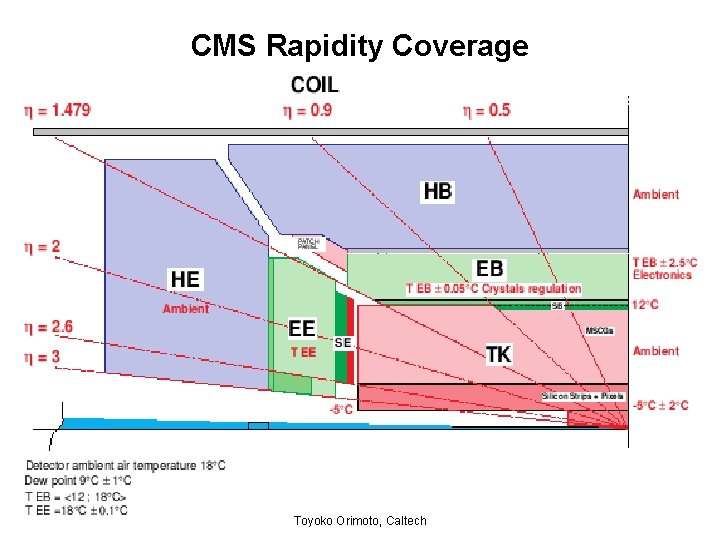
CMS Rapidity Coverage Toyoko Orimoto, Caltech
Toyoko Orimoto, Caltech 35
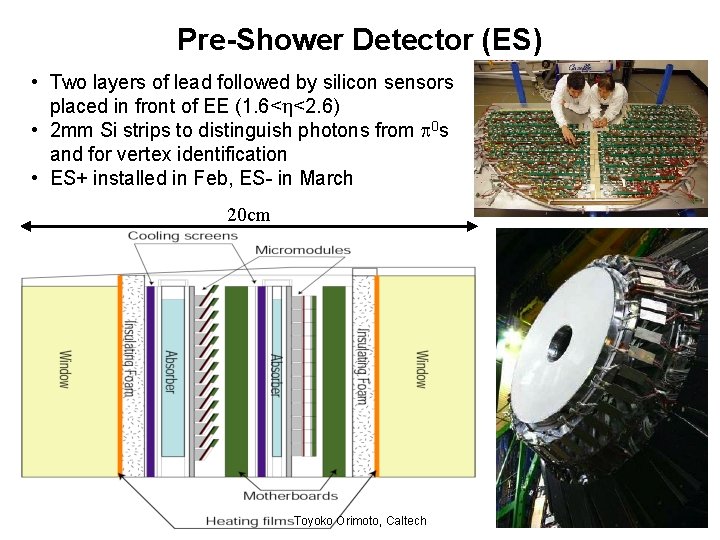
Pre-Shower Detector (ES) • Two layers of lead followed by silicon sensors placed in front of EE (1. 6< <2. 6) • 2 mm Si strips to distinguish photons from 0 s and for vertex identification • ES+ installed in Feb, ES- in March 20 cm Toyoko Orimoto, Caltech 36
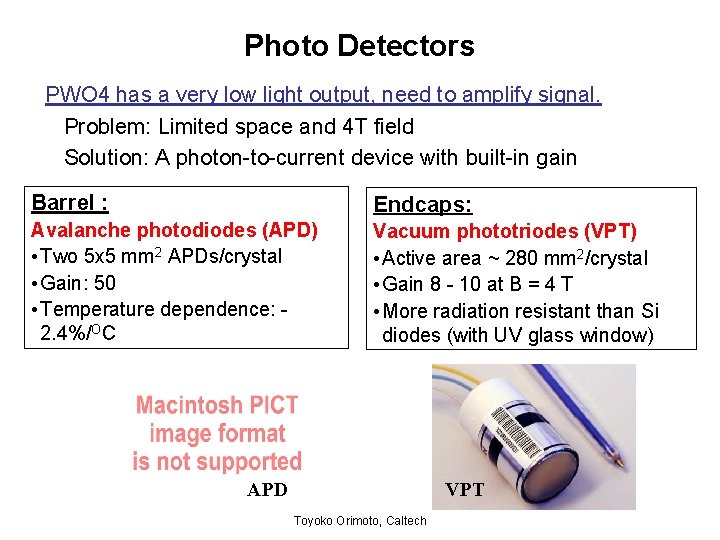
Photo Detectors PWO 4 has a very low light output, need to amplify signal. Problem: Limited space and 4 T field Solution: A photon-to-current device with built-in gain Barrel : Endcaps: Avalanche photodiodes (APD) • Two 5 x 5 mm 2 APDs/crystal • Gain: 50 • Temperature dependence: 2. 4%/OC Vacuum phototriodes (VPT) • Active area ~ 280 mm 2/crystal • Gain 8 - 10 at B = 4 T • More radiation resistant than Si diodes (with UV glass window) APD VPT Toyoko Orimoto, Caltech
Toyoko Orimoto, Caltech 38
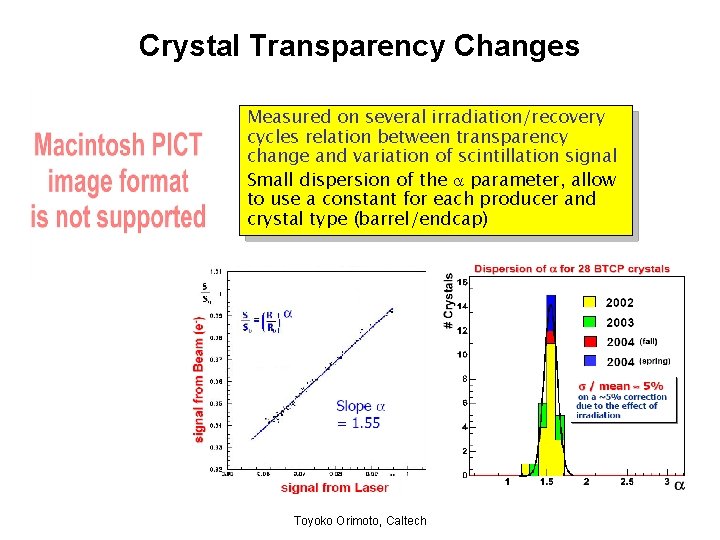
Crystal Transparency Changes Measured on several irradiation/recovery cycles relation between transparency change and variation of scintillation signal Small dispersion of the parameter, allow to use a constant for each producer and crystal type (barrel/endcap) Toyoko Orimoto, Caltech
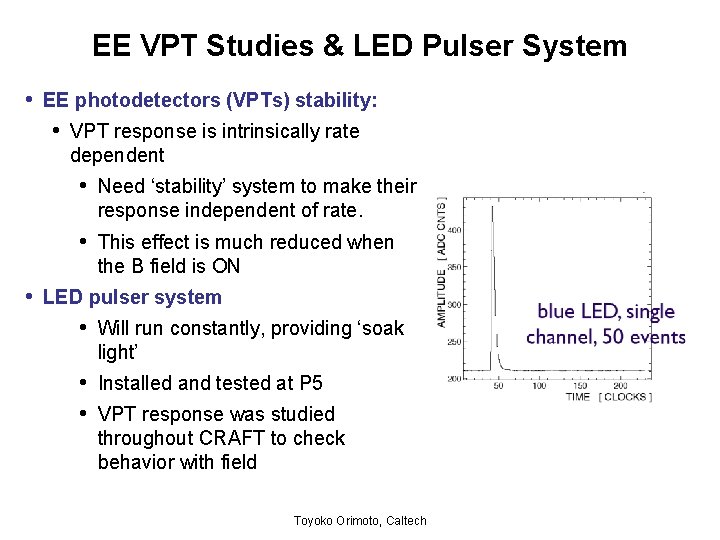
EE VPT Studies & LED Pulser System • EE photodetectors (VPTs) stability: • VPT response is intrinsically rate dependent • Need ‘stability’ system to make their response independent of rate. • This effect is much reduced when the B field is ON • LED pulser system • Will run constantly, providing ‘soak light’ • Installed and tested at P 5 • VPT response was studied throughout CRAFT to check behavior with field Toyoko Orimoto, Caltech
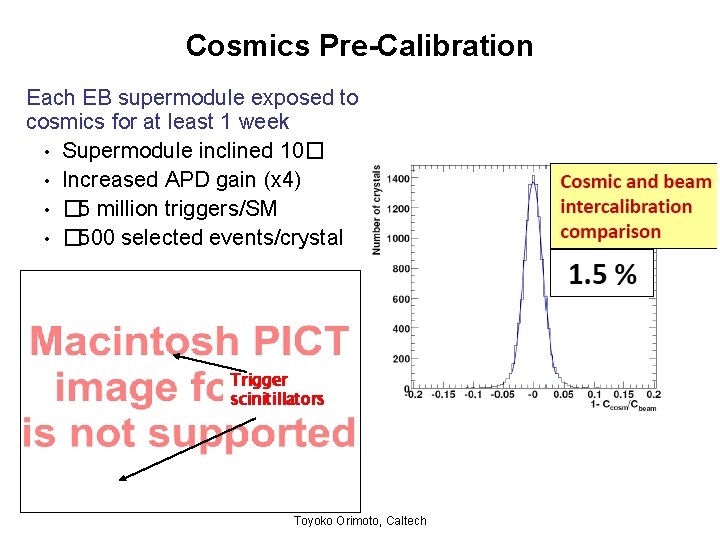
Cosmics Pre-Calibration Each EB supermodule exposed to cosmics for at least 1 week • Supermodule inclined 10� • Increased APD gain (x 4) • � 5 million triggers/SM • � 500 selected events/crystal Trigger scinitillators Toyoko Orimoto, Caltech
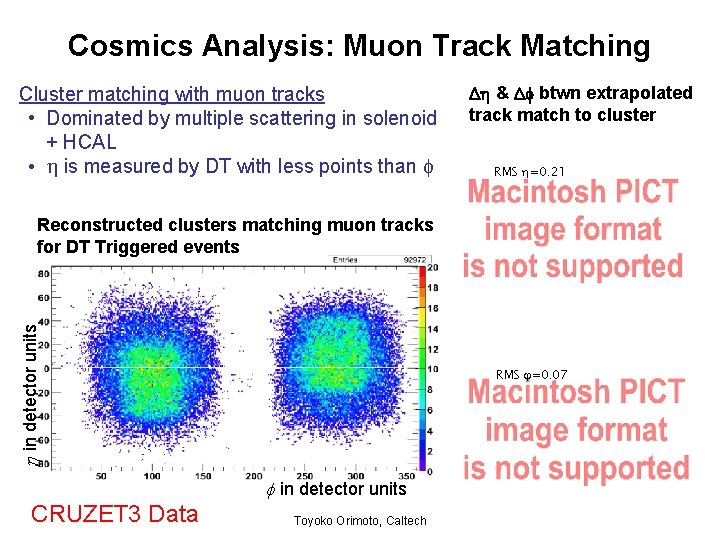
Cosmics Analysis: Muon Track Matching Cluster matching with muon tracks • Dominated by multiple scattering in solenoid + HCAL • is measured by DT with less points than & btwn extrapolated track match to cluster RMS =0. 21 in detector units Reconstructed clusters matching muon tracks for DT Triggered events RMS =0. 07 in detector units CRUZET 3 Data Toyoko Orimoto, Caltech