
CMPUT 301 Lecture 35 Computer Assisted Collaboration Martin
CMPUT 301: Lecture 35 Computer Assisted Collaboration Martin Jagersand Department of Computing Science University of Alberta Based on notes from Pierre Boulanger, Ken Wong, Martin Jagersand

What is Groupware? • Groupware is technology designed to facilitate the work of groups. • To communicate, cooperate, coordinate, solve problems, compete, or negotiate. • Uses technologies relying on modern computer networks, such as email, newsgroups, videophones, or chat. 2

Groupware technologies two primary dimensions: Same time "synchronous“ Same place (co • voting, -located) presentation support Different place • videophones, chat Different time "asynchronous“ • shared computers • Email, workflow 3
CSCW Computer-Supported Cooperative Work • The field of study which examines the design, adoption, and use of groupware • examines cooperation, competition, socialization, and play. 4

Groupware Design • More than Traditional User Interface Design – understanding groups and how people behave in groups. – understanding of networking technology – E. g. how delays in synchronizing views) affect a user's experience. 5
Asynchronous Groupware • Email – by far the most common groupware application, – messages between 2 people, – mailing groups, – attaching files with a message. • Newsgroups – messages among large groups of people – explicitly requested (an "on-demand" service), 6
Asynchronous Groupware 2 • Group calendars – detect when schedules conflict or – Find meeting times that will work for everyone. – help to locate people. • Workflow systems – allow documents to be routed through organizations through a relatively-fixed process. E. g. expense report • Collaborative writing systems – allowing users to track changes and make annotations to documents. 7
Synchronous or Realtime Groupware • Shared whiteboards – allow two or more people to view and draw on a shared drawing surface – different locations. • Video communications – multi-way calling with live video, – essentially a telephone system with an additional visual component. • 3 D immersive AR/VR meetings 8
The Virtual Meeting Place Project • Goal: The main goal of this project is to create a general man-machine interface that is at the focal point of this integration. • Based on VIT VR technology and high speed networks, this interface should allow people to naturally interact with the system and communicate their design over long distances, producing the equivalent of a Virtual Meeting Place. 9
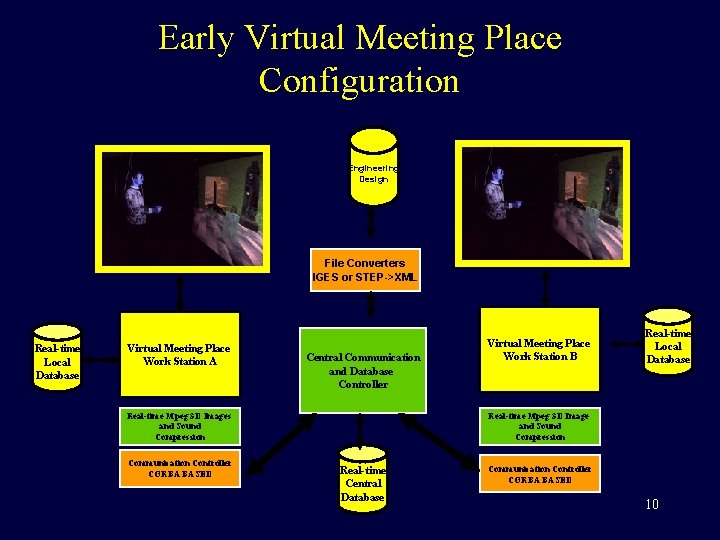
Early Virtual Meeting Place Configuration Engineering Design File Converters IGES or STEP->XML Real-time Local Database Virtual Meeting Place Work Station A Central Communication and Database Controller Real-time Mpeg 3 D Images and Sound Compression Communication Controller CORBA BASED Virtual Meeting Place Work Station B Real-time Local Database Real-time Mpeg 3 D Image and Sound Compression Real-time Central Database Communication Controller CORBA BASED 10
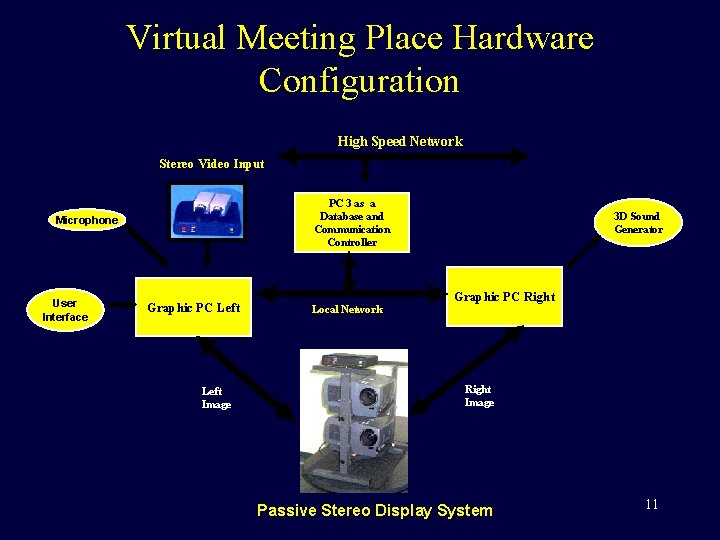
Virtual Meeting Place Hardware Configuration High Speed Network Stereo Video Input PC 3 as a Database and Communication Controller Microphone User Interface Graphic PC Left Image Local Network 3 D Sound Generator Graphic PC Right Image Passive Stereo Display System 11
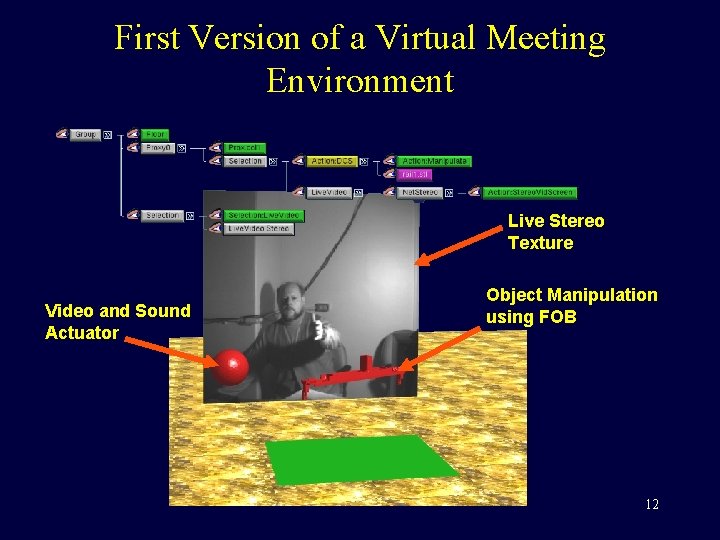
First Version of a Virtual Meeting Environment Live Stereo Texture Video and Sound Actuator Object Manipulation using FOB 12
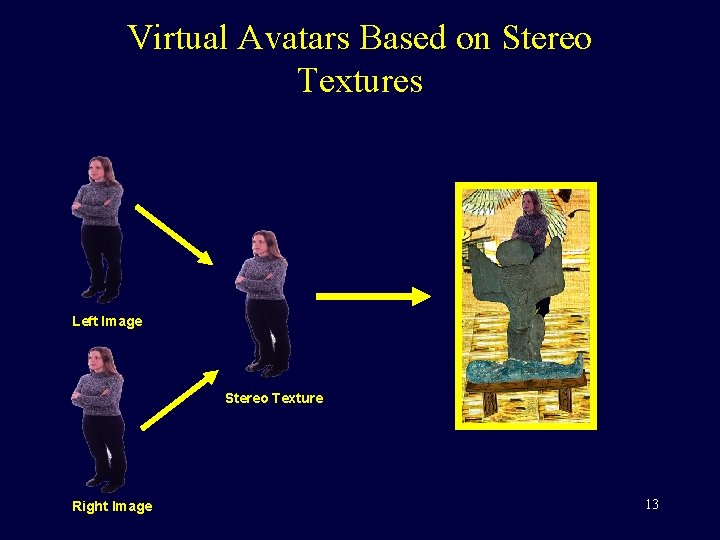
Virtual Avatars Based on Stereo Textures Left Image Stereo Texture Right Image 13
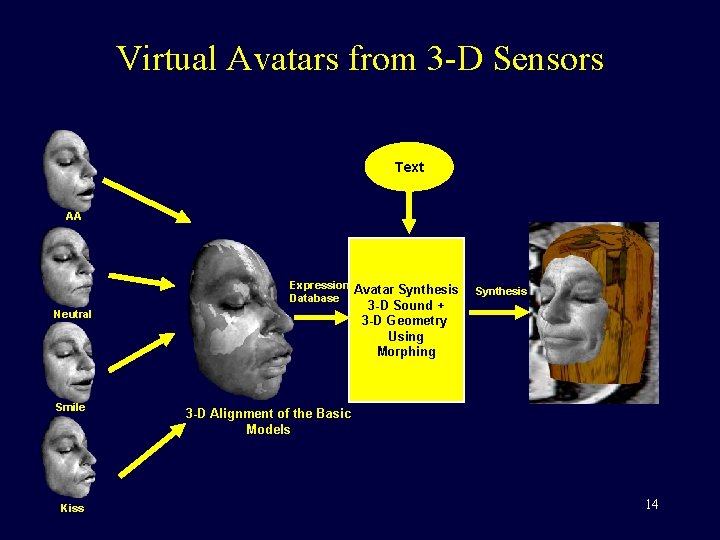
Virtual Avatars from 3 -D Sensors Text AA Expression Avatar Synthesis Database 3 -D Sound + 3 -D Geometry Using Morphing Neutral Smile Kiss Synthesis 3 -D Alignment of the Basic Models 14
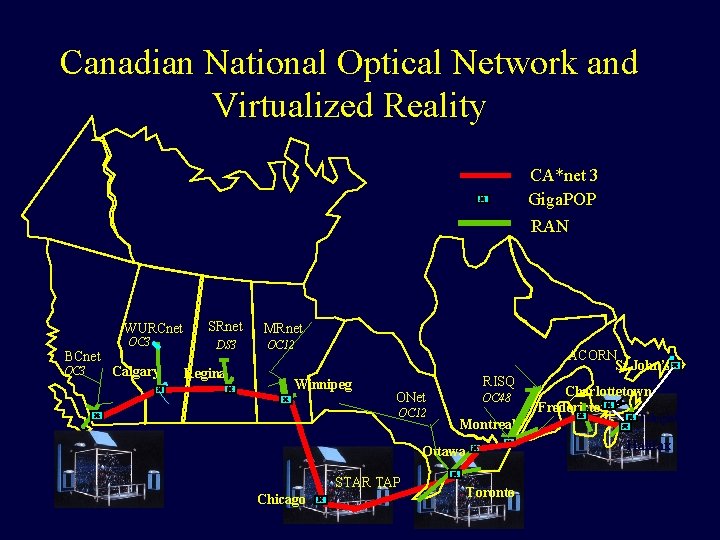
Canadian National Optical Network and Virtualized Reality CA*net 3 Giga. POP RAN WURCnet OC 3 BCnet OC 3 Calgary SRnet MRnet DS 3 OC 12 Regina ACORN St John’s Winnipeg RISQ ONet OC 12 Vancouver OC 48 Montreal Chicago Teleglobe Halifax Ottawa STAR TAP Charlottetown Fredericton Toronto
16
Future of the Technology • This technology can be the basis of a new and more intuitive way of interacting over distances. • Could improve planning and monitoring of the day-to-day operations of many industrial processes by increasing the level of awareness • It is a generic technology that integrates all the information known about a system into a coherent and intuitive representation
- Slides: 17