
CMPU102 51 Spring 2020 Data Structures and Algorithms
![Java array initialization • Initialization using default value for type: – String[] names; names](https://slidetodoc.com/presentation_image_h2/35e9af2a63490155bb59b58fb221ec7b/image-7.jpg "Java array initialization • Initialization using default value for type: – String[] names; names")
![Array access • Individual array elements can be accessed using var. Name[idx] – idx](https://slidetodoc.com/presentation_image_h2/35e9af2a63490155bb59b58fb221ec7b/image-8.jpg "Array access • Individual array elements can be accessed using var. Name[idx] – idx")
![Accessing multi-dimensional arrays • Concatenation of []s used to access inner dimensions • Example](https://slidetodoc.com/presentation_image_h2/35e9af2a63490155bb59b58fb221ec7b/image-12.jpg "Accessing multi-dimensional arrays • Concatenation of []s used to access inner dimensions • Example")
- Slides: 19
CMPU-102 -51 Spring 2020 Data Structures and Algorithms Lecture #6: Java arrays; variable scope; Rui Meireles Peter Lemieszewski
Previously, on CMPU-102… • Object-Oriented Programming (OOP) – 3 pillars: encapsulation, inheritance, polymorphism • Introduction to Java – Classes, methods, fields – Static members – Packages and import statements – Expressions – Text input/output – Control flow 2
The array data structure (IPUJ 3. 8) 3
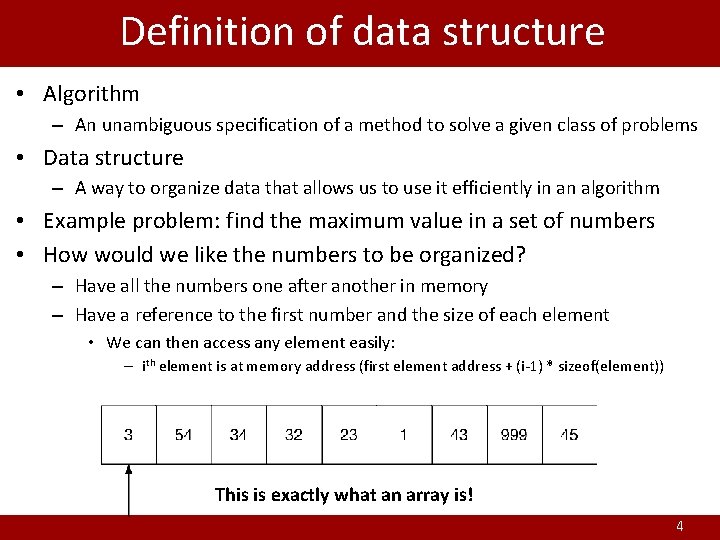
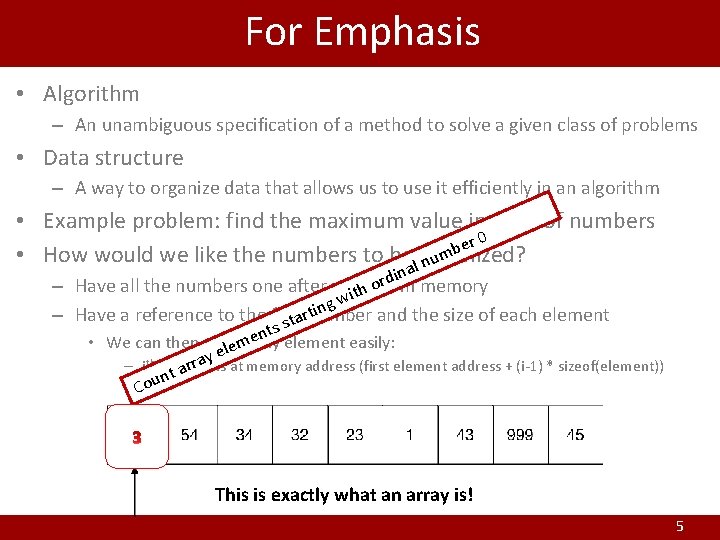
Definition of data structure • Algorithm – An unambiguous specification of a method to solve a given class of problems • Data structure – A way to organize data that allows us to use it efficiently in an algorithm • Example problem: find the maximum value in a set of numbers • How would we like the numbers to be organized? – Have all the numbers one after another in memory – Have a reference to the first number and the size of each element • We can then access any element easily: – ith element is at memory address (first element address + (i-1) * sizeof(element)) This is exactly what an array is! 4
For Emphasis • Algorithm – An unambiguous specification of a method to solve a given class of problems • Data structure – A way to organize data that allows us to use it efficiently in an algorithm • Example problem: find the maximum value in a set of numbers er 0 b • How would we like the numbers to be lorganized? num ina d r – Have all the numbers one after another h o in memory t i gw n i t – Have a reference to the first starnumber and the size of each element s t n element easily: eany • We can then access m ele y a th – i element arr is at memory address (first element address + (i-1) * sizeof(element)) t n Cou This is exactly what an array is! 5
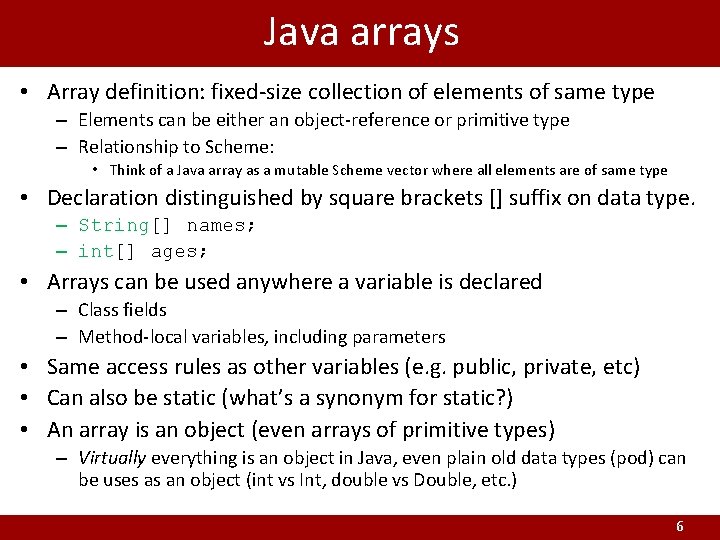
Java arrays • Array definition: fixed-size collection of elements of same type – Elements can be either an object-reference or primitive type – Relationship to Scheme: • Think of a Java array as a mutable Scheme vector where all elements are of same type • Declaration distinguished by square brackets [] suffix on data type. – String[] names; – int[] ages; • Arrays can be used anywhere a variable is declared – Class fields – Method-local variables, including parameters • Same access rules as other variables (e. g. public, private, etc) • Can also be static (what’s a synonym for static? ) a: common • An array is an object (even arrays of primitive types) – Virtually everything is an object in Java, even plain old data types (pod) can be uses as an object (int vs Int, double vs Double, etc. ) 6
Java array initialization • Initialization using default value for type: – String[] names; names = new String[100]; // reserve memory for 100 element String array – int[] ages = new int[100]; – Note even primitive types require the new keyword • Because arrays are always objects, we must reserve memory for each unit/element! • Initialization by enumeration: – String[] names = {"Dorothy", "Tin Man", "Lion"}; – int[] ages = {16, 35, 12}; • Once an array is initialized, its length is forever fixed – Why? Java will use the memory immediately after it for something else – Can be accessed as <array>. length, e. g. ages. length, names. length 7
Array access • Individual array elements can be accessed using var. Name[idx] – idx is integer expression representing the position of the element we want • Indices in Java begin at zero and go to array length – 1 – Every array has a length field – Trying to access elements outside of this range will yield an Array. Index. Out. Of. Bounds. Exception a[2] a[3] • Examples: int[] array = {3, 54, 32, 23, 1, 43, 999, 45}; int first. Element = a[0]; // first. Element = 3; int first. Two = a[0] + a[1]; // first. Two = 3 + 54 = 57 a[a. length-1] = 0; // last element of set to 0 8
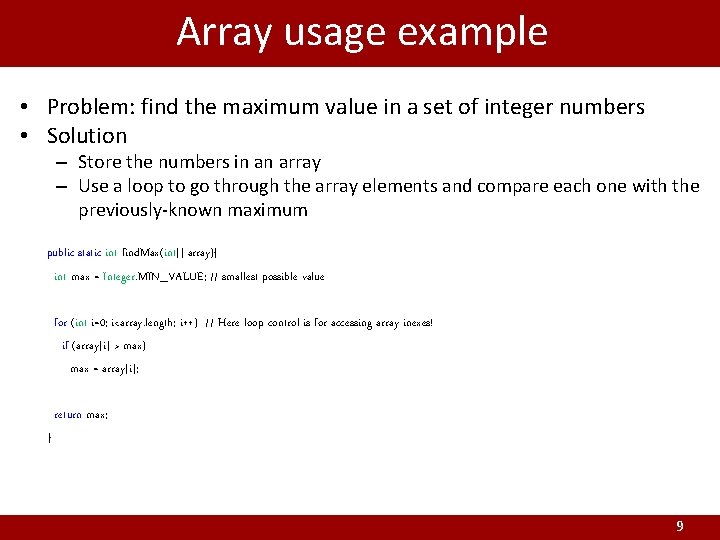
Array usage example • Problem: find the maximum value in a set of integer numbers • Solution – Store the numbers in an array – Use a loop to go through the array elements and compare each one with the previously-known maximum public static int find. Max(int[] array){ int max = Integer. MIN_VALUE; // smallest possible value for (int i=0; i<array. length; i++) // Here loop control is for accessing array inexes! if (array[i] > max) max = array[i]; return max; } 9
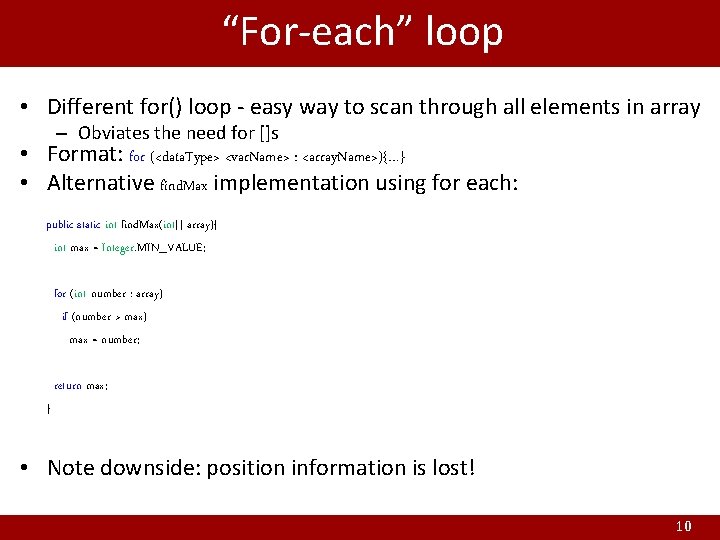
“For-each” loop • Different for() loop - easy way to scan through all elements in array – Obviates the need for []s • Format: for (<data. Type> <var. Name> : <array. Name>){…} • Alternative find. Max implementation using for each: public static int find. Max(int[] array){ int max = Integer. MIN_VALUE; for (int number : array) if (number > max) max = number; return max; } • Note downside: position information is lost! 10
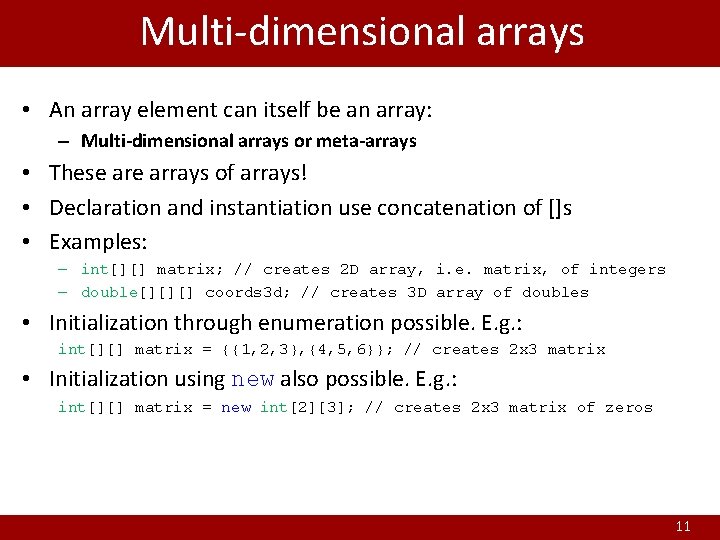
Multi-dimensional arrays • An array element can itself be an array: – Multi-dimensional arrays or meta-arrays • These arrays of arrays! • Declaration and instantiation use concatenation of []s • Examples: – int[][] matrix; // creates 2 D array, i. e. matrix, of integers – double[][][] coords 3 d; // creates 3 D array of doubles • Initialization through enumeration possible. E. g. : int[][] matrix = {{1, 2, 3}, {4, 5, 6}}; // creates 2 x 3 matrix • Initialization using new also possible. E. g. : int[][] matrix = new int[2][3]; // creates 2 x 3 matrix of zeros 11
Accessing multi-dimensional arrays • Concatenation of []s used to access inner dimensions • Example for int[][] m = {{3, 94, 67}, {4, 44, 13}}; 12
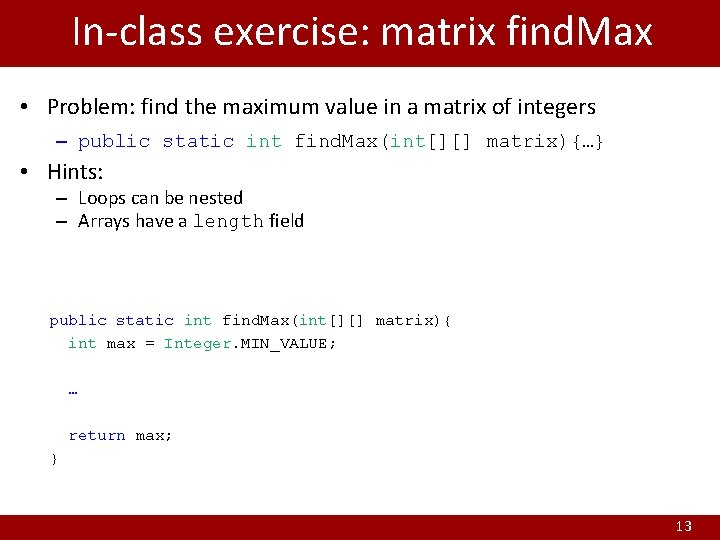
In-class exercise: matrix find. Max • Problem: find the maximum value in a matrix of integers – public static int find. Max(int[][] matrix){…} • Hints: – Loops can be nested – Arrays have a length field public static int find. Max(int[][] matrix){ int max = Integer. MIN_VALUE; … return max; } 13
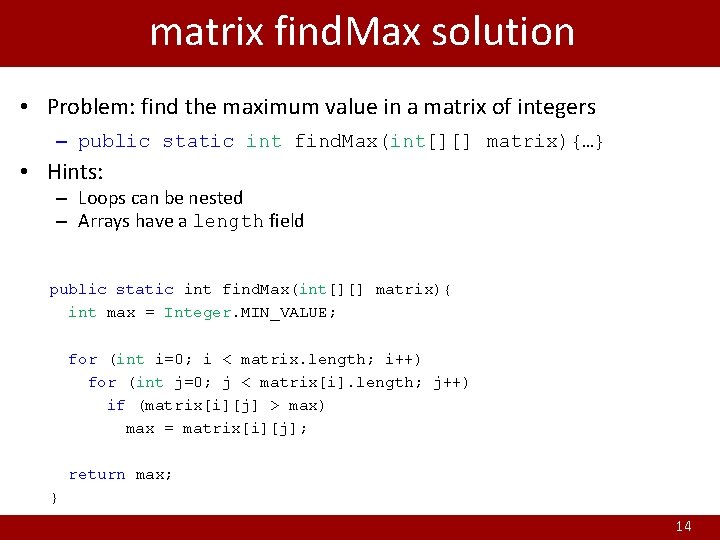
matrix find. Max solution • Problem: find the maximum value in a matrix of integers – public static int find. Max(int[][] matrix){…} • Hints: – Loops can be nested – Arrays have a length field public static int find. Max(int[][] matrix){ int max = Integer. MIN_VALUE; for (int i=0; i < matrix. length; i++) for (int j=0; j < matrix[i]. length; j++) if (matrix[i][j] > max) max = matrix[i][j]; return max; } 14
Java variable scope 15
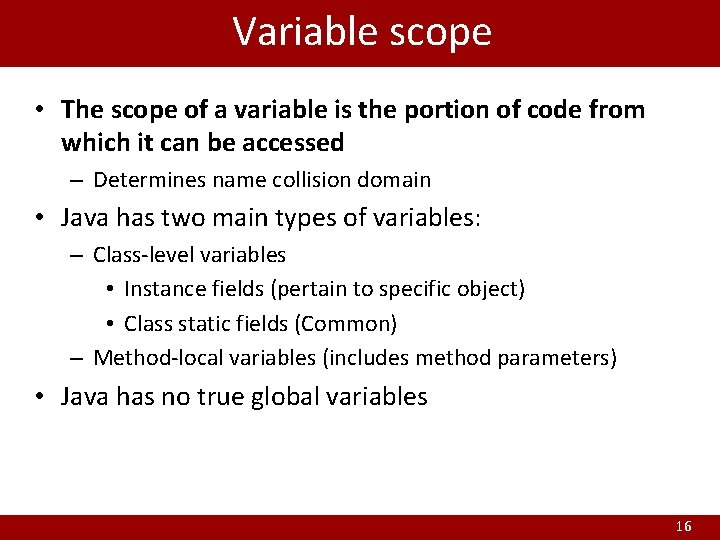
Variable scope • The scope of a variable is the portion of code from which it can be accessed – Determines name collision domain • Java has two main types of variables: – Class-level variables • Instance fields (pertain to specific object) • Class static fields (Common) – Method-local variables (includes method parameters) • Java has no true global variables 16
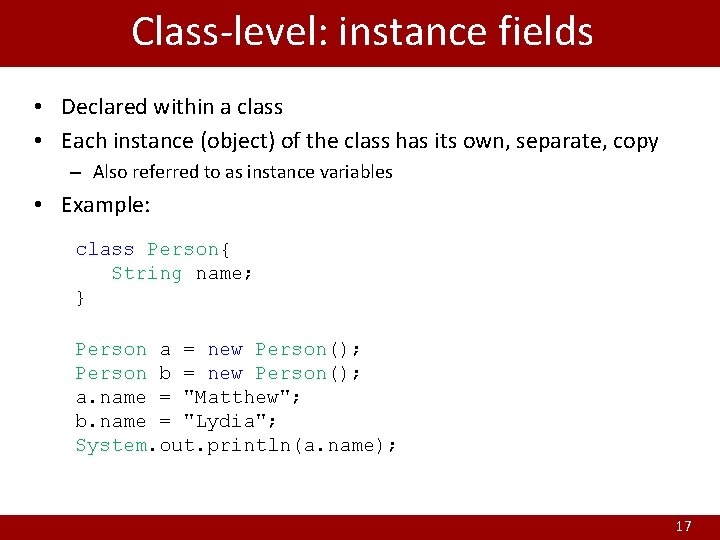
Class-level: instance fields • Declared within a class • Each instance (object) of the class has its own, separate, copy – Also referred to as instance variables • Example: class Person{ String name; } Person a = new Person(); Person b = new Person(); a. name = "Matthew"; b. name = "Lydia"; System. out. println(a. name); 17
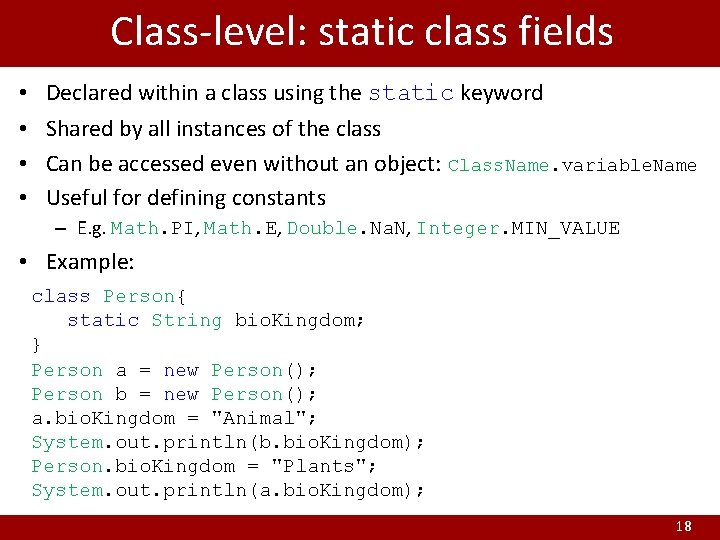
Class-level: static class fields • • Declared within a class using the static keyword Shared by all instances of the class Can be accessed even without an object: Class. Name. variable. Name Useful for defining constants – E. g. Math. PI, Math. E, Double. Na. N, Integer. MIN_VALUE • Example: class Person{ static String bio. Kingdom; } Person a = new Person(); Person b = new Person(); a. bio. Kingdom = "Animal"; System. out. println(b. bio. Kingdom); Person. bio. Kingdom = "Plants"; System. out. println(a. bio. Kingdom); 18
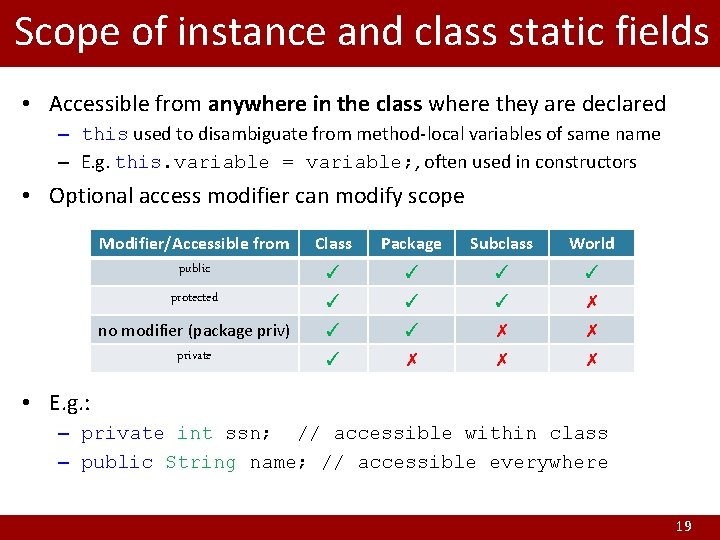
Scope of instance and class static fields • Accessible from anywhere in the class where they are declared – this used to disambiguate from method-local variables of same name – E. g. this. variable = variable; , often used in constructors • Optional access modifier can modify scope Modifier/Accessible from public Class Package Subclass World ✓ ✓ protected ✓ ✓ ✓ ✗ no modifier (package priv) private ✓ ✓ ✗ ✗ ✗ • E. g. : – private int ssn; // accessible within class – public String name; // accessible everywhere 19