
CMPU102 51 Spring 2020 Data Structures and Algorithms
![Set example usage String[] names = {"Jay", "Alice", "Melvor", "Erica"}; Set<String> nset = new](https://slidetodoc.com/presentation_image/2af7d2a3dcc0b6802411c848659bd7df/image-11.jpg "Set example usage String[] names = {\"Jay\", \"Alice\", \"Melvor\", \"Erica\"}; Set<String> nset = new")
- Slides: 16
CMPU-102 -51 Spring 2020 Data Structures and Algorithms Lecture #17: Java’s collections: Iterator, sets Rui Meireles Peter Lemieszewski
Java’s collections framework (IPUJ Chapter 10) 2
Java collections framework • Set of ADT interfaces and data structures that implement them 3
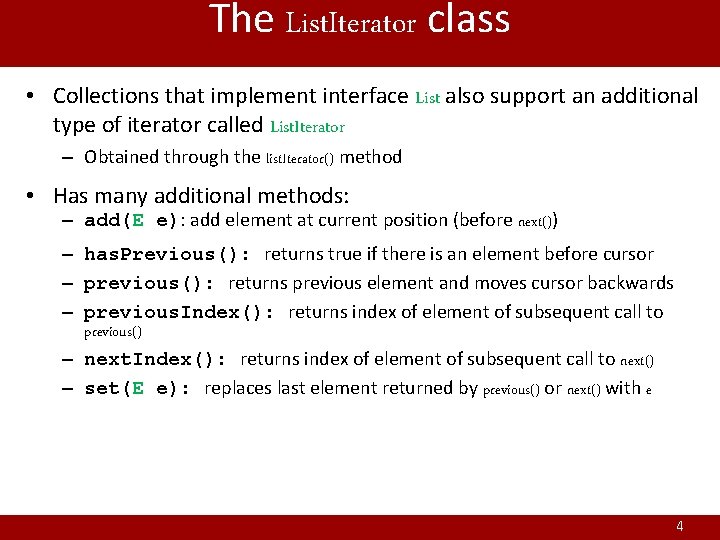
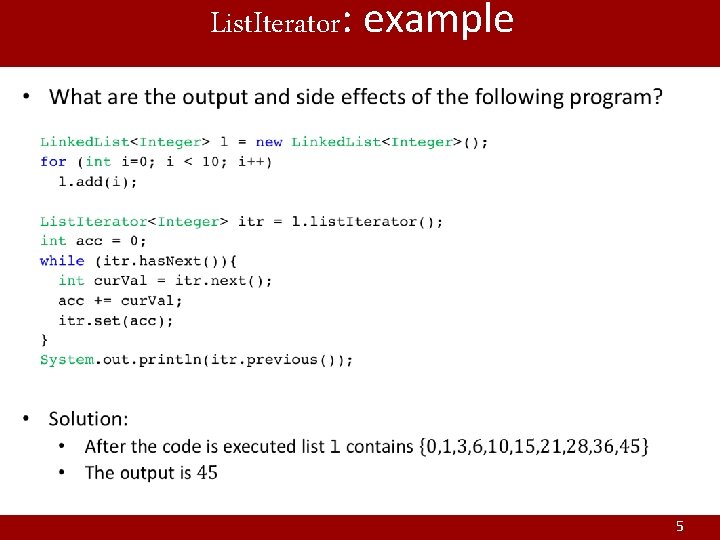
The List. Iterator class • Collections that implement interface List also support an additional type of iterator called List. Iterator – Obtained through the list. Iterator() method • Has many additional methods: – add(E e): add element at current position (before next()) – has. Previous(): returns true if there is an element before cursor – previous(): returns previous element and moves cursor backwards – previous. Index(): returns index of element of subsequent call to previous() – next. Index(): returns index of element of subsequent call to next() – set(E e): replaces last element returned by previous() or next() with e 4
List. Iterator: example 5
Java collections: sets (IPUJ Chapter 10) 6
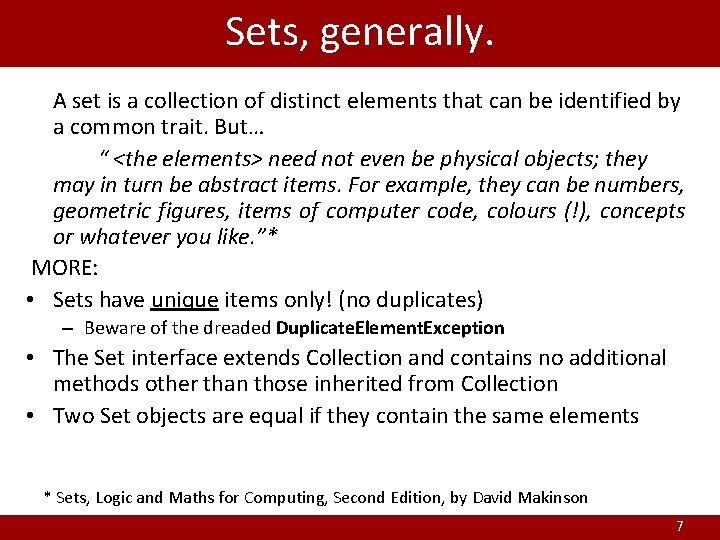
Sets, generally. A set is a collection of distinct elements that can be identified by a common trait. But… “ <the elements> need not even be physical objects; they may in turn be abstract items. For example, they can be numbers, geometric figures, items of computer code, colours (!), concepts or whatever you like. ”* MORE: • Sets have unique items only! (no duplicates) – Beware of the dreaded Duplicate. Element. Exception • The Set interface extends Collection and contains no additional methods other than those inherited from Collection • Two Set objects are equal if they contain the same elements * Sets, Logic and Maths for Computing, Second Edition, by David Makinson 7
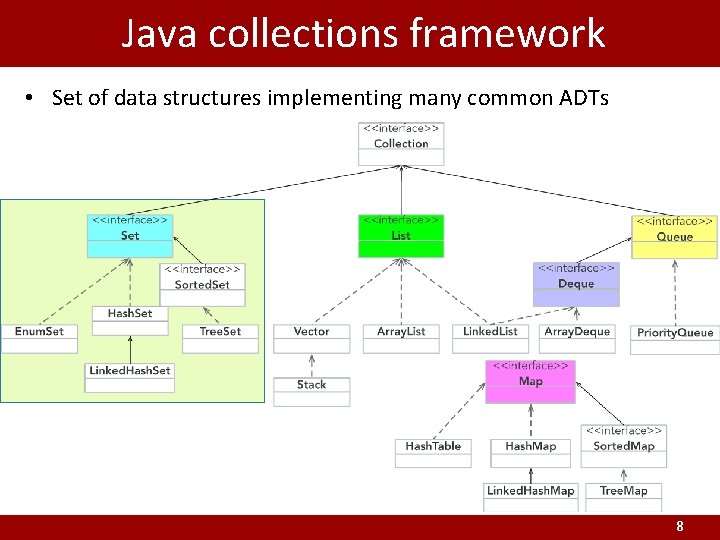
Java collections framework • Set of data structures implementing many common ADTs 8
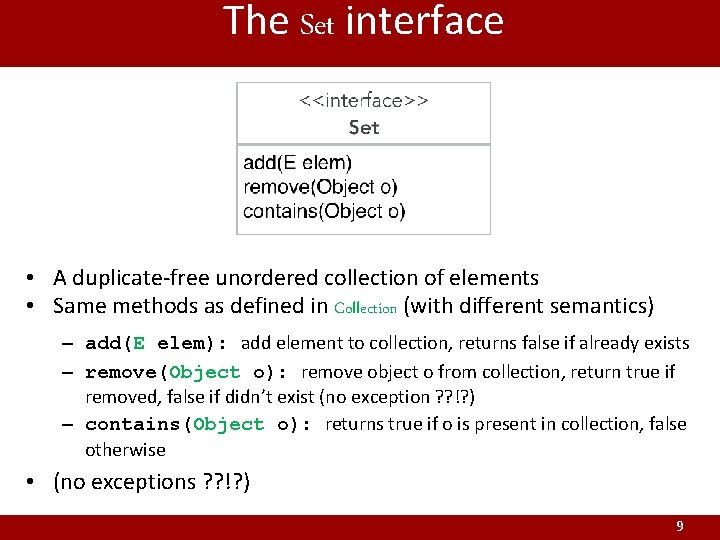
The Set interface • A duplicate-free unordered collection of elements • Same methods as defined in Collection (with different semantics) – add(E elem): add element to collection, returns false if already exists – remove(Object o): remove object o from collection, return true if removed, false if didn’t exist (no exception ? ? !? ) – contains(Object o): returns true if o is present in collection, false otherwise • (no exceptions ? ? !? ) 9
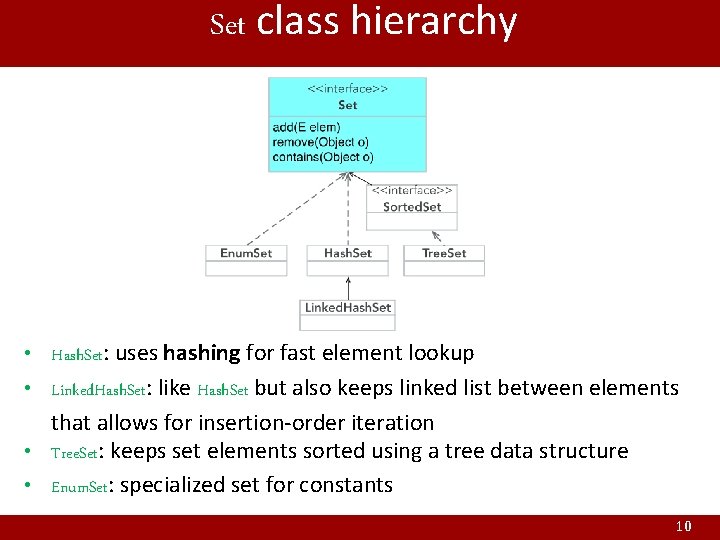
Set class hierarchy • Hash. Set: uses hashing for fast element lookup • Linked. Hash. Set: like Hash. Set but also keeps linked list between elements that allows for insertion-order iteration • Tree. Set: keeps set elements sorted using a tree data structure • Enum. Set: specialized set for constants 10
Set example usage String[] names = {"Jay", "Alice", "Melvor", "Erica"}; Set<String> nset = new Hash. Set<String>(); for (int i=0; i < names. length; i++) nset. add(names[i]); System. out. println("What names am I thinking of? "); Scanner scanner = new Scanner(System. in); while (true){ String guess = scanner. next(); if (guess. to. Lower. Case(). equals("exit")) break; if (nset. contains(guess)) System. out. println("Lucky guess!"); else System. out. println("No. Try again? !"); } 11
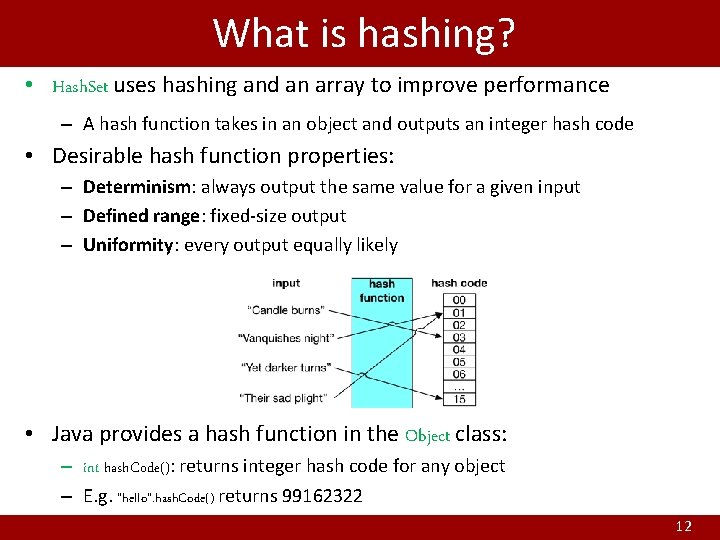
What is hashing? • Hash. Set uses hashing and an array to improve performance – A hash function takes in an object and outputs an integer hash code • Desirable hash function properties: – Determinism: always output the same value for a given input – Defined range: fixed-size output – Uniformity: every output equally likely • Java provides a hash function in the Object class: – int hash. Code(): returns integer hash code for any object – E. g. "hello". hash. Code() returns 99162322 12
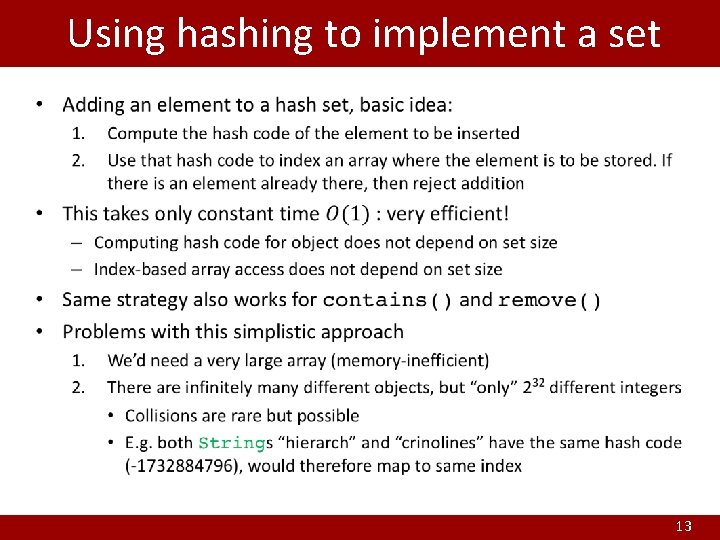
Using hashing to implement a set 13
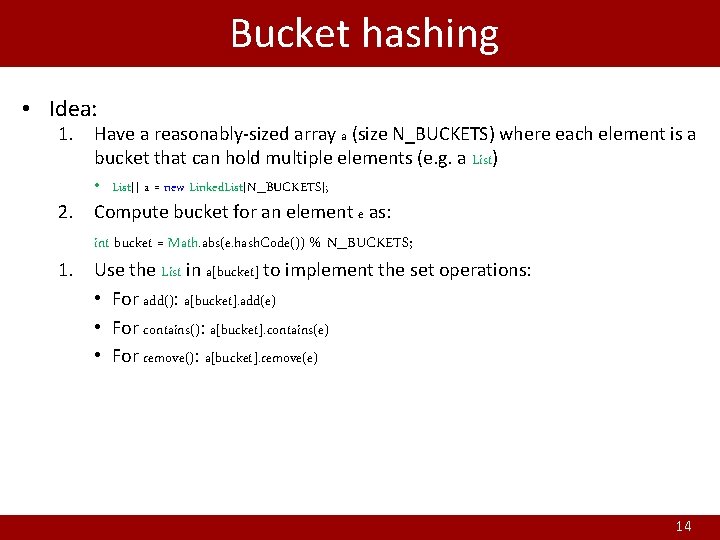
Bucket hashing • Idea: 1. Have a reasonably-sized array a (size N_BUCKETS) where each element is a bucket that can hold multiple elements (e. g. a List) • List[] a = new Linked. List[N_BUCKETS]; 2. Compute bucket for an element e as: int bucket = Math. abs(e. hash. Code()) % N_BUCKETS; 1. Use the List in a[bucket] to implement the set operations: • For add(): a[bucket]. add(e) • For contains(): a[bucket]. contains(e) • For remove(): a[bucket]. remove(e) 14
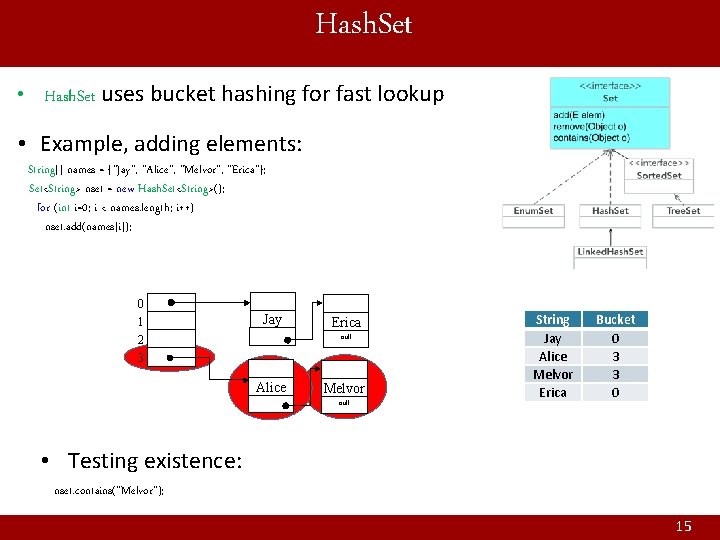
Hash. Set • Hash. Set uses bucket hashing for fast lookup • Example, adding elements: String[] names = {"Jay", "Alice", "Melvor", "Erica"}; Set<String> nset = new Hash. Set<String>(); for (int i=0; i < names. length; i++) nset. add(names[i]); 0 1 2 3 Jay Erica null Alice Melvor null String Jay Alice Melvor Erica Bucket 0 3 3 0 • Testing existence: nset. contains("Melvor"); 15
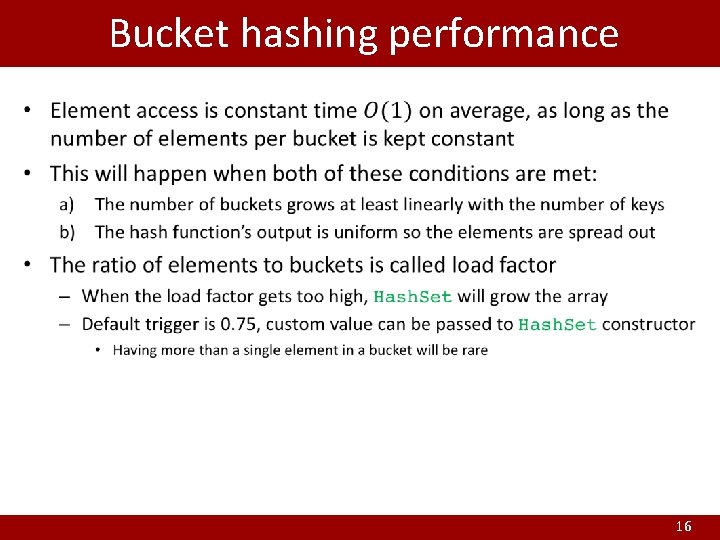
Bucket hashing performance 16