
CMPT 225 Lecture 21 Hashing Part 2 Collision
- Slides: 42
CMPT 225 Lecture 21 – Hashing – Part 2 – Collision Resolution Strategies
Last Lectures We saw how to … Define mapping Define hashing Define, design and implement hash functions 2
Learning Outcomes At the end of these lectures, a student will be able to: define hashing as well as chained and open addressed hash table discuss tradeoffs in designing hash functions and between collision resolution strategies demonstrate and trace operations on hash table 3
Today’s menu Our goal in this set of lecture notes is to describe collision in hashing present collision resolution strategies discuss tradeoffs of these collision resolution strategies 4
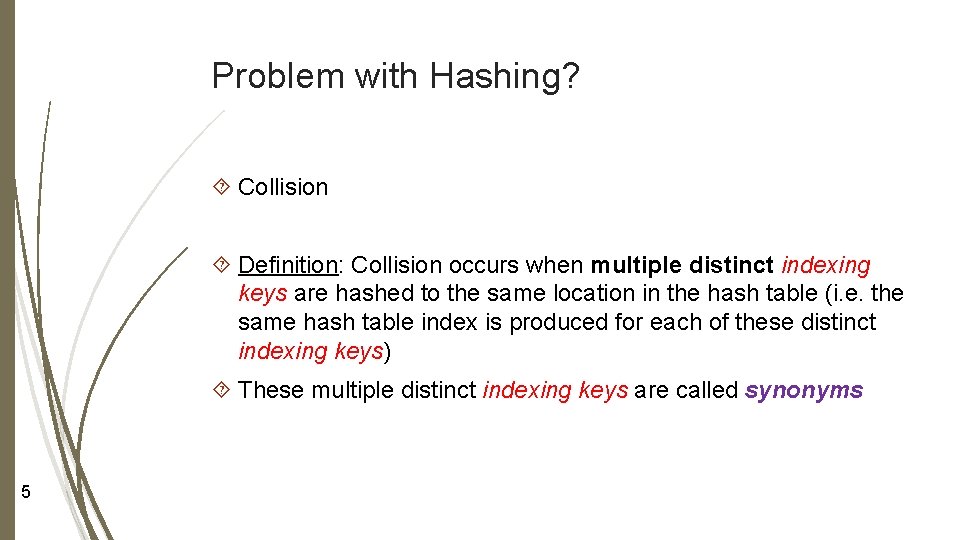
Problem with Hashing? Collision Definition: Collision occurs when multiple distinct indexing keys are hashed to the same location in the hash table (i. e. the same hash table index is produced for each of these distinct indexing keys) These multiple distinct indexing keys are called synonyms 5
Minimizing collisions Two factors that may minimize the number of collisions are: Goodness of hash function Size of the table but they cannot completely eliminate them 6
Collision resolution strategies Definition: Algorithms specifying what to do when collisions occur Some collision resolution strategies: Open Addressing: Linear Probing Hashing Quadratic Probing Hashing Random Probing Hashing Rehashing (Double Hashing) 7 Chain Hashing
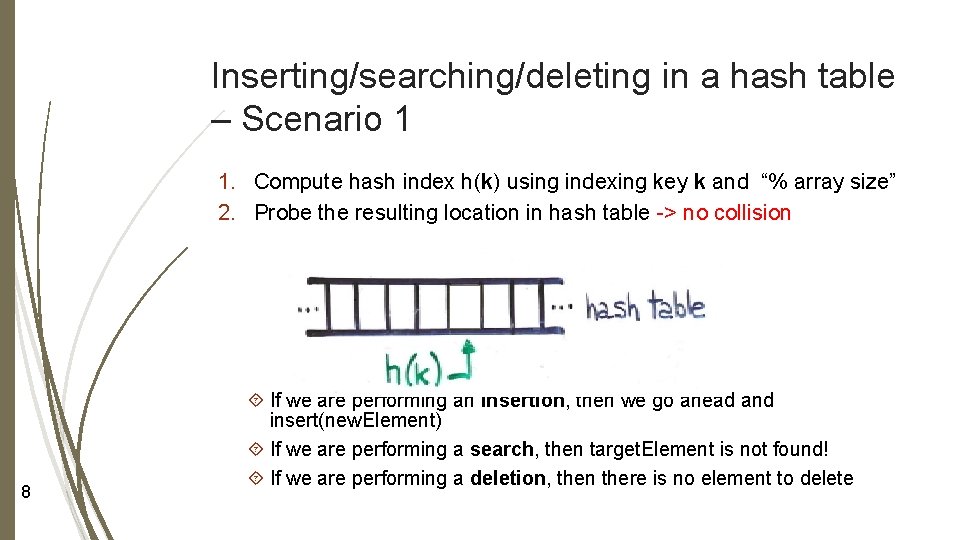
Inserting/searching/deleting in a hash table – Scenario 1 1. Compute hash index h(k) using indexing key k and “% array size” 2. Probe the resulting location in hash table -> no collision 8 If we are performing an insertion, then we go ahead and insert(new. Element) If we are performing a search, then target. Element is not found! If we are performing a deletion, then there is no element to delete
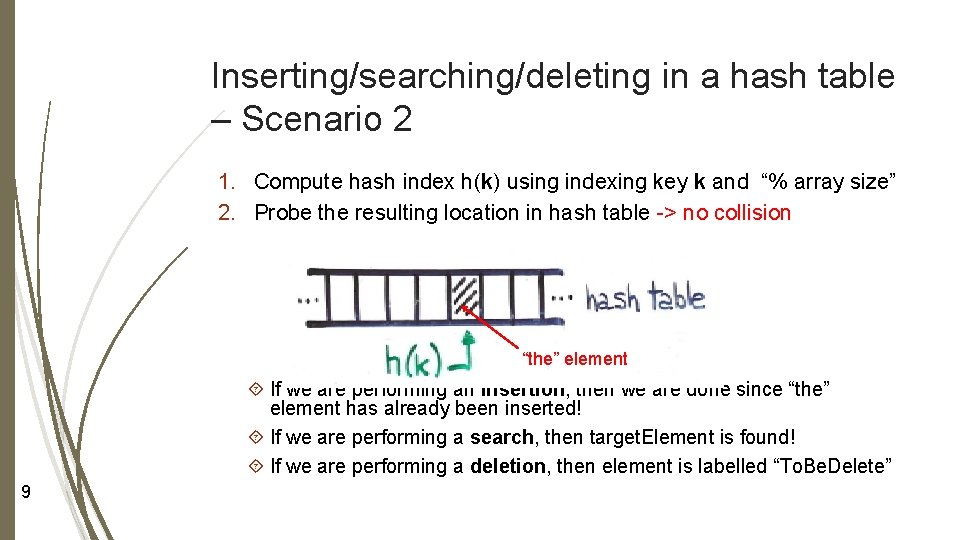
Inserting/searching/deleting in a hash table – Scenario 2 1. Compute hash index h(k) using indexing key k and “% array size” 2. Probe the resulting location in hash table -> no collision “the” element If we are performing an insertion, then we are done since “the” element has already been inserted! If we are performing a search, then target. Element is found! If we are performing a deletion, then element is labelled “To. Be. Delete” 9
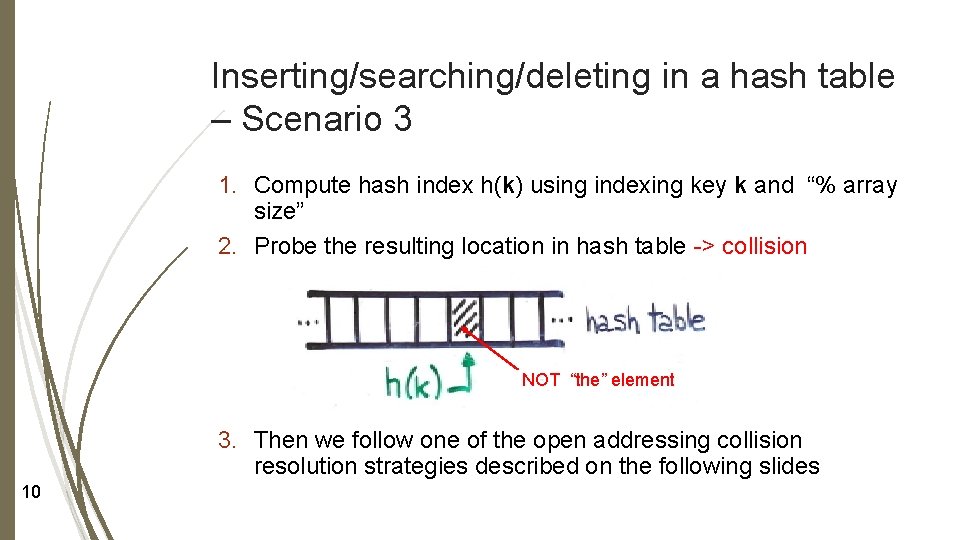
Inserting/searching/deleting in a hash table – Scenario 3 1. Compute hash index h(k) using indexing key k and “% array size” 2. Probe the resulting location in hash table -> collision NOT “the” element 3. Then we follow one of the open addressing collision resolution strategies described on the following slides 10
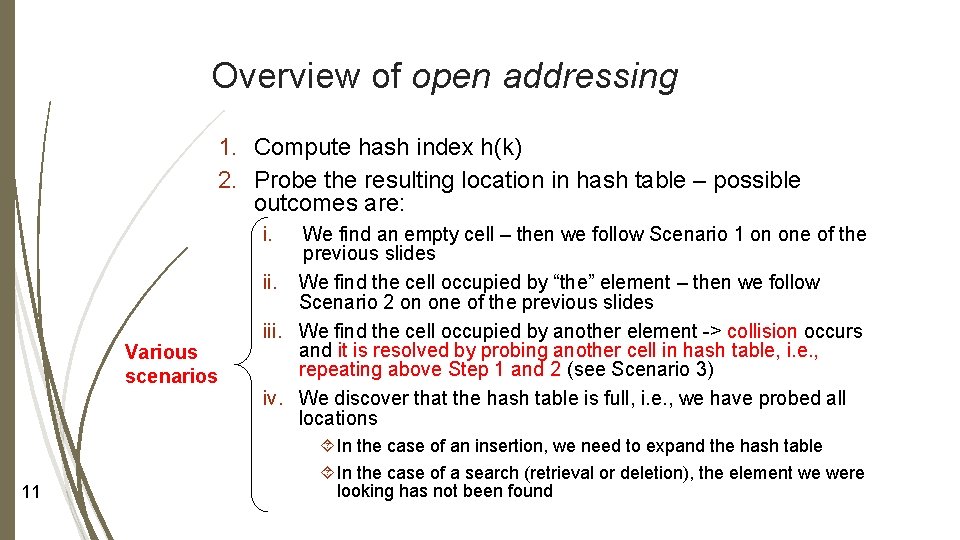
Overview of open addressing 1. Compute hash index h(k) 2. Probe the resulting location in hash table – possible outcomes are: i. Various scenarios 11 We find an empty cell – then we follow Scenario 1 on one of the previous slides ii. We find the cell occupied by “the” element – then we follow Scenario 2 on one of the previous slides iii. We find the cell occupied by another element -> collision occurs and it is resolved by probing another cell in hash table, i. e. , repeating above Step 1 and 2 (see Scenario 3) iv. We discover that the hash table is full, i. e. , we have probed all locations In the case of an insertion, we need to expand the hash table In the case of a search (retrieval or deletion), the element we were looking has not been found
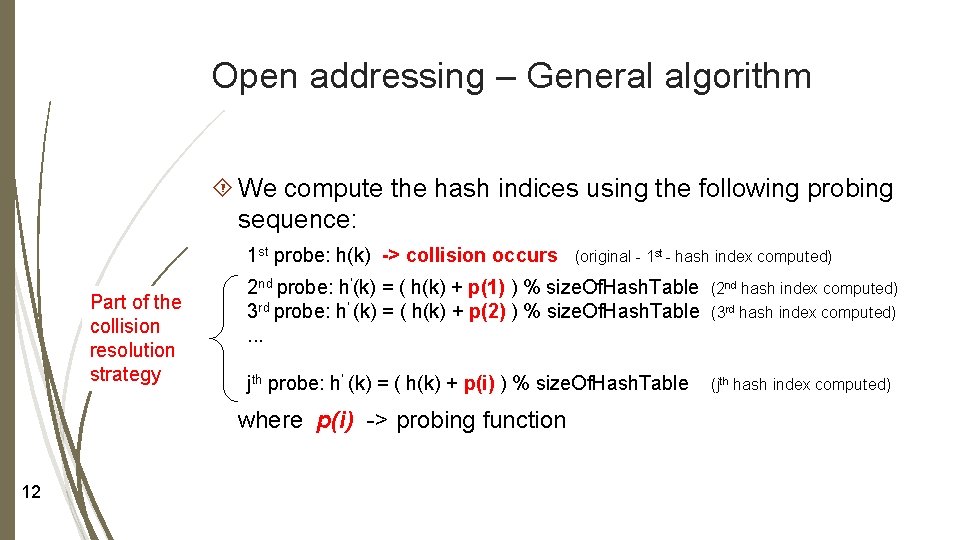
Open addressing – General algorithm We compute the hash indices using the following probing sequence: 1 st probe: h(k) -> collision occurs Part of the collision resolution strategy 2 nd probe: h’(k) = ( h(k) + p(1) ) % size. Of. Hash. Table 3 rd probe: h’ (k) = ( h(k) + p(2) ) % size. Of. Hash. Table. . . (2 nd hash index computed) (3 rd hash index computed) jth probe: h’ (k) = ( h(k) + p(i) ) % size. Of. Hash. Table (jth hash index computed) where p(i) -> probing function 12 (original - 1 st - hash index computed)
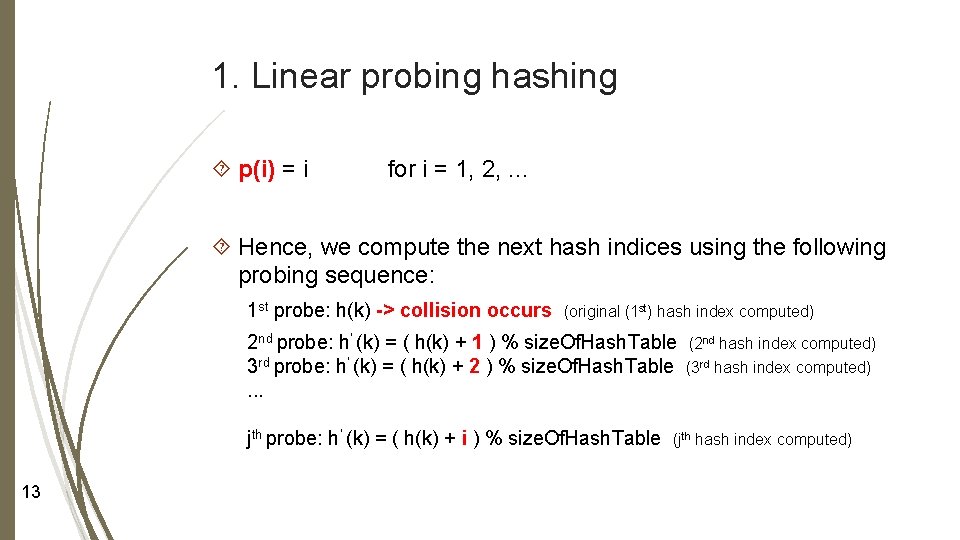
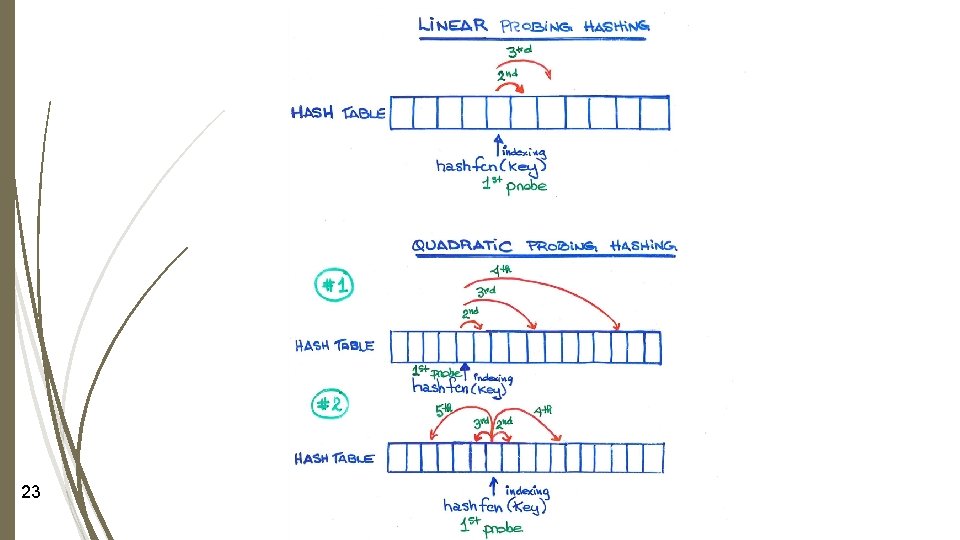
1. Linear probing hashing p(i) = i for i = 1, 2, . . . Hence, we compute the next hash indices using the following probing sequence: 1 st probe: h(k) -> collision occurs (original (1 st) hash index computed) 2 nd probe: h’ (k) = ( h(k) + 1 ) % size. Of. Hash. Table 3 rd probe: h’ (k) = ( h(k) + 2 ) % size. Of. Hash. Table. . . jth probe: h’ (k) = ( h(k) + i ) % size. Of. Hash. Table 13 (2 nd hash index computed) (3 rd hash index computed) (jth hash index computed)
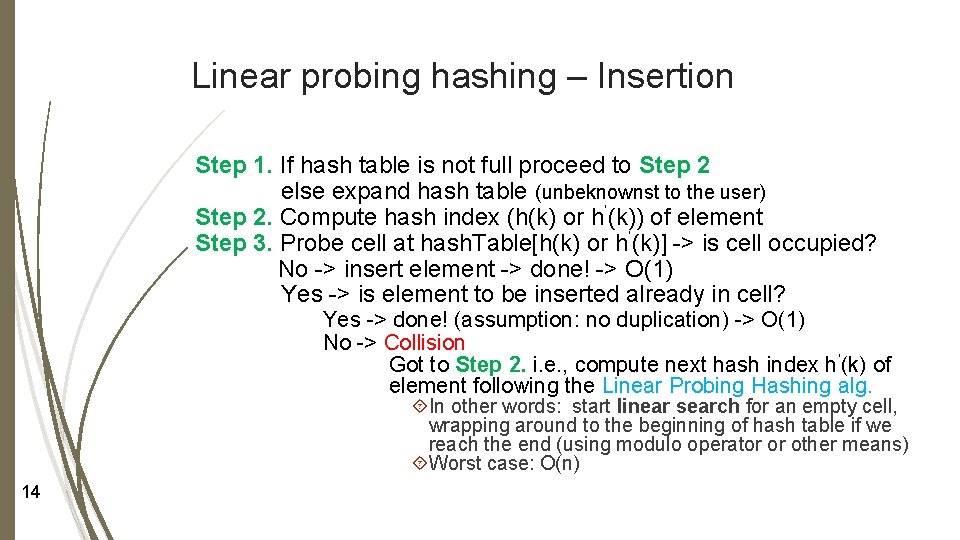
Linear probing hashing – Insertion Step 1. If hash table is not full proceed to Step 2 else expand hash table (unbeknownst to the user) Step 2. Compute hash index (h(k) or h’(k)) of element Step 3. Probe cell at hash. Table[h(k) or h’(k)] -> is cell occupied? No -> insert element -> done! -> O(1) Yes -> is element to be inserted already in cell? Yes -> done! (assumption: no duplication) -> O(1) No -> Collision Got to Step 2. i. e. , compute next hash index h’(k) of element following the Linear Probing Hashing alg. In other words: start linear search for an empty cell, wrapping around to the beginning of hash table if we reach the end (using modulo operator or other means) Worst case: O(n) 14
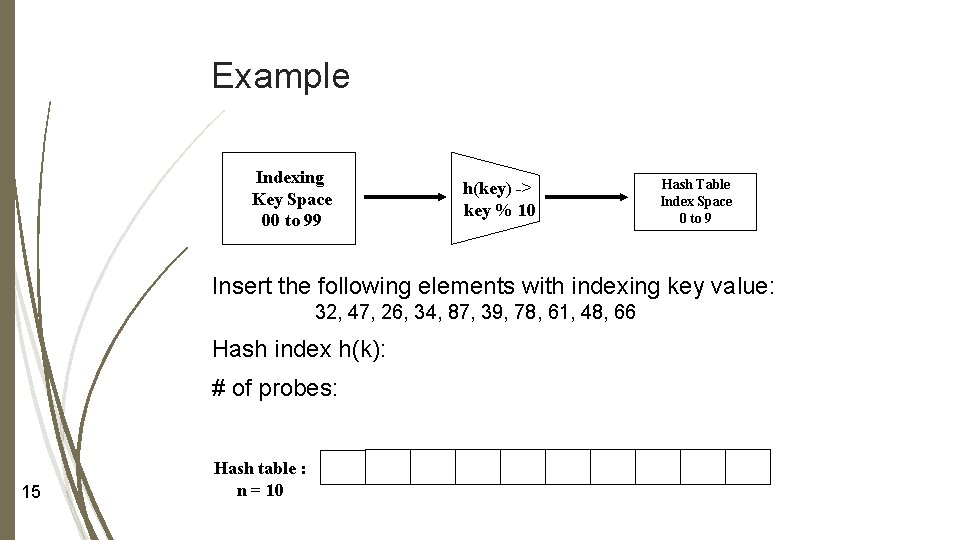
Example Indexing Key Space 00 to 99 h(key) -> key % 10 Hash Table Index Space 0 to 9 Insert the following elements with indexing key value: 32, 47, 26, 34, 87, 39, 78, 61, 48, 66 Hash index h(k): # of probes: 15 Hash table : n = 10
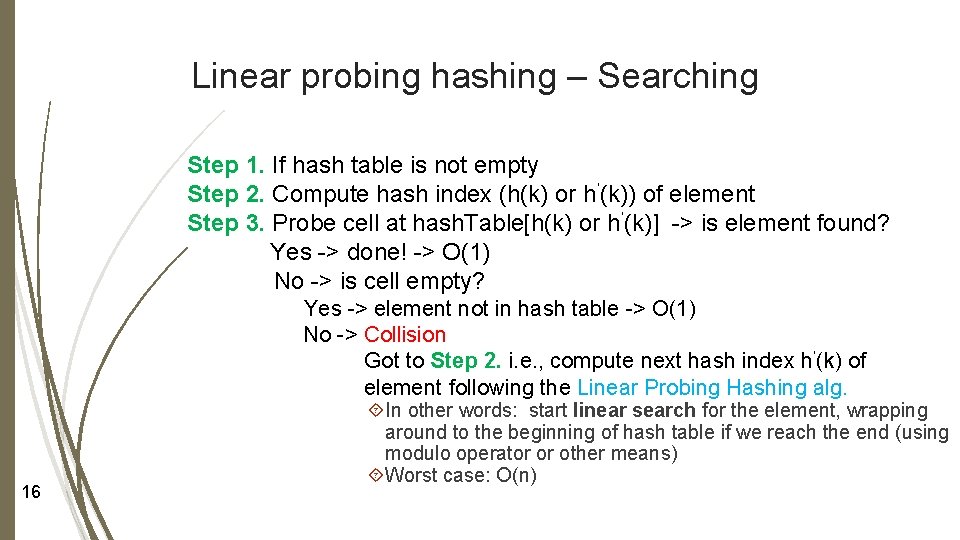
Linear probing hashing – Searching Step 1. If hash table is not empty Step 2. Compute hash index (h(k) or h’(k)) of element Step 3. Probe cell at hash. Table[h(k) or h’(k)] -> is element found? Yes -> done! -> O(1) No -> is cell empty? Yes -> element not in hash table -> O(1) No -> Collision Got to Step 2. i. e. , compute next hash index h’(k) of element following the Linear Probing Hashing alg. 16 In other words: start linear search for the element, wrapping around to the beginning of hash table if we reach the end (using modulo operator or other means) Worst case: O(n)
Summary - Linear probing hashing As we fill our hash table, what is happening? Major drawback: Major advantage: 17
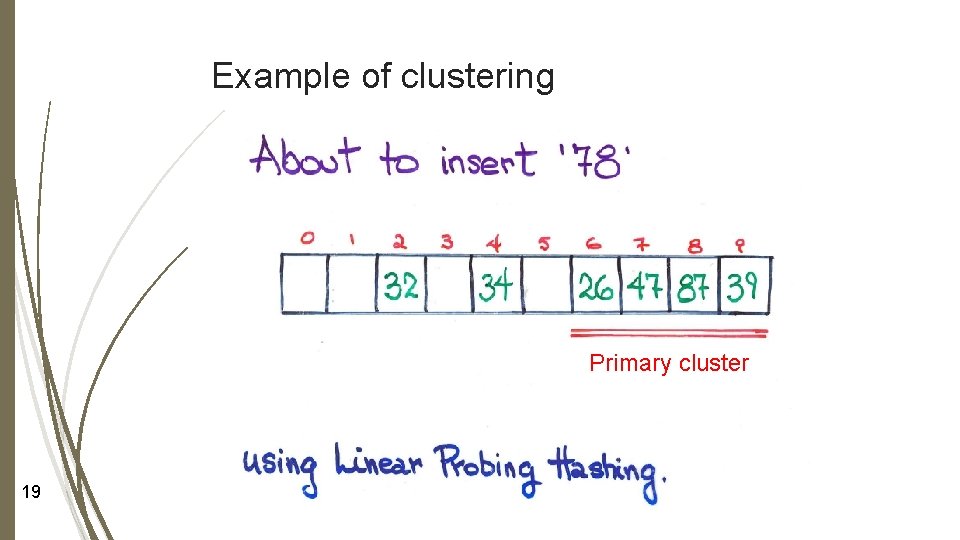
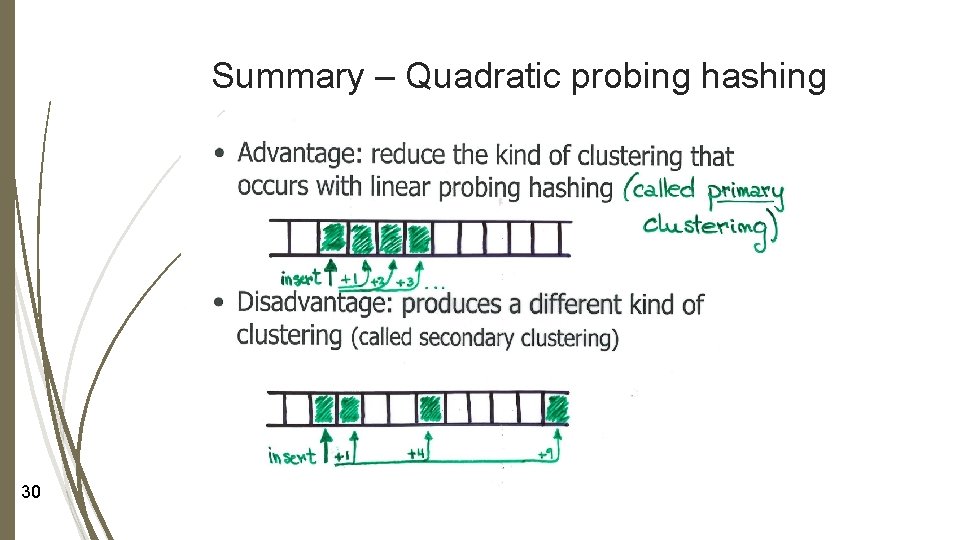
Definition of a cluster Group of consecutive cells that are occupied 18
Example of clustering Primary cluster 19
Hence … Cluster formation undermines the performance of hash table operations: Insertion Search (retrieval and deletion) Question: How to avoid primary cluster buildup? Answer: Choosing the probing function p(i) carefully 20
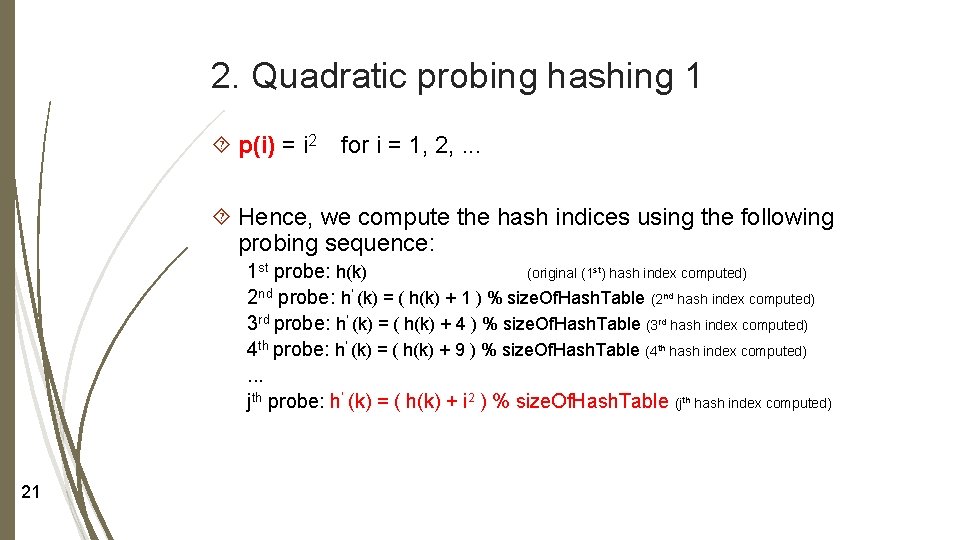
2. Quadratic probing hashing 1 p(i) = i 2 for i = 1, 2, . . . Hence, we compute the hash indices using the following probing sequence: 1 st probe: h(k) (original (1 st) hash index computed) 2 nd probe: h’ (k) = ( h(k) + 1 ) % size. Of. Hash. Table (2 nd hash index computed) 3 rd probe: h’ (k) = ( h(k) + 4 ) % size. Of. Hash. Table (3 rd hash index computed) 4 th probe: h’ (k) = ( h(k) + 9 ) % size. Of. Hash. Table (4 th hash index computed). . . jth probe: h’ (k) = ( h(k) + i 2 ) % size. Of. Hash. Table (jth hash index computed) 21
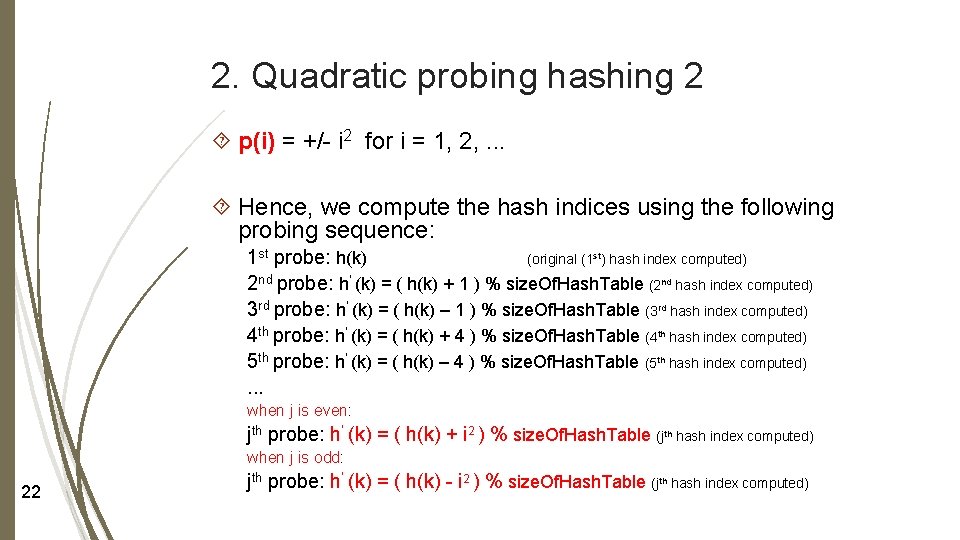
2. Quadratic probing hashing 2 p(i) = +/- i 2 for i = 1, 2, . . . Hence, we compute the hash indices using the following probing sequence: 1 st probe: h(k) (original (1 st) hash index computed) 2 nd probe: h’ (k) = ( h(k) + 1 ) % size. Of. Hash. Table (2 nd hash index computed) 3 rd probe: h’ (k) = ( h(k) – 1 ) % size. Of. Hash. Table (3 rd hash index computed) 4 th probe: h’ (k) = ( h(k) + 4 ) % size. Of. Hash. Table (4 th hash index computed) 5 th probe: h’ (k) = ( h(k) – 4 ) % size. Of. Hash. Table (5 th hash index computed). . . when j is even: jth probe: h’ (k) = ( h(k) + i 2 ) % size. Of. Hash. Table (jth hash index computed) when j is odd: 22 jth probe: h’ (k) = ( h(k) - i 2 ) % size. Of. Hash. Table (jth hash index computed)
23
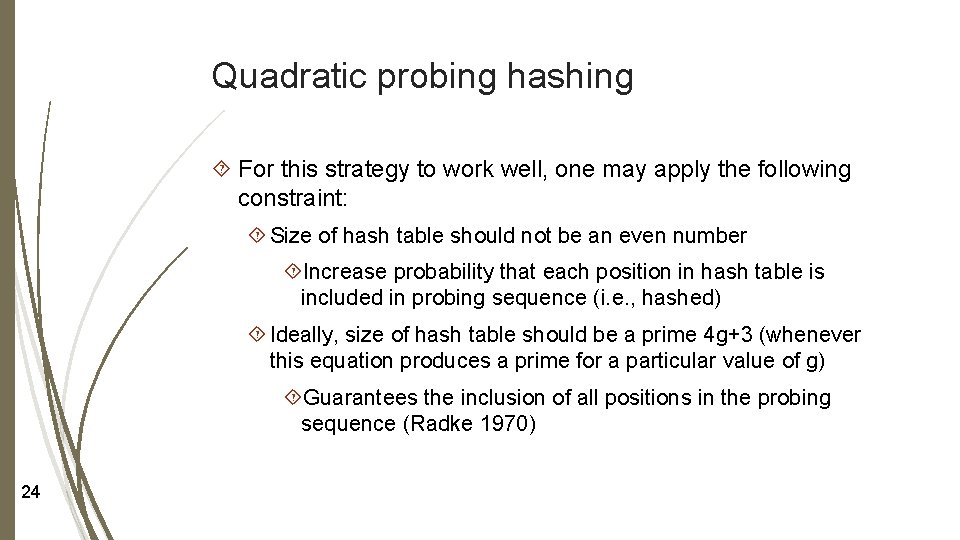
Quadratic probing hashing For this strategy to work well, one may apply the following constraint: Size of hash table should not be an even number Increase probability that each position in hash table is included in probing sequence (i. e. , hashed) Ideally, size of hash table should be a prime 4 g+3 (whenever this equation produces a prime for a particular value of g) Guarantees the inclusion of all positions in the probing sequence (Radke 1970) 24
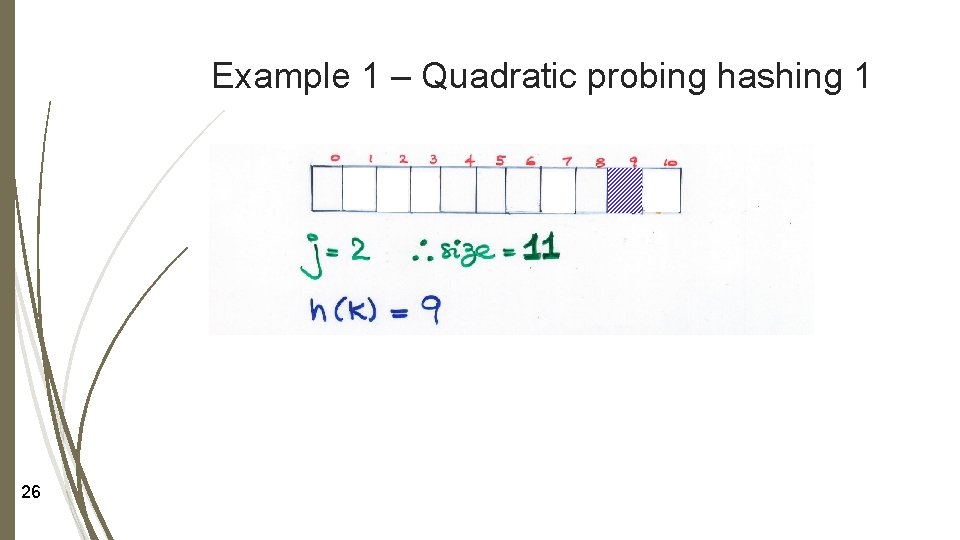
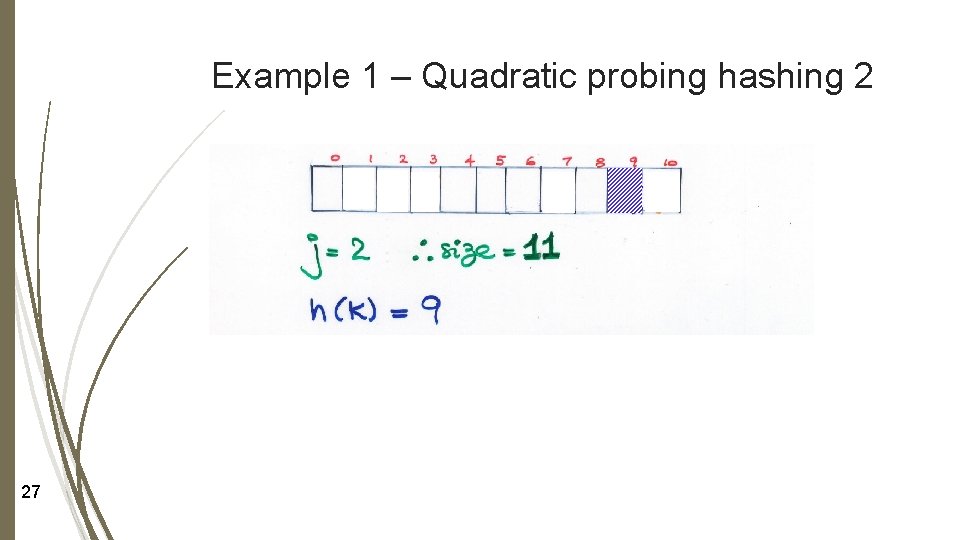
Examples of quadratic probing hashing Example 1: If g = 2, then size of hash table is 11 Assume that h(k) = 9, for some indexing key k, what is the resulting sequence of probes using Quadratic Probing Hashing 1? Quadratic Probing Hashing 2? 25
Example 1 – Quadratic probing hashing 1 26
Example 1 – Quadratic probing hashing 2 27
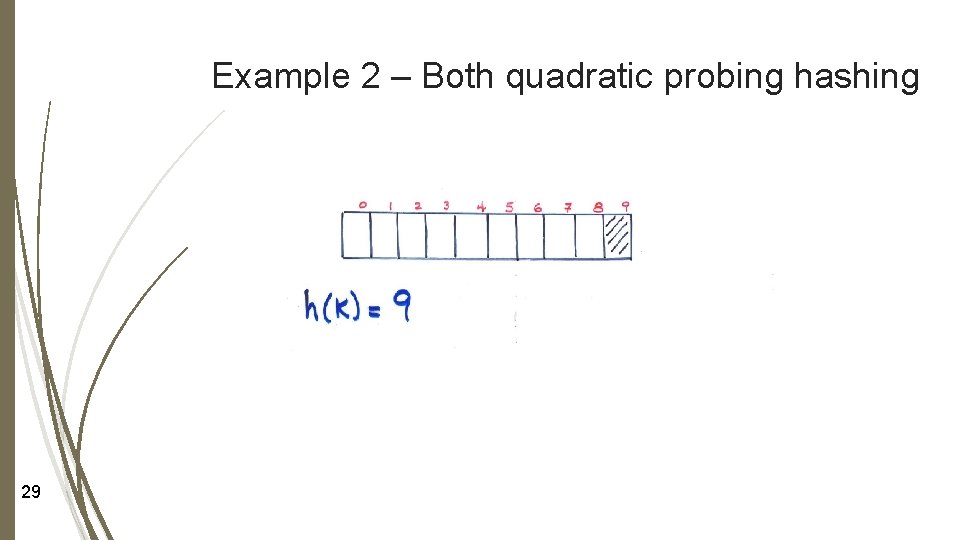
Examples of quadratic probing hashing Example 2: If size of hash table is 10 Assume that h(k) = 9, for some indexing key k, what is the resulting sequence of probes using Quadratic Probing Hashing 1? Quadratic Probing Hashing 2? 28
Example 2 – Both quadratic probing hashing 29
Summary – Quadratic probing hashing 30
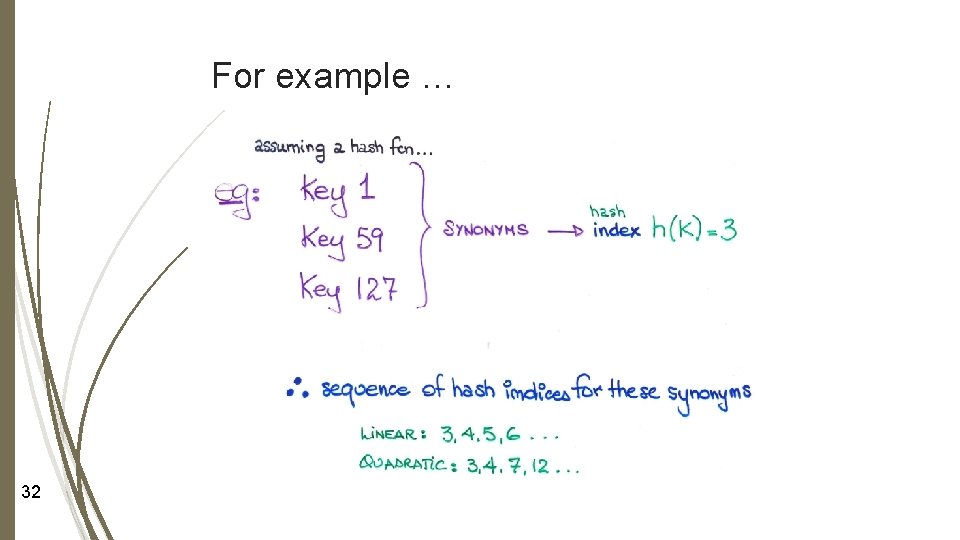
Observation So far… All synonyms produce the same hash index sequences (no matter what the indexing key value is) Goal: For each indexing key, generate a different hash index sequence 31
For example … 32
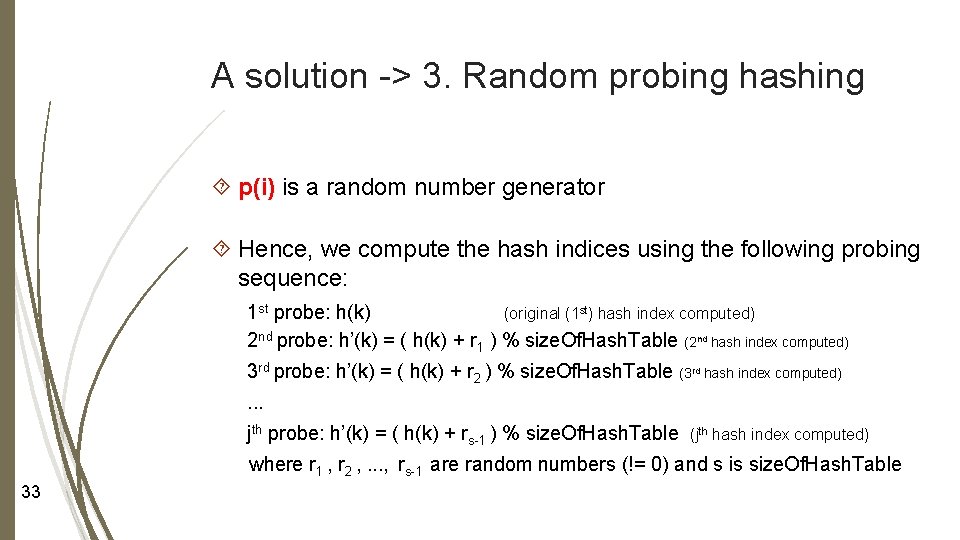
A solution -> 3. Random probing hashing p(i) is a random number generator Hence, we compute the hash indices using the following probing sequence: 1 st probe: h(k) (original (1 st) hash index computed) 2 nd probe: h’(k) = ( h(k) + r 1 ) % size. Of. Hash. Table (2 nd hash index computed) 3 rd probe: h’(k) = ( h(k) + r 2 ) % size. Of. Hash. Table (3 rd hash index computed). . . jth probe: h’(k) = ( h(k) + rs-1 ) % size. Of. Hash. Table (jth hash index computed) where r 1 , r 2 , . . . , rs-1 are random numbers (!= 0) and s is size. Of. Hash. Table 33
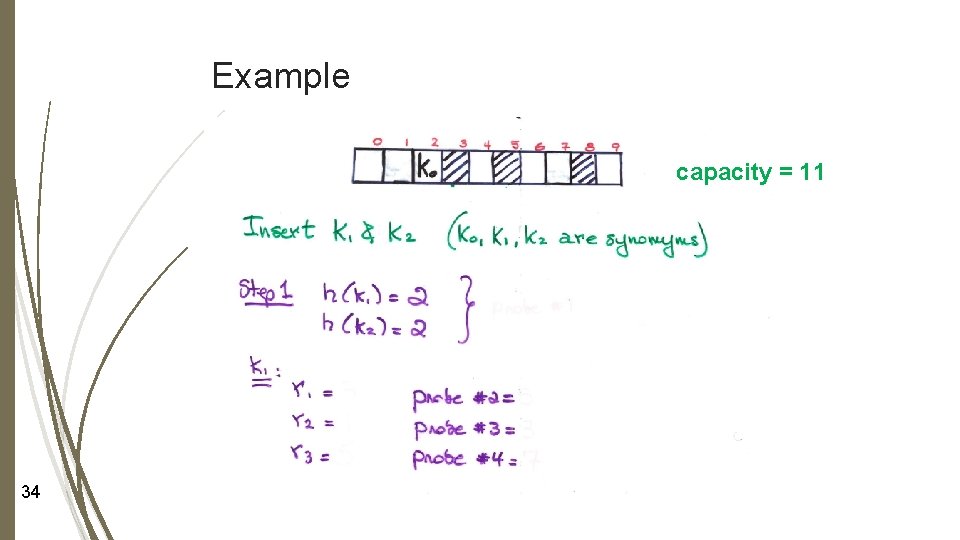
Example capacity = 11 34
Summary: Random probing hashing Advantage: Because random probing hashing creates different sequences of hash indices for each synonym No more constraint on hash table size Prevents formation of secondary clusters Disadvantage: Imposes the constraint that the probing sequence must be the same every time it is generated for a particular indexing key Otherwise, an element with indexing key k that has already been inserted into the hash table may not be found again 35
Random probing hashing Solution 1: If the chosen random number generator is such that it may generates different probing sequences for a particular indexing key (if, for example, the random number generator is initialized at first invocation only), we must save the generated random numbers r 1, r 2, …, rs-1 for that indexing key Solution 2: If the chosen random number generator is such that it always generates the same probing sequence for a particular indexing key (if, for example, the random number generator can be initialized with the same seed every time the probing sequence for a particular indexing key is generated), we must save the seed for that indexing key or generate the seed from the indexing key 36
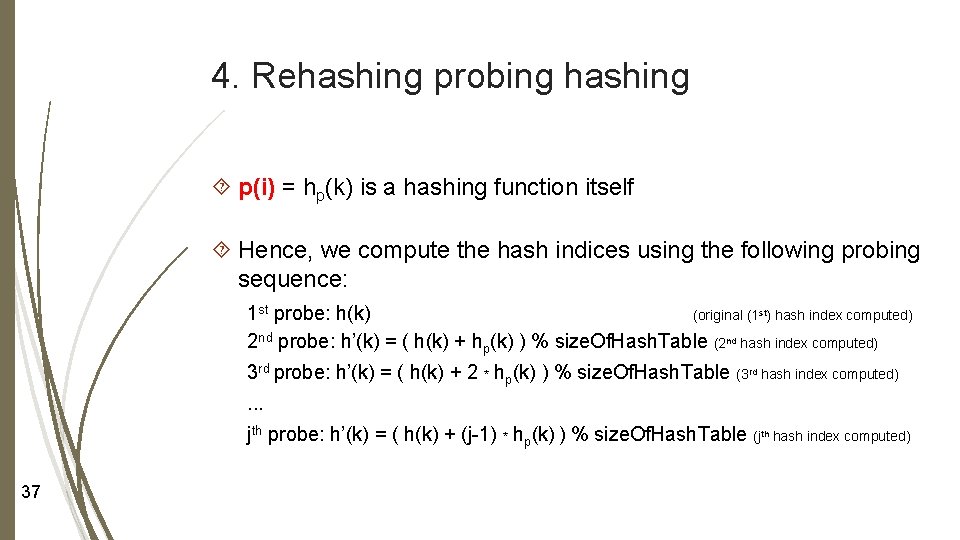
4. Rehashing probing hashing p(i) = hp(k) is a hashing function itself Hence, we compute the hash indices using the following probing sequence: 1 st probe: h(k) (original (1 st) hash index computed) 2 nd probe: h’(k) = ( h(k) + hp(k) ) % size. Of. Hash. Table (2 nd hash index computed) 3 rd probe: h’(k) = ( h(k) + 2 * hp(k) ) % size. Of. Hash. Table (3 rd hash index computed). . . jth probe: h’(k) = ( h(k) + (j-1) * hp(k) ) % size. Of. Hash. Table (jth hash index computed) 37
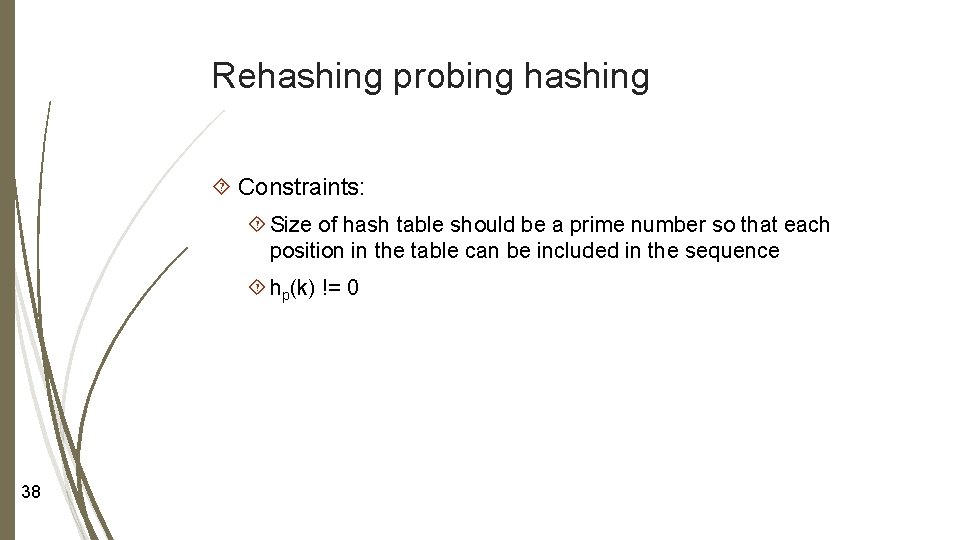
Rehashing probing hashing Constraints: Size of hash table should be a prime number so that each position in the table can be included in the sequence hp(k) != 0 38
Example Textbook: See Double Hashing pages 575 -577 39
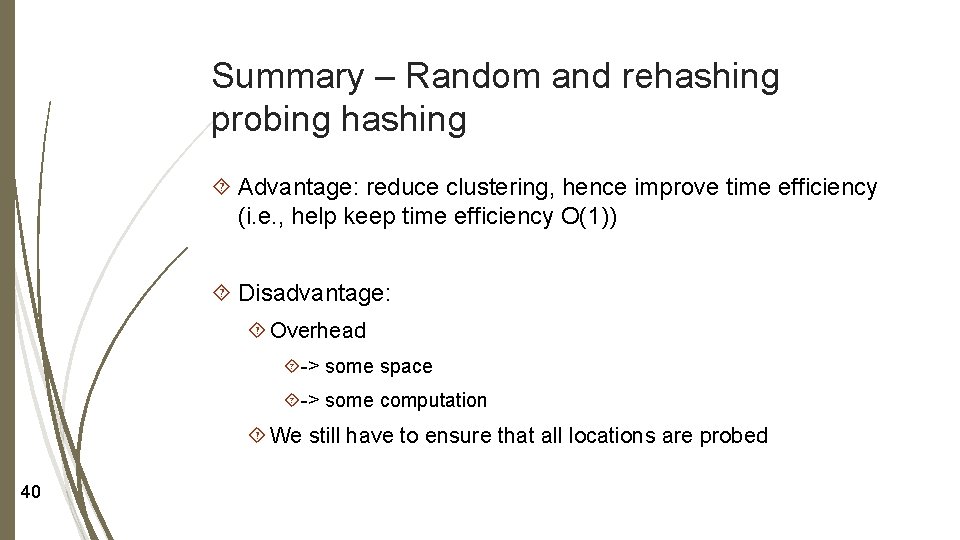
Summary – Random and rehashing probing hashing Advantage: reduce clustering, hence improve time efficiency (i. e. , help keep time efficiency O(1)) Disadvantage: Overhead -> some space -> some computation We still have to ensure that all locations are probed 40
√ Learning Check We can now … describe collision in hashing present collision resolution strategies discuss tradeoffs of these collision resolution strategies 41
Next Lecture Hashing – Part 3 – Chain Hashing 42