
CMPE 180 A Data Structures and Algorithms in

- Slides: 80
CMPE 180 A Data Structures and Algorithms in C++ December 1 Class Meeting Department of Computer Engineering San Jose State University Fall 2020 Instructor: Ron Mak www. cs. sjsu. edu/~mak
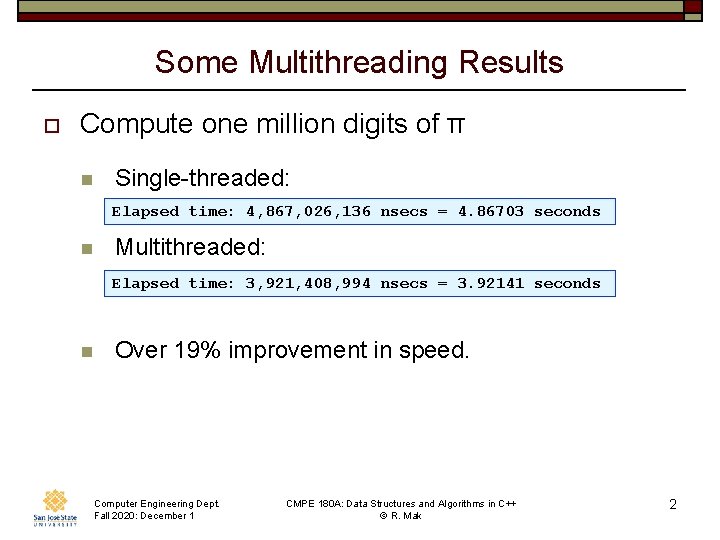
Some Multithreading Results o Compute one million digits of π n Single-threaded: Elapsed time: 4, 867, 026, 136 nsecs = 4. 86703 seconds n Multithreaded: Elapsed time: 3, 921, 408, 994 nsecs = 3. 92141 seconds n Over 19% improvement in speed. Computer Engineering Dept. Fall 2020: December 1 CMPE 180 A: Data Structures and Algorithms in C++ © R. Mak 2
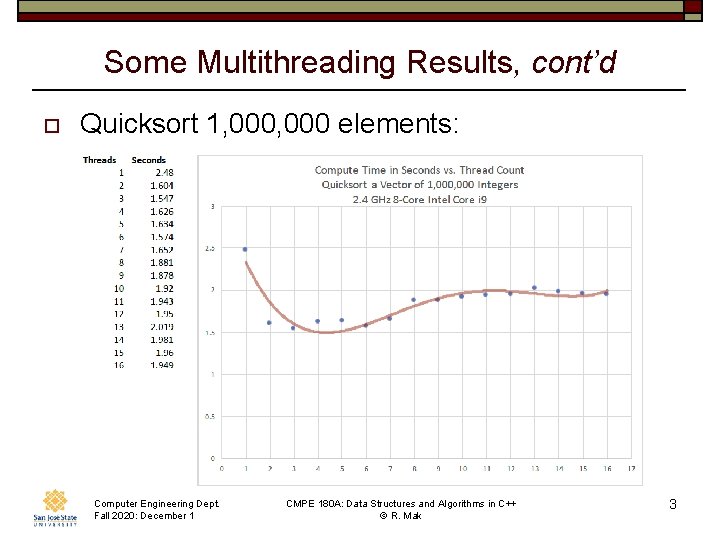
Some Multithreading Results, cont’d o Quicksort 1, 000 elements: Computer Engineering Dept. Fall 2020: December 1 CMPE 180 A: Data Structures and Algorithms in C++ © R. Mak 3
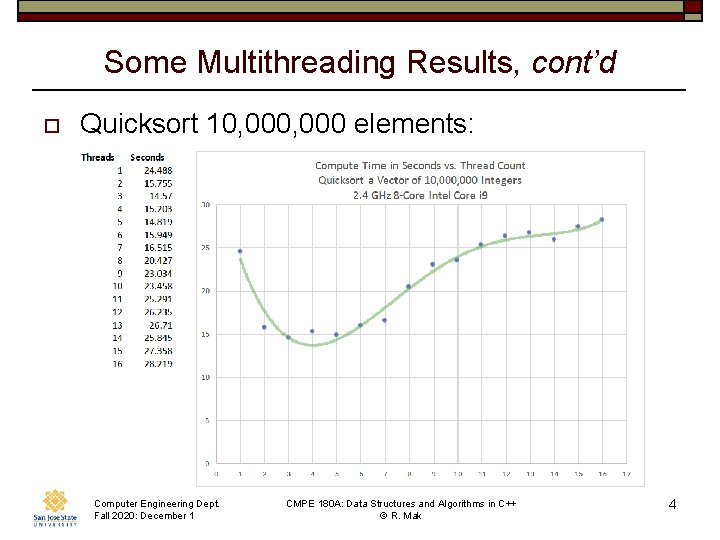
Some Multithreading Results, cont’d o Quicksort 10, 000 elements: Computer Engineering Dept. Fall 2020: December 1 CMPE 180 A: Data Structures and Algorithms in C++ © R. Mak 4
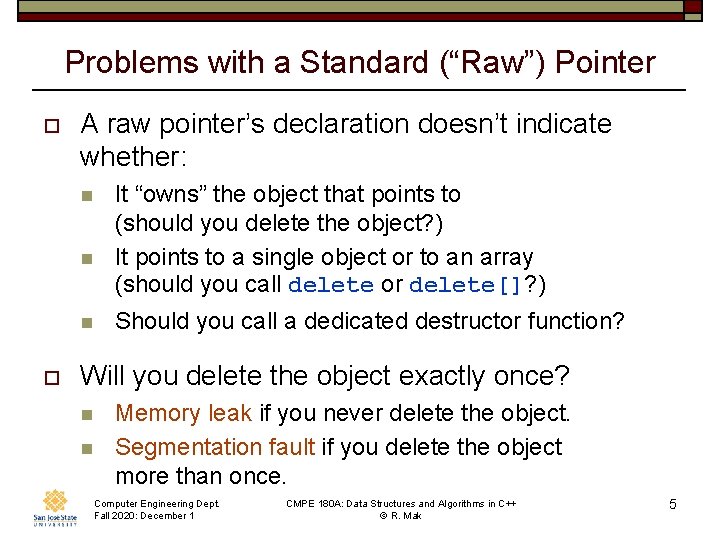
Problems with a Standard (“Raw”) Pointer o A raw pointer’s declaration doesn’t indicate whether: n n n o It “owns” the object that points to (should you delete the object? ) It points to a single object or to an array (should you call delete or delete[]? ) Should you call a dedicated destructor function? Will you delete the object exactly once? n n Memory leak if you never delete the object. Segmentation fault if you delete the object more than once. Computer Engineering Dept. Fall 2020: December 1 CMPE 180 A: Data Structures and Algorithms in C++ © R. Mak 5
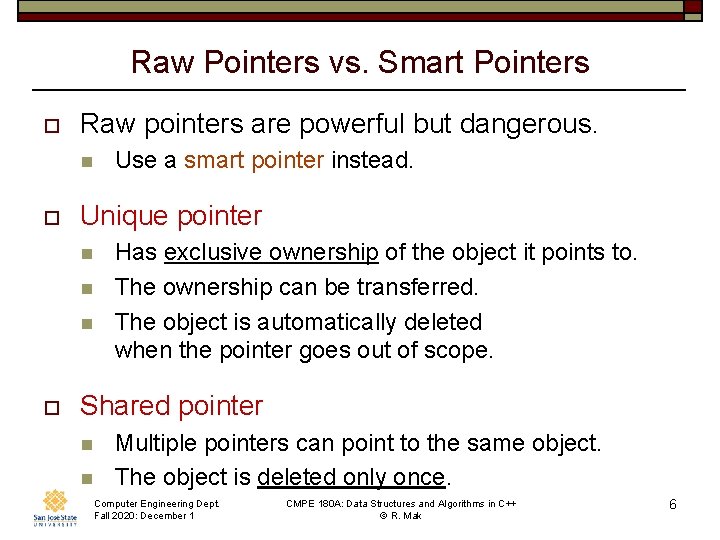
Raw Pointers vs. Smart Pointers o Raw pointers are powerful but dangerous. n o Unique pointer n n n o Use a smart pointer instead. Has exclusive ownership of the object it points to. The ownership can be transferred. The object is automatically deleted when the pointer goes out of scope. Shared pointer n n Multiple pointers can point to the same object. The object is deleted only once. Computer Engineering Dept. Fall 2020: December 1 CMPE 180 A: Data Structures and Algorithms in C++ © R. Mak 6
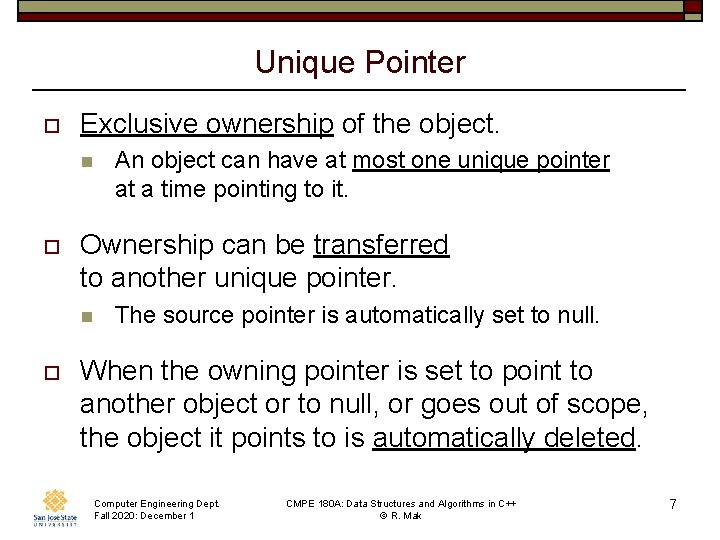
Unique Pointer o Exclusive ownership of the object. n o Ownership can be transferred to another unique pointer. n o An object can have at most one unique pointer at a time pointing to it. The source pointer is automatically set to null. When the owning pointer is set to point to another object or to null, or goes out of scope, the object it points to is automatically deleted. Computer Engineering Dept. Fall 2020: December 1 CMPE 180 A: Data Structures and Algorithms in C++ © R. Mak 7
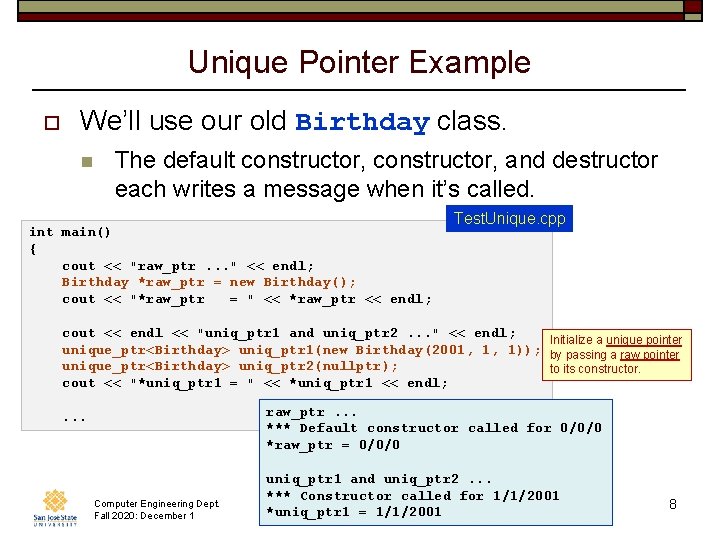
Unique Pointer Example o We’ll use our old Birthday class. n The default constructor, and destructor each writes a message when it’s called. int main() { cout << "raw_ptr. . . " << endl; Birthday *raw_ptr = new Birthday(); cout << "*raw_ptr = " << *raw_ptr << endl; Test. Unique. cpp cout << endl << "uniq_ptr 1 and uniq_ptr 2. . . " << endl; Initialize a unique pointer unique_ptr<Birthday> uniq_ptr 1(new Birthday(2001, 1, 1)); by passing a raw pointer unique_ptr<Birthday> uniq_ptr 2(nullptr); to its constructor. cout << "*uniq_ptr 1 = " << *uniq_ptr 1 << endl; raw_ptr. . . *** Default constructor called for 0/0/0 *raw_ptr = 0/0/0 . . . Computer Engineering Dept. Fall 2020: December 1 uniq_ptr 1 and uniq_ptr 2. . . *** Constructor called for 1/1/2001 CMPE 180 A: Data Structures and Algorithms in C++ *uniq_ptr 1 = 1/1/2001 © R. Mak 8
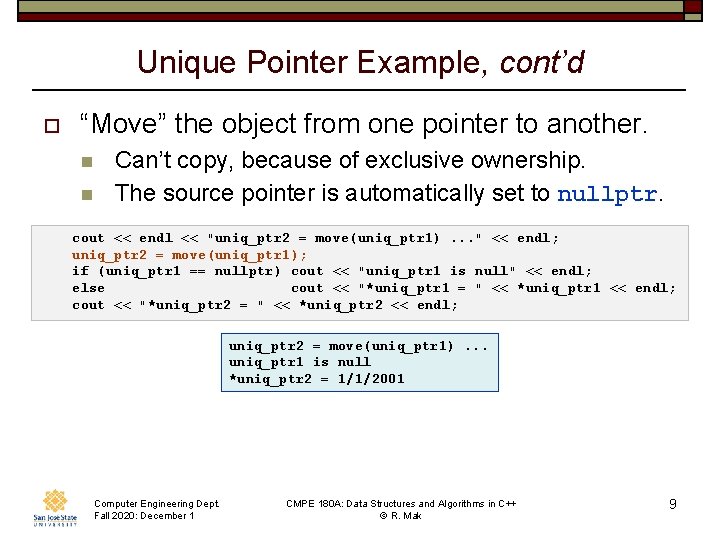
Unique Pointer Example, cont’d o “Move” the object from one pointer to another. n n Can’t copy, because of exclusive ownership. The source pointer is automatically set to nullptr. cout << endl << "uniq_ptr 2 = move(uniq_ptr 1). . . " << endl; uniq_ptr 2 = move(uniq_ptr 1); if (uniq_ptr 1 == nullptr) cout << "uniq_ptr 1 is null" << endl; else cout << "*uniq_ptr 1 = " << *uniq_ptr 1 << endl; cout << "*uniq_ptr 2 = " << *uniq_ptr 2 << endl; uniq_ptr 2 = move(uniq_ptr 1). . . uniq_ptr 1 is null *uniq_ptr 2 = 1/1/2001 Computer Engineering Dept. Fall 2020: December 1 CMPE 180 A: Data Structures and Algorithms in C++ © R. Mak 9
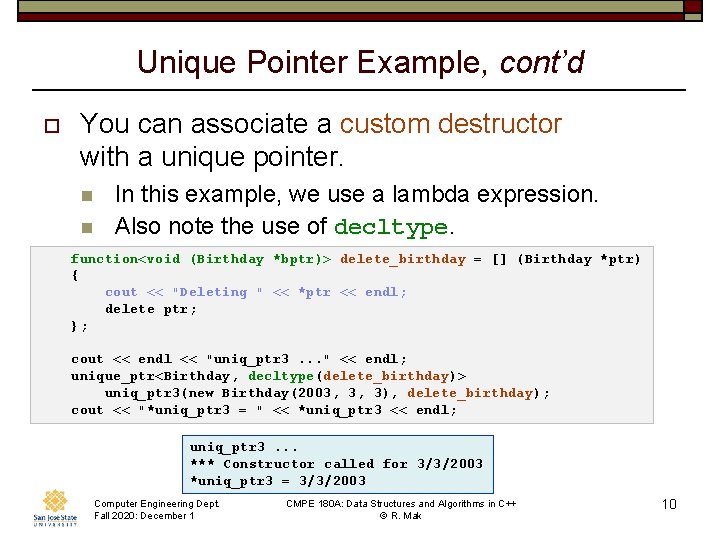
Unique Pointer Example, cont’d o You can associate a custom destructor with a unique pointer. n n In this example, we use a lambda expression. Also note the use of decltype. function<void (Birthday *bptr)> delete_birthday = [] (Birthday *ptr) { cout << "Deleting " << *ptr << endl; delete ptr; }; cout << endl << "uniq_ptr 3. . . " << endl; unique_ptr<Birthday, decltype(delete_birthday)> uniq_ptr 3(new Birthday(2003, 3, 3), delete_birthday); cout << "*uniq_ptr 3 = " << *uniq_ptr 3 << endl; uniq_ptr 3. . . *** Constructor called for 3/3/2003 *uniq_ptr 3 = 3/3/2003 Computer Engineering Dept. Fall 2020: December 1 CMPE 180 A: Data Structures and Algorithms in C++ © R. Mak 10
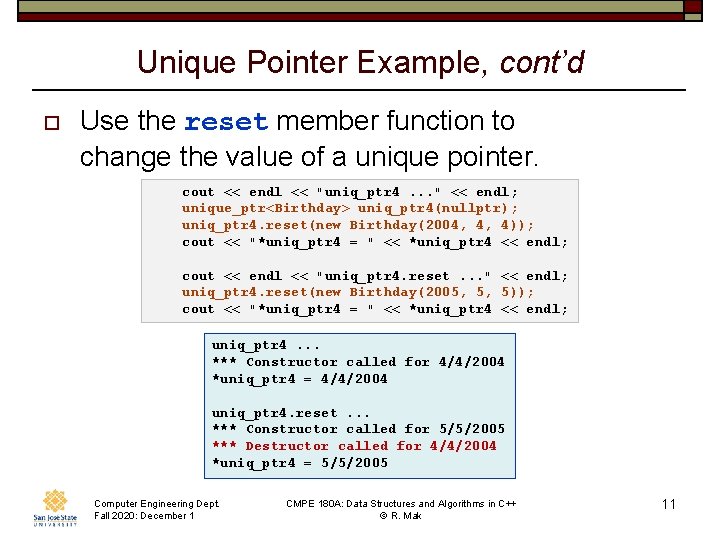
Unique Pointer Example, cont’d o Use the reset member function to change the value of a unique pointer. cout << endl << "uniq_ptr 4. . . " << endl; unique_ptr<Birthday> uniq_ptr 4(nullptr); uniq_ptr 4. reset(new Birthday(2004, 4, 4)); cout << "*uniq_ptr 4 = " << *uniq_ptr 4 << endl; cout << endl << "uniq_ptr 4. reset. . . " << endl; uniq_ptr 4. reset(new Birthday(2005, 5, 5)); cout << "*uniq_ptr 4 = " << *uniq_ptr 4 << endl; uniq_ptr 4. . . *** Constructor called for 4/4/2004 *uniq_ptr 4 = 4/4/2004 uniq_ptr 4. reset. . . *** Constructor called for 5/5/2005 *** Destructor called for 4/4/2004 *uniq_ptr 4 = 5/5/2005 Computer Engineering Dept. Fall 2020: December 1 CMPE 180 A: Data Structures and Algorithms in C++ © R. Mak 11
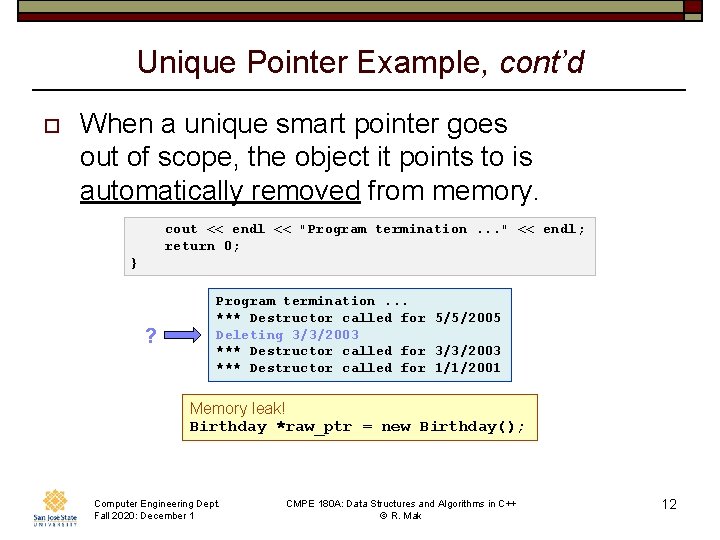
Unique Pointer Example, cont’d o When a unique smart pointer goes out of scope, the object it points to is automatically removed from memory. cout << endl << "Program termination. . . " << endl; return 0; } ? Program termination. . . *** Destructor called for 5/5/2005 Deleting 3/3/2003 *** Destructor called for 1/1/2001 Memory leak! Birthday *raw_ptr = new Birthday(); Computer Engineering Dept. Fall 2020: December 1 CMPE 180 A: Data Structures and Algorithms in C++ © R. Mak 12
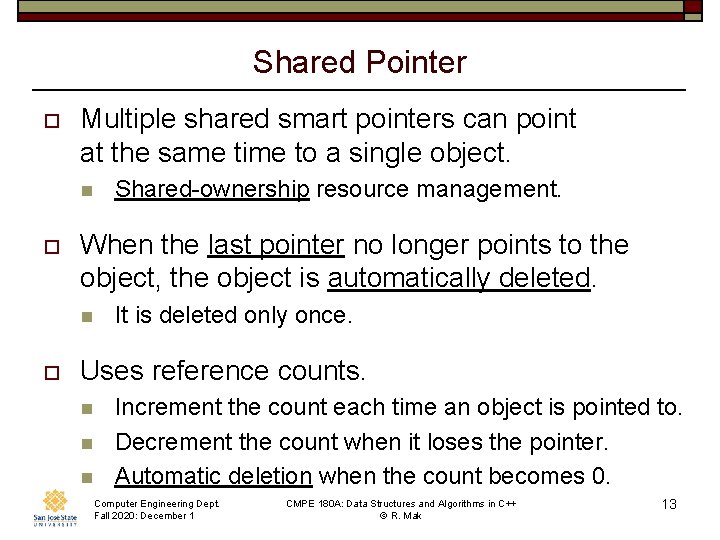
Shared Pointer o Multiple shared smart pointers can point at the same time to a single object. n o When the last pointer no longer points to the object, the object is automatically deleted. n o Shared-ownership resource management. It is deleted only once. Uses reference counts. n n n Increment the count each time an object is pointed to. Decrement the count when it loses the pointer. Automatic deletion when the count becomes 0. Computer Engineering Dept. Fall 2020: December 1 CMPE 180 A: Data Structures and Algorithms in C++ © R. Mak 13
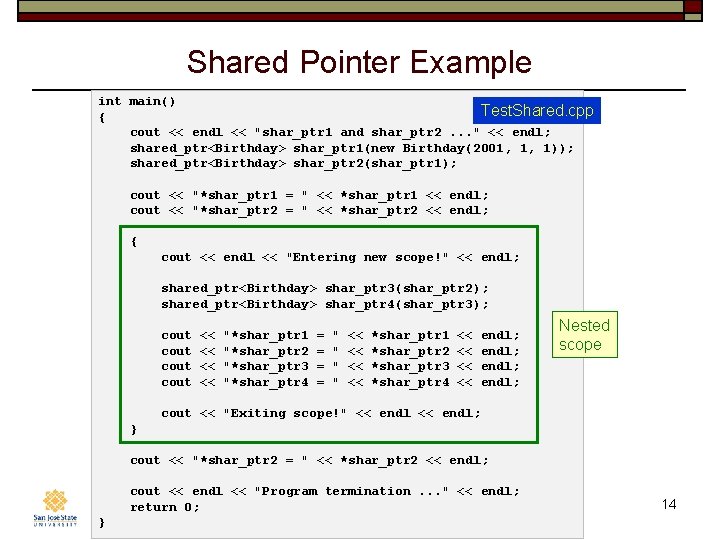
Shared Pointer Example int main() Test. Shared. cpp { cout << endl << "shar_ptr 1 and shar_ptr 2. . . " << endl; shared_ptr<Birthday> shar_ptr 1(new Birthday(2001, 1, 1)); shared_ptr<Birthday> shar_ptr 2(shar_ptr 1); cout << "*shar_ptr 1 = " << *shar_ptr 1 << endl; cout << "*shar_ptr 2 = " << *shar_ptr 2 << endl; { cout << endl << "Entering new scope!" << endl; shared_ptr<Birthday> shar_ptr 3(shar_ptr 2); shared_ptr<Birthday> shar_ptr 4(shar_ptr 3); cout << << "*shar_ptr 1 "*shar_ptr 2 "*shar_ptr 3 "*shar_ptr 4 = = " " << << *shar_ptr 1 *shar_ptr 2 *shar_ptr 3 *shar_ptr 4 << << endl; Nested scope cout << "Exiting scope!" << endl; } cout << "*shar_ptr 2 = " << *shar_ptr 2 << endl; cout << endl << "Program termination. . . " << endl; Computer Engineering return 0; Dept. Fall 2020: December 1 } CMPE 180 A: Data Structures and Algorithms in C++ © R. Mak 14
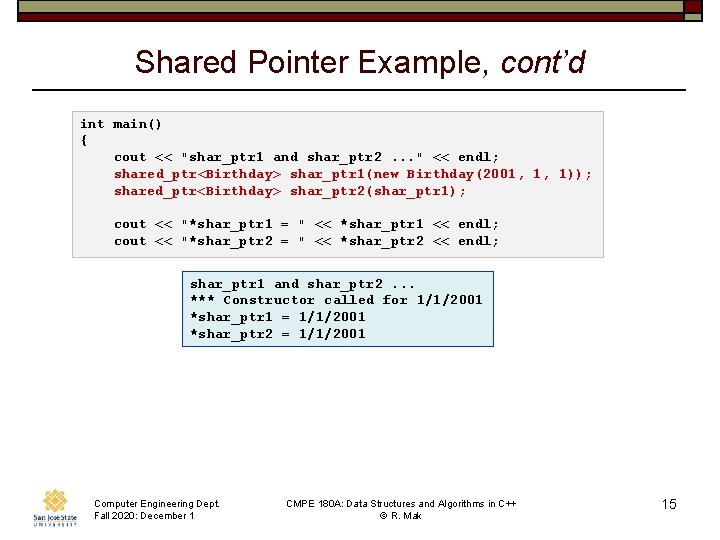
Shared Pointer Example, cont’d int main() { cout << "shar_ptr 1 and shar_ptr 2. . . " << endl; shared_ptr<Birthday> shar_ptr 1(new Birthday(2001, 1, 1)); shared_ptr<Birthday> shar_ptr 2(shar_ptr 1); cout << "*shar_ptr 1 = " << *shar_ptr 1 << endl; cout << "*shar_ptr 2 = " << *shar_ptr 2 << endl; shar_ptr 1 and shar_ptr 2. . . *** Constructor called for 1/1/2001 *shar_ptr 1 = 1/1/2001 *shar_ptr 2 = 1/1/2001 Computer Engineering Dept. Fall 2020: December 1 CMPE 180 A: Data Structures and Algorithms in C++ © R. Mak 15
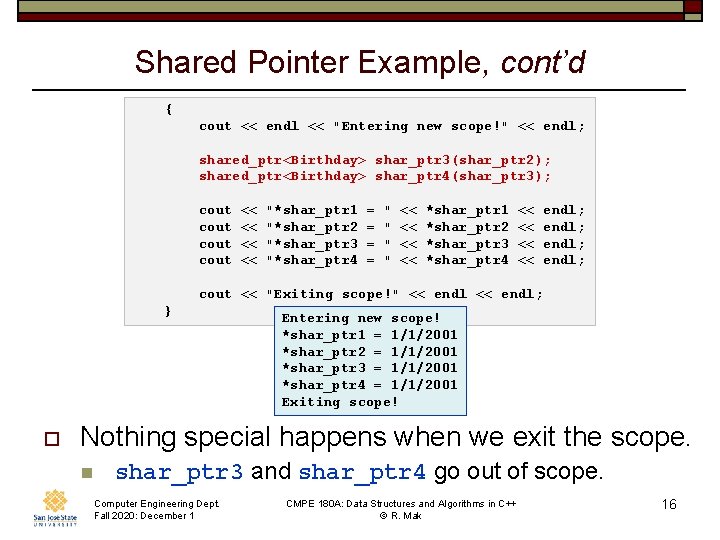
Shared Pointer Example, cont’d { cout << endl << "Entering new scope!" << endl; shared_ptr<Birthday> shar_ptr 3(shar_ptr 2); shared_ptr<Birthday> shar_ptr 4(shar_ptr 3); cout << << "*shar_ptr 1 "*shar_ptr 2 "*shar_ptr 3 "*shar_ptr 4 = = " " << << *shar_ptr 1 *shar_ptr 2 *shar_ptr 3 *shar_ptr 4 << << endl; cout << "Exiting scope!" << endl; } o Entering new scope! *shar_ptr 1 = 1/1/2001 *shar_ptr 2 = 1/1/2001 *shar_ptr 3 = 1/1/2001 *shar_ptr 4 = 1/1/2001 Exiting scope! Nothing special happens when we exit the scope. n shar_ptr 3 and shar_ptr 4 go out of scope. Computer Engineering Dept. Fall 2020: December 1 CMPE 180 A: Data Structures and Algorithms in C++ © R. Mak 16
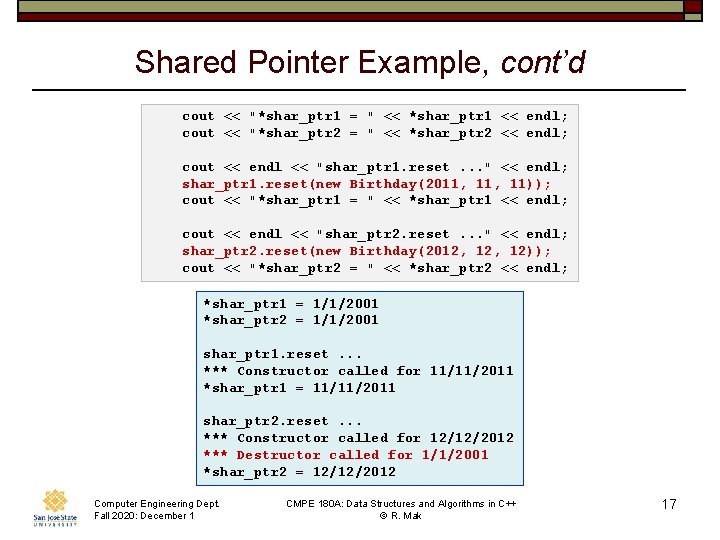
Shared Pointer Example, cont’d cout << "*shar_ptr 1 = " << *shar_ptr 1 << endl; cout << "*shar_ptr 2 = " << *shar_ptr 2 << endl; cout << endl << "shar_ptr 1. reset. . . " << endl; shar_ptr 1. reset(new Birthday(2011, 11)); cout << "*shar_ptr 1 = " << *shar_ptr 1 << endl; cout << endl << "shar_ptr 2. reset. . . " << endl; shar_ptr 2. reset(new Birthday(2012, 12)); cout << "*shar_ptr 2 = " << *shar_ptr 2 << endl; *shar_ptr 1 = 1/1/2001 *shar_ptr 2 = 1/1/2001 shar_ptr 1. reset. . . *** Constructor called for 11/11/2011 *shar_ptr 1 = 11/11/2011 shar_ptr 2. reset. . . *** Constructor called for 12/12/2012 *** Destructor called for 1/1/2001 *shar_ptr 2 = 12/12/2012 Computer Engineering Dept. Fall 2020: December 1 CMPE 180 A: Data Structures and Algorithms in C++ © R. Mak 17
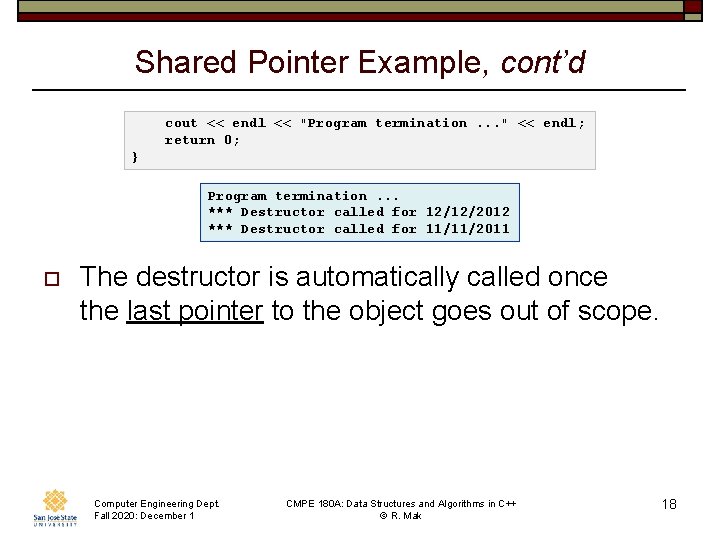
Shared Pointer Example, cont’d cout << endl << "Program termination. . . " << endl; return 0; } Program termination. . . *** Destructor called for 12/12/2012 *** Destructor called for 11/11/2011 o The destructor is automatically called once the last pointer to the object goes out of scope. Computer Engineering Dept. Fall 2020: December 1 CMPE 180 A: Data Structures and Algorithms in C++ © R. Mak 18
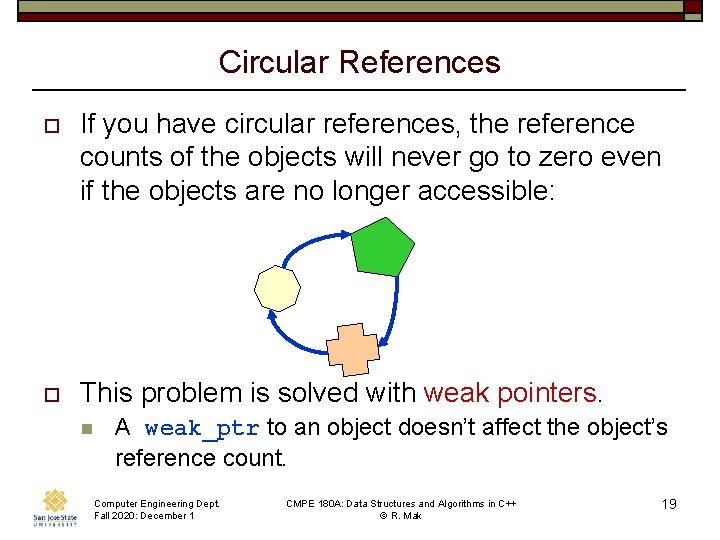
Circular References o If you have circular references, the reference counts of the objects will never go to zero even if the objects are no longer accessible: o This problem is solved with weak pointers. n A weak_ptr to an object doesn’t affect the object’s reference count. Computer Engineering Dept. Fall 2020: December 1 CMPE 180 A: Data Structures and Algorithms in C++ © R. Mak 19
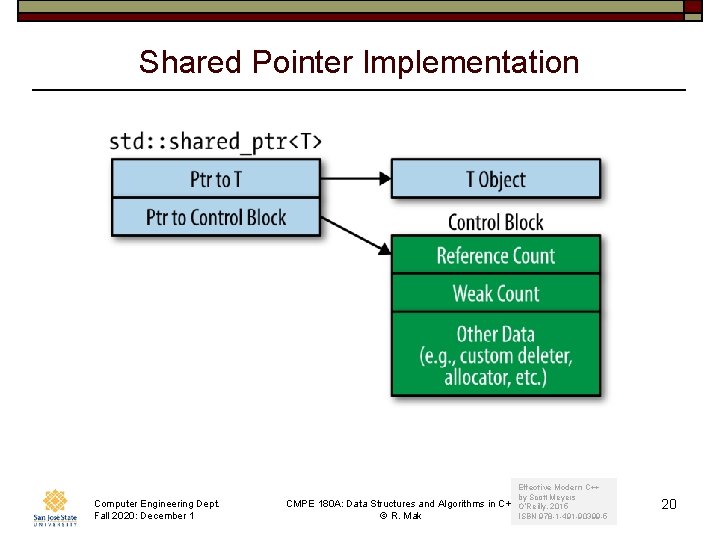
Shared Pointer Implementation Computer Engineering Dept. Fall 2020: December 1 CMPE 180 A: Data Structures and Algorithms in © R. Mak Effective Modern C++ by Scott Meyers C++ O’Reilly, 2015 ISBN 978 -1 -491 -90399 -5 20
Break Computer Engineering Dept. Fall 2020: December 1 CMPE 180 A: Data Structures and Algorithms in C++ © R. Mak 21
Graphs o A graph is one of the most versatile data structures in computer science. Computer Engineering Dept. Fall 2020: December 1 CMPE 180 A: Data Structures and Algorithms in C++ © R. Mak 22
Uses of Graphs o o o o Model connectivity in computer and communications networks. Represent a map of locations and distances between them. Model flow capacities in transportation networks. Find a path from a starting condition to a goal condition. Model state transitions in computer algorithms. Model an order for finishing subtasks in a complex activity. Model relationships such as family trees, business and military organizations, and scientific taxonomies. Computer Engineering Dept. Fall 2020: December 1 CMPE 180 A: Data Structures and Algorithms in C++ © R. Mak 23
Graph Terms o A graph G = (V, E) is a set of vertices V and a set of edges (arcs) E. o An edge is a pair (v, w), where v and w are in V. o If the pair is ordered, the graph is directed and is called a digraph. Computer Engineering Dept. Fall 2020: December 1 CMPE 180 A: Data Structures and Algorithms in C++ © R. Mak 24
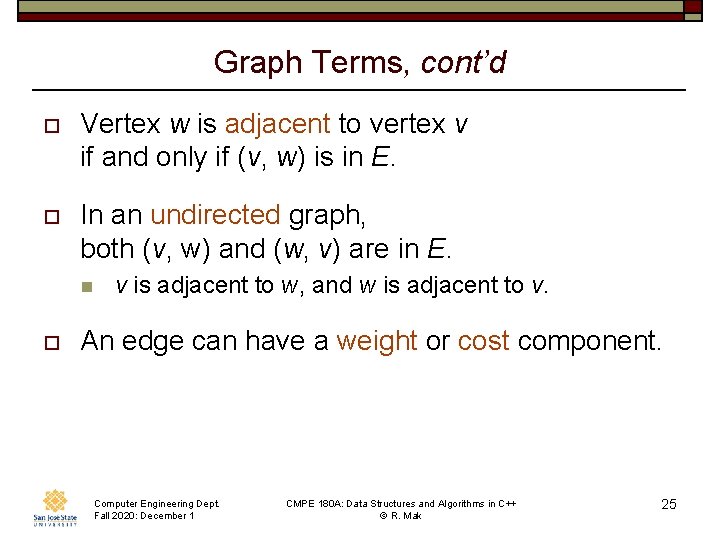
Graph Terms, cont’d o Vertex w is adjacent to vertex v if and only if (v, w) is in E. o In an undirected graph, both (v, w) and (w, v) are in E. n o v is adjacent to w, and w is adjacent to v. An edge can have a weight or cost component. Computer Engineering Dept. Fall 2020: December 1 CMPE 180 A: Data Structures and Algorithms in C++ © R. Mak 25
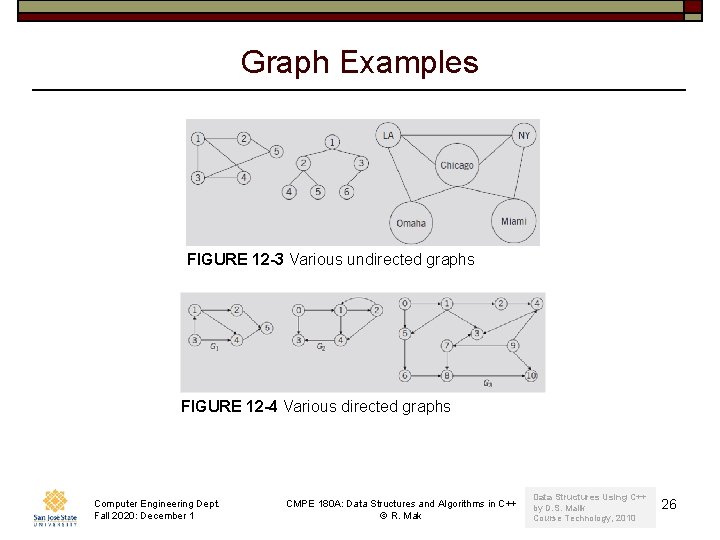
Graph Examples FIGURE 12 -3 Various undirected graphs FIGURE 12 -4 Various directed graphs Computer Engineering Dept. Fall 2020: December 1 CMPE 180 A: Data Structures and Algorithms in C++ © R. Mak Data Structures Using C++ by D. S. Malik Course Technology, 2010 26
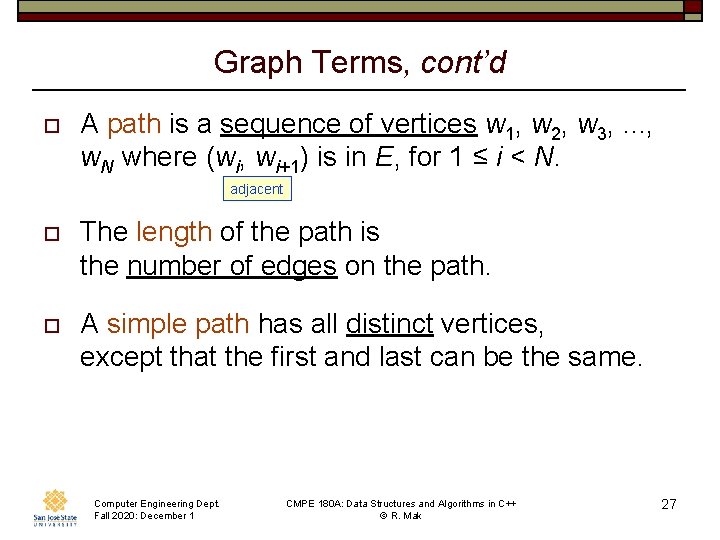
Graph Terms, cont’d o A path is a sequence of vertices w 1, w 2, w 3, . . . , w. N where (wi, wi+1) is in E, for 1 ≤ i < N. adjacent o The length of the path is the number of edges on the path. o A simple path has all distinct vertices, except that the first and last can be the same. Computer Engineering Dept. Fall 2020: December 1 CMPE 180 A: Data Structures and Algorithms in C++ © R. Mak 27
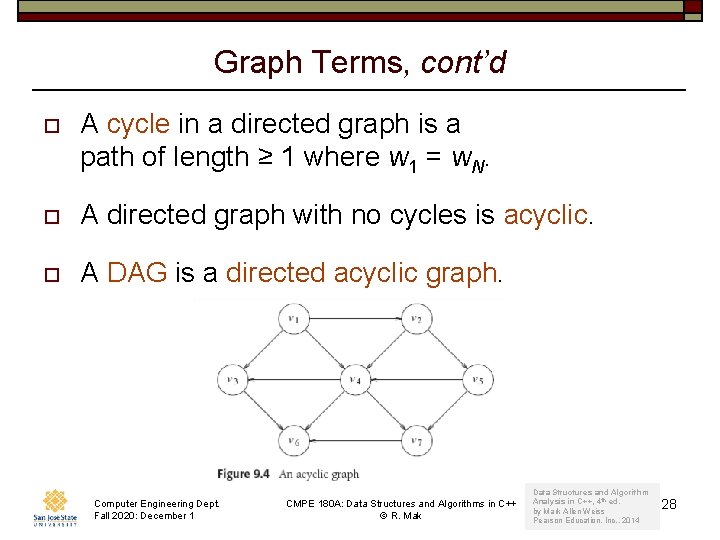
Graph Terms, cont’d o A cycle in a directed graph is a path of length ≥ 1 where w 1 = w. N. o A directed graph with no cycles is acyclic. o A DAG is a directed acyclic graph. Computer Engineering Dept. Fall 2020: December 1 CMPE 180 A: Data Structures and Algorithms in C++ © R. Mak Data Structures and Algorithm Analysis in C++, 4 th ed. by Mark Allen Weiss Pearson Education, Inc. , 2014 28
Graph Terms, cont’d o The indegree of a vertex v is the number of incoming edges (u, v). Computer Engineering Dept. Fall 2020: December 1 CMPE 180 A: Data Structures and Algorithms in C++ © R. Mak 29
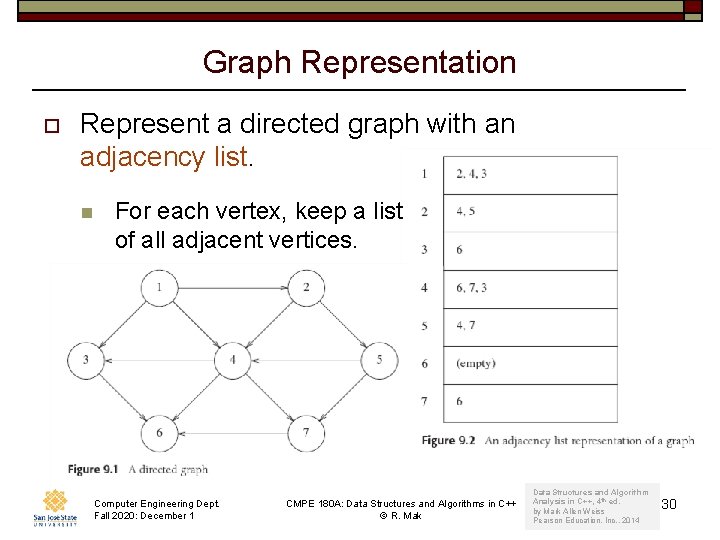
Graph Representation o Represent a directed graph with an adjacency list. n For each vertex, keep a list of all adjacent vertices. Computer Engineering Dept. Fall 2020: December 1 CMPE 180 A: Data Structures and Algorithms in C++ © R. Mak Data Structures and Algorithm Analysis in C++, 4 th ed. by Mark Allen Weiss Pearson Education, Inc. , 2014 30
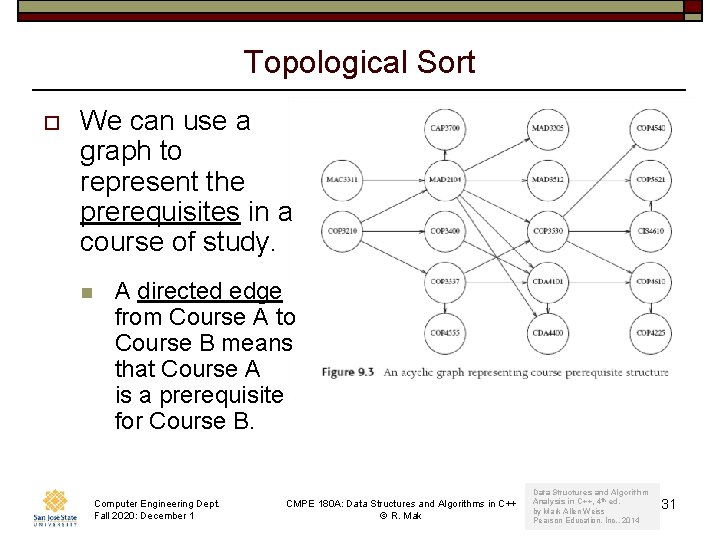
Topological Sort o We can use a graph to represent the prerequisites in a course of study. n A directed edge from Course A to Course B means that Course A is a prerequisite for Course B. Computer Engineering Dept. Fall 2020: December 1 CMPE 180 A: Data Structures and Algorithms in C++ © R. Mak Data Structures and Algorithm Analysis in C++, 4 th ed. by Mark Allen Weiss Pearson Education, Inc. , 2014 31
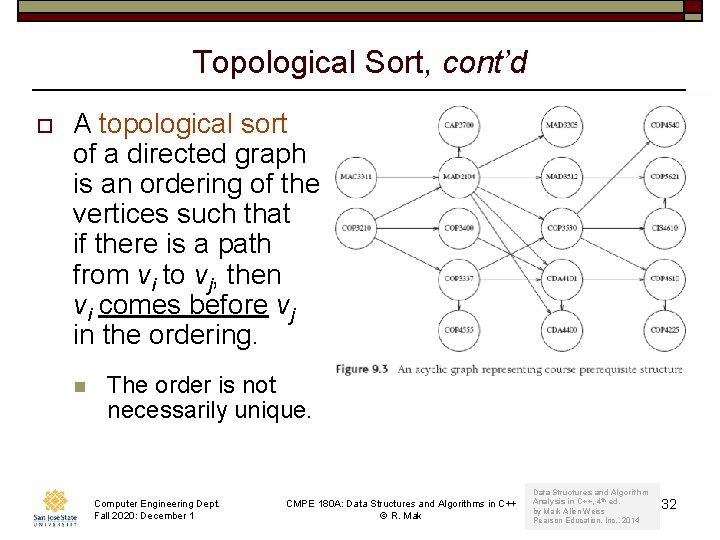
Topological Sort, cont’d o A topological sort of a directed graph is an ordering of the vertices such that if there is a path from vi to vj, then vi comes before vj in the ordering. n The order is not necessarily unique. Computer Engineering Dept. Fall 2020: December 1 CMPE 180 A: Data Structures and Algorithms in C++ © R. Mak Data Structures and Algorithm Analysis in C++, 4 th ed. by Mark Allen Weiss Pearson Education, Inc. , 2014 32
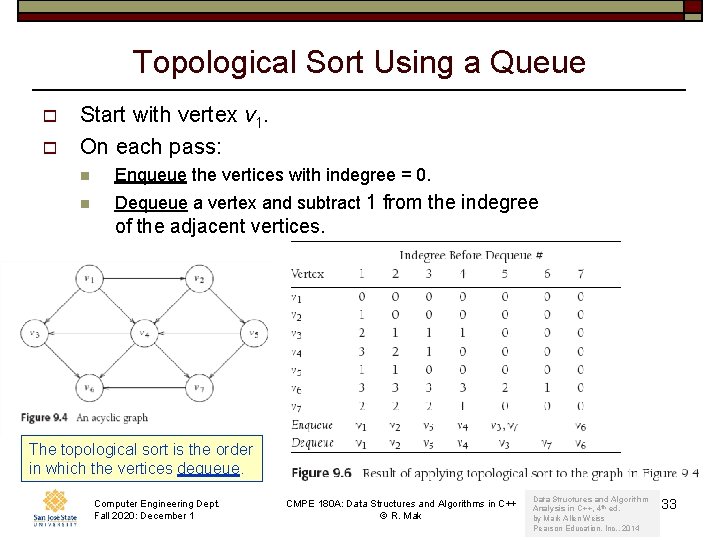
Topological Sort Using a Queue o o Start with vertex v 1. On each pass: n Enqueue the vertices with indegree = 0. n Dequeue a vertex and subtract 1 from the indegree of the adjacent vertices. The topological sort is the order in which the vertices dequeue. Computer Engineering Dept. Fall 2020: December 1 CMPE 180 A: Data Structures and Algorithms in C++ © R. Mak Data Structures and Algorithm Analysis in C++, 4 th ed. by Mark Allen Weiss Pearson Education, Inc. , 2014 33
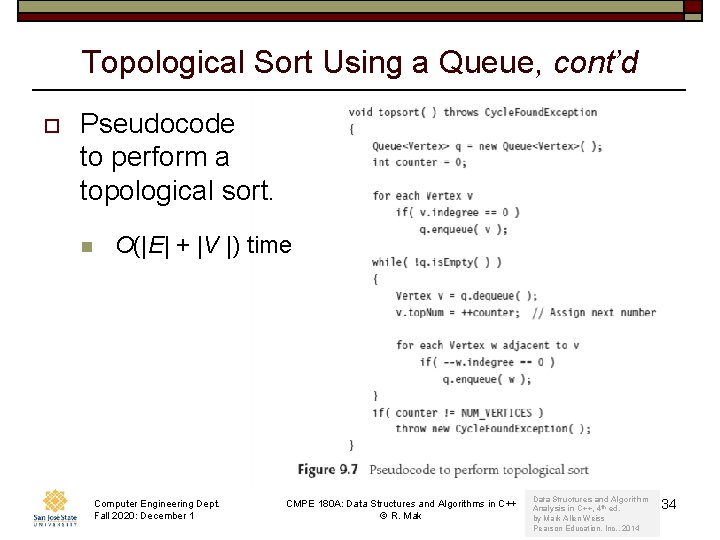
Topological Sort Using a Queue, cont’d o Pseudocode to perform a topological sort. n O(|E| + |V |) time Computer Engineering Dept. Fall 2020: December 1 CMPE 180 A: Data Structures and Algorithms in C++ © R. Mak Data Structures and Algorithm Analysis in C++, 4 th ed. by Mark Allen Weiss Pearson Education, Inc. , 2014 34
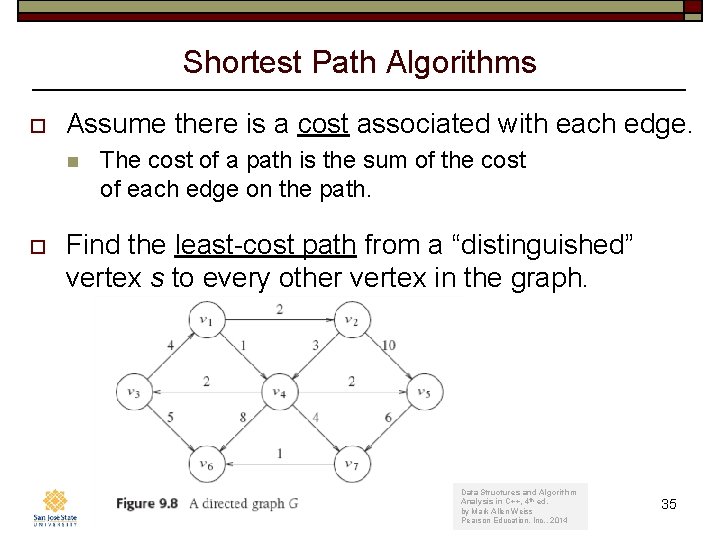
Shortest Path Algorithms o Assume there is a cost associated with each edge. n o The cost of a path is the sum of the cost of each edge on the path. Find the least-cost path from a “distinguished” vertex s to every other vertex in the graph. Data Structures and Algorithm Computer Engineering Dept. Fall 2020: December 1 Analysis C++, 4 th ed. CMPE 180 A: Data Structures and Algorithms in in. C++ by Mark Allen Weiss © R. Mak Pearson Education, Inc. , 2014 35
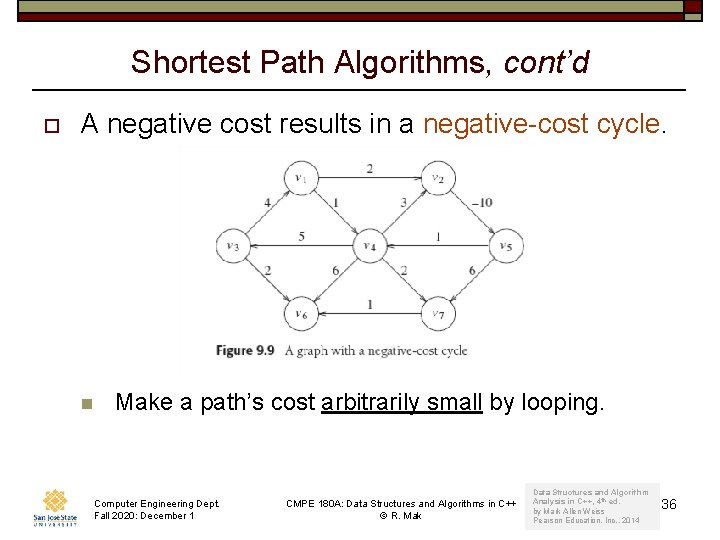
Shortest Path Algorithms, cont’d o A negative cost results in a negative-cost cycle. n Make a path’s cost arbitrarily small by looping. Computer Engineering Dept. Fall 2020: December 1 CMPE 180 A: Data Structures and Algorithms in C++ © R. Mak Data Structures and Algorithm Analysis in C++, 4 th ed. by Mark Allen Weiss Pearson Education, Inc. , 2014 36
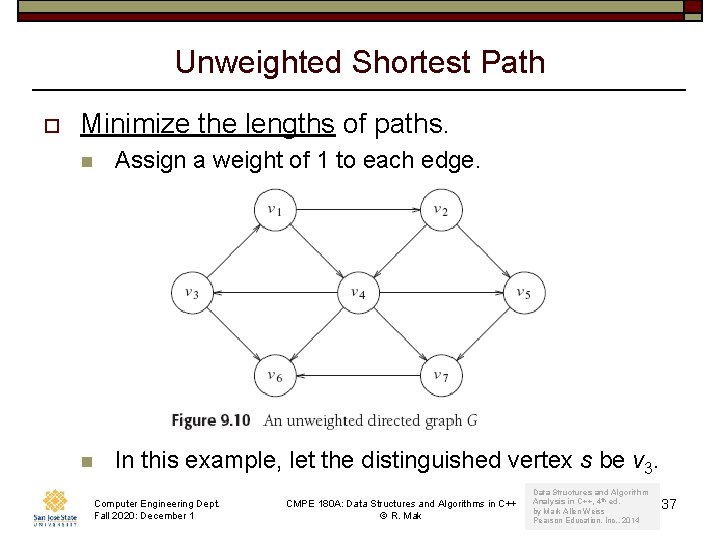
Unweighted Shortest Path o Minimize the lengths of paths. n Assign a weight of 1 to each edge. n In this example, let the distinguished vertex s be v 3. Computer Engineering Dept. Fall 2020: December 1 CMPE 180 A: Data Structures and Algorithms in C++ © R. Mak Data Structures and Algorithm Analysis in C++, 4 th ed. by Mark Allen Weiss Pearson Education, Inc. , 2014 37
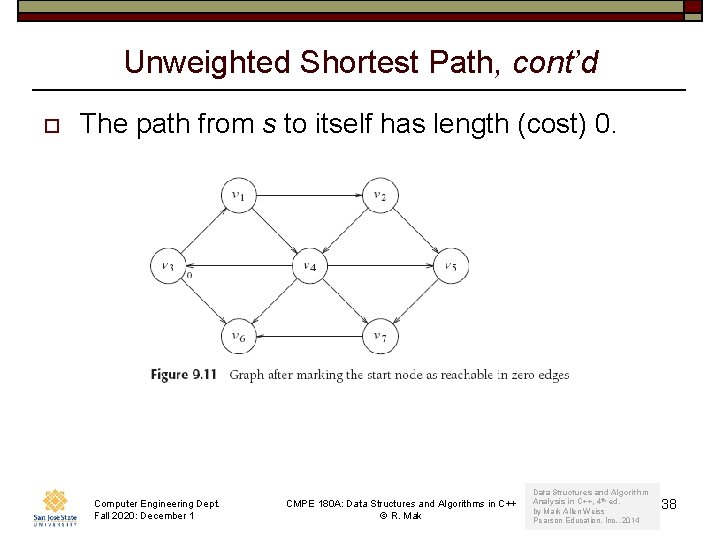
Unweighted Shortest Path, cont’d o The path from s to itself has length (cost) 0. Computer Engineering Dept. Fall 2020: December 1 CMPE 180 A: Data Structures and Algorithms in C++ © R. Mak Data Structures and Algorithm Analysis in C++, 4 th ed. by Mark Allen Weiss Pearson Education, Inc. , 2014 38
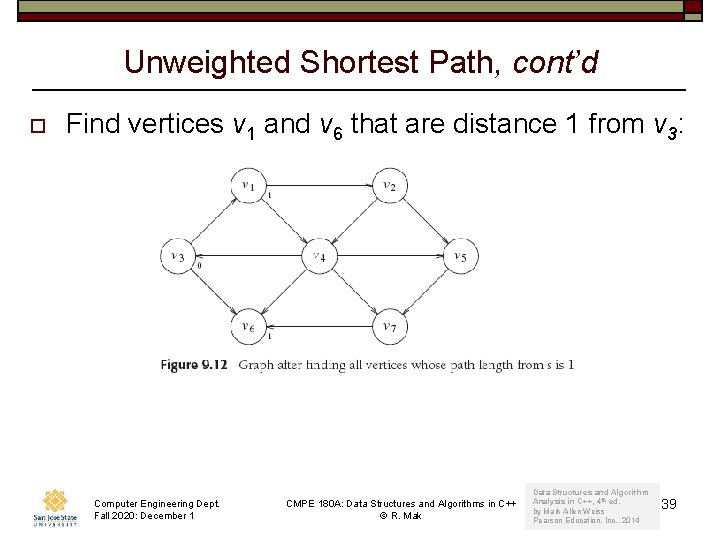
Unweighted Shortest Path, cont’d o Find vertices v 1 and v 6 that are distance 1 from v 3: Computer Engineering Dept. Fall 2020: December 1 CMPE 180 A: Data Structures and Algorithms in C++ © R. Mak Data Structures and Algorithm Analysis in C++, 4 th ed. by Mark Allen Weiss Pearson Education, Inc. , 2014 39
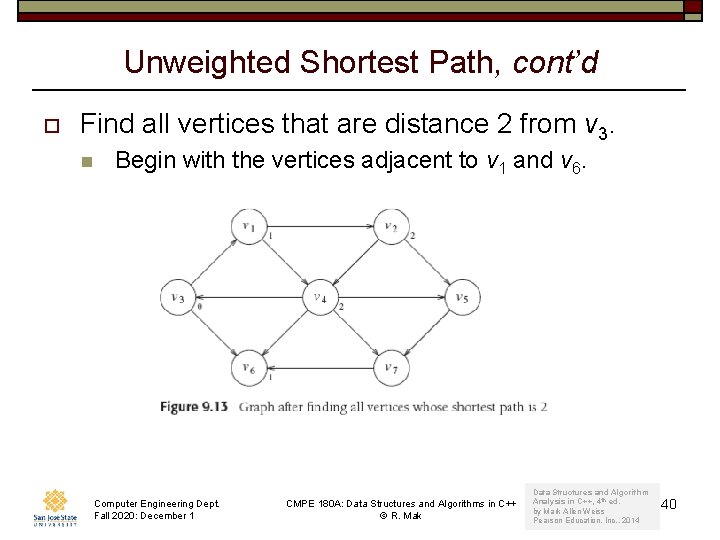
Unweighted Shortest Path, cont’d o Find all vertices that are distance 2 from v 3. n Begin with the vertices adjacent to v 1 and v 6. Computer Engineering Dept. Fall 2020: December 1 CMPE 180 A: Data Structures and Algorithms in C++ © R. Mak Data Structures and Algorithm Analysis in C++, 4 th ed. by Mark Allen Weiss Pearson Education, Inc. , 2014 40
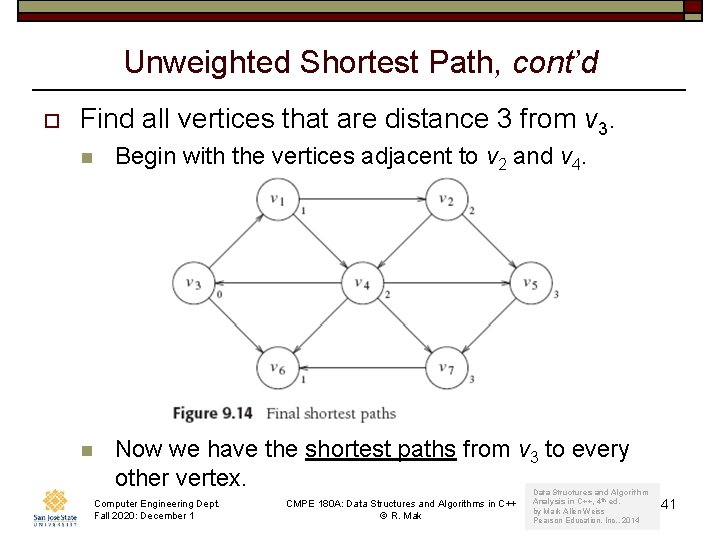
Unweighted Shortest Path, cont’d o Find all vertices that are distance 3 from v 3. n Begin with the vertices adjacent to v 2 and v 4. n Now we have the shortest paths from v 3 to every other vertex. Computer Engineering Dept. Fall 2020: December 1 CMPE 180 A: Data Structures and Algorithms in C++ © R. Mak Data Structures and Algorithm Analysis in C++, 4 th ed. by Mark Allen Weiss Pearson Education, Inc. , 2014 41
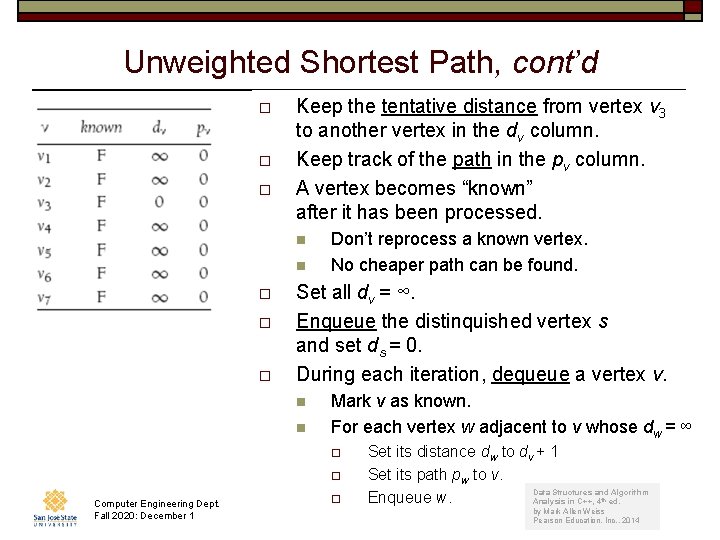
Unweighted Shortest Path, cont’d o o o Keep the tentative distance from vertex v 3 to another vertex in the dv column. Keep track of the path in the pv column. A vertex becomes “known” after it has been processed. n n o o o Don’t reprocess a known vertex. No cheaper path can be found. Set all dv = ∞. Enqueue the distinquished vertex s and set ds = 0. During each iteration, dequeue a vertex v. n n Mark v as known. For each vertex w adjacent to v whose dw = ∞ Set its distance dw to dv + 1 o Set its path pw to v. Data Structures and Algorithm o Data Enqueue Analysis in C++, 4 ed. CMPE 180 A: Structures and w. Algorithms in C++ 42 by Mark Allen Weiss o Computer Engineering Dept. Fall 2020: December 1 th © R. Mak Pearson Education, Inc. , 2014
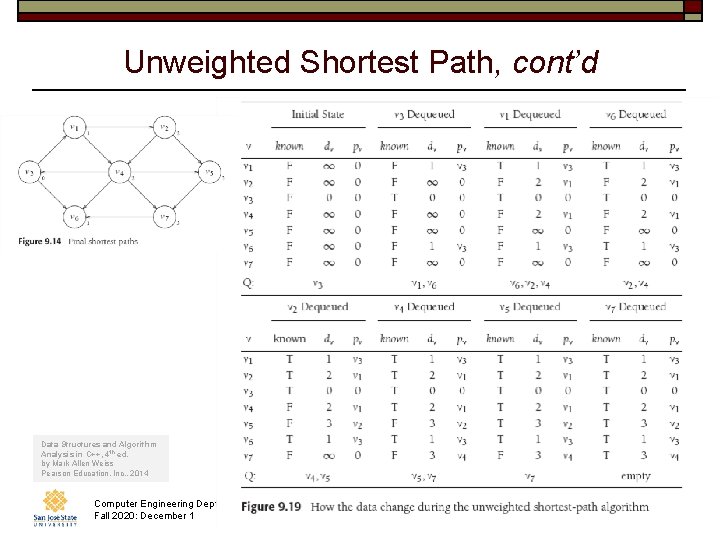
Unweighted Shortest Path, cont’d Data Structures and Algorithm Analysis in C++, 4 th ed. by Mark Allen Weiss Pearson Education, Inc. , 2014 Computer Engineering Dept. Fall 2020: December 1 CMPE 180 A: Data Structures and Algorithms in C++ © R. Mak 43
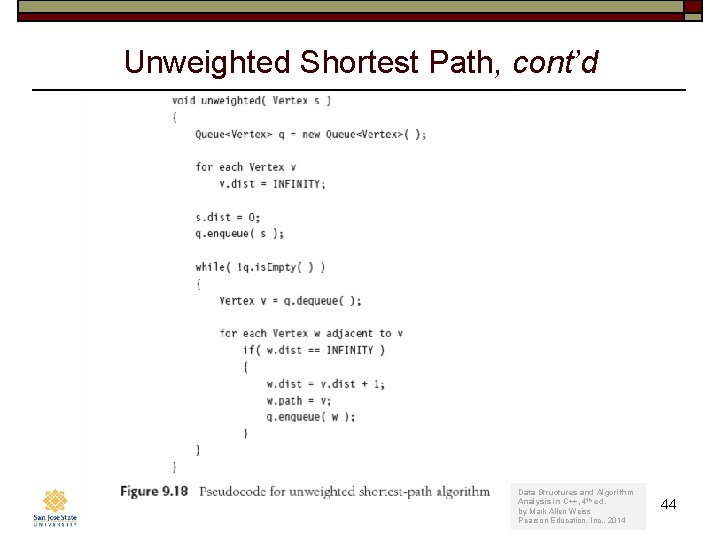
Unweighted Shortest Path, cont’d Data Structures and Algorithm Computer Engineering Dept. Fall 2020: December 1 CMPE 180 A: Data Structures and Algorithms in C++ Analysis in C++, 4 th ed. by Mark Allen Weiss © R. Mak Pearson Education, Inc. , 2014 44
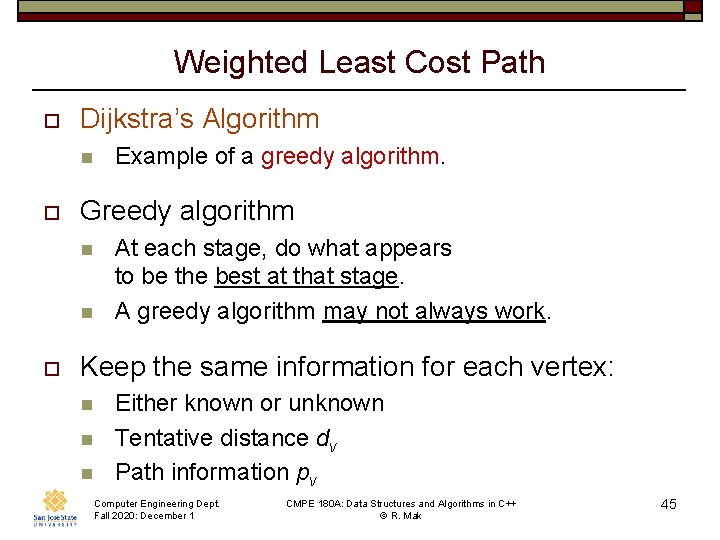
Weighted Least Cost Path o Dijkstra’s Algorithm n o Greedy algorithm n n o Example of a greedy algorithm. At each stage, do what appears to be the best at that stage. A greedy algorithm may not always work. Keep the same information for each vertex: n n n Either known or unknown Tentative distance dv Path information pv Computer Engineering Dept. Fall 2020: December 1 CMPE 180 A: Data Structures and Algorithms in C++ © R. Mak 45
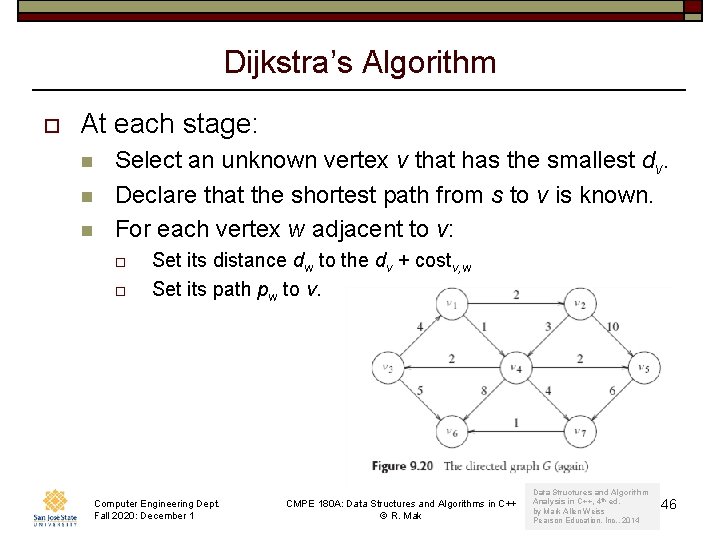
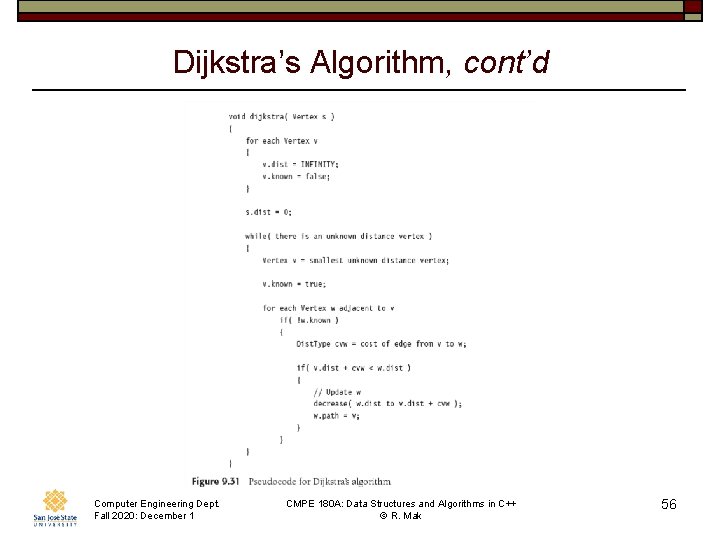
Dijkstra’s Algorithm o At each stage: n n n Select an unknown vertex v that has the smallest dv. Declare that the shortest path from s to v is known. For each vertex w adjacent to v: o o Set its distance dw to the dv + costv, w Set its path pw to v. Computer Engineering Dept. Fall 2020: December 1 CMPE 180 A: Data Structures and Algorithms in C++ © R. Mak Data Structures and Algorithm Analysis in C++, 4 th ed. by Mark Allen Weiss Pearson Education, Inc. , 2014 46
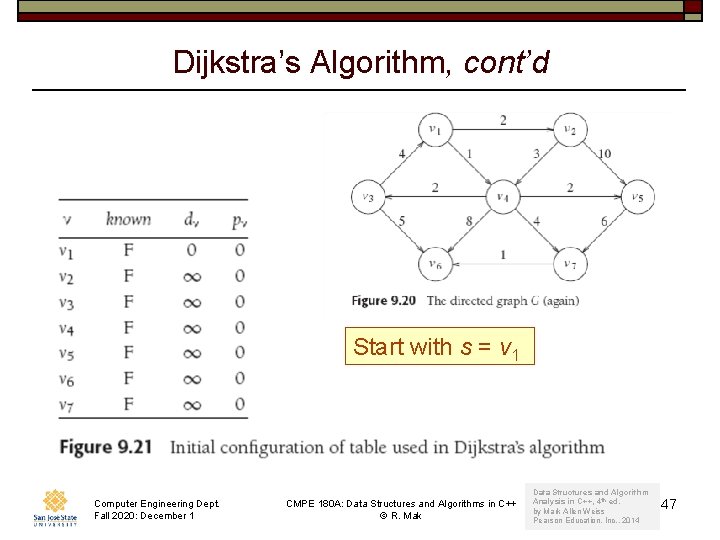
Dijkstra’s Algorithm, cont’d Start with s = v 1 Computer Engineering Dept. Fall 2020: December 1 CMPE 180 A: Data Structures and Algorithms in C++ © R. Mak Data Structures and Algorithm Analysis in C++, 4 th ed. by Mark Allen Weiss Pearson Education, Inc. , 2014 47
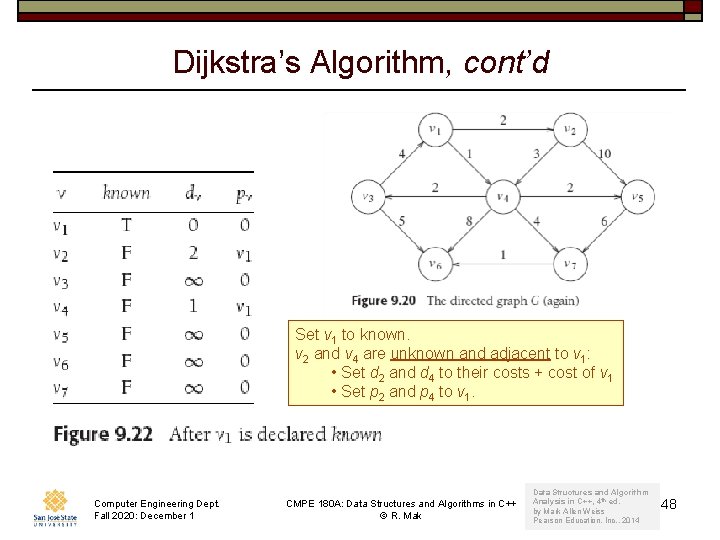
Dijkstra’s Algorithm, cont’d Set v 1 to known. v 2 and v 4 are unknown and adjacent to v 1: • Set d 2 and d 4 to their costs + cost of v 1 • Set p 2 and p 4 to v 1. Computer Engineering Dept. Fall 2020: December 1 CMPE 180 A: Data Structures and Algorithms in C++ © R. Mak Data Structures and Algorithm Analysis in C++, 4 th ed. by Mark Allen Weiss Pearson Education, Inc. , 2014 48
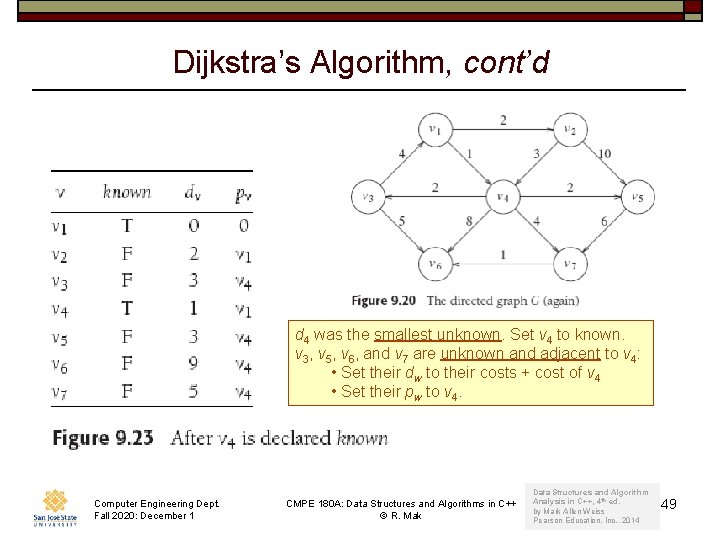
Dijkstra’s Algorithm, cont’d d 4 was the smallest unknown. Set v 4 to known. v 3, v 5, v 6, and v 7 are unknown and adjacent to v 4: • Set their dw to their costs + cost of v 4 • Set their pw to v 4. Computer Engineering Dept. Fall 2020: December 1 CMPE 180 A: Data Structures and Algorithms in C++ © R. Mak Data Structures and Algorithm Analysis in C++, 4 th ed. by Mark Allen Weiss Pearson Education, Inc. , 2014 49
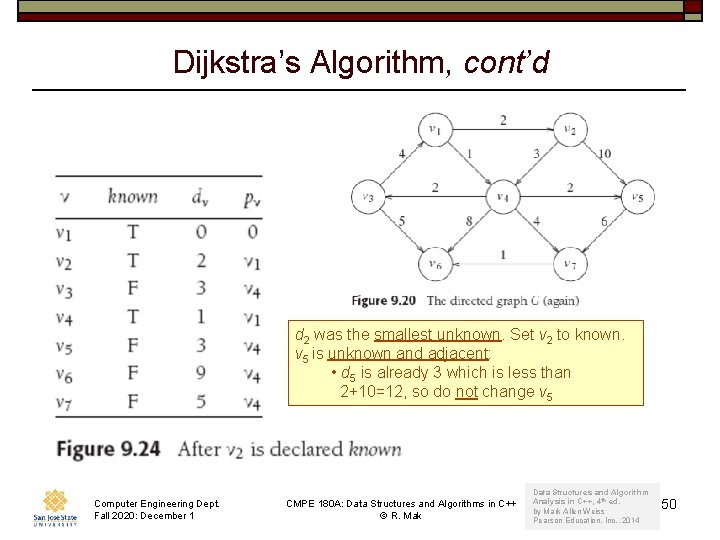
Dijkstra’s Algorithm, cont’d d 2 was the smallest unknown. Set v 2 to known. v 5 is unknown and adjacent: • d 5 is already 3 which is less than 2+10=12, so do not change v 5 Computer Engineering Dept. Fall 2020: December 1 CMPE 180 A: Data Structures and Algorithms in C++ © R. Mak Data Structures and Algorithm Analysis in C++, 4 th ed. by Mark Allen Weiss Pearson Education, Inc. , 2014 50
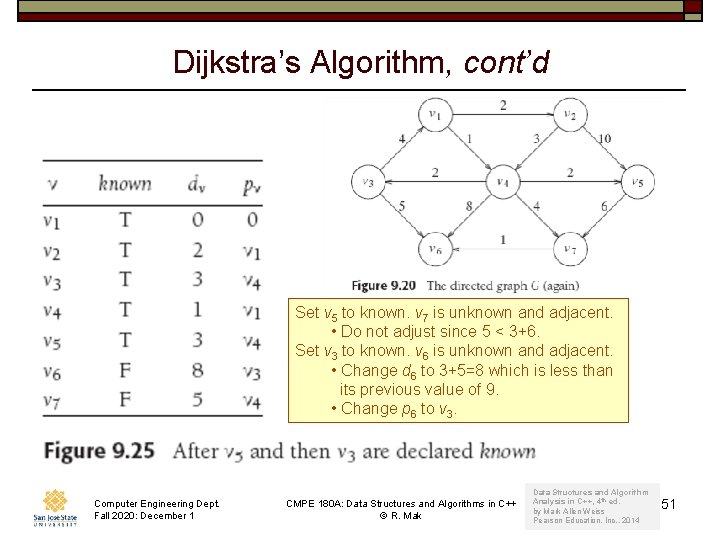
Dijkstra’s Algorithm, cont’d Set v 5 to known. v 7 is unknown and adjacent. • Do not adjust since 5 < 3+6. Set v 3 to known. v 6 is unknown and adjacent. • Change d 6 to 3+5=8 which is less than its previous value of 9. • Change p 6 to v 3. Computer Engineering Dept. Fall 2020: December 1 CMPE 180 A: Data Structures and Algorithms in C++ © R. Mak Data Structures and Algorithm Analysis in C++, 4 th ed. by Mark Allen Weiss Pearson Education, Inc. , 2014 51
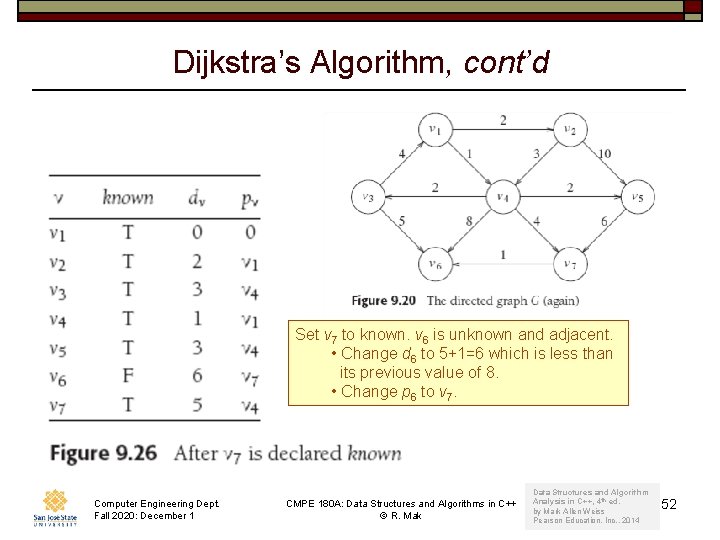
Dijkstra’s Algorithm, cont’d Set v 7 to known. v 6 is unknown and adjacent. • Change d 6 to 5+1=6 which is less than its previous value of 8. • Change p 6 to v 7. Computer Engineering Dept. Fall 2020: December 1 CMPE 180 A: Data Structures and Algorithms in C++ © R. Mak Data Structures and Algorithm Analysis in C++, 4 th ed. by Mark Allen Weiss Pearson Education, Inc. , 2014 52
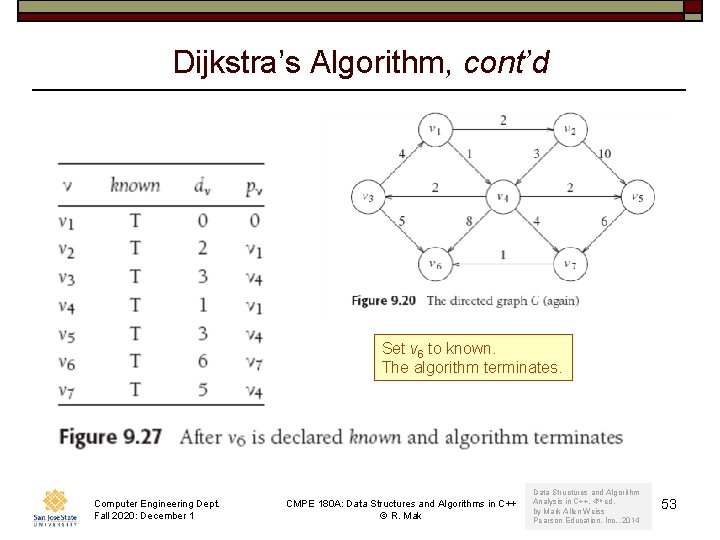
Dijkstra’s Algorithm, cont’d Set v 6 to known. The algorithm terminates. Computer Engineering Dept. Fall 2020: December 1 CMPE 180 A: Data Structures and Algorithms in C++ © R. Mak Data Structures and Algorithm Analysis in C++, 4 th ed. by Mark Allen Weiss Pearson Education, Inc. , 2014 53
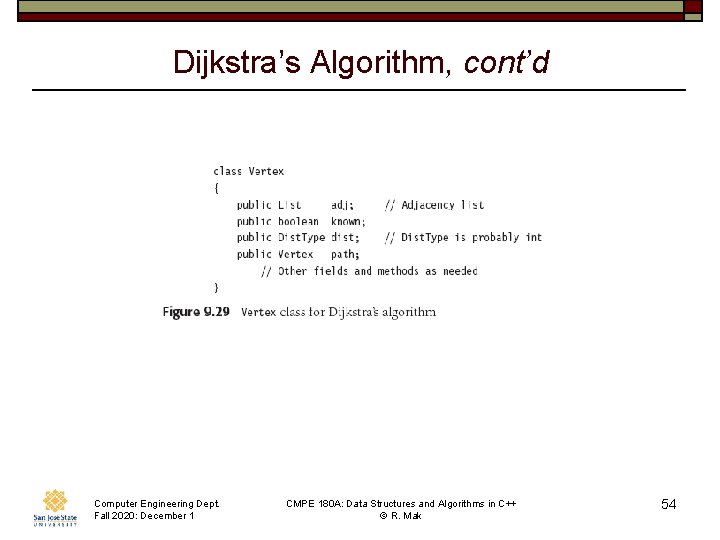
Dijkstra’s Algorithm, cont’d Computer Engineering Dept. Fall 2020: December 1 CMPE 180 A: Data Structures and Algorithms in C++ © R. Mak 54
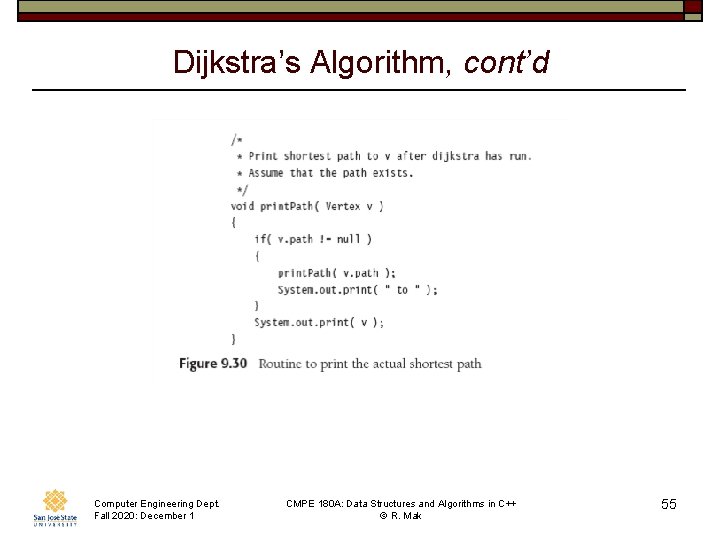
Dijkstra’s Algorithm, cont’d Computer Engineering Dept. Fall 2020: December 1 CMPE 180 A: Data Structures and Algorithms in C++ © R. Mak 55
Dijkstra’s Algorithm, cont’d Computer Engineering Dept. Fall 2020: December 1 CMPE 180 A: Data Structures and Algorithms in C++ © R. Mak 56
Minimum Spanning Tree (MST) o Suppose you’re wiring a new house. n o What’s the minimum length of wire you need to purchase? Represent the house as an undirected graph. n n n Each electrical outlet is a vertex. The wires between the outlets are the edges. The cost of each edge is the length of the wire. Computer Engineering Dept. Fall 2020: December 1 CMPE 180 A: Data Structures and Algorithms in C++ © R. Mak 57
Minimum Spanning Tree (MST), cont’d o Create a tree formed from the edges of an undirected graph that connects all the vertices at the lowest total cost. Computer Engineering Dept. Fall 2020: December 1 CMPE 180 A: Data Structures and Algorithms in C++ © R. Mak 58
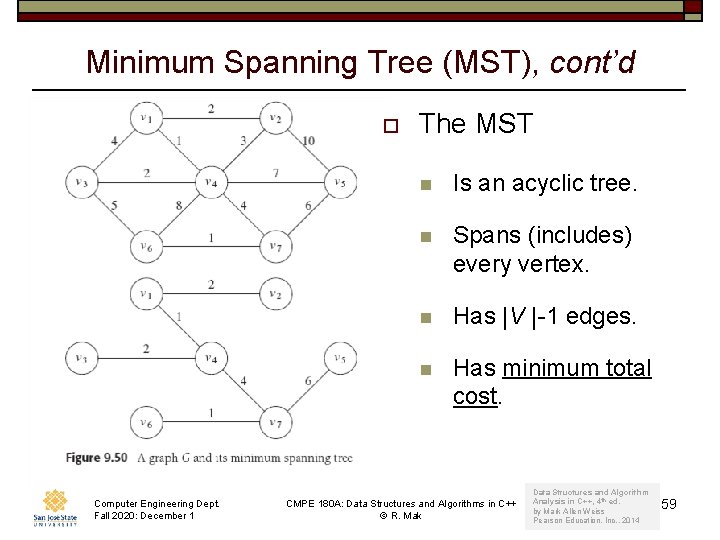
Minimum Spanning Tree (MST), cont’d o Computer Engineering Dept. Fall 2020: December 1 The MST n Is an acyclic tree. n Spans (includes) every vertex. n Has |V |-1 edges. n Has minimum total cost. CMPE 180 A: Data Structures and Algorithms in C++ © R. Mak Data Structures and Algorithm Analysis in C++, 4 th ed. by Mark Allen Weiss Pearson Education, Inc. , 2014 59
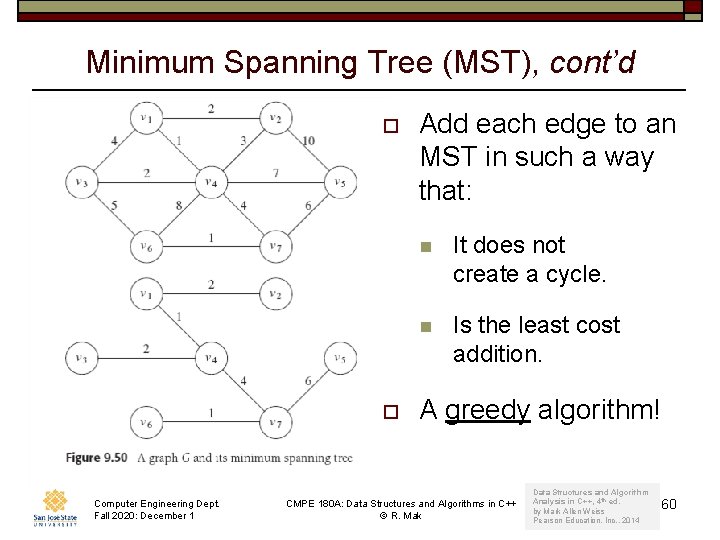
Minimum Spanning Tree (MST), cont’d o o Computer Engineering Dept. Fall 2020: December 1 Add each edge to an MST in such a way that: n It does not create a cycle. n Is the least cost addition. A greedy algorithm! CMPE 180 A: Data Structures and Algorithms in C++ © R. Mak Data Structures and Algorithm Analysis in C++, 4 th ed. by Mark Allen Weiss Pearson Education, Inc. , 2014 60
Prim’s Algorithm for MST o Rediscovered by Robert C. Prim in 1957 to solve connection network problems. n First discovered in 1930 by Czech mathematician Vojtěch Jarník. o At any point during the algorithm, some vertices are in the MST and others are not. o Choose one vertex to start. Computer Engineering Dept. Fall 2020: December 1 CMPE 180 A: Data Structures and Algorithms in C++ © R. Mak 61
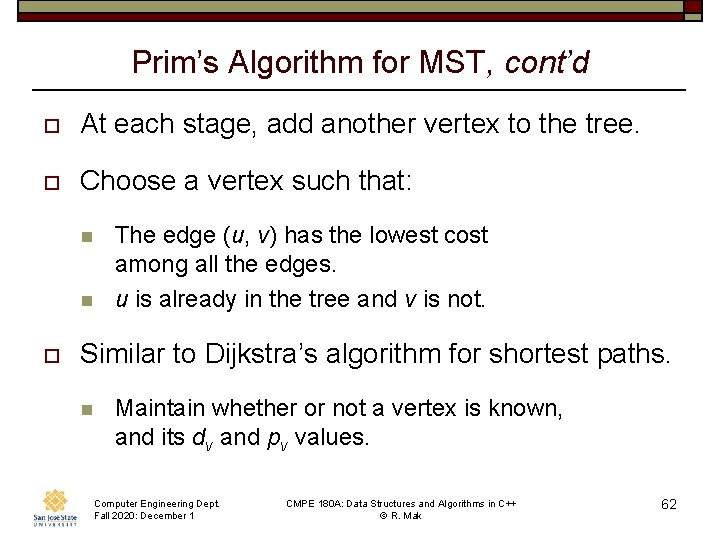
Prim’s Algorithm for MST, cont’d o At each stage, add another vertex to the tree. o Choose a vertex such that: n n o The edge (u, v) has the lowest cost among all the edges. u is already in the tree and v is not. Similar to Dijkstra’s algorithm for shortest paths. n Maintain whether or not a vertex is known, and its dv and pv values. Computer Engineering Dept. Fall 2020: December 1 CMPE 180 A: Data Structures and Algorithms in C++ © R. Mak 62
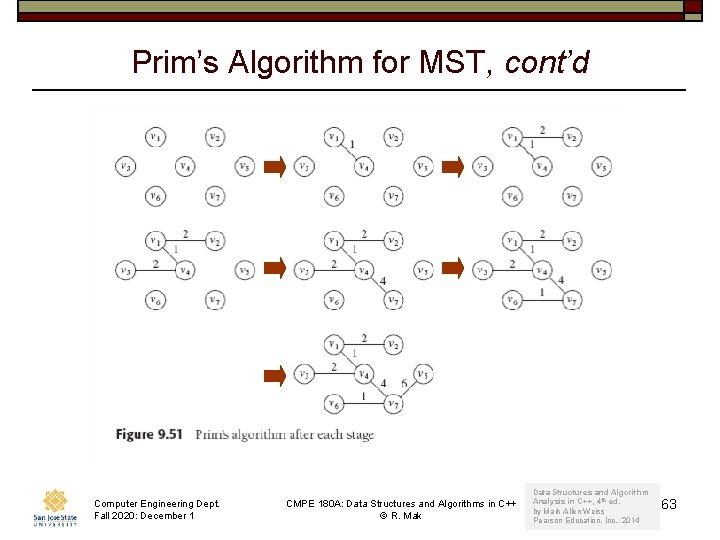
Prim’s Algorithm for MST, cont’d Computer Engineering Dept. Fall 2020: December 1 CMPE 180 A: Data Structures and Algorithms in C++ © R. Mak Data Structures and Algorithm Analysis in C++, 4 th ed. by Mark Allen Weiss Pearson Education, Inc. , 2014 63
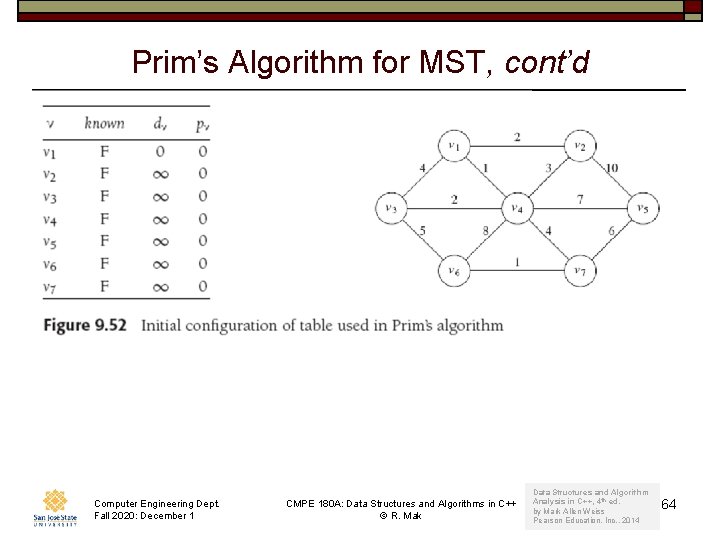
Prim’s Algorithm for MST, cont’d Computer Engineering Dept. Fall 2020: December 1 CMPE 180 A: Data Structures and Algorithms in C++ © R. Mak Data Structures and Algorithm Analysis in C++, 4 th ed. by Mark Allen Weiss Pearson Education, Inc. , 2014 64
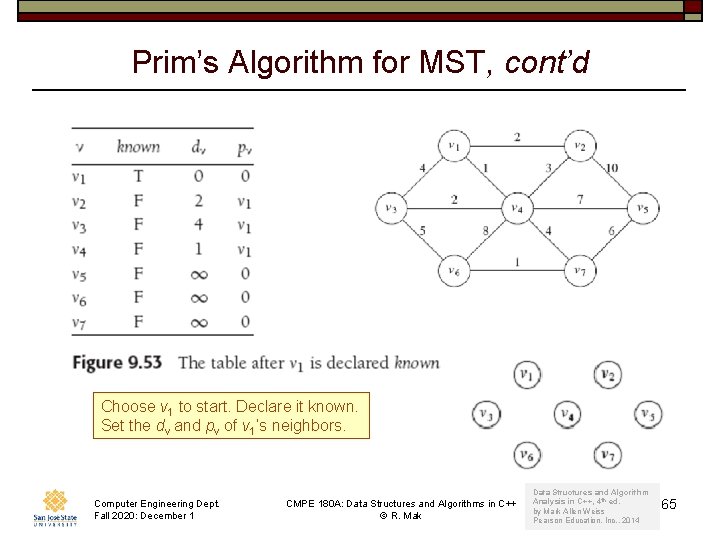
Prim’s Algorithm for MST, cont’d Choose v 1 to start. Declare it known. Set the dv and pv of v 1’s neighbors. Computer Engineering Dept. Fall 2020: December 1 CMPE 180 A: Data Structures and Algorithms in C++ © R. Mak Data Structures and Algorithm Analysis in C++, 4 th ed. by Mark Allen Weiss Pearson Education, Inc. , 2014 65
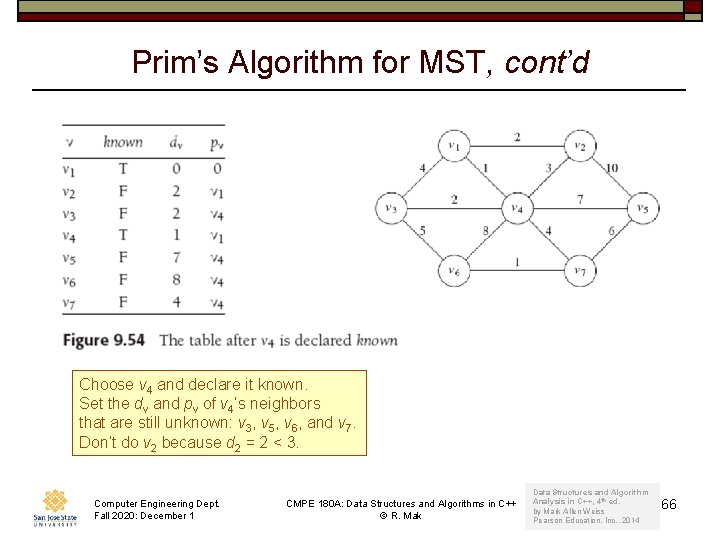
Prim’s Algorithm for MST, cont’d Choose v 4 and declare it known. Set the dv and pv of v 4’s neighbors that are still unknown: v 3, v 5, v 6, and v 7. Don’t do v 2 because d 2 = 2 < 3. Computer Engineering Dept. Fall 2020: December 1 CMPE 180 A: Data Structures and Algorithms in C++ © R. Mak Data Structures and Algorithm Analysis in C++, 4 th ed. by Mark Allen Weiss Pearson Education, Inc. , 2014 66
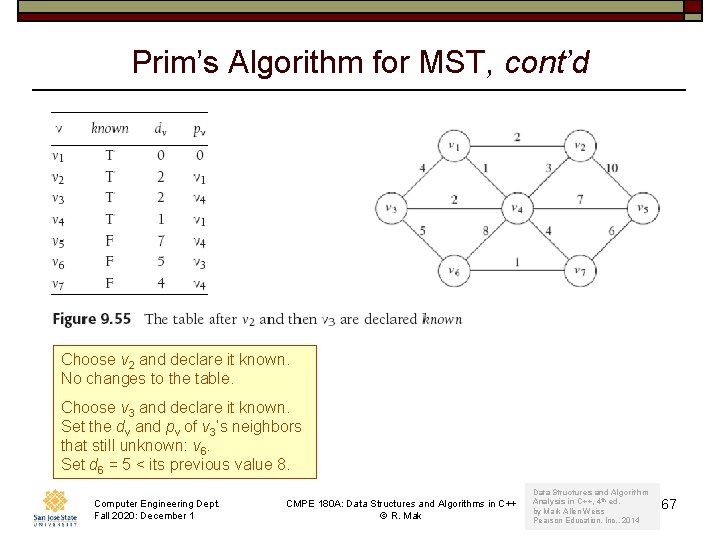
Prim’s Algorithm for MST, cont’d Choose v 2 and declare it known. No changes to the table. Choose v 3 and declare it known. Set the dv and pv of v 3’s neighbors that still unknown: v 6. Set d 6 = 5 < its previous value 8. Computer Engineering Dept. Fall 2020: December 1 CMPE 180 A: Data Structures and Algorithms in C++ © R. Mak Data Structures and Algorithm Analysis in C++, 4 th ed. by Mark Allen Weiss Pearson Education, Inc. , 2014 67
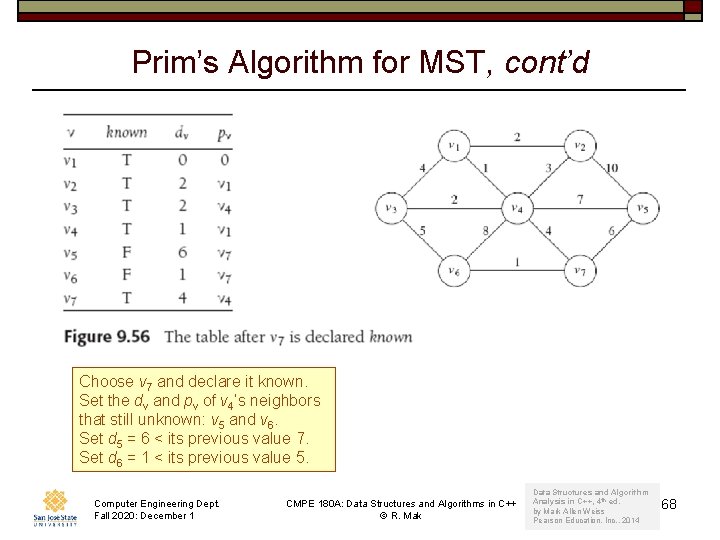
Prim’s Algorithm for MST, cont’d Choose v 7 and declare it known. Set the dv and pv of v 4’s neighbors that still unknown: v 5 and v 6. Set d 5 = 6 < its previous value 7. Set d 6 = 1 < its previous value 5. Computer Engineering Dept. Fall 2020: December 1 CMPE 180 A: Data Structures and Algorithms in C++ © R. Mak Data Structures and Algorithm Analysis in C++, 4 th ed. by Mark Allen Weiss Pearson Education, Inc. , 2014 68
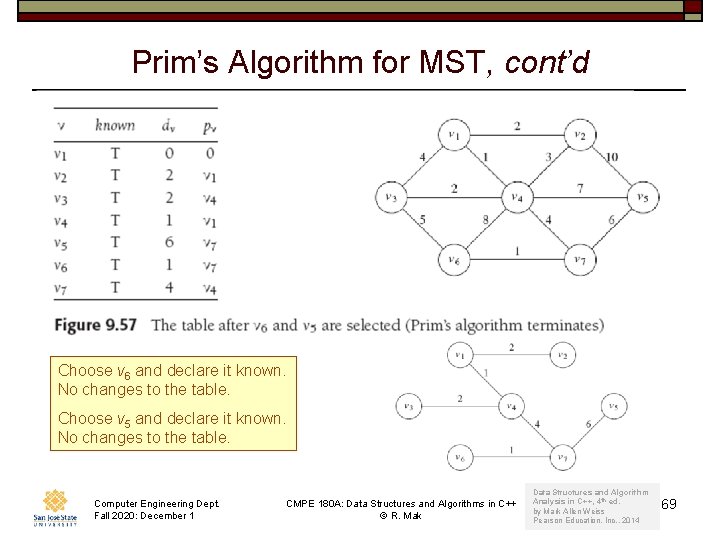
Prim’s Algorithm for MST, cont’d Choose v 6 and declare it known. No changes to the table. Choose v 5 and declare it known. No changes to the table. Computer Engineering Dept. Fall 2020: December 1 CMPE 180 A: Data Structures and Algorithms in C++ © R. Mak Data Structures and Algorithm Analysis in C++, 4 th ed. by Mark Allen Weiss Pearson Education, Inc. , 2014 69
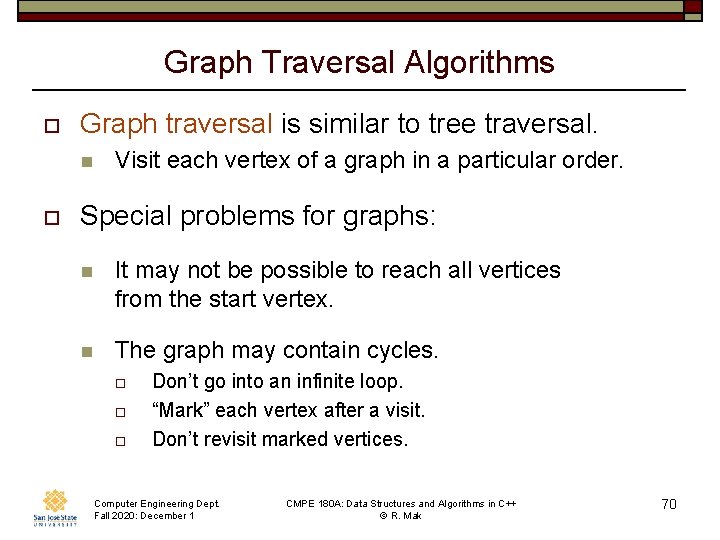
Graph Traversal Algorithms o Graph traversal is similar to tree traversal. n o Visit each vertex of a graph in a particular order. Special problems for graphs: n It may not be possible to reach all vertices from the start vertex. n The graph may contain cycles. o o o Don’t go into an infinite loop. “Mark” each vertex after a visit. Don’t revisit marked vertices. Computer Engineering Dept. Fall 2020: December 1 CMPE 180 A: Data Structures and Algorithms in C++ © R. Mak 70
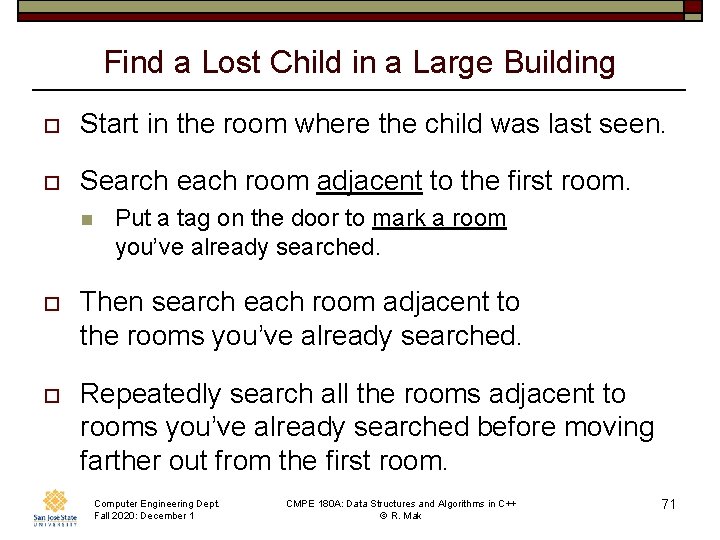
Find a Lost Child in a Large Building o Start in the room where the child was last seen. o Search each room adjacent to the first room. n Put a tag on the door to mark a room you’ve already searched. o Then search each room adjacent to the rooms you’ve already searched. o Repeatedly search all the rooms adjacent to rooms you’ve already searched before moving farther out from the first room. Computer Engineering Dept. Fall 2020: December 1 CMPE 180 A: Data Structures and Algorithms in C++ © R. Mak 71
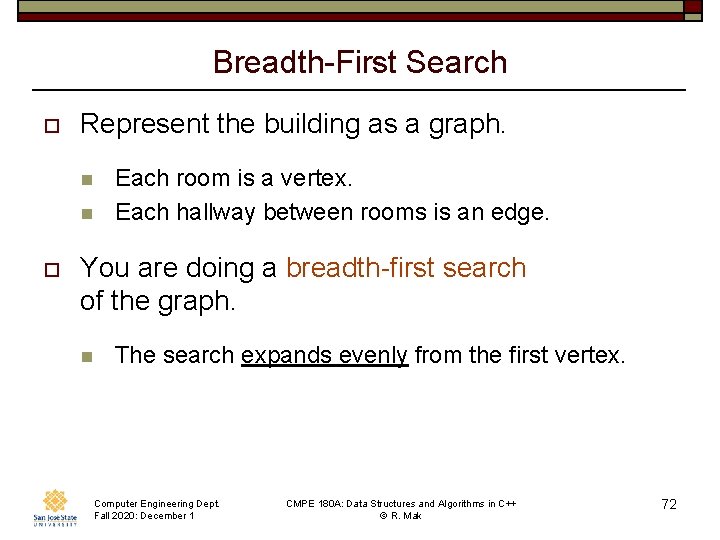
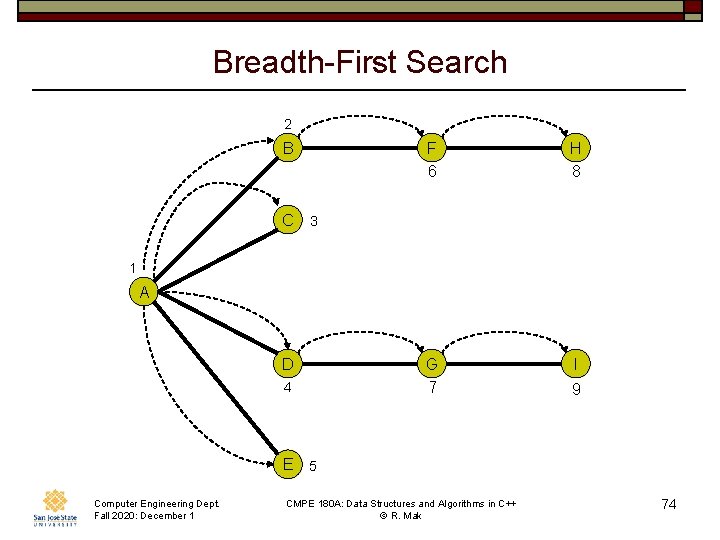
Breadth-First Search o Represent the building as a graph. n n o Each room is a vertex. Each hallway between rooms is an edge. You are doing a breadth-first search of the graph. n The search expands evenly from the first vertex. Computer Engineering Dept. Fall 2020: December 1 CMPE 180 A: Data Structures and Algorithms in C++ © R. Mak 72
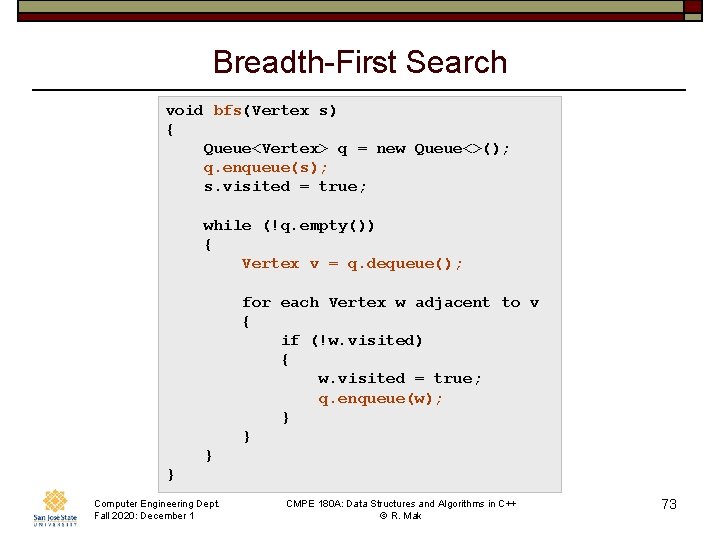
Breadth-First Search void bfs(Vertex s) { Queue<Vertex> q = new Queue<>(); q. enqueue(s); s. visited = true; while (!q. empty()) { Vertex v = q. dequeue(); for each Vertex w adjacent to v { if (!w. visited) { w. visited = true; q. enqueue(w); } } Computer Engineering Dept. Fall 2020: December 1 CMPE 180 A: Data Structures and Algorithms in C++ © R. Mak 73
Breadth-First Search 2 B F 6 H 8 G 7 I C 3 1 A D 4 E Computer Engineering Dept. Fall 2020: December 1 9 5 CMPE 180 A: Data Structures and Algorithms in C++ © R. Mak 74
You’re Lost in a Maze o You have a bag of breadcrumbs. o As you go down each path, you drop breadcrumbs to mark your path. o Whenever you come to a dead end, you retrace your path by following your breadcrumbs. o You continue retracing your path (“backtracking”) until you come to an intersection with an unmarked path. o You (recursively) go down the unmarked path. Computer Engineering Dept. Fall 2020: December 1 CMPE 180 A: Data Structures and Algorithms in C++ © R. Mak 75
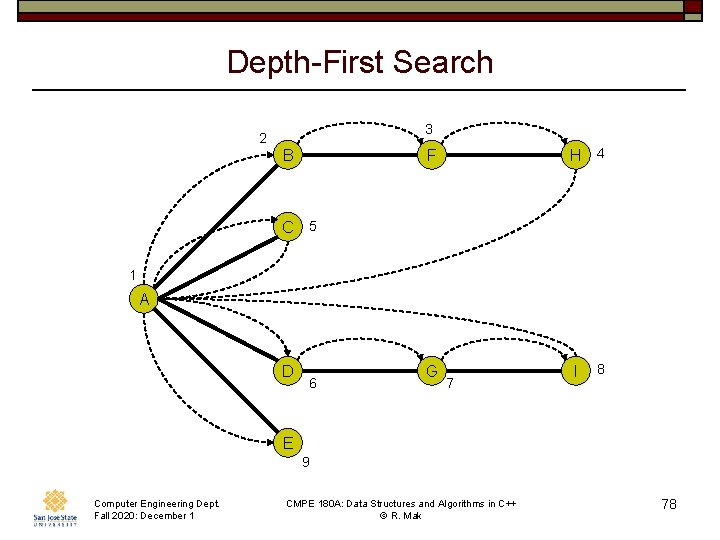
Depth-First Search o Represent the maze as a graph. n n o Each path is an edge. Each intersection is a vertex. You are doing a depth-first search of the graph. Computer Engineering Dept. Fall 2020: December 1 CMPE 180 A: Data Structures and Algorithms in C++ © R. Mak 76
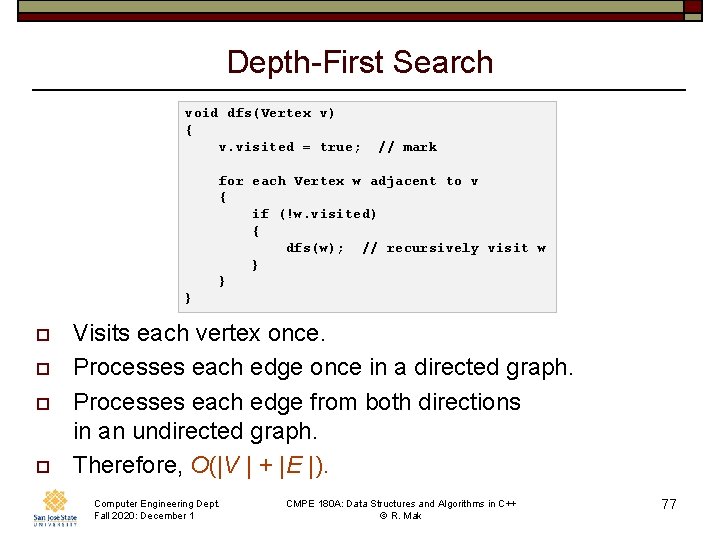
Depth-First Search void dfs(Vertex v) { v. visited = true; // mark for each Vertex w adjacent to v { if (!w. visited) { dfs(w); // recursively visit w } } } o o Visits each vertex once. Processes each edge once in a directed graph. Processes each edge from both directions in an undirected graph. Therefore, O(|V | + |E |). Computer Engineering Dept. Fall 2020: December 1 CMPE 180 A: Data Structures and Algorithms in C++ © R. Mak 77
Depth-First Search 3 2 B H 4 F C 5 1 A D 6 G 7 I 8 E 9 Computer Engineering Dept. Fall 2020: December 1 CMPE 180 A: Data Structures and Algorithms in C++ © R. Mak 78
Depth-First Search and Games o Depth-first search is used by game-playing programs. n Example: IBM’s “Deep Blue” chess playing program. o Use a graph to represent the possible moves from the present situation into the future. o Each vertex is a decision point for either you or your opponent. Computer Engineering Dept. Fall 2020: December 1 CMPE 180 A: Data Structures and Algorithms in C++ © R. Mak 79
Depth-First Search and Games, cont’d o Perform a depth-first search to look at possible move outcomes of both you and your opponent. o Each edge would have the cost of going down that path. o Backtrack if a path is a dead end or its cost is not beneficial. o How deeply your program can search depends on the computer’s memory and the allowed search time. Computer Engineering Dept. Fall 2020: December 1 CMPE 180 A: Data Structures and Algorithms in C++ © R. Mak 80