
CMOS Transistor and Circuits Instructed by Shmuel Wimer
CMOS Transistor and Circuits Instructed by Shmuel Wimer Eng. School, Bar-Ilan University Credits: David Harris Harvey Mudd College (Some materials copied/taken/adapted from Harris’ lecture notes) Jan 2015 CMOS Transistor 1
Outline q MOS Capacitor q n. MOS I-V Characteristics q p. MOS I-V Characteristics q DC characteristics and transfer function q Noise margin q Latchup q Pass transistors q Tristate inverter Jan 2015 CMOS Transistor 2

Introduction q So far, we have treated transistors as ideal switches q An ON transistor passes a finite amount of current – Depends on terminal voltages – Derive current-voltage (I-V) relationships q Transistor gate, source, drain all have capacitance – I = C (DV/Dt) → Dt = (C/I) DV – Capacitance and current determine speed q Also explore what a “degraded level” really means Jan 2015 CMOS Transistor 3
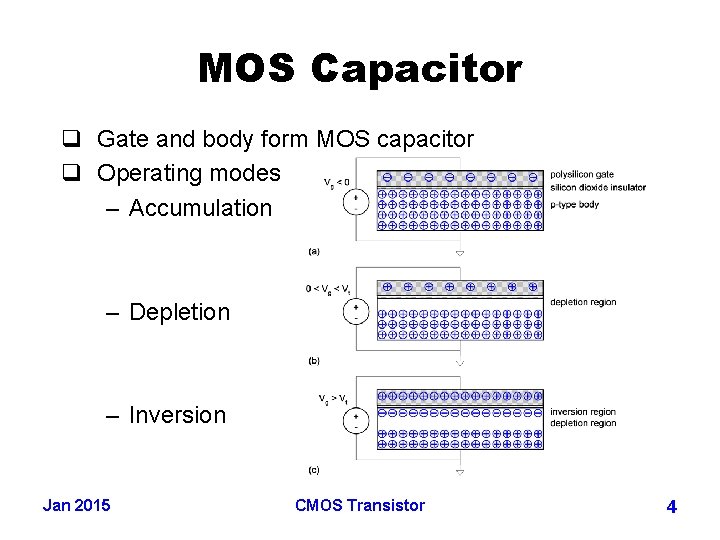
MOS Capacitor q Gate and body form MOS capacitor q Operating modes – Accumulation – Depletion – Inversion Jan 2015 CMOS Transistor 4
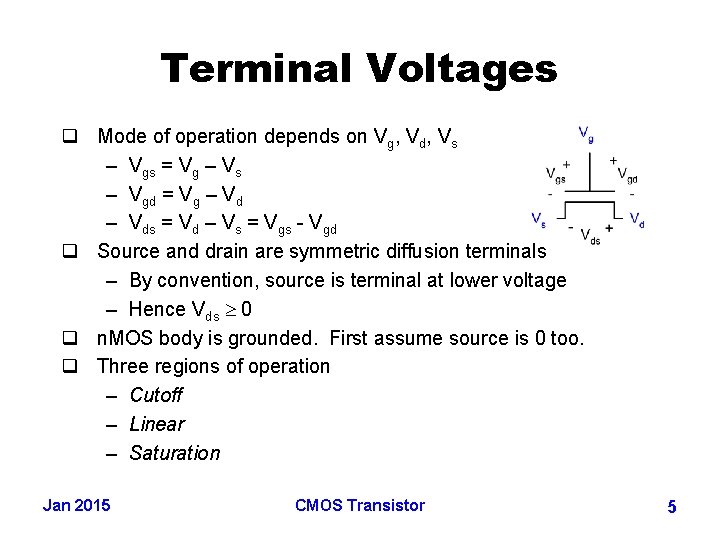
Terminal Voltages q Mode of operation depends on Vg, Vd, Vs – Vgs = Vg – Vs – Vgd = Vg – Vds = Vd – Vs = Vgs - Vgd q Source and drain are symmetric diffusion terminals – By convention, source is terminal at lower voltage – Hence Vds 0 q n. MOS body is grounded. First assume source is 0 too. q Three regions of operation – Cutoff – Linear – Saturation Jan 2015 CMOS Transistor 5
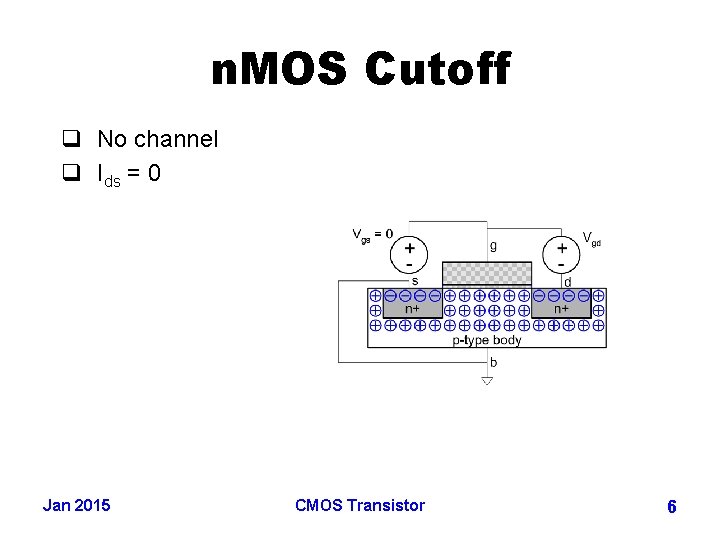
n. MOS Cutoff q No channel q Ids = 0 Jan 2015 CMOS Transistor 6
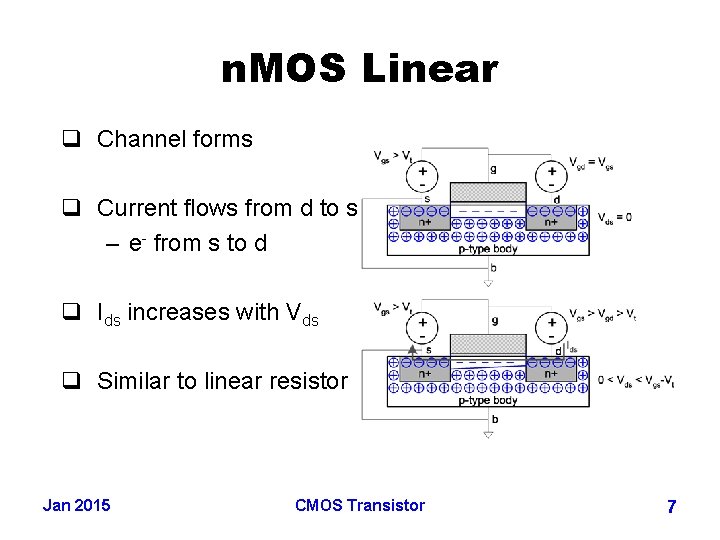
n. MOS Linear q Channel forms q Current flows from d to s – e- from s to d q Ids increases with Vds q Similar to linear resistor Jan 2015 CMOS Transistor 7
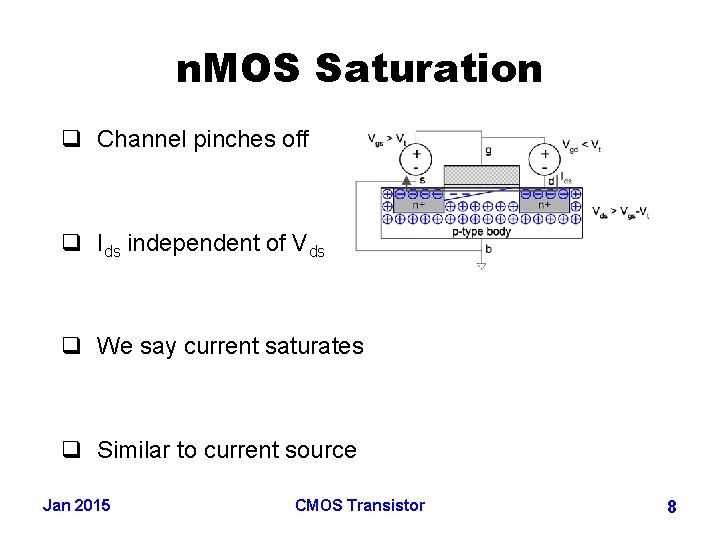
n. MOS Saturation q Channel pinches off q Ids independent of Vds q We say current saturates q Similar to current source Jan 2015 CMOS Transistor 8
I-V Characteristics q In Linear region, Ids depends on: – How much charge is in the channel – How fast is the charge moving Jan 2015 CMOS Transistor 9
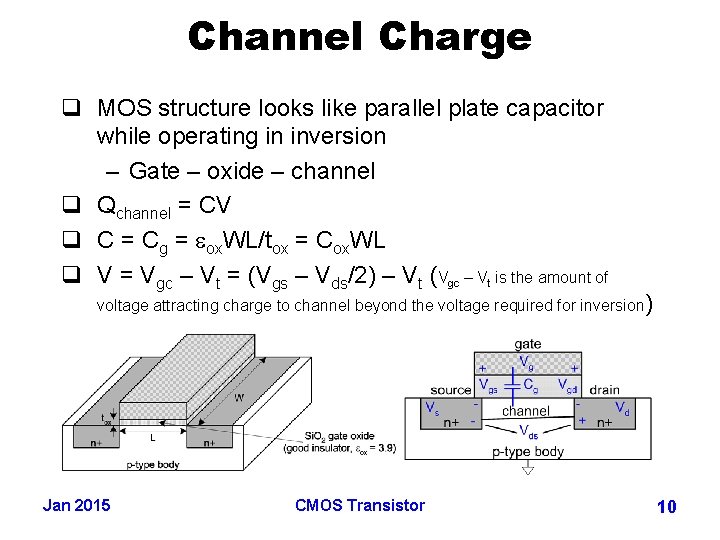
Channel Charge q MOS structure looks like parallel plate capacitor while operating in inversion – Gate – oxide – channel q Qchannel = CV q C = Cg = eox. WL/tox = Cox. WL q V = Vgc – Vt = (Vgs – Vds/2) – Vt (Vgc – Vt is the amount of voltage attracting charge to channel beyond the voltage required for inversion) Jan 2015 CMOS Transistor 10
Carrier velocity q Charge is carried by eq Carrier velocity v proportional to lateral E-field between source and drain q v = m. E m called mobility q E = Vds/L q Time for carrier to cross channel: – t=L/v Jan 2015 CMOS Transistor 11
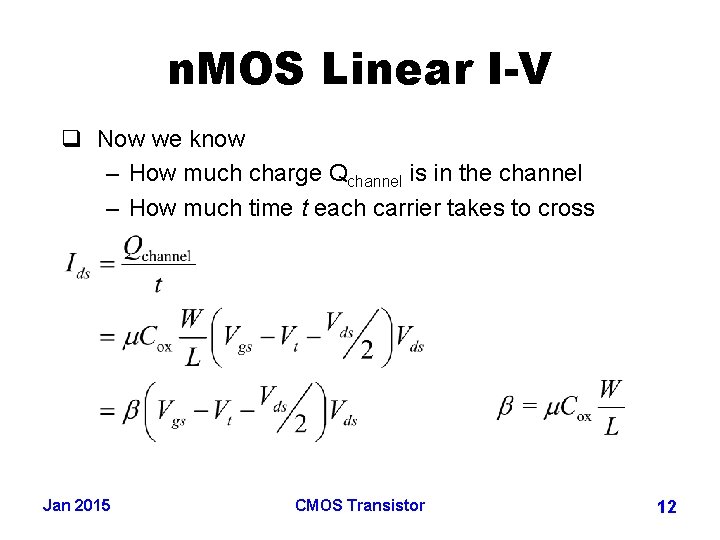
n. MOS Linear I-V q Now we know – How much charge Qchannel is in the channel – How much time t each carrier takes to cross Jan 2015 CMOS Transistor 12
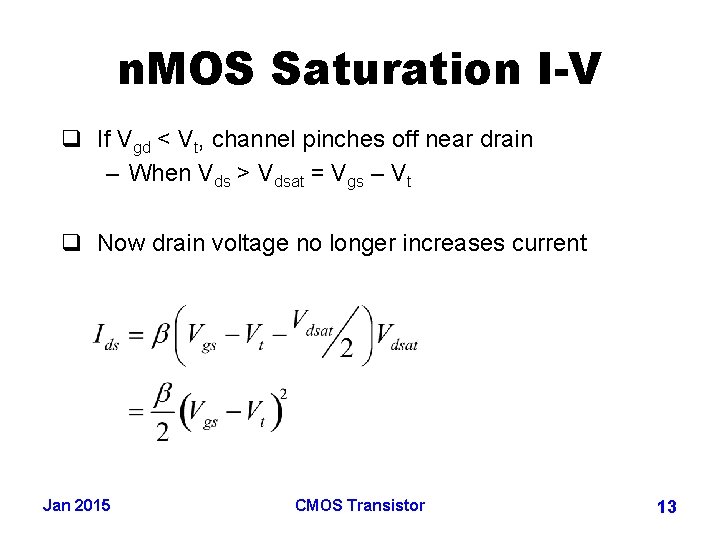
n. MOS Saturation I-V q If Vgd < Vt, channel pinches off near drain – When Vds > Vdsat = Vgs – Vt q Now drain voltage no longer increases current Jan 2015 CMOS Transistor 13
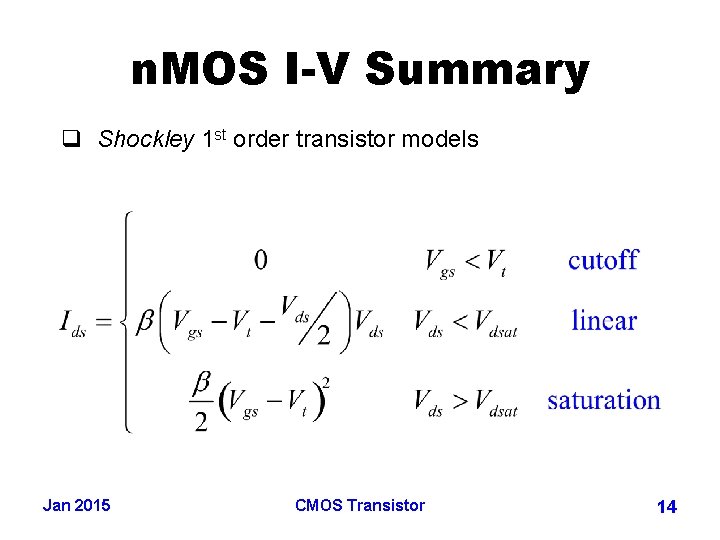
n. MOS I-V Summary q Shockley 1 st order transistor models Jan 2015 CMOS Transistor 14
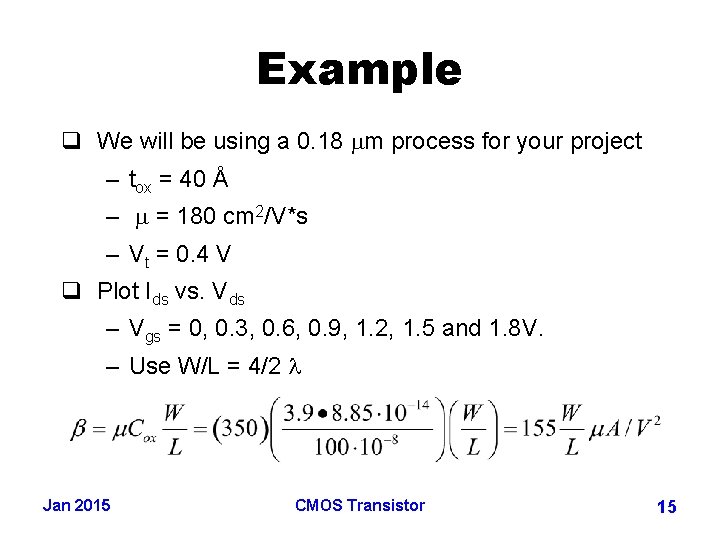
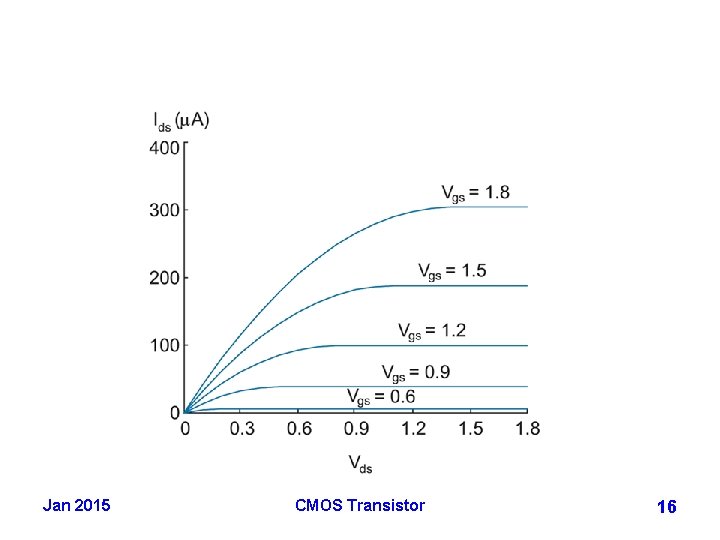
Example q We will be using a 0. 18 mm process for your project – tox = 40 Å – m = 180 cm 2/V*s – Vt = 0. 4 V q Plot Ids vs. Vds – Vgs = 0, 0. 3, 0. 6, 0. 9, 1. 2, 1. 5 and 1. 8 V. – Use W/L = 4/2 l Jan 2015 CMOS Transistor 15
Jan 2015 CMOS Transistor 16
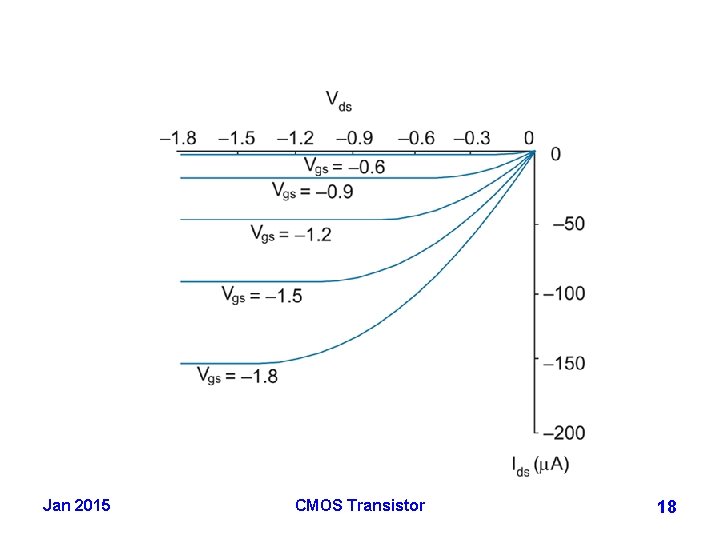
p. MOS I-V q All doping and voltages are inverted for p. MOS q Mobility mp is determined by holes – Typically 2 -3 x lower than that of electrons mn q Thus p. MOS must be wider to provide same current – In this class, assume mn / mp = 2 Jan 2015 CMOS Transistor 17
Jan 2015 CMOS Transistor 18
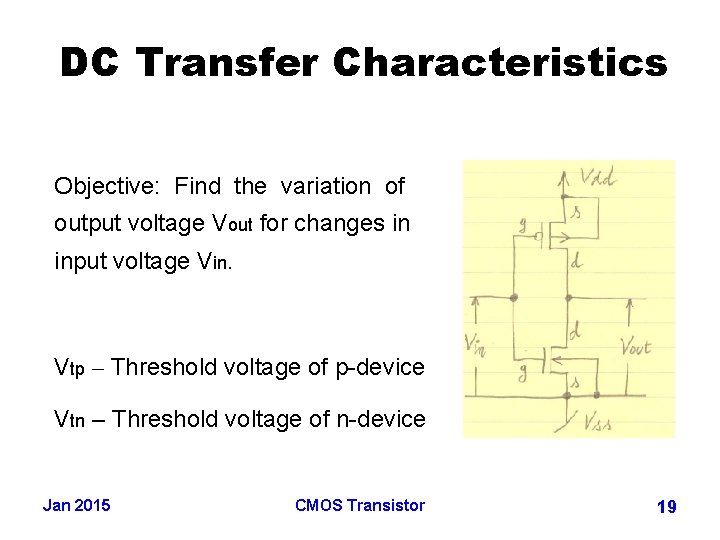
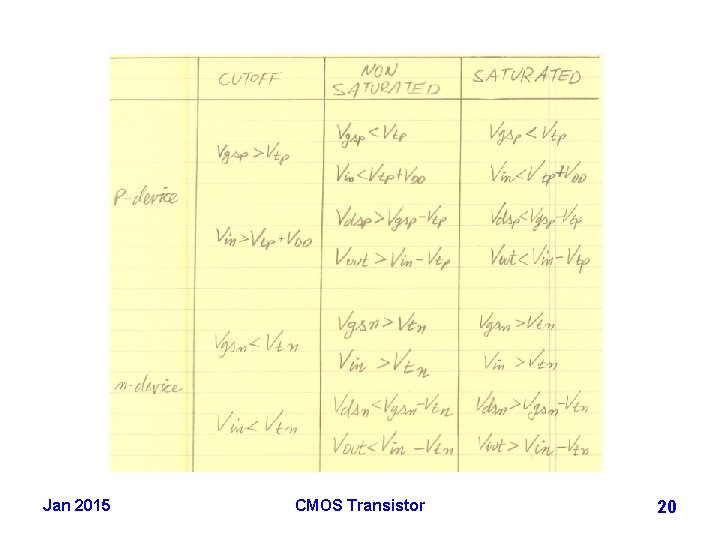
DC Transfer Characteristics Objective: Find the variation of output voltage Vout for changes in input voltage Vin. Vtp – Threshold voltage of p-device Vtn – Threshold voltage of n-device Jan 2015 CMOS Transistor 19
Jan 2015 CMOS Transistor 20
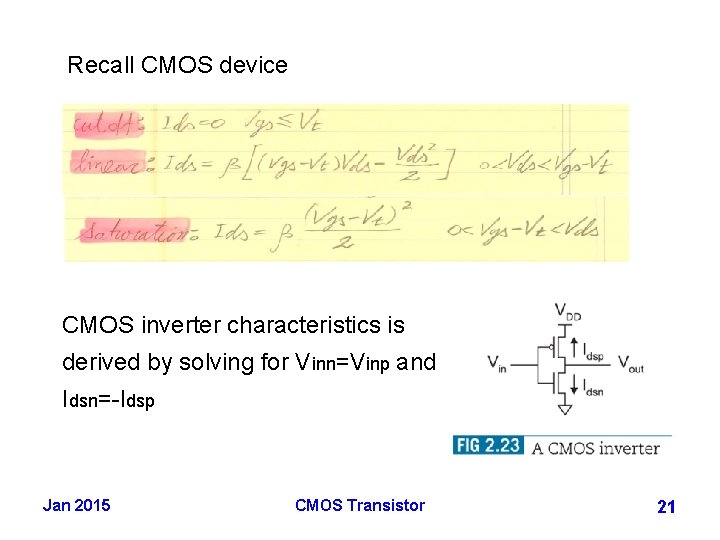
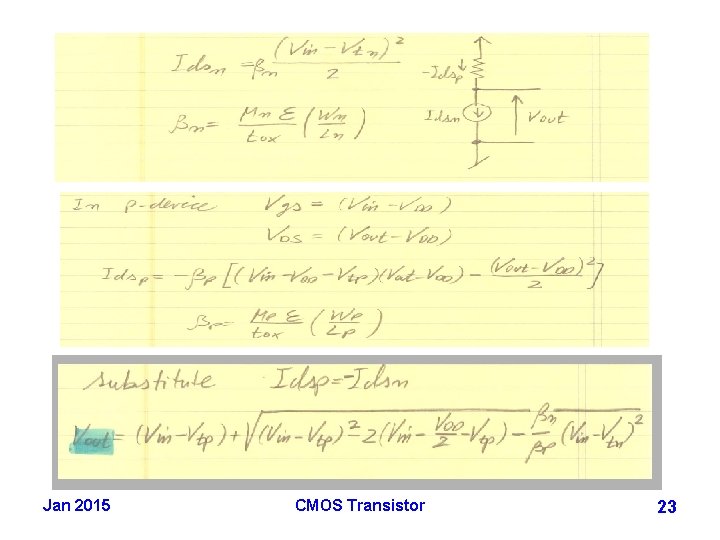
Recall CMOS device CMOS inverter characteristics is derived by solving for Vinn=Vinp and Idsn=-Idsp Jan 2015 CMOS Transistor 21
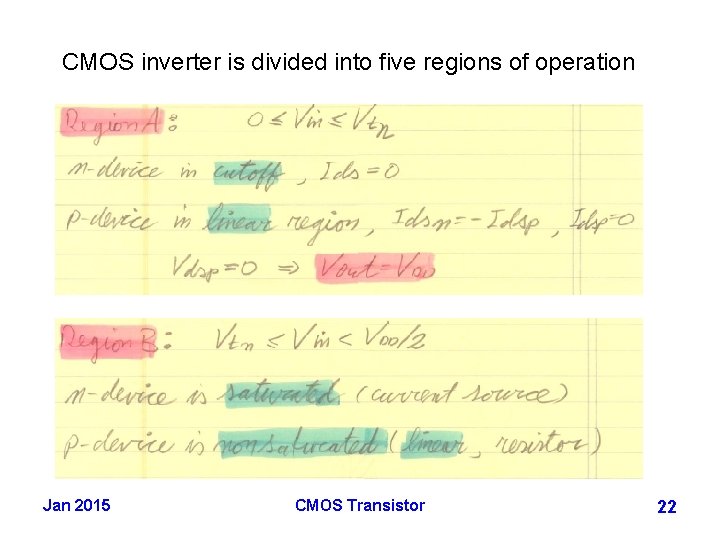
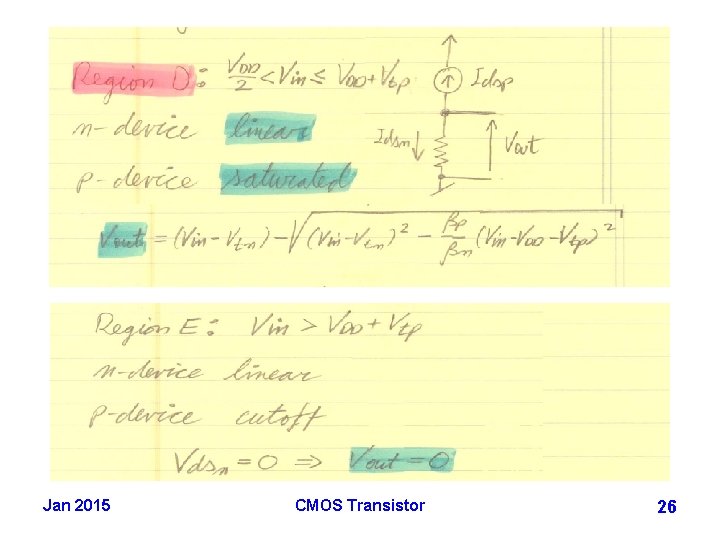
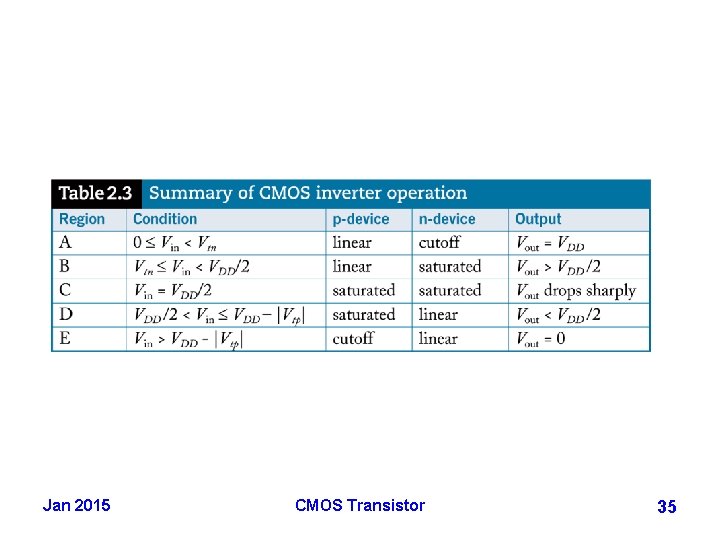
CMOS inverter is divided into five regions of operation Jan 2015 CMOS Transistor 22
Jan 2015 CMOS Transistor 23
Jan 2015 CMOS Transistor 24
Jan 2015 CMOS Transistor 25
Jan 2015 CMOS Transistor 26
I-V Characteristics q Make p. MOS is wider than n. MOS such that bn = bp Jan 2015 CMOS Transistor 27
Current vs. Vout, Vin Jan 2015 CMOS Transistor 28
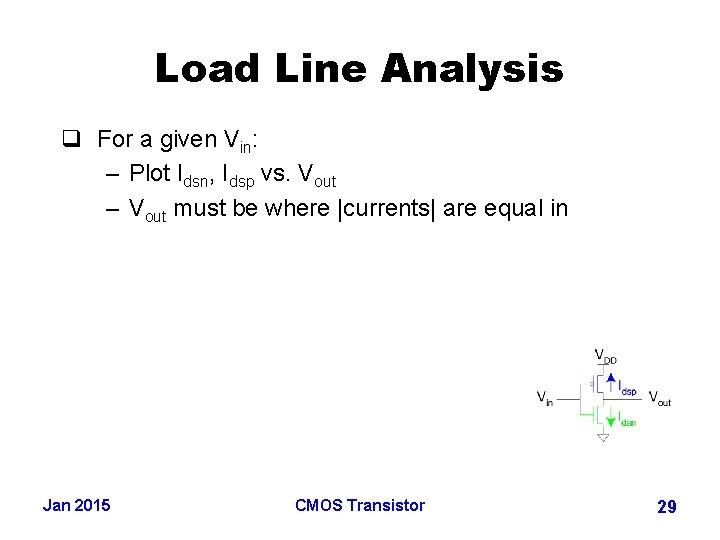
Load Line Analysis q For a given Vin: – Plot Idsn, Idsp vs. Vout – Vout must be where |currents| are equal in Jan 2015 CMOS Transistor 29
Load Line Summary Jan 2015 CMOS Transistor 30
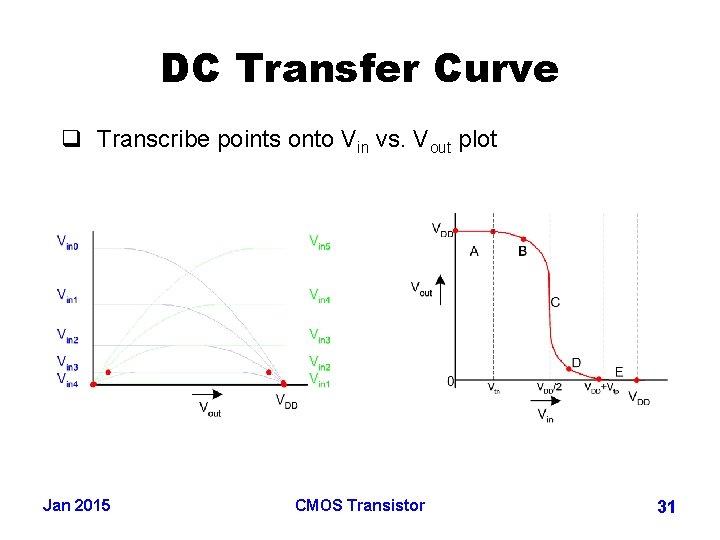
DC Transfer Curve q Transcribe points onto Vin vs. Vout plot Jan 2015 CMOS Transistor 31
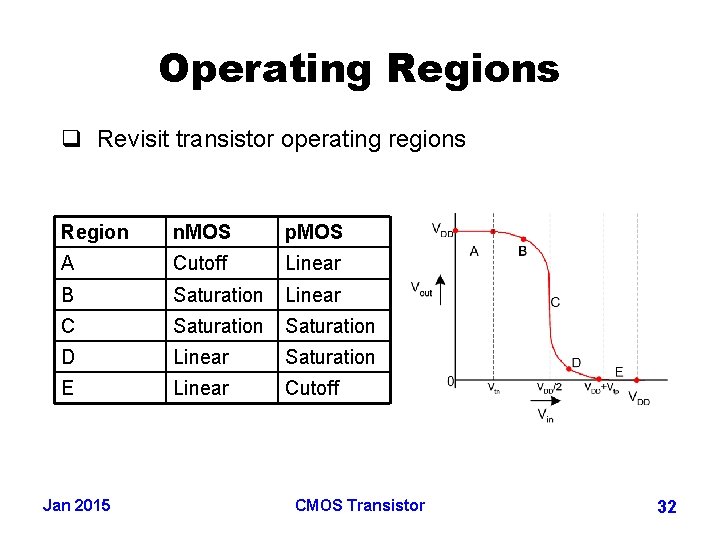
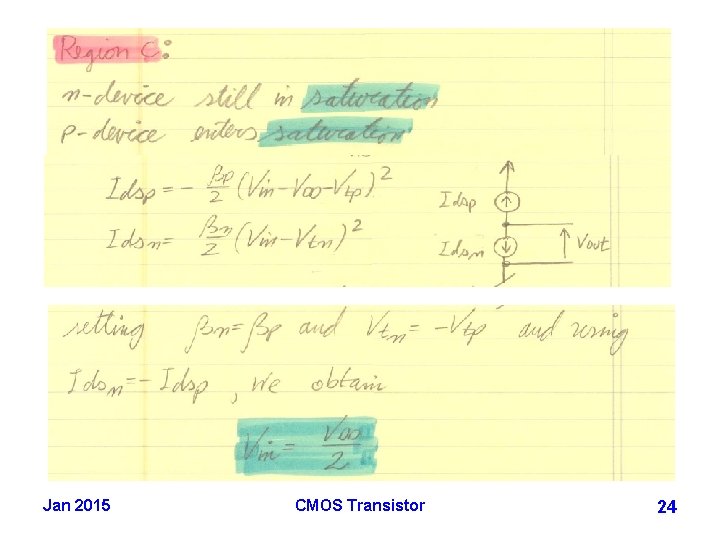
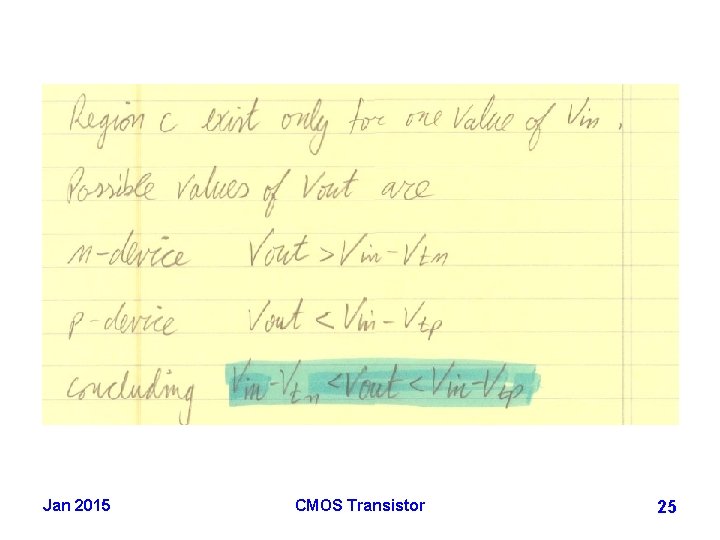
Operating Regions q Revisit transistor operating regions Region n. MOS p. MOS A Cutoff Linear B Saturation Linear C Saturation D Linear Saturation E Linear Cutoff Jan 2015 CMOS Transistor 32
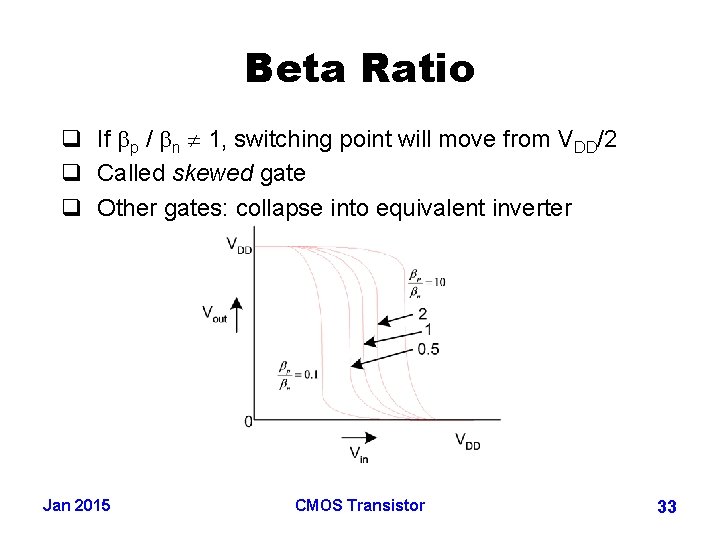
Beta Ratio q If bp / bn 1, switching point will move from VDD/2 q Called skewed gate q Other gates: collapse into equivalent inverter Jan 2015 CMOS Transistor 33
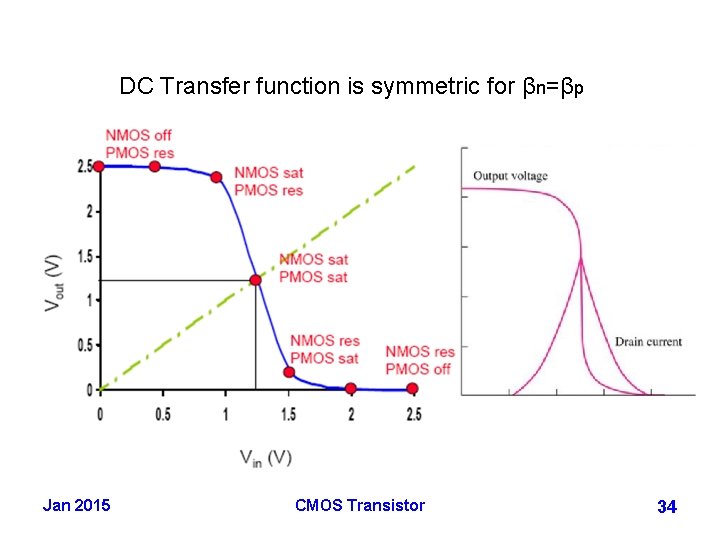
DC Transfer function is symmetric for βn=βp Jan 2015 CMOS Transistor 34
Jan 2015 CMOS Transistor 35
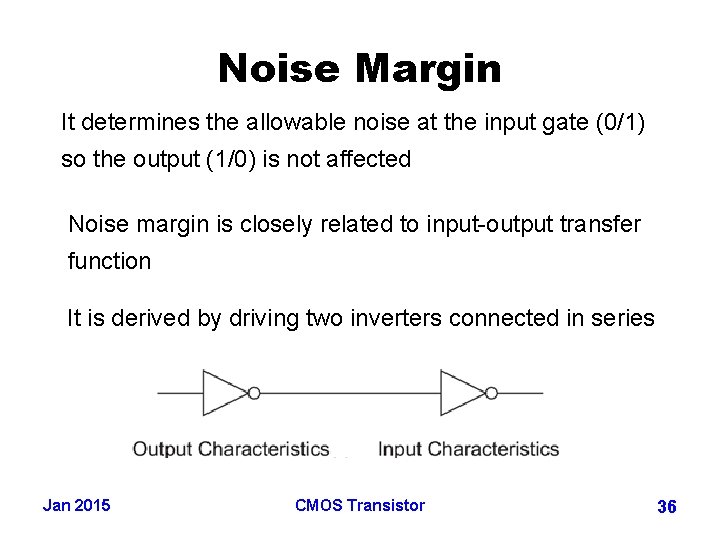
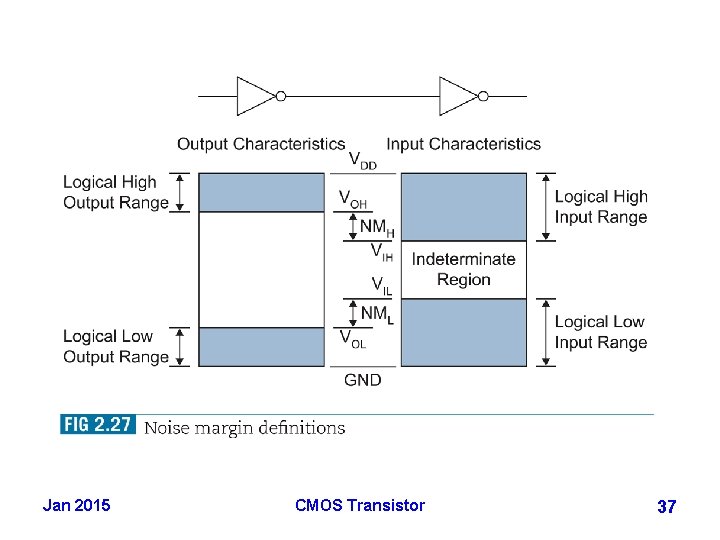
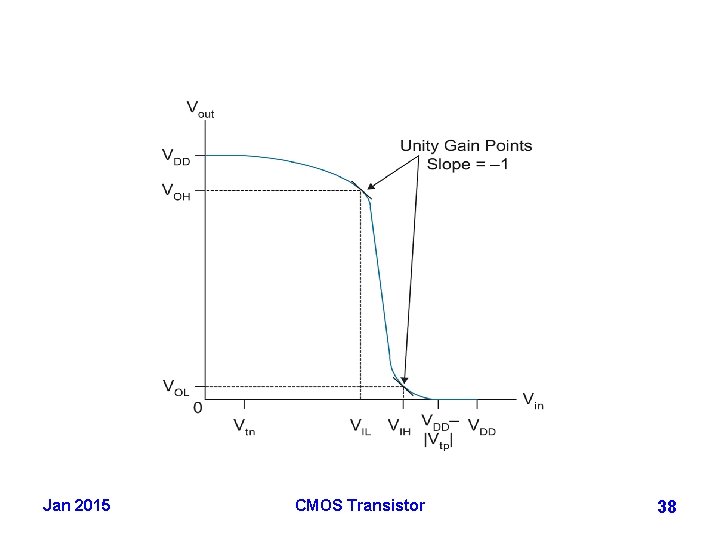
Noise Margin It determines the allowable noise at the input gate (0/1) so the output (1/0) is not affected Noise margin is closely related to input-output transfer function It is derived by driving two inverters connected in series Jan 2015 CMOS Transistor 36
Jan 2015 CMOS Transistor 37
Jan 2015 CMOS Transistor 38
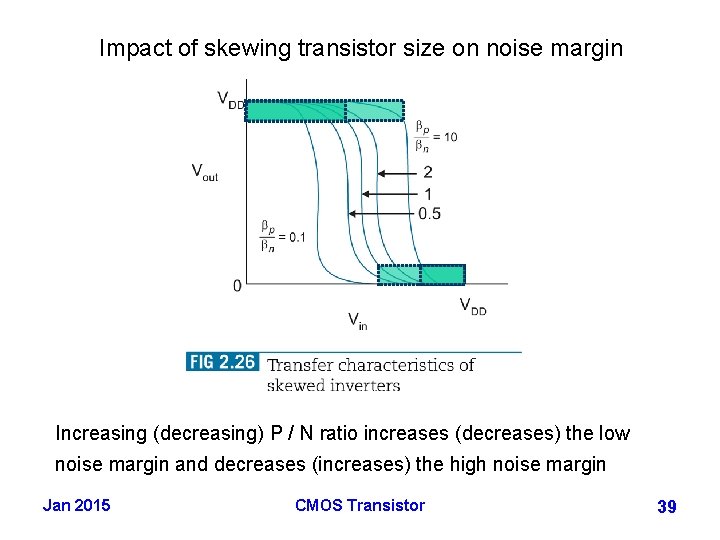
Impact of skewing transistor size on noise margin Increasing (decreasing) P / N ratio increases (decreases) the low noise margin and decreases (increases) the high noise margin Jan 2015 CMOS Transistor 39
Latchup in CMOS Circuits Jan 2015 CMOS Transistor 40
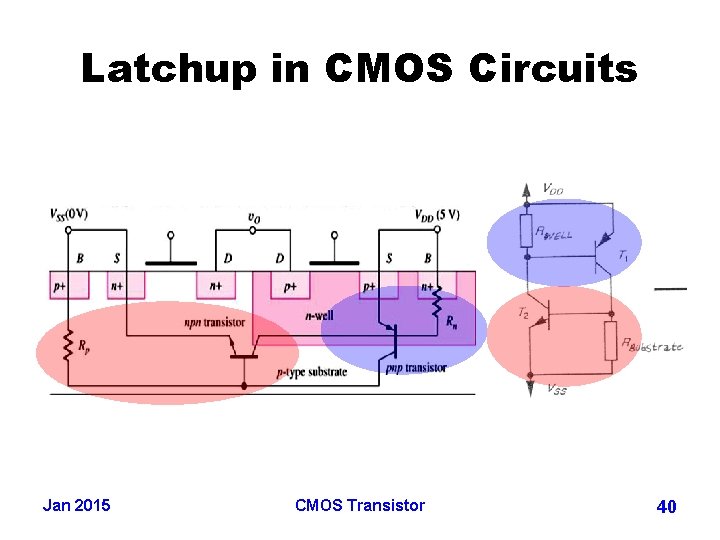
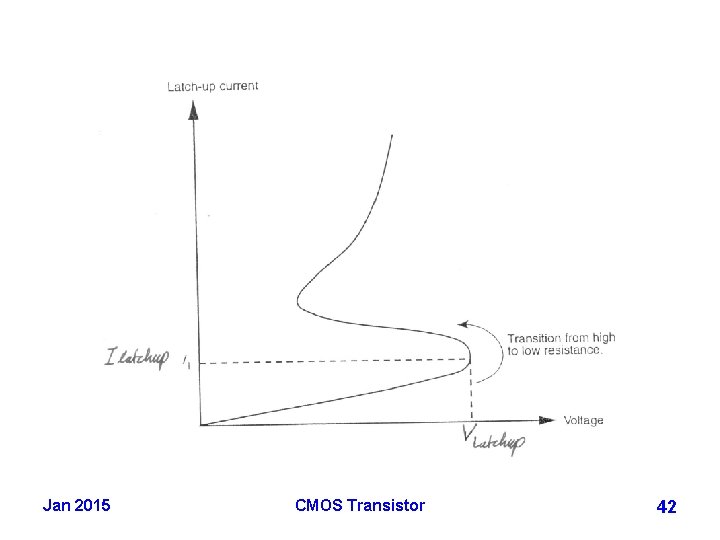
Parasitic bipolar transistors are formed by substrate and source / drain devices Latchup occurs by establishing a low-resistance paths connecting VDD to VSS Latchup may be induced by power supply glitches or incident radiation If sufficiently large substrate current flows, VBE of NPN device increases, and its collector current grows. This increases the current through RWELL. VBE of PNP device increases, further increasing substrate current. Jan 2015 CMOS Transistor 41
Jan 2015 CMOS Transistor 42
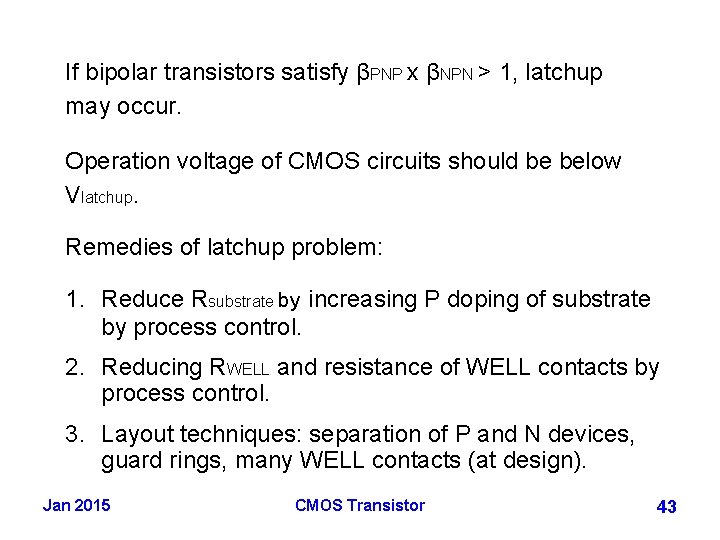
If bipolar transistors satisfy βPNP x βNPN > 1, latchup may occur. Operation voltage of CMOS circuits should be below Vlatchup. Remedies of latchup problem: 1. Reduce Rsubstrate by increasing P doping of substrate by process control. 2. Reducing RWELL and resistance of WELL contacts by process control. 3. Layout techniques: separation of P and N devices, guard rings, many WELL contacts (at design). Jan 2015 CMOS Transistor 43
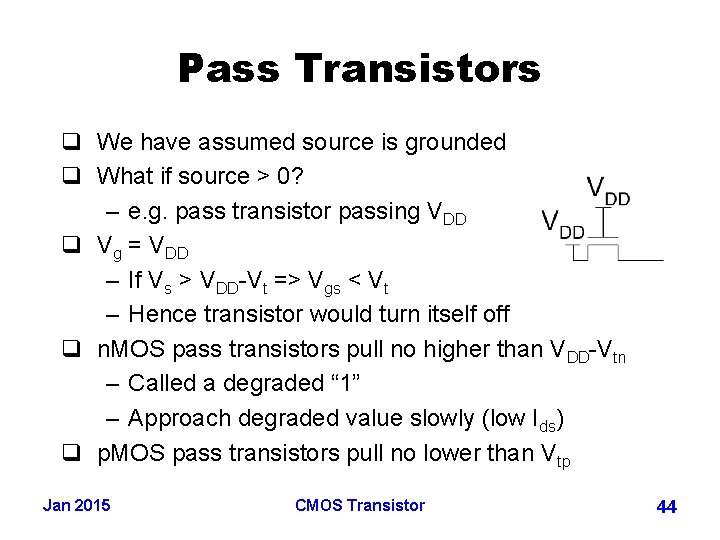
Pass Transistors q We have assumed source is grounded q What if source > 0? – e. g. pass transistor passing VDD q Vg = VDD – If Vs > VDD-Vt => Vgs < Vt – Hence transistor would turn itself off q n. MOS pass transistors pull no higher than VDD-Vtn – Called a degraded “ 1” – Approach degraded value slowly (low Ids) q p. MOS pass transistors pull no lower than Vtp Jan 2015 CMOS Transistor 44
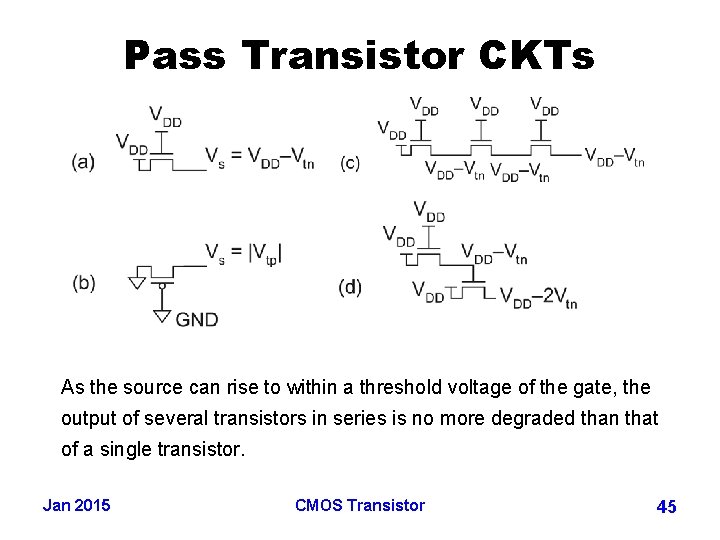
Pass Transistor CKTs As the source can rise to within a threshold voltage of the gate, the output of several transistors in series is no more degraded than that of a single transistor. Jan 2015 CMOS Transistor 45
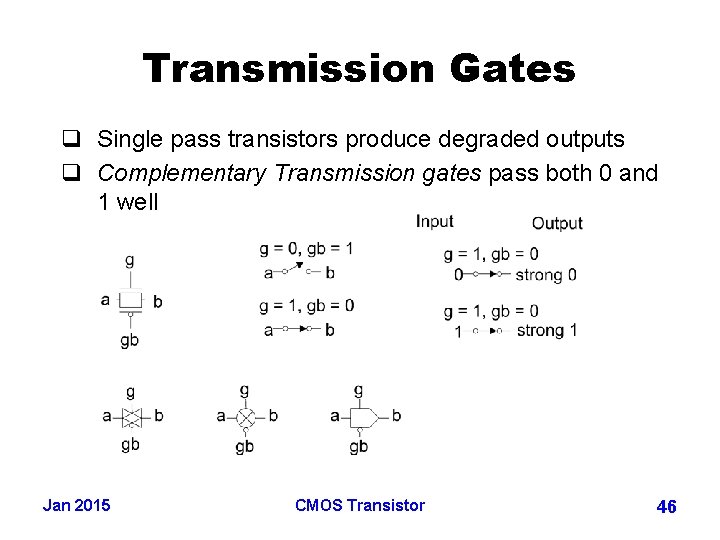
Transmission Gates q Single pass transistors produce degraded outputs q Complementary Transmission gates pass both 0 and 1 well Jan 2015 CMOS Transistor 46
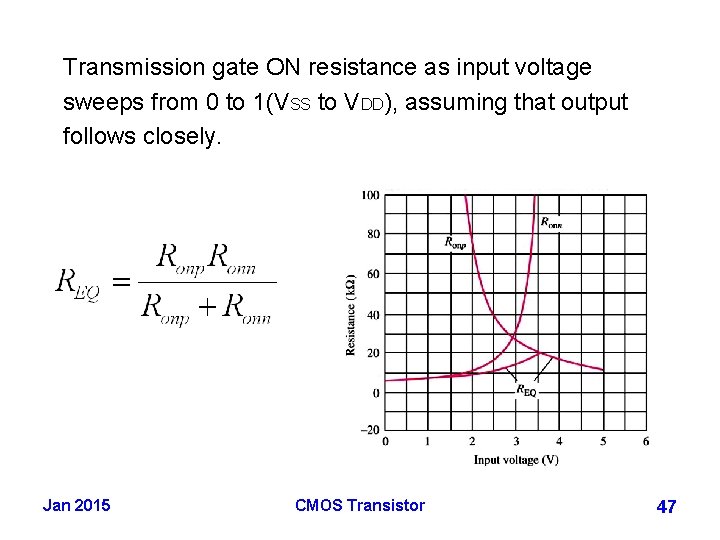
Transmission gate ON resistance as input voltage sweeps from 0 to 1(VSS to VDD), assuming that output follows closely. Jan 2015 CMOS Transistor 47
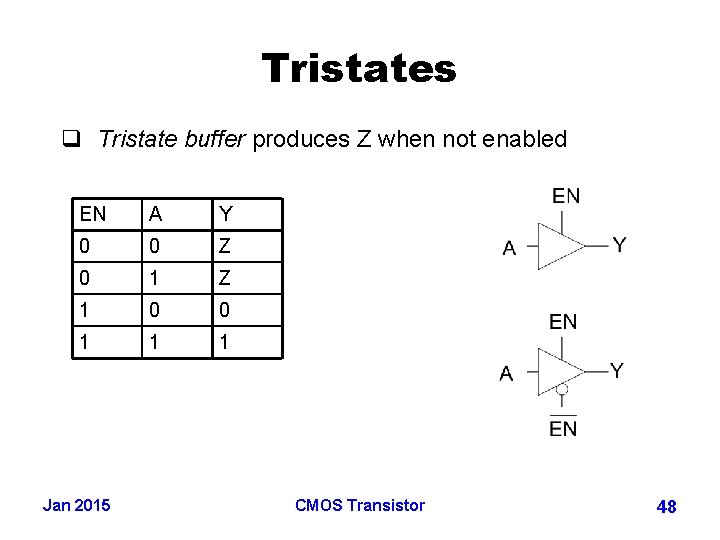
Tristates q Tristate buffer produces Z when not enabled EN A Y 0 0 Z 0 1 Z 1 0 0 1 1 1 Jan 2015 CMOS Transistor 48
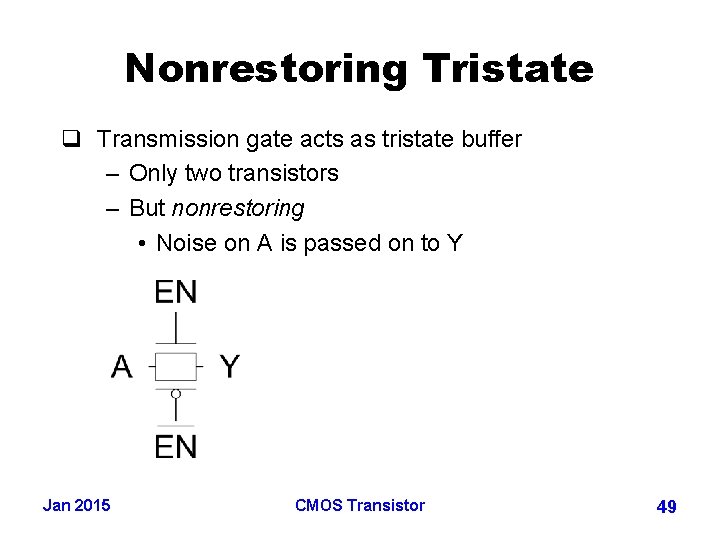
Nonrestoring Tristate q Transmission gate acts as tristate buffer – Only two transistors – But nonrestoring • Noise on A is passed on to Y Jan 2015 CMOS Transistor 49
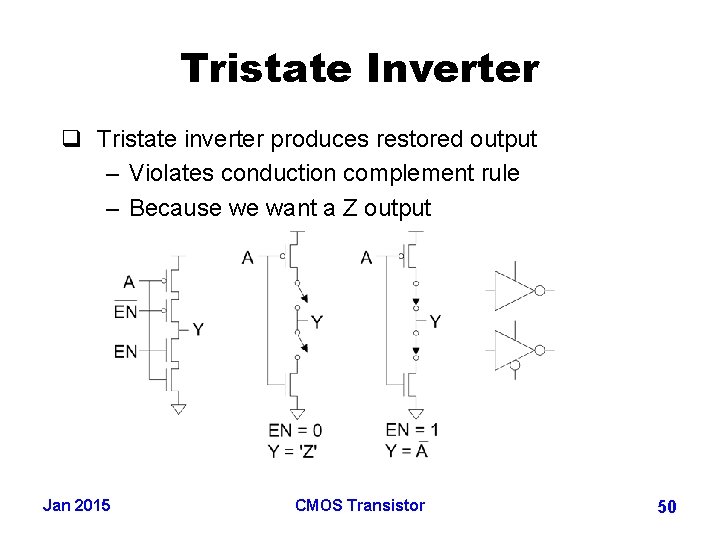
Tristate Inverter q Tristate inverter produces restored output – Violates conduction complement rule – Because we want a Z output Jan 2015 CMOS Transistor 50
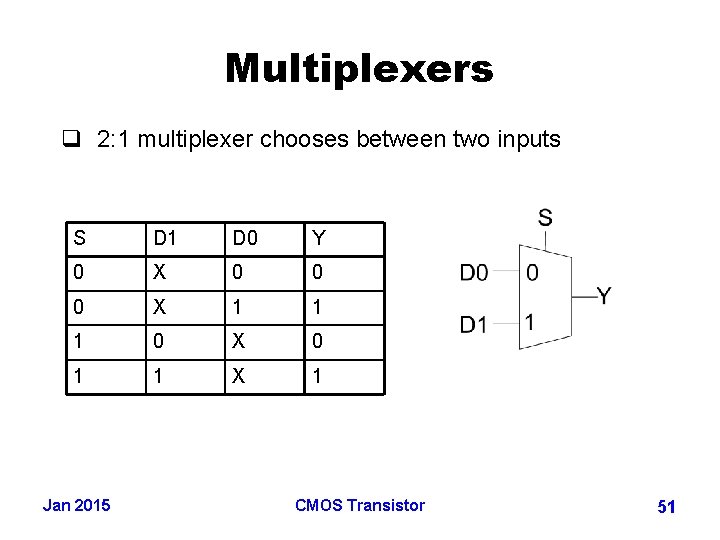
Multiplexers q 2: 1 multiplexer chooses between two inputs S D 1 D 0 Y 0 X 0 0 0 X 1 1 1 0 X 0 1 1 X 1 Jan 2015 CMOS Transistor 51
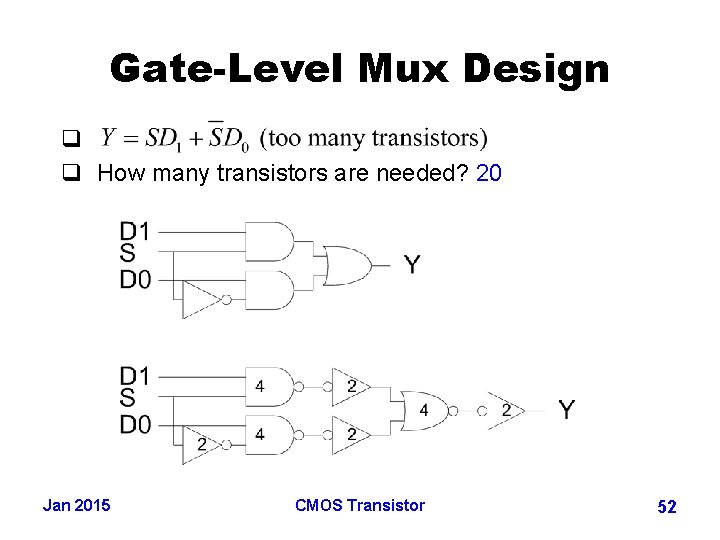
Gate-Level Mux Design q q How many transistors are needed? 20 Jan 2015 CMOS Transistor 52
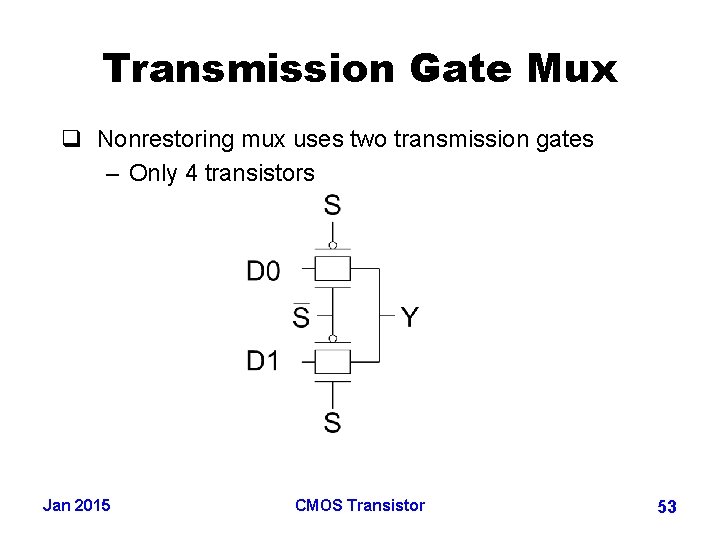
Transmission Gate Mux q Nonrestoring mux uses two transmission gates – Only 4 transistors Jan 2015 CMOS Transistor 53
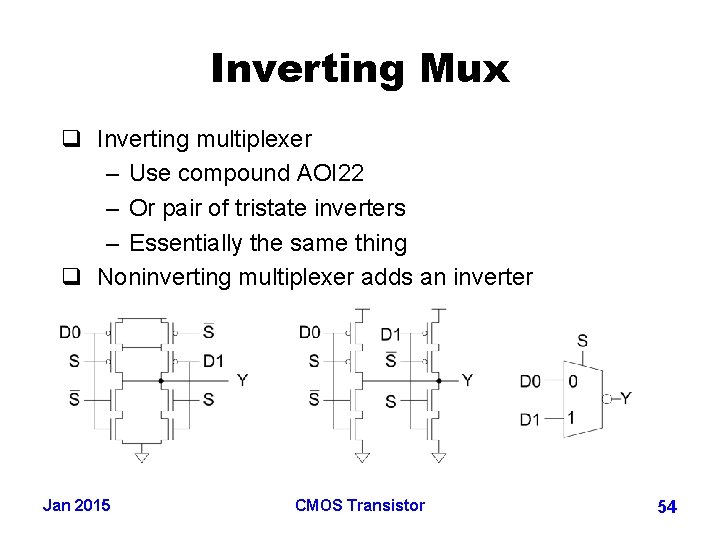
Inverting Mux q Inverting multiplexer – Use compound AOI 22 – Or pair of tristate inverters – Essentially the same thing q Noninverting multiplexer adds an inverter Jan 2015 CMOS Transistor 54
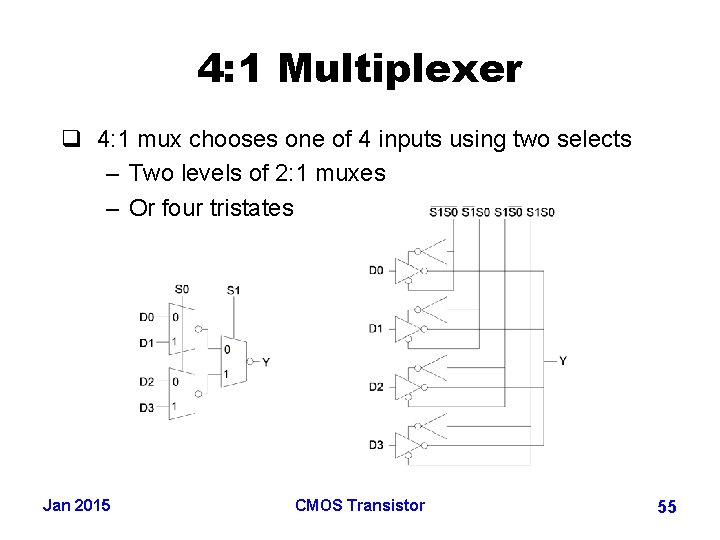
4: 1 Multiplexer q 4: 1 mux chooses one of 4 inputs using two selects – Two levels of 2: 1 muxes – Or four tristates Jan 2015 CMOS Transistor 55
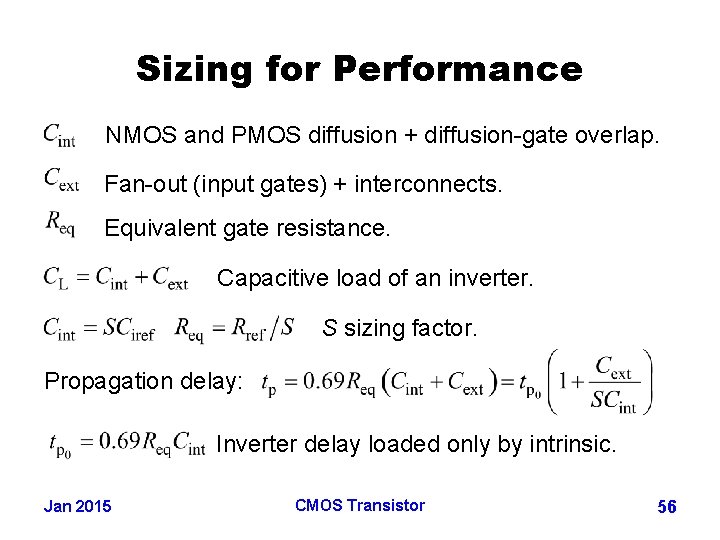
Sizing for Performance NMOS and PMOS diffusion + diffusion-gate overlap. Fan-out (input gates) + interconnects. Equivalent gate resistance. Capacitive load of an inverter. S sizing factor. Propagation delay: Inverter delay loaded only by intrinsic. Jan 2015 CMOS Transistor 56
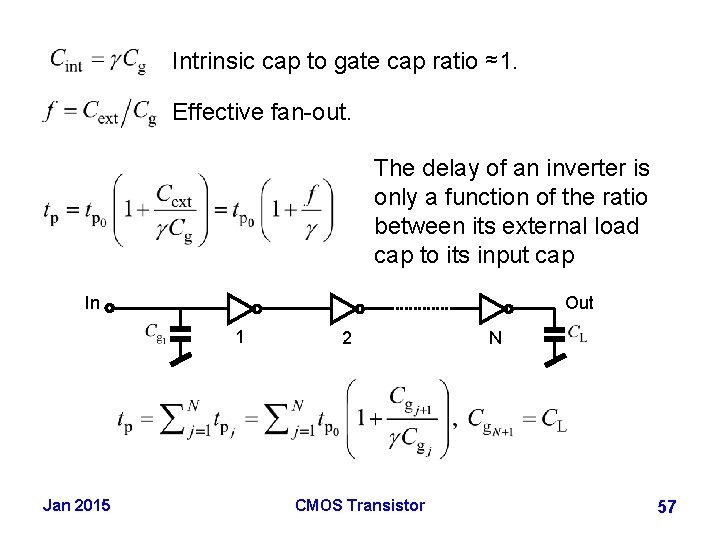
Intrinsic cap to gate cap ratio ≈1. Effective fan-out. The delay of an inverter is only a function of the ratio between its external load cap to its input cap In Out 1 Jan 2015 2 CMOS Transistor N 57
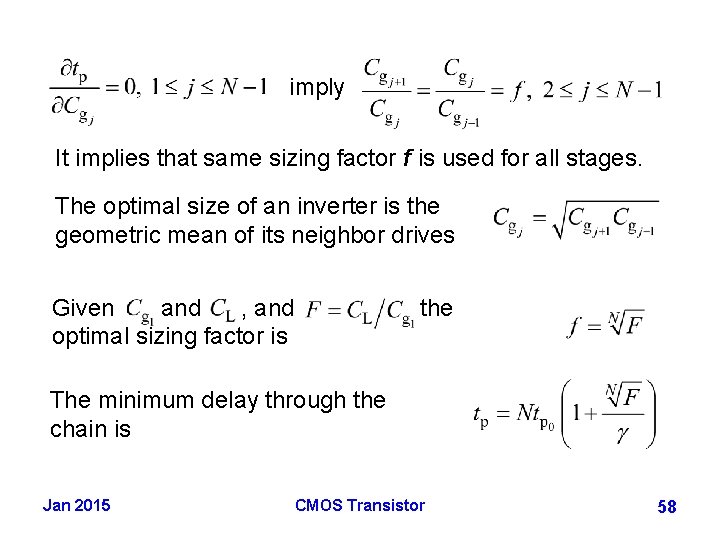
imply It implies that same sizing factor f is used for all stages. The optimal size of an inverter is the geometric mean of its neighbor drives Given and , and optimal sizing factor is the The minimum delay through the chain is Jan 2015 CMOS Transistor 58
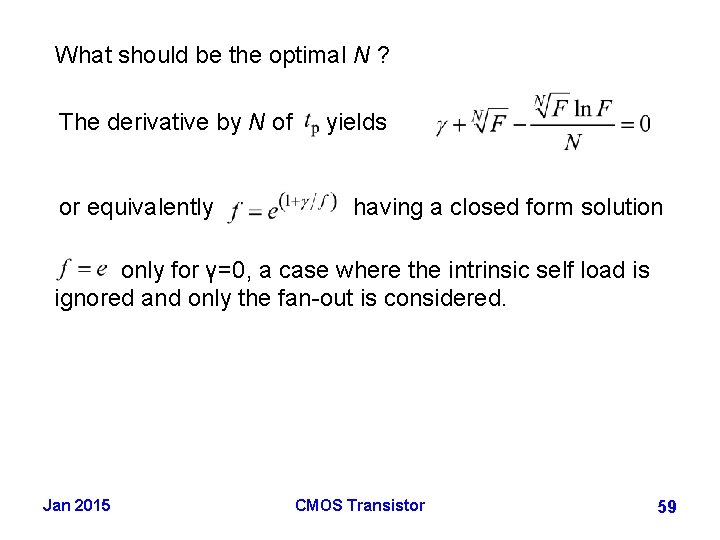
What should be the optimal N ? The derivative by N of or equivalently yields having a closed form solution only for γ=0, a case where the intrinsic self load is ignored and only the fan-out is considered. Jan 2015 CMOS Transistor 59
- Slides: 59