
CMOS technology and CMOS Logic gate Transistors in
- Slides: 25
CMOS technology and CMOS Logic gate
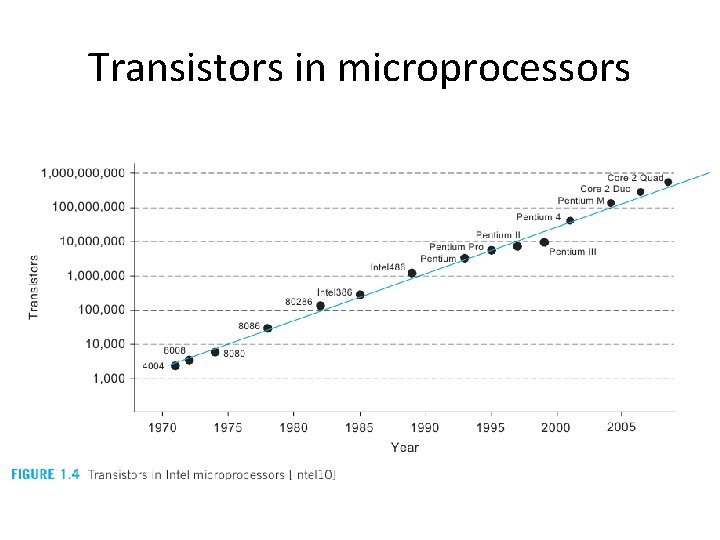
Transistors in microprocessors
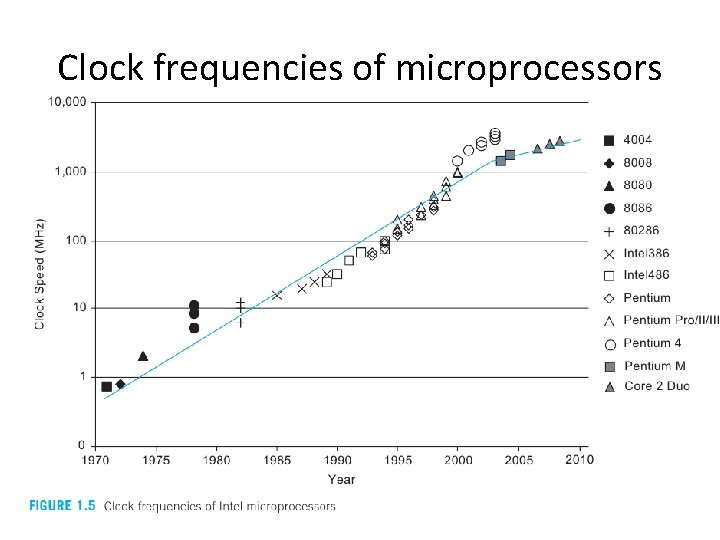
Clock frequencies of microprocessors
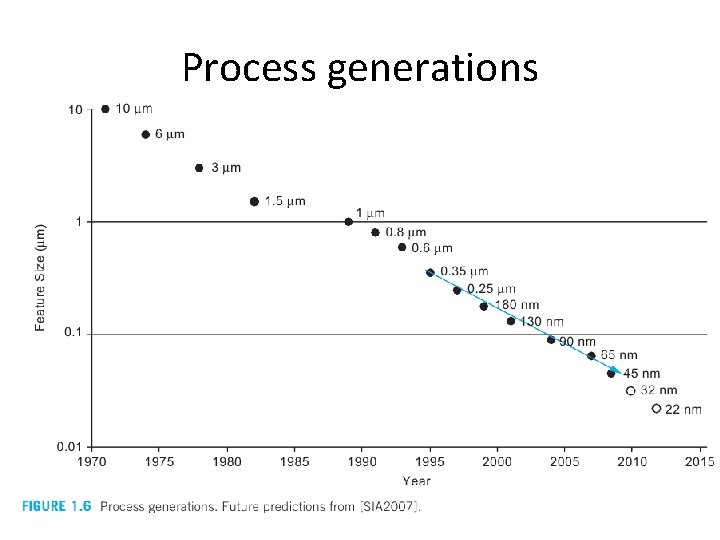
Process generations
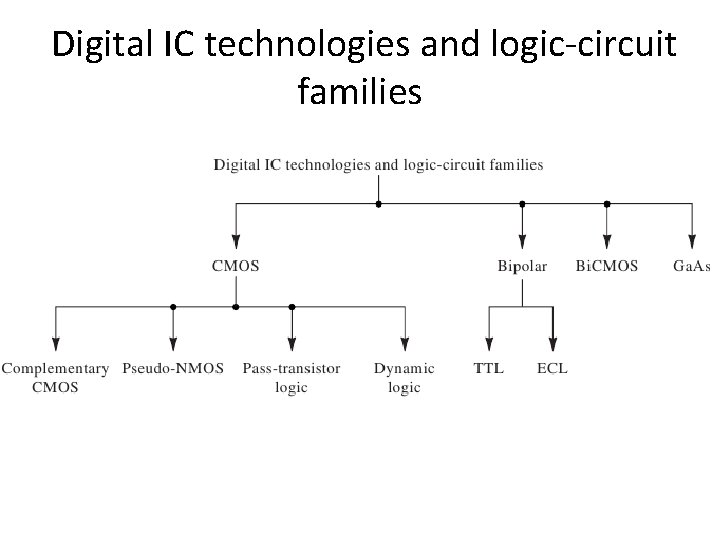
Digital IC technologies and logic-circuit families
Digital IC technologies and logic-circuit families • Bipolar Two logic-circuit families based on the bipolar junction transistor are in some use at present: TTL and ECL (emitter-coupled logic) • Bi. CMOS combines the high operating speeds possible with BJTs with the low power dissipation and other excellent characteristics of CMOS. Bi. CMOS allows for the implementation of both analog and digital circuits on the same chip • At present, Bi. CMOS is used to great advantage in special applications, including memory chips
Digital IC technologies and logic-circuit families • Gallium Arsenide (Ga. As) The high carrier mobility in Ga. As results in very high speeds of operation • Ga. As remains an “emerging technology, ” one that appears to have great potential but has not yet achieved such potential commercially.
CMOS technology • CMOS technology is, by a very large margin, the most dominant of all the IC technologies available for digital-circuit design. • Although early microprocessors were made using NMOS logic CMOS has completely replaced NMOS. • There a number of reasons for this development, the most important of which is the much lower power dissipation of CMOS circuits.
Some of the reasons for CMOS displacing bipolar technology in digital applications are as follows. 1. CMOS logic circuits dissipate much less power than bipolar logic circuits and thus one can pack more CMOS circuits on a chip than is possible with bipolar circuits. 2. The high input impedance of the MOS transistor allows the designer to use charge storage as a means for the temporary storage of information in both logic and memory circuits. This technique cannot be used in bipolar circuits. 3. The feature size (i. e. , minimum channel length) of the MOS transistor has decreased dramatically over the years, with some recently reported designs utilizing channel lengths as short as 32 nm. This permits very tight circuit packing and, correspondingly, very high levels of integration. A microprocessor chip reported in 2009 had 2. 3 billion transistors.
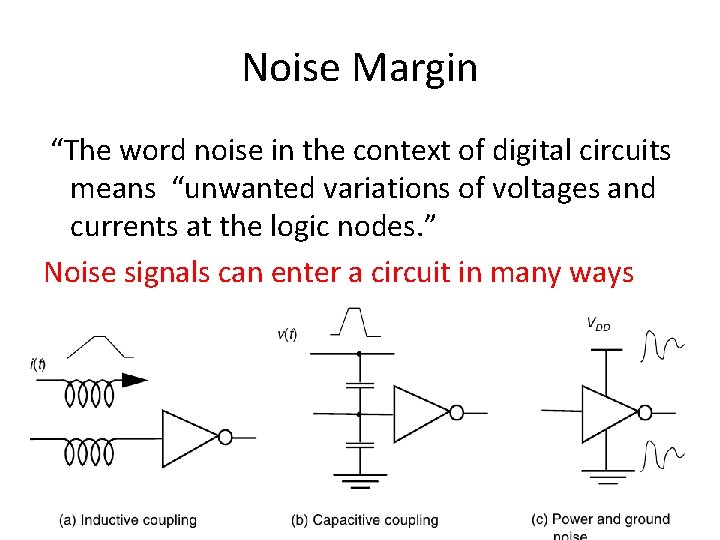
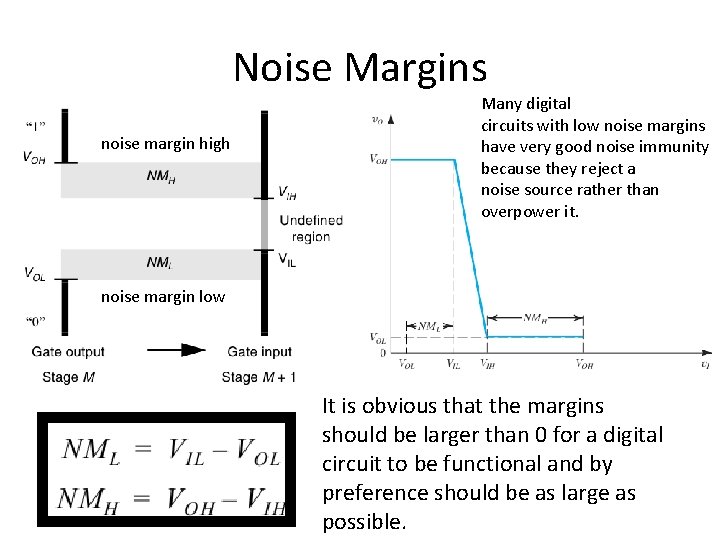
Noise Margin “The word noise in the context of digital circuits means “unwanted variations of voltages and currents at the logic nodes. ” Noise signals can enter a circuit in many ways
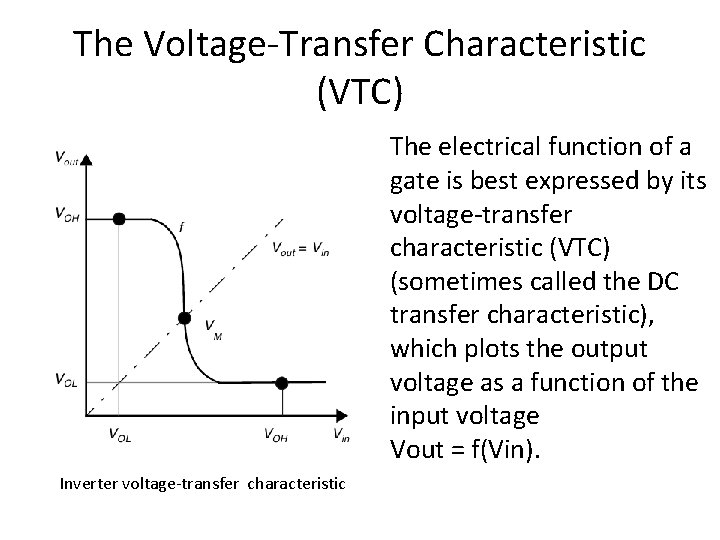
The Voltage-Transfer Characteristic (VTC) The electrical function of a gate is best expressed by its voltage-transfer characteristic (VTC) (sometimes called the DC transfer characteristic), which plots the output voltage as a function of the input voltage Vout = f(Vin). Inverter voltage-transfer characteristic
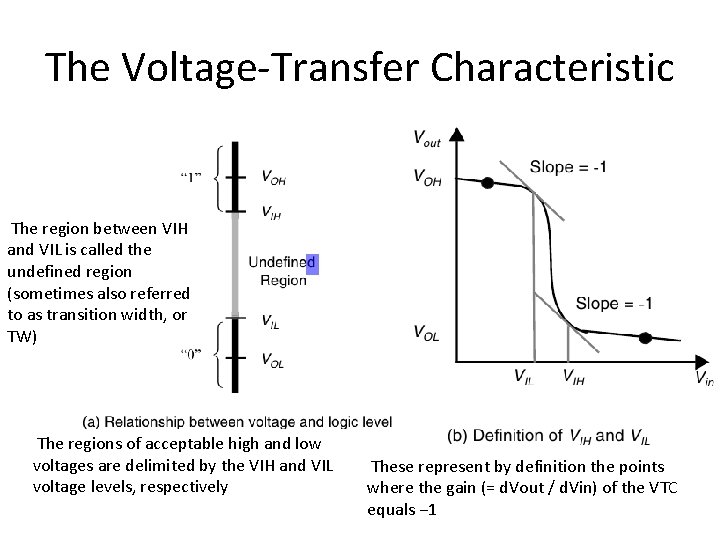
The Voltage-Transfer Characteristic The region between VIH and VIL is called the undefined region (sometimes also referred to as transition width, or TW) The regions of acceptable high and low voltages are delimited by the VIH and VIL voltage levels, respectively These represent by definition the points where the gain (= d. Vout / d. Vin) of the VTC equals − 1
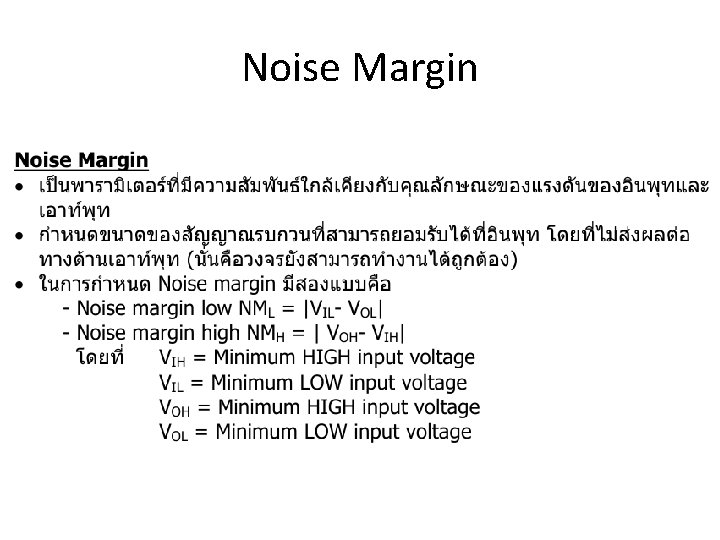
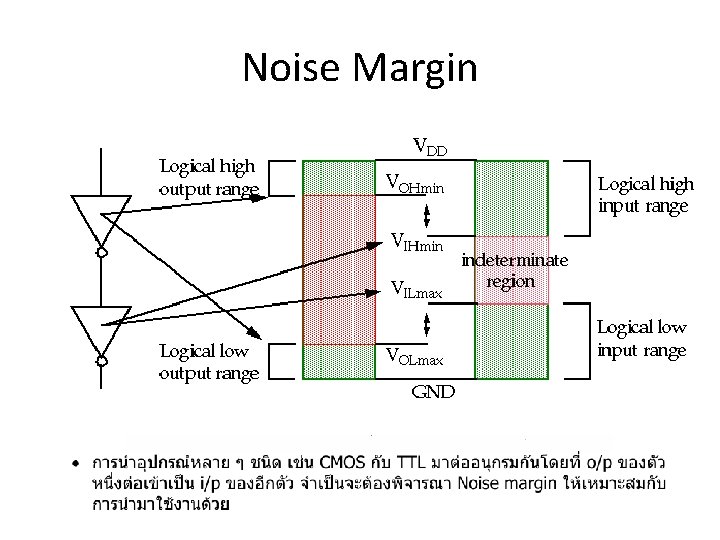
Noise Margins noise margin high Many digital circuits with low noise margins have very good noise immunity because they reject a noise source rather than overpower it. noise margin low It is obvious that the margins should be larger than 0 for a digital circuit to be functional and by preference should be as large as possible.
Noise Margin
Noise Margin
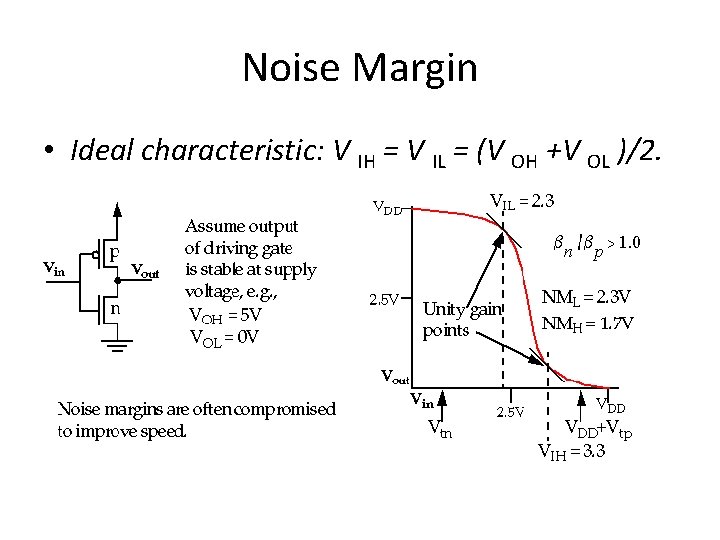
Noise Margin • Ideal characteristic: V IH = V IL = (V OH +V OL )/2.
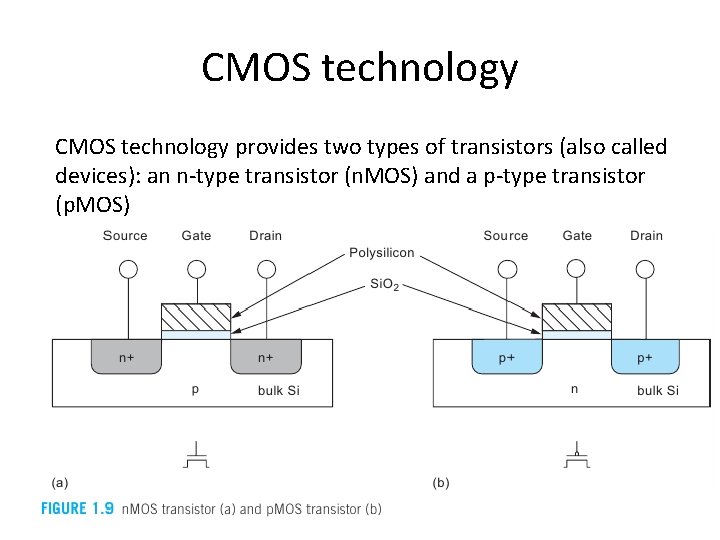
CMOS technology provides two types of transistors (also called devices): an n-type transistor (n. MOS) and a p-type transistor (p. MOS)
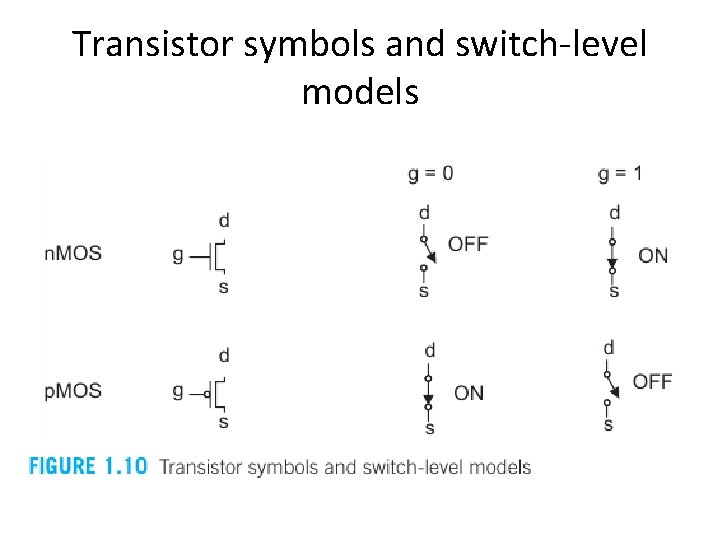
Transistor symbols and switch-level models
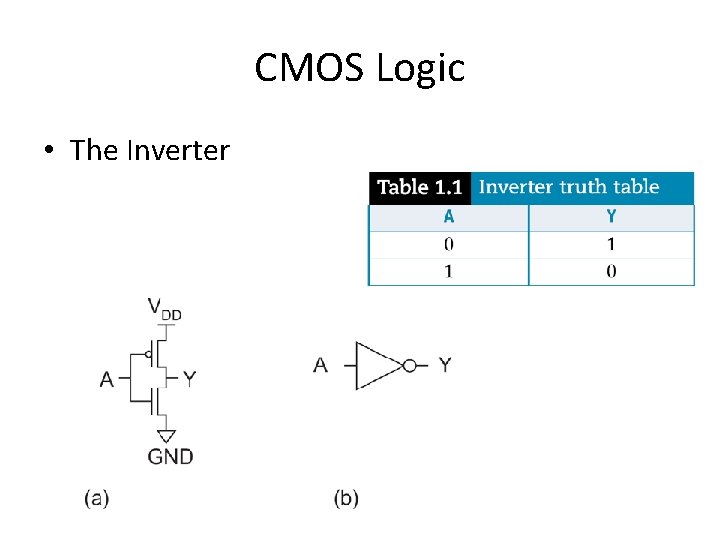
CMOS Logic • The Inverter
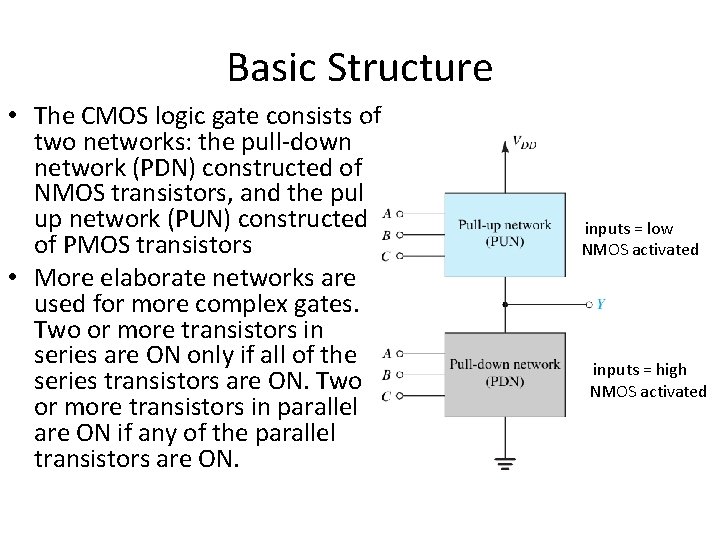
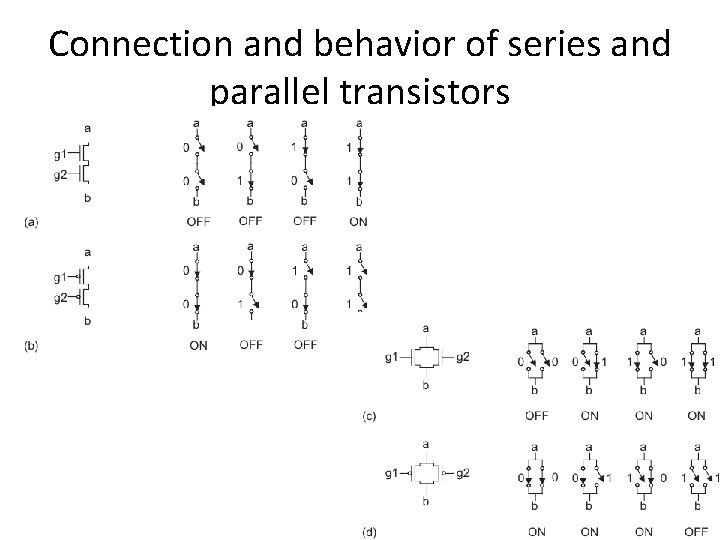
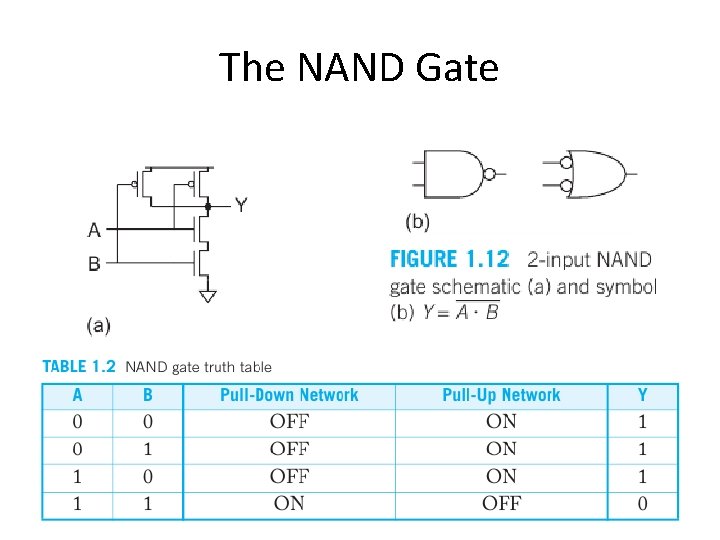
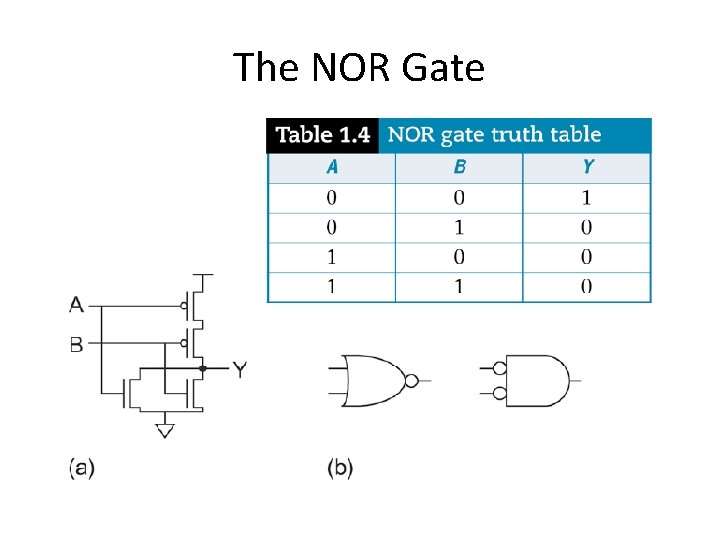
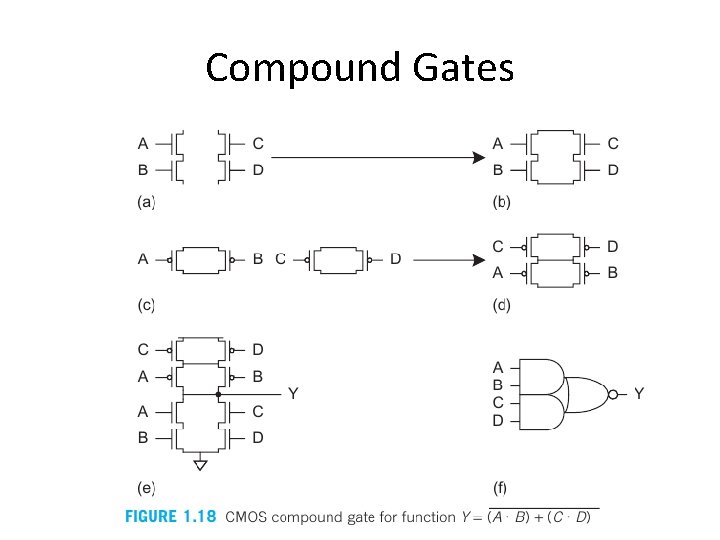
Basic Structure • The CMOS logic gate consists of two networks: the pull-down network (PDN) constructed of NMOS transistors, and the pullup network (PUN) constructed of PMOS transistors • More elaborate networks are used for more complex gates. Two or more transistors in series are ON only if all of the series transistors are ON. Two or more transistors in parallel are ON if any of the parallel transistors are ON. inputs = low NMOS activated inputs = high NMOS activated
Connection and behavior of series and parallel transistors
The NAND Gate
The NOR Gate
Compound Gates
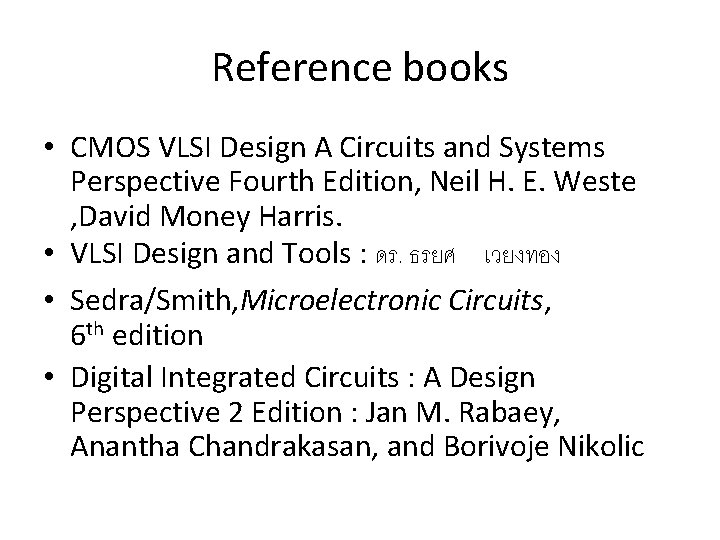
Reference books • CMOS VLSI Design A Circuits and Systems Perspective Fourth Edition, Neil H. E. Weste , David Money Harris. • VLSI Design and Tools : ดร. ธรยศ เวยงทอง • Sedra/Smith, Microelectronic Circuits, 6 th edition • Digital Integrated Circuits : A Design Perspective 2 Edition : Jan M. Rabaey, Anantha Chandrakasan, and Borivoje Nikolic