
CMOS Integrated NanowiresNanotubes CMOSInn Researcher Takeshi Kawano Advisor
CMOS Integrated Nanowires/Nanotubes (CMOS-Inn) Researcher Takeshi Kawano Advisor Professor Liwei Lin Berkeley Sensor & Actuator Center kawano@me. berkeley. edu © 2006 University of California Prepublication Data March 2006
Outline § Background § Motivation § Local synthesis of CNTs § Self-assembled CNTs between Si structures § CNT/Si junction at secondary structure § Electrical properties of CNTs § CNTs as sensor § Summary © 2006 University of California Prepublication Data March 2006
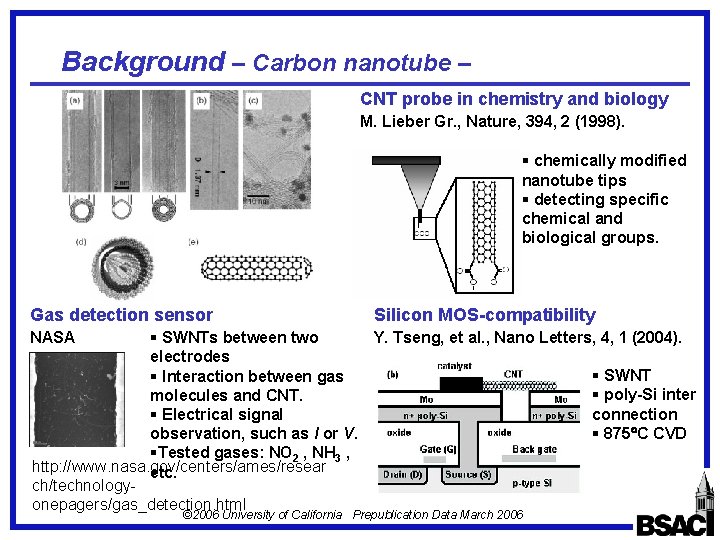
Background – Carbon nanotube – CNT probe in chemistry and biology M. Lieber Gr. , Nature, 394, 2 (1998). § chemically modified nanotube tips § detecting specific chemical and biological groups. Gas detection sensor Silicon MOS-compatibility § SWNTs between two Y. Tseng, et al. , Nano Letters, 4, 1 (2004). electrodes § SWNT § Interaction between gas § poly-Si inter molecules and CNT. connection § Electrical signal § 875 C CVD observation, such as I or V. §Tested gases: NO 2 , NH 3 , http: //www. nasa. gov/centers/ames/resear etc. ch/technologyonepagers/gas_detection. html NASA © 2006 University of California Prepublication Data March 2006
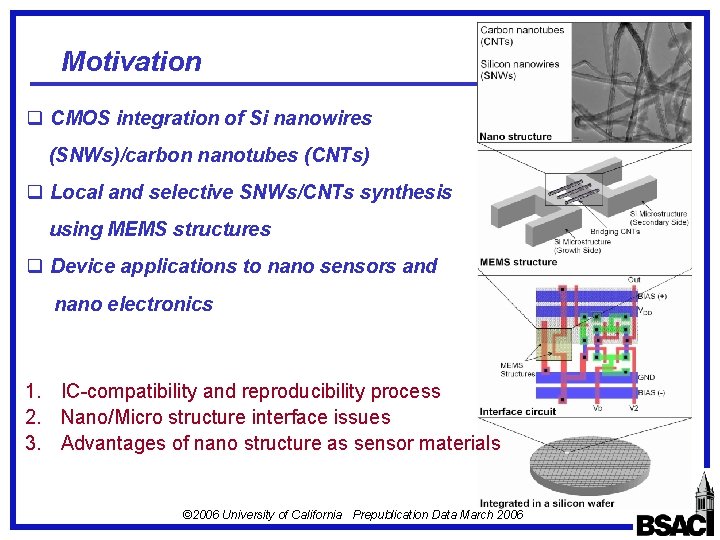
Motivation q CMOS integration of Si nanowires (SNWs)/carbon nanotubes (CNTs) q Local and selective SNWs/CNTs synthesis using MEMS structures q Device applications to nano sensors and nano electronics 1. IC-compatibility and reproducibility process 2. Nano/Micro structure interface issues 3. Advantages of nano structure as sensor materials © 2006 University of California Prepublication Data March 2006

Local Synthesis of Bridging CNTs Local&selective CNT synthesis Temperature 850 – 900 C C 2 H 2 gas flow 50 sccm Synthesis pressure 50 – 250 Torr Electric field assisted CNT synthesis Gaps between Si structures 5 – 10 mm Bias between Si (V 2 ) 2– 5 V Electric field (V 2 / gaps) 0. 2 – 1 V/mm © 2006 University of California Prepublication Data March 2006
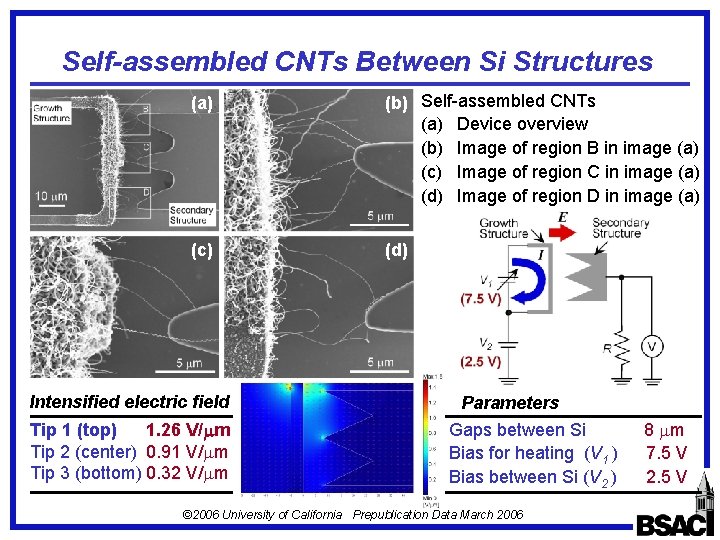
Self-assembled CNTs Between Si Structures (a) (b) Self-assembled CNTs (a) Device overview (b) Image of region B in image (a) (c) Image of region C in image (a) (d) Image of region D in image (a) (c) (d) Intensified electric field Tip 1 (top) 1. 26 V/mm Tip 2 (center) 0. 91 V/mm Tip 3 (bottom) 0. 32 V/mm Parameters Gaps between Si Bias for heating (V 1 ) Bias between Si (V 2 ) © 2006 University of California Prepublication Data March 2006 8 mm 7. 5 V 2. 5 V
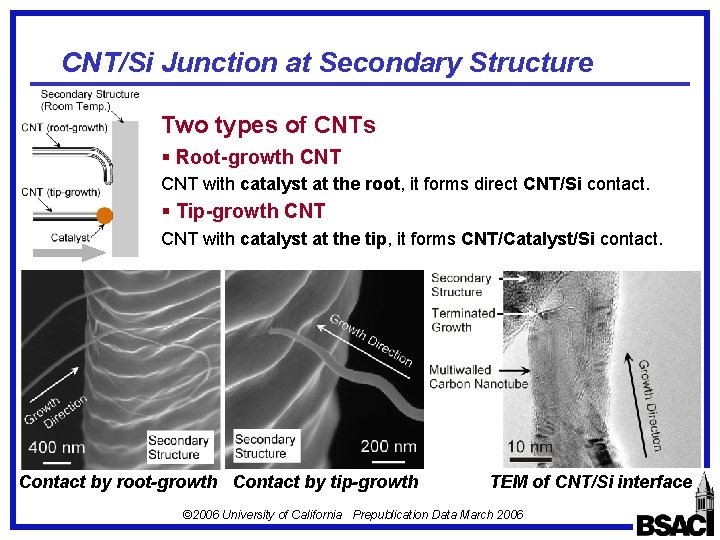
CNT/Si Junction at Secondary Structure Two types of CNTs § Root-growth CNT with catalyst at the root, it forms direct CNT/Si contact. § Tip-growth CNT with catalyst at the tip, it forms CNT/Catalyst/Si contact. Contact by root-growth Contact by tip-growth TEM of CNT/Si interface © 2006 University of California Prepublication Data March 2006

I-V curves of CNTs § linear curves § Repeatable characteristics § CNT/Si forms ohmic contact § Resistance of 480 k. W (10 CNTs) … if one CNT dominates the I-V, Diameter of CNT: 50 3 nm Length of CNT: 8. 8 mm (Average) Resistance per unit length =5. 5 104 W/mm I-V curves of the assembled CNT (when the contact resistance = 0) © 2006 University of California Prepublication Data March 2006
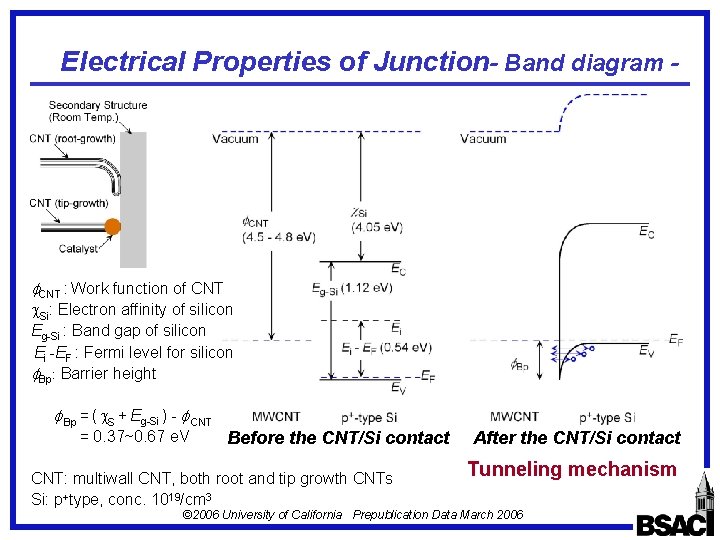
Electrical Properties of Junction- Band diagram - CNT : Work function of CNT Si: Electron affinity of silicon Eg-Si : Band gap of silicon Ei -EF : Fermi level for silicon Bp: Barrier height Bp = ( S + Eg-Si ) - CNT = 0. 37~0. 67 e. V Before the CNT/Si contact CNT: multiwall CNT, both root and tip growth CNTs Si: p+type, conc. 1019/cm 3 After the CNT/Si contact Tunneling mechanism © 2006 University of California Prepublication Data March 2006
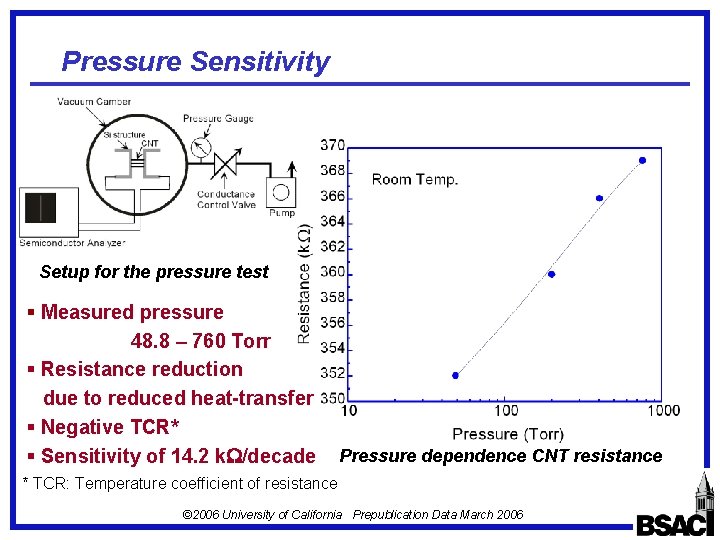
Pressure Sensitivity Setup for the pressure test § Measured pressure 48. 8 – 760 Torr § Resistance reduction due to reduced heat-transfer § Negative TCR* § Sensitivity of 14. 2 k. W/decade Pressure dependence CNT resistance * TCR: Temperature coefficient of resistance © 2006 University of California Prepublication Data March 2006
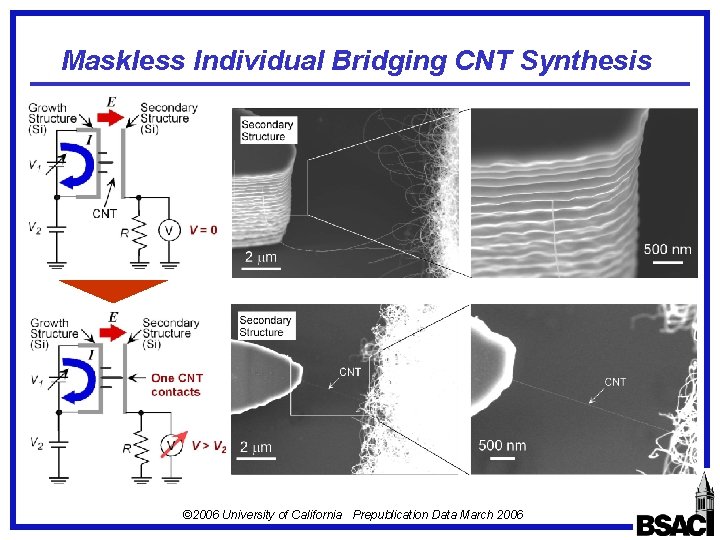
Maskless Individual Bridging CNT Synthesis © 2006 University of California Prepublication Data March 2006
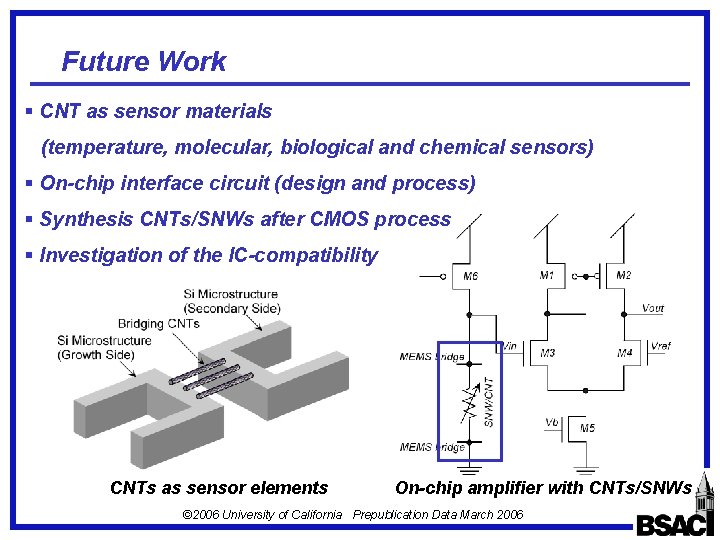
Future Work § CNT as sensor materials (temperature, molecular, biological and chemical sensors) § On-chip interface circuit (design and process) § Synthesis CNTs/SNWs after CMOS process § Investigation of the IC-compatibility CNTs as sensor elements On-chip amplifier with CNTs/SNWs © 2006 University of California Prepublication Data March 2006
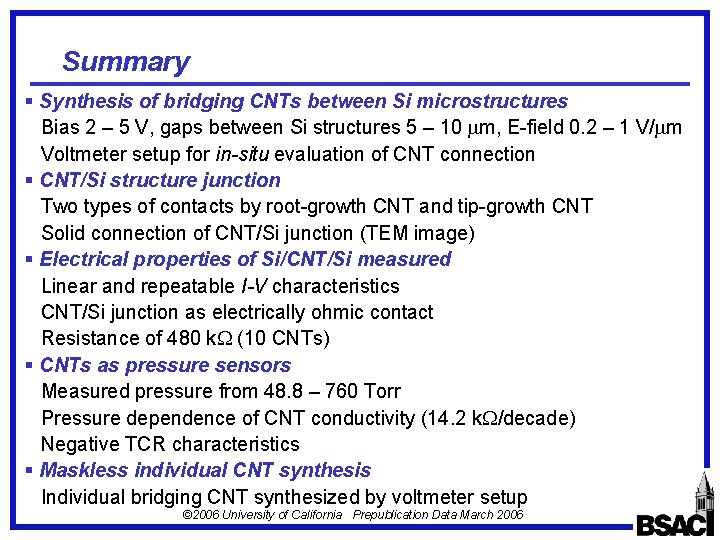
Summary § Synthesis of bridging CNTs between Si microstructures Bias 2 – 5 V, gaps between Si structures 5 – 10 mm, E-field 0. 2 – 1 V/mm Voltmeter setup for in-situ evaluation of CNT connection § CNT/Si structure junction Two types of contacts by root-growth CNT and tip-growth CNT Solid connection of CNT/Si junction (TEM image) § Electrical properties of Si/CNT/Si measured Linear and repeatable I-V characteristics CNT/Si junction as electrically ohmic contact Resistance of 480 k. W (10 CNTs) § CNTs as pressure sensors Measured pressure from 48. 8 – 760 Torr Pressure dependence of CNT conductivity (14. 2 k. W/decade) Negative TCR characteristics § Maskless individual CNT synthesis Individual bridging CNT synthesized by voltmeter setup © 2006 University of California Prepublication Data March 2006
Acknowledgements I would like to thank S. Chen, F. Ouyang, M. Cho, O. Englander, D. Christensen (synthesis, supports), Sha Li (I-V measurement), L. Luo, B. Sosnowchik (SEM, kind discussions), R. Yangand (FEMLAB simulation) and other Lab mates. And I would like to thank T. Yuzvinsky, at the Physics department at UC Berkeley, for his TEM work. © 2006 University of California Prepublication Data March 2006
- Slides: 14