
CMOS Active Filters Gbor C Temes School of
CMOS Active Filters Gábor C. Temes School of Electrical Engineering and Computer Science Oregon State University Rev. Sept. 2011 temes@ece. orst. edu 1 / 107
Structure of the Lecture • Continuous-time CMOS filters; • Discrete-time switched-capacitor filters (SCFs); • Non-ideal effects in SCFs; • Design examples: a Gm-C filter and an SCF; • The switched-R/MOSFET-C filter. temes@ece. orst. edu 2 / 107
Classification of Filters • Digital filter: both time and amplitude are quantized. • Analog filter: time may be continuous (CT) or discrete (DT); the amplitude is always continuous (CA). • Examples of CT/CA filters: active-RC filter, Gm-C filter. • Examples of DT/CA filters: switched-capacitor filter (SCF), switched-current filter (SIF). • Digital filters need complex circuitry, data converters. • CT analog filters are fast, not very linear and accurate, may need tuning circuit for controlled response. • DT/CA filters are linear, accurate, slower. temes@ece. orst. edu 3 / 107
Filter Design • Steps in design: 1. Approximation – translates the specifications into a realizable rational function of s (for CT filters) or z (for DT filters). May use MATLAB to obtain Chebyshev, Bessel, etc. response. 2. System-level (high-level)implementation – may use Simulink, etc. Architectural and circuit design should include scaling for impedance level and signal swing. 3. Transistor-level implementation – may use SPICE, Spectre, etc. This lecture will focus on Step. 2 for CMOS filters. temes@ece. orst. edu 4 / 107
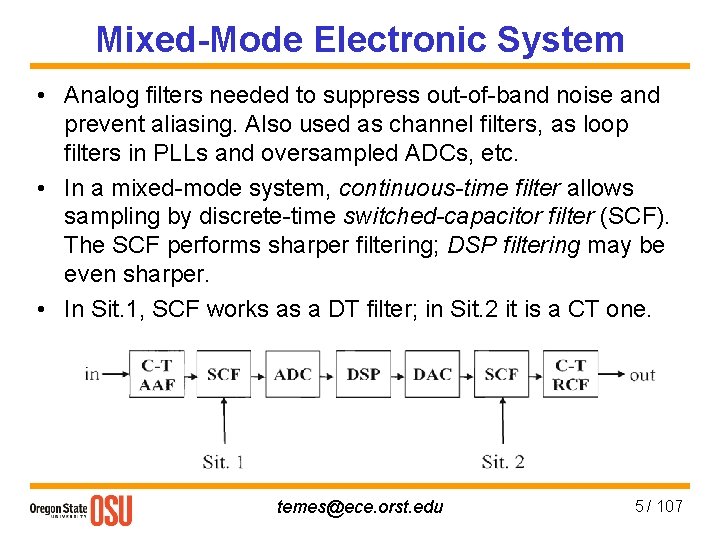
Mixed-Mode Electronic System • Analog filters needed to suppress out-of-band noise and prevent aliasing. Also used as channel filters, as loop filters in PLLs and oversampled ADCs, etc. • In a mixed-mode system, continuous-time filter allows sampling by discrete-time switched-capacitor filter (SCF). The SCF performs sharper filtering; DSP filtering may be even sharper. • In Sit. 1, SCF works as a DT filter; in Sit. 2 it is a CT one. temes@ece. orst. edu 5 / 107
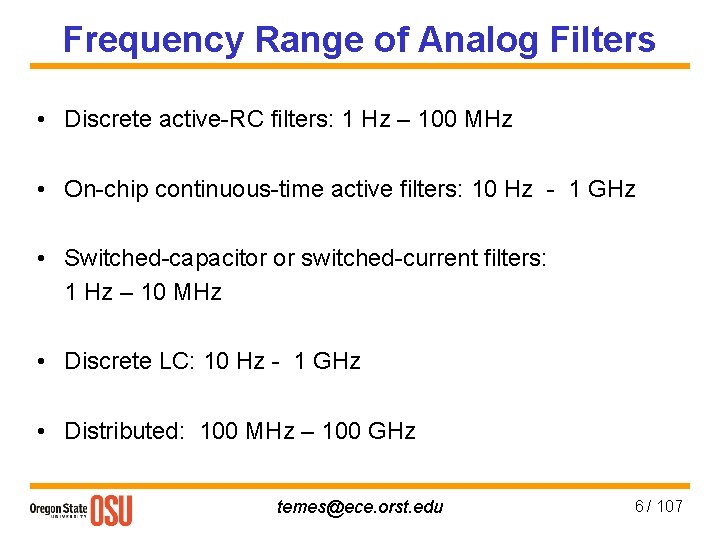
Frequency Range of Analog Filters • Discrete active-RC filters: 1 Hz – 100 MHz • On-chip continuous-time active filters: 10 Hz - 1 GHz • Switched-capacitor or switched-current filters: 1 Hz – 10 MHz • Discrete LC: 10 Hz - 1 GHz • Distributed: 100 MHz – 100 GHz temes@ece. orst. edu 6 / 107

Accuracy Considerations • The absolute accuracy of on-chip analog components is poor (10% - 50%). The matching accuracy of like elements can be much better with careful layout. • In untuned analog integrated circuits, on-chip Rs can be matched to each other typically within a few %, Cs within 0. 05%, with careful layout. The transconductance (Gm) of stages can be matched to about 10 - 30%. • In an active-RC filter, the time constant Tc is determined by RC products, accurate to only 20 – 50%. In a Gm-C filter , Tc ~ C/Gm, also inaccurate. Tuning may be used. • In an SC filter, Tc ~ (C 1/C 2)/fc, where fc is the clock frequency. Tc accuracy may be 0. 05% or better! temes@ece. orst. edu 7 / 107
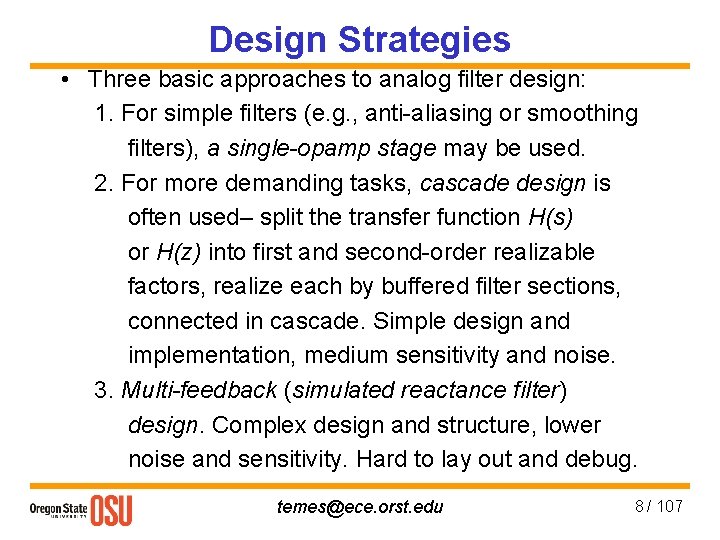
Design Strategies • Three basic approaches to analog filter design: 1. For simple filters (e. g. , anti-aliasing or smoothing filters), a single-opamp stage may be used. 2. For more demanding tasks, cascade design is often used– split the transfer function H(s) or H(z) into first and second-order realizable factors, realize each by buffered filter sections, connected in cascade. Simple design and implementation, medium sensitivity and noise. 3. Multi-feedback (simulated reactance filter) design. Complex design and structure, lower noise and sensitivity. Hard to lay out and debug. temes@ece. orst. edu 8 / 107
![Active-RC Filters [1], [4], [5] • Single-amplifier filters: Sallen-Key filter; Kerwin filter; Rauch filter,](http://slidetodoc.com/presentation_image_h/787b29355a4e25635b7da2a487ad4a89/image-9.jpg "Active-RC Filters [1], [4], [5] • Single-amplifier filters: Sallen-Key filter; Kerwin filter; Rauch filter,")
Active-RC Filters [1], [4], [5] • Single-amplifier filters: Sallen-Key filter; Kerwin filter; Rauch filter, Deliyannis-Friend filter. Simple structures, but with high sensitivity for high-Q response. • Integrator-based filter sections: Tow-Thomas biquads; Ackerberg-Mossberg filter. 2 or 3 op-amps, lower sensitivity for high-Q. May be cascaded. • Cascade design issues: pole-zero pairing, section ordering, dynamic range optimization. OK passband sensitivities, good stopband rejection. • Simulated LC filters: gyrator-based and integrator-based filters; dynamic range optimization. Low passband sensitivities and noise, but high stopband sensitivity and complexity in design, layout, testing. temes@ece. orst. edu 9 / 107
![Sallen-Key Filter [1], [4] First single-opamp biquad. General diagram: Often, K = 1. Has](http://slidetodoc.com/presentation_image_h/787b29355a4e25635b7da2a487ad4a89/image-10.jpg "Sallen-Key Filter [1], [4] First single-opamp biquad. General diagram: Often, K = 1. Has")
Sallen-Key Filter [1], [4] First single-opamp biquad. General diagram: Often, K = 1. Has 5 parameters, only 3 specified values. Scaling or noise reduction possible. • Amplifier not grounded. Input common-mode changes with output. Differential implementation difficult. temes@ece. orst. edu 10 / 107
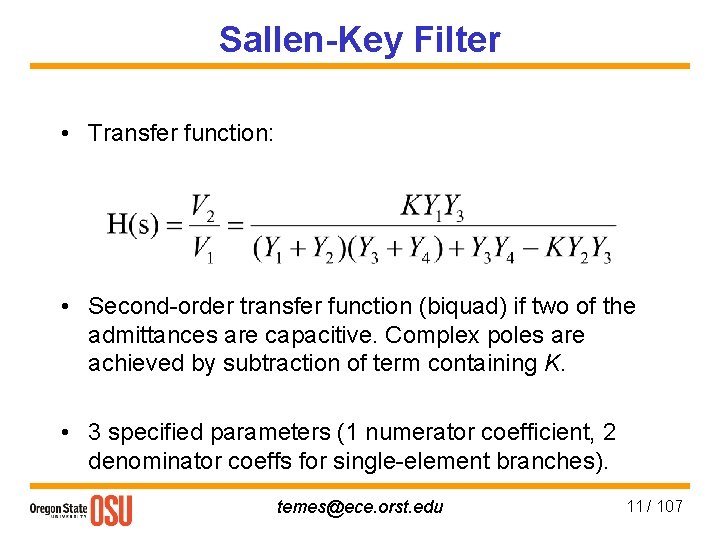
Sallen-Key Filter • Transfer function: • Second-order transfer function (biquad) if two of the admittances are capacitive. Complex poles are achieved by subtraction of term containing K. • 3 specified parameters (1 numerator coefficient, 2 denominator coeffs for single-element branches). temes@ece. orst. edu 11 / 107
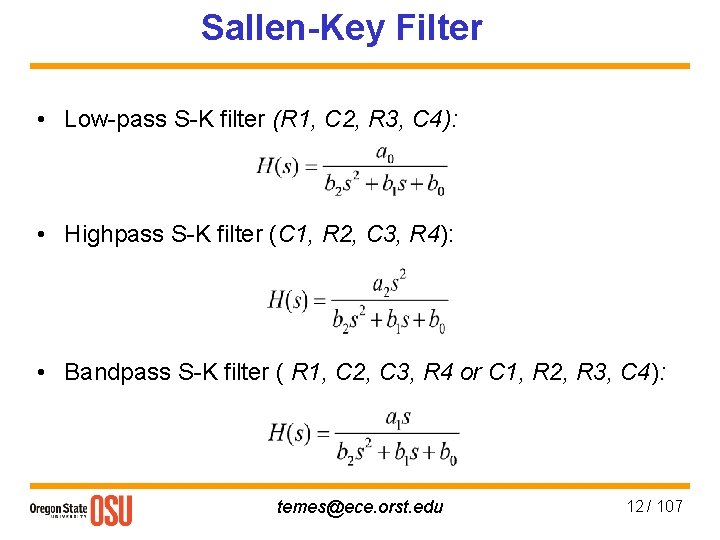
Sallen-Key Filter • Low-pass S-K filter (R 1, C 2, R 3, C 4): • Highpass S-K filter (C 1, R 2, C 3, R 4): • Bandpass S-K filter ( R 1, C 2, C 3, R 4 or C 1, R 2, R 3, C 4): temes@ece. orst. edu 12 / 107
Sallen-Key Filter • Pole frequency ωo: absolute value of natural mode; • Pole Q: ωo/2|real part of pole|. Determines the stability, sensitivity, and noise gain. Q > 5 is dangerous, Q > 10 can be lethal! For S-K filter, d. Q/Q ~ (3 Q – 1) d. K/K. So, if Q = 10, 1% error in K results in 30% error in Q. • Pole Q tends to be high in band-pass filters, so S-K may not be suitable for those. • Usually, only the peak gain, the Q and the pole frequency ωo are specified. There are 2 extra degrees of freedom. May be used for specified R noise, minimum total C, equal capacitors, or K = 1. • Use a differential difference amplifier for differential circuitry. temes@ece. orst. edu 13 / 107
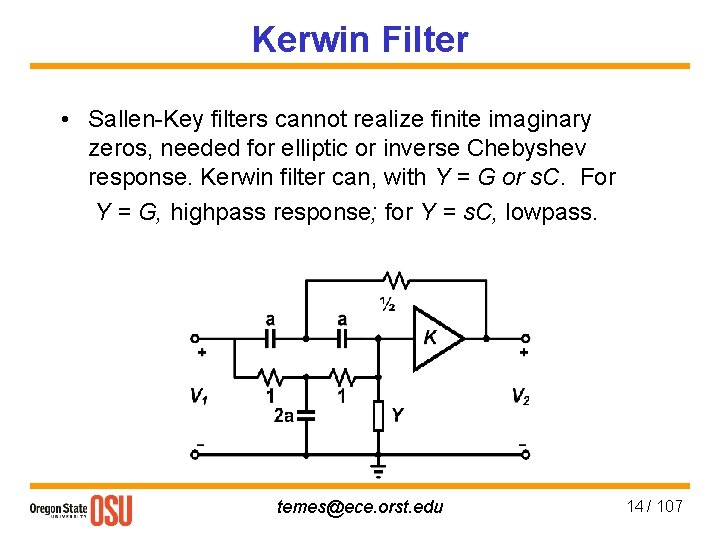
Kerwin Filter • Sallen-Key filters cannot realize finite imaginary zeros, needed for elliptic or inverse Chebyshev response. Kerwin filter can, with Y = G or s. C. For Y = G, highpass response; for Y = s. C, lowpass. temes@ece. orst. edu 14 / 107
![Deliyannis-Friend Filter [1] Single-opamp bandpass filter: • Grounded opamp, Vcm = 0. The circuit](http://slidetodoc.com/presentation_image_h/787b29355a4e25635b7da2a487ad4a89/image-15.jpg "Deliyannis-Friend Filter [1] Single-opamp bandpass filter: • Grounded opamp, Vcm = 0. The circuit")
Deliyannis-Friend Filter [1] Single-opamp bandpass filter: • Grounded opamp, Vcm = 0. The circuit may be realized in a fully differential form suitable for noise cancellation. Input CM is held at analog ground. • Finite gain slightly reduces gain factor and Q. Sensitivity is not too high even for high Q. temes@ece. orst. edu 15 / 107
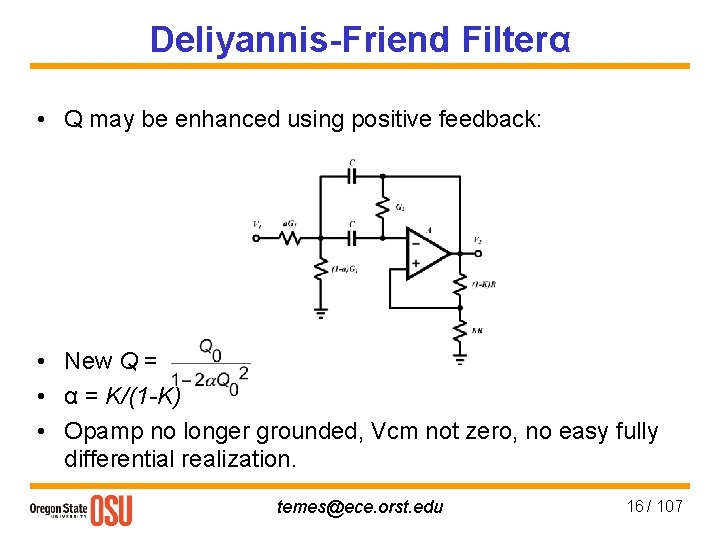
Deliyannis-Friend Filterα • Q may be enhanced using positive feedback: • New Q = • α = K/(1 -K) • Opamp no longer grounded, Vcm not zero, no easy fully differential realization. temes@ece. orst. edu 16 / 107
![Rauch Filter [1] Often applied as anti-aliasing low-pass filter: Transfer function: • Grounded opamp,](http://slidetodoc.com/presentation_image_h/787b29355a4e25635b7da2a487ad4a89/image-17.jpg "Rauch Filter [1] Often applied as anti-aliasing low-pass filter: Transfer function: • Grounded opamp,")
Rauch Filter [1] Often applied as anti-aliasing low-pass filter: Transfer function: • Grounded opamp, may be realized fully differentially. 5 parameters, 3 constraints. Min. noise, or C 1 = C 2, or min. total C can be achieved. temes@ece. orst. edu 17 / 107
![Tow-Thomas Biquad [1] • Multi-opamp integrator-based biquads: lower sensitivities, better stability, and more versatile](http://slidetodoc.com/presentation_image_h/787b29355a4e25635b7da2a487ad4a89/image-18.jpg "Tow-Thomas Biquad [1] • Multi-opamp integrator-based biquads: lower sensitivities, better stability, and more versatile")
Tow-Thomas Biquad [1] • Multi-opamp integrator-based biquads: lower sensitivities, better stability, and more versatile use. • They can be realized in fully differential form. • The Tow-Thomas biquad is a sine-wave oscillator, stabilized by one or more additional element (R 1): • In its differential form, the inverter is not required. temes@ece. orst. edu 18 / 107
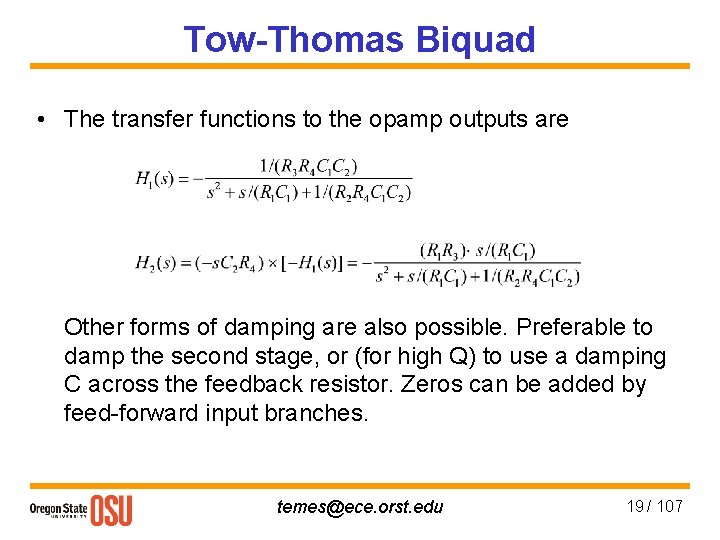
Tow-Thomas Biquad • The transfer functions to the opamp outputs are Other forms of damping are also possible. Preferable to damp the second stage, or (for high Q) to use a damping C across the feedback resistor. Zeros can be added by feed-forward input branches. temes@ece. orst. edu 19 / 107
![Ackerberg–Mossberg Filter [1] • Similar to the Tow-Thomas biquad, but less sensitive to finite](http://slidetodoc.com/presentation_image_h/787b29355a4e25635b7da2a487ad4a89/image-20.jpg "Ackerberg–Mossberg Filter [1] • Similar to the Tow-Thomas biquad, but less sensitive to finite")
Ackerberg–Mossberg Filter [1] • Similar to the Tow-Thomas biquad, but less sensitive to finite opamp gain effects. • The inverter is not needed for fully differential realization. Then it becomes the Tow-Thomas structure. temes@ece. orst. edu 20 / 107
![Cascade Filter Design [3], [5] • Higher-order filter can constructed by cascading loworder ones.](http://slidetodoc.com/presentation_image_h/787b29355a4e25635b7da2a487ad4a89/image-21.jpg "Cascade Filter Design [3], [5] • Higher-order filter can constructed by cascading loworder ones.")
Cascade Filter Design [3], [5] • Higher-order filter can constructed by cascading loworder ones. The Hi(s) are multiplied, provided the stage outputs are buffered. • The Hi(s) can be obtained from the overall H(s) by factoring the numerator and denominator, and assigning conjugate zeros and poles to each biquad. • Sharp peaks and dips in |H(f)| cause noise spurs in the output. So, dominant poles should be paired with the nearest zeros. temes@ece. orst. edu 21 / 107
![Cascade Filter Design [5] • Ordering of sections in a cascade filter dictated by](http://slidetodoc.com/presentation_image_h/787b29355a4e25635b7da2a487ad4a89/image-22.jpg "Cascade Filter Design [5] • Ordering of sections in a cascade filter dictated by")
Cascade Filter Design [5] • Ordering of sections in a cascade filter dictated by low noise and overload avoidance. Some rules of thumb: • High-Q sections should be in the middle; • First sections should be low-pass or band-pass, to suppress incoming high-frequency noise; • All-pass sections should be near the input; • Last stages should be high-pass or band-pass to avoid output dc offset. temes@ece. orst. edu 22 / 107
![Dynamic Range Optimization [3] • Scaling for dynamic range optimization is very important in](http://slidetodoc.com/presentation_image_h/787b29355a4e25635b7da2a487ad4a89/image-23.jpg "Dynamic Range Optimization [3] • Scaling for dynamic range optimization is very important in")
Dynamic Range Optimization [3] • Scaling for dynamic range optimization is very important in multi-op-amp filters. • Active-RC structure: • Op-amp output swing must remain in linear range, but should be made large, as this reduces the noise gain from the stage output to the filter output. However, it reduces the feedback factor and hence increases the settling time. temes@ece. orst. edu 23 / 107
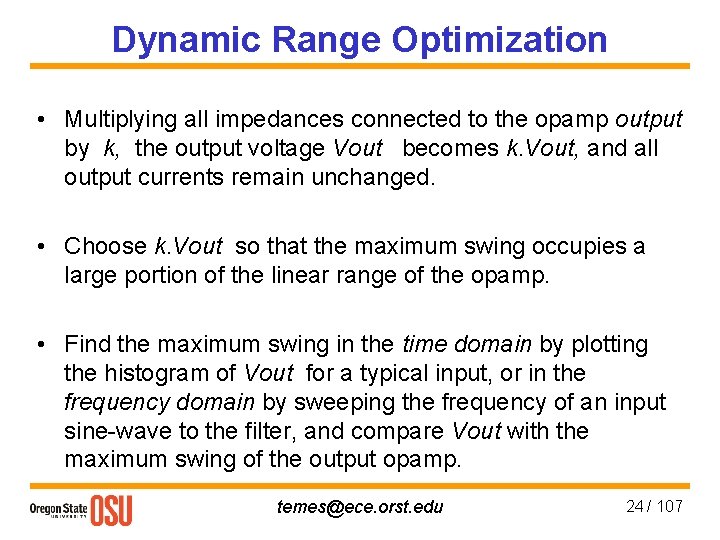
Dynamic Range Optimization • Multiplying all impedances connected to the opamp output by k, the output voltage Vout becomes k. Vout, and all output currents remain unchanged. • Choose k. Vout so that the maximum swing occupies a large portion of the linear range of the opamp. • Find the maximum swing in the time domain by plotting the histogram of Vout for a typical input, or in the frequency domain by sweeping the frequency of an input sine-wave to the filter, and compare Vout with the maximum swing of the output opamp. temes@ece. orst. edu 24 / 107
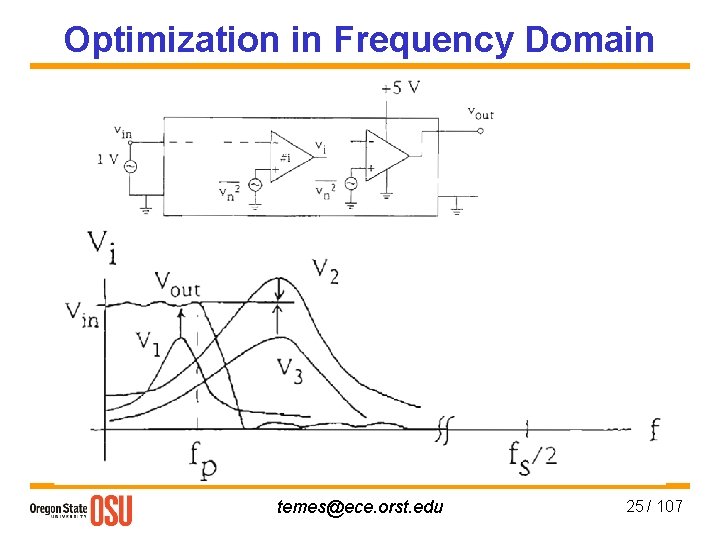
Optimization in Frequency Domain temes@ece. orst. edu 25 / 107
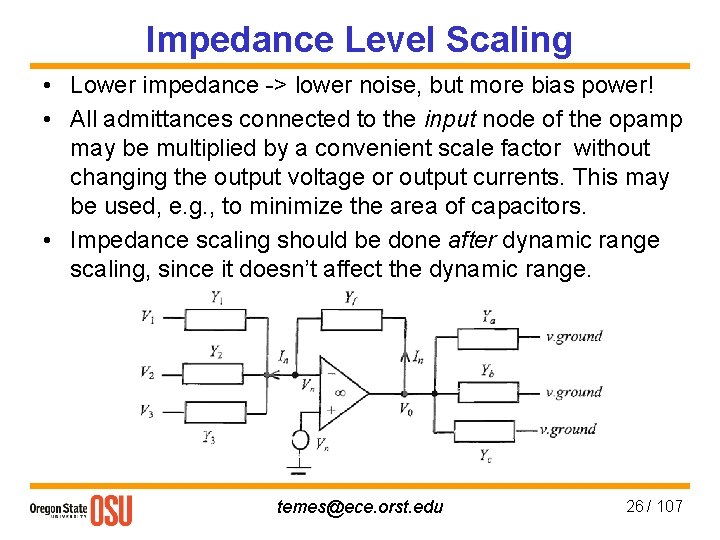
Impedance Level Scaling • Lower impedance -> lower noise, but more bias power! • All admittances connected to the input node of the opamp may be multiplied by a convenient scale factor without changing the output voltage or output currents. This may be used, e. g. , to minimize the area of capacitors. • Impedance scaling should be done after dynamic range scaling, since it doesn’t affect the dynamic range. temes@ece. orst. edu 26 / 107
![Tunable Active-RC Filters [2], [3] • Tolerances of RC time constants typically 30 ~](http://slidetodoc.com/presentation_image_h/787b29355a4e25635b7da2a487ad4a89/image-27.jpg "Tunable Active-RC Filters [2], [3] • Tolerances of RC time constants typically 30 ~")
Tunable Active-RC Filters [2], [3] • Tolerances of RC time constants typically 30 ~ 50%, so the realized frequency response may not be acceptable. • Resistors may be trimmed, or made variable and then automatically tuned, to obtain time constants locked to the period T of a crystal-controlled clock signal. • Simplest: replace Rs by MOSFETs operating in their linear (triode) region. MOSFET-C filters result. • Compared to Gm-C filters, slower and need more power, but may be more linear, and easier to design. temes@ece. orst. edu 27 / 107
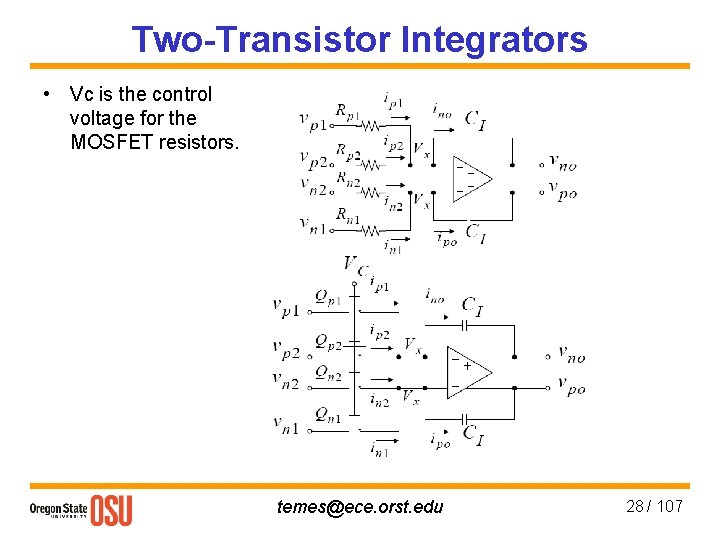
Two-Transistor Integrators • Vc is the control voltage for the MOSFET resistors. temes@ece. orst. edu 28 / 107
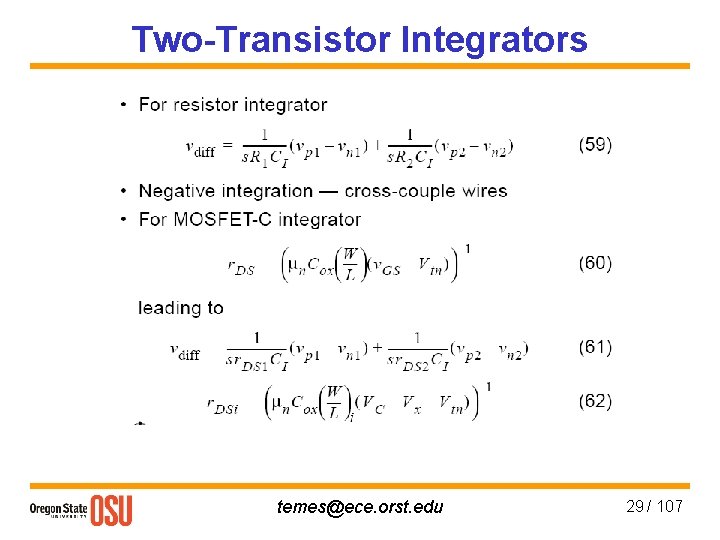
Two-Transistor Integrators temes@ece. orst. edu 29 / 107
![MOSFET-C Biquad Filter [2], [3] • Tow-Thomas MOSFET-C biquad: temes@ece. orst. edu 30 /](http://slidetodoc.com/presentation_image_h/787b29355a4e25635b7da2a487ad4a89/image-30.jpg "MOSFET-C Biquad Filter [2], [3] • Tow-Thomas MOSFET-C biquad: temes@ece. orst. edu 30 /")
MOSFET-C Biquad Filter [2], [3] • Tow-Thomas MOSFET-C biquad: temes@ece. orst. edu 30 / 107

Four-Transistor Integrator • Linearity of MOSFET-C integrators can be improved by using 4 transistors rather than 2 (Z. Czarnul): • May be analyzed as a two-input integrator with inputs (Vpi -Vni) and (Vni-Vpi). temes@ece. orst. edu 31 / 107
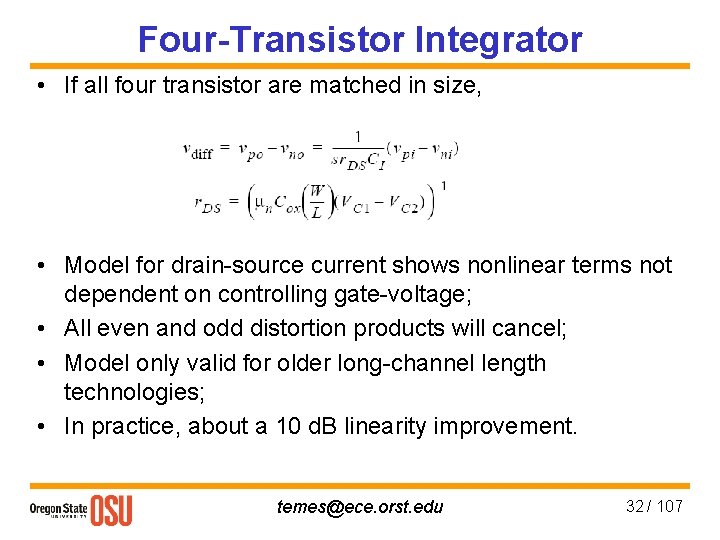
Four-Transistor Integrator • If all four transistor are matched in size, • Model for drain-source current shows nonlinear terms not dependent on controlling gate-voltage; • All even and odd distortion products will cancel; • Model only valid for older long-channel length technologies; • In practice, about a 10 d. B linearity improvement. temes@ece. orst. edu 32 / 107
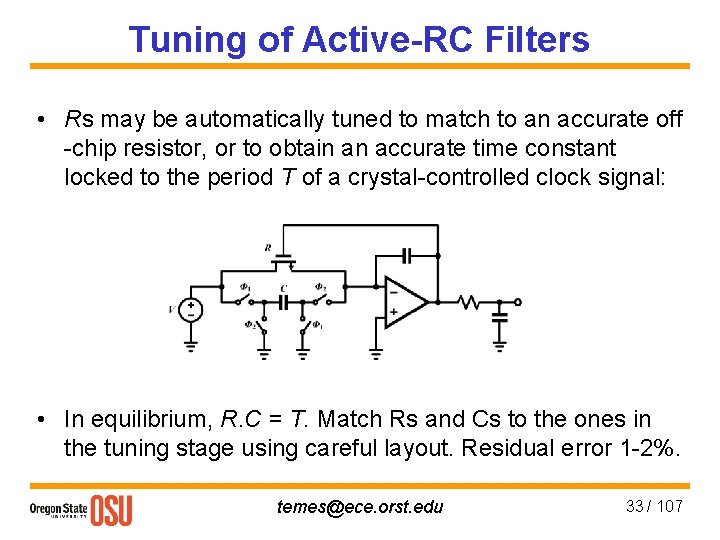
Tuning of Active-RC Filters • Rs may be automatically tuned to match to an accurate off -chip resistor, or to obtain an accurate time constant locked to the period T of a crystal-controlled clock signal: • In equilibrium, R. C = T. Match Rs and Cs to the ones in the tuning stage using careful layout. Residual error 1 -2%. temes@ece. orst. edu 33 / 107
![Switched-R Filters [6] • Replace tuned resistors by a combination of two resistors and](http://slidetodoc.com/presentation_image_h/787b29355a4e25635b7da2a487ad4a89/image-34.jpg "Switched-R Filters [6] • Replace tuned resistors by a combination of two resistors and")
Switched-R Filters [6] • Replace tuned resistors by a combination of two resistors and a periodically opened/closed switch. • Automatically tune the duty cycle of the switch: temes@ece. orst. edu 34 / 107
![Simulated LC Filters [3], [5] • A doubly-terminated LC filter with near-optimum power transmission](http://slidetodoc.com/presentation_image_h/787b29355a4e25635b7da2a487ad4a89/image-35.jpg "Simulated LC Filters [3], [5] • A doubly-terminated LC filter with near-optimum power transmission")
Simulated LC Filters [3], [5] • A doubly-terminated LC filter with near-optimum power transmission in its passband has low sensitivities to all L & C variations, since the output signal can only decrease if a parameter is changed from its nominal value. temes@ece. orst. edu 35 / 107
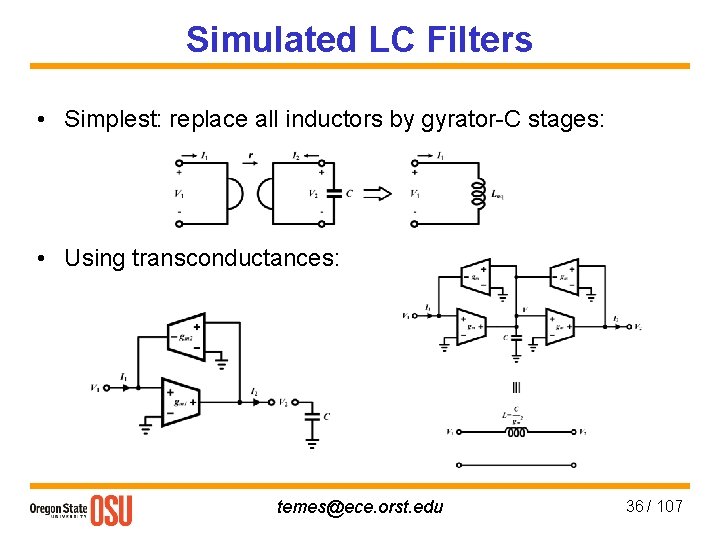
Simulated LC Filters • Simplest: replace all inductors by gyrator-C stages: • Using transconductances: temes@ece. orst. edu 36 / 107
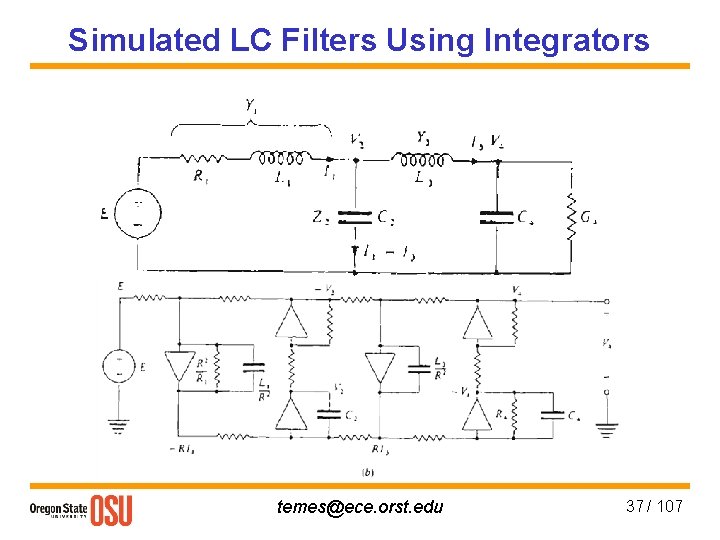
Simulated LC Filters Using Integrators temes@ece. orst. edu 37 / 107
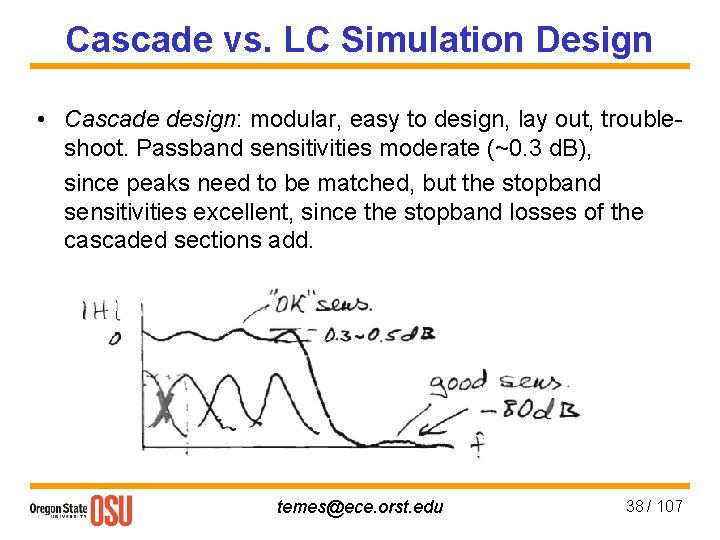
Cascade vs. LC Simulation Design • Cascade design: modular, easy to design, lay out, troubleshoot. Passband sensitivities moderate (~0. 3 d. B), since peaks need to be matched, but the stopband sensitivities excellent, since the stopband losses of the cascaded sections add. temes@ece. orst. edu 38 / 107
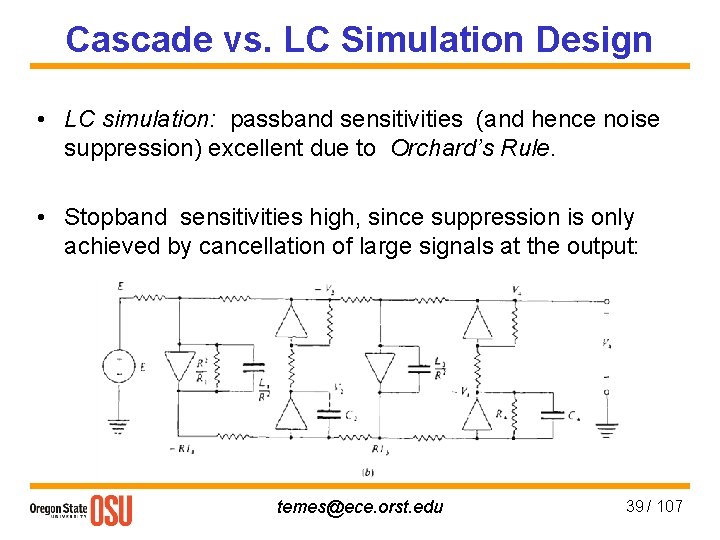
Cascade vs. LC Simulation Design • LC simulation: passband sensitivities (and hence noise suppression) excellent due to Orchard’s Rule. • Stopband sensitivities high, since suppression is only achieved by cancellation of large signals at the output: temes@ece. orst. edu 39 / 107
![Gm-C Filters [1], [2], [5] • Alternative realization of tunable continuous-time filters: Gm-C filters.](http://slidetodoc.com/presentation_image_h/787b29355a4e25635b7da2a487ad4a89/image-40.jpg "Gm-C Filters [1], [2], [5] • Alternative realization of tunable continuous-time filters: Gm-C filters.")
Gm-C Filters [1], [2], [5] • Alternative realization of tunable continuous-time filters: Gm-C filters. • Faster than active-RC filters, since they use open-loop stages, and (usually) no opamps. . • Lower power, since the active blocks drive only capacitive loads. • More difficult to achieve linear operation (no feedback). temes@ece. orst. edu 40 / 107

Gm-C Integrator • Uses a transconductor to realize an integrator; • The output current of Gm is (ideally) linearly related to the input voltage; • Output and input impedances are ideally infinite. • Gm is not an operational transconductance amplifier (OTA) which needs a high Gm value, but need not be very linear. temes@ece. orst. edu 41 / 107
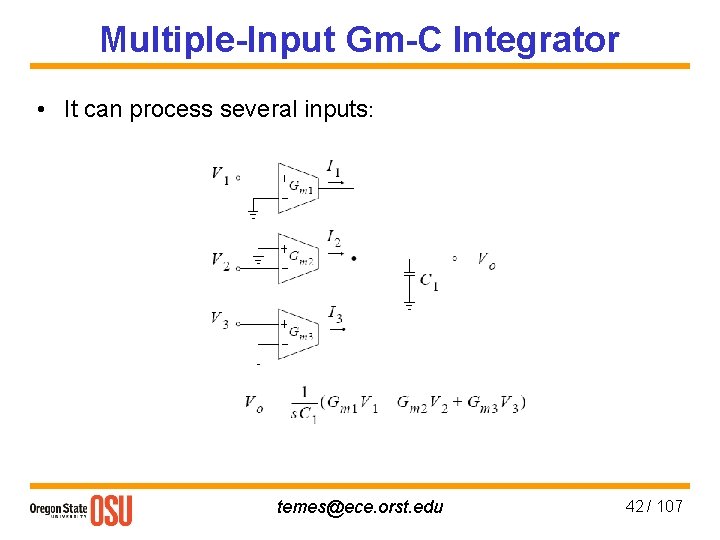
Multiple-Input Gm-C Integrator • It can process several inputs: temes@ece. orst. edu 42 / 107
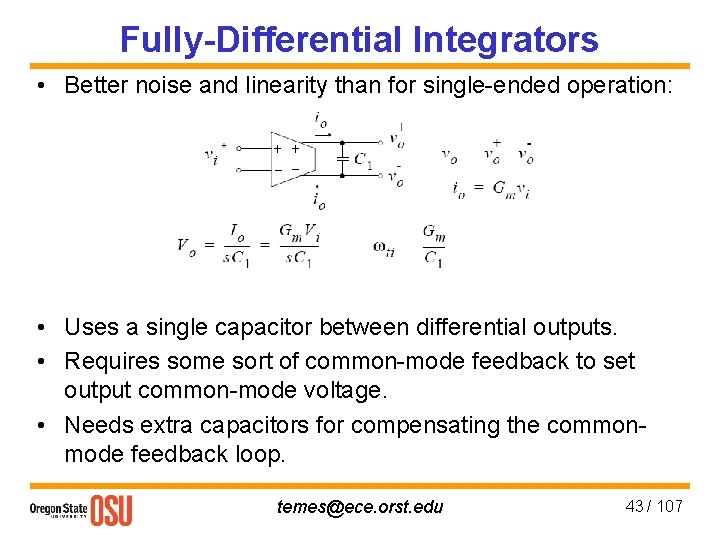
Fully-Differential Integrators • Better noise and linearity than for single-ended operation: • Uses a single capacitor between differential outputs. • Requires some sort of common-mode feedback to set output common-mode voltage. • Needs extra capacitors for compensating the commonmode feedback loop. temes@ece. orst. edu 43 / 107
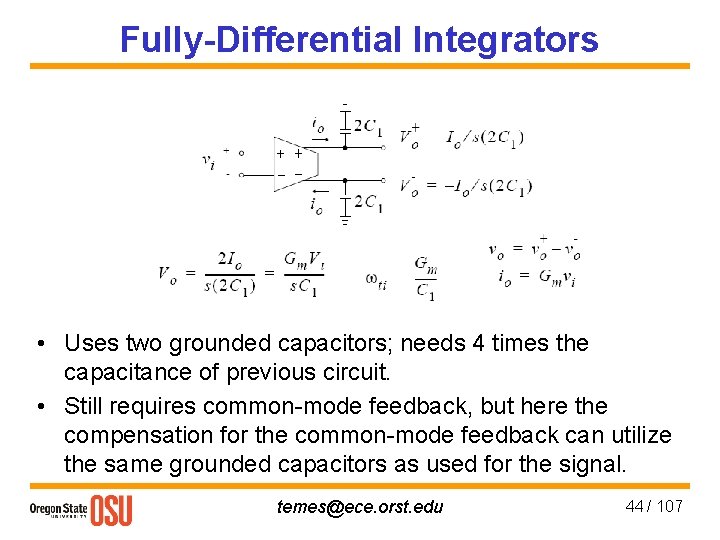
Fully-Differential Integrators • Uses two grounded capacitors; needs 4 times the capacitance of previous circuit. • Still requires common-mode feedback, but here the compensation for the common-mode feedback can utilize the same grounded capacitors as used for the signal. temes@ece. orst. edu 44 / 107
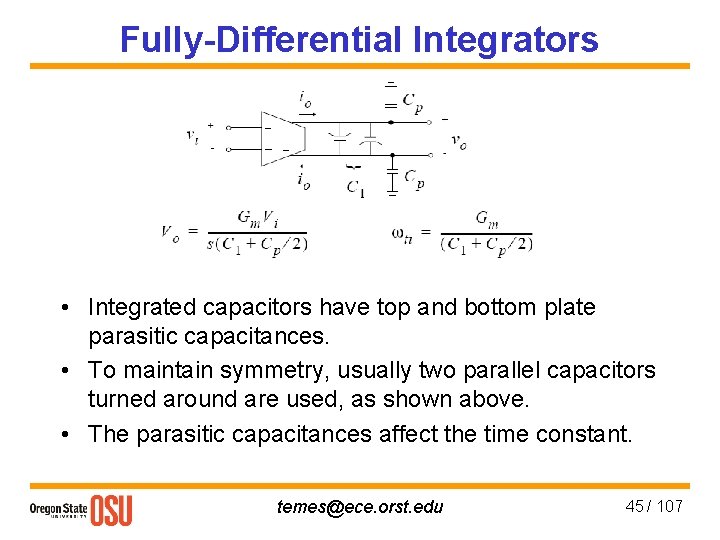
Fully-Differential Integrators • Integrated capacitors have top and bottom plate parasitic capacitances. • To maintain symmetry, usually two parallel capacitors turned around are used, as shown above. • The parasitic capacitances affect the time constant. temes@ece. orst. edu 45 / 107
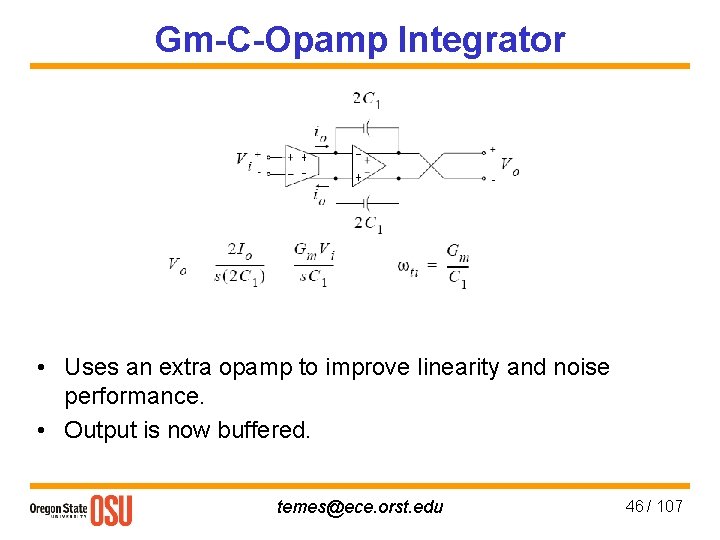
Gm-C-Opamp Integrator • Uses an extra opamp to improve linearity and noise performance. • Output is now buffered. temes@ece. orst. edu 46 / 107
Gm-C-Opamp Integrator Advantages • Effect of parasitics reduced by opamp gain —more accurate time constant and better linearity. • Less sensitive to noise pick-up, since transconductor output is low impedance (due to opamp feedback). • Gm cell drives virtual ground — output impedance of Gm cell can be lower, and smaller voltage swing is needed. Disadvantages • Lower operating speed because it now relies on feedback; • Larger power dissipation; • Larger silicon area. temes@ece. orst. edu 47 / 107
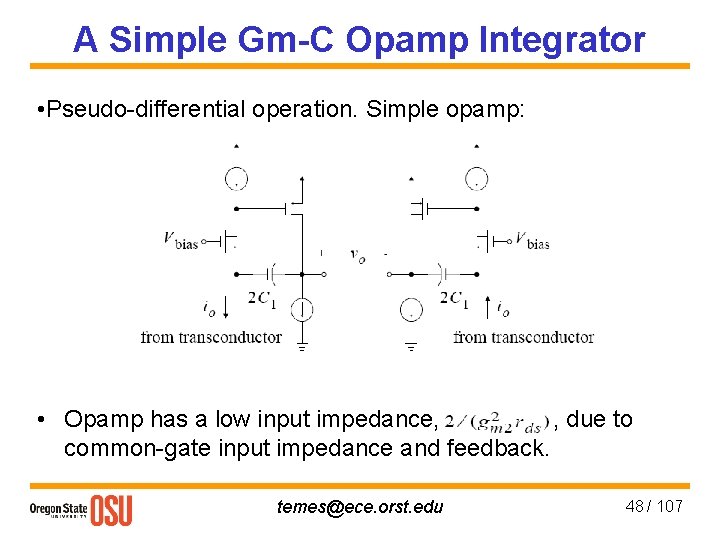
A Simple Gm-C Opamp Integrator • Pseudo-differential operation. Simple opamp: • Opamp has a low input impedance, d, due to common-gate input impedance and feedback. temes@ece. orst. edu 48 / 107
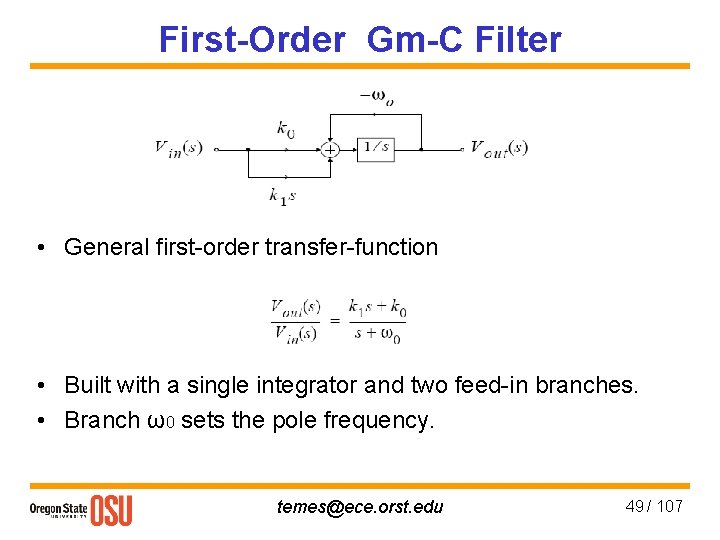
First-Order Gm-C Filter • General first-order transfer-function • Built with a single integrator and two feed-in branches. • Branch ω0 sets the pole frequency. temes@ece. orst. edu 49 / 107
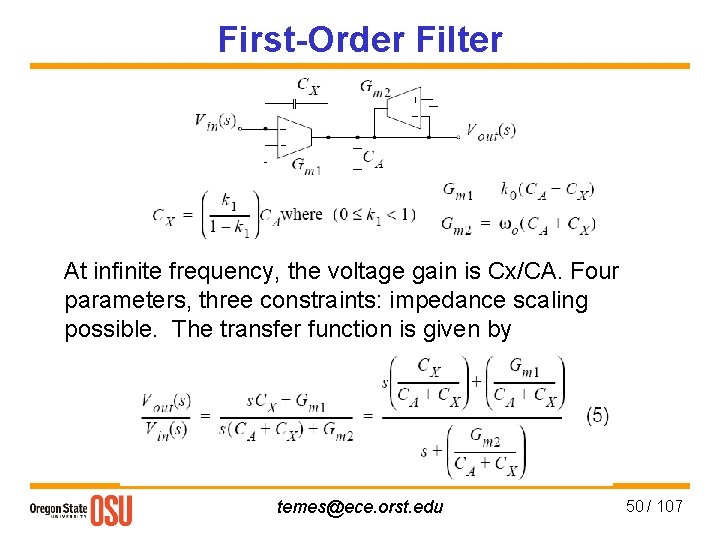
First-Order Filter At infinite frequency, the voltage gain is Cx/CA. Four parameters, three constraints: impedance scaling possible. The transfer function is given by temes@ece. orst. edu 50 / 107
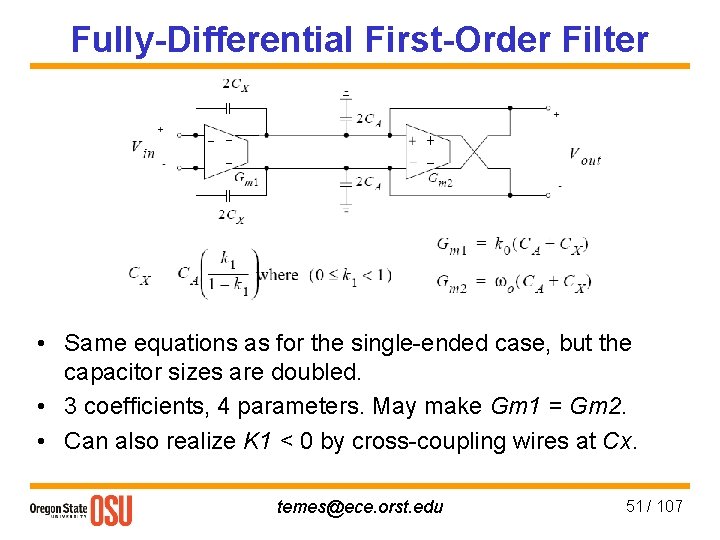
Fully-Differential First-Order Filter • Same equations as for the single-ended case, but the capacitor sizes are doubled. • 3 coefficients, 4 parameters. May make Gm 1 = Gm 2. • Can also realize K 1 < 0 by cross-coupling wires at Cx. temes@ece. orst. edu 51 / 107
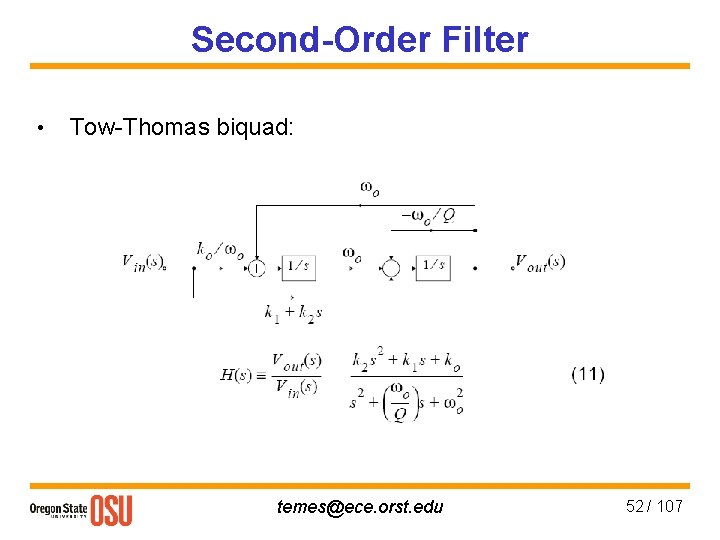
Second-Order Filter • Tow-Thomas biquad: temes@ece. orst. edu 52 / 107
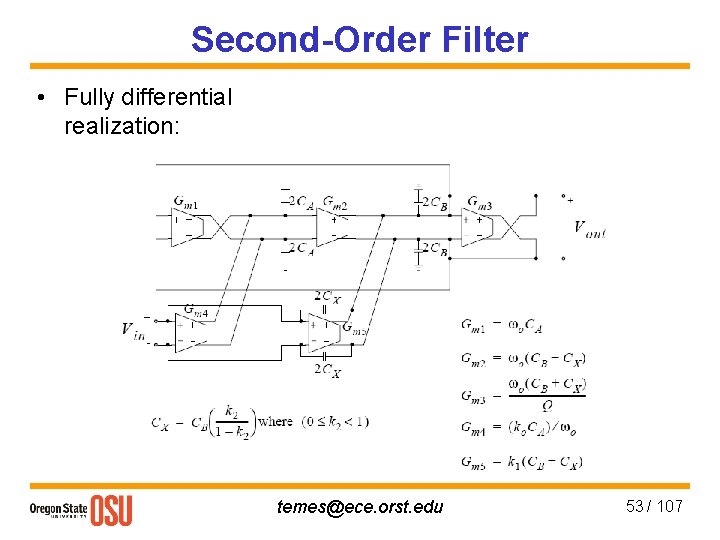
Second-Order Filter • Fully differential realization: temes@ece. orst. edu 53 / 107
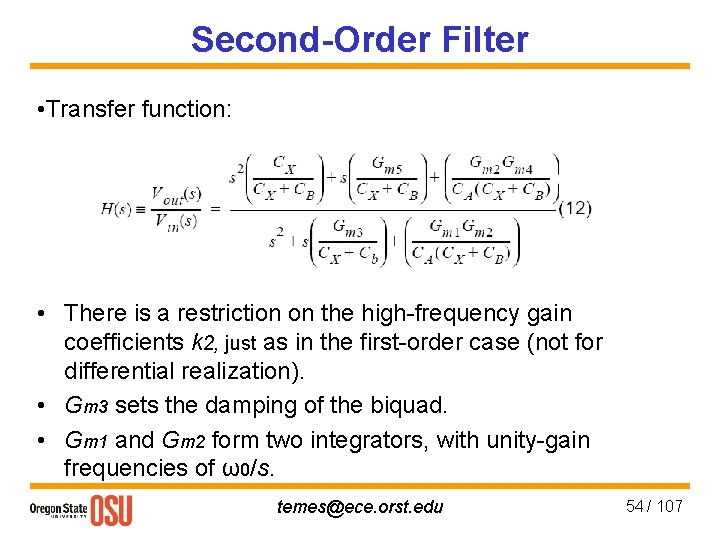
Second-Order Filter • Transfer function: • There is a restriction on the high-frequency gain coefficients k 2, just as in the first-order case (not for differential realization). • Gm 3 sets the damping of the biquad. • Gm 1 and Gm 2 form two integrators, with unity-gain frequencies of ω0/s. temes@ece. orst. edu 54 / 107
Second-Order Filter • 5 coefficients needed to match in H(s), 8 designable parameters (5 Gms, 3 capacitances). • Extra degrees of freedom may be used for dynamic range at internal node and impedance scaling, and for using matched Gm blocks. • In cascade design, the input admittance Yin is important. If Cx = 0, Yin = 0. Otherwise, it is Yin = s. Cx [ 1 – H(s)]. • Yin may be absorbed in the previous stage’s output capacitor CB. temes@ece. orst. edu 55 / 107
Scaling of Cascade Gm-C Filter • In a cascade of biquads, H(s) = H 1(s). H 2(s). …. Before realization, scale all Hi(s) so that the maximum output swings are the largest allowable. This takes care of the output swings of Gm 2, Gm 3, and Gm 5. • Multiply Gm 1 and Gm 4, or divide CA, by the desired voltage scale factor for the internal capacitor CA. This takes care of the output swings of Gm 1 and GM 4. • It is possible to multiply the Gms and capacitors of both integrators by any constant, to scale the impedances of the circuit at a convenient level (noise vs. chip area and power). temes@ece. orst. edu 56 / 107
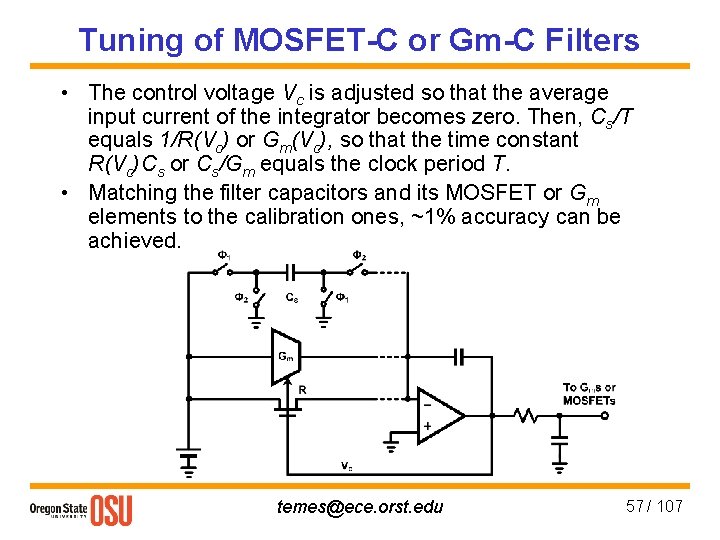
Tuning of MOSFET-C or Gm-C Filters • The control voltage Vc is adjusted so that the average input current of the integrator becomes zero. Then, Cs/T equals 1/R(Vc) or Gm(Vc), so that the time constant R(Vc)Cs or Cs/Gm equals the clock period T. • Matching the filter capacitors and its MOSFET or Gm elements to the calibration ones, ~1% accuracy can be achieved. temes@ece. orst. edu 57 / 107
Switched-Capacitor Filters Gábor C. Temes School of Electrical Engineering and Computer Science Oregon State University temes@ece. orst. edu 58 / 107
![Switched-Capacitor Circuit Techniques [2], [3] • Signal entered and read out as voltages, but](http://slidetodoc.com/presentation_image_h/787b29355a4e25635b7da2a487ad4a89/image-59.jpg "Switched-Capacitor Circuit Techniques [2], [3] • Signal entered and read out as voltages, but")
Switched-Capacitor Circuit Techniques [2], [3] • Signal entered and read out as voltages, but processed internally as charges on capacitors. Since CMOS reserves charges well, high SNR and linearity possible. • Replaces absolute accuracy of R & C (10 -30%) with matching accuracy of C (0. 05 -0. 2%); • Can realize accurate and tunable large RC time constants; • Can realize high-order dynamic range circuits with high dynamic range; • Allows medium-accuracy data conversion without trimming; • Can realize large mixed-mode systems for telephony, audio, aerospace, physics etc. Applications on a single CMOS chip. • Tilted the MOS VS. BJT contest decisively. temes@ece. orst. edu 59 / 107
Competing Techniques • Switched-current circuitry: Can be simpler and faster, but achieves lower dynamic range & much more THD; Needs more power. Can use basic digital technology; now SC can too! • Continuous-time filters: much faster, less linear, less accurate, lower dynamic range. Need tuning. temes@ece. orst. edu 60 / 107
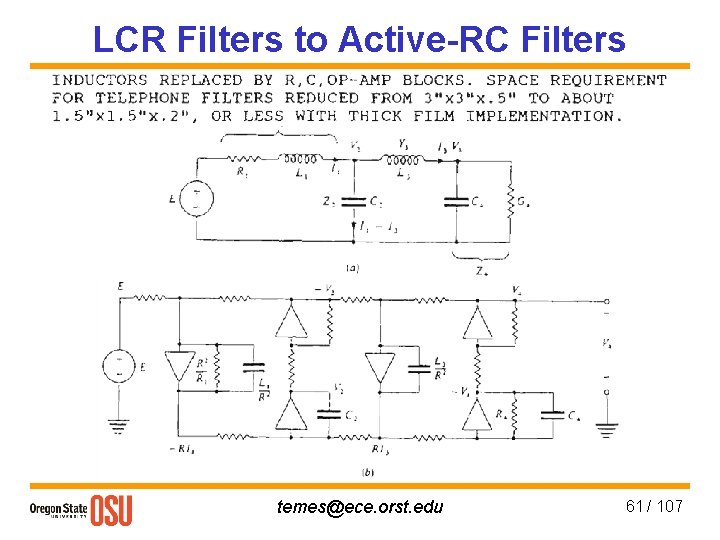
LCR Filters to Active-RC Filters temes@ece. orst. edu 61 / 107
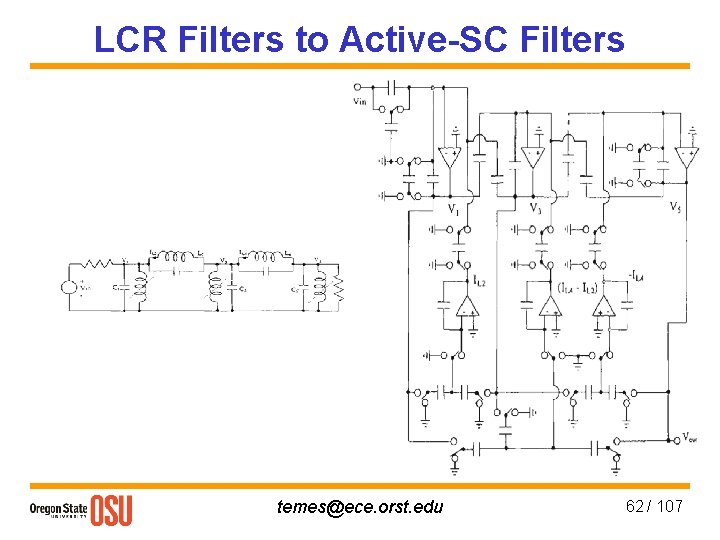
LCR Filters to Active-SC Filters temes@ece. orst. edu 62 / 107
Typical Applications of SC Technology –(1) Line-Powered Systems: • • • Telecom systems (telephone, radio, video, audio) Digital/analog interfaces Smart sensors Instrumentation Neural nets. Music synthesizers temes@ece. orst. edu 63 / 107
Typical Applications of SC Technology –(2) Battery-Powered Micropower Systems: • • Watches Calculators Hearing aids Pagers Implantable medical devices Portable instruments, sensors Nuclear array sensors (micropower, may not be battery powered) temes@ece. orst. edu 64 / 107
New SC Circuit Techniques To improve accuracy: • Oversampling, noise shaping • Dynamic matching • Digital correction • Self-calibration • Offset/gain compensation To improve speed, selectivity: • Ga. As technology • Bi. CMOS technology • N-path, multirate circuits temes@ece. orst. edu 65 / 107
Typical SC Stages • Amplifiers: programmable, precision, AGC, buffer, driver, sense • Filters • S/H and T/H stages • MUX and de. MUX stages • PLLs • VCOs • Modulators, demodulators • Precision comparators • Attenuators • ADC/DAC blocks temes@ece. orst. edu 66 / 107
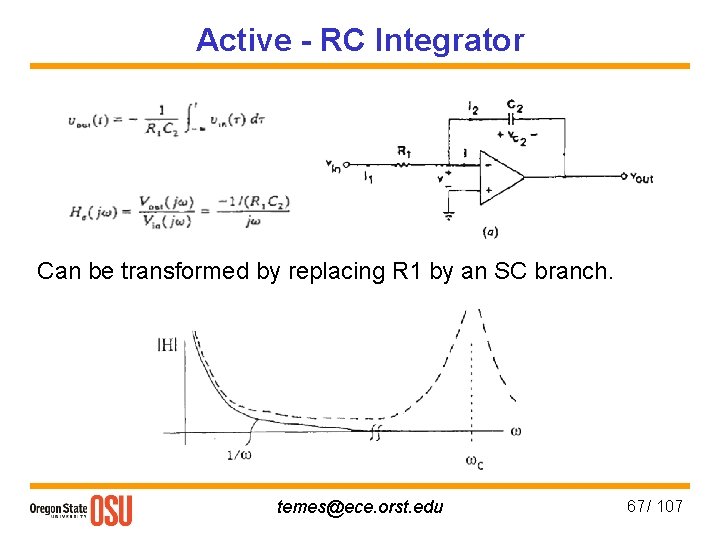
Active - RC Integrator Can be transformed by replacing R 1 by an SC branch. temes@ece. orst. edu 67 / 107
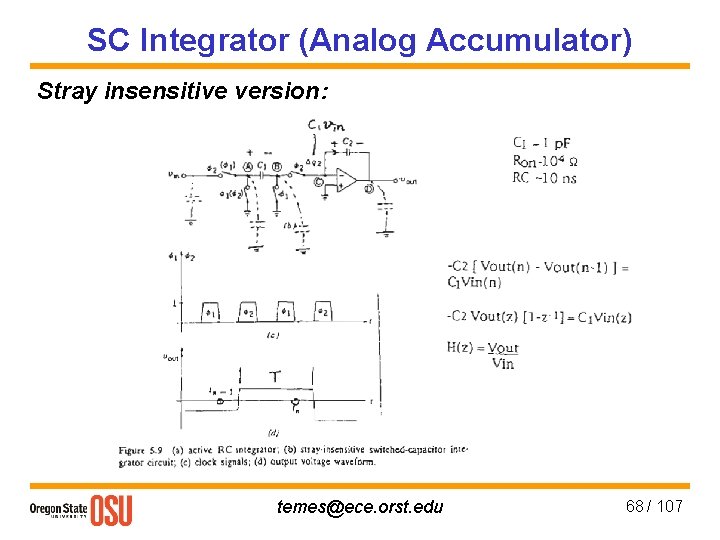
SC Integrator (Analog Accumulator) Stray insensitive version: temes@ece. orst. edu 68 / 107
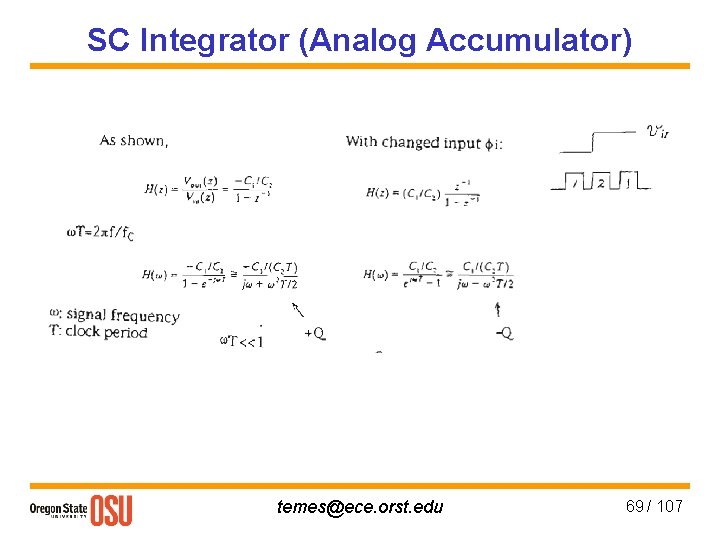
SC Integrator (Analog Accumulator) temes@ece. orst. edu 69 / 107
SC Integrator Issues • Every node is an opamp input or output node – low impedance, insensitive to stray capacitances. • Clock phases must be non-overlapping to preserve signal charges. Gap shouldn’t be too large for good SNR. • For single-ended stage, positive = delaying, negative = non-delaying. For differential, polarity is arbitrary. • For cascade design, two integrators can be connected in a Tow-Thomas loop. No inverter stage needed; SC branch can invert charge polarity. temes@ece. orst. edu 70 / 107
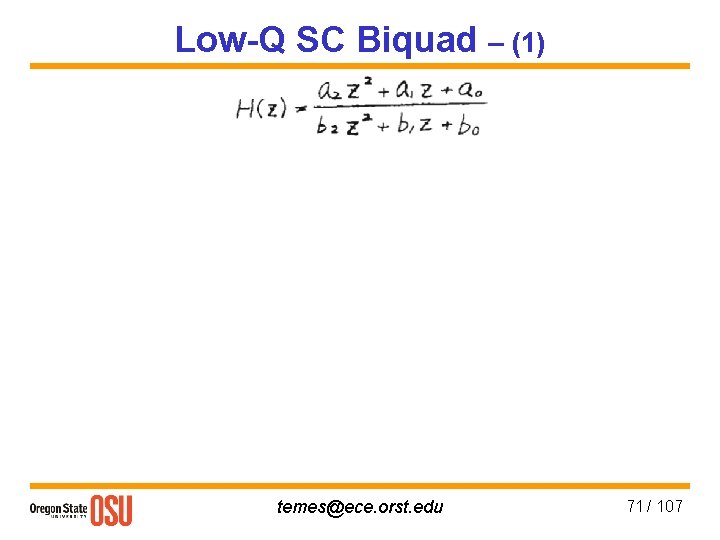
Low-Q SC Biquad – (1) temes@ece. orst. edu 71 / 107
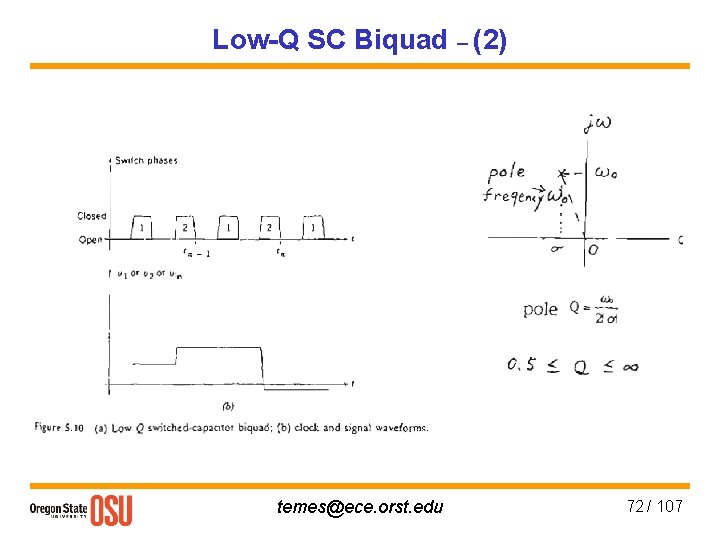
Low-Q SC Biquad – (2) temes@ece. orst. edu 72 / 107
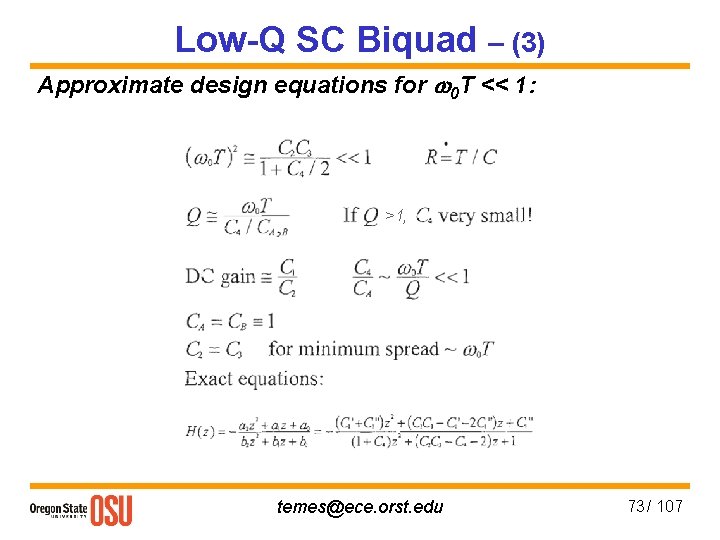
Low-Q SC Biquad – (3) Approximate design equations for w 0 T << 1: >1, temes@ece. orst. edu 73 / 107
Low-Q SC Biquad – (4) • Without C 4, sine-wave oscillator. With C 4, loop phase < 360 degrees for any element values. Poles always inside the unit circle. • DC feedback always negative. • Pole locations determined by C 4/CA only - sensitive to mismatch for high Q! • Capacitance ratio CA/C 4 large for high Q. temes@ece. orst. edu 74 / 107
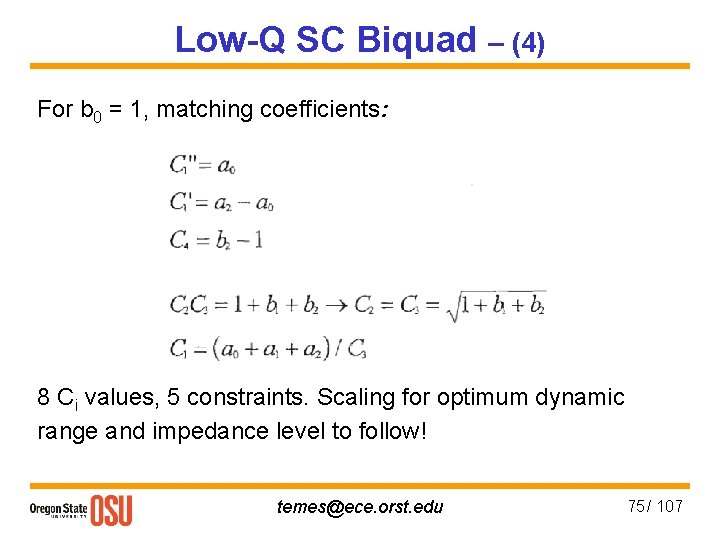
Low-Q SC Biquad – (4) For b 0 = 1, matching coefficients: 8 Ci values, 5 constraints. Scaling for optimum dynamic range and impedance level to follow! temes@ece. orst. edu 75 / 107
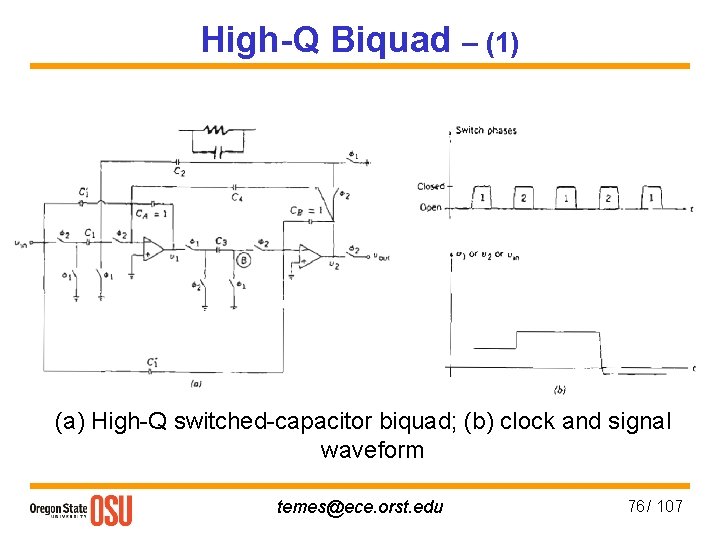
High-Q Biquad – (1) (a) High-Q switched-capacitor biquad; (b) clock and signal waveform temes@ece. orst. edu 76 / 107
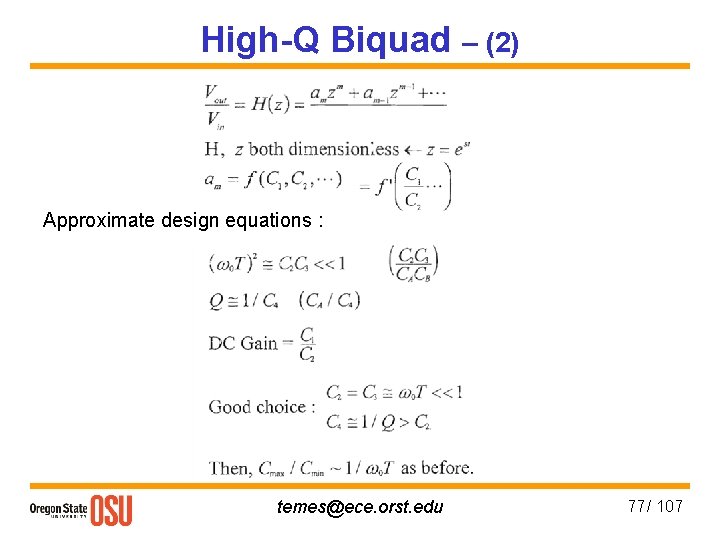
High-Q Biquad – (2) Approximate design equations : temes@ece. orst. edu 77 / 107
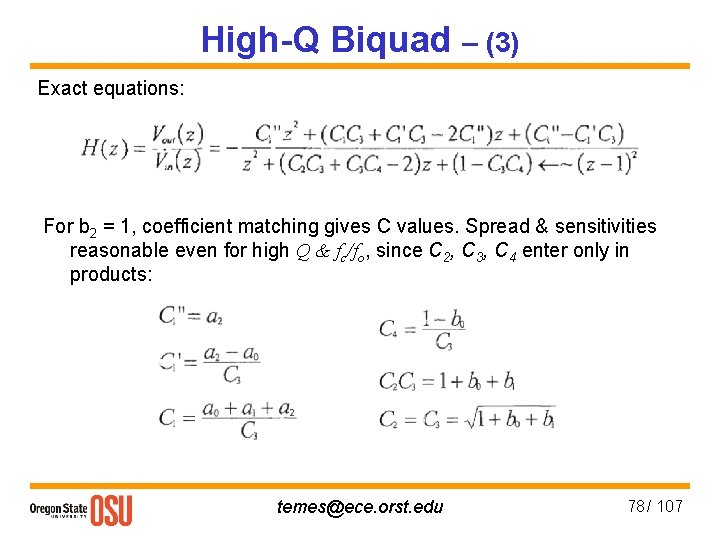
High-Q Biquad – (3) Exact equations: For b 2 = 1, coefficient matching gives C values. Spread & sensitivities reasonable even for high Q & fc/fo, since C 2, C 3, C 4 enter only in products: temes@ece. orst. edu 78 / 107
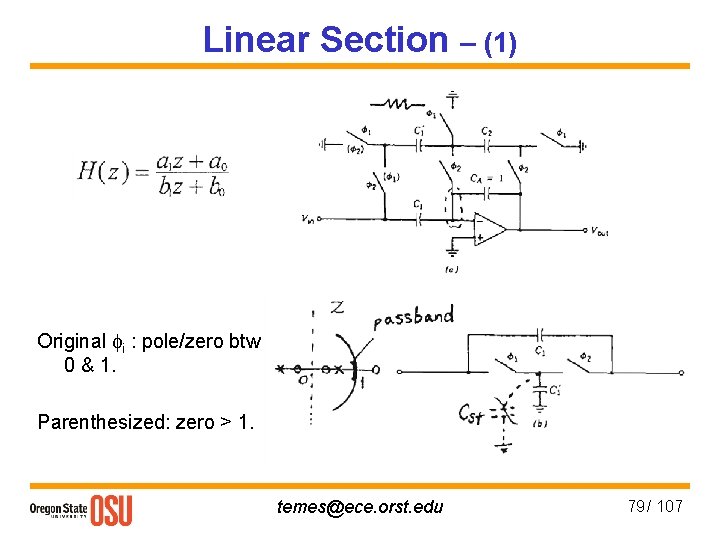
Linear Section – (1) Original fi : pole/zero btw 0 & 1. Parenthesized: zero > 1. temes@ece. orst. edu 79 / 107
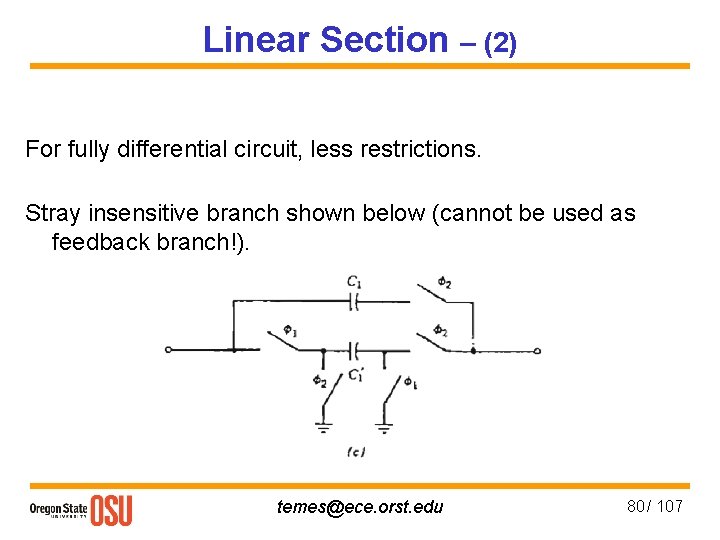
Linear Section – (2) For fully differential circuit, less restrictions. Stray insensitive branch shown below (cannot be used as feedback branch!). temes@ece. orst. edu 80 / 107
Cascade Design – (1) temes@ece. orst. edu 81 / 107
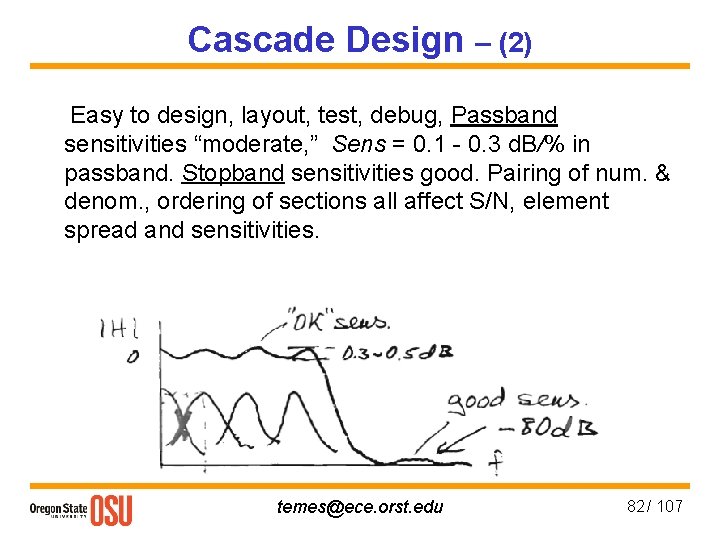
Cascade Design – (2) Easy to design, layout, test, debug, Passband sensitivities “moderate, ” Sens = 0. 1 - 0. 3 d. B/% in passband. Stopband sensitivities good. Pairing of num. & denom. , ordering of sections all affect S/N, element spread and sensitivities. temes@ece. orst. edu 82 / 107
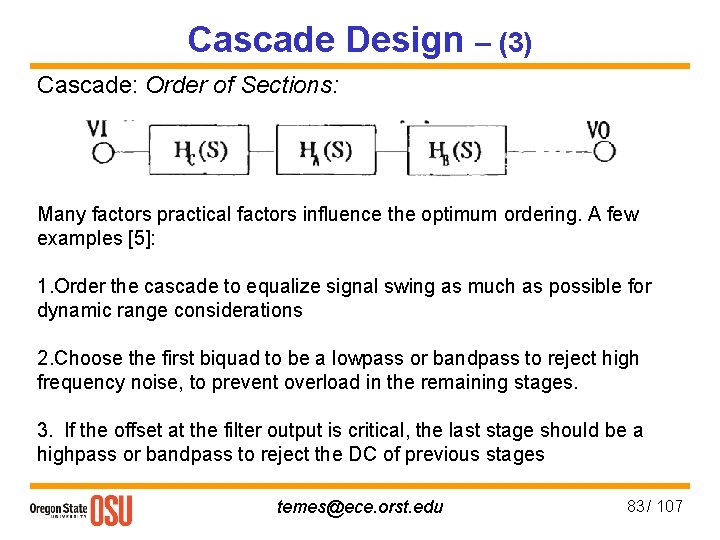
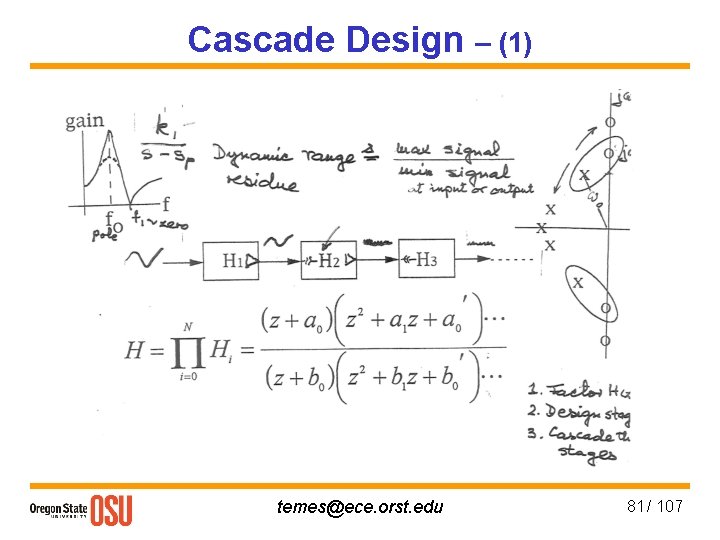
Cascade Design – (3) Cascade: Order of Sections: Many factors practical factors influence the optimum ordering. A few examples [5]: 1. Order the cascade to equalize signal swing as much as possible for dynamic range considerations 2. Choose the first biquad to be a lowpass or bandpass to reject high frequency noise, to prevent overload in the remaining stages. 3. lf the offset at the filter output is critical, the last stage should be a highpass or bandpass to reject the DC of previous stages temes@ece. orst. edu 83 / 107
Cascade Design – (4) 4. The last stage should NOT in general be high Q because these stages tend to have higher fundamental noise and worse sensitivity to power supply noise. Put high-Q section in the middle! 5. In general do not place allpass stages at the end of the cascade because these have wideband noise. It is usually best to place allpass stages towards the beginning of the filter. 6. If several highpass or bandpass stages are available one can place them at the beginning, middle and end of the filter. This will prevent input offset from overloading the filter, will prevent internal offsets of the filter itself from accumulating (and hence decreasing available signal swing) and will provide a filter output with low offset. 7. The effect of thermal noise at the filter output varies with ordering; therefore, by reordering several d. B of SNR can often be gained. (John Khouri, unpublished notes) temes@ece. orst. edu 84 / 107
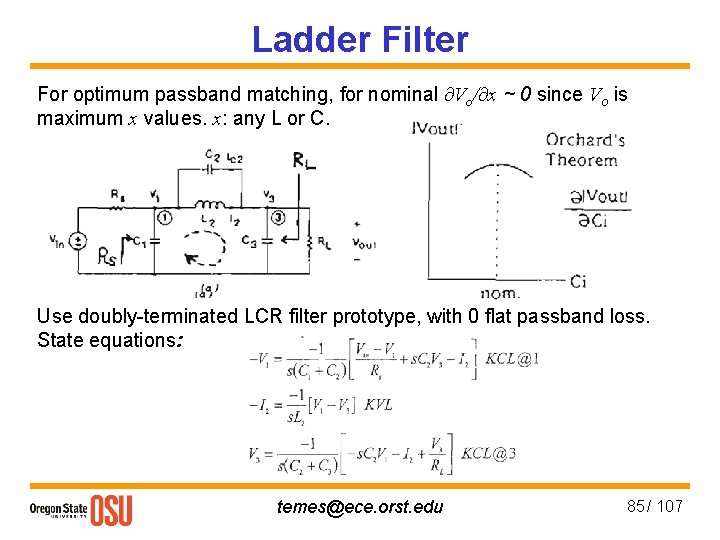
Ladder Filter For optimum passband matching, for nominal ∂Vo/∂x ~ 0 since Vo is maximum x values. x: any L or C. Use doubly-terminated LCR filter prototype, with 0 flat passband loss. State equations: temes@ece. orst. edu 85 / 107
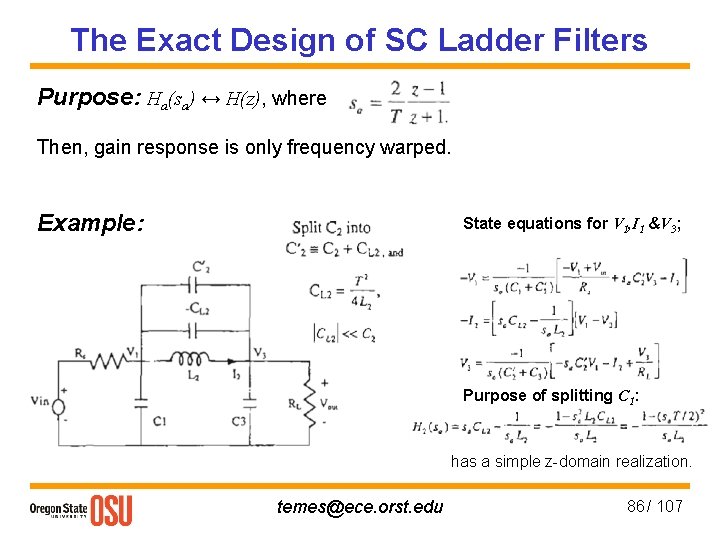
The Exact Design of SC Ladder Filters Purpose: Ha(sa) ↔ H(z), where Then, gain response is only frequency warped. Example: State equations for V 1, I 1 &V 3; Purpose of splitting C 1: has a simple z-domain realization. temes@ece. orst. edu 86 / 107
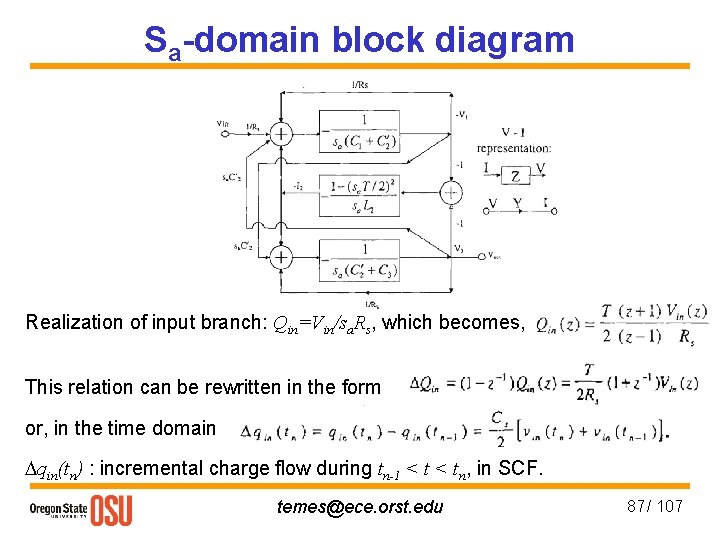
Sa-domain block diagram Realization of input branch: Qin=Vin/sa. Rs, which becomes, This relation can be rewritten in the form or, in the time domain Dqin(tn) : incremental charge flow during tn-1 < tn, in SCF. temes@ece. orst. edu 87 / 107
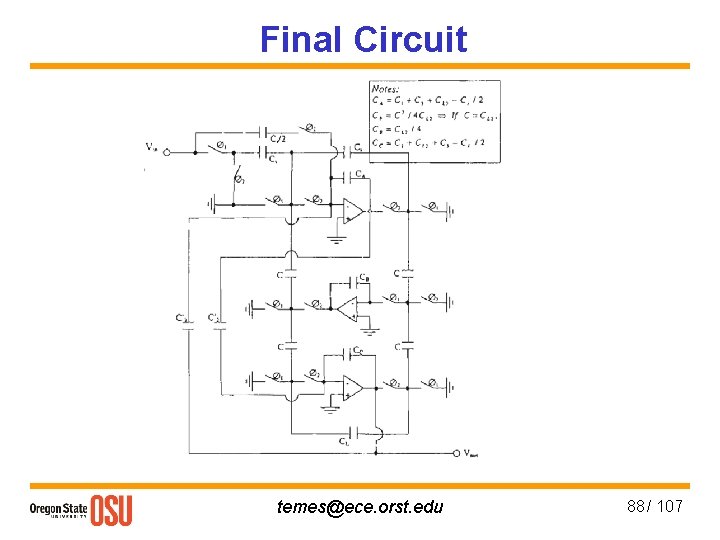
Final Circuit temes@ece. orst. edu 88 / 107
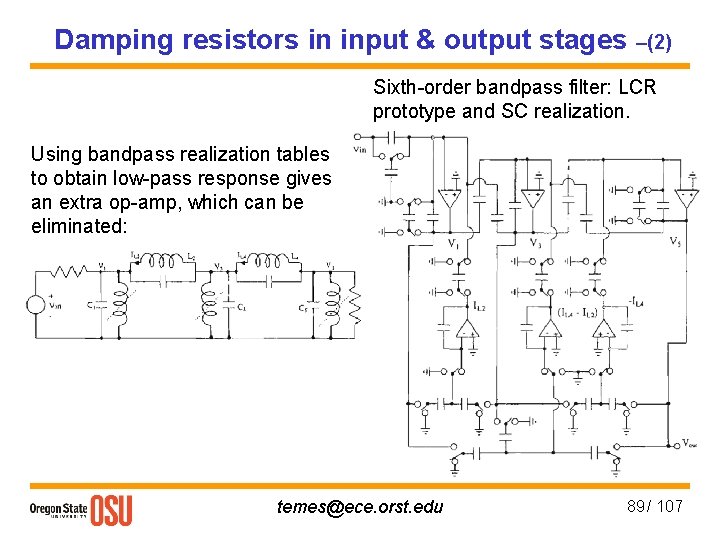
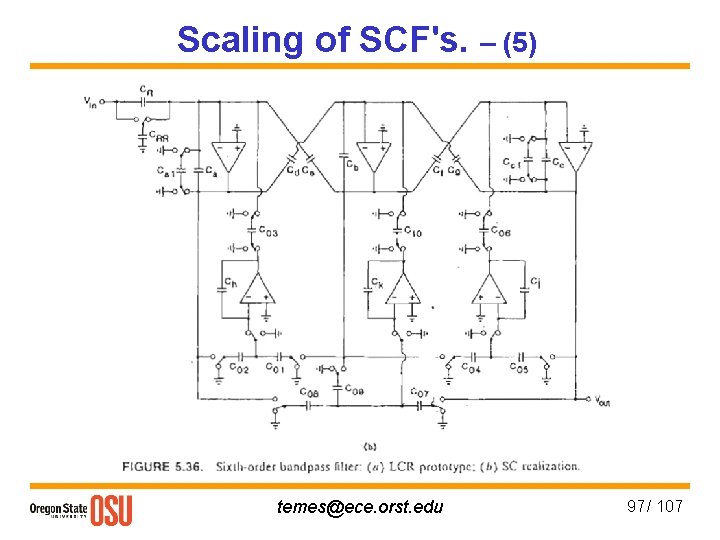
Damping resistors in input & output stages –(2) Sixth-order bandpass filter: LCR prototype and SC realization. Using bandpass realization tables to obtain low-pass response gives an extra op-amp, which can be eliminated: temes@ece. orst. edu 89 / 107
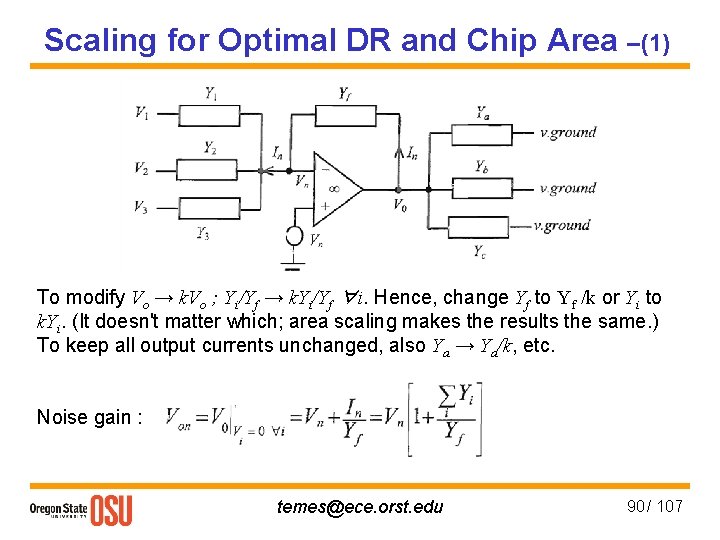
Scaling for Optimal DR and Chip Area –(1) To modify Vo → k. Vo ; Yi/Yf → k. Yi/Yf ∀i. Hence, change Yf to Yf /k or Yi to k. Yi. (It doesn't matter which; area scaling makes the results the same. ) To keep all output currents unchanged, also Ya → Ya/k, etc. Noise gain : temes@ece. orst. edu 90 / 107
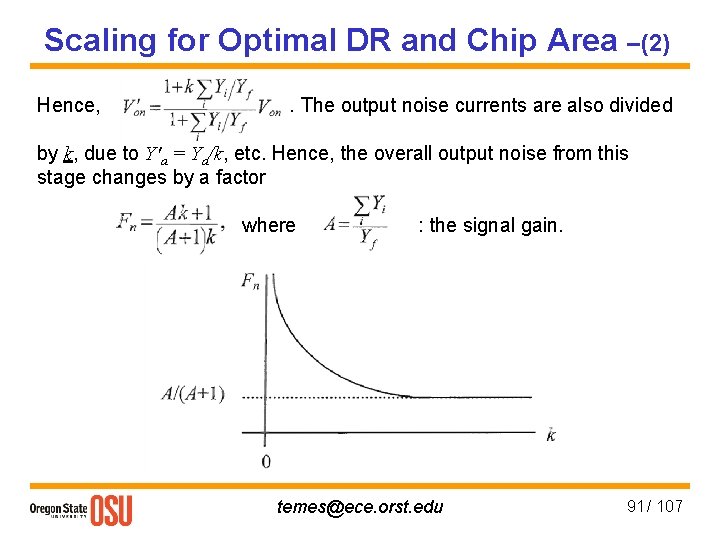
Scaling for Optimal DR and Chip Area –(2) Hence, . The output noise currents are also divided by k, due to Y′a = Ya/k, etc. Hence, the overall output noise from this stage changes by a factor where : the signal gain. temes@ece. orst. edu 91 / 107
Scaling for Optimal DR and Chip Area –(3) The output signal does not change, so the SNR improves with increasing k. However, the noise reduction is slower than 1/k, and also this noise is only one of the terms in the output noise power. If Vo> VDD, distortion occurs, hence k ≤ kmax is limited such that Yo saturates for the same Vin as the overall Vout. Any k > kmax forces the input signal to be reduced by k so the SNR will now decrease with k. Conclusion: kmax is optimum, if settling time is not an issue. temes@ece. orst. edu 92 / 107
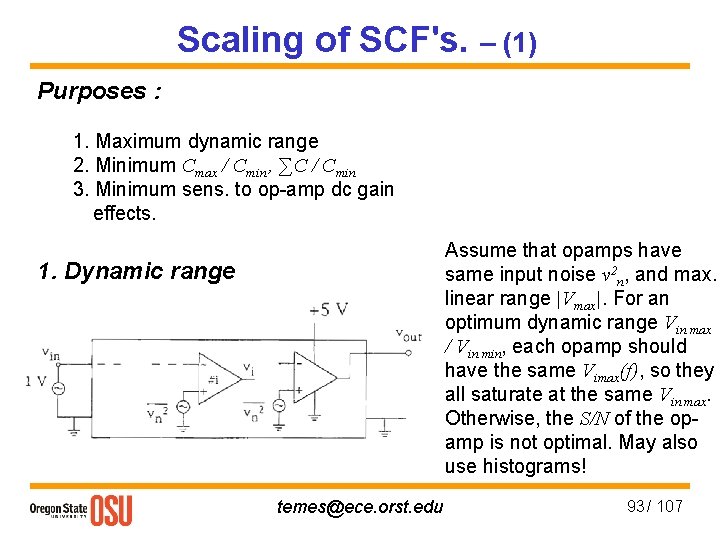
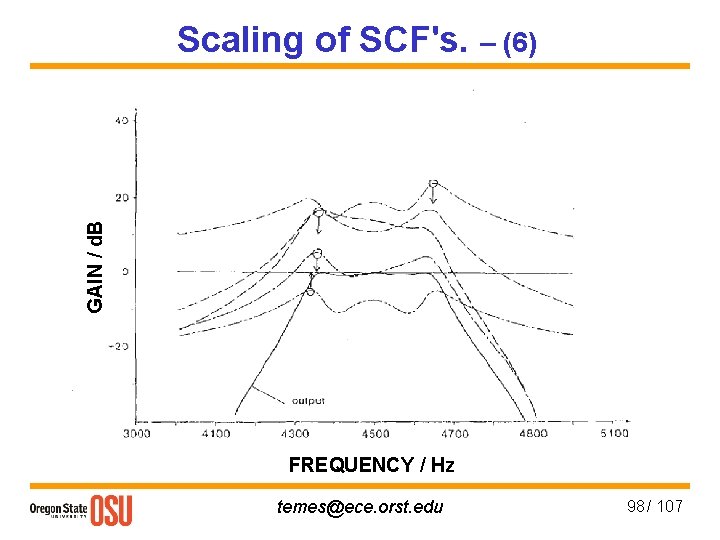
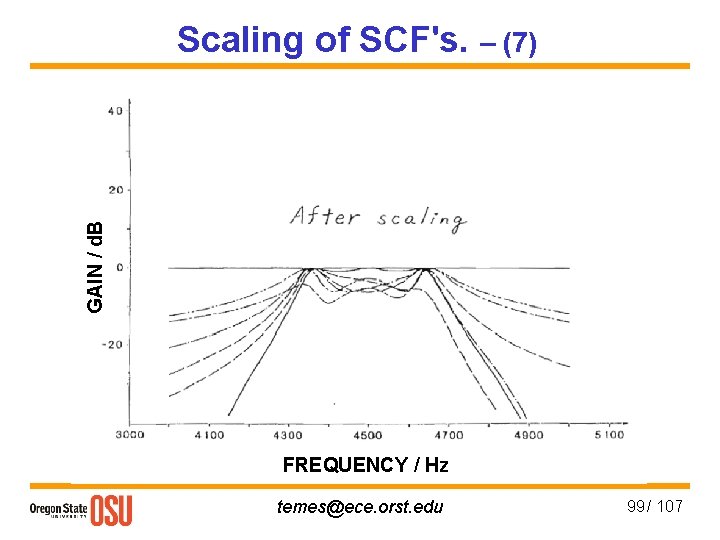
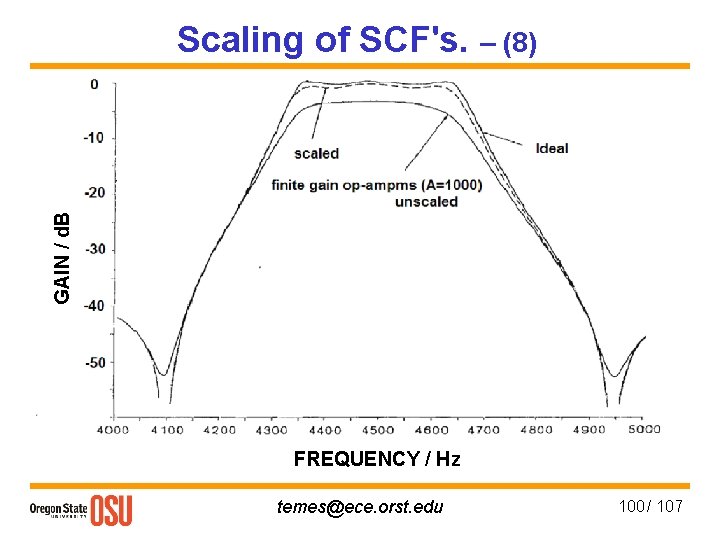
Scaling of SCF's. – (1) Purposes : 1. Maximum dynamic range 2. Minimum Cmax / Cmin , ∑C / Cmin 3. Minimum sens. to op-amp dc gain effects. Assume that opamps have same input noise v 2 n, and max. linear range |Vmax|. For an optimum dynamic range Vin max / Vin min, each opamp should have the same Vimax(f), so they all saturate at the same Vin max. Otherwise, the S/N of the opamp is not optimal. May also use histograms! 1. Dynamic range temes@ece. orst. edu 93 / 107
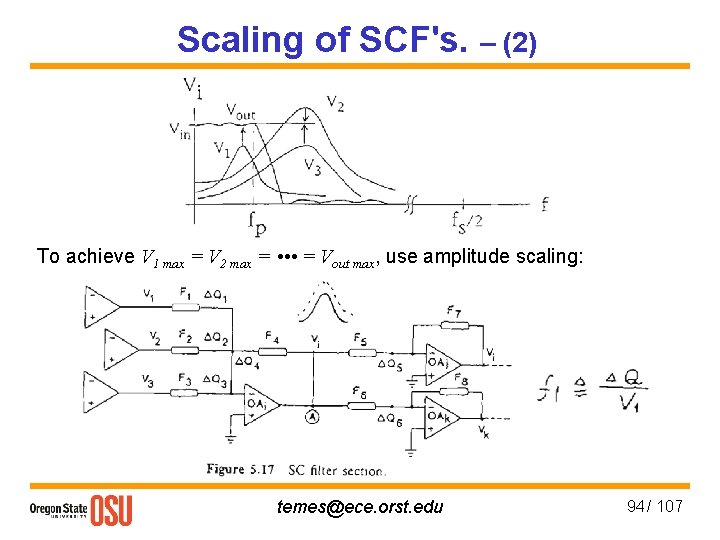
Scaling of SCF's. – (2) To achieve V 1 max = V 2 max = • • • = Vout max, use amplitude scaling: temes@ece. orst. edu 94 / 107
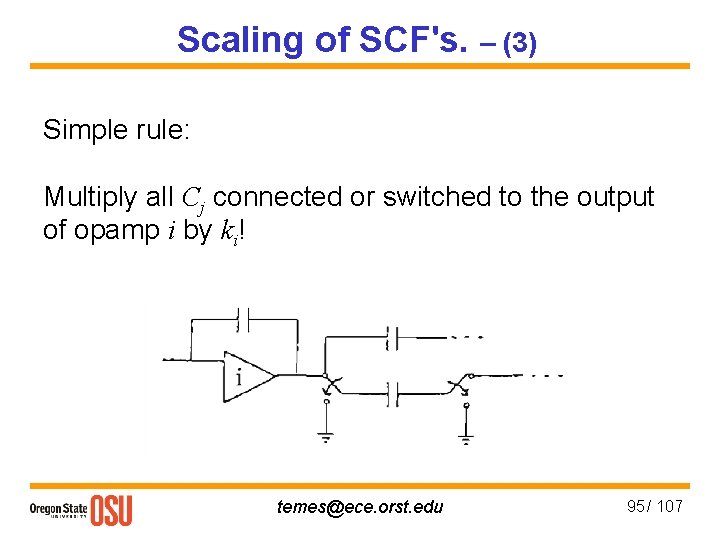
Scaling of SCF's. – (3) Simple rule: Multiply all Cj connected or switched to the output of opamp i by ki! temes@ece. orst. edu 95 / 107
Scaling of SCF's. – (4) 2. Minimum Cmax/Cmin: If all fn(z) & h(z) are multiplied by the same li, nothing will not change. Choose li = Cmin / Ci min where Ci min is the smallest C connected to the input of op-amp i, and Cmin is the smallest value of cap. permitted by the technology (usually 0. 1 p. F ≤ Cmin ≤ 0. 5 p. F for strayinsensitive circuits). Big effect on Cmax / Cmin! 3. Sensitivities: The sensitivity of the gain to Ck remain unchanged by scaling; the sens. To op-amp gain effects are very much affected. Optimum dynamic-range scaling is nearly optimal for dc gain sens. as well. temes@ece. orst. edu 96 / 107
Scaling of SCF's. – (5) temes@ece. orst. edu 97 / 107
GAIN / d. B Scaling of SCF's. – (6) FREQUENCY / Hz temes@ece. orst. edu 98 / 107
GAIN / d. B Scaling of SCF's. – (7) FREQUENCY / Hz temes@ece. orst. edu 99 / 107
GAIN / d. B Scaling of SCF's. – (8) FREQUENCY / Hz temes@ece. orst. edu 100 / 107
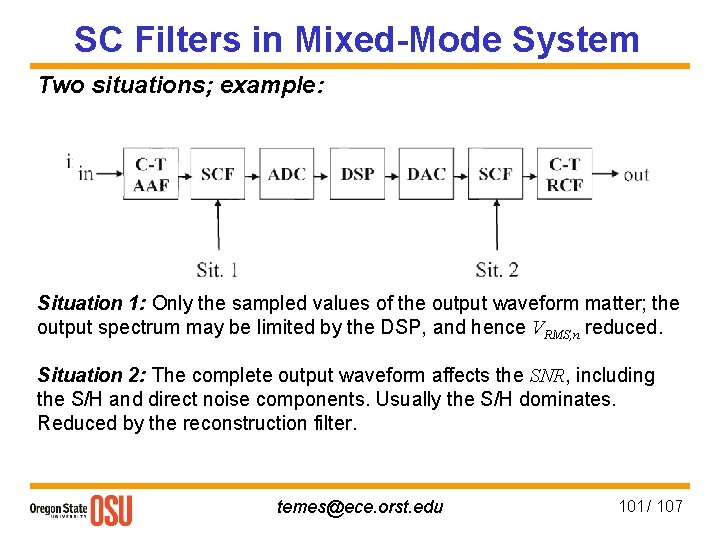
SC Filters in Mixed-Mode System Two situations; example: Situation 1: Only the sampled values of the output waveform matter; the output spectrum may be limited by the DSP, and hence VRMS, n reduced. Situation 2: The complete output waveform affects the SNR, including the S/H and direct noise components. Usually the S/H dominates. Reduced by the reconstruction filter. temes@ece. orst. edu 101 / 107
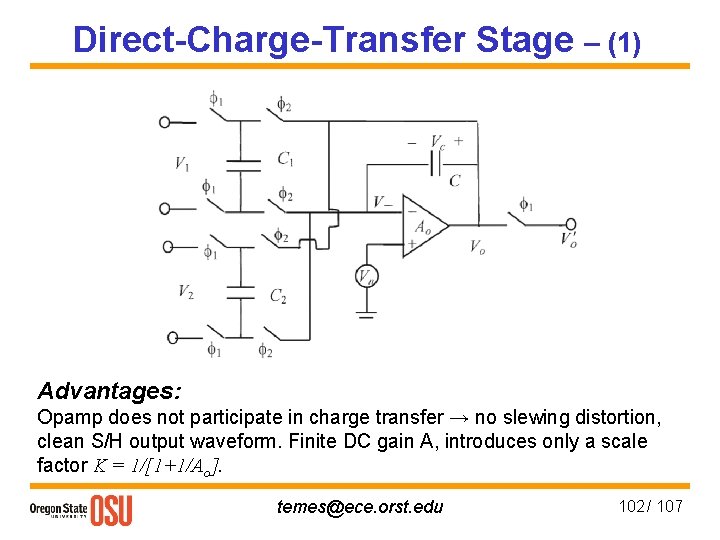
Direct-Charge-Transfer Stage – (1) Advantages: Opamp does not participate in charge transfer → no slewing distortion, clean S/H output waveform. Finite DC gain A, introduces only a scale factor K = 1/[1+1/Ao]. temes@ece. orst. edu 102 / 107
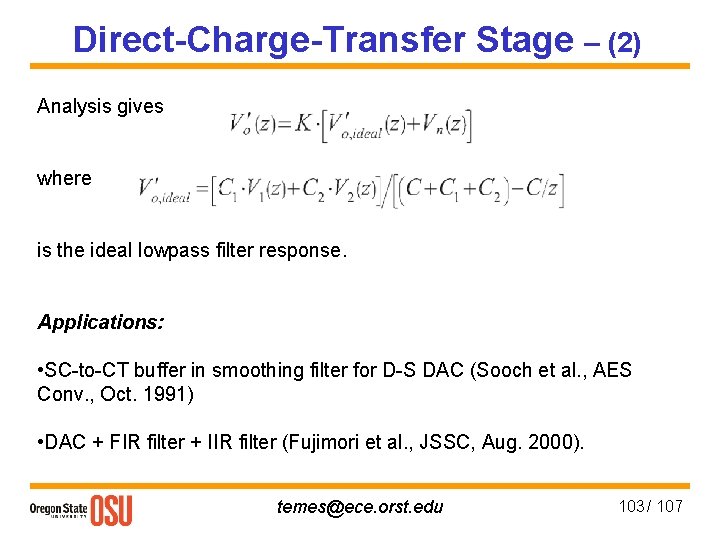
Direct-Charge-Transfer Stage – (2) Analysis gives where is the ideal lowpass filter response. Applications: • SC-to-CT buffer in smoothing filter for D-S DAC (Sooch et al. , AES Conv. , Oct. 1991) • DAC + FIR filter + IIR filter (Fujimori et al. , JSSC, Aug. 2000). temes@ece. orst. edu 103 / 107
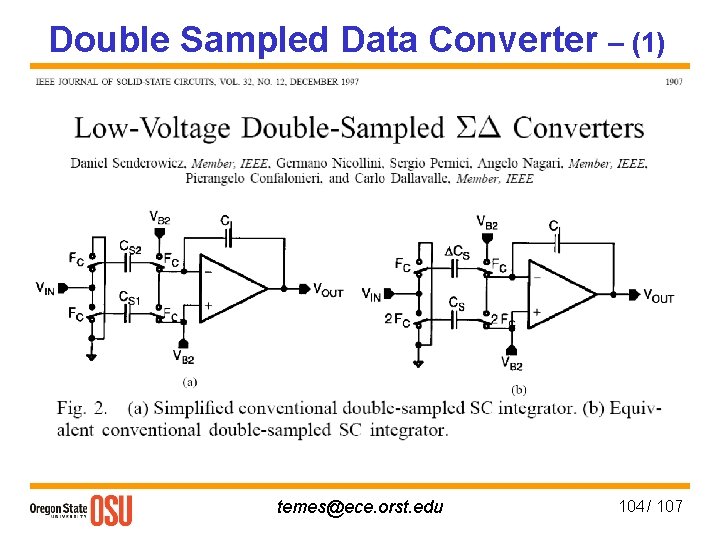
Double Sampled Data Converter – (1) temes@ece. orst. edu 104 / 107
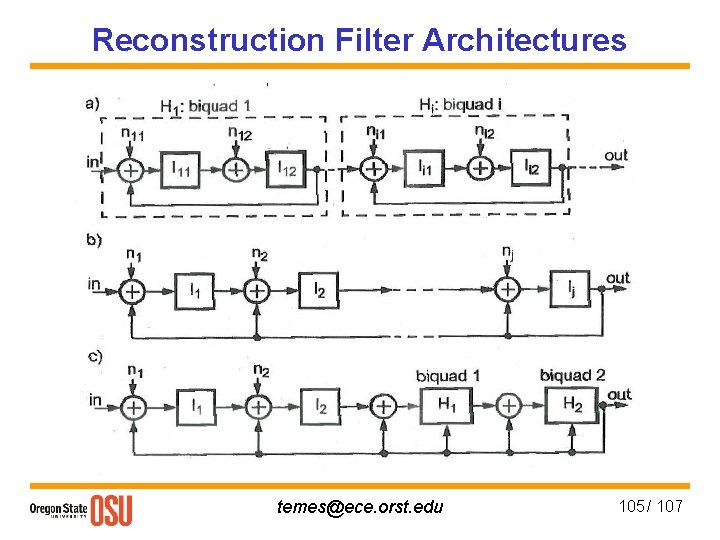
Reconstruction Filter Architectures temes@ece. orst. edu 105 / 107
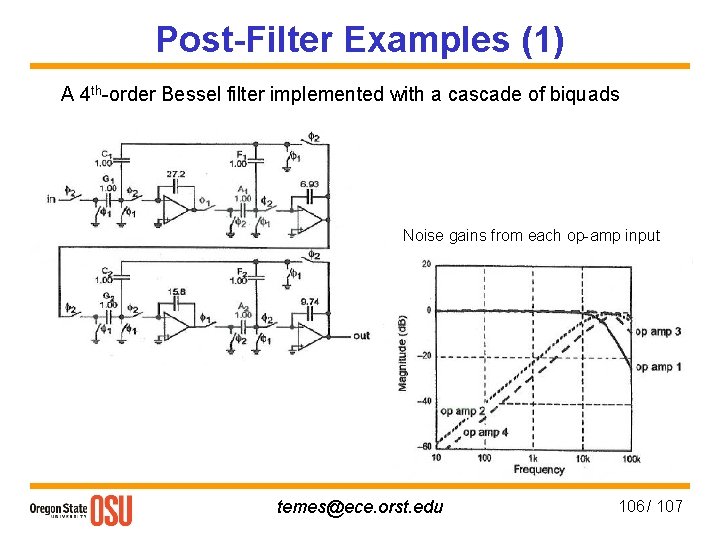
Post-Filter Examples (1) A 4 th-order Bessel filter implemented with a cascade of biquads Noise gains from each op-amp input temes@ece. orst. edu 106 / 107
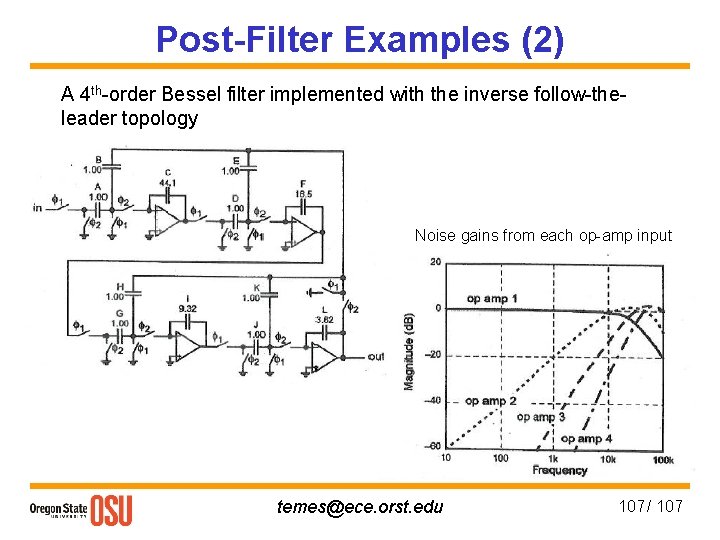
Post-Filter Examples (2) A 4 th-order Bessel filter implemented with the inverse follow-theleader topology Noise gains from each op-amp input temes@ece. orst. edu 107 / 107
![References [1] R. Schaumann et al. , Design of Analog Filters (2 nd edition),](http://slidetodoc.com/presentation_image_h/787b29355a4e25635b7da2a487ad4a89/image-108.jpg "References [1] R. Schaumann et al. , Design of Analog Filters (2 nd edition),")
References [1] R. Schaumann et al. , Design of Analog Filters (2 nd edition), Oxford University Press, 2010. [2] D. A. Johns and K. Martin, Analog Integrated Circuits, Wiley, 1997. [3] R. Gregorian and G. C. Temes, Analog MOS Integrated Circuits for Signal Processing, Wiley, 1986. [4] Introduction to Circuit Synthesis and Design, G. C. Temes and J. W. La. Patra, Mc. Graw-Hill, 1977. [5] John Khoury, Integrated Continuous-Time Filters, Unpublished Lecture Notes, EPFL, 1998. [6] P. Kurahashi et al. , “A 0. 6 -V Highly Linear Switched. R-MOSFET-C Filter, CICC, Sept. 2006, pp. 833 -836. temes@ece. orst. edu / 107
- Slides: 108