
CMOS 60 GHz Beamforming Circuit Design for Active
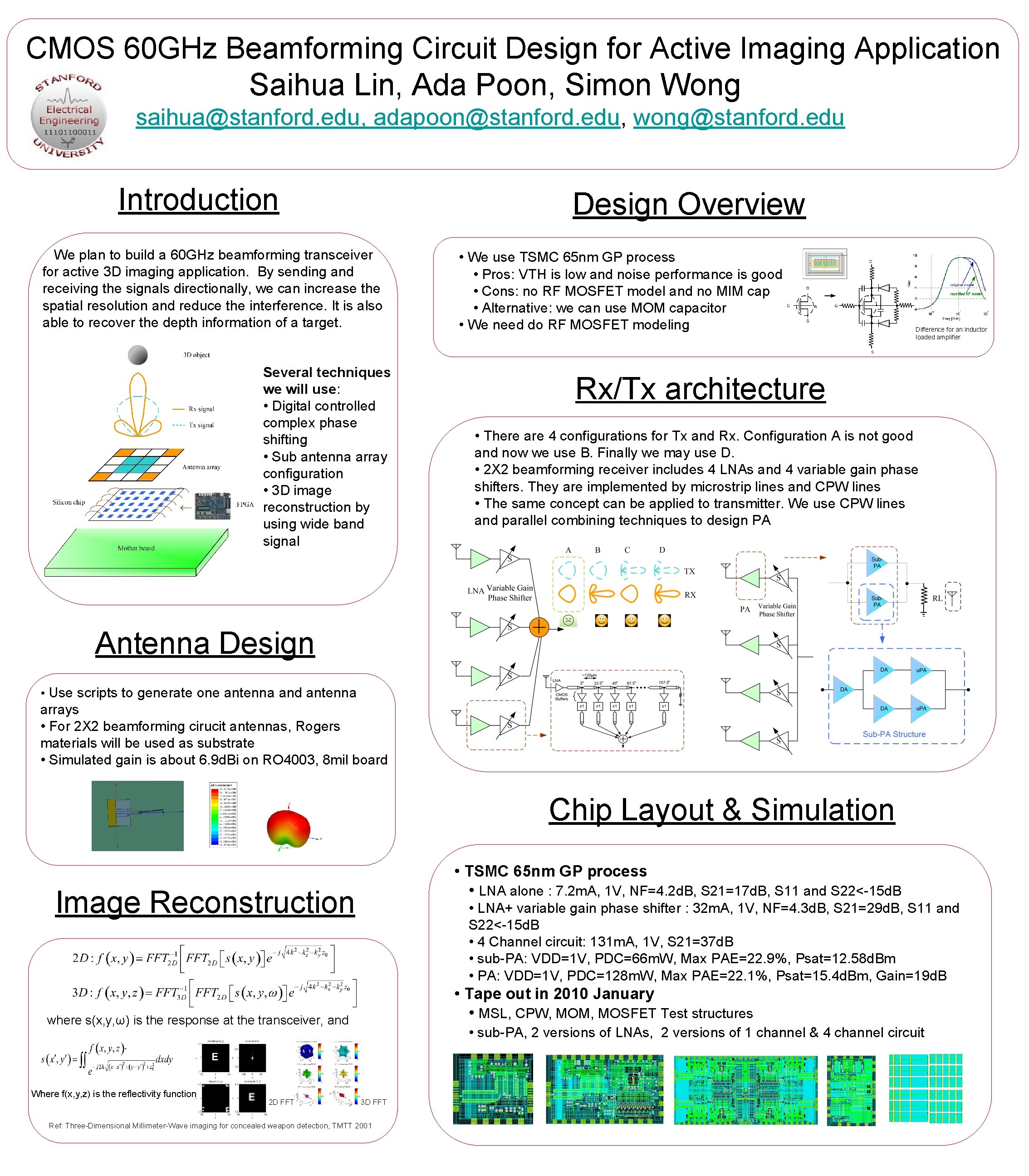
CMOS 60 GHz Beamforming Circuit Design for Active Imaging Application Saihua Lin, Ada Poon, Simon Wong saihua@stanford. edu, adapoon@stanford. edu, wong@stanford. edu Introduction Design Overview We plan to build a 60 GHz beamforming transceiver for active 3 D imaging application. By sending and receiving the signals directionally, we can increase the spatial resolution and reduce the interference. It is also able to recover the depth information of a target. Several techniques we will use: • Digital controlled complex phase shifting • Sub antenna array configuration • 3 D image reconstruction by using wide band signal • We use TSMC 65 nm GP process • Pros: VTH is low and noise performance is good • Cons: no RF MOSFET model and no MIM cap • Alternative: we can use MOM capacitor • We need do RF MOSFET modeling Difference for an inductor loaded amplifier Rx/Tx architecture • There are 4 configurations for Tx and Rx. Configuration A is not good and now we use B. Finally we may use D. • 2 X 2 beamforming receiver includes 4 LNAs and 4 variable gain phase shifters. They are implemented by microstrip lines and CPW lines • The same concept can be applied to transmitter. We use CPW lines and parallel combining techniques to design PA Antenna Design • Use scripts to generate one antenna and antenna arrays • For 2 X 2 beamforming cirucit antennas, Rogers materials will be used as substrate • Simulated gain is about 6. 9 d. Bi on RO 4003, 8 mil board Chip Layout & Simulation • TSMC 65 nm GP process • LNA alone : 7. 2 m. A, 1 V, NF=4. 2 d. B, S 21=17 d. B, S 11 and S 22<-15 d. B Image Reconstruction • LNA+ variable gain phase shifter : 32 m. A, 1 V, NF=4. 3 d. B, S 21=29 d. B, S 11 and S 22<-15 d. B • 4 Channel circuit: 131 m. A, 1 V, S 21=37 d. B • sub-PA: VDD=1 V, PDC=66 m. W, Max PAE=22. 9%, Psat=12. 58 d. Bm • PA: VDD=1 V, PDC=128 m. W, Max PAE=22. 1%, Psat=15. 4 d. Bm, Gain=19 d. B • Tape out in 2010 January • MSL, CPW, MOM, MOSFET Test structures where s(x, y, ω) is the response at the transceiver, and Where f(x, y, z) is the reflectivity function 2 D FFT • sub-PA, 2 versions of LNAs, 2 versions of 1 channel & 4 channel circuit 3 D FFT Ref: Three-Dimensional Millimeter-Wave imaging for concealed weapon detection, TMTT 2001
- Slides: 1