
CML 2312 ADMINISTRATIVE LAW Forcese CML 2312 Administrative
- Slides: 62
CML 2312: ADMINISTRATIVE LAW Forcese CML 2312: Administrative Law (Forcese)
Study and analysis of the administrative process generally, and the exercise of power by public officials and the control thereof exercised by the courts, the administration itself and the legislature. -- Former Edition of the Common Law Course Book Elements of Definition Keywords Power Public official Control CML 2312: Administrative Law (Forcese) SETTING THE STAGE Defining Administrative Law
Law which relates to the organization, duties, and quasi-judicial and judicial powers of the executive, to proceedings before tribunals and to the making of subordinate legislation -- Canadian Pocket Law Dictionary Elements of Definition Keywords Power Public official Control Law Tribunals Subordinate legislation CML 2312: Administrative Law (Forcese) SETTING THE STAGE Defining Administrative Law
Body of laws created by administrative agencies in the form of rules, regulations, orders & decisions to carry out regulatory powers & duties of such agencies. -- Black’s Law Dictionary (US) Elements of Definition Keywords Power Public official Control Law Tribunals & administrative agencies Subordinate legislation CML 2312: Administrative Law (Forcese) SETTING THE STAGE Defining Administrative Law
Administrative law is the body of law that establishes or describes the legal parameters of powers that exist by virtue of statute or residual Royal Prerogative. In terms of the relation between administrative process and the regular courts, administrative law embodies the principles by which the courts supervise the functioning of persons and bodies that derive their powers from either statute or the Royal Prerogative. -- Mullan (2001) Elements of Definition Keywords Power Public official Control Law Tribunals & administrative agencies Subordinate legislation Statute or royal prerogative CML 2312: Administrative Law (Forcese) SETTING THE STAGE Defining Administrative Law
Administrative law "deals with the legal limitations on the actions of government officials, and on the remedies which are available to anyone affected by a transgression of these limits. " -- Villers and Jones (1998) Elements of Definition Keywords Power Public official Control Law Tribunals & administrative agencies Subordinate legislation Statute or royal prerogative Remedies CML 2312: Administrative Law (Forcese) SETTING THE STAGE Defining Administrative Law
Administrative law "deals with the legal limitations on the actions of government officials, and on the remedies which are available to anyone affected by a transgression of these limits. " -- Villers and Jones (1998) Elements of Definition Unpack definition • • “Legal limitations” “Government officials” “Remedy” “Anyone affected by the transgression” CML 2312: Administrative Law (Forcese) SETTING THE STAGE Defining Administrative Law
Administrative law deals with the legal limitations on the actions of government officials. Specifically, it concerns itself with the proper exercise of delegated power by these government officials and the control of this power by the courts. In large part, administrative law is about the scope and nature of judicial review of decisions made by government officials. It also about the remedies that are available to parties affected by decisions made by government officials that do not conform to standards set for the proper exercise of power -- Consolidated definition Elements of Definition Keywords Power Public official Control Law Tribunals & administrative agencies Subordinate legislation Statute or royal prerogative Remedies CML 2312: Administrative Law (Forcese) SETTING THE STAGE Defining Administrative Law
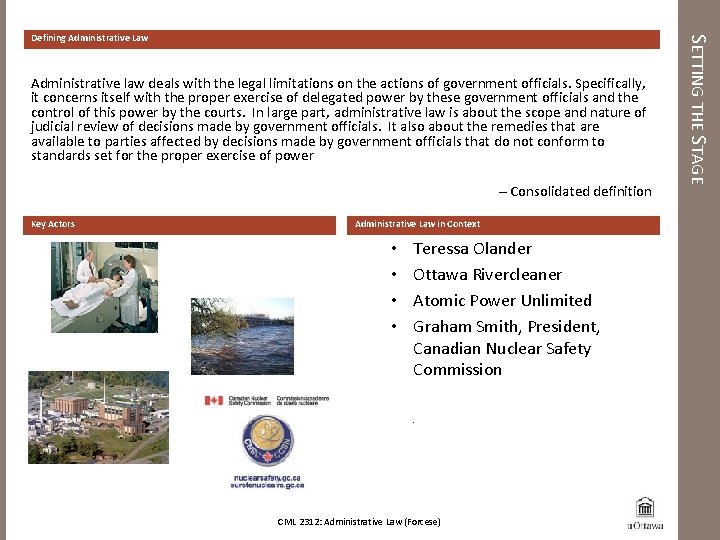
Administrative law deals with the legal limitations on the actions of government officials. Specifically, it concerns itself with the proper exercise of delegated power by these government officials and the control of this power by the courts. In large part, administrative law is about the scope and nature of judicial review of decisions made by government officials. It also about the remedies that are available to parties affected by decisions made by government officials that do not conform to standards set for the proper exercise of power -- Consolidated definition Key Actors Administrative Law in Context • • Teressa Olander Ottawa Rivercleaner Atomic Power Unlimited Graham Smith, President, Canadian Nuclear Safety Commission. CML 2312: Administrative Law (Forcese) SETTING THE STAGE Defining Administrative Law
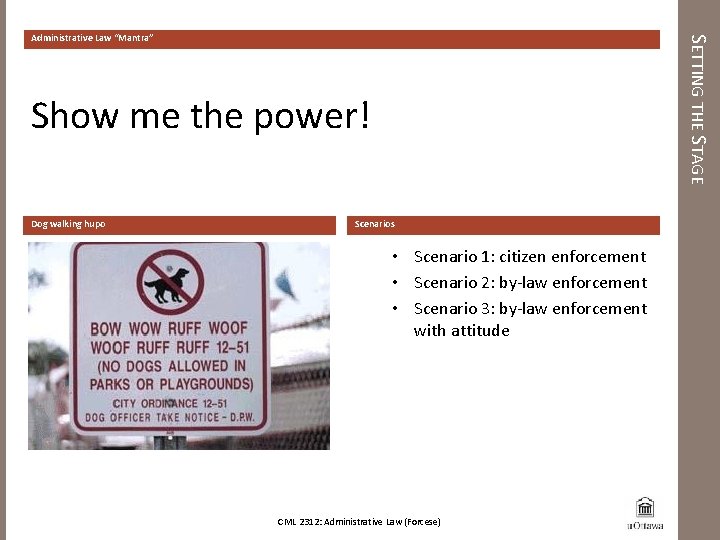
SETTING THE STAGE Administrative Law “Mantra” Show me the power! Dog walking hupo Scenarios • Scenario 1: citizen enforcement • Scenario 2: by-law enforcement • Scenario 3: by-law enforcement with attitude CML 2312: Administrative Law (Forcese)
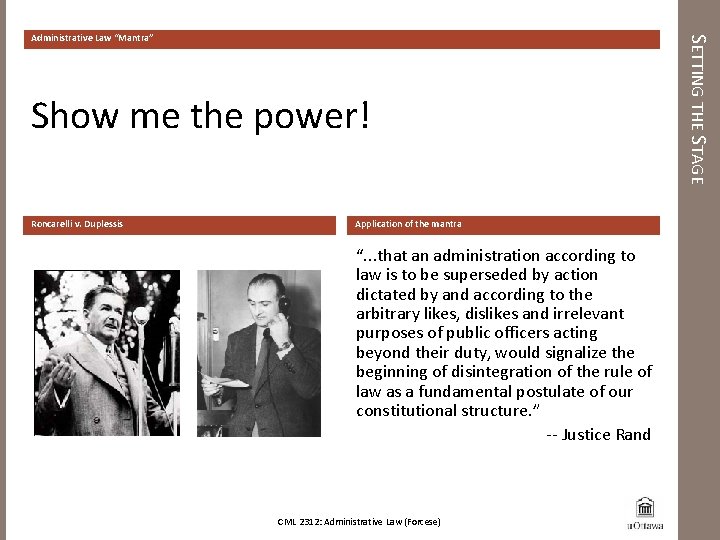
Show me the power! Roncarelli v. Duplessis Application of the mantra “. . . that an administration according to law is to be superseded by action dictated by and according to the arbitrary likes, dislikes and irrelevant purposes of public officers acting beyond their duty, would signalize the beginning of disintegration of the rule of law as a fundamental postulate of our constitutional structure. ” -- Justice Rand CML 2312: Administrative Law (Forcese) SETTING THE STAGE Administrative Law “Mantra”
SETTING THE STAGE The Public Law Setting Life the law is history not logic. 1000 Years of History Key Concepts • Parliamentary sovereignty & rule of law • Executive power • Delegation • Jurisdiction & ultra vires CML 2312: Administrative Law (Forcese)
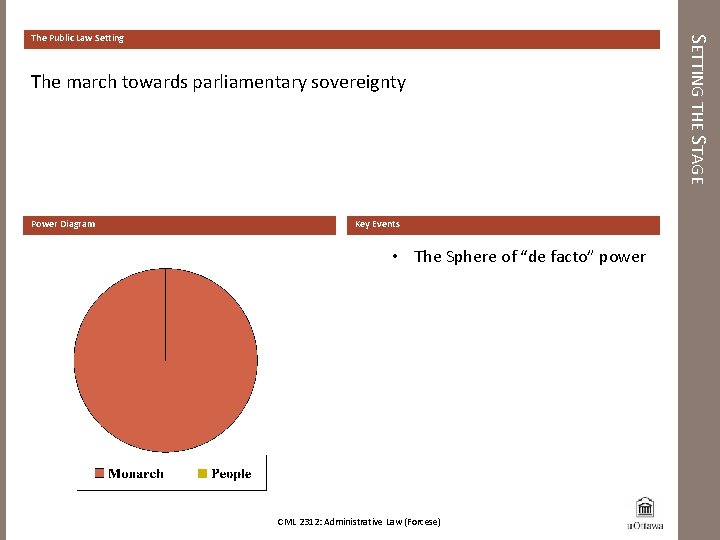
The march towards parliamentary sovereignty Power Diagram Key Events • The Sphere of “de facto” power CML 2312: Administrative Law (Forcese) SETTING THE STAGE The Public Law Setting
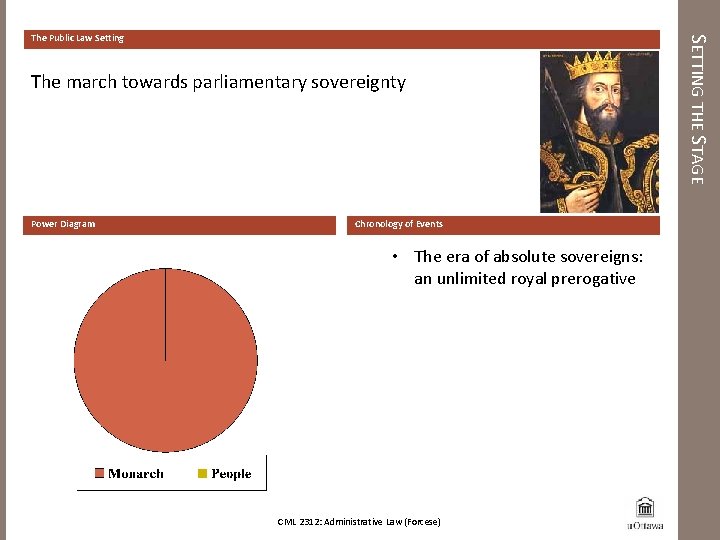
The march towards parliamentary sovereignty Power Diagram Chronology of Events • The era of absolute sovereigns: an unlimited royal prerogative CML 2312: Administrative Law (Forcese) SETTING THE STAGE The Public Law Setting
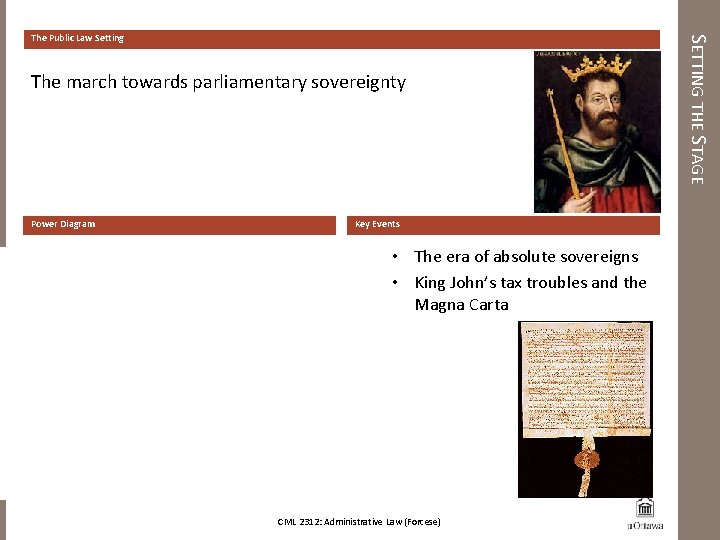
The march towards parliamentary sovereignty Power Diagram Key Events • The era of absolute sovereigns • King John’s tax troubles and the Magna Carta CML 2312: Administrative Law (Forcese) SETTING THE STAGE The Public Law Setting
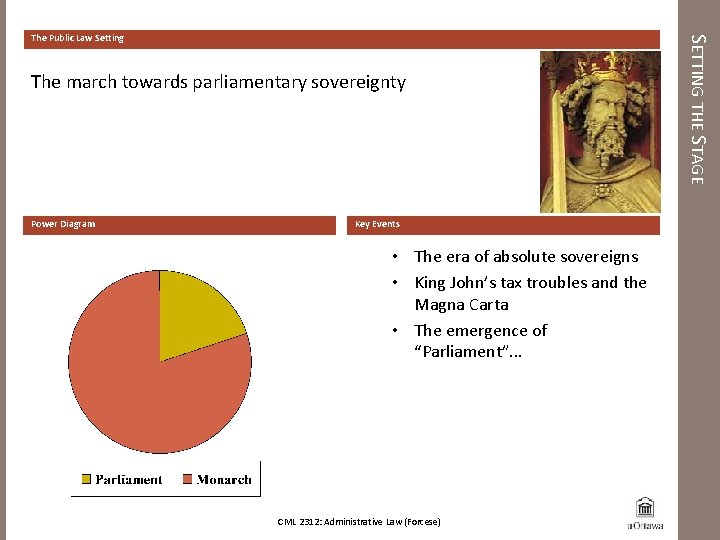
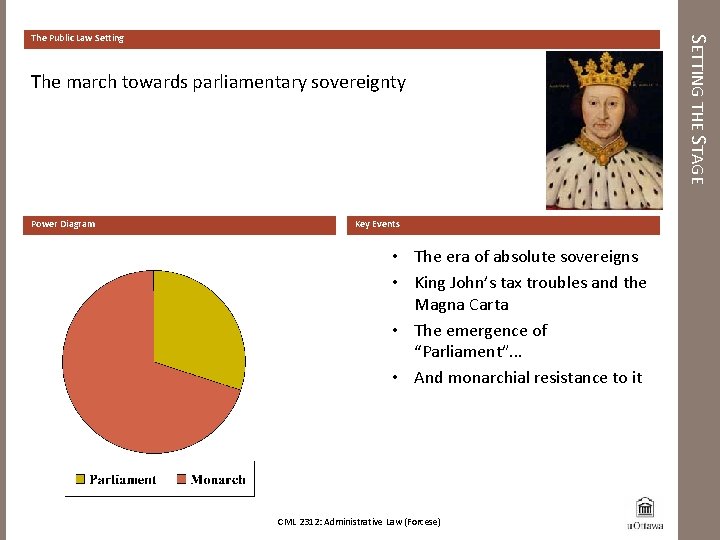
The march towards parliamentary sovereignty Power Diagram Key Events • The era of absolute sovereigns • King John’s tax troubles and the Magna Carta • The emergence of “Parliament”. . . CML 2312: Administrative Law (Forcese) SETTING THE STAGE The Public Law Setting
The march towards parliamentary sovereignty Power Diagram Key Events • The era of absolute sovereigns • King John’s tax troubles and the Magna Carta • The emergence of “Parliament”. . . • And monarchial resistance to it CML 2312: Administrative Law (Forcese) SETTING THE STAGE The Public Law Setting
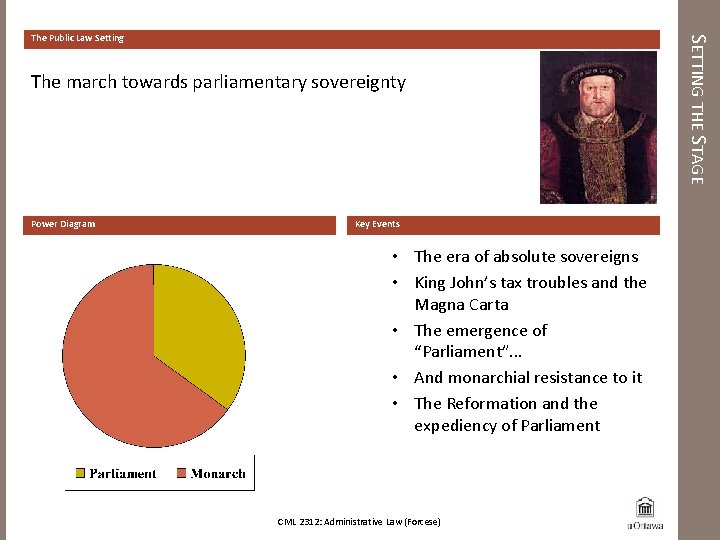
The march towards parliamentary sovereignty Power Diagram Key Events • The era of absolute sovereigns • King John’s tax troubles and the Magna Carta • The emergence of “Parliament”. . . • And monarchial resistance to it • The Reformation and the expediency of Parliament CML 2312: Administrative Law (Forcese) SETTING THE STAGE The Public Law Setting
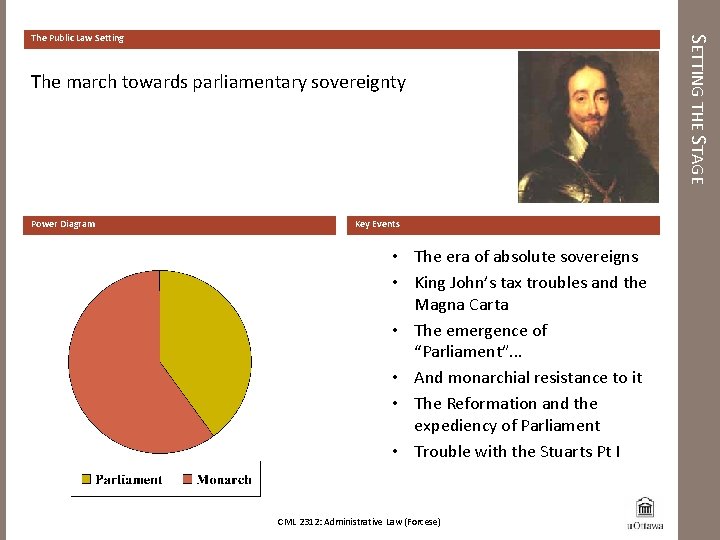
The march towards parliamentary sovereignty Power Diagram Key Events • The era of absolute sovereigns • King John’s tax troubles and the Magna Carta • The emergence of “Parliament”. . . • And monarchial resistance to it • The Reformation and the expediency of Parliament • Trouble with the Stuarts Pt I CML 2312: Administrative Law (Forcese) SETTING THE STAGE The Public Law Setting
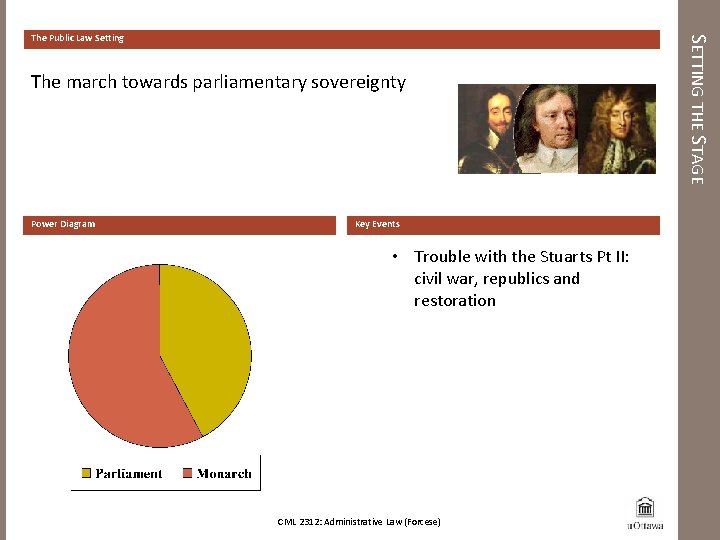
The march towards parliamentary sovereignty Power Diagram Key Events • Trouble with the Stuarts Pt II: civil war, republics and restoration CML 2312: Administrative Law (Forcese) SETTING THE STAGE The Public Law Setting
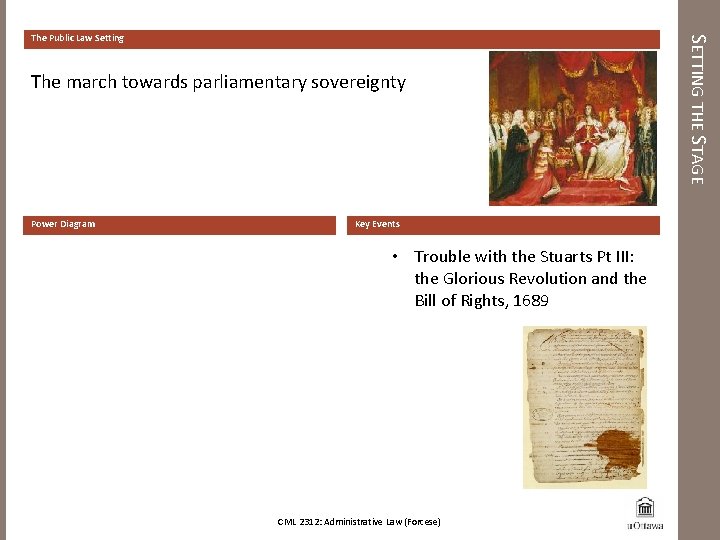
The march towards parliamentary sovereignty Power Diagram Key Events • Trouble with the Stuarts Pt III: the Glorious Revolution and the Bill of Rights, 1689 CML 2312: Administrative Law (Forcese) SETTING THE STAGE The Public Law Setting
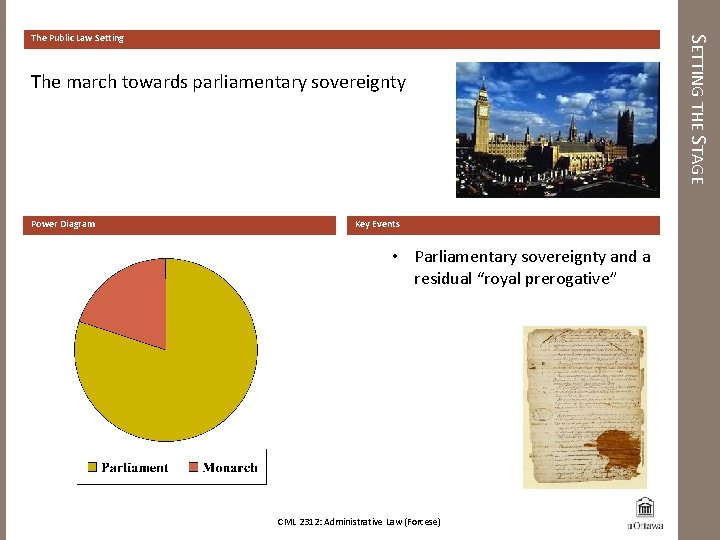
The march towards parliamentary sovereignty Power Diagram Key Events • Parliamentary sovereignty and a residual “royal prerogative” CML 2312: Administrative Law (Forcese) SETTING THE STAGE The Public Law Setting
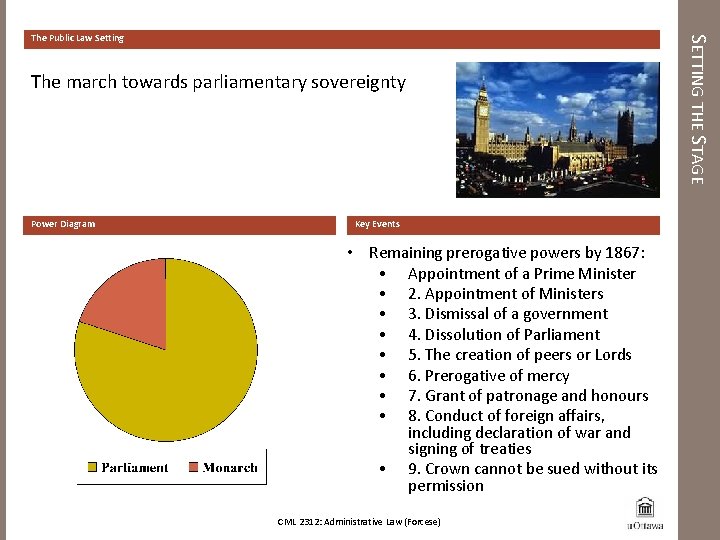
The march towards parliamentary sovereignty Power Diagram Key Events • Remaining prerogative powers by 1867: • Appointment of a Prime Minister • 2. Appointment of Ministers • 3. Dismissal of a government • 4. Dissolution of Parliament • 5. The creation of peers or Lords • 6. Prerogative of mercy • 7. Grant of patronage and honours • 8. Conduct of foreign affairs, including declaration of war and signing of treaties • 9. Crown cannot be sued without its permission CML 2312: Administrative Law (Forcese) SETTING THE STAGE The Public Law Setting
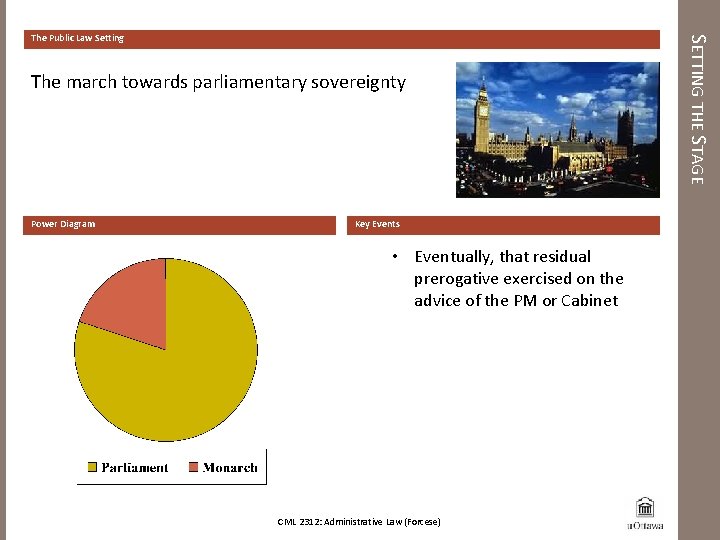
The march towards parliamentary sovereignty Power Diagram Key Events • Eventually, that residual prerogative exercised on the advice of the PM or Cabinet CML 2312: Administrative Law (Forcese) SETTING THE STAGE The Public Law Setting
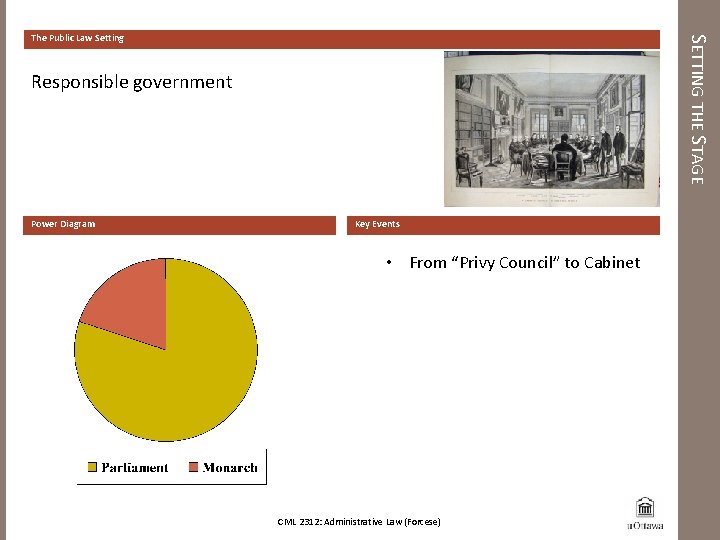
SETTING THE STAGE The Public Law Setting Responsible government Power Diagram Key Events • From “Privy Council” to Cabinet CML 2312: Administrative Law (Forcese)
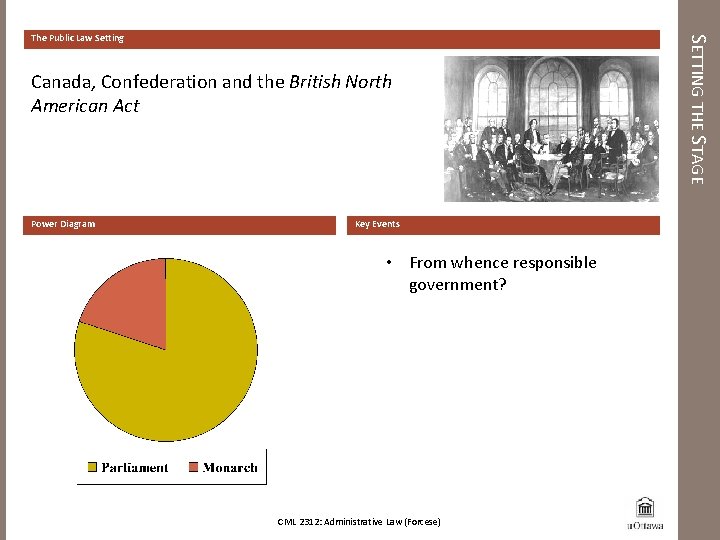
Canada, Confederation and the British North American Act Power Diagram Key Events • From whence responsible government? CML 2312: Administrative Law (Forcese) SETTING THE STAGE The Public Law Setting
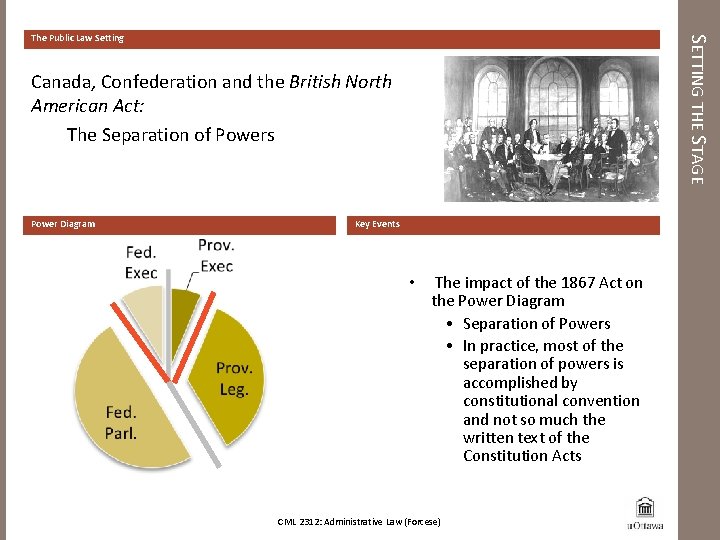
SETTING THE STAGE The Public Law Setting Canada, Confederation and the British North American Act: The Separation of Powers Power Diagram Key Events • The impact of the 1867 Act on the Power Diagram • Separation of Powers • In practice, most of the separation of powers is accomplished by constitutional convention and not so much the written text of the Constitution Acts CML 2312: Administrative Law (Forcese)
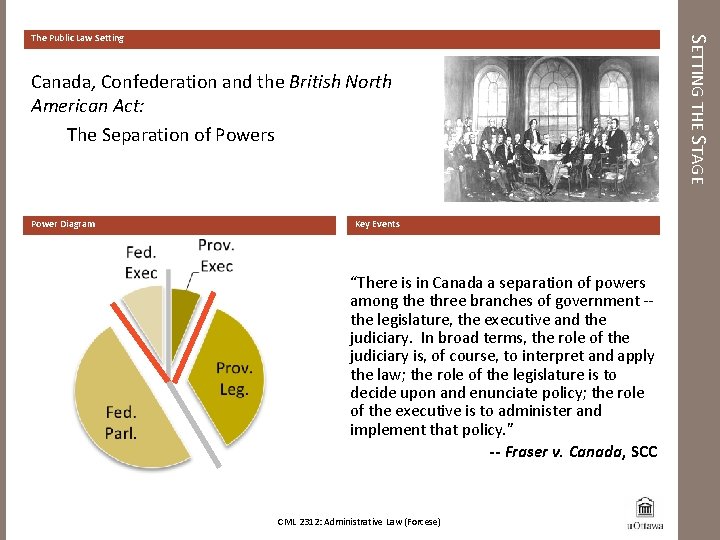
Canada, Confederation and the British North American Act: The Separation of Powers Power Diagram Key Events “There is in Canada a separation of powers among the three branches of government -the legislature, the executive and the judiciary. In broad terms, the role of the judiciary is, of course, to interpret and apply the law; the role of the legislature is to decide upon and enunciate policy; the role of the executive is to administer and implement that policy. ” -- Fraser v. Canada, SCC CML 2312: Administrative Law (Forcese) SETTING THE STAGE The Public Law Setting
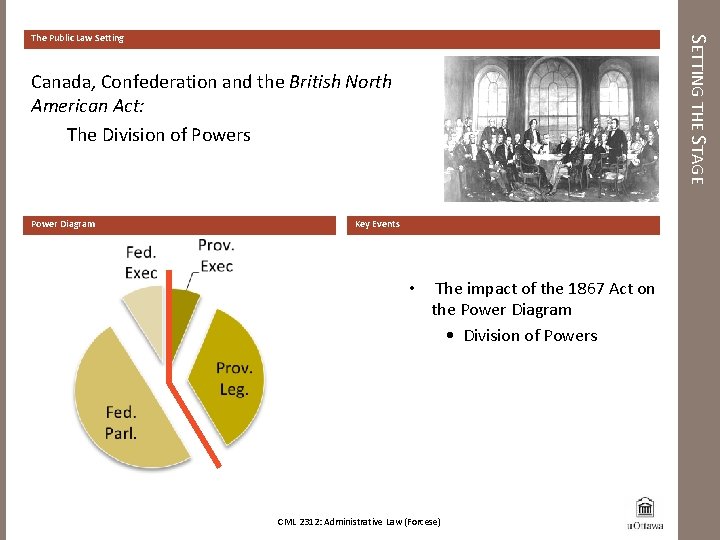
SETTING THE STAGE The Public Law Setting Canada, Confederation and the British North American Act: The Division of Powers Power Diagram Key Events • The impact of the 1867 Act on the Power Diagram • Division of Powers CML 2312: Administrative Law (Forcese)
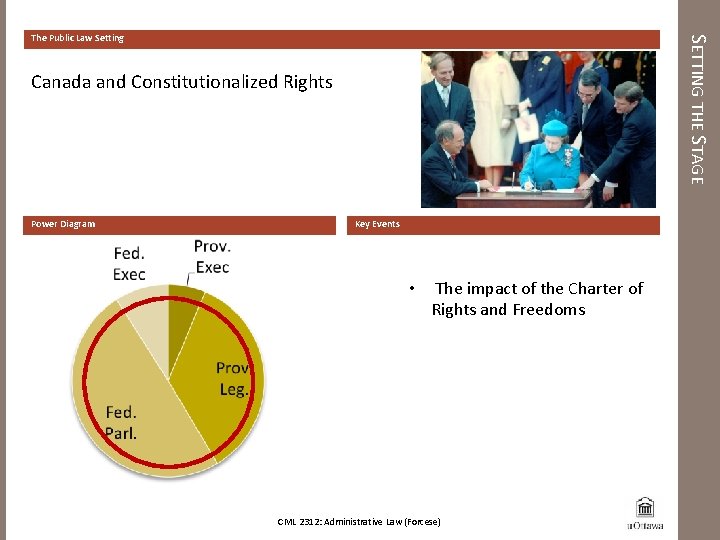
SETTING THE STAGE The Public Law Setting Canada and Constitutionalized Rights Power Diagram Key Events • The impact of the Charter of Rights and Freedoms CML 2312: Administrative Law (Forcese)
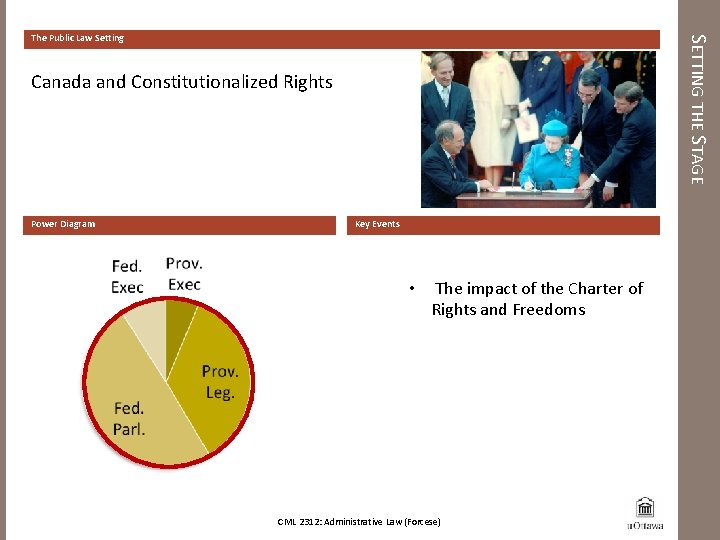
SETTING THE STAGE The Public Law Setting Canada and Constitutionalized Rights Power Diagram Key Events • The impact of the Charter of Rights and Freedoms CML 2312: Administrative Law (Forcese)
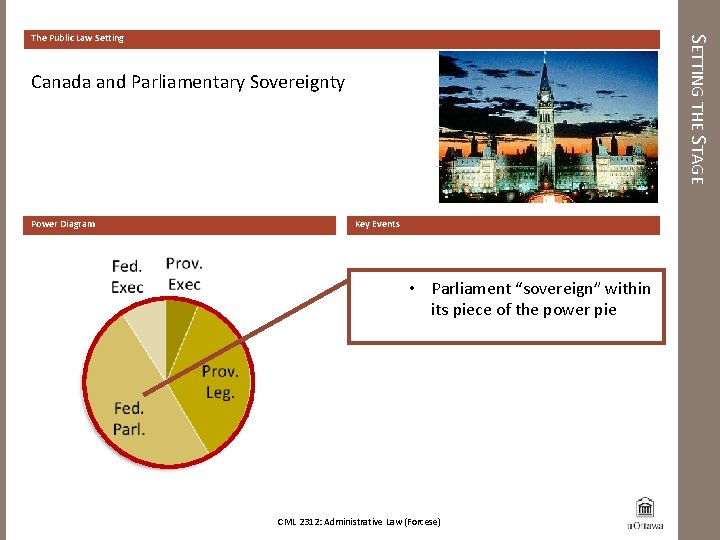
SETTING THE STAGE The Public Law Setting Canada and Parliamentary Sovereignty Power Diagram Key Events • Parliament “sovereign” within its piece of the power pie CML 2312: Administrative Law (Forcese)
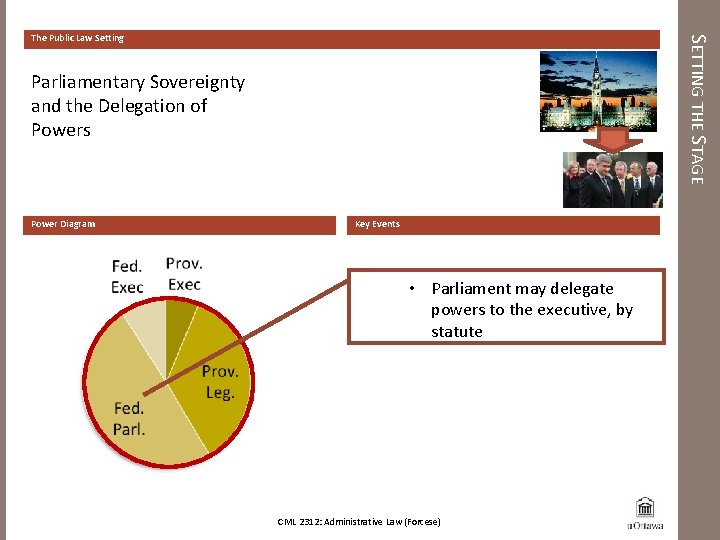
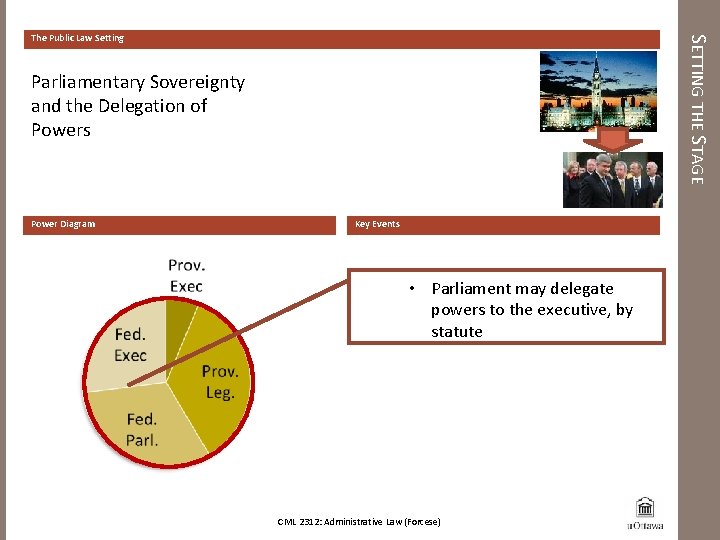
SETTING THE STAGE The Public Law Setting Parliamentary Sovereignty and the Delegation of Powers Power Diagram Key Events • Parliament may delegate powers to the executive, by statute CML 2312: Administrative Law (Forcese)
SETTING THE STAGE The Public Law Setting Parliamentary Sovereignty and the Delegation of Powers Power Diagram Key Events • Parliament may delegate powers to the executive, by statute CML 2312: Administrative Law (Forcese)
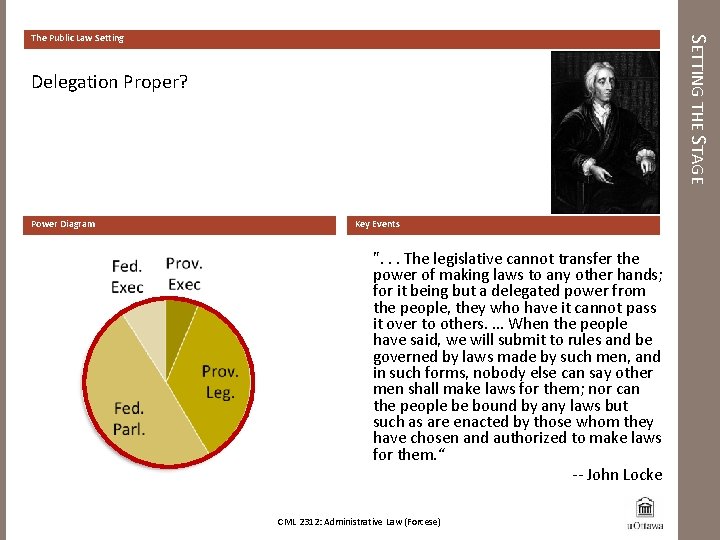
SETTING THE STAGE The Public Law Setting Delegation Proper? Power Diagram Key Events ". . . The legislative cannot transfer the power of making laws to any other hands; for it being but a delegated power from the people, they who have it cannot pass it over to others. … When the people have said, we will submit to rules and be governed by laws made by such men, and in such forms, nobody else can say other men shall make laws for them; nor can the people be bound by any laws but such as are enacted by those whom they have chosen and authorized to make laws for them. “ -- John Locke CML 2312: Administrative Law (Forcese)
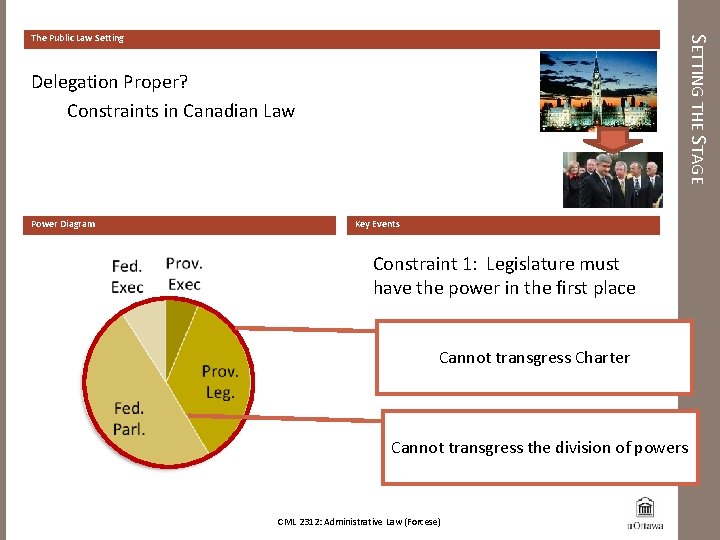
SETTING THE STAGE The Public Law Setting Delegation Proper? Constraints in Canadian Law Power Diagram Key Events Constraint 1: Legislature must have the power in the first place Cannot transgress Charter Cannot transgress the division of powers CML 2312: Administrative Law (Forcese)
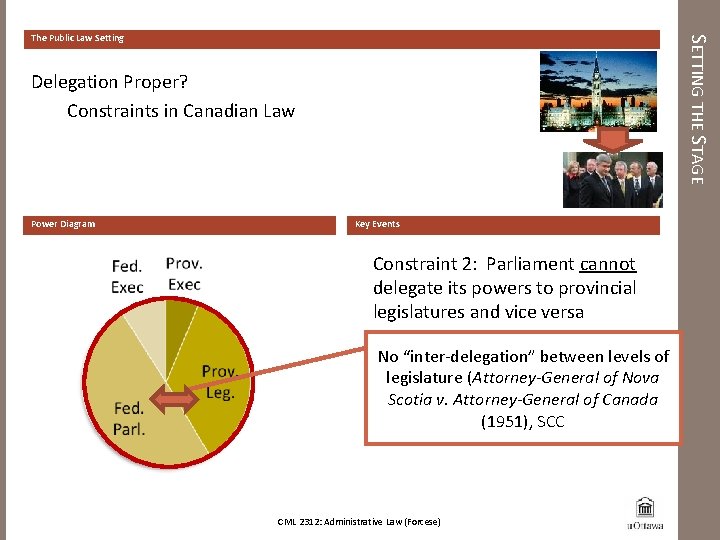
SETTING THE STAGE The Public Law Setting Delegation Proper? Constraints in Canadian Law Power Diagram Key Events Constraint 2: Parliament cannot delegate its powers to provincial legislatures and vice versa No “inter-delegation” between levels of legislature (Attorney-General of Nova Scotia v. Attorney-General of Canada (1951), SCC CML 2312: Administrative Law (Forcese)
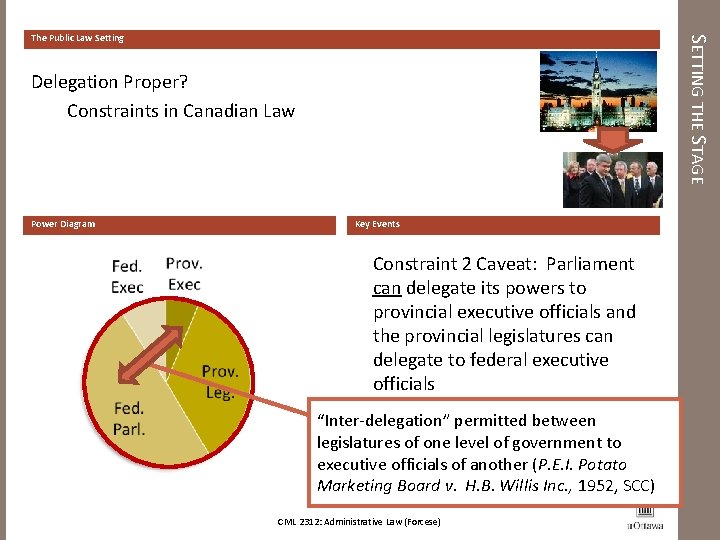
SETTING THE STAGE The Public Law Setting Delegation Proper? Constraints in Canadian Law Power Diagram Key Events Constraint 2 Caveat: Parliament can delegate its powers to provincial executive officials and the provincial legislatures can delegate to federal executive officials “Inter-delegation” permitted between legislatures of one level of government to executive officials of another (P. E. I. Potato Marketing Board v. H. B. Willis Inc. , 1952, SCC) CML 2312: Administrative Law (Forcese)
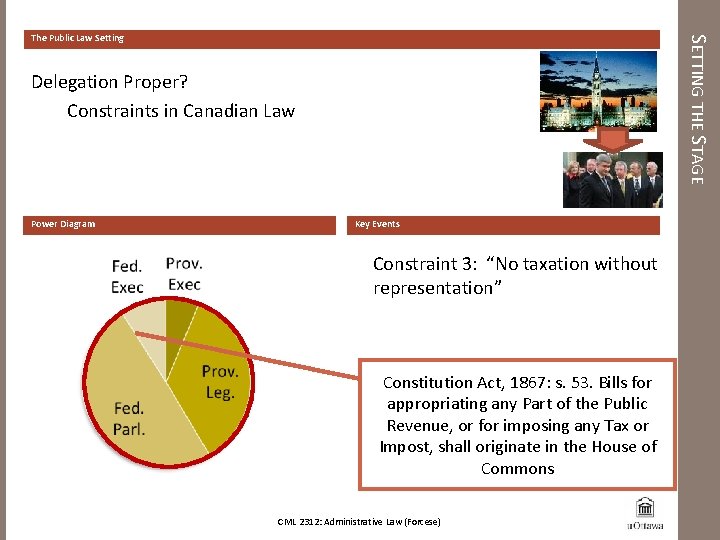
SETTING THE STAGE The Public Law Setting Delegation Proper? Constraints in Canadian Law Power Diagram Key Events Constraint 3: “No taxation without representation” Constitution Act, 1867: s. 53. Bills for appropriating any Part of the Public Revenue, or for imposing any Tax or Impost, shall originate in the House of Commons CML 2312: Administrative Law (Forcese)
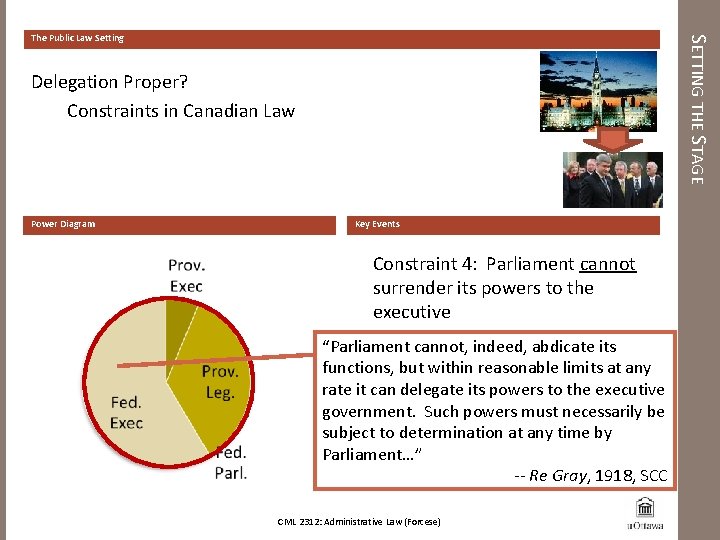
SETTING THE STAGE The Public Law Setting Delegation Proper? Constraints in Canadian Law Power Diagram Key Events Constraint 4: Parliament cannot surrender its powers to the executive “Parliament cannot, indeed, abdicate its functions, but within reasonable limits at any rate it can delegate its powers to the executive government. Such powers must necessarily be subject to determination at any time by Parliament…” -- Re Gray, 1918, SCC CML 2312: Administrative Law (Forcese)
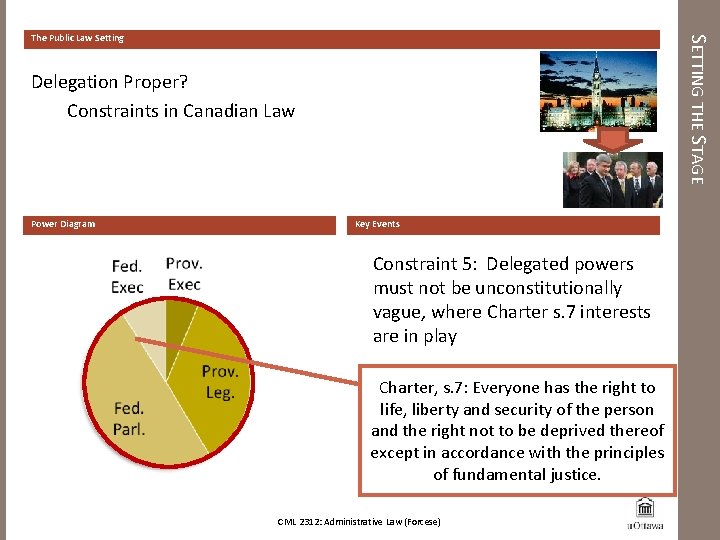
SETTING THE STAGE The Public Law Setting Delegation Proper? Constraints in Canadian Law Power Diagram Key Events Constraint 5: Delegated powers must not be unconstitutionally vague, where Charter s. 7 interests are in play Charter, s. 7: Everyone has the right to life, liberty and security of the person and the right not to be deprived thereof except in accordance with the principles of fundamental justice. CML 2312: Administrative Law (Forcese)
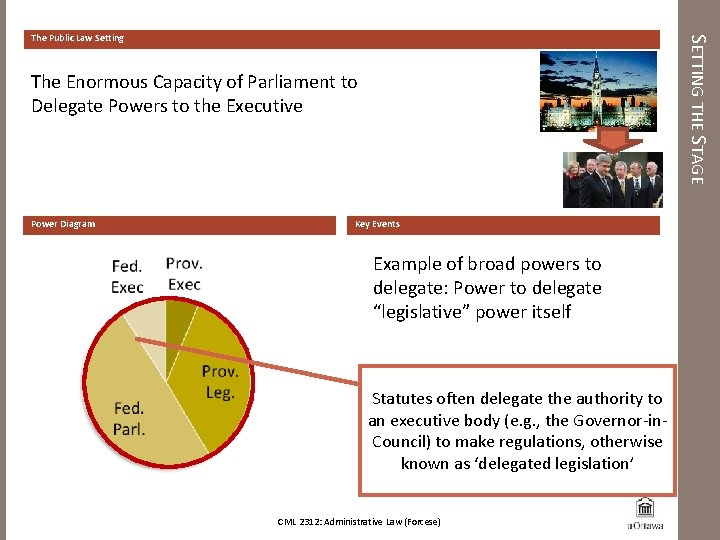
SETTING THE STAGE The Public Law Setting The Enormous Capacity of Parliament to Delegate Powers to the Executive Power Diagram Key Events Example of broad powers to delegate: Power to delegate “legislative” power itself Statutes often delegate the authority to an executive body (e. g. , the Governor-in. Council) to make regulations, otherwise known as ‘delegated legislation’ CML 2312: Administrative Law (Forcese)
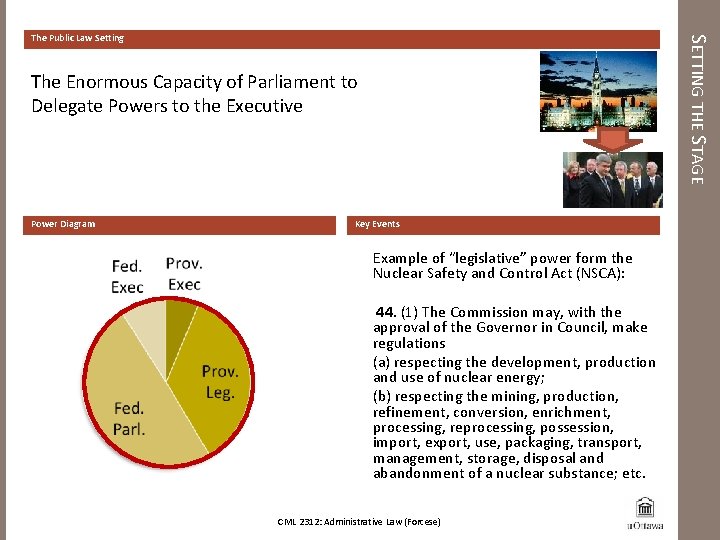
SETTING THE STAGE The Public Law Setting The Enormous Capacity of Parliament to Delegate Powers to the Executive Power Diagram Key Events Example of “legislative” power form the Nuclear Safety and Control Act (NSCA): 44. (1) The Commission may, with the approval of the Governor in Council, make regulations (a) respecting the development, production and use of nuclear energy; (b) respecting the mining, production, refinement, conversion, enrichment, processing, reprocessing, possession, import, export, use, packaging, transport, management, storage, disposal and abandonment of a nuclear substance; etc. CML 2312: Administrative Law (Forcese)
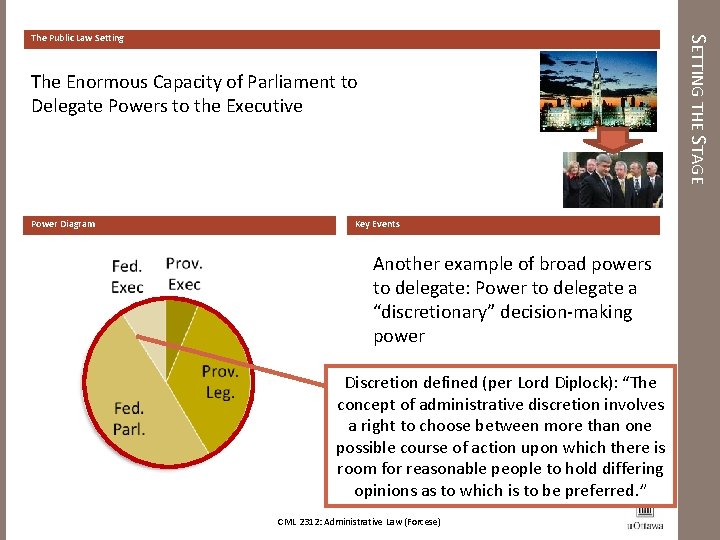
SETTING THE STAGE The Public Law Setting The Enormous Capacity of Parliament to Delegate Powers to the Executive Power Diagram Key Events Another example of broad powers to delegate: Power to delegate a “discretionary” decision-making power Discretion defined (per Lord Diplock): “The concept of administrative discretion involves a right to choose between more than one possible course of action upon which there is room for reasonable people to hold differing opinions as to which is to be preferred. ” CML 2312: Administrative Law (Forcese)
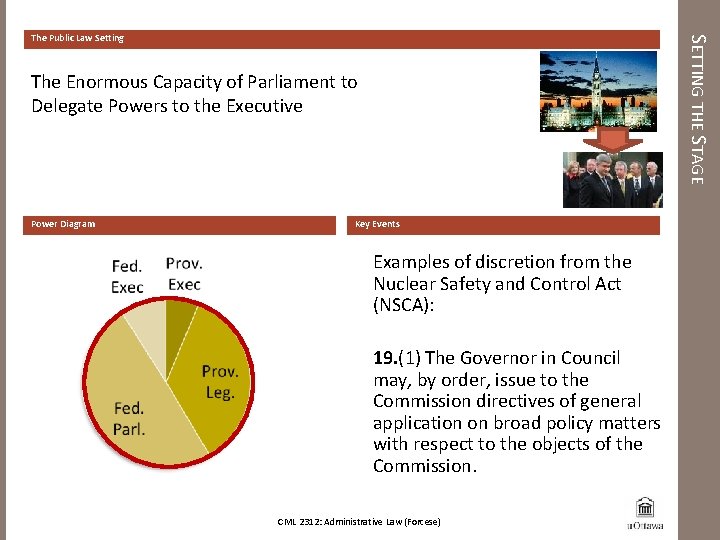
SETTING THE STAGE The Public Law Setting The Enormous Capacity of Parliament to Delegate Powers to the Executive Power Diagram Key Events Examples of discretion from the Nuclear Safety and Control Act (NSCA): 19. (1) The Governor in Council may, by order, issue to the Commission directives of general application on broad policy matters with respect to the objects of the Commission. CML 2312: Administrative Law (Forcese)
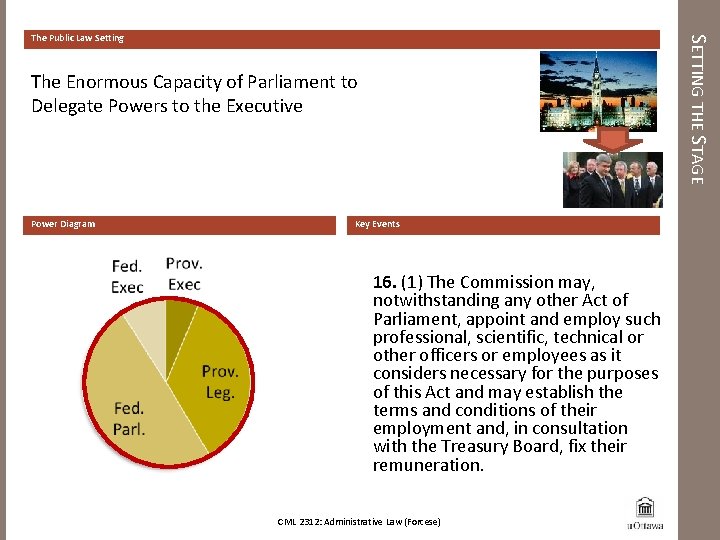
SETTING THE STAGE The Public Law Setting The Enormous Capacity of Parliament to Delegate Powers to the Executive Power Diagram Key Events 16. (1) The Commission may, notwithstanding any other Act of Parliament, appoint and employ such professional, scientific, technical or other officers or employees as it considers necessary for the purposes of this Act and may establish the terms and conditions of their employment and, in consultation with the Treasury Board, fix their remuneration. CML 2312: Administrative Law (Forcese)
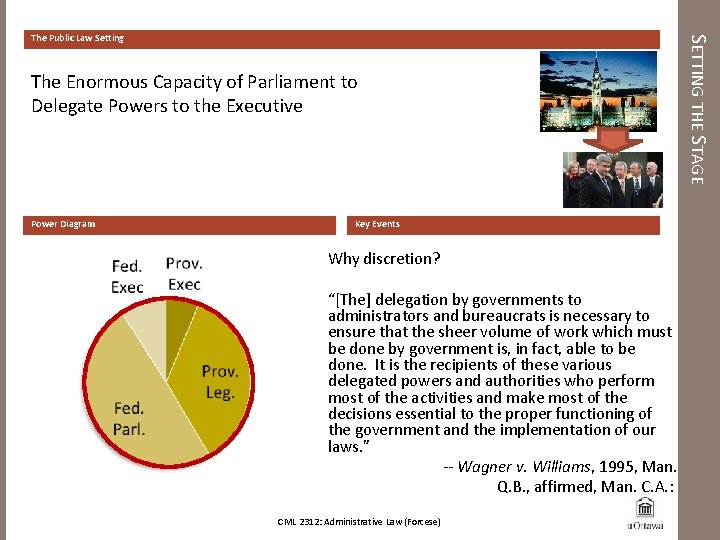
The Enormous Capacity of Parliament to Delegate Powers to the Executive Power Diagram Key Events Why discretion? “[The] delegation by governments to administrators and bureaucrats is necessary to ensure that the sheer volume of work which must be done by government is, in fact, able to be done. It is the recipients of these various delegated powers and authorities who perform most of the activities and make most of the decisions essential to the proper functioning of the government and the implementation of our laws. ” -- Wagner v. Williams, 1995, Man. Q. B. , affirmed, Man. C. A. : CML 2312: Administrative Law (Forcese) SETTING THE STAGE The Public Law Setting
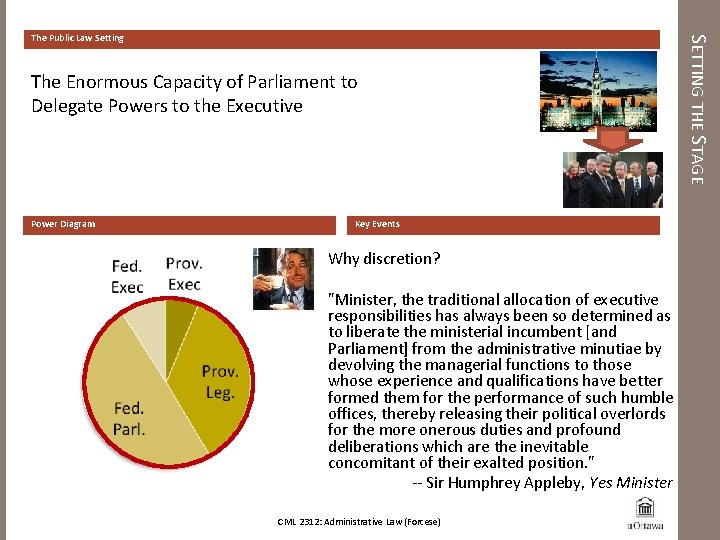
The Enormous Capacity of Parliament to Delegate Powers to the Executive Power Diagram Key Events Why discretion? "Minister, the traditional allocation of executive responsibilities has always been so determined as to liberate the ministerial incumbent [and Parliament] from the administrative minutiae by devolving the managerial functions to those whose experience and qualifications have better formed them for the performance of such humble offices, thereby releasing their political overlords for the more onerous duties and profound deliberations which are the inevitable concomitant of their exalted position. " -- Sir Humphrey Appleby, Yes Minister CML 2312: Administrative Law (Forcese) SETTING THE STAGE The Public Law Setting
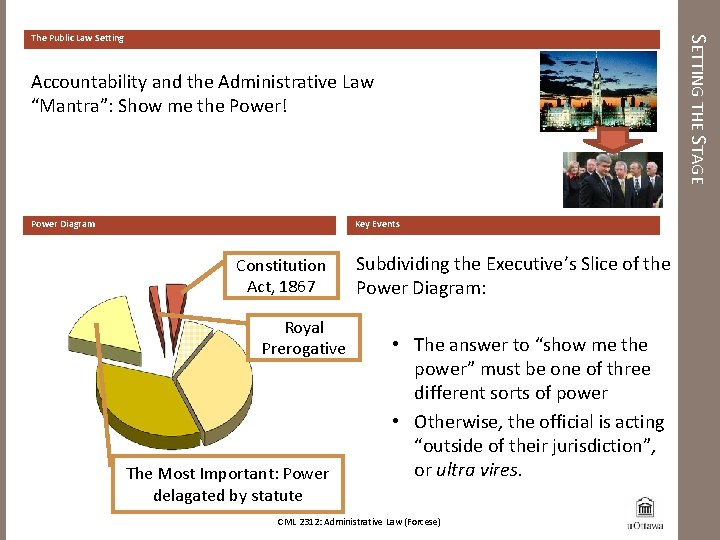
SETTING THE STAGE The Public Law Setting Accountability and the Administrative Law “Mantra”: Show me the Power! Power Diagram Key Events Constitution Act, 1867 Royal Prerogative The Most Important: Power delagated by statute Subdividing the Executive’s Slice of the Power Diagram: • The answer to “show me the power” must be one of three different sorts of power • Otherwise, the official is acting “outside of their jurisdiction”, or ultra vires. CML 2312: Administrative Law (Forcese)
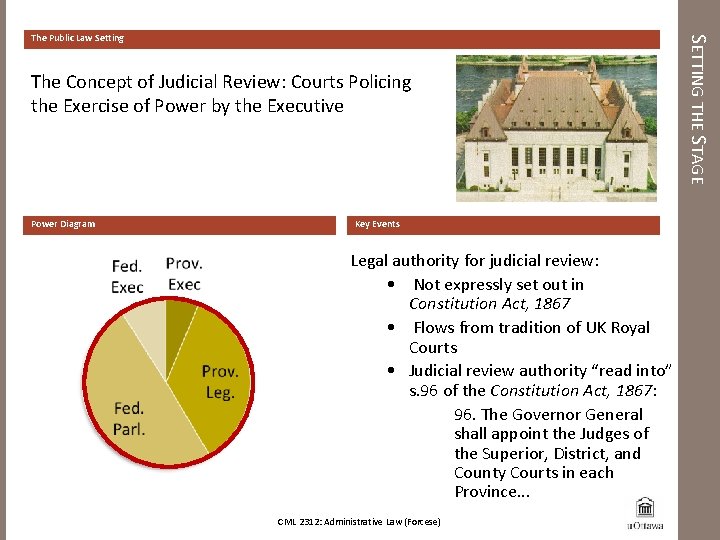
The Concept of Judicial Review: Courts Policing the Exercise of Power by the Executive Power Diagram Key Events Legal authority for judicial review: • Not expressly set out in Constitution Act, 1867 • Flows from tradition of UK Royal Courts • Judicial review authority “read into” s. 96 of the Constitution Act, 1867: 96. The Governor General shall appoint the Judges of the Superior, District, and County Courts in each Province. . . CML 2312: Administrative Law (Forcese) SETTING THE STAGE The Public Law Setting
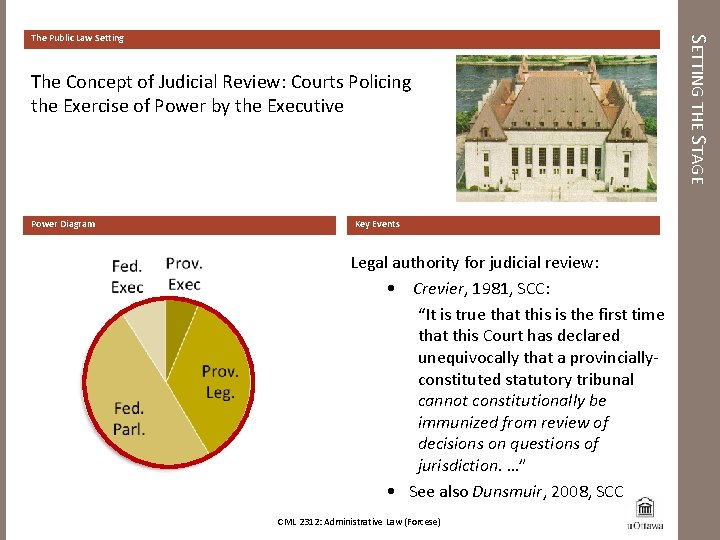
The Concept of Judicial Review: Courts Policing the Exercise of Power by the Executive Power Diagram Key Events Legal authority for judicial review: • Crevier, 1981, SCC: “It is true that this is the first time that this Court has declared unequivocally that a provinciallyconstituted statutory tribunal cannot constitutionally be immunized from review of decisions on questions of jurisdiction. …” • See also Dunsmuir, 2008, SCC CML 2312: Administrative Law (Forcese) SETTING THE STAGE The Public Law Setting
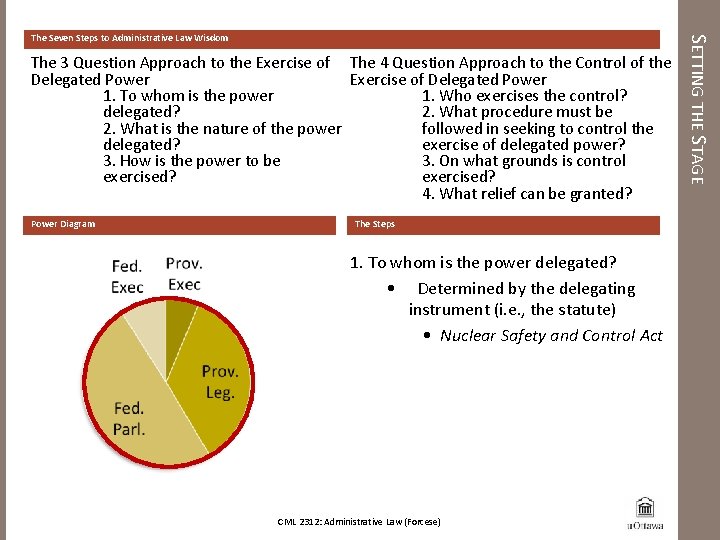
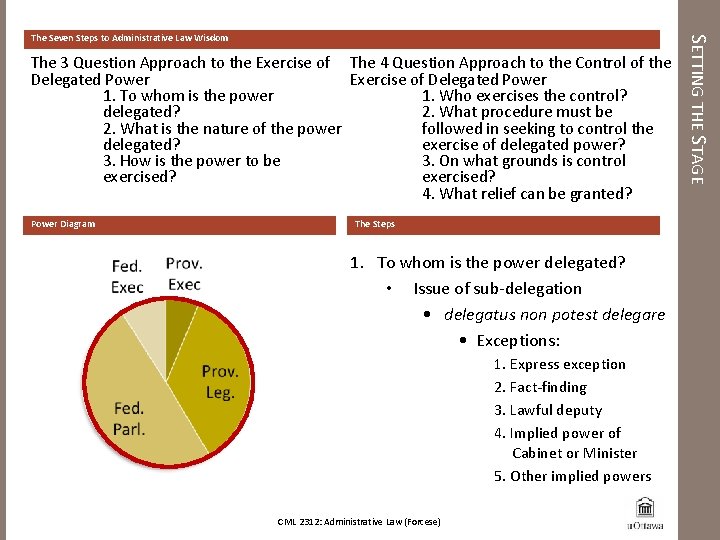
The 3 Question Approach to the Exercise of The 4 Question Approach to the Control of the Delegated Power Exercise of Delegated Power 1. To whom is the power 1. Who exercises the control? delegated? 2. What procedure must be 2. What is the nature of the power followed in seeking to control the delegated? exercise of delegated power? 3. How is the power to be 3. On what grounds is control exercised? 4. What relief can be granted? Power Diagram The Steps 1. To whom is the power delegated? • Determined by the delegating instrument (i. e. , the statute) • Nuclear Safety and Control Act CML 2312: Administrative Law (Forcese) SETTING THE STAGE The Seven Steps to Administrative Law Wisdom
The 3 Question Approach to the Exercise of The 4 Question Approach to the Control of the Delegated Power Exercise of Delegated Power 1. To whom is the power 1. Who exercises the control? delegated? 2. What procedure must be 2. What is the nature of the power followed in seeking to control the delegated? exercise of delegated power? 3. How is the power to be 3. On what grounds is control exercised? 4. What relief can be granted? Power Diagram The Steps 1. To whom is the power delegated? • Issue of sub-delegation • delegatus non potest delegare • Exceptions: 1. Express exception 2. Fact-finding 3. Lawful deputy 4. Implied power of Cabinet or Minister 5. Other implied powers CML 2312: Administrative Law (Forcese) SETTING THE STAGE The Seven Steps to Administrative Law Wisdom
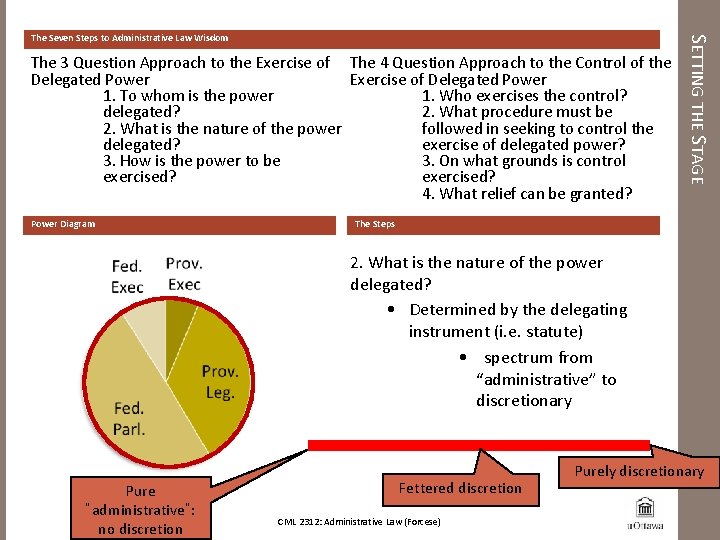
The 3 Question Approach to the Exercise of The 4 Question Approach to the Control of the Delegated Power Exercise of Delegated Power 1. To whom is the power 1. Who exercises the control? delegated? 2. What procedure must be 2. What is the nature of the power followed in seeking to control the delegated? exercise of delegated power? 3. How is the power to be 3. On what grounds is control exercised? 4. What relief can be granted? Power Diagram SETTING THE STAGE The Seven Steps to Administrative Law Wisdom The Steps 2. What is the nature of the power delegated? • Determined by the delegating instrument (i. e. statute) • spectrum from “administrative” to discretionary Pure “administrative”: no discretion Fettered discretion CML 2312: Administrative Law (Forcese) Purely discretionary
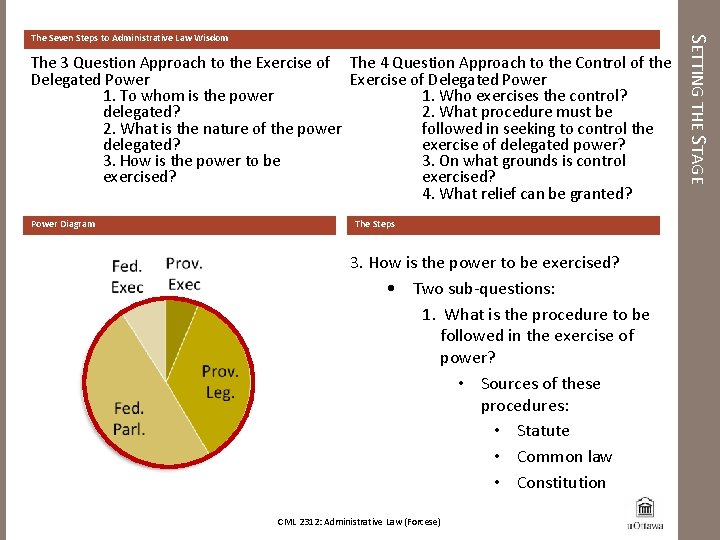
The 3 Question Approach to the Exercise of The 4 Question Approach to the Control of the Delegated Power Exercise of Delegated Power 1. To whom is the power 1. Who exercises the control? delegated? 2. What procedure must be 2. What is the nature of the power followed in seeking to control the delegated? exercise of delegated power? 3. How is the power to be 3. On what grounds is control exercised? 4. What relief can be granted? Power Diagram The Steps 3. How is the power to be exercised? • Two sub-questions: 1. What is the procedure to be followed in the exercise of power? • Sources of these procedures: • Statute • Common law • Constitution CML 2312: Administrative Law (Forcese) SETTING THE STAGE The Seven Steps to Administrative Law Wisdom
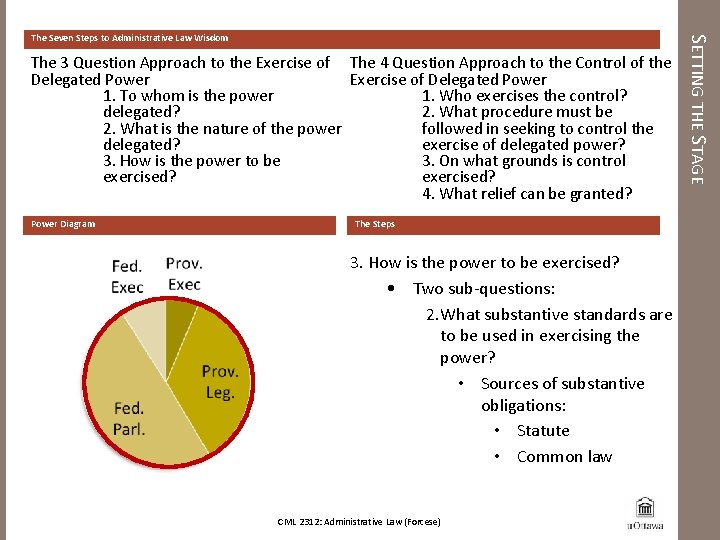
The 3 Question Approach to the Exercise of The 4 Question Approach to the Control of the Delegated Power Exercise of Delegated Power 1. To whom is the power 1. Who exercises the control? delegated? 2. What procedure must be 2. What is the nature of the power followed in seeking to control the delegated? exercise of delegated power? 3. How is the power to be 3. On what grounds is control exercised? 4. What relief can be granted? Power Diagram The Steps 3. How is the power to be exercised? • Two sub-questions: 2. What substantive standards are to be used in exercising the power? • Sources of substantive obligations: • Statute • Common law CML 2312: Administrative Law (Forcese) SETTING THE STAGE The Seven Steps to Administrative Law Wisdom
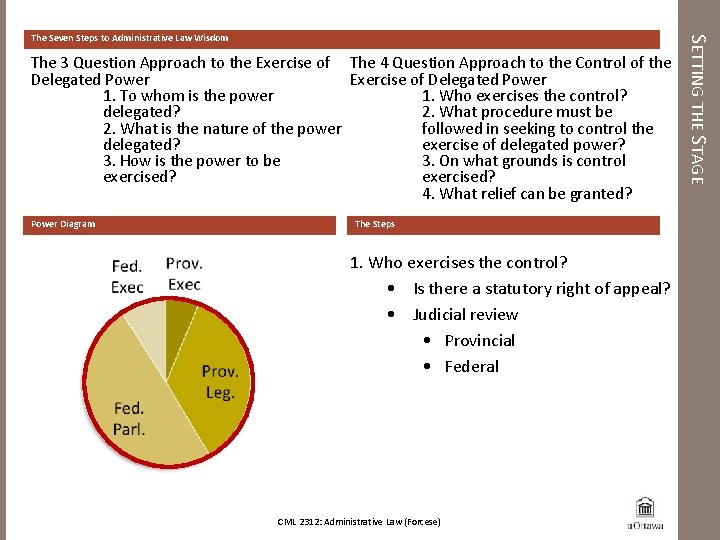
The 3 Question Approach to the Exercise of The 4 Question Approach to the Control of the Delegated Power Exercise of Delegated Power 1. To whom is the power 1. Who exercises the control? delegated? 2. What procedure must be 2. What is the nature of the power followed in seeking to control the delegated? exercise of delegated power? 3. How is the power to be 3. On what grounds is control exercised? 4. What relief can be granted? Power Diagram The Steps 1. Who exercises the control? • Is there a statutory right of appeal? • Judicial review • Provincial • Federal CML 2312: Administrative Law (Forcese) SETTING THE STAGE The Seven Steps to Administrative Law Wisdom
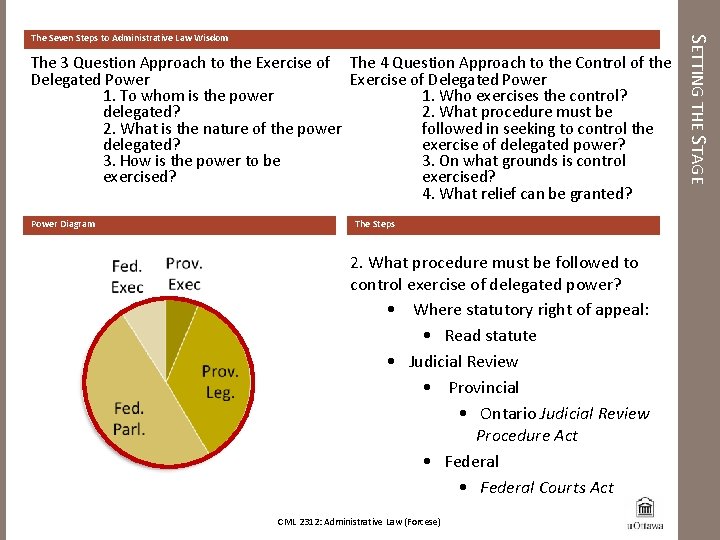
The 3 Question Approach to the Exercise of The 4 Question Approach to the Control of the Delegated Power Exercise of Delegated Power 1. To whom is the power 1. Who exercises the control? delegated? 2. What procedure must be 2. What is the nature of the power followed in seeking to control the delegated? exercise of delegated power? 3. How is the power to be 3. On what grounds is control exercised? 4. What relief can be granted? Power Diagram The Steps 2. What procedure must be followed to control exercise of delegated power? • Where statutory right of appeal: • Read statute • Judicial Review • Provincial • Ontario Judicial Review Procedure Act • Federal Courts Act CML 2312: Administrative Law (Forcese) SETTING THE STAGE The Seven Steps to Administrative Law Wisdom
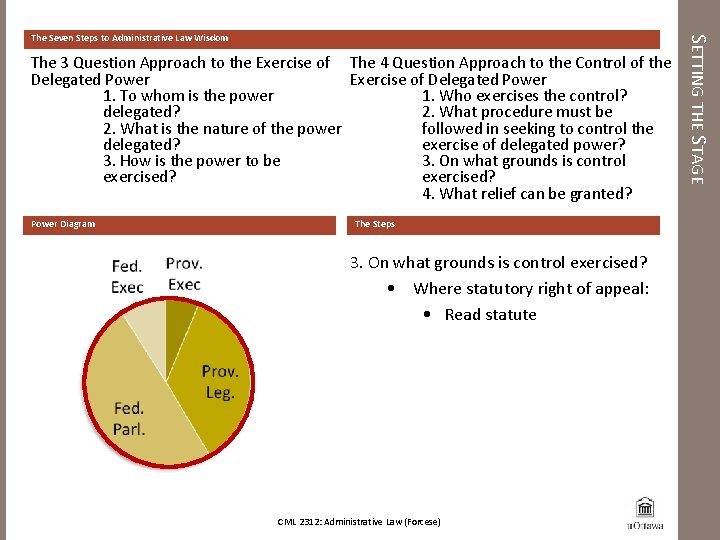
The 3 Question Approach to the Exercise of The 4 Question Approach to the Control of the Delegated Power Exercise of Delegated Power 1. To whom is the power 1. Who exercises the control? delegated? 2. What procedure must be 2. What is the nature of the power followed in seeking to control the delegated? exercise of delegated power? 3. How is the power to be 3. On what grounds is control exercised? 4. What relief can be granted? Power Diagram The Steps 3. On what grounds is control exercised? • Where statutory right of appeal: • Read statute CML 2312: Administrative Law (Forcese) SETTING THE STAGE The Seven Steps to Administrative Law Wisdom
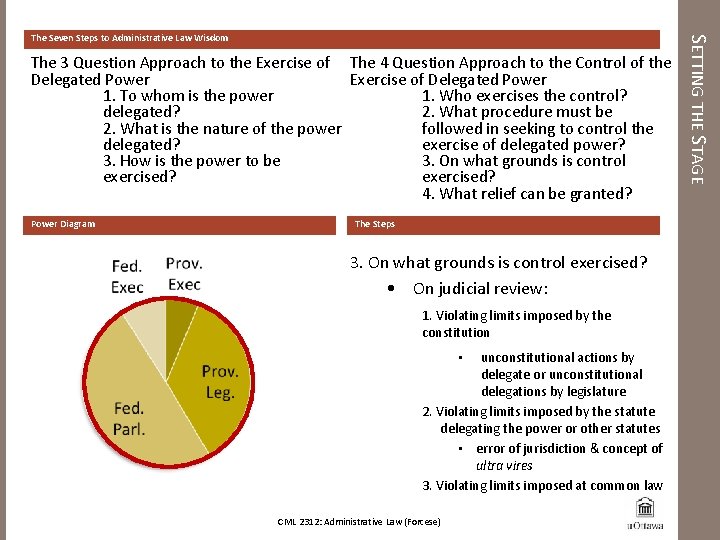
The 3 Question Approach to the Exercise of The 4 Question Approach to the Control of the Delegated Power Exercise of Delegated Power 1. To whom is the power 1. Who exercises the control? delegated? 2. What procedure must be 2. What is the nature of the power followed in seeking to control the delegated? exercise of delegated power? 3. How is the power to be 3. On what grounds is control exercised? 4. What relief can be granted? Power Diagram The Steps 3. On what grounds is control exercised? • On judicial review: 1. Violating limits imposed by the constitution unconstitutional actions by delegate or unconstitutional delegations by legislature 2. Violating limits imposed by the statute delegating the power or other statutes • error of jurisdiction & concept of ultra vires 3. Violating limits imposed at common law • CML 2312: Administrative Law (Forcese) SETTING THE STAGE The Seven Steps to Administrative Law Wisdom
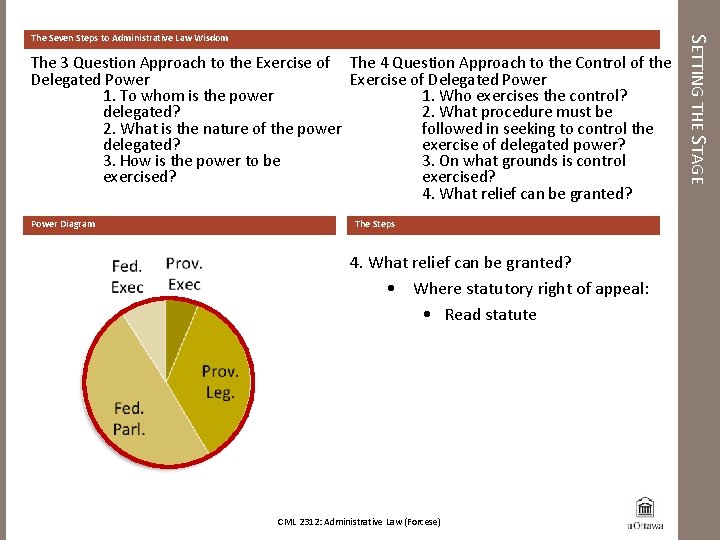
The 3 Question Approach to the Exercise of The 4 Question Approach to the Control of the Delegated Power Exercise of Delegated Power 1. To whom is the power 1. Who exercises the control? delegated? 2. What procedure must be 2. What is the nature of the power followed in seeking to control the delegated? exercise of delegated power? 3. How is the power to be 3. On what grounds is control exercised? 4. What relief can be granted? Power Diagram The Steps 4. What relief can be granted? • Where statutory right of appeal: • Read statute CML 2312: Administrative Law (Forcese) SETTING THE STAGE The Seven Steps to Administrative Law Wisdom
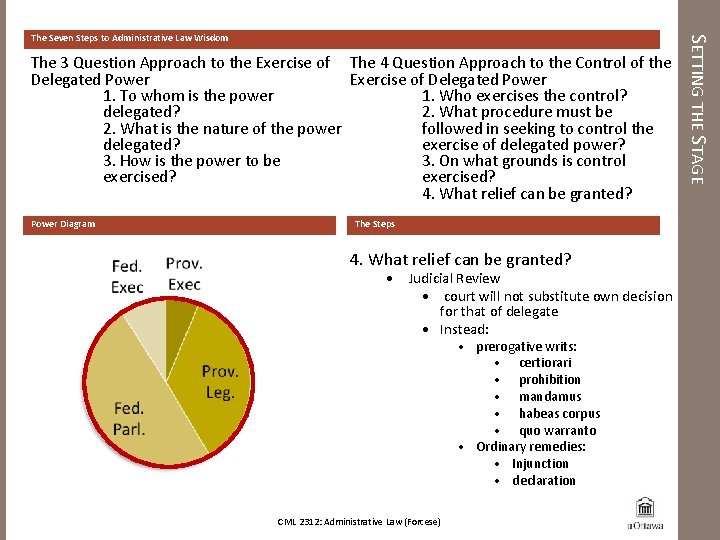
The 3 Question Approach to the Exercise of The 4 Question Approach to the Control of the Delegated Power Exercise of Delegated Power 1. To whom is the power 1. Who exercises the control? delegated? 2. What procedure must be 2. What is the nature of the power followed in seeking to control the delegated? exercise of delegated power? 3. How is the power to be 3. On what grounds is control exercised? 4. What relief can be granted? Power Diagram The Steps 4. What relief can be granted? • Judicial Review • court will not substitute own decision for that of delegate • Instead: • prerogative writs: • certiorari • prohibition • mandamus • habeas corpus • quo warranto • Ordinary remedies: • Injunction • declaration CML 2312: Administrative Law (Forcese) SETTING THE STAGE The Seven Steps to Administrative Law Wisdom