
CMC Unit IV P VIDYA SAGAR ASSOCIATE PROFESSOR
- Slides: 36
CMC Unit IV P. VIDYA SAGAR ( ASSOCIATE PROFESSOR)
Syllabus FREQUENCY MANAGEMENT AND CHANNEL ASSIGNMENT Numbering and grouping, Setup access and paging channels, Channel assignments to cell sites and mobile units, Channel sharing and barrowing, sectorization, Overlaid cells, Non fixed channel assignment. 12/4/2020
Frequency Management Ø Frequency management Ø Designating set-up channels and voice channels (done by the FCC), Ø Numbering the channels(done by the FCC), and Ø Grouping the voice channels into subsets (done by each system according to its preference). 3 12/4/2020
Channel assignment Ø Means the allocation of specific channels to cell sites and mobile units. Ø A fixed channel set – Cell site- long-term basis Ø During a call- Mobile unit - short-term basis (handled by MTSO). Ø Ideally channel assignment should be based on causing the least interference in the system. 4 12/4/2020
Numbering the Channels Ø The total number of channels (January 1988) is 832. Ø But most mobile units and systems are still operating on 666 channels. Ø A channel consists of two frequency channel bandwidths, Ø one in the low band Ø one in the high band 5 12/4/2020
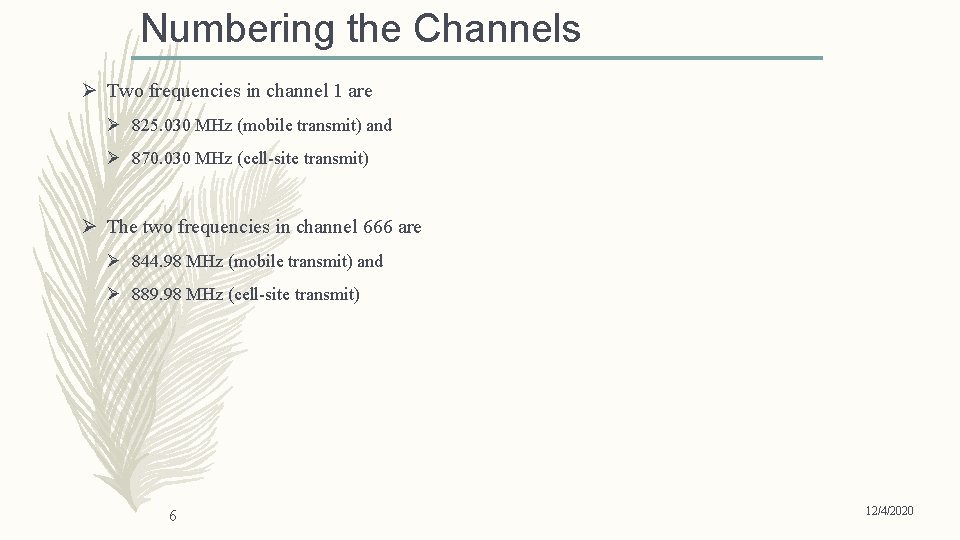
Numbering the Channels Ø Two frequencies in channel 1 are Ø 825. 030 MHz (mobile transmit) and Ø 870. 030 MHz (cell-site transmit) Ø The two frequencies in channel 666 are Ø 844. 98 MHz (mobile transmit) and Ø 889. 98 MHz (cell-site transmit) 6 12/4/2020
Numbering the Channels Ø The 666 channels are divided into two groups: Ø block A system Ø block B system 7 12/4/2020
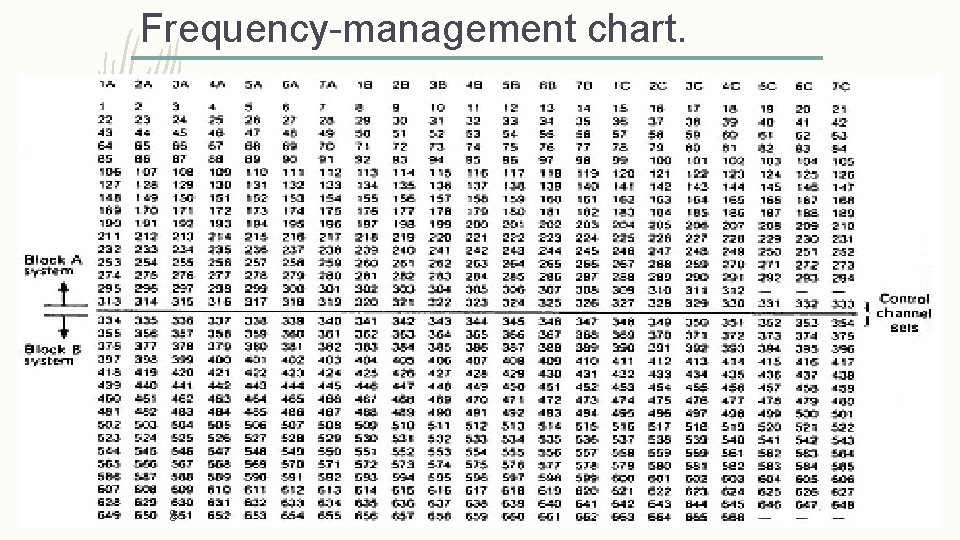
Frequency-management chart. 8 12/4/2020
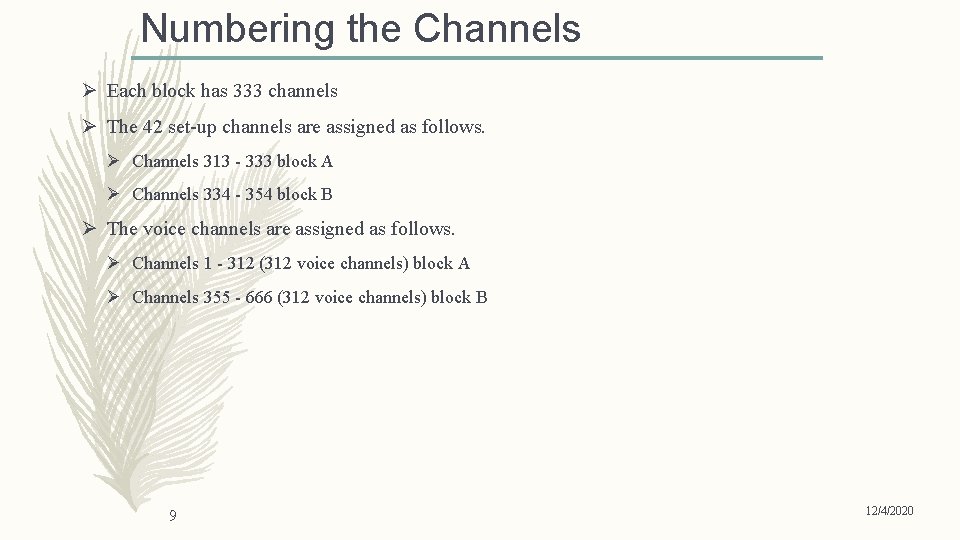
Numbering the Channels Ø Each block has 333 channels Ø The 42 set-up channels are assigned as follows. Ø Channels 313 - 333 block A Ø Channels 334 - 354 block B Ø The voice channels are assigned as follows. Ø Channels 1 - 312 (312 voice channels) block A Ø Channels 355 - 666 (312 voice channels) block B 9 12/4/2020
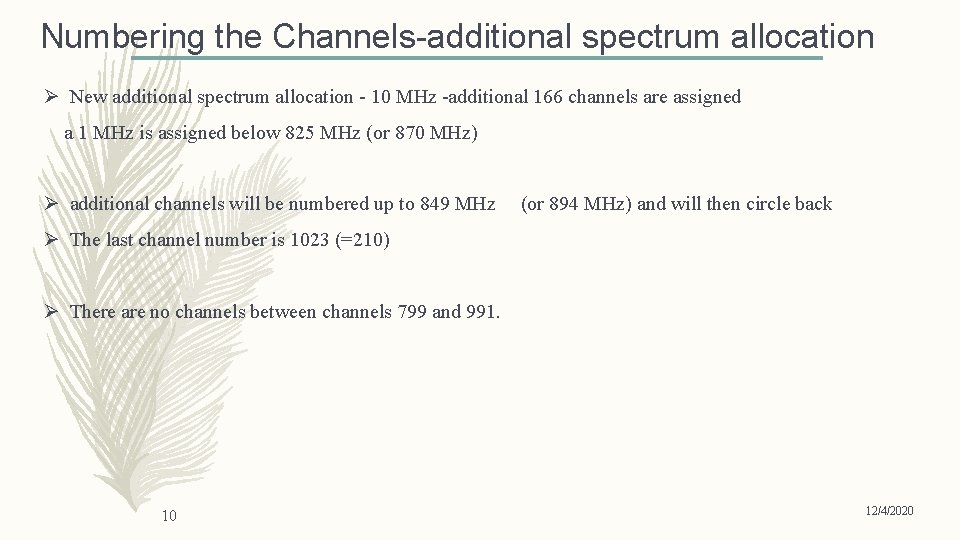
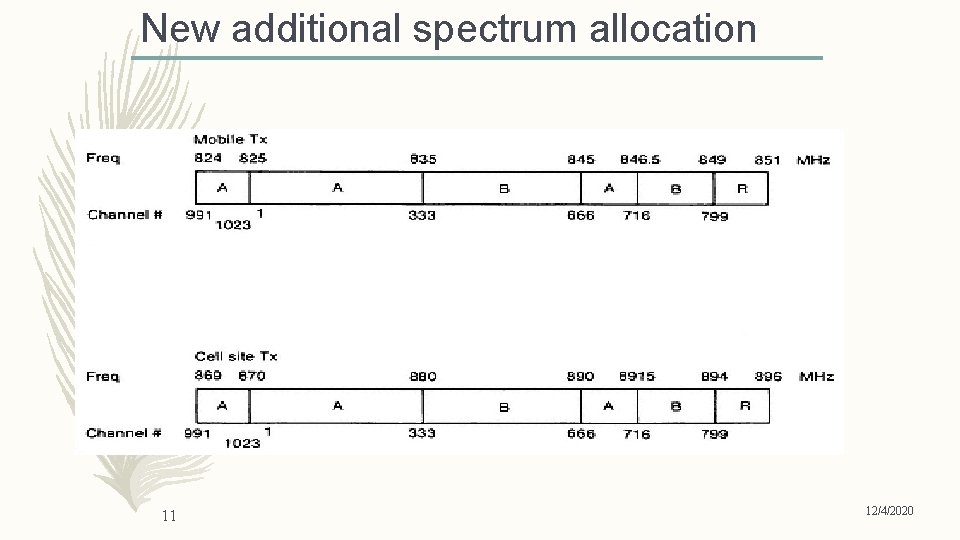
Numbering the Channels-additional spectrum allocation Ø New additional spectrum allocation - 10 MHz -additional 166 channels are assigned a 1 MHz is assigned below 825 MHz (or 870 MHz) Ø additional channels will be numbered up to 849 MHz (or 894 MHz) and will then circle back Ø The last channel number is 1023 (=210) Ø There are no channels between channels 799 and 991. 10 12/4/2020
New additional spectrum allocation 11 12/4/2020
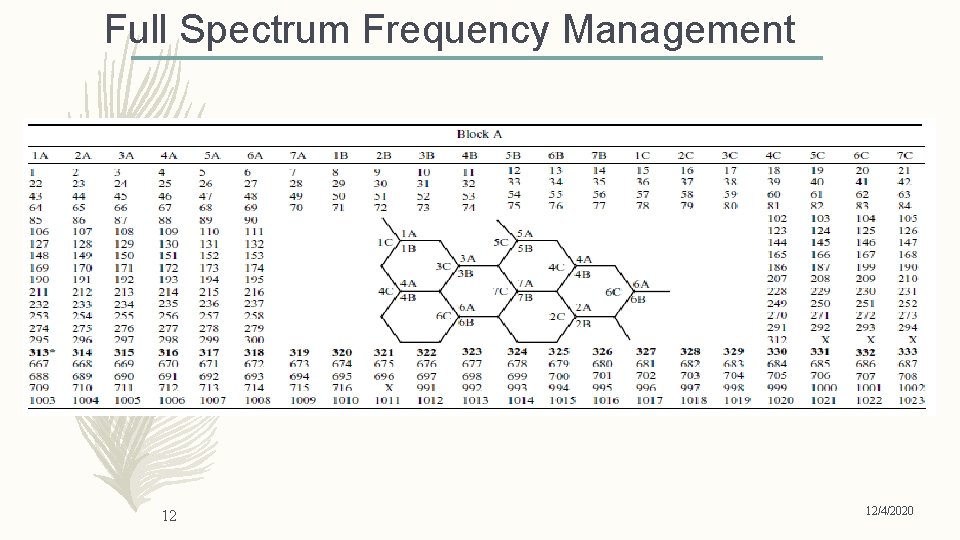
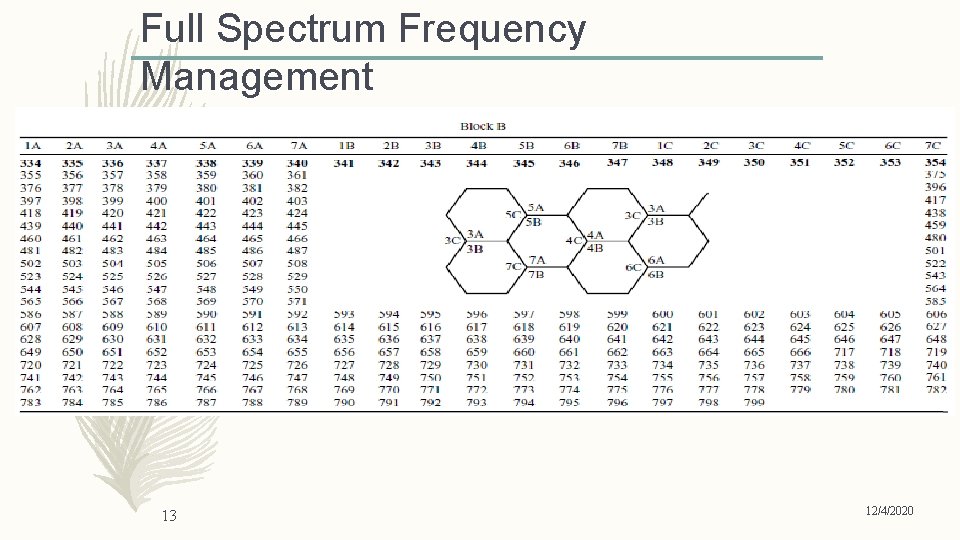
Full Spectrum Frequency Management 12 12/4/2020
Full Spectrum Frequency Management 13 12/4/2020
Grouping into Subsets Ø Voice channels for each system is 312 Ø We can group these into any number of subsets Ø 21 set-up channels for each system Ø it is logical to group the 312 channels into 21 subsets Ø Each subset then consists of 16 channels Ø In each set, the closest adjacent channel is 21 channels away 14 12/4/2020
Grouping into Subsets Ø The 16 channels in each subset - connected to a channel combiner Ø Wide separation between adjacent channels -requirement of minimum isolation Ø Each 16 -channel subset is idealized for each 16 -channel combiner 15 12/4/2020
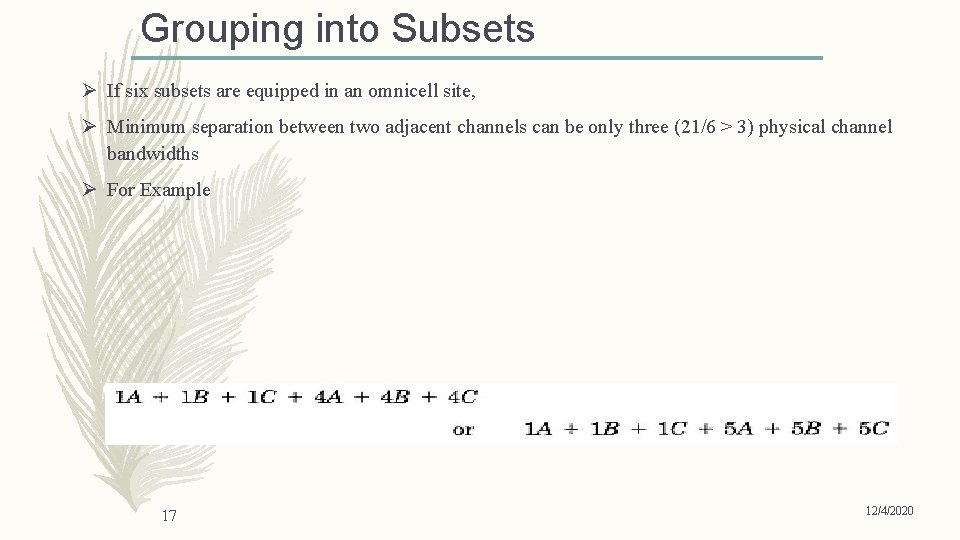
Grouping into Subsets Ø In a seven-cell pattern system each cell contains three subsets, Ø i. A + i. B + i. C Ø Ø where i is an integer from 1 to 7 Ø The total number of voice channels in a cell is about 45 Ø The minimum separation between three subsets is 7 channels (21/3) 16 12/4/2020
Grouping into Subsets Ø If six subsets are equipped in an omnicell site, Ø Minimum separation between two adjacent channels can be only three (21/6 > 3) physical channel bandwidths Ø For Example 17 12/4/2020
Techniques for increasing frequency spectrum Ø Increasing the number of radio channels using narrow banding, spread spectrum, or time division Ø Improving spatial frequency-spectrum reuse Ø Frequency management and channel assignment Ø Improving spectrum efficiency in time Ø Reducing the load of invalid calls Ø Voice storage service for No-Answer calls Ø Call forwarding Ø Call waiting for Busy-Call situations Ø Queuing Ø Off air call setup Ø Reducing the customer keep dialling case 18 12/4/2020
Set-up Channels Ø Set-up channels, also called control channels, Ø Channels designated to set up calls Ø A system can be operated without set-up channels Ø Set-up channels can be classified by usage into two types Ø access channels Ø paging channels 19 12/4/2020
Access channels - Operational functions Ø Power of a forward set-up channel [or forward control channel (FOCC)] Ø The set-up channel received level (Threshold)-RECC Ø Change power at the mobile unit(Messages) Ø Mobile station control message Ø System parameter overhead message Ø Control-filler message Ø Direct call - retry 20 12/4/2020
Paging Channels Ø The assigned forward set-up channel (FOCC) of each cell site is used to page the mobile unit with the same mobile station control message Selecting a voice channel For mobile-originating calls For paging calls 21 12/4/2020
Channel Assignment to the Cell Sites. Fixed Channel Assignment Ø Set-up channels & Voice channels Ø long-term basis 22 12/4/2020
Fixed Channel Assignment Ø Setup-channels Ø 21 channels Ø N = 4, 7, 12 cell reuse patterns Ø Omni-directional antennas Ø One channel per cell Ø Unused set-up channels Ø Avoid interference between block A and B 23 12/4/2020
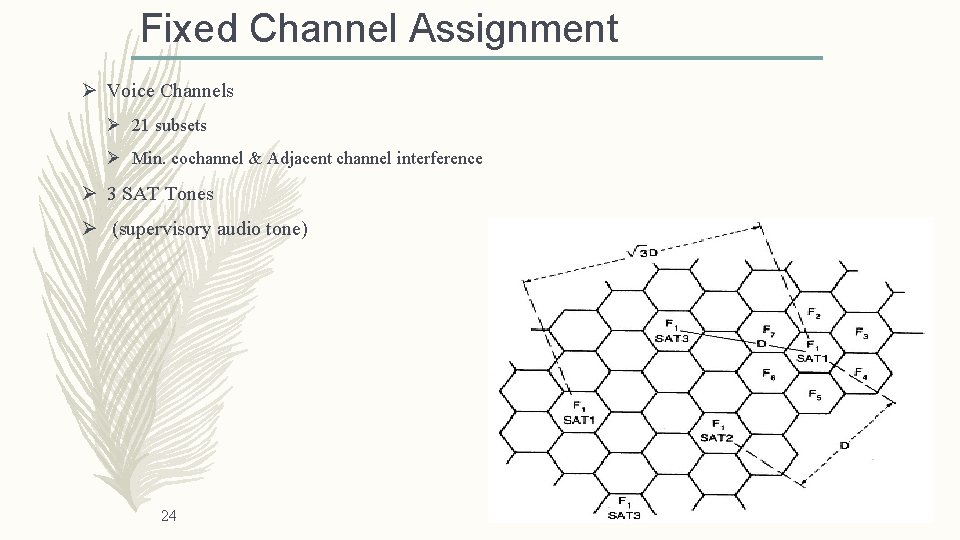
Fixed Channel Assignment Ø Voice Channels Ø 21 subsets Ø Min. cochannel & Adjacent channel interference Ø 3 SAT Tones Ø (supervisory audio tone) 24 12/4/2020
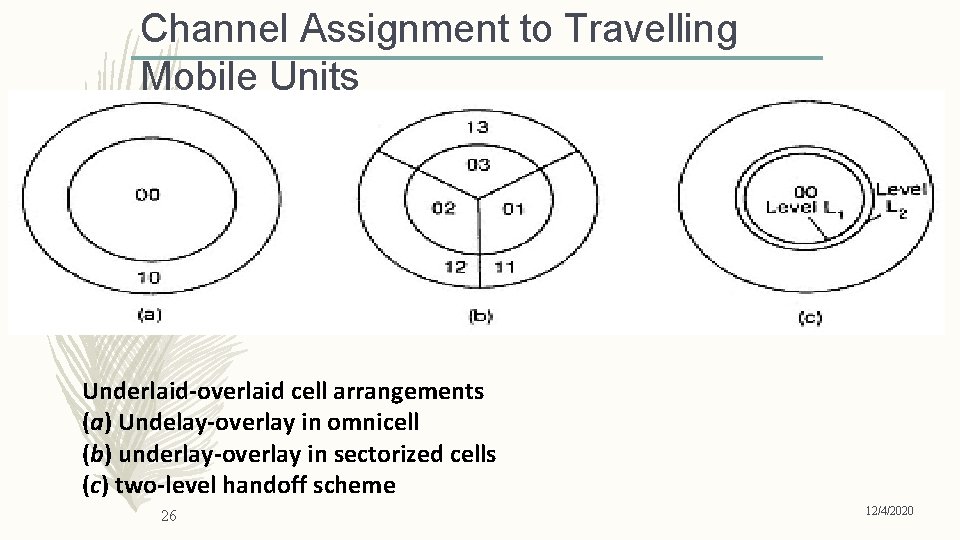
Channel Assignment to Travelling Mobile Units Ø Underlay-overlay Ø Frequency Assignment Ø Tilted Antenna 25 12/4/2020
Channel Assignment to Travelling Mobile Units Underlaid-overlaid cell arrangements (a) Undelay-overlay in omnicell (b) underlay-overlay in sectorized cells (c) two-level handoff scheme 26 12/4/2020
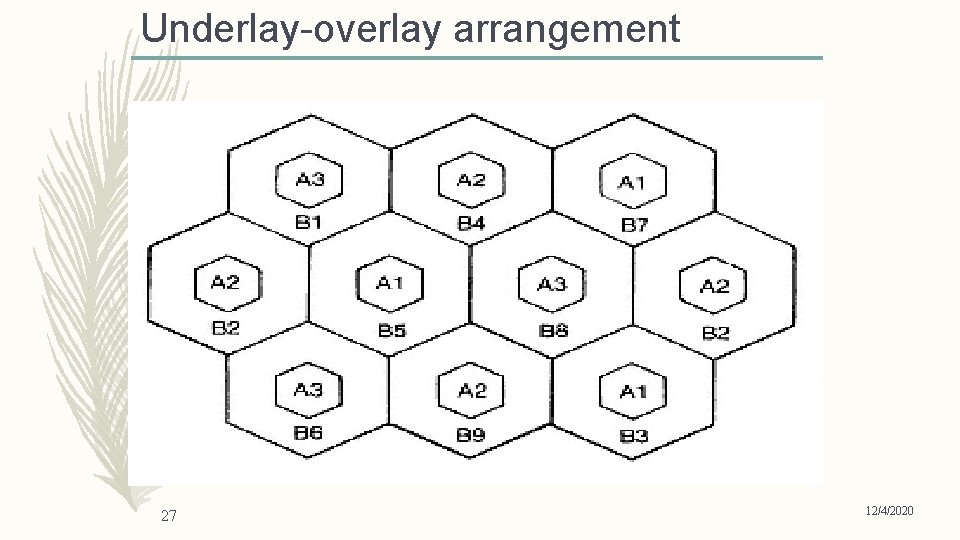
Underlay-overlay arrangement 27 12/4/2020
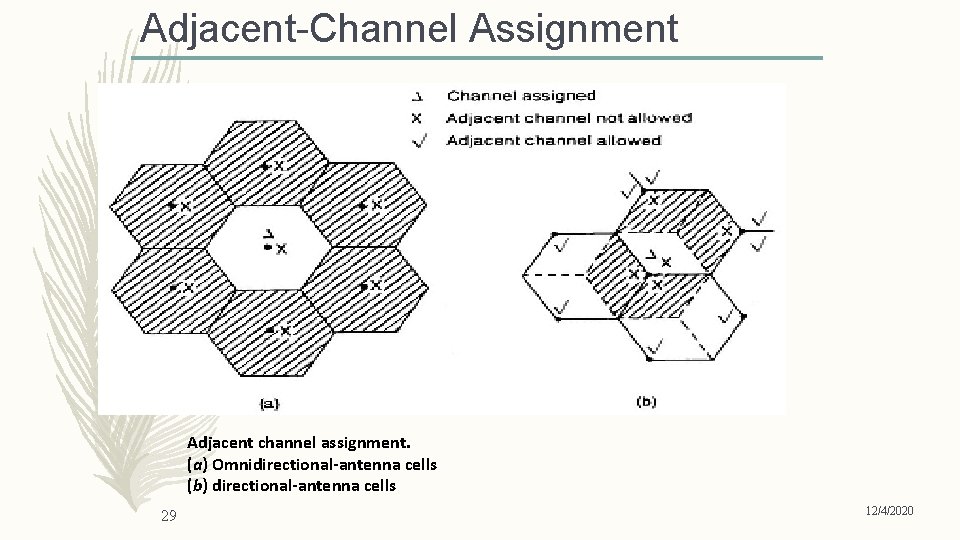
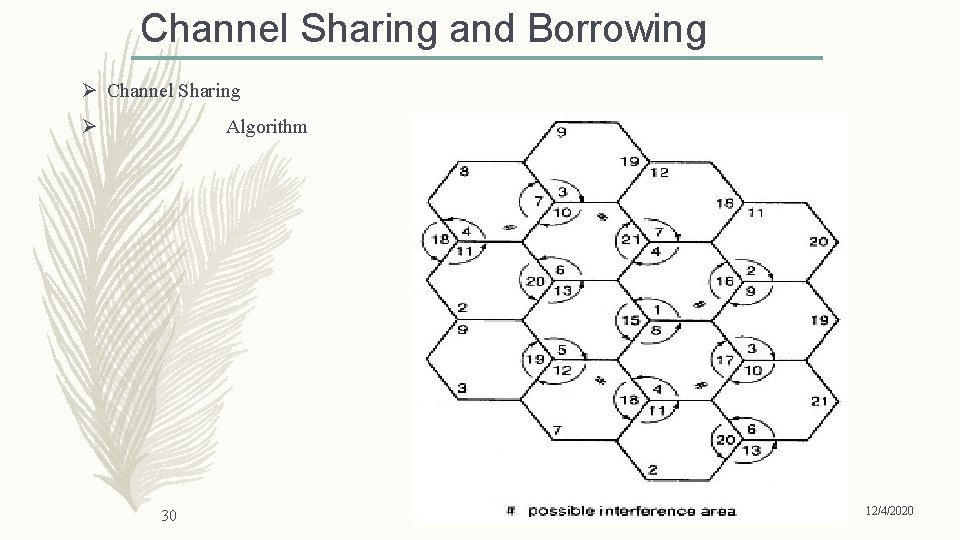
Fixed Channel Assignment Ø Adjacent-Channel Assignment Ø Channel Sharing and Borrowing Ø Sectorization 28 12/4/2020
Adjacent-Channel Assignment Adjacent channel assignment. (a) Omnidirectional-antenna cells (b) directional-antenna cells 29 12/4/2020
Channel Sharing and Borrowing Ø Channel Sharing Ø Algorithm 30 12/4/2020
Sectorization Ø The 120 o sector cell for both transmitting and receiving Ø The 60 o sector cell for both transmitting and receiving Ø 120 o or 60 o sector cell for receiving sectorization only , and transmitting antenna is omnidirectional 31 12/4/2020
Non-Fixed Channel Assignment algorithms Ø Dynamic Channel Assignment Ø Hybrid channel Assignment Ø Borrowing channel Assignment Ø Forcible-borrowing channel Assignment 32 12/4/2020
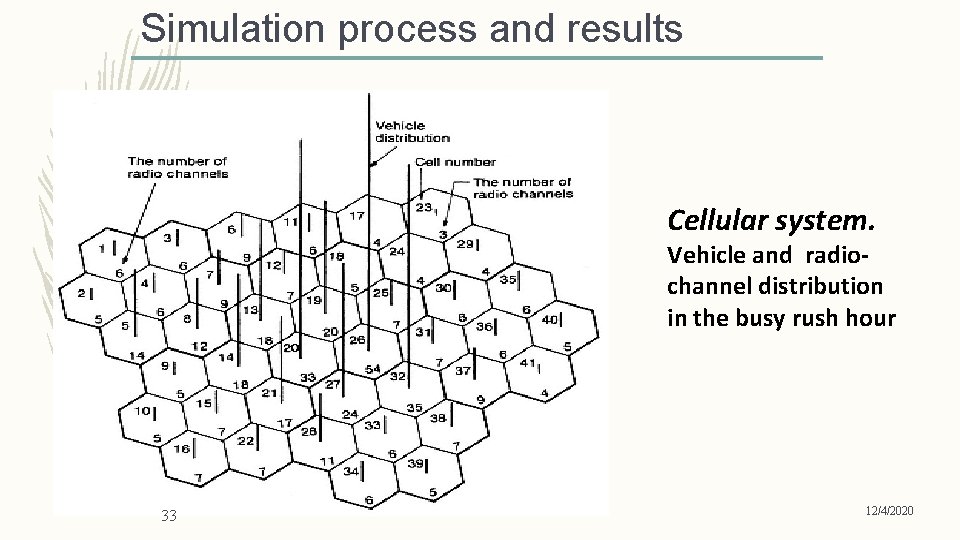
Simulation process and results Cellular system. Vehicle and radiochannel distribution in the busy rush hour 33 12/4/2020
Simulation process and results Ø Average Blocking Ø Handoff Blocking 34 12/4/2020
Ø Thank you… 35 12/4/2020
Ø Thank You njraoiisc@gmail. com; rajani 341949@yahoo. com 36 12/4/2020