
CMAQurban fine scale air pollution modelling in London
CMAQ-urban: fine scale air pollution modelling in London Nutthida Kitwiroon and Sean Beevers King’s College London MRC-HPA Centre for Environment and Health Imperial College London
Talk summary Motivation for developing the local scale modelling Modelling methods Evaluation Future work MRC-HPA Centre for Environment and Health Imperial College London
Motivation o To provide evidence of the impact on air quality, of intergovernmental, national and local authority policies o In the UK, policy’s aimed at meeting NO 2, PM 10 and PM 2. 5 EU limit values (http: //www. defra. gov. uk/publications/2011/04/13/pb 13378 -air-pollution/) o Epidemiological requirements for spatio-temporal analysis o To include space-time-activity data in exposure assessments both for policy development and to reflect the dose from pollutants that have a range of toxicity (PM). MRC-HPA Centre for Environment and Health Imperial College London
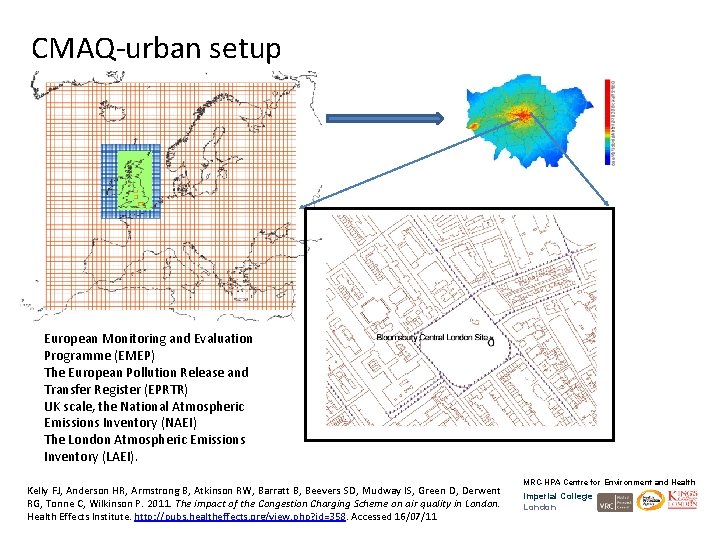
CMAQ-urban setup European Monitoring and Evaluation Programme (EMEP) The European Pollution Release and Transfer Register (EPRTR) UK scale, the National Atmospheric Emissions Inventory (NAEI) The London Atmospheric Emissions Inventory (LAEI). Kelly FJ, Anderson HR, Armstrong B, Atkinson RW, Barratt B, Beevers SD, Mudway IS, Green D, Derwent RG, Tonne C, Wilkinson P. 2011. The impact of the Congestion Charging Scheme on air quality in London. Health Effects Institute. http: //pubs. healtheffects. org/view. php? id=358. Accessed 16/07/11 MRC-HPA Centre for Environment and Health Imperial College London
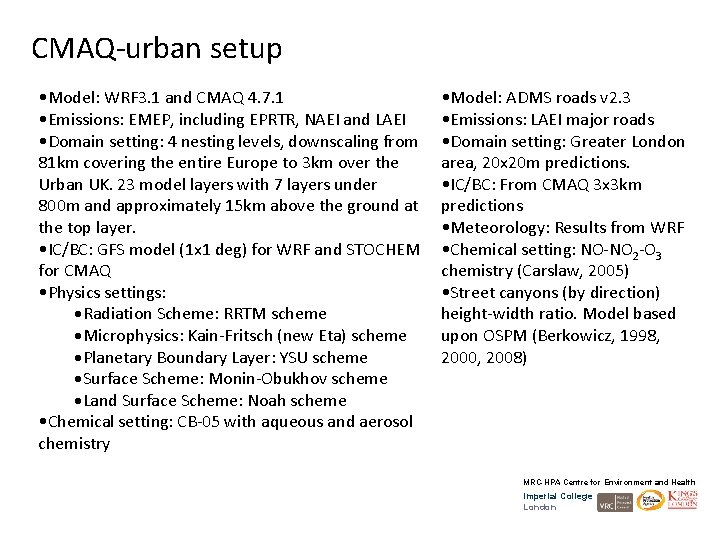
CMAQ-urban setup • Model: WRF 3. 1 and CMAQ 4. 7. 1 • Emissions: EMEP, including EPRTR, NAEI and LAEI • Domain setting: 4 nesting levels, downscaling from 81 km covering the entire Europe to 3 km over the Urban UK. 23 model layers with 7 layers under 800 m and approximately 15 km above the ground at the top layer. • IC/BC: GFS model (1 x 1 deg) for WRF and STOCHEM for CMAQ • Physics settings: Radiation Scheme: RRTM scheme Microphysics: Kain-Fritsch (new Eta) scheme Planetary Boundary Layer: YSU scheme Surface Scheme: Monin-Obukhov scheme Land Surface Scheme: Noah scheme • Chemical setting: CB-05 with aqueous and aerosol chemistry • Model: ADMS roads v 2. 3 • Emissions: LAEI major roads • Domain setting: Greater London area, 20 x 20 m predictions. • IC/BC: From CMAQ 3 x 3 km predictions • Meteorology: Results from WRF • Chemical setting: NO-NO 2 -O 3 chemistry (Carslaw, 2005) • Street canyons (by direction) height-width ratio. Model based upon OSPM (Berkowicz, 1998, 2000, 2008) MRC-HPA Centre for Environment and Health Imperial College London
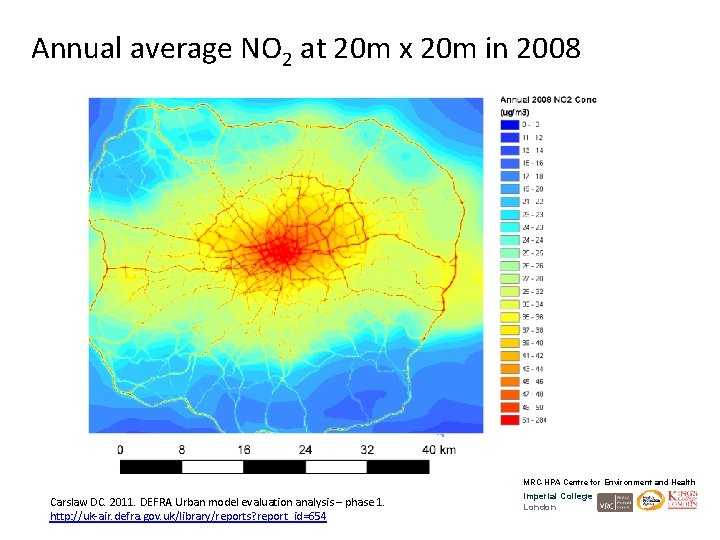
Annual average NO 2 at 20 m x 20 m in 2008 MRC-HPA Centre for Environment and Health Carslaw DC. 2011. DEFRA Urban model evaluation analysis – phase 1. http: //uk-air. defra. gov. uk/library/reports? report_id=654 Imperial College London
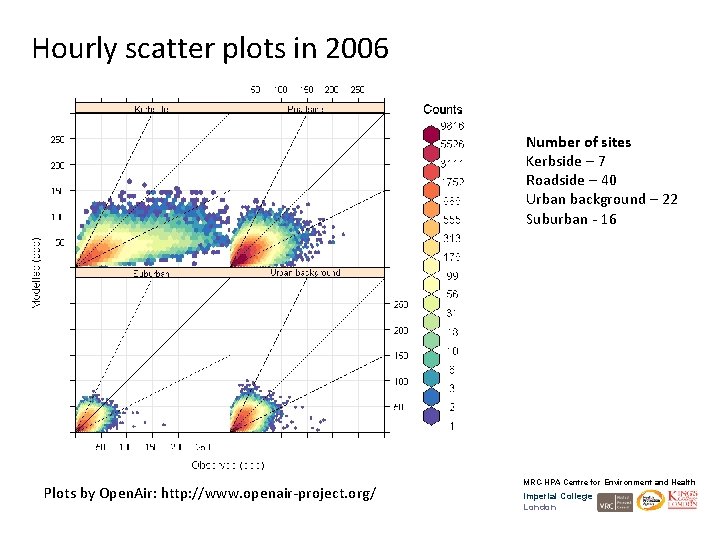
Hourly scatter plots in 2006 Number of sites Kerbside – 7 Roadside – 40 Urban background – 22 Suburban - 16 Plots by Open. Air: http: //www. openair-project. org/ MRC-HPA Centre for Environment and Health Imperial College London
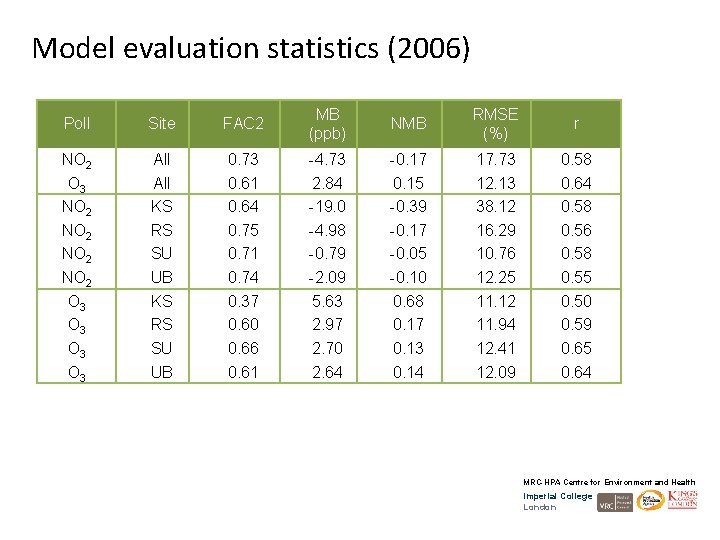
Model evaluation statistics (2006) Poll Site FAC 2 MB (ppb) NMB RMSE (%) r NO 2 O 3 NO 2 O 3 O 3 All KS RS SU UB 0. 73 0. 61 0. 64 0. 75 0. 71 0. 74 0. 37 0. 60 0. 66 0. 61 -4. 73 2. 84 -19. 0 -4. 98 -0. 79 -2. 09 5. 63 2. 97 2. 70 2. 64 -0. 17 0. 15 -0. 39 -0. 17 -0. 05 -0. 10 0. 68 0. 17 0. 13 0. 14 17. 73 12. 13 38. 12 16. 29 10. 76 12. 25 11. 12 11. 94 12. 41 12. 09 0. 58 0. 64 0. 58 0. 56 0. 58 0. 55 0. 50 0. 59 0. 65 0. 64 MRC-HPA Centre for Environment and Health Imperial College London
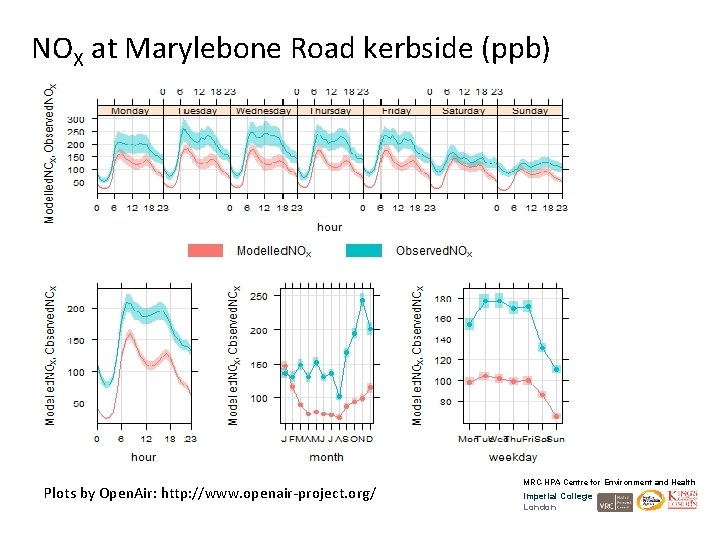
NOX at Marylebone Road kerbside (ppb) Plots by Open. Air: http: //www. openair-project. org/ MRC-HPA Centre for Environment and Health Imperial College London
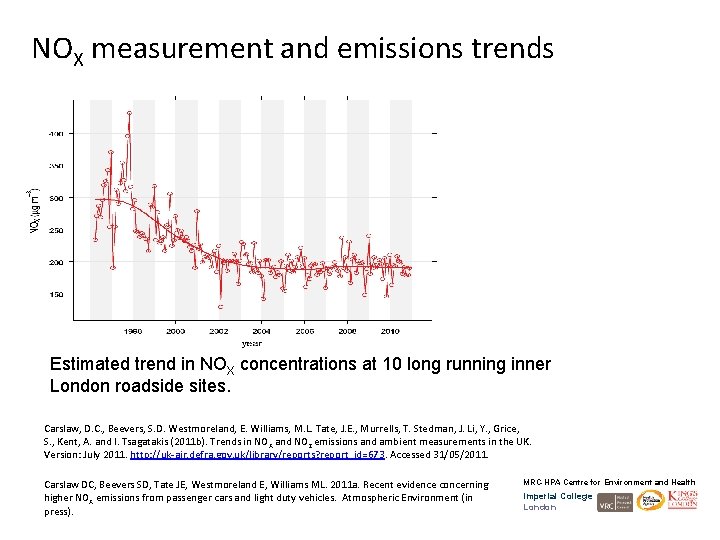
NOX measurement and emissions trends Estimated trend in NOX concentrations at 10 long running inner London roadside sites. Carslaw, D. C. , Beevers, S. D. Westmoreland, E. Williams, M. L. Tate, J. E. , Murrells, T. Stedman, J. Li, Y. , Grice, S. , Kent, A. and I. Tsagatakis (2011 b). Trends in NOX and NO 2 emissions and ambient measurements in the UK. Version: July 2011. http: //uk-air. defra. gov. uk/library/reports? report_id=673. Accessed 31/05/2011. Carslaw DC, Beevers SD, Tate JE, Westmoreland E, Williams ML. 2011 a. Recent evidence concerning higher NOX emissions from passenger cars and light duty vehicles. Atmospheric Environment (in press). MRC-HPA Centre for Environment and Health Imperial College London
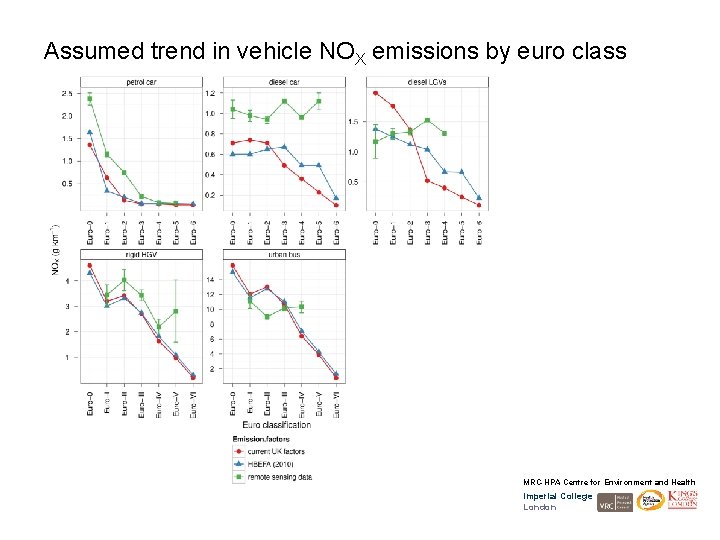
Assumed trend in vehicle NOX emissions by euro class MRC-HPA Centre for Environment and Health Imperial College London
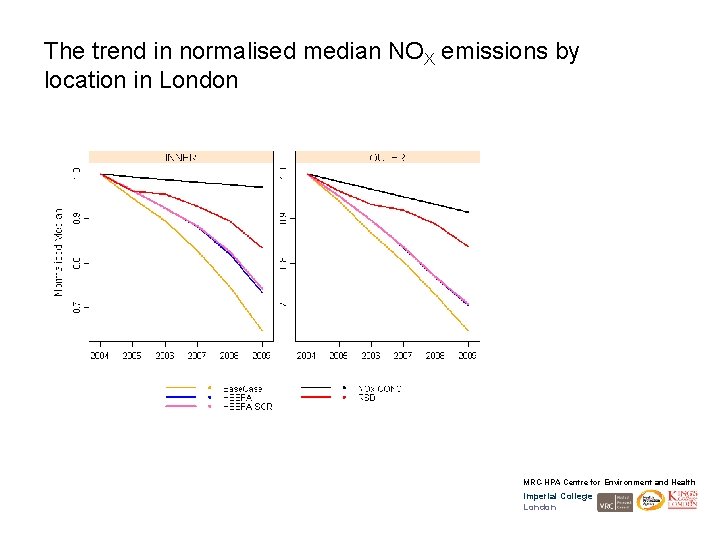
The trend in normalised median NOX emissions by location in London MRC-HPA Centre for Environment and Health Imperial College London
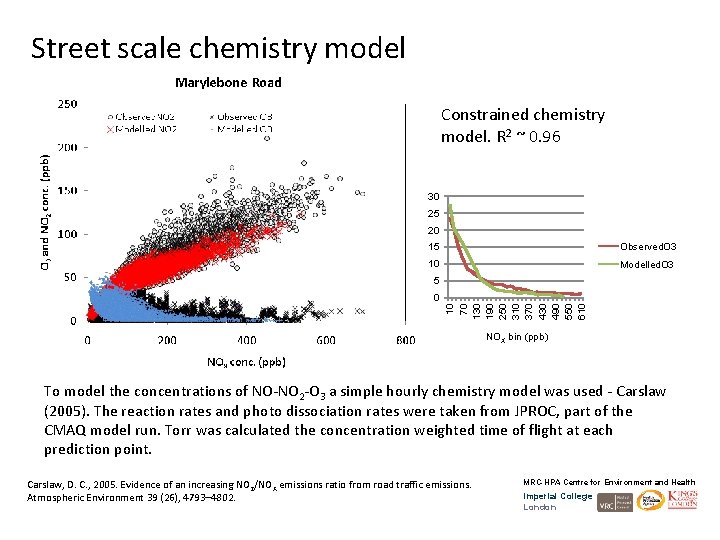
Street scale chemistry model Constrained chemistry model. R 2 ~ 0. 96 30 25 20 15 Observed. O 3 10 Modelled. O 3 0 10 70 130 190 250 310 370 430 490 550 610 5 NOX bin (ppb) To model the concentrations of NO-NO 2 -O 3 a simple hourly chemistry model was used - Carslaw (2005). The reaction rates and photo dissociation rates were taken from JPROC, part of the CMAQ model run. Torr was calculated the concentration weighted time of flight at each prediction point. Carslaw, D. C. , 2005. Evidence of an increasing NO 2/NOX emissions ratio from road traffic emissions. Atmospheric Environment 39 (26), 4793– 4802. MRC-HPA Centre for Environment and Health Imperial College London
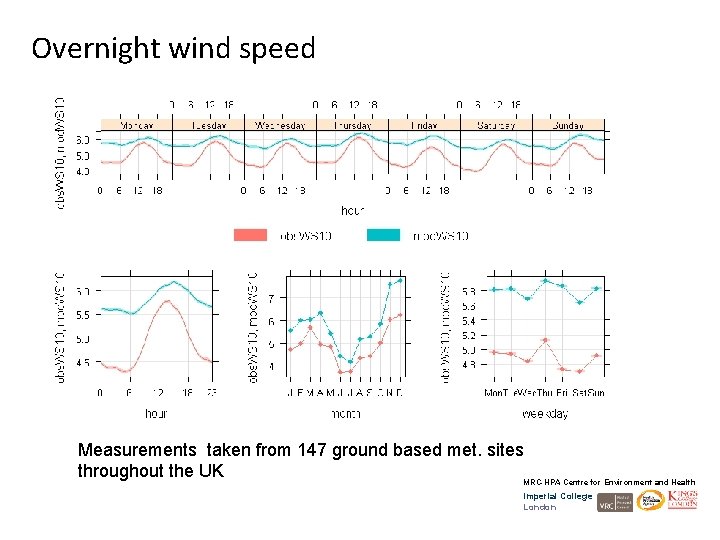
Overnight wind speed Measurements taken from 147 ground based met. sites throughout the UK MRC-HPA Centre for Environment and Health Imperial College London
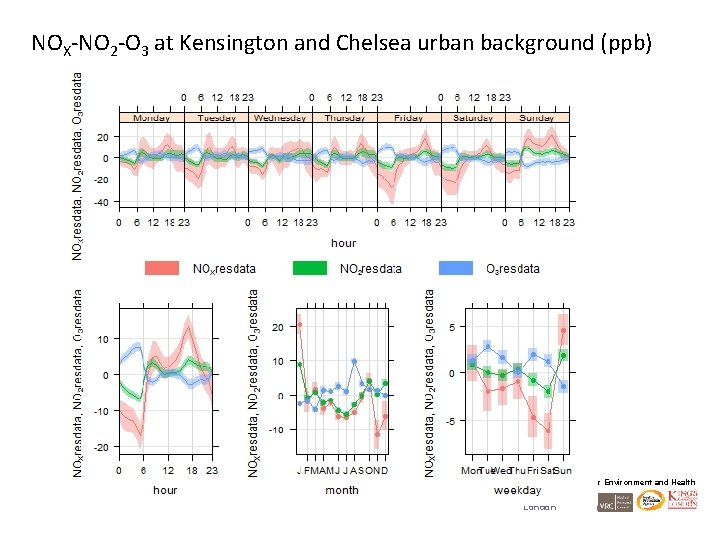
NOX-NO 2 -O 3 at Kensington and Chelsea urban background (ppb) MRC-HPA Centre for Environment and Health Imperial College London
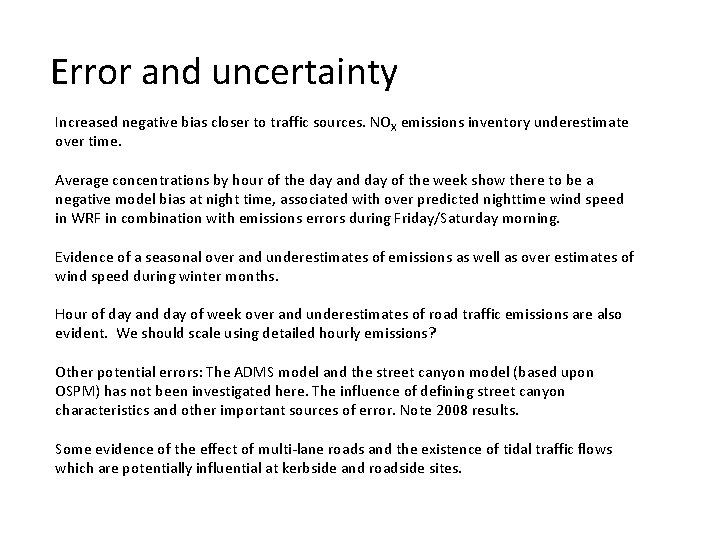
Error and uncertainty Increased negative bias closer to traffic sources. NOX emissions inventory underestimate over time. Average concentrations by hour of the day and day of the week show there to be a negative model bias at night time, associated with over predicted nighttime wind speed in WRF in combination with emissions errors during Friday/Saturday morning. Evidence of a seasonal over and underestimates of emissions as well as over estimates of wind speed during winter months. Hour of day and day of week over and underestimates of road traffic emissions are also evident. We should scale using detailed hourly emissions? Other potential errors: The ADMS model and the street canyon model (based upon OSPM) has not been investigated here. The influence of defining street canyon characteristics and other important sources of error. Note 2008 results. Some evidence of the effect of multi-lane roads and the existence of tidal traffic flows which are potentially influential at kerbside and roadside sites.
Conclusions and future work The results look promising, although some work remains. The final model will include PM - testing CMAQ v 5 beta at present. Model uses Predict NOX/NO 2/O 3 and PM 10/PM 2. 5 from European to local road scales (all in one model) Use with space-time-activity data in London to improve estimates of personal exposure and to use these in epidemiological studies. Adding exposure in specific micro-environments to the model in London e. g. Indoor/in vehicle/tube as part of the MRC/NERC “Traffic” project. MRC-HPA Centre for Environment and Health Imperial College London
Thanks for your attention… Thanks to colleagues at ERG: David Carslaw and Martin Williams Thanks to DEFRA for funding for NOX emissions trends work and Transport for London for funding the LAEI MRC-HPA Centre for Environment and Health Imperial College London
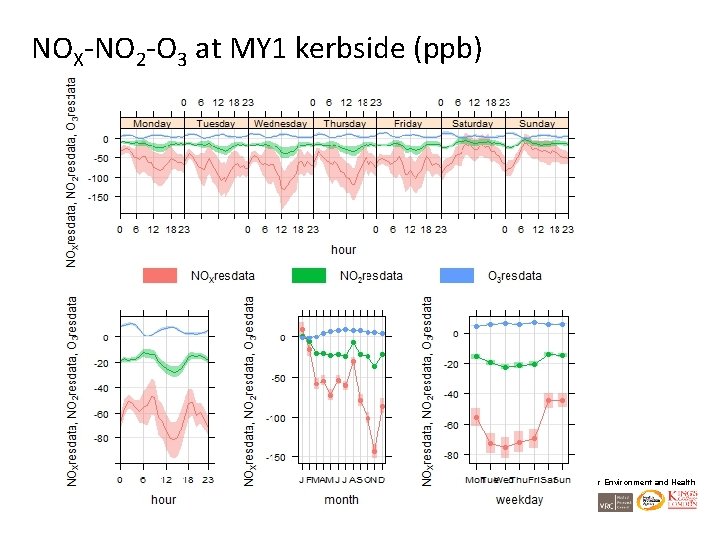
NOX-NO 2 -O 3 at MY 1 kerbside (ppb) MRC-HPA Centre for Environment and Health Imperial College London
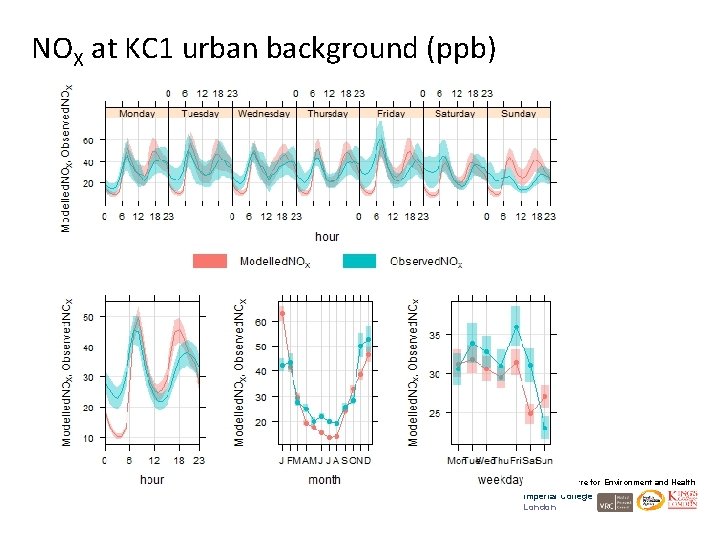
NOX at KC 1 urban background (ppb) MRC-HPA Centre for Environment and Health Imperial College London
- Slides: 20