
CM 600 Advanced Construction Finance Chapter 2 Construction
- Slides: 24
CM 600 Advanced Construction Finance Chapter 2: Construction Accounting Systems Sung Joon Suk Associate Professor Kimmel School of Construction Management College of Engineering and Technology 1
Study Focus • Construction Accounting Systems – Purposes of the Accounting System – Cost Reporting Versus Cost Control – Components of a Cost Control System – Components of Accounting Systems – Methods of Accounting – Financial Statements 2
Purposes of the Accounting System • • Process cash receipts and disbursements Prepare financial statements Pay Income and employment tax Provide data for financial management 3
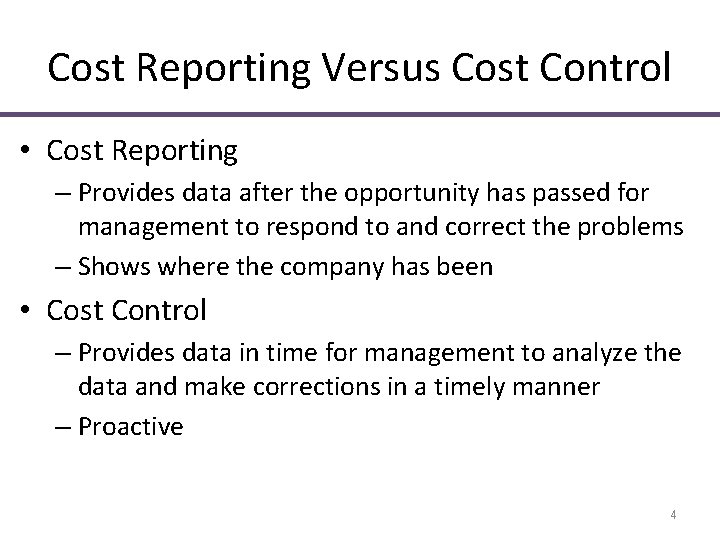
Cost Reporting Versus Cost Control • Cost Reporting – Provides data after the opportunity has passed for management to respond to and correct the problems – Shows where the company has been • Cost Control – Provides data in time for management to analyze the data and make corrections in a timely manner – Proactive 4
Components of a Cost Control System • • Strong job cost and equipment tracking Uses management by exception Follows established procedures Data must readily be available 5
Components of an Accounting System • General Ledger – Chart of accounts – Balance sheet and income statement • Job Cost Ledger – Costs by project • Equipment Ledger – Costs by piece of equipment or vehicle 6
Method of Accounting • • Cash Accrual Percentage of completion Completed contract 7
Method of Accounting (cont’d) • Cash – Revenue is recognized when payment is received – Expenses are recognized when bills are paid – Easiest to use – Little use for financial management because data is not up to date 8
Method of Accounting (cont’d) • Accrual – Revenue is recognized when the company has the right to received payment – Retention is not a revenue until the job is complete – Expenses are recognized when the company is obligated to pay bills – May pay income taxes on imaginary profits 9
Method of Accounting (cont’d) • Percentage of Completion – Revenue is recognized throughout the project – Retention is recognized throughout the project – Expenses are recognized throughout the project – Estimated profits are equally distributed throughout the project – Based upon expected revenues and expenses 10
Method of Accounting (cont’d) • Completed Contract – Revenue is recognized at completion of the project – Expenses are recognized at completion of the project – Revenues and expenses are known – Useless for financial management – May create large swings in income 11
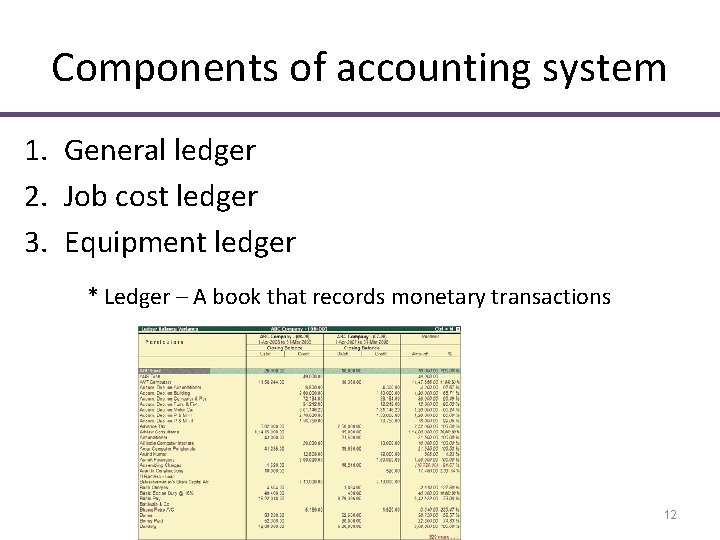
Components of accounting system 1. General ledger 2. Job cost ledger 3. Equipment ledger * Ledger – A book that records monetary transactions 12
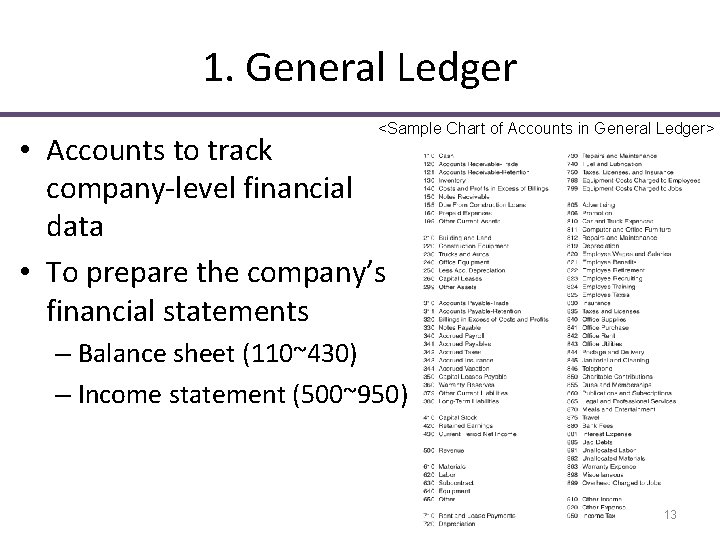
1. General Ledger <Sample Chart of Accounts in General Ledger> • Accounts to track company-level financial data • To prepare the company’s financial statements – Balance sheet (110~430) – Income statement (500~950) 13
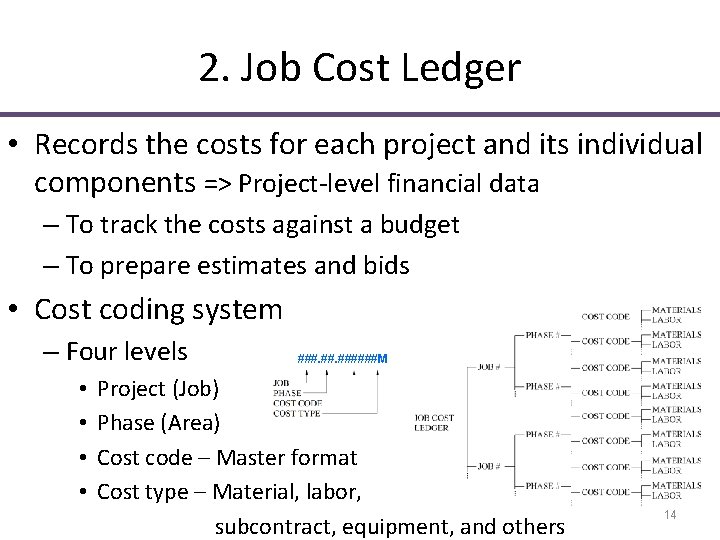
2. Job Cost Ledger • Records the costs for each project and its individual components => Project-level financial data – To track the costs against a budget – To prepare estimates and bids • Cost coding system – Four levels • • ######M Project (Job) Phase (Area) Cost code – Master format Cost type – Material, labor, subcontract, equipment, and others 14
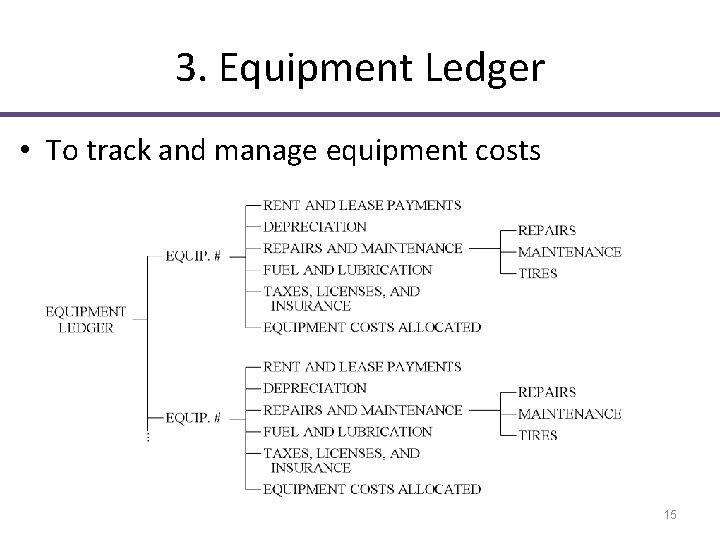
3. Equipment Ledger • To track and manage equipment costs 15
Financial Statements • Definition from Wikipedia – “a formal record of the financial activities of a business, person, or other entity” • Financial statements 1. 2. 3. 4. Balance sheet (statement of financial position) Income statement Statement of cash flows Statement of shareholder’s equity 16
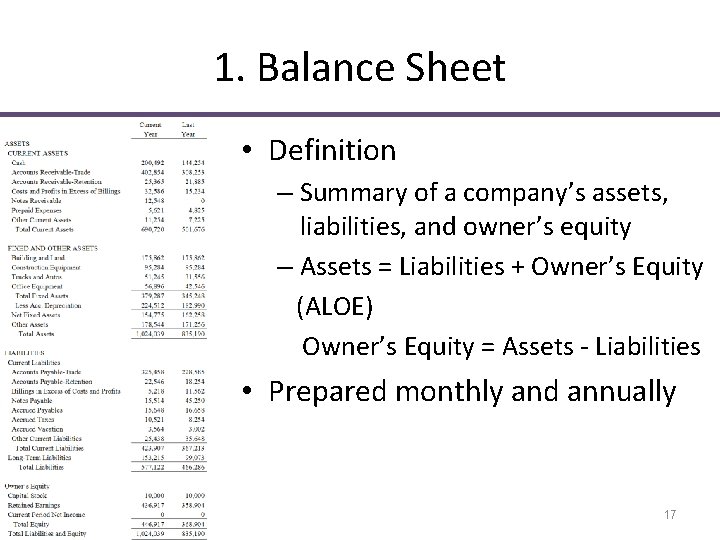
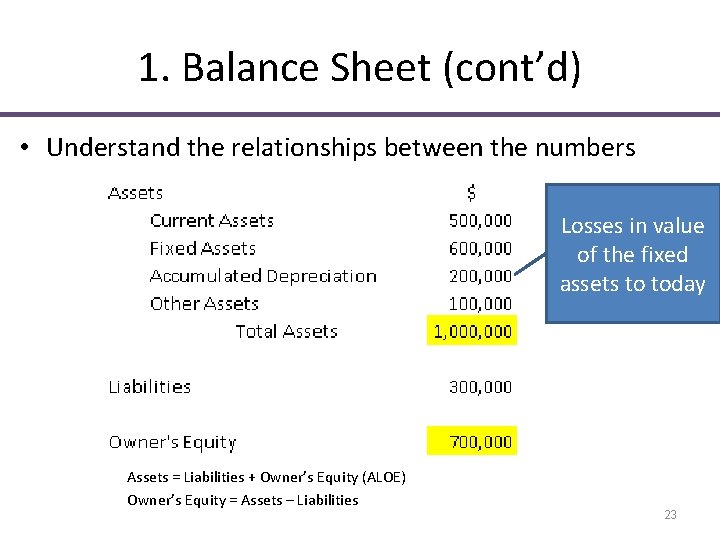
1. Balance Sheet • Definition – Summary of a company’s assets, liabilities, and owner’s equity – Assets = Liabilities + Owner’s Equity (ALOE) Owner’s Equity = Assets - Liabilities • Prepared monthly and annually 17
1. Balance Sheet (cont’d) • Assets – Resources held by the company that probably lead to some future cash inflows – Three categories • Current assets – Cash within one year • Long term assets or fixed assets – Cash not in one year • Other assets – Patent – Reputation (goodwill) 18
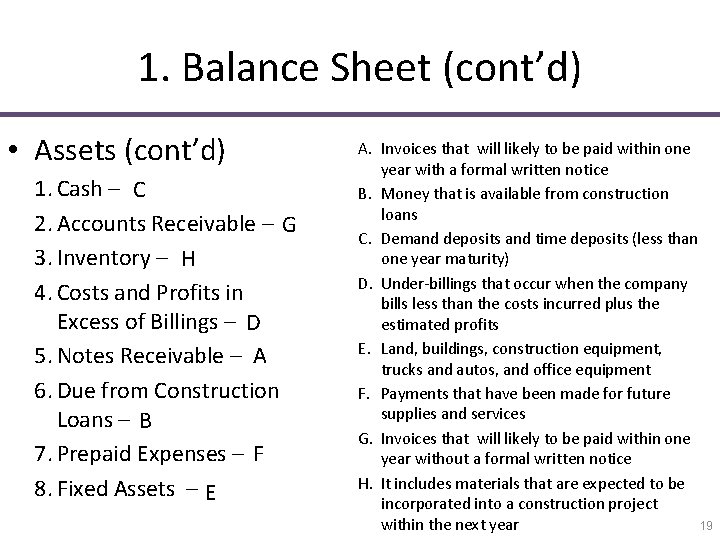
1. Balance Sheet (cont’d) • Assets (cont’d) 1. Cash ‒ C 2. Accounts Receivable ‒ G 3. Inventory ‒ H 4. Costs and Profits in Excess of Billings ‒ D 5. Notes Receivable ‒ A 6. Due from Construction Loans ‒ B 7. Prepaid Expenses ‒ F 8. Fixed Assets ‒ E A. Invoices that will likely to be paid within one year with a formal written notice B. Money that is available from construction loans C. Demand deposits and time deposits (less than one year maturity) D. Under-billings that occur when the company bills less than the costs incurred plus the estimated profits E. Land, buildings, construction equipment, trucks and autos, and office equipment F. Payments that have been made for future supplies and services G. Invoices that will likely to be paid within one year without a formal written notice H. It includes materials that are expected to be incorporated into a construction project within the next year 19
1. Balance Sheet (cont’d) • Liabilities – Financial obligations for a company to pay – Two categories • Current liabilities – To be paid within one year • Long-term liabilities – To be paid not in one year 20
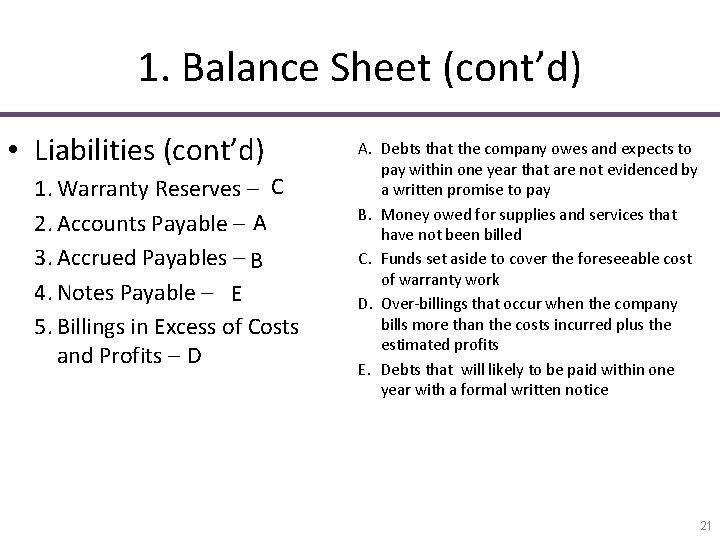
1. Balance Sheet (cont’d) • Liabilities (cont’d) 1. Warranty Reserves ‒ C 2. Accounts Payable ‒ A 3. Accrued Payables ‒ B 4. Notes Payable ‒ E 5. Billings in Excess of Costs and Profits ‒ D A. Debts that the company owes and expects to pay within one year that are not evidenced by a written promise to pay B. Money owed for supplies and services that have not been billed C. Funds set aside to cover the foreseeable cost of warranty work D. Over-billings that occur when the company bills more than the costs incurred plus the estimated profits E. Debts that will likely to be paid within one year with a formal written notice 21
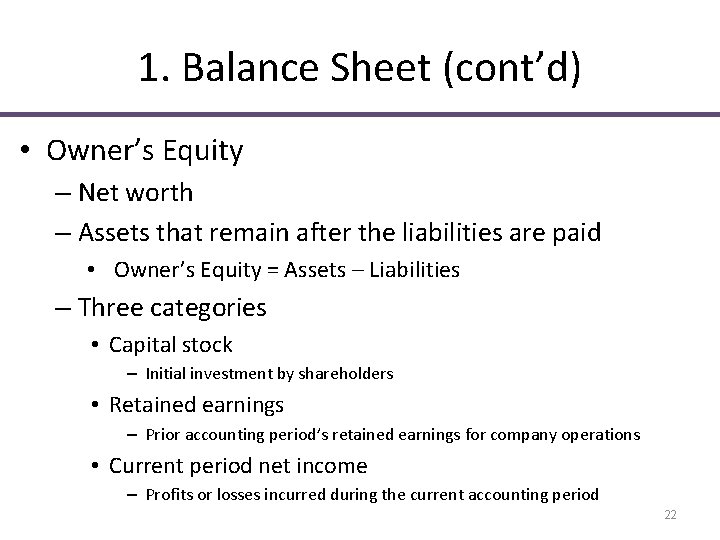
1. Balance Sheet (cont’d) • Owner’s Equity – Net worth – Assets that remain after the liabilities are paid • Owner’s Equity = Assets ‒ Liabilities – Three categories • Capital stock – Initial investment by shareholders • Retained earnings – Prior accounting period’s retained earnings for company operations • Current period net income – Profits or losses incurred during the current accounting period 22
1. Balance Sheet (cont’d) • Understand the relationships between the numbers Losses in value of the fixed assets to today Assets = Liabilities + Owner’s Equity (ALOE) Owner’s Equity = Assets – Liabilities 23
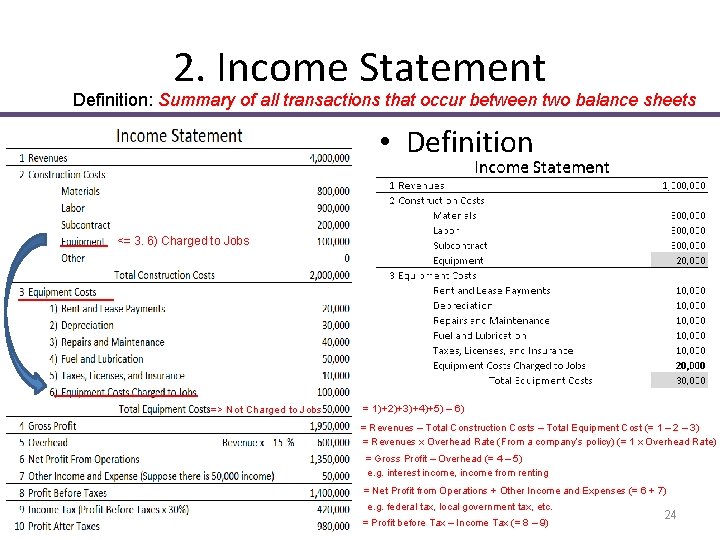
2. Income Statement Definition: Summary of all transactions that occur between two balance sheets • Definition <= 3. 6) Charged to Jobs => Not Charged to Jobs = 1)+2)+3)+4)+5) – 6) = Revenues ‒ Total Construction Costs ‒ Total Equipment Cost (= 1 ‒ 2 ‒ 3) = Revenues x Overhead Rate (From a company’s policy) (= 1 x Overhead Rate) = Gross Profit ‒ Overhead (= 4 ‒ 5) e. g. interest income, income from renting = Net Profit from Operations + Other Income and Expenses (= 6 + 7) e. g. federal tax, local government tax, etc. = Profit before Tax ‒ Income Tax (= 8 ‒ 9) 24