
Clustering Part 2 continued 1 BIRCH skipped 2
Clustering Part 2 continued 1. BIRCH skipped 2. Density-based Clustering --- DBSCAN and DENCLUE 3. GRID-based Approaches --- STING and CLIQUE 4. SOM skipped 5. Cluster Validation other set of transparencies 6. Outlier/Anomaly Detection other set of transparencies Slides in red will be used for Part 1. 1
BIRCH (1996) n n Birch: Balanced Iterative Reducing and Clustering using Hierarchies, by Zhang, Ramakrishnan, Livny (SIGMOD’ 96) Incrementally construct a CF (Clustering Feature) tree, a hierarchical data structure for multiphase clustering n n Phase 1: scan DB to build an initial in-memory CF tree (a multi-level compression of the data that tries to preserve the inherent clustering structure of the data) Phase 2: use an arbitrary clustering algorithm to cluster the leaf nodes of the CF-tree n Scales linearly: finds a good clustering with a single scan n Weakness: handles only numeric data, and sensitive to the and improves the quality with a few additional scans order of the data record. 2
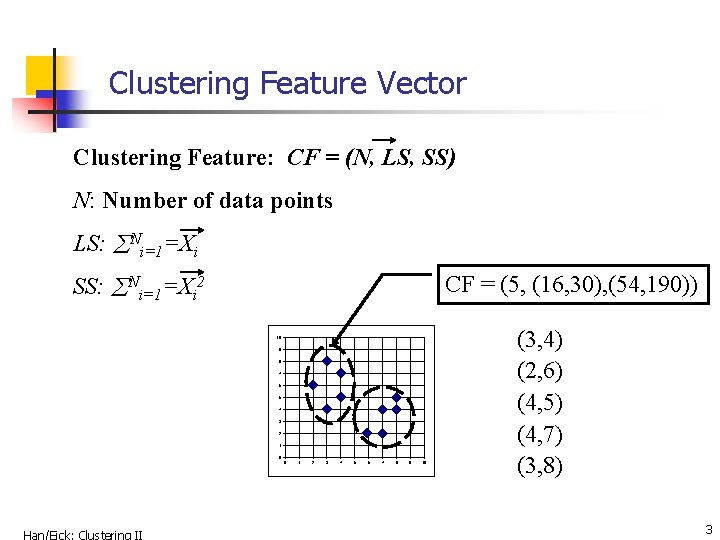
Clustering Feature Vector Clustering Feature: CF = (N, LS, SS) N: Number of data points LS: Ni=1=Xi SS: Ni=1=Xi 2 CF = (5, (16, 30), (54, 190)) 10 9 8 7 6 5 4 3 2 1 0 0 1 2 3 4 5 6 7 8 9 10 (3, 4) (2, 6) (4, 5) (4, 7) (3, 8) 3
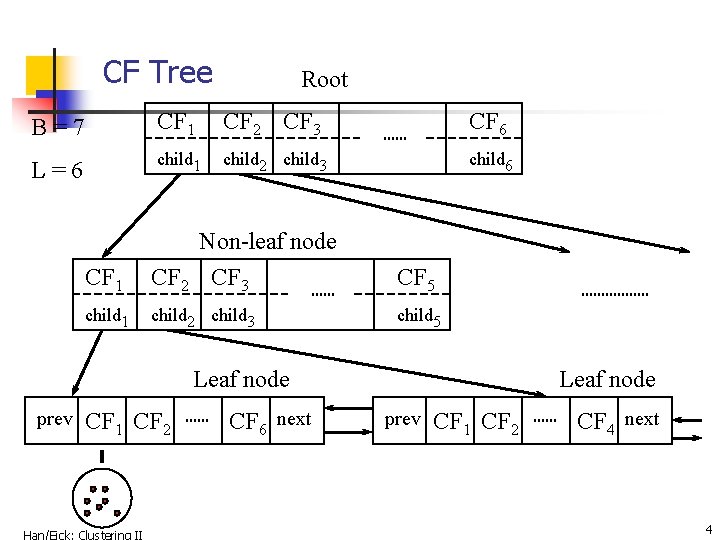
CF Tree Root B=7 CF 1 CF 2 CF 3 CF 6 L=6 child 1 child 2 child 3 child 6 CF 1 Non-leaf node CF 2 CF 3 CF 5 child 1 child 2 child 3 child 5 Leaf node prev CF 1 CF 2 CF 6 next Leaf node prev CF 1 CF 2 CF 4 next 4
Chapter 8. Cluster Analysis n What is Cluster Analysis? n Types of Data in Cluster Analysis n A Categorization of Major Clustering Methods n Partitioning Methods n Hierarchical Methods n Density-Based Methods n Grid-Based Methods n Model-Based Clustering Methods n Outlier Analysis n Summary 5
Density-Based Clustering Methods n n n Clustering based on density (local cluster criterion), such as density-connected points or based on an explicitly constructed density function Major features: n Discover clusters of arbitrary shape n Handle noise n Usually one scan n Need density estimation parameters Several interesting studies: n DBSCAN: Ester, et al. (KDD’ 96) n OPTICS: Ankerst, et al (SIGMOD’ 99). n DENCLUE: Hinneburg & D. Keim (KDD’ 98) n CLIQUE: Agrawal, et al. (SIGMOD’ 98) 6
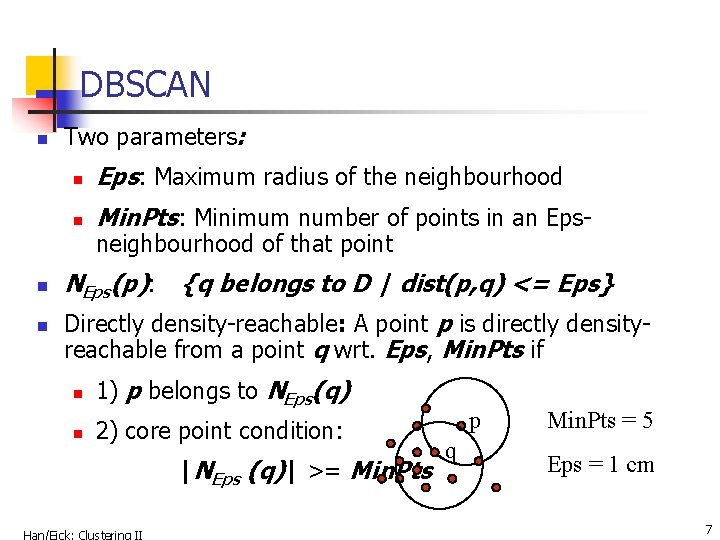
DBSCAN n n n Two parameters: n Eps: Maximum radius of the neighbourhood n Min. Pts: Minimum number of points in an Epsneighbourhood of that point NEps(p): {q belongs to D | dist(p, q) <= Eps} Directly density-reachable: A point p is directly densityreachable from a point q wrt. Eps, Min. Pts if n 1) p belongs to NEps(q) n 2) core point condition: |NEps (q)| >= Min. Pts p q Min. Pts = 5 Eps = 1 cm 7
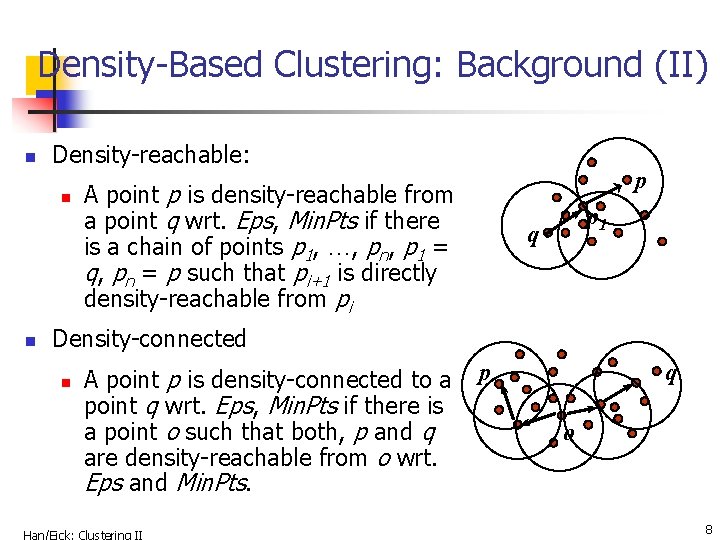
Density-Based Clustering: Background (II) n Density-reachable: n n p A point p is density-reachable from a point q wrt. Eps, Min. Pts if there is a chain of points p 1, …, pn, p 1 = q, pn = p such that pi+1 is directly density-reachable from pi p 1 q Density-connected n A point p is density-connected to a point q wrt. Eps, Min. Pts if there is a point o such that both, p and q are density-reachable from o wrt. Eps and Min. Pts. p q o 8
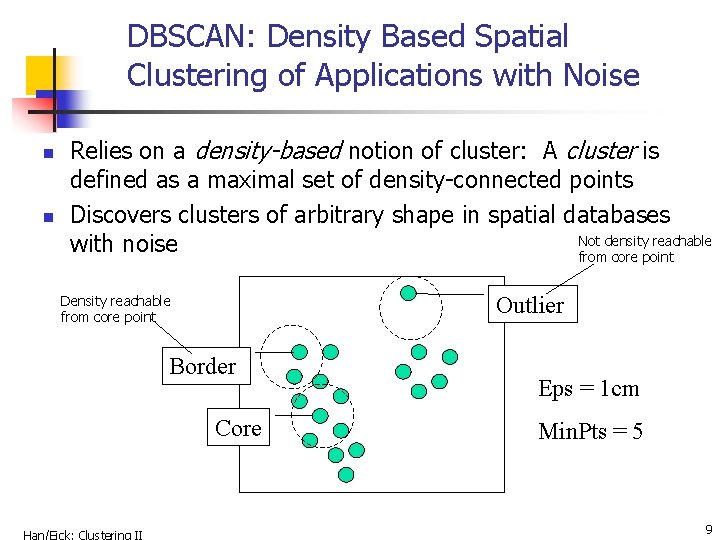
DBSCAN: Density Based Spatial Clustering of Applications with Noise n n Relies on a density-based notion of cluster: A cluster is defined as a maximal set of density-connected points Discovers clusters of arbitrary shape in spatial databases Not density reachable with noise from core point Outlier Density reachable from core point Border Core Eps = 1 cm Min. Pts = 5 9
DBSCAN: The Algorithm n n n Arbitrary select a point p Retrieve all points density-reachable from p wrt Eps and Min. Pts. If p is a core point, a cluster is formed. If p ia not a core point, no points are densityreachable from p and DBSCAN visits the next point of the database. Continue the process until all of the points have been processed. 10
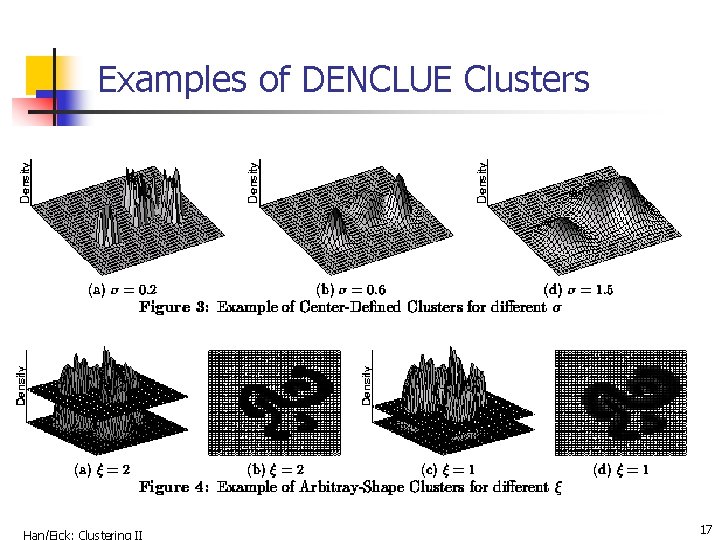
DENCLUE: using density functions n DENsity-based CLUst. Ering by Hinneburg & Keim (KDD’ 98) n Major features n Solid mathematical foundation n Good for data sets with large amounts of noise n n n Allows a compact mathematical description of arbitrarily shaped clusters in high-dimensional data sets Significant faster than existing algorithm (faster than DBSCAN by a factor of up to 45) But needs a large number of parameters 11
Denclue: Technical Essence n n n Influence function: describes the impact of a data point within its neighborhood. Overall density of the data space can be calculated as the sum of the influences of all data points. Clusters can be determined mathematically by identifying density attractors; object that are associated with the same density attractor belong to the same cluster Density attractors are local maximal of the overall density function. Uses grid-cells to speed up computations; only data points in neighboring grid-cells are used to determine the density for a point. 12
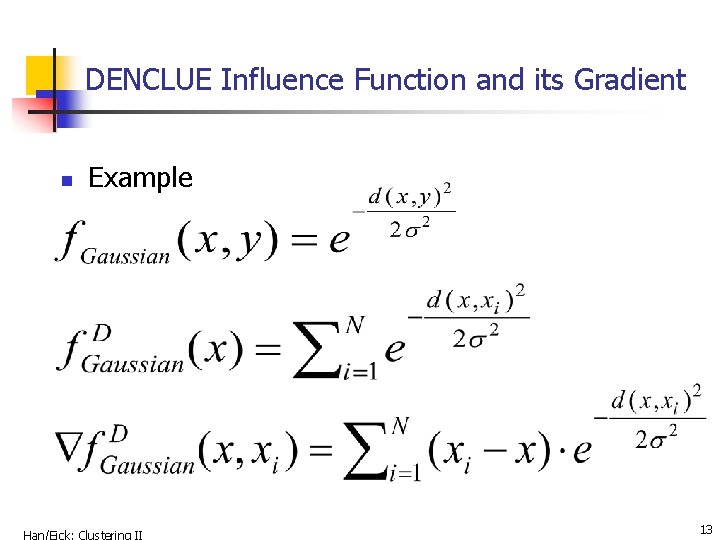
DENCLUE Influence Function and its Gradient n Example 13
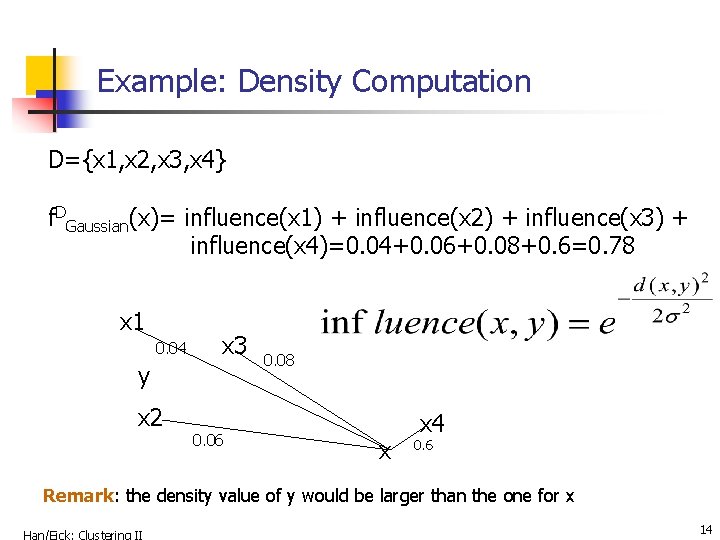
Example: Density Computation D={x 1, x 2, x 3, x 4} f. DGaussian(x)= influence(x 1) + influence(x 2) + influence(x 3) + influence(x 4)=0. 04+0. 06+0. 08+0. 6=0. 78 x 1 0. 04 x 3 y x 2 0. 06 0. 08 x x 4 0. 6 Remark: the density value of y would be larger than the one for x 14
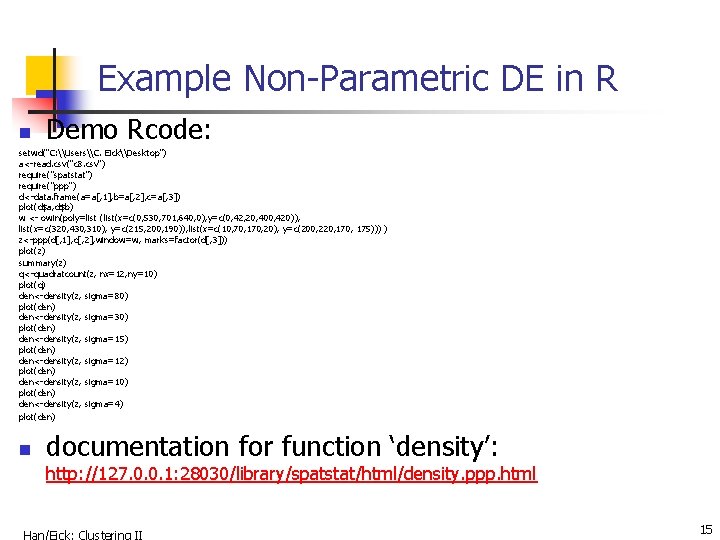
Example Non-Parametric DE in R n Demo Rcode: setwd("C: \Users\C. Eick\Desktop") a<-read. csv("c 8. csv") require("spatstat") require("ppp") d<-data. frame(a=a[, 1], b=a[, 2], c=a[, 3]) plot(d$a, d$b) w <- owin(poly=list (list(x=c(0, 530, 701, 640, 0), y=c(0, 42, 20, 400, 420)), list(x=c(320, 430, 310), y=c(215, 200, 190)), list(x=c(10, 70, 170, 20), y=c(200, 220, 175))) ) z<-ppp(d[, 1], d[, 2], window=w, marks=factor(d[, 3])) plot(z) summary(z) q<-quadratcount(z, nx=12, ny=10) plot(q) den<-density(z, sigma=80) plot(den) den<-density(z, sigma=30) plot(den) den<-density(z, sigma=15) plot(den) den<-density(z, sigma=12) plot(den) den<-density(z, sigma=10) plot(den) den<-density(z, sigma=4) plot(den) n documentation for function ‘density’: http: //127. 0. 0. 1: 28030/library/spatstat/html/density. ppp. html 15
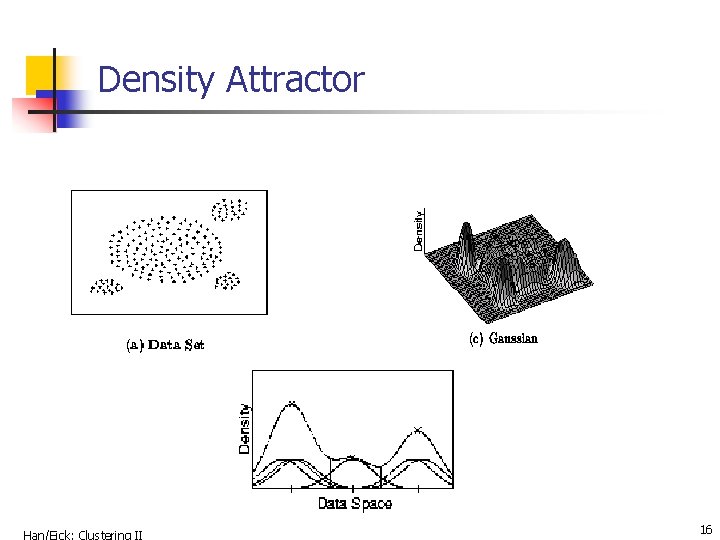
Density Attractor 16
Examples of DENCLUE Clusters 17
Basic Steps DENCLUE Algorithms 1. 2. 3. Determine density attractors Associate data objects with density attractors using hill climbing ( initial clustering) Merge the initial clusters further relying on a hierarchical clustering approach (optional) 18
Density-based Clustering: Pros and Cons n +: can discover clusters of arbitrary shape +: not sensitive to outliers and supports outlier detection n n +: can handle noise n +-: medium algorithm complexities -: finding good density estimation parameters is frequently difficult; more difficult to use than K-means. n -: usually, do not do well in clustering highdimensional datasets. n n -: cluster models are not well understood (yet) 19
Chapter 8. Cluster Analysis n What is Cluster Analysis? n Types of Data in Cluster Analysis n A Categorization of Major Clustering Methods n Partitioning Methods n Hierarchical Methods n Density-Based Methods n Grid-Based Methods n Model-Based Clustering Methods n Outlier Analysis n Summary 20
Steps of Grid-based Clustering Algorithms Basic Grid-based Algorithm 1. Define a set of grid-cells 2. Assign objects to the appropriate grid cell and compute the density of each cell. 3. Eliminate cells, whose density is below a certain threshold . 4. Form clusters from contiguous (adjacent) groups of dense cells (usually minimizing a given objective function). 21
Advantages of Grid-based Clustering Algorithms n n fast: n No distance computations n Clustering is performed on summaries and not individual objects; complexity is usually O(#populated-grid-cells) and not O(#objects) n Easy to determine which clusters are neighboring Shapes are limited to union of rectangular gridcells 22

Grid-Based Clustering Methods n Several interesting methods (in addition to the basic gridbased algorithm) n n STING (a STatistical INformation Grid approach) by Wang, Yang and Muntz (1997) CLIQUE: Agrawal, et al. (SIGMOD’ 98) 23
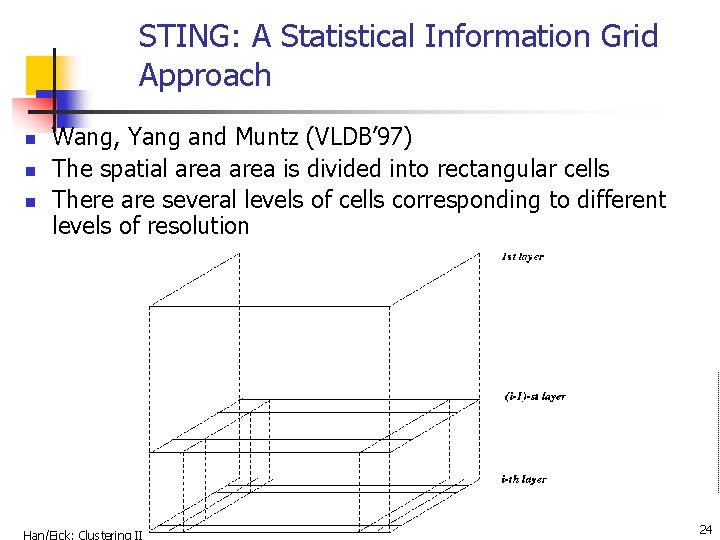
STING: A Statistical Information Grid Approach n n n Wang, Yang and Muntz (VLDB’ 97) The spatial area is divided into rectangular cells There are several levels of cells corresponding to different levels of resolution 24
STING: A Statistical Information Grid Approach (2) n n n n Main contribution of STING is the proposal of a data structure that can be used for many purposes (e. g. SCMRG, BIRCH kind of uses it) The data structure is used to form clusters based on queries Each cell at a high level is partitioned into a number of smaller cells in the next lower level Statistical info of each cell is calculated and stored beforehand is used to answer queries Parameters of higher level cells can be easily calculated from parameters of lower level cell n count, mean, s, min, max n type of distribution—normal, uniform, etc. Use a top-down approach to answer spatial data queries Clusters are formed by merging cells that match a given query description ( next slide) 25
STING: Query Processing(3) Used a top-down approach to answer spatial data queries 1. Start from a pre-selected layer—typically with a small number of cells 2. From the pre-selected layer until you reach the bottom layer do the following: n 3. For each cell in the current level compute the confidence interval indicating a cell’s relevance to a given query; n If it is relevant, include the cell in a cluster n If it irrelevant, remove cell from further consideration n otherwise, look for relevant cells at the next lower layer Combine relevant cells into relevant regions (based on gridneighborhood) and return the so obtained clusters as your answers. 26
STING: A Statistical Information Grid Approach (3) n n Advantages: n Query-independent, easy to parallelize, incremental update n O(K), where K is the number of grid cells at the lowest level n Can be used in conjunction with a grid-based clustering algorithm Disadvantages: n All the cluster boundaries are either horizontal or vertical, and no diagonal boundary is detected 27
Subspace Clustering n Clustering in very high-dimensional spaces is very difficult n High dimensional attribute spaces tend to be sparse it is hard to find any clusters n It is very difficult to create summaries from clusters in very difficult n This creates the motivation for subspace clustering: n Find interesting subspaces (areas that are dense with respect to the attributes belonging to the subspace) n Find clusters for each interesting n Remark: multiple, overlapping clusters might be obtained; basically one clustering for each subspace. 28
CLIQUE (Clustering In QUEst) n Agrawal, Gehrke, Gunopulos, Raghavan (SIGMOD’ 98). n Automatically identifying subspaces of a high dimensional data space that allow better clustering than original space n CLIQUE can be considered as both density-based and gridbased n It partitions each dimension into the same number of equal length interval n It partitions an m-dimensional data space into nonoverlapping rectangular units n A unit is dense if the fraction of total data points contained in the unit exceeds the input model parameter n A cluster is a maximal set of connected dense units within a subspace 29
CLIQUE: The Major Steps n n n Partition the data space and find the number of points that lie inside each cell of the partition. Identify the subspaces that contain clusters using the Apriori principle Identify clusters: n n Determine dense units in all subspaces of interests Determine connected dense units in all subspaces of interests. 30
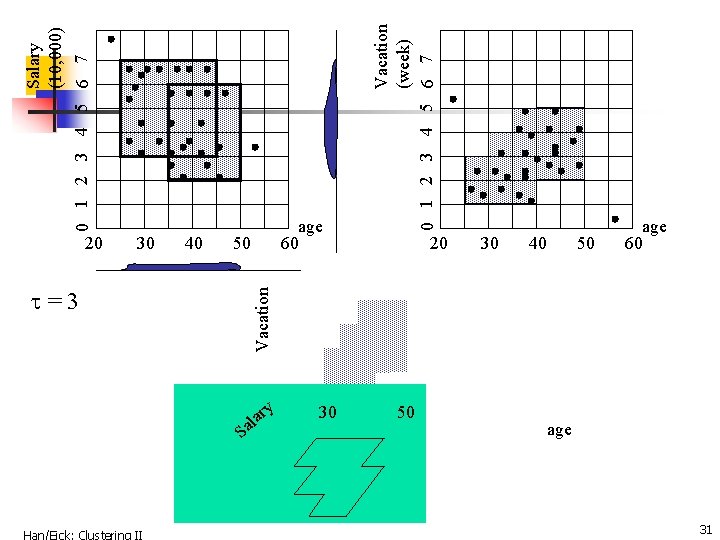
=3 30 40 Vacation 20 50 Salary (10, 000) 0 1 2 3 4 5 6 7 r a l Sa y 30 Vacation (week) 0 1 2 3 4 5 6 7 age 60 20 50 30 40 50 age 60 age 31
Strength and Weakness of CLIQUE n n Strength n It automatically finds subspaces of the highest dimensionality such that high density clusters exist in those subspaces n It is insensitive to the order of records in input and does not presume some canonical data distribution n It scales linearly with the size of input and has good scalability as the number of dimensions in the data increases Weakness n The accuracy of the clustering result may be degraded at the expense of simplicity of the method n Quite expensive 32
Self-organizing feature maps (SOMs) n n n Clustering is also performed by having several units competing for the current object The unit whose weight vector is closest to the current object wins The winner and its neighbors learn by having their weights adjusted SOMs are believed to resemble processing that can occur in the brain Useful for visualizing high-dimensional data in 2 - or 3 -D space 33
References (1) n n n n n R. Agrawal, J. Gehrke, D. Gunopulos, and P. Raghavan. Automatic subspace clustering of high dimensional data for data mining applications. SIGMOD'98 M. R. Anderberg. Cluster Analysis for Applications. Academic Press, 1973. M. Ankerst, M. Breunig, H. -P. Kriegel, and J. Sander. Optics: Ordering points to identify the clustering structure, SIGMOD’ 99. P. Arabie, L. J. Hubert, and G. De Soete. Clustering and Classification. World Scietific, 1996 M. Ester, H. -P. Kriegel, J. Sander, and X. Xu. A density-based algorithm for discovering clusters in large spatial databases. KDD'96. M. Ester, H. -P. Kriegel, and X. Xu. Knowledge discovery in large spatial databases: Focusing techniques for efficient class identification. SSD'95. D. Fisher. Knowledge acquisition via incremental conceptual clustering. Machine Learning, 2: 139 -172, 1987. D. Gibson, J. Kleinberg, and P. Raghavan. Clustering categorical data: An approach based on dynamic systems. In Proc. VLDB’ 98. S. Guha, R. Rastogi, and K. Shim. Cure: An efficient clustering algorithm for large databases. SIGMOD'98. A. K. Jain and R. C. Dubes. Algorithms for Clustering Data. Printice Hall, 1988. 34
References (2) n n n n n L. Kaufman and P. J. Rousseeuw. Finding Groups in Data: an Introduction to Cluster Analysis. John Wiley & Sons, 1990. E. Knorr and R. Ng. Algorithms for mining distance-based outliers in large datasets. VLDB’ 98. G. J. Mc. Lachlan and K. E. Bkasford. Mixture Models: Inference and Applications to Clustering. John Wiley and Sons, 1988. P. Michaud. Clustering techniques. Future Generation Computer systems, 13, 1997. R. Ng and J. Han. Efficient and effective clustering method for spatial data mining. VLDB'94. E. Schikuta. Grid clustering: An efficient hierarchical clustering method for very large data sets. Proc. 1996 Int. Conf. on Pattern Recognition, 101 -105. G. Sheikholeslami, S. Chatterjee, and A. Zhang. Wave. Cluster: A multi-resolution clustering approach for very large spatial databases. VLDB’ 98. W. Wang, Yang, R. Muntz, STING: A Statistical Information grid Approach to Spatial Data Mining, VLDB’ 97. T. Zhang, R. Ramakrishnan, and M. Livny. BIRCH : an efficient data clustering method for very large databases. SIGMOD'96. 35
- Slides: 35