
Clustering of peptide fragment structures reveals natures building
Clustering of peptide fragment structures reveals nature’s building block approach Ashish V. Tendulkar Research Scholar Kanwal Rekhi School of I. T. I. I. T. Bombay Guide: Prof. P. Wangikar Co-guide: Prof. Sunita Sarawagi
Outline Terms Objectives Approach Results Conclusion
Terms Protein is made up of amino acids. There are in all 20 different types amino acids. Protein is a linear sequence of amino acid. Protein takes up 3 -D structure. The structure is result of its amino acid sequence.
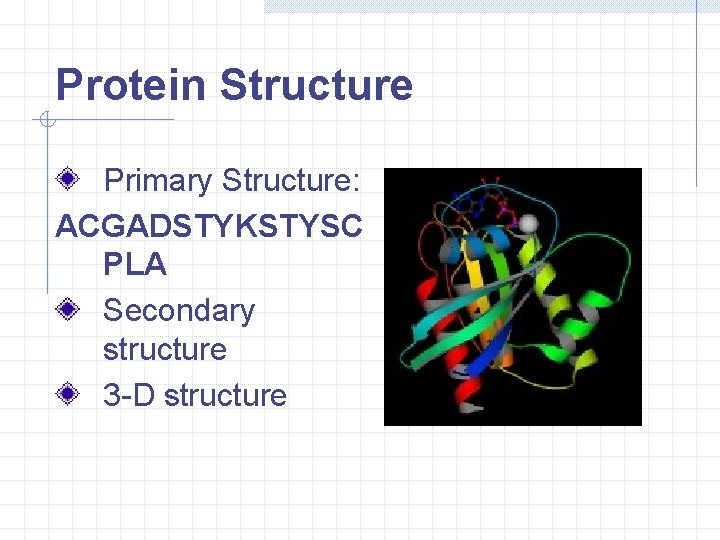
Protein Structure Primary Structure: ACGADSTYKSTYSC PLA Secondary structure 3 -D structure
Objectives Prediction of protein structure from merely its sequence. Protein sequence is believed to take up vast number of conformations Learn relation between sequence and structure by example of known protein structures. Build library of sequence-structure mapping
Salient Features Geometric invariant: A quantity, which is unchanged under a group of geometric transformations, in this case, the group of translations and rotations in 3 dimensional space. Examples of continuous invariants: signed volumes, areas, lengths. For our group of transformations, it has been shown that invariants suffice to decide superimposability of two structures. Thus, if two patterns K 1 and K 2 are not superimposable then there is an invariant f such that f(K 1) ≉ f(K 2).
Salient Features We discretize a structure by its evaluations on a fixed suite of N invariants and mapped into the N-dimensional space as a vector. We examine 1. 2 million peptides from 4, 500 non-redundant protein structures. This collection may now be subjected to the tools of data-mining. Clustering of Patterns: A cluster is a small region in this Nspace, which has a large number of pattern-vectors. Closeness of points and density is decided via a training regime

All overlapping octapeptide fragments from PDB_95 Geometric invariant based representation of each peptide as a point in 56 -dimensional space and clustering Dense cluster of peptides in a 56 -dimensiona box GIk GI 56 GI 2 Wi GI 1 Training regime to decide the tolerance window Wi in each dimension based on known superimposable peptides. Categorization of clusters “Functional” clusters with majority of peptides drawn from a single SCOP superfamily. “Structural” clusters Hierarchical clustering based on closeness of centroinds of clusters
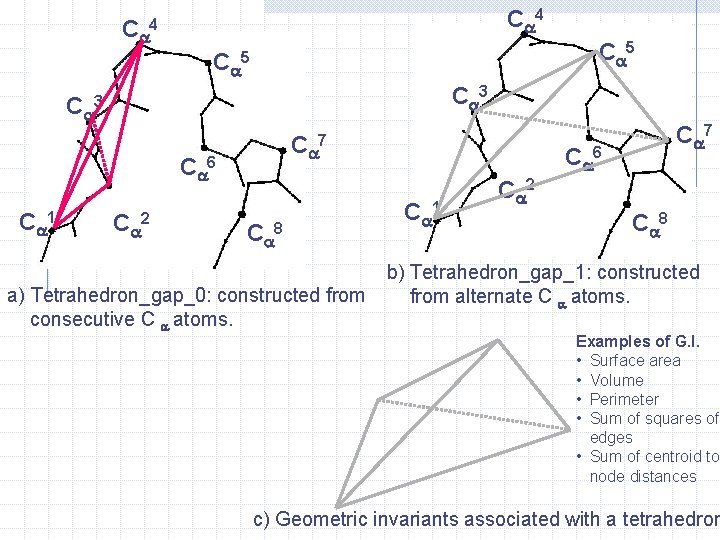
C C 4 4 C C C 3 3 C C 1 C 5 5 C 2 C 6 C 7 8 a) Tetrahedron_gap_0: constructed from consecutive C atoms. C 7 C 6 C 1 C 2 C 8 b) Tetrahedron_gap_1: constructed from alternate C atoms. Examples of G. I. • Surface area • Volume • Perimeter • Sum of squares of edges • Sum of centroid to node distances c) Geometric invariants associated with a tetrahedron
Summary of Peptide Library 12000 clusters, size range from 5 -160, 000. 2000 functional clusters. Demonstrates nature’s bias toward a selected conformations. Potential applications in protein structure prediction.
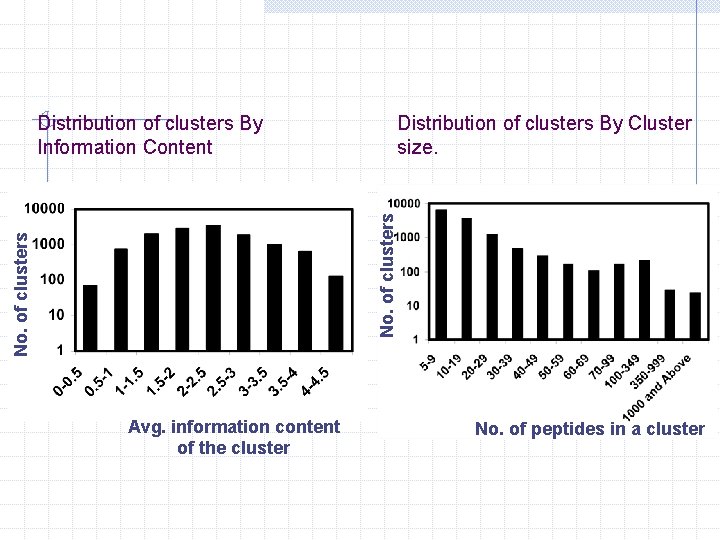
Distribution of clusters By Cluster size. No. of clusters Distribution of clusters By Information Content Avg. information content of the cluster No. of peptides in a cluster
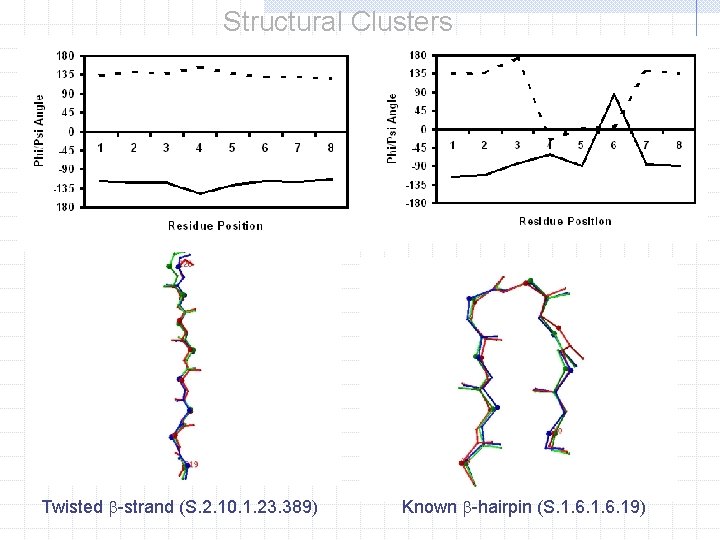
Structural Clusters Twisted -strand (S. 2. 10. 1. 23. 389) Known -hairpin (S. 1. 6. 19)
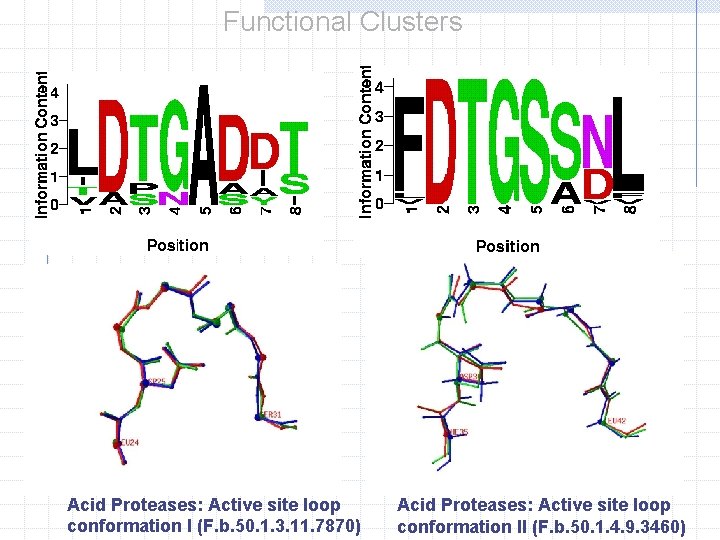
Functional Clusters Acid Proteases: Active site loop conformation I (F. b. 50. 1. 3. 11. 7870) Acid Proteases: Active site loop conformation II (F. b. 50. 1. 4. 9. 3460)
Conclusions Century old “Geometric Invariant theory” applied to protein structure for the first time. Peptide fragment library(DPFS) can be used in protein structure prediction. It is available on web at www. it. iitb. ac. in/dpfs/
Acknowledgements Prof. Milind Sohoni for his inputs on Geometric Invariants Anand Joshi for his contribution in the project
- Slides: 15