
Clustering Big Data Lecture 4 Emphasis on Streaming
Clustering Big Data: Lecture 4 Emphasis on Streaming http: //www. cohenwang. com/edith/bigdataclass 2013 Instructors: Edith Cohen Amos Fiat Haim Kaplan Tova Milo
Credit to Evimaria Terzi, Moses Charikar § Many slides from http: //www. cs. bu. edu/~evimaria/ § Also from presentation of Moses Charikar http: //www. aladdin. cs. cmu. edu/workshops. . /integrated_wshp/logistics-cmu. pdf
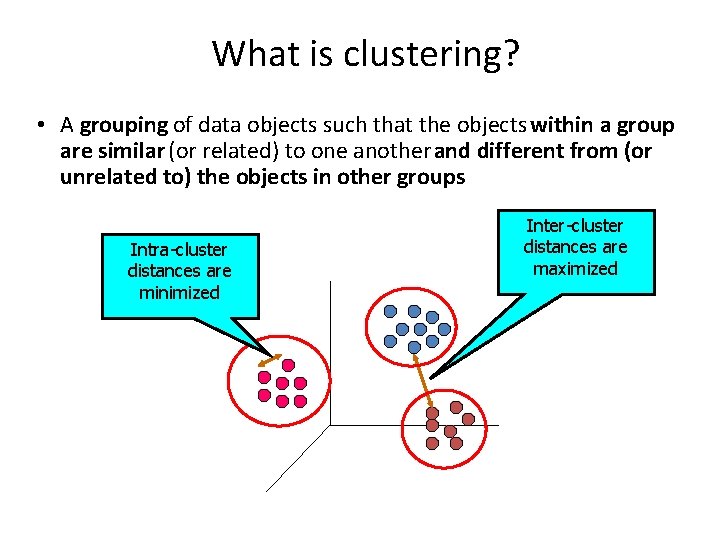
What is clustering? • A grouping of data objects such that the objects within a group are similar (or related) to one another and different from (or unrelated to) the objects in other groups Intra-cluster distances are minimized Inter-cluster distances are maximized
The clustering task • Group observations into groups so that the observations belonging in the same group are similar, whereas observations in different groups are different • Basic questions: – What does “similar” mean – What is a good partition of the objects? I. e. , how is the quality of a solution measured – How to find a good partition of the observations
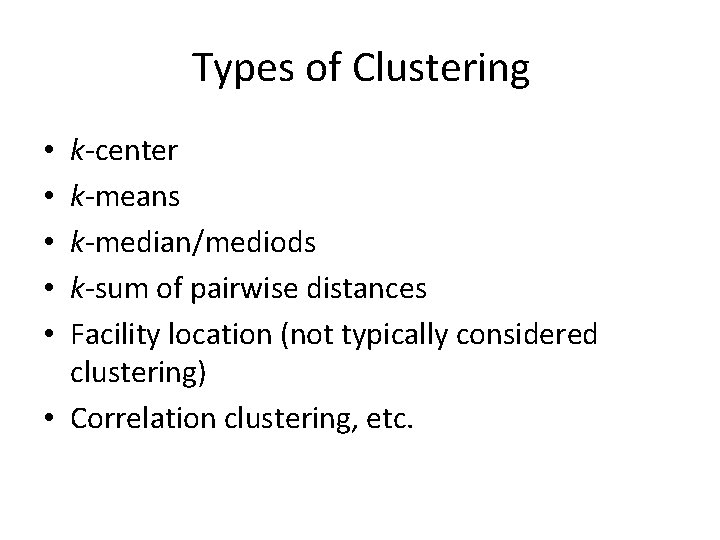
Types of Clustering k-center k-means k-median/mediods k-sum of pairwise distances Facility location (not typically considered clustering) • Correlation clustering, etc. • • •
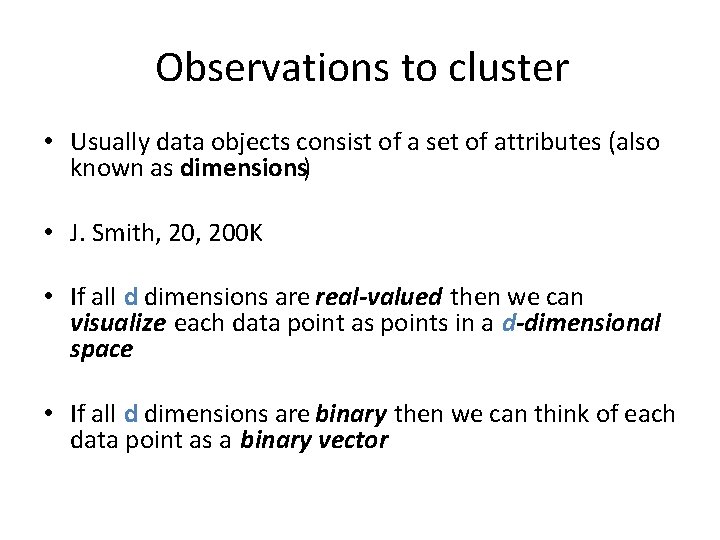
Observations to cluster • Usually data objects consist of a set of attributes (also known as dimensions) • J. Smith, 200 K • If all d dimensions are real-valued then we can visualize each data point as points in a d-dimensional space • If all d dimensions are binary then we can think of each data point as a binary vector
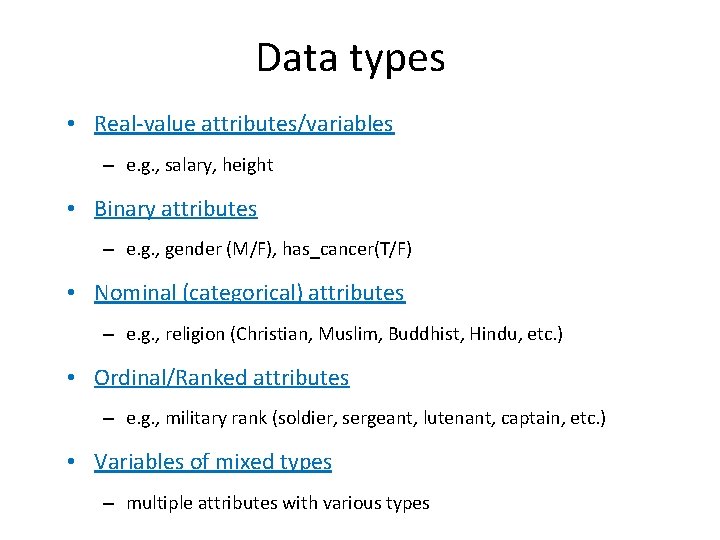
Data types • Real-value attributes/variables – e. g. , salary, height • Binary attributes – e. g. , gender (M/F), has_cancer(T/F) • Nominal (categorical) attributes – e. g. , religion (Christian, Muslim, Buddhist, Hindu, etc. ) • Ordinal/Ranked attributes – e. g. , military rank (soldier, sergeant, lutenant, captain, etc. ) • Variables of mixed types – multiple attributes with various types
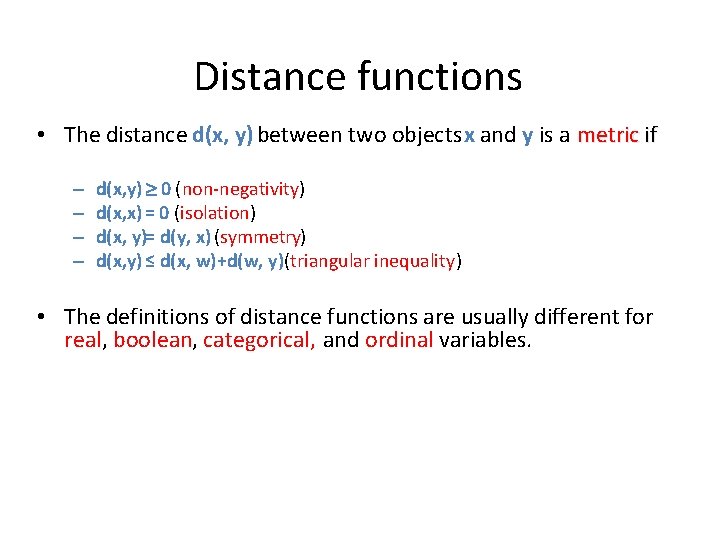
Distance functions • The distance d(x, y) between two objects x and y is a metric if – – d(x, y) 0 (non-negativity) d(x, x) = 0 (isolation) d(x, y)= d(y, x) (symmetry) d(x, y) ≤ d(x, w)+d(w, y)(triangular inequality) • The definitions of distance functions are usually different for real, boolean, categorical, and ordinal variables.
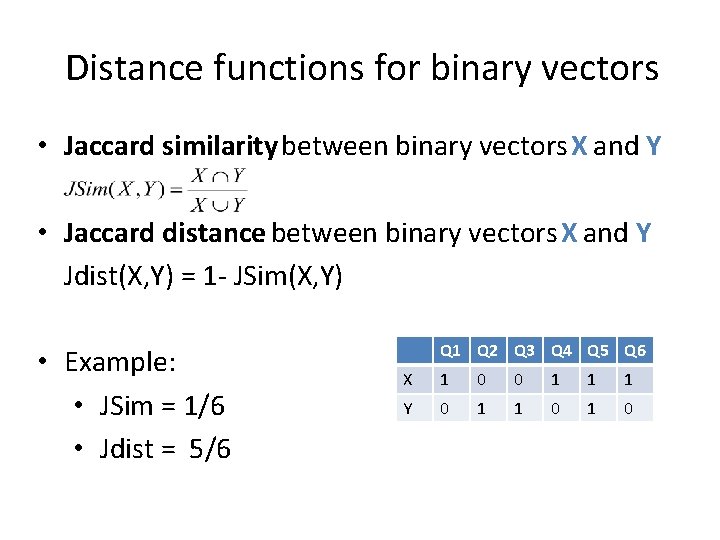
Distance functions for binary vectors • Jaccard similarity between binary vectors X and Y • Jaccard distance between binary vectors X and Y Jdist(X, Y) = 1 - JSim(X, Y) • Example: • JSim = 1/6 • Jdist = 5/6 Q 1 Q 2 Q 3 Q 4 Q 5 Q 6 X 1 0 0 1 1 1 Y 0 1 1 0
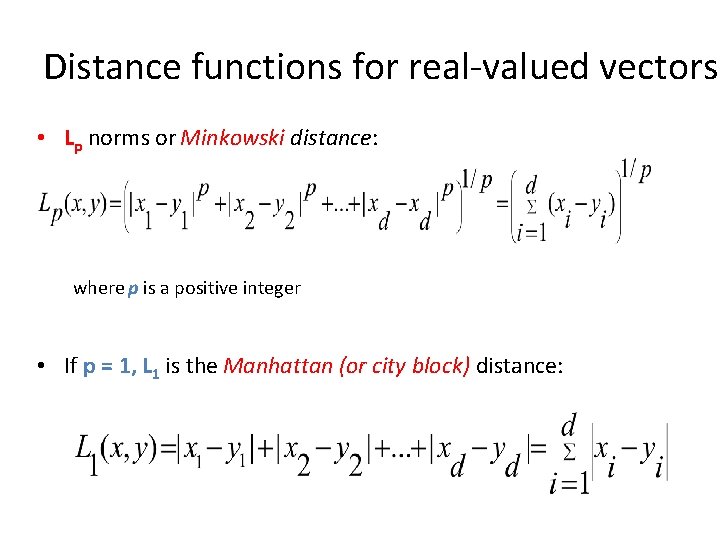
Distance functions for real-valued vectors • Lp norms or Minkowski distance: where p is a positive integer • If p = 1, L 1 is the Manhattan (or city block) distance:
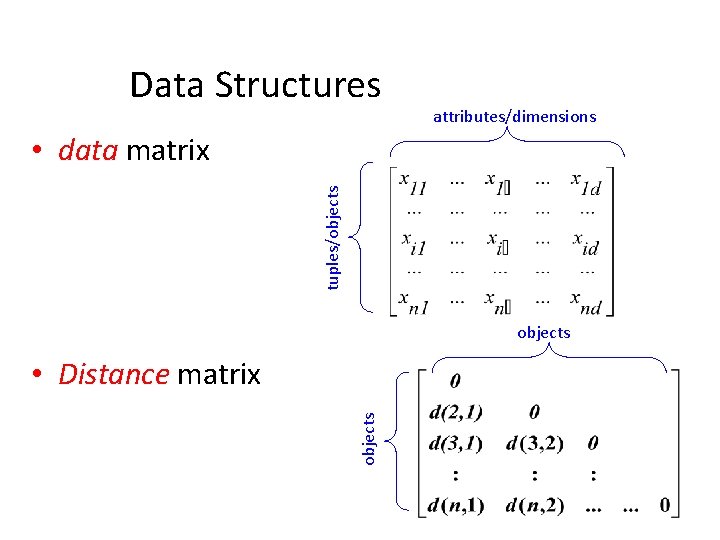
Data Structures attributes/dimensions tuples/objects • data matrix objects • Distance matrix
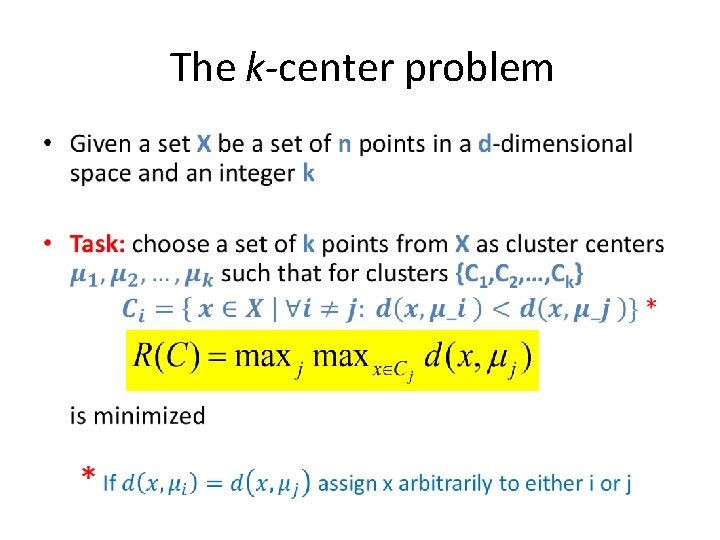
The k-center problem •
Some properties • NP-hard if the dimensionality of the data is at least 2 (d>=2) • For d=1 the problem is solvable in polynomial time • A simple combinatorial algorithm works well in practice
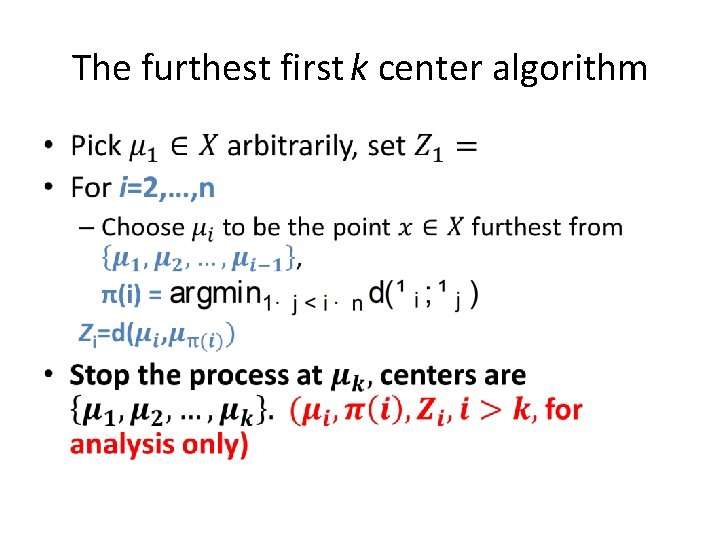
The furthest first k center algorithm •
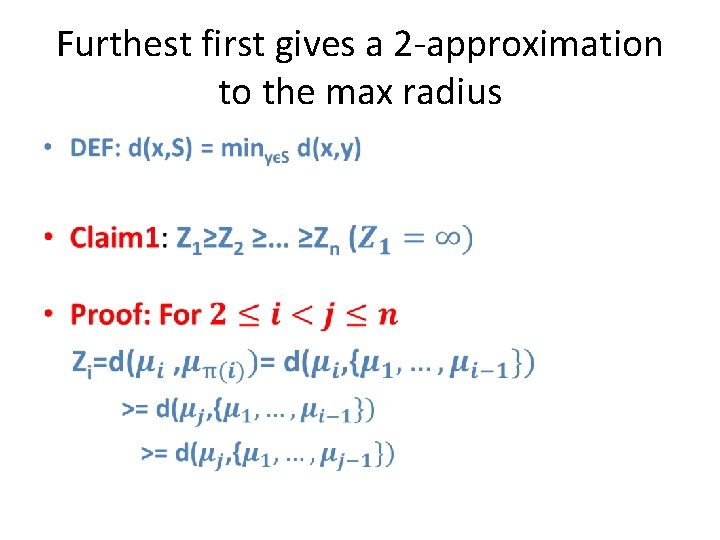
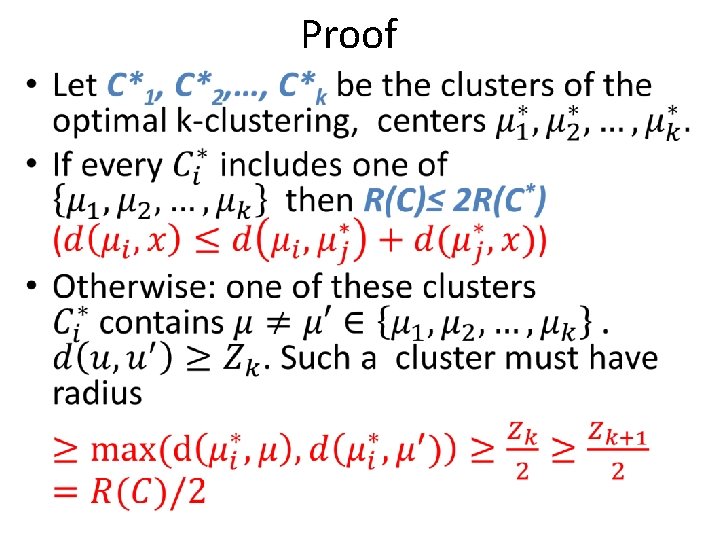
Furthest first gives a 2 -approximation to the max radius •
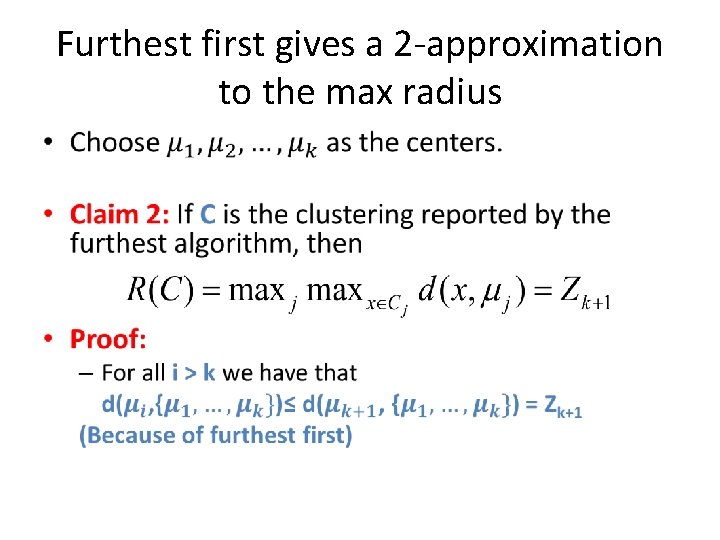
Furthest first gives a 2 -approximation to the max radius •
Proof •
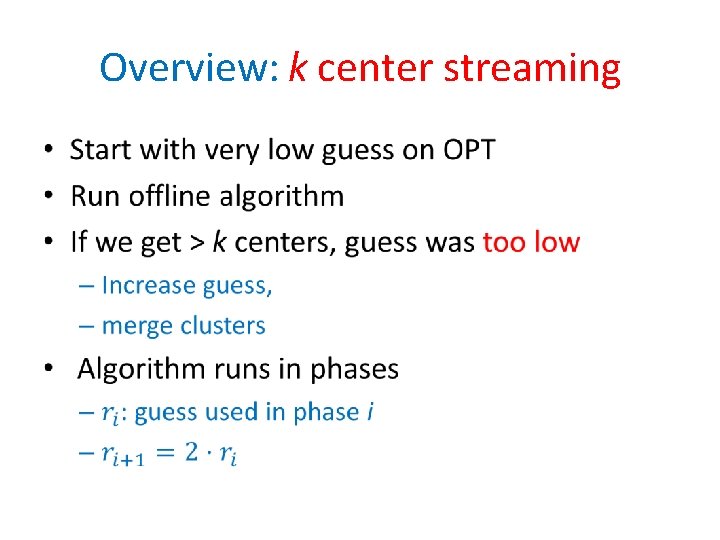
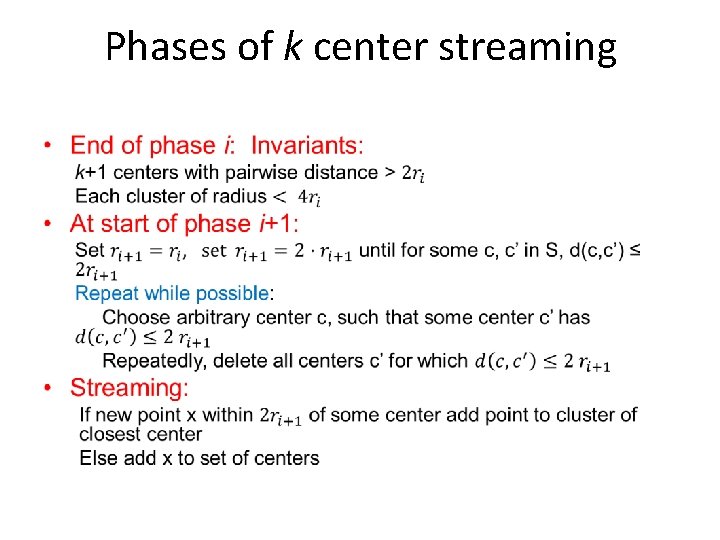
Next: A k center Streaming Algorithm • The furthest algorithm needed to go through the points of X multiple times (compute the furthest point repeatedly) • We now give a streaming algorithm for k center that does only one pass through the data • Needs only O(k) memory
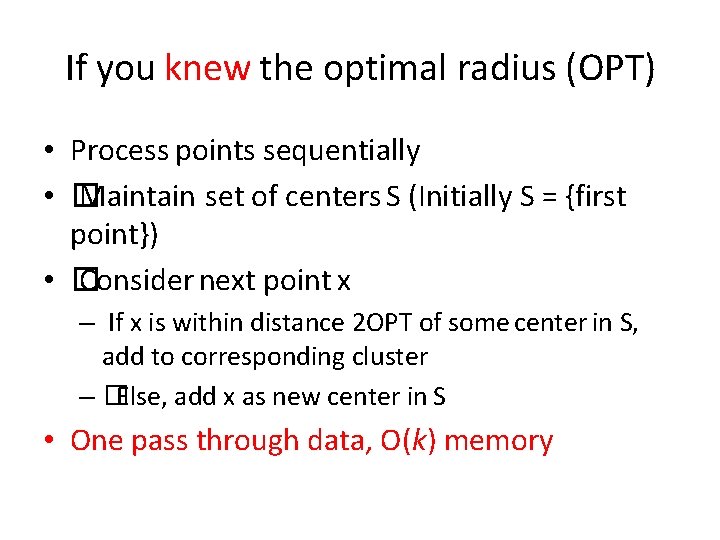
If you knew the optimal radius (OPT) • Process points sequentially • � Maintain set of centers S (Initially S = {first point}) • � Consider next point x – If x is within distance 2 OPT of some center in S, add to corresponding cluster – �Else, add x as new center in S • One pass through data, O(k) memory
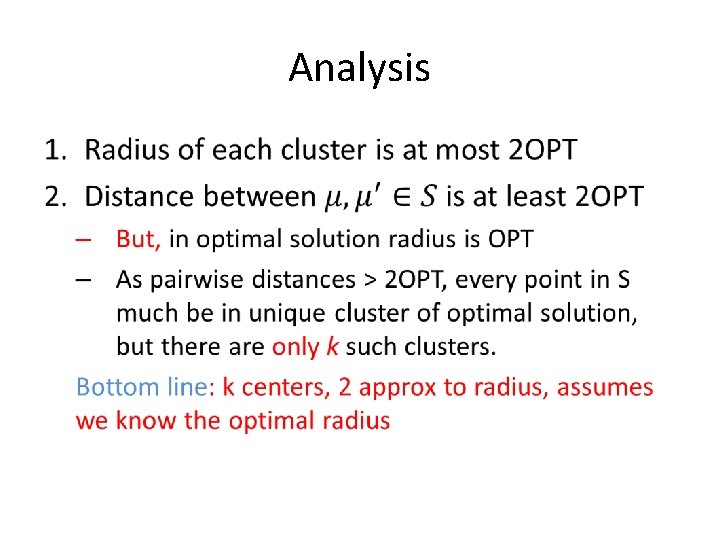
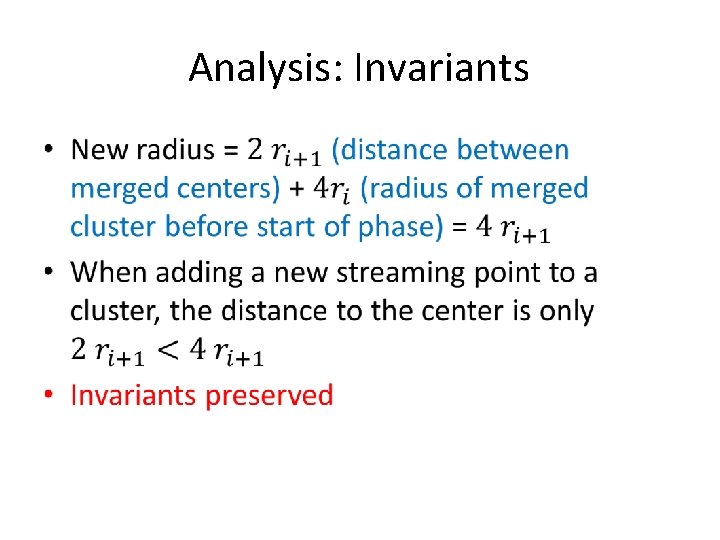
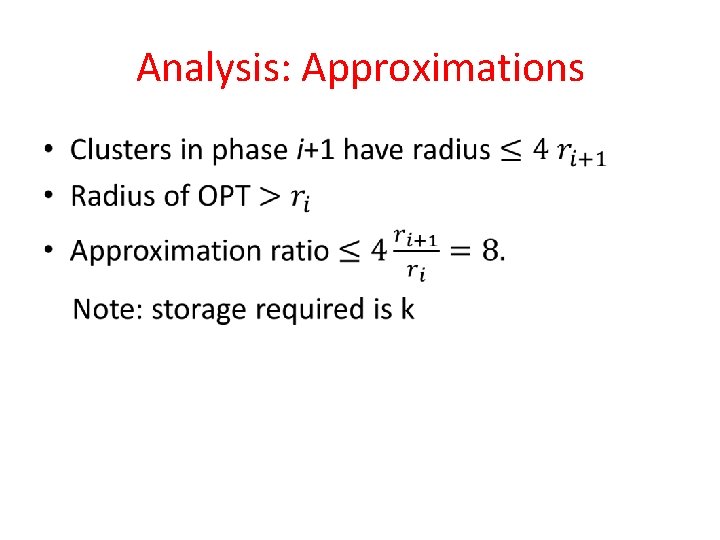
Analysis •
Overview: k center streaming •
Phases of k center streaming •
Analysis: Invariants •
Analysis: Approximations •
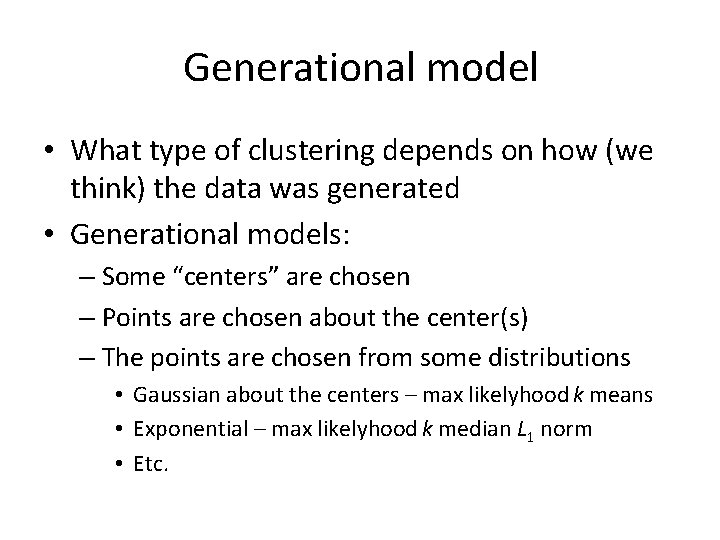
Generational model • What type of clustering depends on how (we think) the data was generated • Generational models: – Some “centers” are chosen – Points are chosen about the center(s) – The points are chosen from some distributions • Gaussian about the centers – max likelyhood k means • Exponential – max likelyhood k median L 1 norm • Etc.
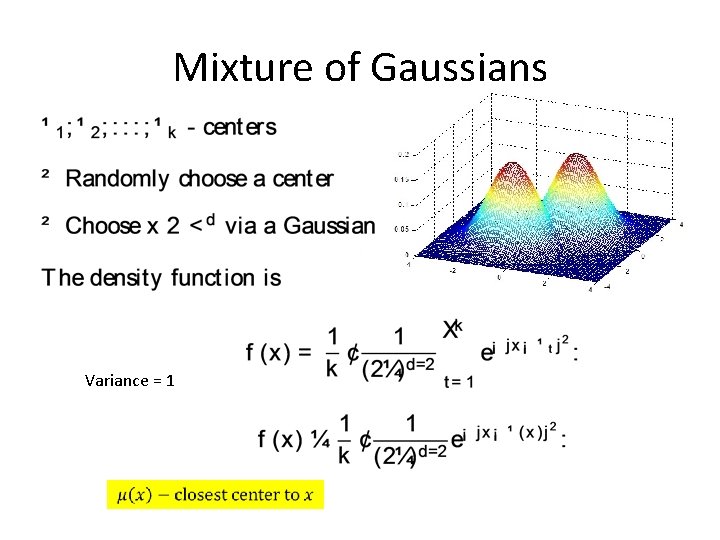
Mixture of Gaussians Variance = 1
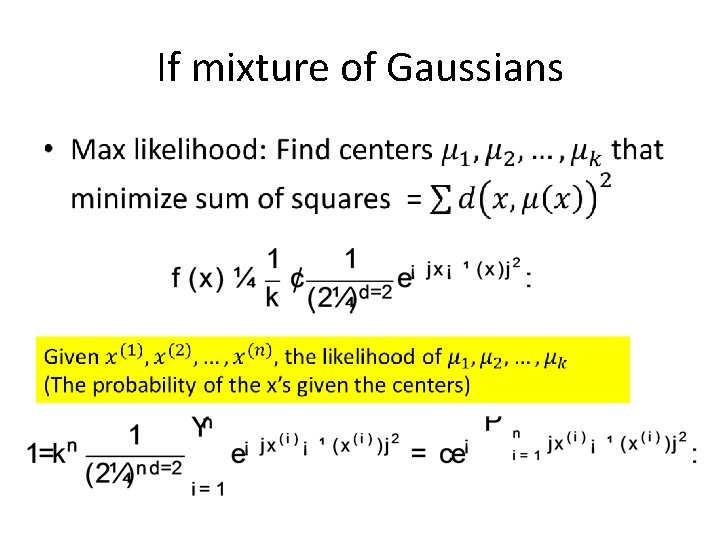
If mixture of Gaussians •
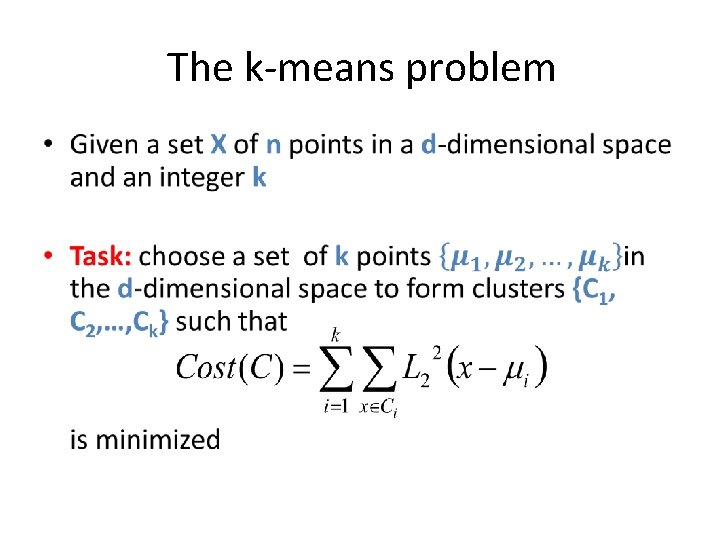
The k-means problem •
Algorithmic properties of the k-means problem • NP-hard if the dimensionality of the data is at least 2 (d>=2) • For d=1 the problem is solvable in polynomial time • A simple iterative algorithm works quite well in practice
EM Algorithm • Initialize k distribution parameters (θ 1, …, θk); Each distribution parameter corresponds to a cluster center • Iterate between two steps – Expectation step: (probabilistically) assign points to clusters – Maximation step: estimate model parameters that maximize the likelihood for the given assignment of points
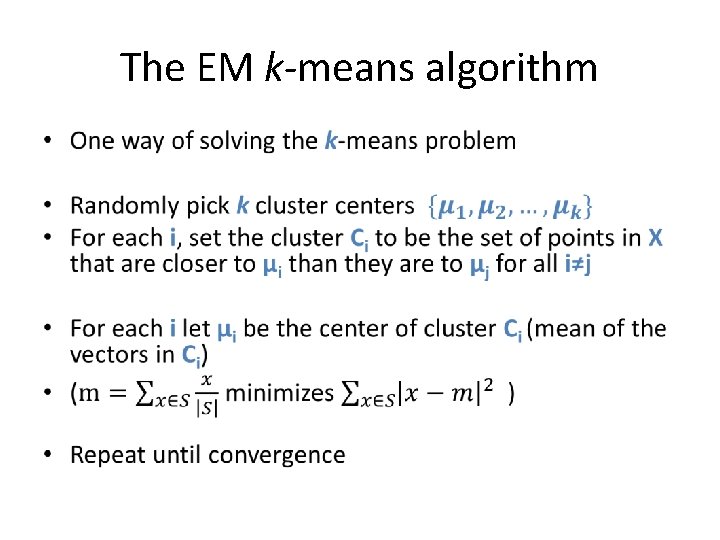
The EM k-means algorithm •
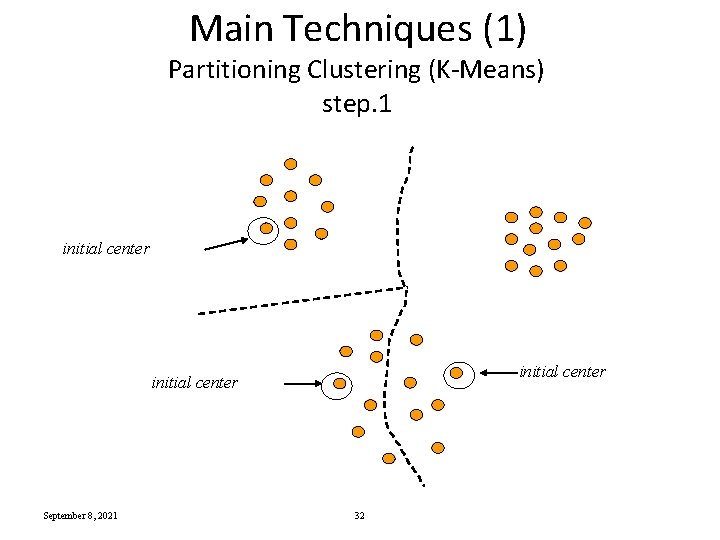
Main Techniques (1) Partitioning Clustering (K-Means) step. 1 initial center September 8, 2021 32
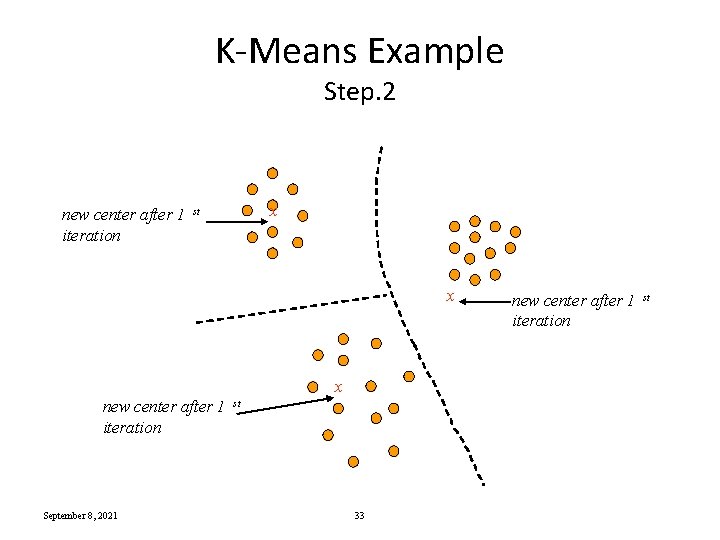
K-Means Example Step. 2 new center after 1 iteration x st x x new center after 1 iteration September 8, 2021 st 33 new center after 1 iteration st
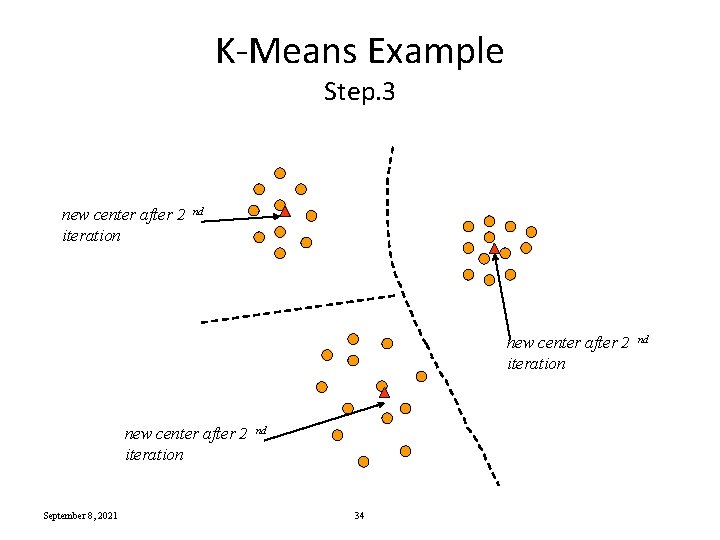
K-Means Example Step. 3 new center after 2 iteration nd new center after 2 iteration September 8, 2021 nd 34 nd
Properties of the EM k-means algorithm • Finds a local optimum • Converges often quickly (but not always) • The choice of initial points can have large influence in the result • Not a streaming algorithm
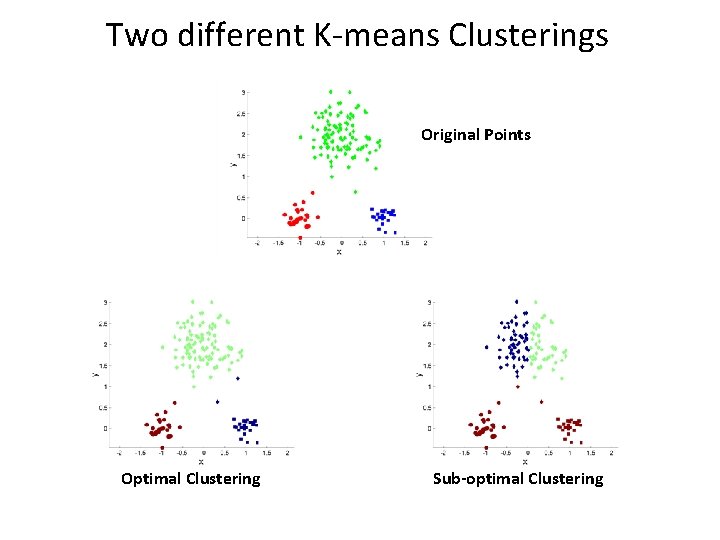
Two different K-means Clusterings Original Points Optimal Clustering Sub-optimal Clustering
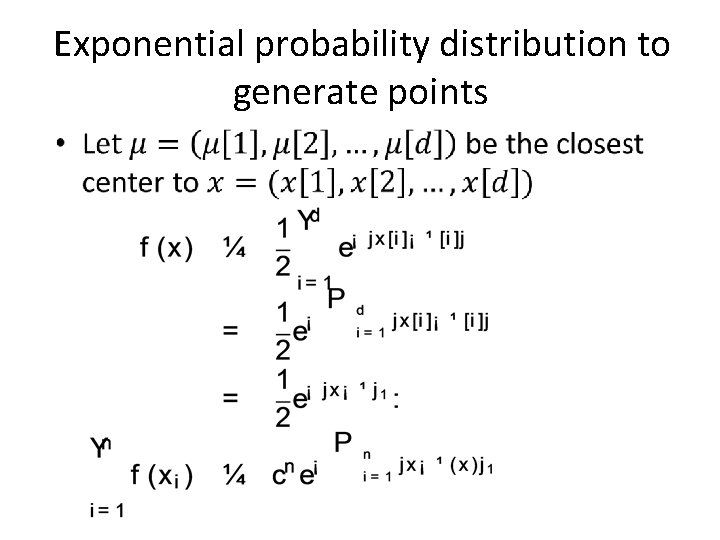
Exponential probability distribution to generate points •
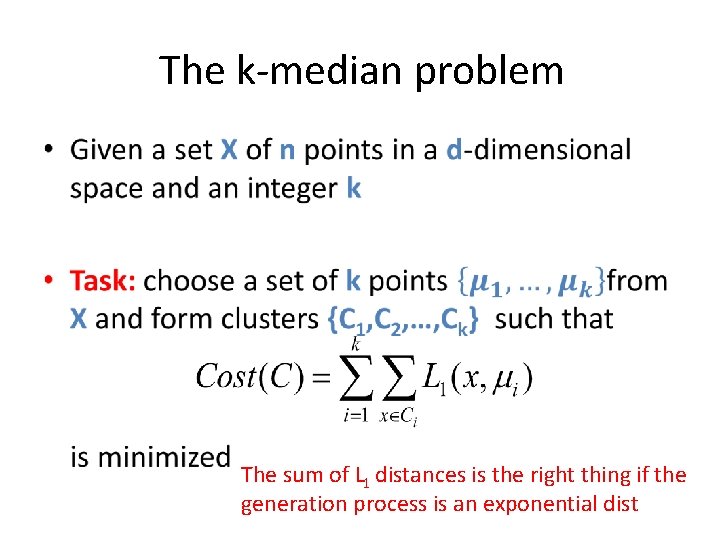
The k-median problem • The sum of L 1 distances is the right thing if the generation process is an exponential dist
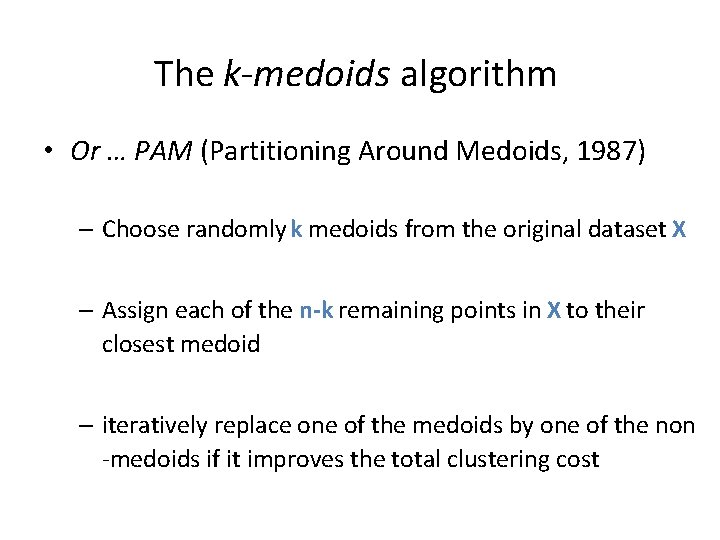
The k-medoids algorithm • Or … PAM (Partitioning Around Medoids, 1987) – Choose randomly k medoids from the original dataset X – Assign each of the n-k remaining points in X to their closest medoid – iteratively replace one of the medoids by one of the non -medoids if it improves the total clustering cost
Discussion of PAM algorithm • The algorithm is very similar to the k-means algorithm • It has the same advantages and disadvantages • Not a streaming algorithm
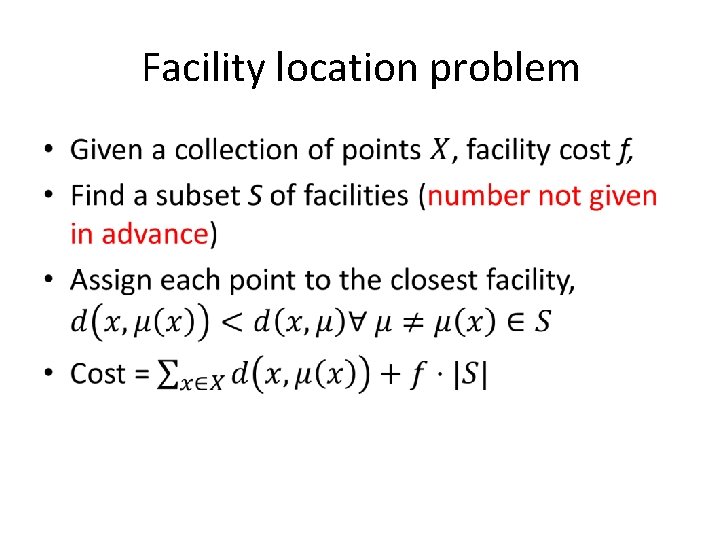
Facility location problem •
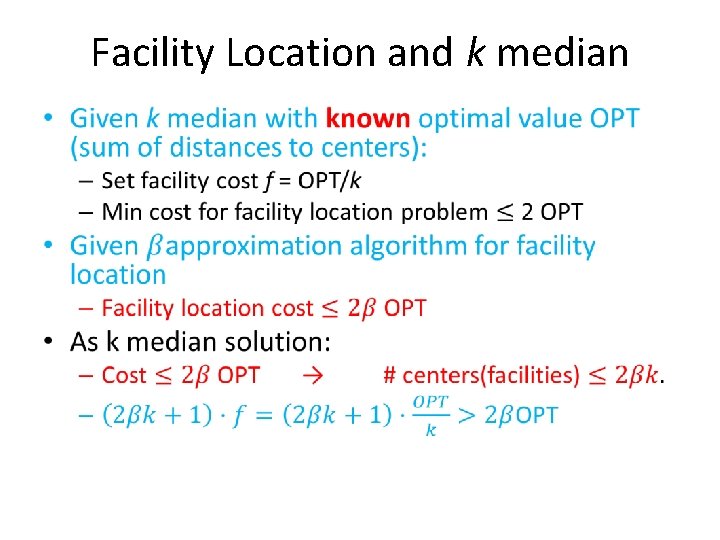
Facility Location and k median •
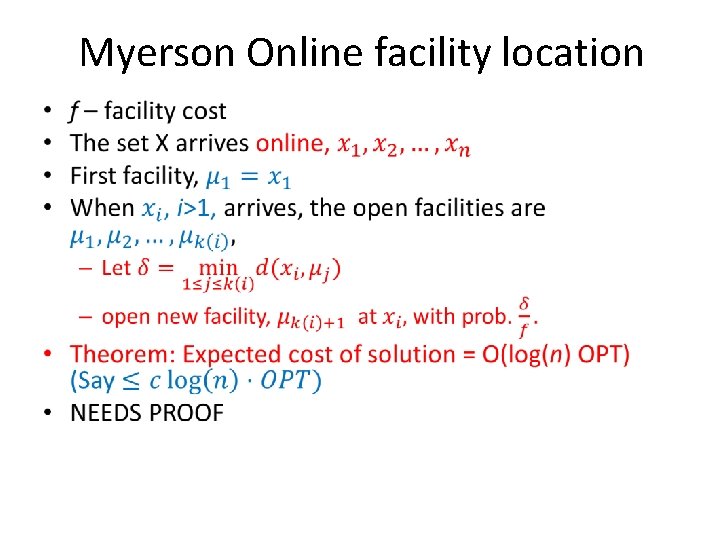
Myerson Online facility location •
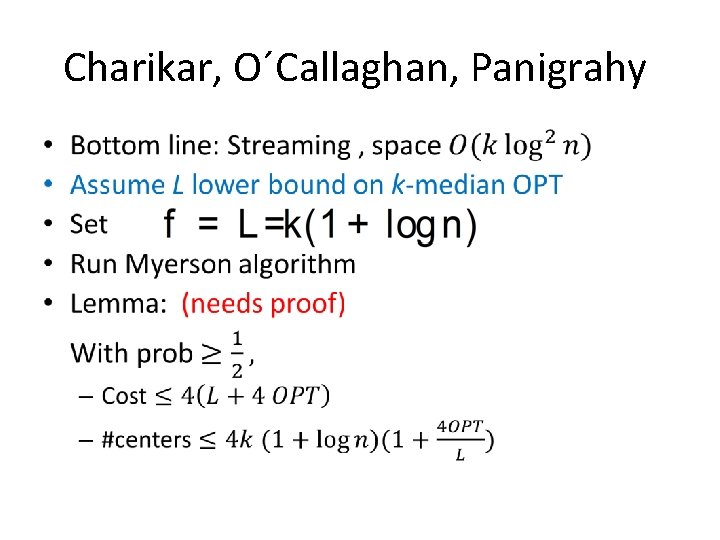
Charikar, O´Callaghan, Panigrahy •
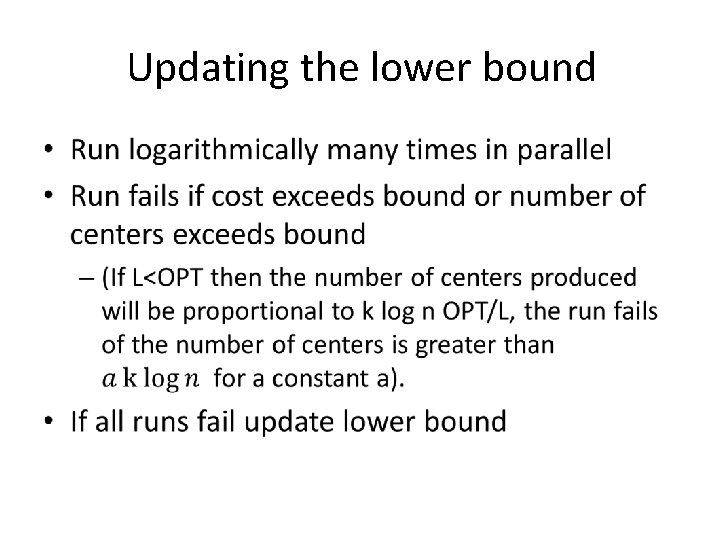
Updating the lower bound •
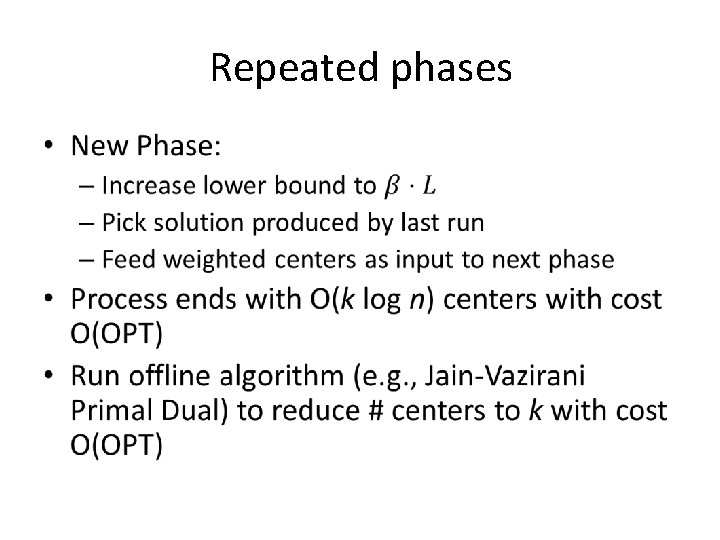
Repeated phases •
- Slides: 46