
Clustering Basic Concepts and Algorithms 1 Jeff Howbert
Clustering Basic Concepts and Algorithms 1 Jeff Howbert Introduction to Machine Learning Winter 2012 1
Clustering definition l l l Given: – Set of data points – Set of attributes on each data point – A measure of similarity between data points Find clusters such that: – Data points within a cluster are more similar to one another – Data points in separate clusters are less similar to one another Similarity measures: – Euclidean distance if attributes are continuous – Other problem-specific measures Jeff Howbert Introduction to Machine Learning Winter 2012 2

Clustering definition l Find groups (clusters) of data points such that data points in a group will be similar (or related) to one another and different from (or unrelated to) the data points in other groups Inter-cluster distances are maximized Intra-cluster distances are minimized Jeff Howbert Introduction to Machine Learning Winter 2012 3
Approaches to clustering l A clustering is a set of clusters l Important distinction between hierarchical and partitional clustering – Partitional: data points divided into finite number of partitions (non-overlapping subsets) u each data point is assigned to exactly one subset – Hierarchical: data points placed into a set of nested clusters, organized into a hierarchical tree expresses a continuum of similarities and clustering u Jeff Howbert Introduction to Machine Learning Winter 2012 4
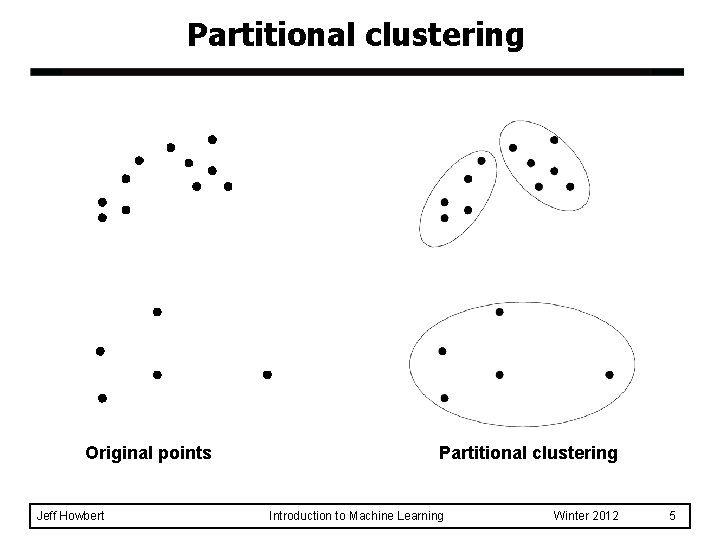
Partitional clustering Original points Jeff Howbert Partitional clustering Introduction to Machine Learning Winter 2012 5
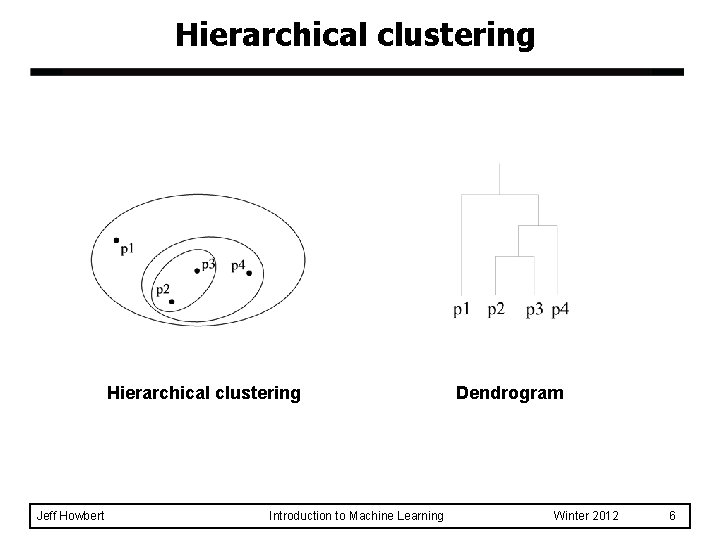
Hierarchical clustering Jeff Howbert Introduction to Machine Learning Dendrogram Winter 2012 6
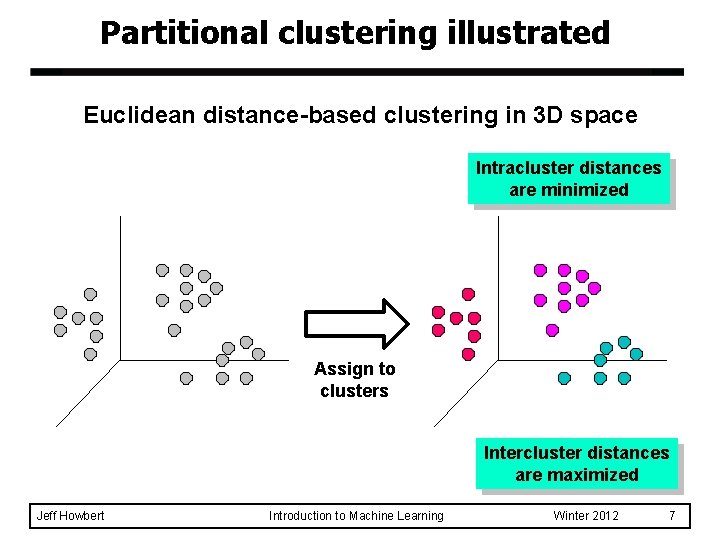
Partitional clustering illustrated Euclidean distance-based clustering in 3 D space Intracluster distances are minimized Assign to clusters Intercluster distances are maximized Jeff Howbert Introduction to Machine Learning Winter 2012 7
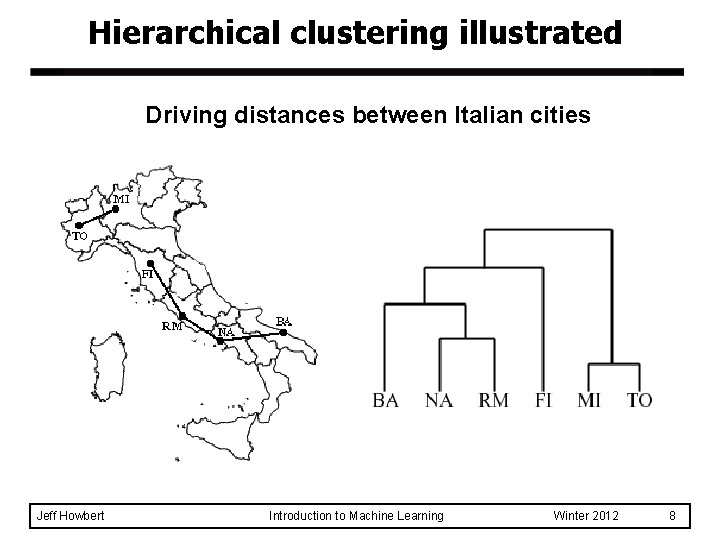
Hierarchical clustering illustrated Driving distances between Italian cities Jeff Howbert Introduction to Machine Learning Winter 2012 8
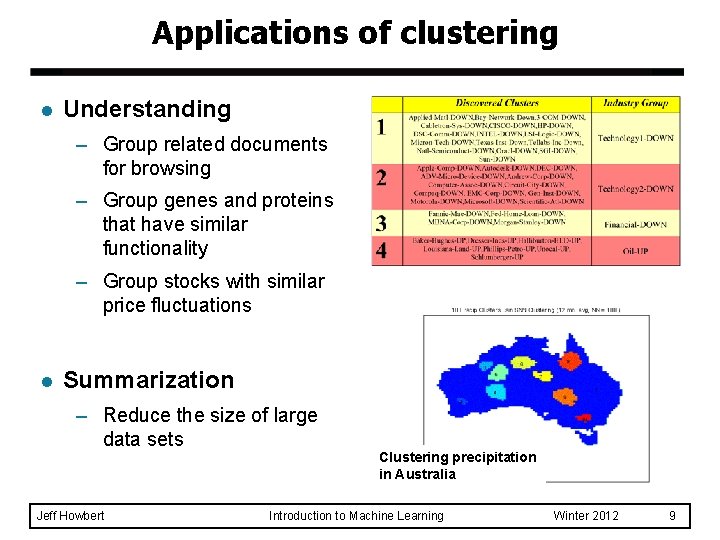
Applications of clustering l Understanding – Group related documents for browsing – Group genes and proteins that have similar functionality – Group stocks with similar price fluctuations l Summarization – Reduce the size of large data sets Jeff Howbert Clustering precipitation in Australia Introduction to Machine Learning Winter 2012 9
Clustering application 1 l Market segmentation – Goal: subdivide a market into distinct subsets of customers, such that each subset is conceivably a submarket which can be reached with a customized marketing mix. – Approach: u Collect different attributes of customers based on their geographical and lifestyle related information. u Find clusters of similar customers. u Measure the clustering quality by observing buying patterns of customers in same cluster vs. those from different clusters. Jeff Howbert Introduction to Machine Learning Winter 2012 10
Clustering application 2 l Document clustering – Goal: Find groups of documents that are similar to each other based on the important terms appearing in them. – Approach: Identify frequently occurring terms in each document. Form a similarity measure based on the frequencies of different terms. Use it to cluster. – Benefit: Information retrieval can utilize the clusters to relate a new document or search term to clustered documents. Jeff Howbert Introduction to Machine Learning Winter 2012 11
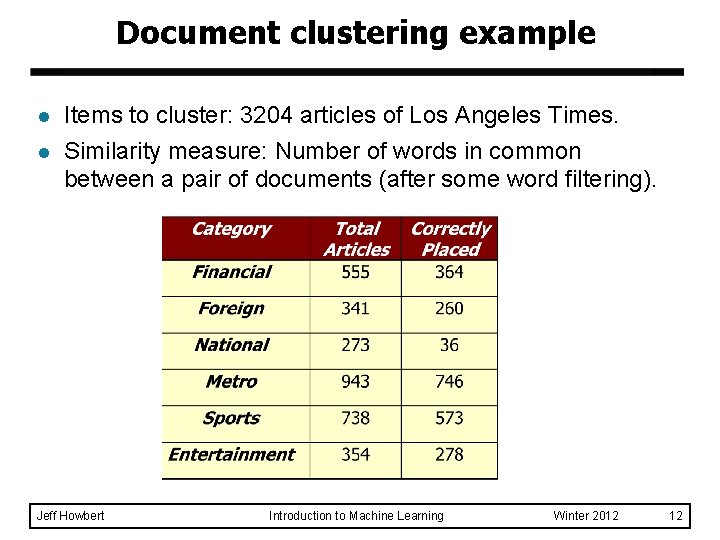
Document clustering example l l Items to cluster: 3204 articles of Los Angeles Times. Similarity measure: Number of words in common between a pair of documents (after some word filtering). Jeff Howbert Introduction to Machine Learning Winter 2012 12
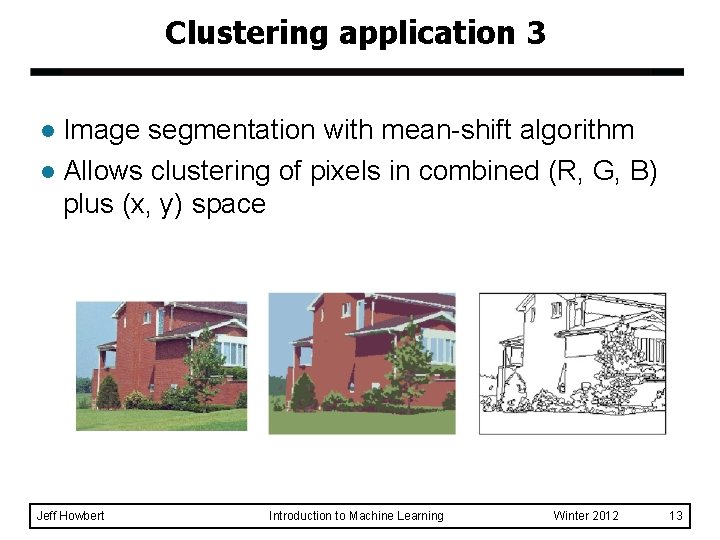
Clustering application 3 Image segmentation with mean-shift algorithm l Allows clustering of pixels in combined (R, G, B) plus (x, y) space l Jeff Howbert Introduction to Machine Learning Winter 2012 13
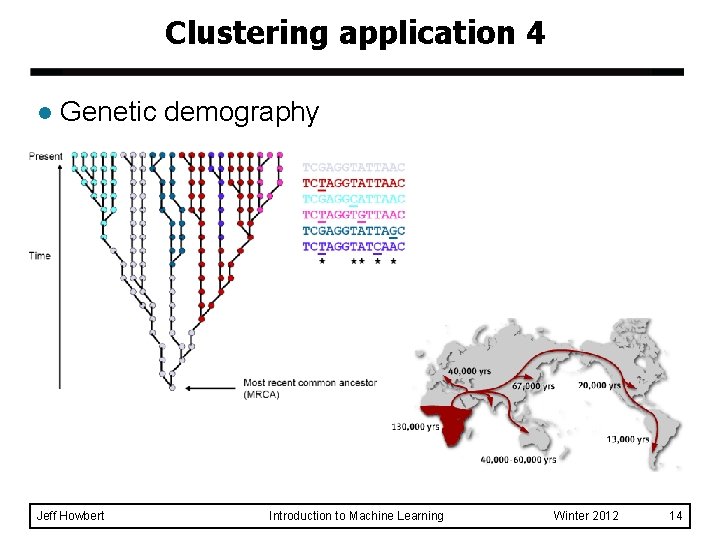
Clustering application 4 l Genetic demography Jeff Howbert Introduction to Machine Learning Winter 2012 14
What is not clustering? l Supervised classification – Have class label information l Simple segmentation – Dividing students into different registration groups alphabetically, by last name l Results of a query – Groupings are a result of an external specification Jeff Howbert Introduction to Machine Learning Winter 2012 15
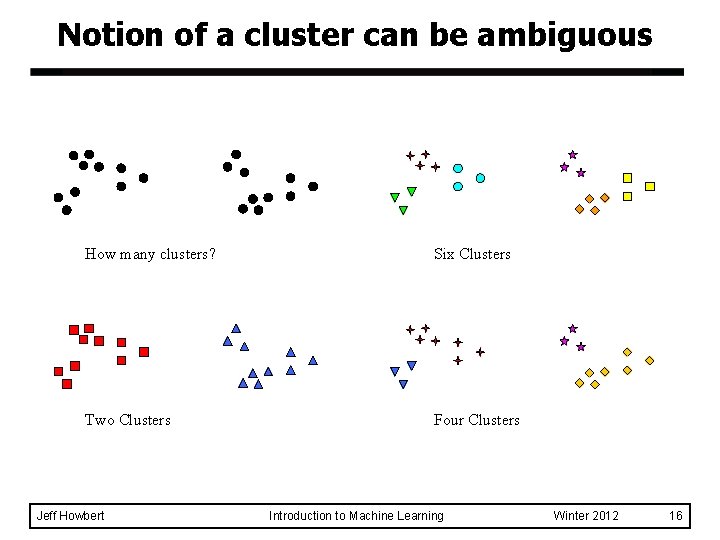
Notion of a cluster can be ambiguous How many clusters? Six Clusters Two Clusters Four Clusters Jeff Howbert Introduction to Machine Learning Winter 2012 16
Other approaches to clustering l Exclusive versus non-exclusive – In non-exclusive clusterings, points may belong to multiple clusters. – Can represent multiple classes or ‘border’ points l Fuzzy versus non-fuzzy – In fuzzy clustering, a point belongs to every cluster with some weight between 0 and 1 – Weights must sum to 1 – Probabilistic clustering has similar characteristics l Partial versus complete – In some cases, we only want to cluster some of the data l Heterogeneous versus homogeneous – Clusters of widely different sizes, shapes, and densities Jeff Howbert Introduction to Machine Learning Winter 2012 17
Types of clusters Well-separated clusters l Center-based clusters l Contiguous clusters l Density-based clusters l Property or conceptual l Described by an objective function l Jeff Howbert Introduction to Machine Learning Winter 2012 18
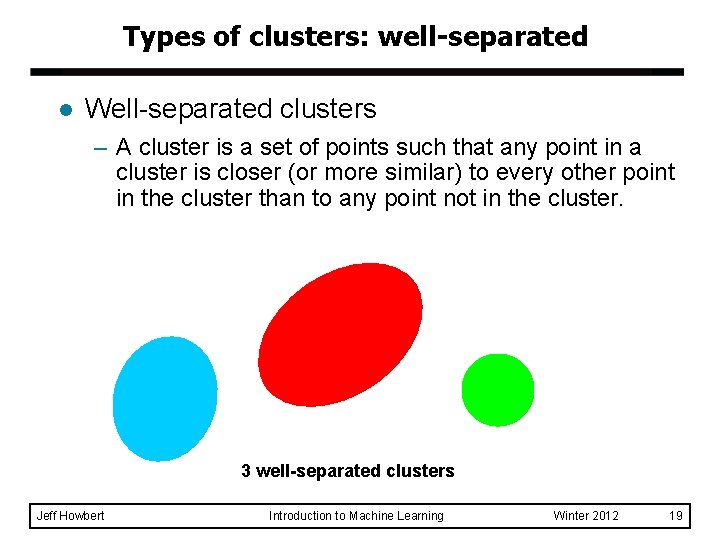
Types of clusters: well-separated l Well-separated clusters – A cluster is a set of points such that any point in a cluster is closer (or more similar) to every other point in the cluster than to any point not in the cluster. 3 well-separated clusters Jeff Howbert Introduction to Machine Learning Winter 2012 19
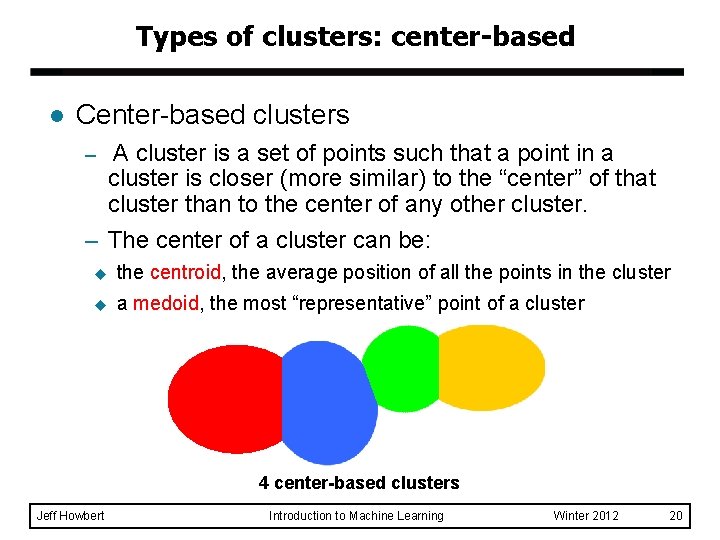
Types of clusters: center-based l Center-based clusters – A cluster is a set of points such that a point in a cluster is closer (more similar) to the “center” of that cluster than to the center of any other cluster. – The center of a cluster can be: u the centroid, the average position of all the points in the cluster u a medoid, the most “representative” point of a cluster 4 center-based clusters Jeff Howbert Introduction to Machine Learning Winter 2012 20
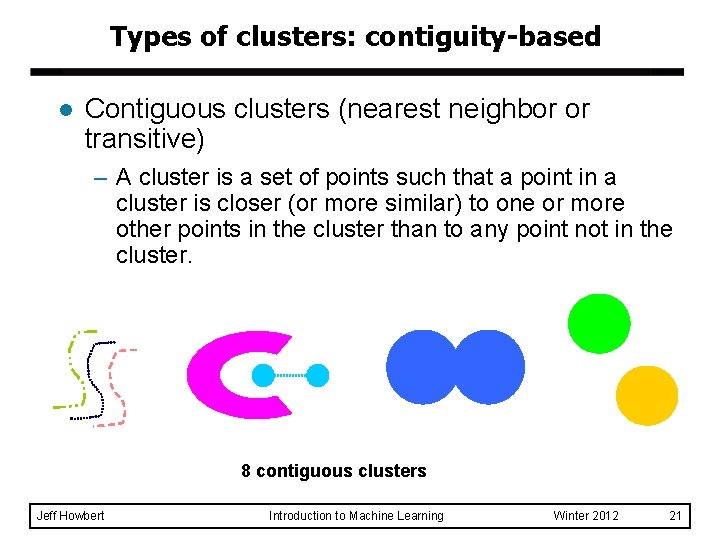
Types of clusters: contiguity-based l Contiguous clusters (nearest neighbor or transitive) – A cluster is a set of points such that a point in a cluster is closer (or more similar) to one or more other points in the cluster than to any point not in the cluster. 8 contiguous clusters Jeff Howbert Introduction to Machine Learning Winter 2012 21
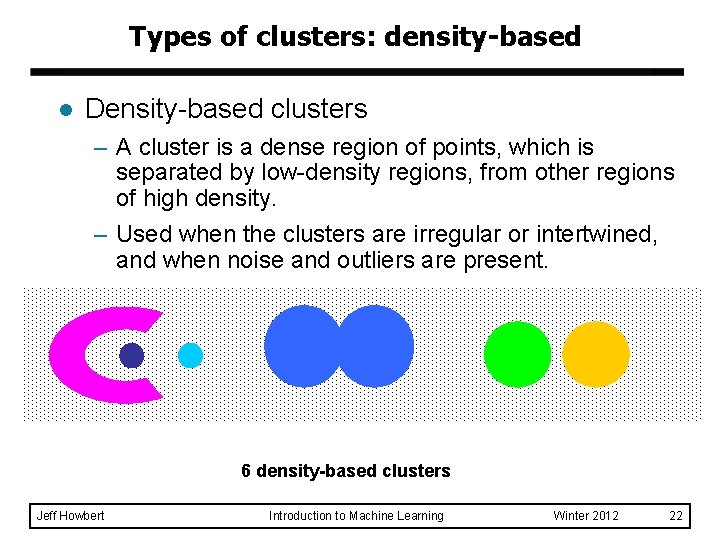
Types of clusters: density-based l Density-based clusters – A cluster is a dense region of points, which is separated by low-density regions, from other regions of high density. – Used when the clusters are irregular or intertwined, and when noise and outliers are present. 6 density-based clusters Jeff Howbert Introduction to Machine Learning Winter 2012 22
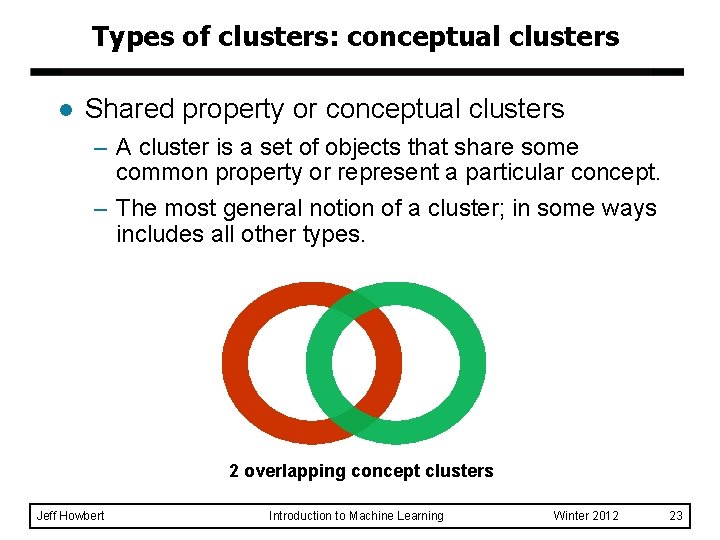
Types of clusters: conceptual clusters l Shared property or conceptual clusters – A cluster is a set of objects that share some common property or represent a particular concept. – The most general notion of a cluster; in some ways includes all other types. 2 overlapping concept clusters Jeff Howbert Introduction to Machine Learning Winter 2012 23
Types of clusters: objective function l Clusters defined by an objective function – Set of clusters minimizes or maximizes some objective function. – Enumerate all possible ways of dividing the points into clusters and evaluate the `goodness' of each potential set of clusters by using the given objective function. (NP-hard) – Can have global or local objective function. u Hierarchical clustering algorithms typically have local objective function. u Partitional algorithms typically have global objective function. – A variation of the global objective function approach is to fit the data to a parameterized model. u Parameters for the model are determined from the data. Example: Gaussian mixture models (GMM) assume the data is a ‘mixture' of a fixed number of Gaussian distributions. u Jeff Howbert Introduction to Machine Learning Winter 2012 24
Characteristics of input data are important l Type of similarity or density measure – This is a derived measure, but central to clustering l Sparseness – Dictates type of similarity – Adds to efficiency l Attribute type – Dictates type of similarity l Domain of data – Dictates type of similarity – Other characteristics, e. g. , autocorrelation l l l Jeff Howbert Dimensionality Noise and outliers Type of distribution Introduction to Machine Learning Winter 2012 25
Clustering algorithms Jeff Howbert l k-Means and its variants l Hierarchical clustering l Density-based clustering Introduction to Machine Learning Winter 2012 26
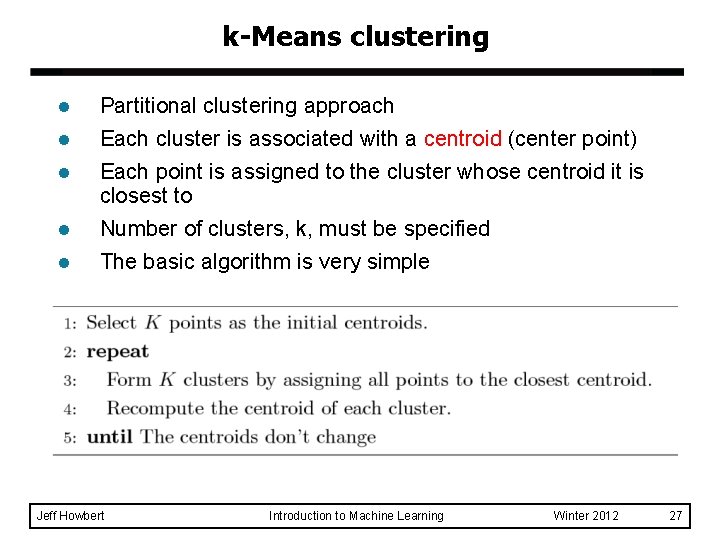
k-Means clustering l Partitional clustering approach l Each cluster is associated with a centroid (center point) l Each point is assigned to the cluster whose centroid it is closest to l Number of clusters, k, must be specified l The basic algorithm is very simple Jeff Howbert Introduction to Machine Learning Winter 2012 27
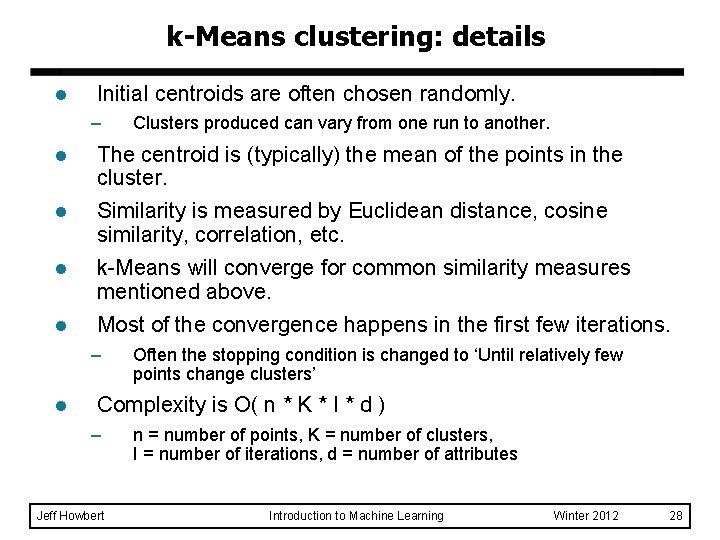
k-Means clustering: details l Initial centroids are often chosen randomly. – Clusters produced can vary from one run to another. l The centroid is (typically) the mean of the points in the cluster. l Similarity is measured by Euclidean distance, cosine similarity, correlation, etc. l k-Means will converge for common similarity measures mentioned above. l Most of the convergence happens in the first few iterations. – l Often the stopping condition is changed to ‘Until relatively few points change clusters’ Complexity is O( n * K * I * d ) – Jeff Howbert n = number of points, K = number of clusters, I = number of iterations, d = number of attributes Introduction to Machine Learning Winter 2012 28
Demo: k-means clustering . . videosk-means. mp 4 on web: http: //www. youtube. com/watch? v=74 rv 4 sn. Ll 70 Jeff Howbert Introduction to Machine Learning Winter 2012 29
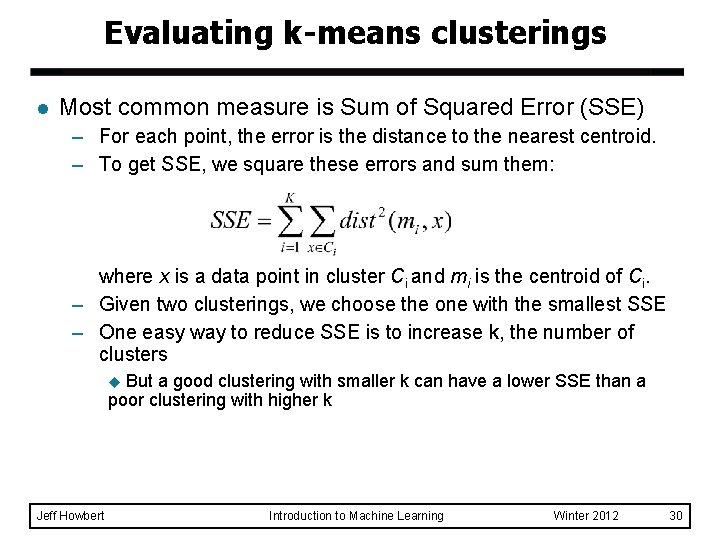
Evaluating k-means clusterings l Most common measure is Sum of Squared Error (SSE) – For each point, the error is the distance to the nearest centroid. – To get SSE, we square these errors and sum them: where x is a data point in cluster Ci and mi is the centroid of Ci. – Given two clusterings, we choose the one with the smallest SSE – One easy way to reduce SSE is to increase k, the number of clusters But a good clustering with smaller k can have a lower SSE than a poor clustering with higher k u Jeff Howbert Introduction to Machine Learning Winter 2012 30
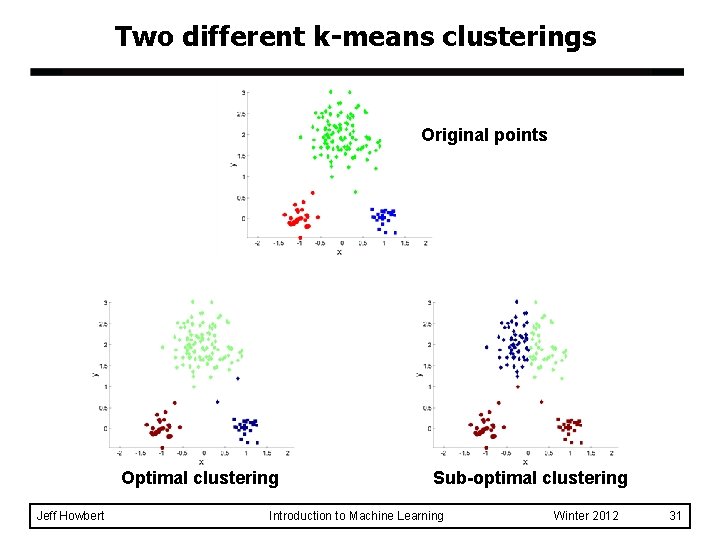
Two different k-means clusterings Original points Optimal clustering Jeff Howbert Sub-optimal clustering Introduction to Machine Learning Winter 2012 31
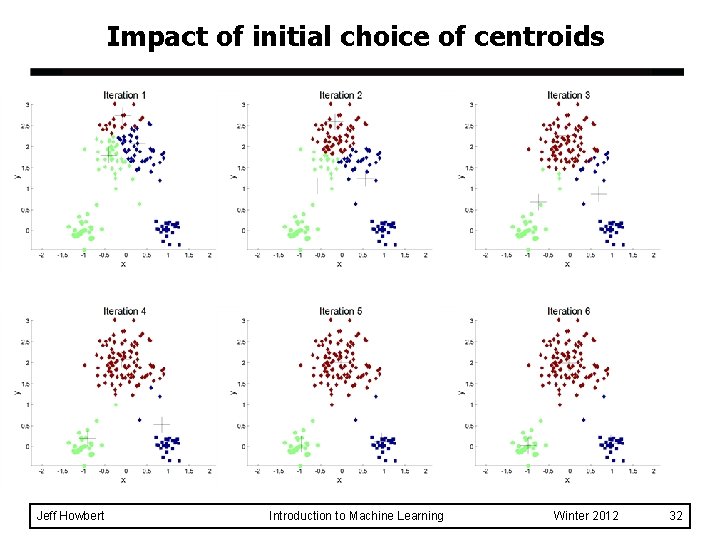
Impact of initial choice of centroids Jeff Howbert Introduction to Machine Learning Winter 2012 32
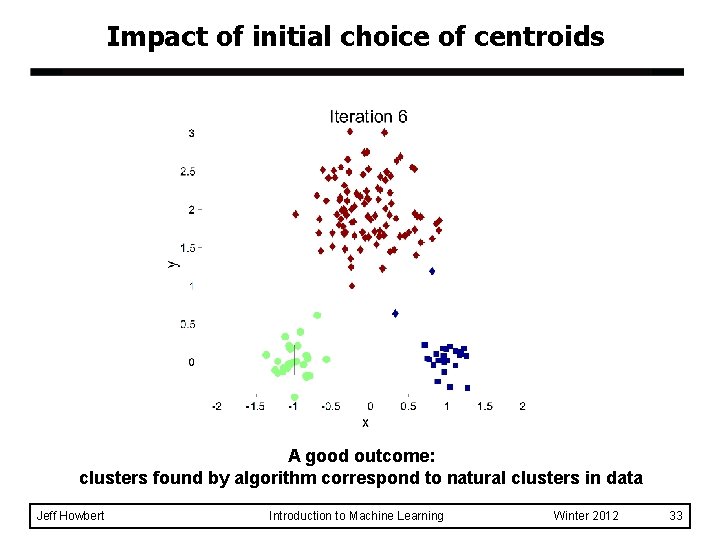
Impact of initial choice of centroids A good outcome: clusters found by algorithm correspond to natural clusters in data Jeff Howbert Introduction to Machine Learning Winter 2012 33
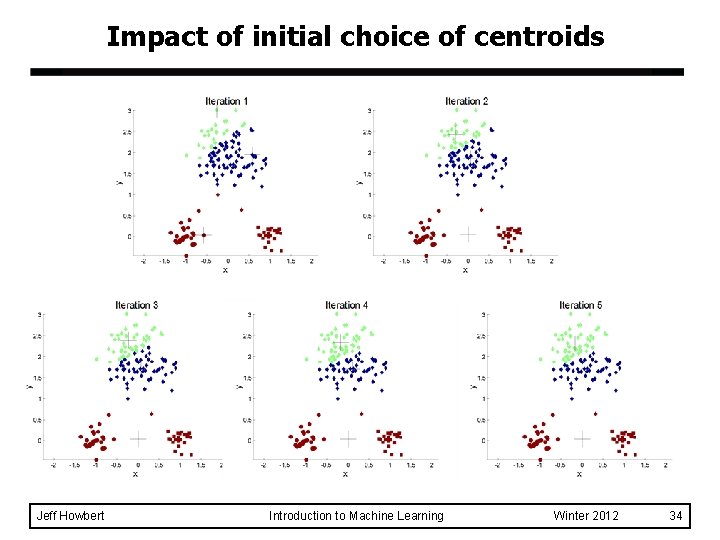
Impact of initial choice of centroids Jeff Howbert Introduction to Machine Learning Winter 2012 34
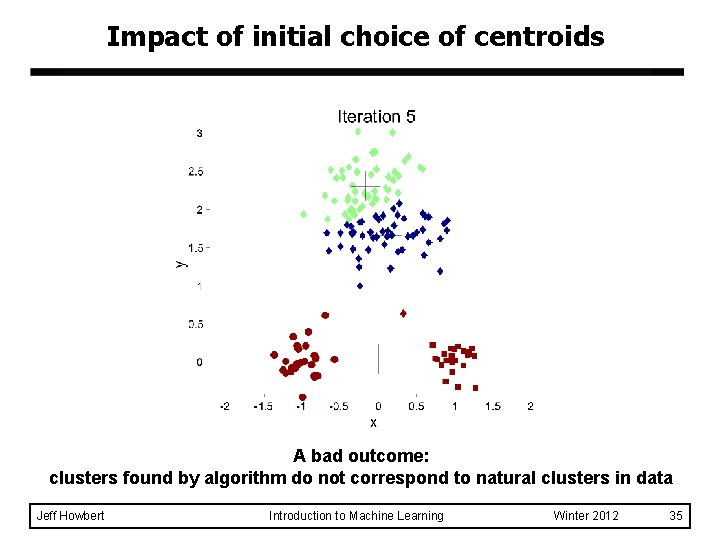
Impact of initial choice of centroids A bad outcome: clusters found by algorithm do not correspond to natural clusters in data Jeff Howbert Introduction to Machine Learning Winter 2012 35
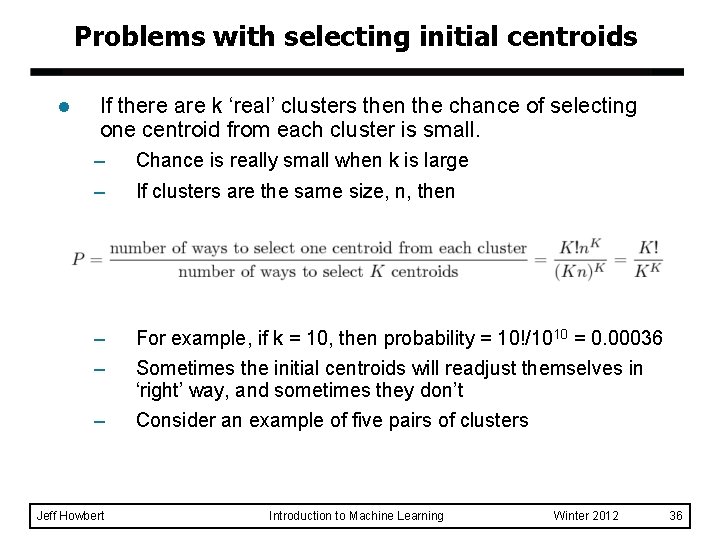
Problems with selecting initial centroids l If there are k ‘real’ clusters then the chance of selecting one centroid from each cluster is small. – – Chance is really small when k is large – – For example, if k = 10, then probability = 10!/1010 = 0. 00036 – Consider an example of five pairs of clusters Jeff Howbert If clusters are the same size, n, then Sometimes the initial centroids will readjust themselves in ‘right’ way, and sometimes they don’t Introduction to Machine Learning Winter 2012 36
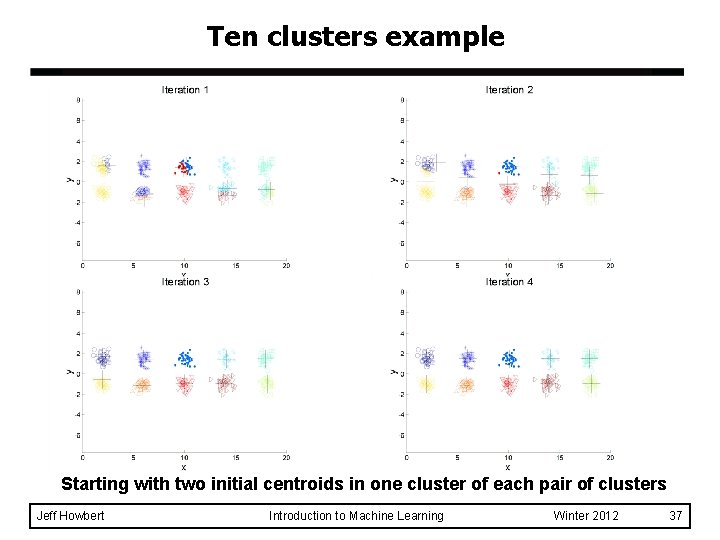
Ten clusters example Starting with two initial centroids in one cluster of each pair of clusters Jeff Howbert Introduction to Machine Learning Winter 2012 37
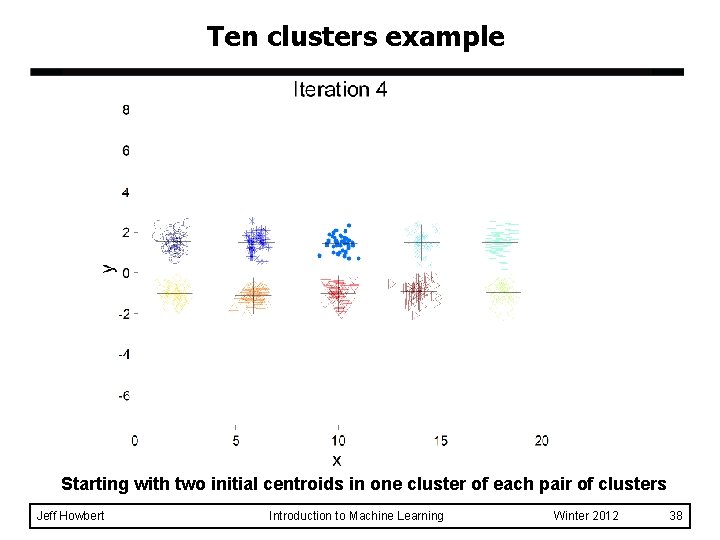
Ten clusters example Starting with two initial centroids in one cluster of each pair of clusters Jeff Howbert Introduction to Machine Learning Winter 2012 38
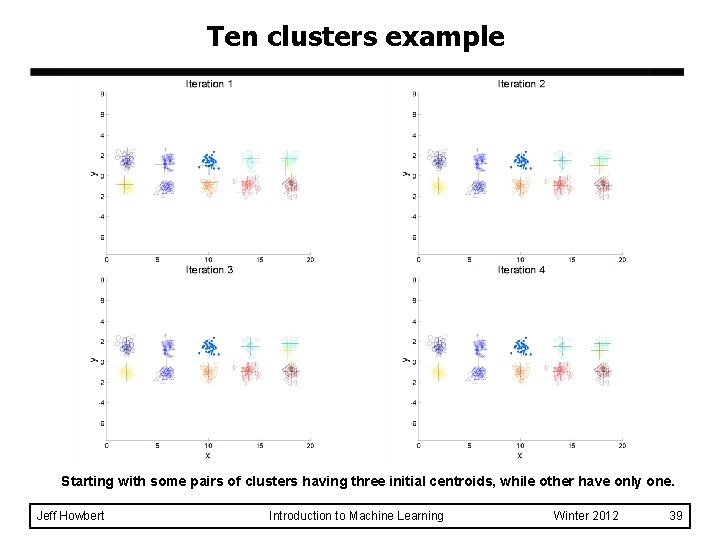
Ten clusters example Starting with some pairs of clusters having three initial centroids, while other have only one. Jeff Howbert Introduction to Machine Learning Winter 2012 39
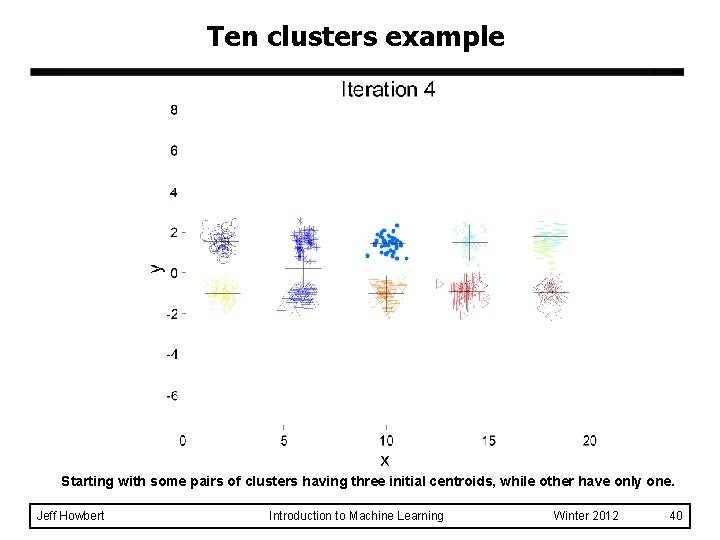
Ten clusters example Starting with some pairs of clusters having three initial centroids, while other have only one. Jeff Howbert Introduction to Machine Learning Winter 2012 40
Solutions to initial centroids problem l Multiple runs – Helps, but probability is not on your side Sample and use hierarchical clustering to determine initial centroids l Select more than k initial centroids and then select among these initial centroids l – Select most widely separated Postprocessing l Bisecting k-means l – Not as susceptible to initialization issues Jeff Howbert Introduction to Machine Learning Winter 2012 41
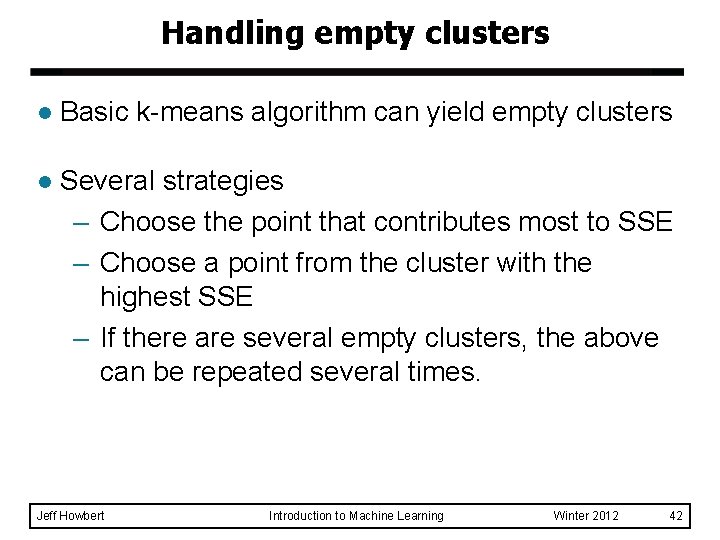
Handling empty clusters l Basic k-means algorithm can yield empty clusters l Several strategies – Choose the point that contributes most to SSE – Choose a point from the cluster with the highest SSE – If there are several empty clusters, the above can be repeated several times. Jeff Howbert Introduction to Machine Learning Winter 2012 42
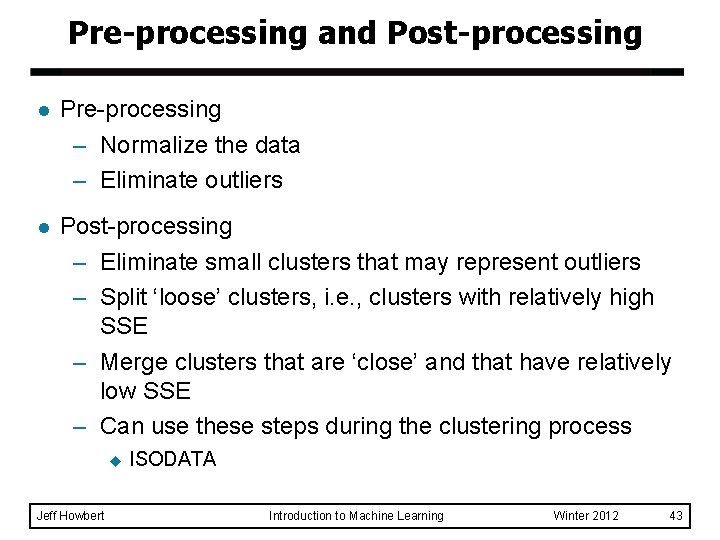
Pre-processing and Post-processing l Pre-processing – Normalize the data – Eliminate outliers l Post-processing – Eliminate small clusters that may represent outliers – Split ‘loose’ clusters, i. e. , clusters with relatively high SSE – Merge clusters that are ‘close’ and that have relatively low SSE – Can use these steps during the clustering process u Jeff Howbert ISODATA Introduction to Machine Learning Winter 2012 43
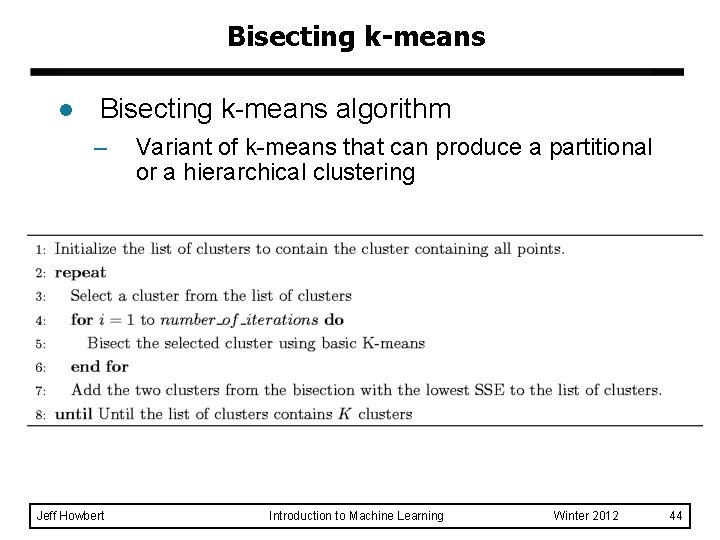
Bisecting k-means l Bisecting k-means algorithm – Jeff Howbert Variant of k-means that can produce a partitional or a hierarchical clustering Introduction to Machine Learning Winter 2012 44
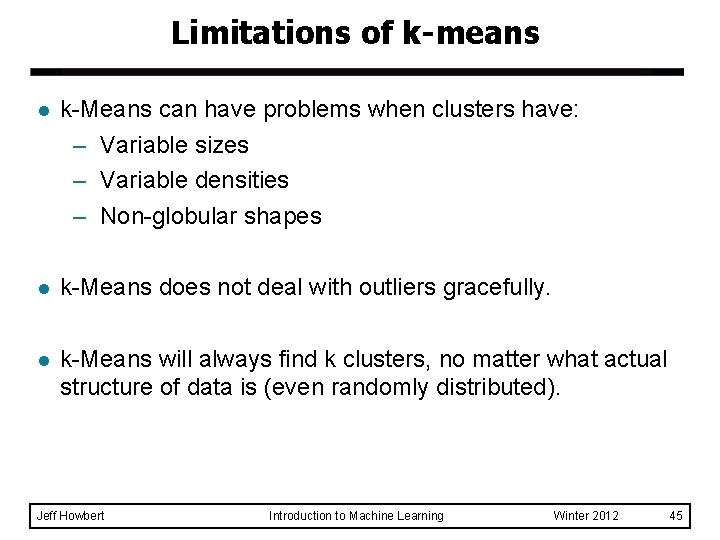
Limitations of k-means l k-Means can have problems when clusters have: – Variable sizes – Variable densities – Non-globular shapes l k-Means does not deal with outliers gracefully. l k-Means will always find k clusters, no matter what actual structure of data is (even randomly distributed). Jeff Howbert Introduction to Machine Learning Winter 2012 45
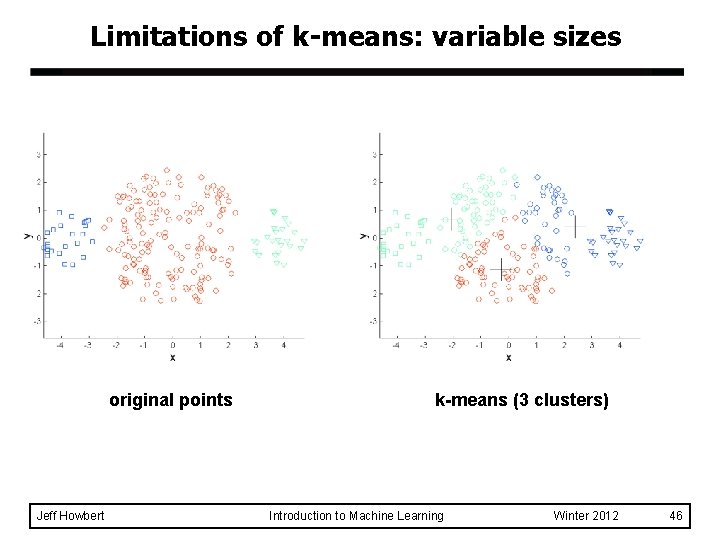
Limitations of k-means: variable sizes original points Jeff Howbert k-means (3 clusters) Introduction to Machine Learning Winter 2012 46
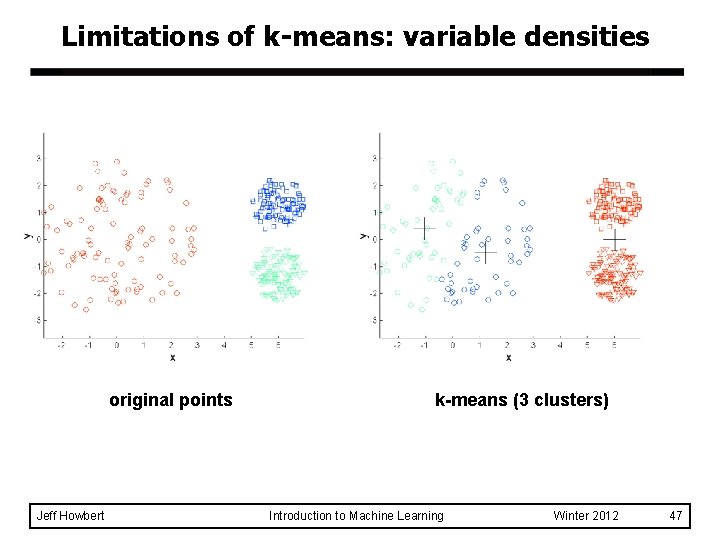
Limitations of k-means: variable densities original points Jeff Howbert k-means (3 clusters) Introduction to Machine Learning Winter 2012 47
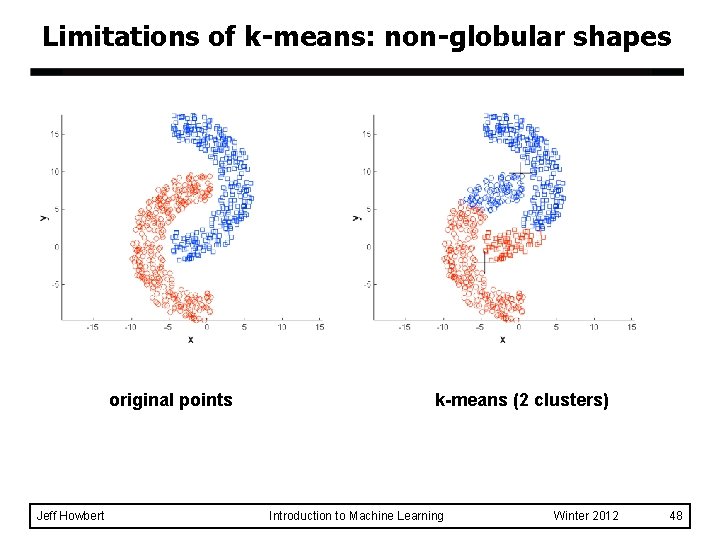
Limitations of k-means: non-globular shapes original points Jeff Howbert k-means (2 clusters) Introduction to Machine Learning Winter 2012 48
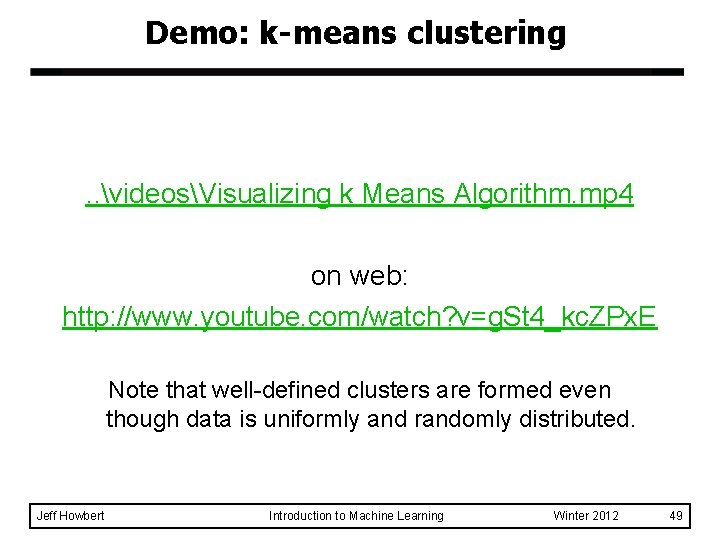
Demo: k-means clustering . . videosVisualizing k Means Algorithm. mp 4 on web: http: //www. youtube. com/watch? v=g. St 4_kc. ZPx. E Note that well-defined clusters are formed even though data is uniformly and randomly distributed. Jeff Howbert Introduction to Machine Learning Winter 2012 49
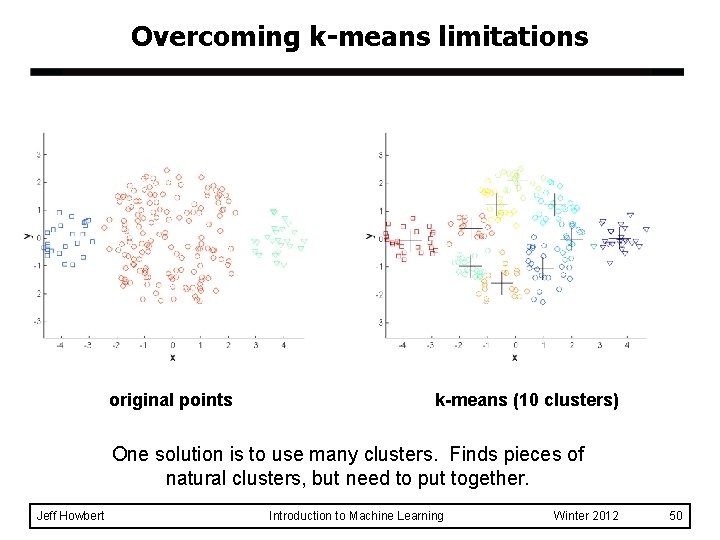
Overcoming k-means limitations original points k-means (10 clusters) One solution is to use many clusters. Finds pieces of natural clusters, but need to put together. Jeff Howbert Introduction to Machine Learning Winter 2012 50
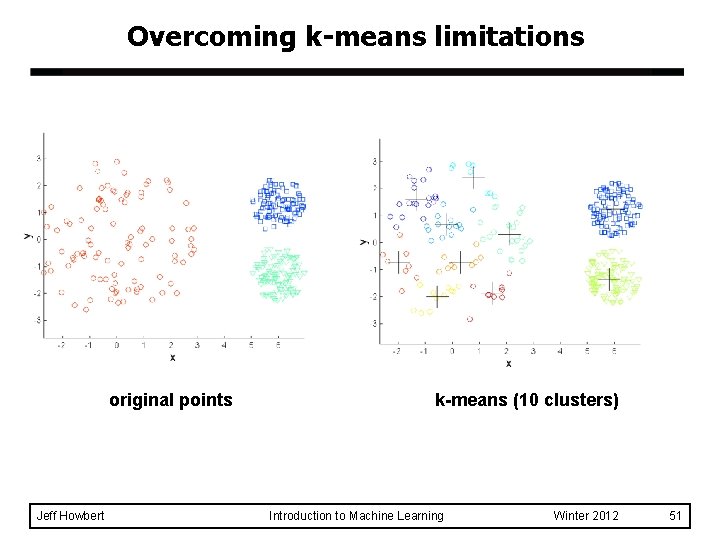
Overcoming k-means limitations original points Jeff Howbert k-means (10 clusters) Introduction to Machine Learning Winter 2012 51
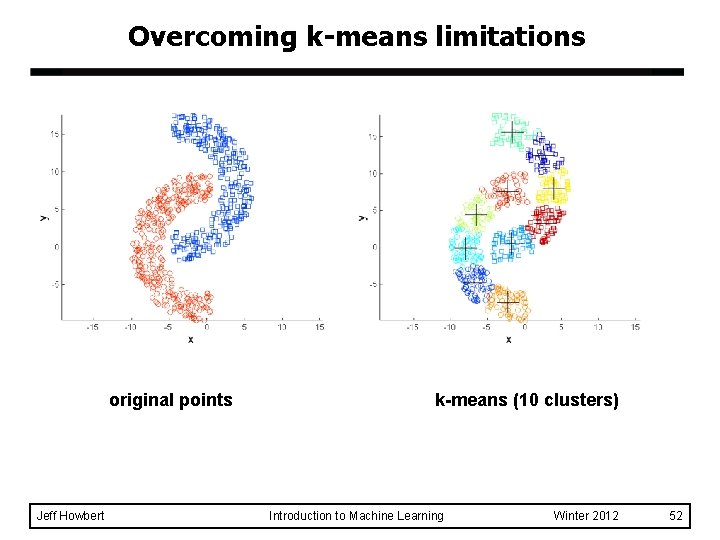
Overcoming k-means limitations original points Jeff Howbert k-means (10 clusters) Introduction to Machine Learning Winter 2012 52
MATLAB interlude matlab_demo_10. m Jeff Howbert Introduction to Machine Learning Winter 2012 53
- Slides: 53