
Clustering and Topic Analysis CS 5604 Final Presentation



- Slides: 30
Clustering and Topic Analysis CS 5604 Final Presentation December 12, 2017 Virginia Tech, Blacksburg VA 24061
Acknowledgments ●Global Event and Trend Archive Research (GETAR) project, supported by NSF IIS-1619028 ●Integrated Digital Event Archiving and Library (IDEAL) project supported by NSF IIS-1319578 ●CS 5604 GTA Liuqing Li, Instructor Edward A. Fox
Team Members Topic Analysis Clustering Ashish Baghudana Rammohan Chintha Shruti Shetty Mo Yang Aman Ahuja Pavan Bellam Ashish Malpani Prathyush Sambaturu
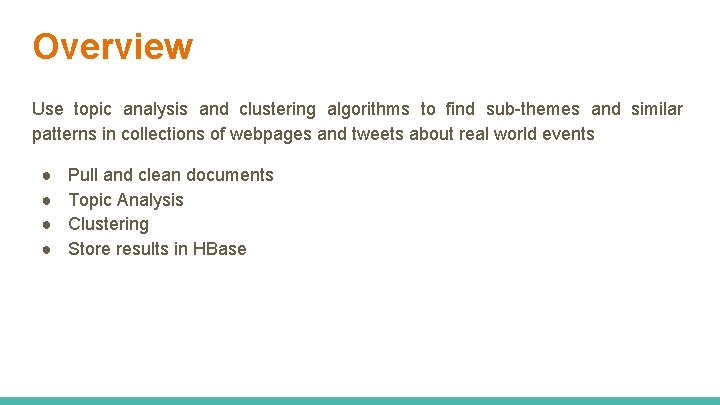
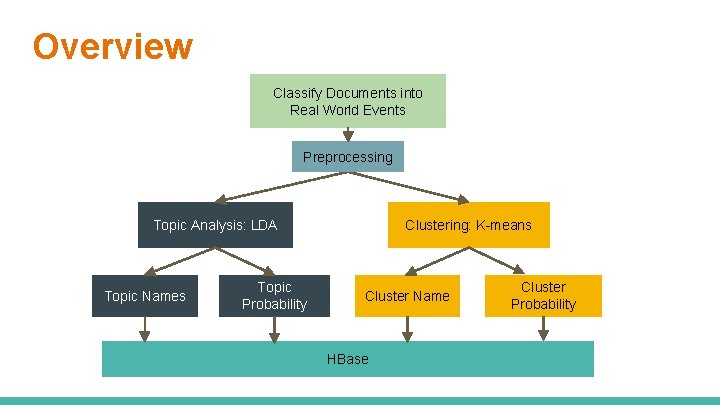
Overview Use topic analysis and clustering algorithms to find sub-themes and similar patterns in collections of webpages and tweets about real world events ● ● Pull and clean documents Topic Analysis Clustering Store results in HBase
Overview Classify Documents into Real World Events Preprocessing Topic Analysis: LDA Topic Names Topic Probability Clustering: K-means Cluster Name HBase Cluster Probability
Topic Analysis
A (really) brief overview of topic models Topic models discover “abstract” topics in a collection of documents where a topic is a group of “semantically similar” words. ● Mainly latent Dirichlet allocation (LDA) or its variants ○ ○ Probabilistic algorithm Optimized via Gibbs Sampling or Expectation Maximization ● LDA assumes documents a mixture over topics and topics a mixture over words
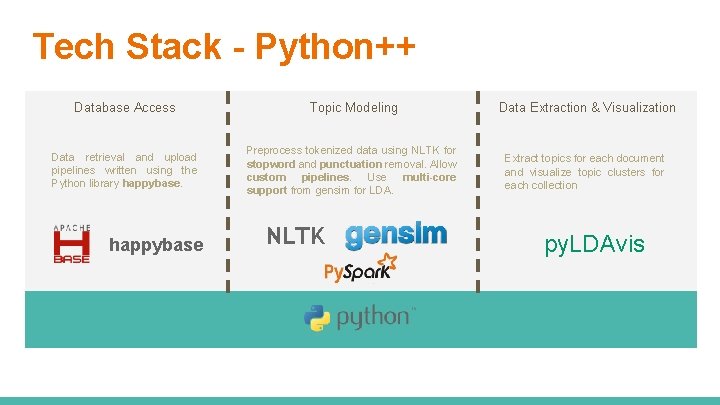
Tech Stack - Python++ Database Access Topic Modeling Data Extraction & Visualization Data retrieval and upload pipelines written using the Python library happybase. Preprocess tokenized data using NLTK for stopword and punctuation removal. Allow custom pipelines. Use multi-core support from gensim for LDA. Extract topics for each document and visualize topic clusters for each collection happybase NLTK py. LDAvis
Alternate Tech Stacks ● Scala + Spark + MLLib is an alternate stack ○ ○ Might scale better for larger datasets However, lacks the visualization and evaluation mechanisms that are built into gensim and py. LDAvis ● Gotchas ○ Py. Spark + MLLib ■ does not implement the class Distributed. LDAModel ■ LDAModel does not implement several important methods such as: top. Topics. Per. Document(), log. Perplexity() and topic. Coherence() ● Python + Gensim is best suited (multi-core support really helps!)
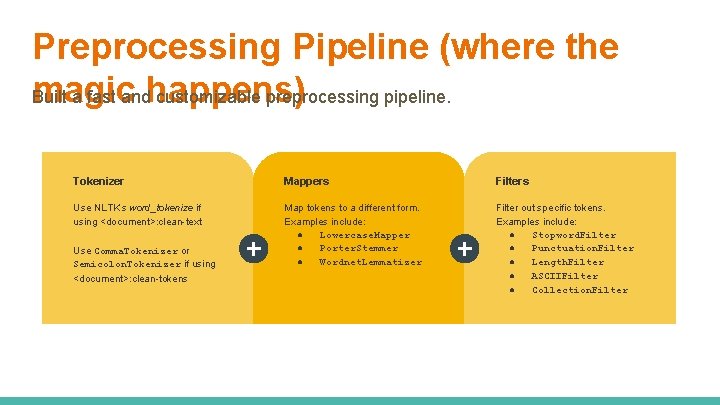
Preprocessing Pipeline (where the magic Built a fast andhappens) customizable preprocessing pipeline. Tokenizer Mappers Filters Use NLTK’s word_tokenize if using <document>: clean-text Map tokens to a different form. Examples include: ● Lowercase. Mapper ● Porter. Stemmer ● Wordnet. Lemmatizer Filter out specific tokens. Examples include: ● Stopword. Filter ● Punctuation. Filter ● Length. Filter ● ASCIIFilter ● Collection. Filter Use Comma. Tokenizer or Semicolon. Tokenizer if using <document>: clean-tokens
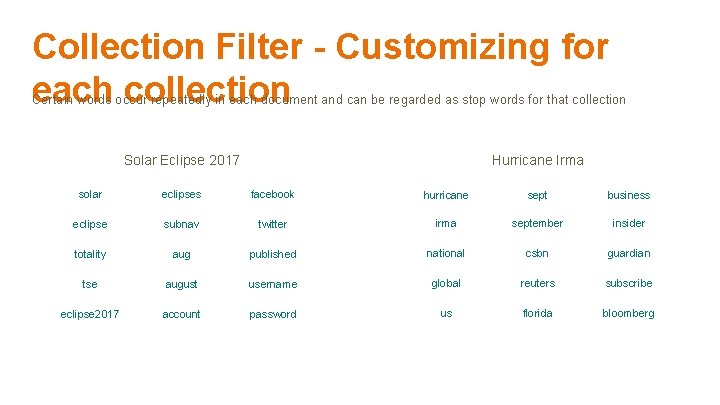
Collection Filter - Customizing for each collection Certain words occur repeatedly in each document and can be regarded as stop words for that collection Solar Eclipse 2017 Hurricane Irma solar eclipses facebook hurricane sept business eclipse subnav twitter irma september insider totality aug published national csbn guardian tse august username global reuters subscribe eclipse 2017 account password us florida bloomberg
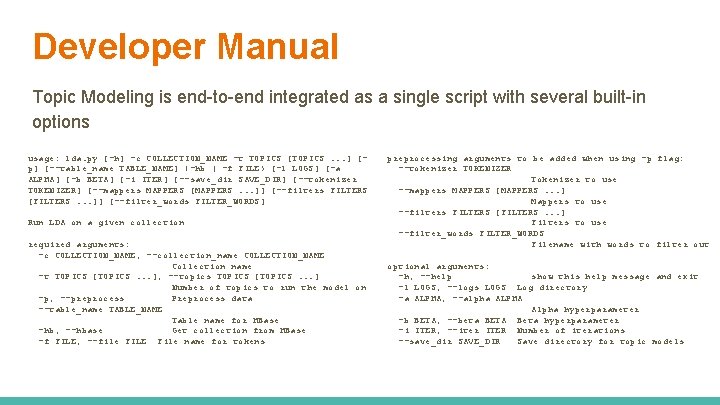
Developer Manual Topic Modeling is end-to-end integrated as a single script with several built-in options usage: lda. py [-h] -c COLLECTION_NAME -t TOPICS [TOPICS. . . ] [p] [--table_name TABLE_NAME] (-hb | -f FILE) [-l LOGS] [-a ALPHA] [-b BETA] [-i ITER] [--save_dir SAVE_DIR] [--tokenizer TOKENIZER] [--mappers MAPPERS [MAPPERS. . . ]] [--filters FILTERS [FILTERS. . . ]] [--filter_words FILTER_WORDS] Run LDA on a given collection required arguments: -c COLLECTION_NAME, --collection_name COLLECTION_NAME Collection name -t TOPICS [TOPICS. . . ], --topics TOPICS [TOPICS. . . ] Number of topics to run the model on -p, --preprocess Preprocess data --table_name TABLE_NAME Table name for HBase -hb, --hbase Get collection from HBase -f FILE, --file FILE File name for tokens preprocessing arguments to be added when using -p flag: --tokenizer TOKENIZER Tokenizer to use --mappers MAPPERS [MAPPERS. . . ] Mappers to use --filters FILTERS [FILTERS. . . ] Filters to use --filter_words FILTER_WORDS Filename with words to filter out optional arguments: -h, --help show this help message and exit -l LOGS, --logs LOGS Log directory -a ALPHA, --alpha ALPHA Alpha hyperparameter -b BETA, --beta BETA Beta hyperparameter -i ITER, --iter ITER Number of iterations --save_dir SAVE_DIR Save directory for topic models
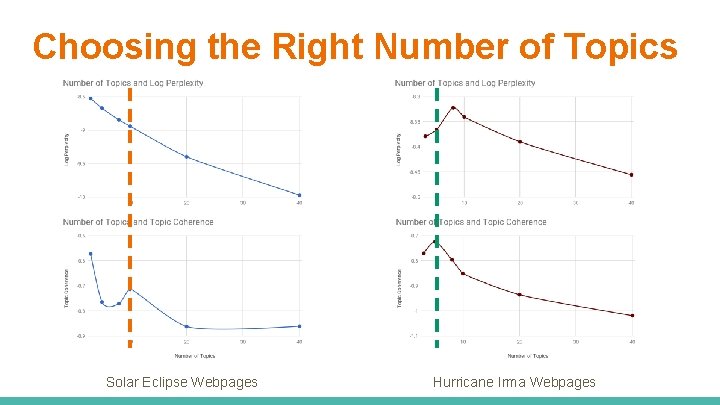
Choosing the Right Number of Topics Solar Eclipse Webpages Hurricane Irma Webpages
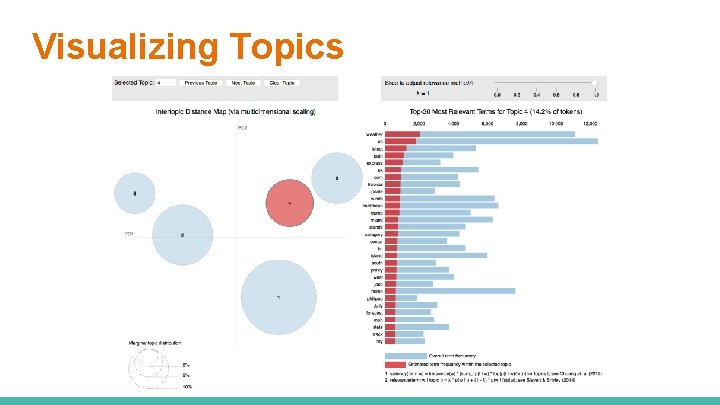
Visualizing Topics
Naming Topics Once we finalize on the number of topics, each “topic” has to be named. We follow two strategies: ● Automatic Naming ○ ○ Choose the first non-repeating word in the topic-word distribution (sorted by probability) Suitable for large number of topics ● Manual Naming ○ ○ Look at top words manually to decide topic name Suitable for small number of topics
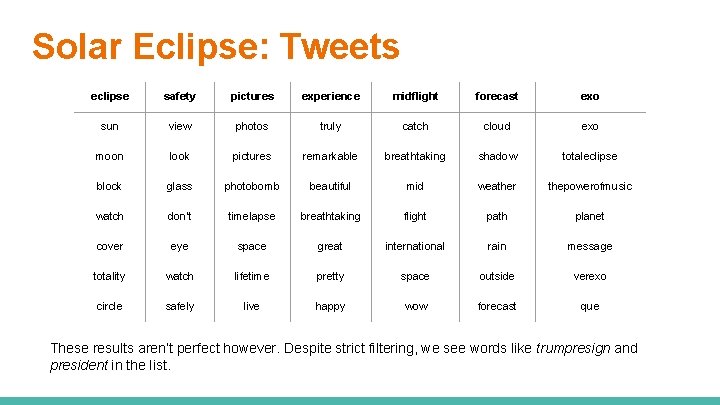
Solar Eclipse: Tweets eclipse safety pictures experience midflight forecast exo sun view photos truly catch cloud exo moon look pictures remarkable breathtaking shadow totaleclipse block glass photobomb beautiful mid weather thepowerofmusic watch don’t timelapse breathtaking flight path planet cover eye space great international rain message totality watch lifetime pretty space outside verexo circle safely live happy wow forecast que These results aren’t perfect however. Despite strict filtering, we see words like trumpresign and president in the list.
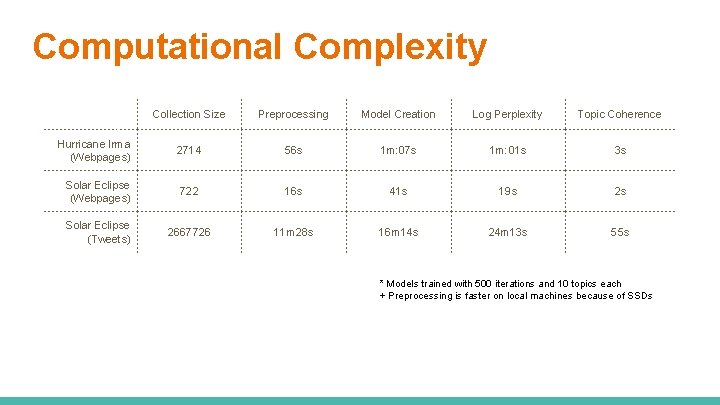
Computational Complexity Collection Size Preprocessing Model Creation Log Perplexity Topic Coherence Hurricane Irma (Webpages) 2714 56 s 1 m: 07 s 1 m: 01 s 3 s Solar Eclipse (Webpages) 722 16 s 41 s 19 s 2 s Solar Eclipse (Tweets) 2667726 11 m 28 s 16 m 14 s 24 m 13 s 55 s * Models trained with 500 iterations and 10 topics each + Preprocessing is faster on local machines because of SSDs
HBase Fields We populate: ● ● ● topic: topic-list topic: probability-list topic: display-topicnames How these are used: ● ● The front-end team uses display-topicnames as a facet in their interface It is also possible to use probability scores for recommending similar documents
Shortcomings and Improvements ● Automatic elimination of collection-specific stop-words ○ Currently requires manual curation ● Crowd experiments to decide topic names and coherence ○ ○ Topic names decided either naively or based on the experimenter’s judgement Better to use the class strength to crowdsource annotations ● Topic modeling visualizations can be part of front end ○ ○ py. LDAvis provides visualizations of the documents in a cluster via a MDS algorithm Could be part of the faceted search ● Joint models for Tweets and Webpages
Clustering
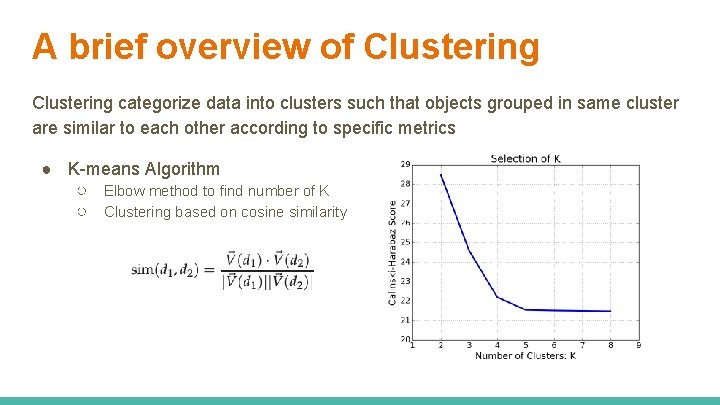
A brief overview of Clustering categorize data into clusters such that objects grouped in same cluster are similar to each other according to specific metrics ● K-means Algorithm ○ ○ Elbow method to find number of K Clustering based on cosine similarity
Tech Stack ● Data. Base Access: Data retrieval and upload pipelines written using the Python library happybase. ● Clustering: Preprocess tokenized data using NLTK for stopword and punctuation removal. Scala and Spark for used for Clustering ● Result Evaluation & Visualization: Python and matplotlib are used for calculating inter-/intra-cluster similarity and plotting the results happybase
Developer Manual Create a Scala Package using sbt-package And submit the generated jar to Spark-submit <jar file> <input file> For large datasets, performance metrics like driver memory can be enhanced
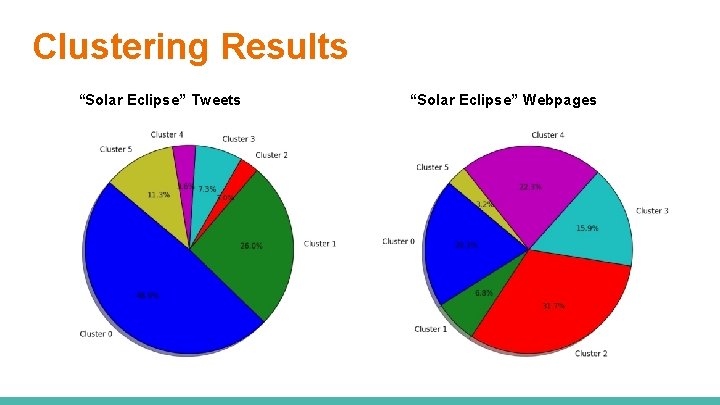
Clustering Results “Solar Eclipse” Tweets “Solar Eclipse” Webpages
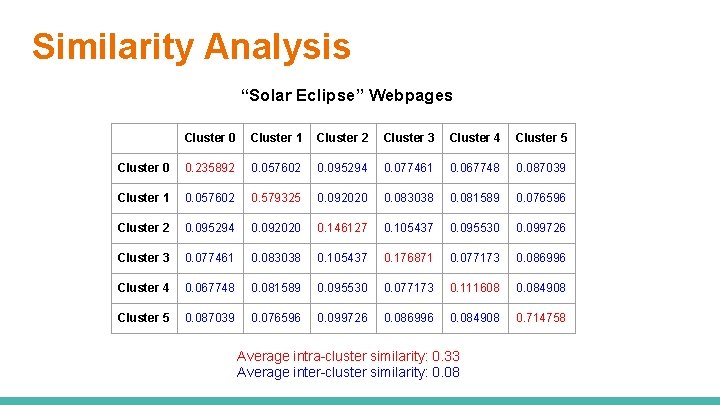
Similarity Analysis “Solar Eclipse” Webpages Cluster 0 Cluster 1 Cluster 2 Cluster 3 Cluster 4 Cluster 5 Cluster 0 0. 235892 0. 057602 0. 095294 0. 077461 0. 067748 0. 087039 Cluster 1 0. 057602 0. 579325 0. 092020 0. 083038 0. 081589 0. 076596 Cluster 2 0. 095294 0. 092020 0. 146127 0. 105437 0. 095530 0. 099726 Cluster 3 0. 077461 0. 083038 0. 105437 0. 176871 0. 077173 0. 086996 Cluster 4 0. 067748 0. 081589 0. 095530 0. 077173 0. 111608 0. 084908 Cluster 5 0. 087039 0. 076596 0. 099726 0. 086996 0. 084908 0. 714758 Average intra-cluster similarity: 0. 33 Average inter-cluster similarity: 0. 08
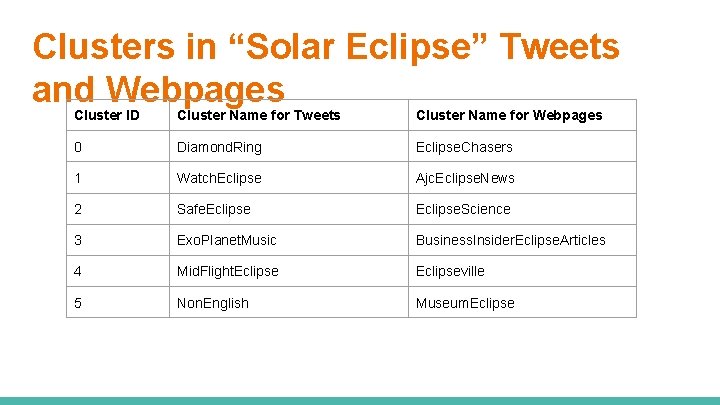
Naming Clusters by Frequent words ● K-means just returns clusters of documents, but does not name the clusters ● We can name each cluster by looking at a handful of documents in the cluster manually, which can be tedious in Big Data scenario ● Therefore, - we determine the most frequent words in all documents within a cluster - name the cluster based on a few very frequent words in the cluster (Assumption: The frequent words in the cluster describe the information in the documents within the cluster)
Clusters in “Solar Eclipse” Tweets and Webpages Cluster ID Cluster Name for Tweets Cluster Name for Webpages 0 Diamond. Ring Eclipse. Chasers 1 Watch. Eclipse Ajc. Eclipse. News 2 Safe. Eclipse. Science 3 Exo. Planet. Music Business. Insider. Eclipse. Articles 4 Mid. Flight. Eclipseville 5 Non. English Museum. Eclipse
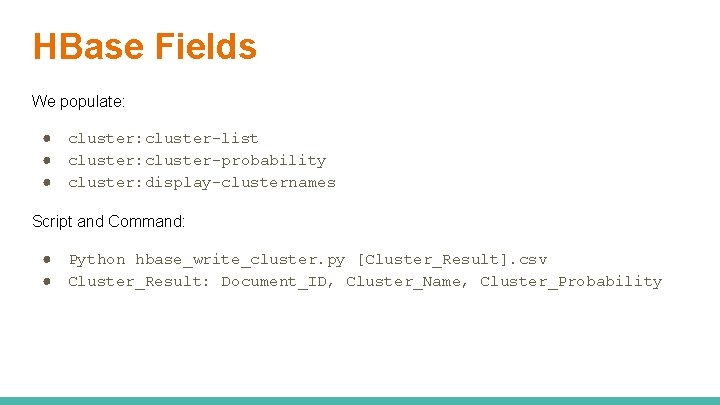
HBase Fields We populate: ● ● ● cluster: cluster-list cluster: cluster-probability cluster: display-clusternames Script and Command: ● ● Python hbase_write_cluster. py [Cluster_Result]. csv Cluster_Result: Document_ID, Cluster_Name, Cluster_Probability
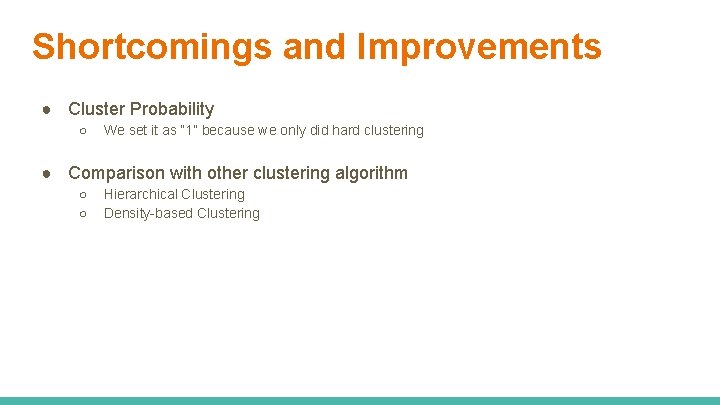
Shortcomings and Improvements ● Cluster Probability ○ We set it as “ 1” because we only did hard clustering ● Comparison with other clustering algorithm ○ ○ Hierarchical Clustering Density-based Clustering
Questions? Code Repository: https: //github. com/ashishbaghudana/cs 5604 https: //github. com/yuan 9/CS 5604_CTA