
Cluster Upgrading through a Value Chain Approach SMEs
- Slides: 23
Cluster Upgrading through a Value Chain Approach SMEs and Cluster Development
General objective You will be asked to apply your learning to your context. You should become able to: n Provide guidelines on how to apply the value chain methodology to upgrading clusters.
Learning objectives n n n Explain what a value chain is Justify the relevance of the value chain approach to cluster upgrading Describe the contribution of the ILO to cluster upgrading Map a value chain Identify ways to upgrade clusters Prepare an action plan for cluster upgrading.
UNIT 1 Introduction to the ‘value chain’ concept A value chain is a sequence of targetoriented combinations of production factors that create a marketable product or service - from its conception to its final consumption. The activities constituting a value chain can be: • contained within a single firm or divided among different firms • within a single geographical area or spread over wider areas.
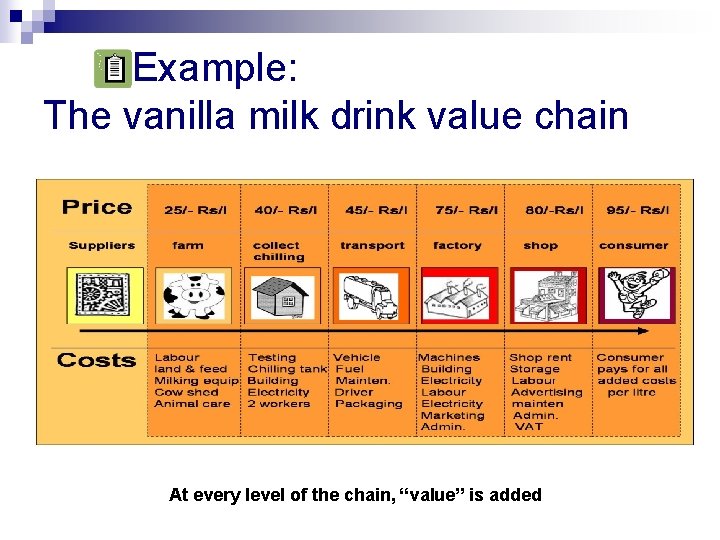
Example: The vanilla milk drink value chain At every level of the chain, “value” is added
Time for reflection n Consider a product or service you know well. Can you briefly set out its value chain? Is it a short or a long value chain? Is it limited to local markets or open to international markets?
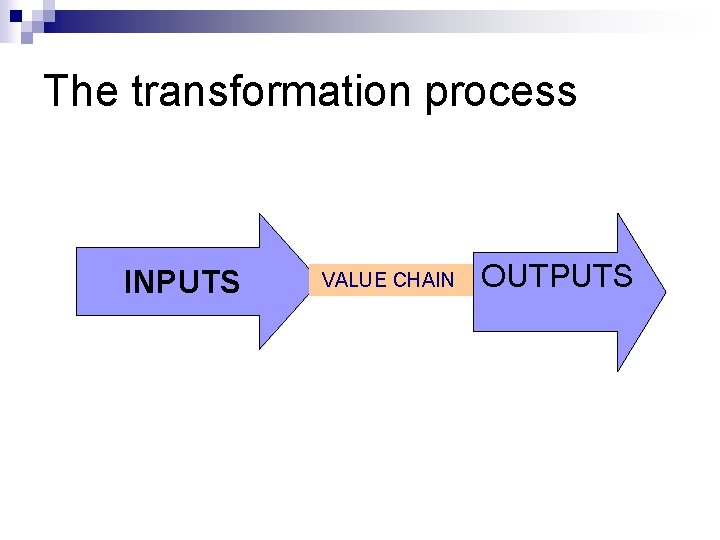
The transformation process INPUTS VALUE CHAIN OUTPUTS
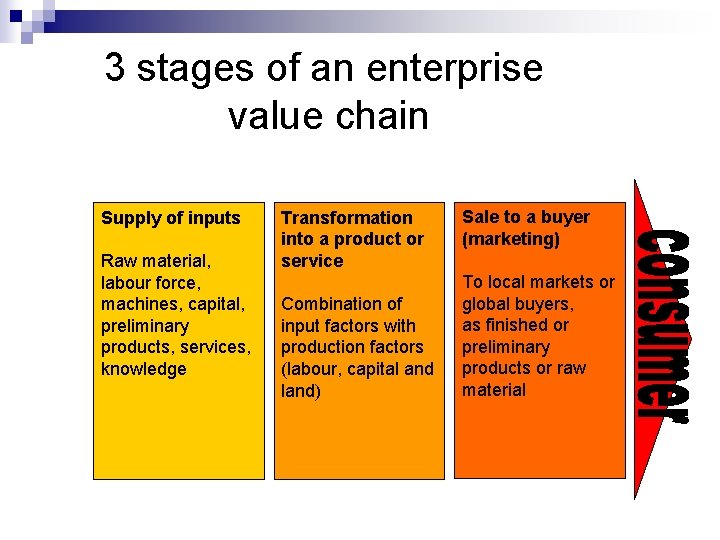
3 stages of an enterprise value chain Supply of inputs Raw material, labour force, machines, capital, preliminary products, services, knowledge Transformation into a product or service Combination of input factors with production factors (labour, capital and land) Sale to a buyer (marketing) To local markets or global buyers, as finished or preliminary products or raw material
Types of value chain governance a. b. c. Hierarchical: dominant players determine the overall character of the chain. Network relationships: the relationships are “modular”, “relational” or “captive”. Market-based relationships: little exchange of information occurs.
Time for reflection n What is going on around you? Consider the product or service for which you set out the value chain in the previous exercise. ¨ What kind of relationships are there among the participants in the chain? ¨ What type of governance can you see there?
The value chain approach n The value chain approach is a way to analyse and upgrade clusters or sectors.
Advantages of the value chain approach n n n It focuses on making a cluster or sector more competitive It provides a broader picture of the performance of a sector It facilitates the identification of “where” and “how much” value is added It helps to identify the strengths, weaknesses, opportunities and threats of a cluster or sector It is both a “market-demand” and a “supplydriven” production approach.
Time for reflection n Can you see relevant differences between the traditional development approach you are familiar with, aimed at increasing productivity, and the value chain approach?
Cluster upgrading n By “upgrading”, we mean a multi-dimensional process that helps to increase the economic competitiveness of enterprises and their clusters, and has a positive impact on the workforce, the community and society at large.
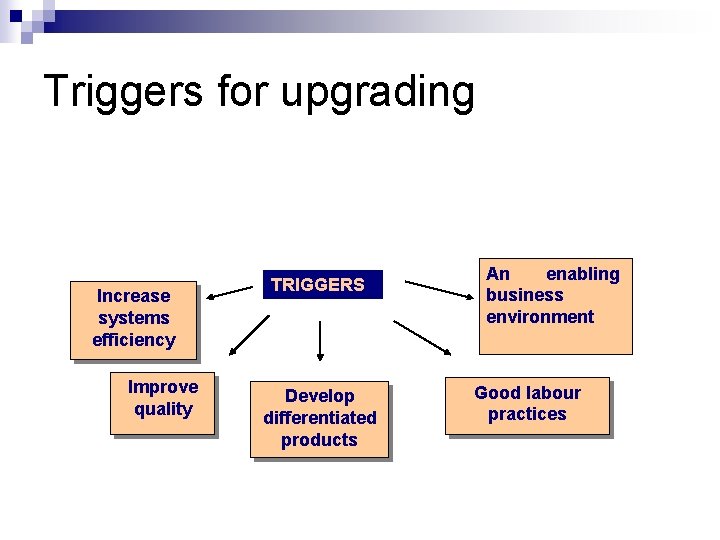
Triggers for upgrading Increase systems efficiency Improve quality TRIGGERS Develop differentiated products An enabling business environment Good labour practices
What do we upgrade? Product n Process n Function n Market n Supply n Inter-chain n Intra-chain n
Time for reflection n Can you provide an example of upgrading economic competitiveness? What were the results? How might better results have been achieved?
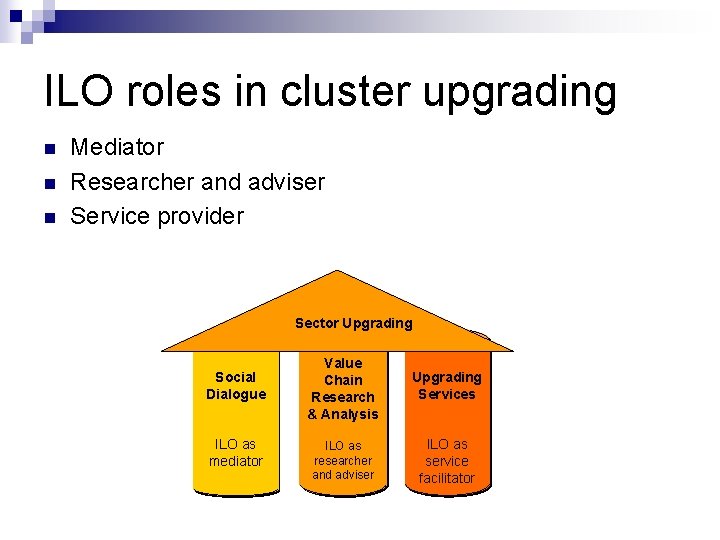
ILO roles in cluster upgrading n n n Mediator Researcher and adviser Service provider Sector Upgrading Social Dialogue ILO as mediator Value Chain Research & Analysis Upgrading Services ILO as researcher and adviser ILO as service facilitator
UNIT 2 Value chain analysis n n The starting point of any value chain analysis is mapping. Mapping a chain means visually representing the connections among stakeholders. In its simplest form, it is merely a flow chart.
How to undertake a value chain analysis n n n Step 1: Verify the initial value chain maps Step 2: Assess the overall value chain Step 3: Assess individual positions in the value chain
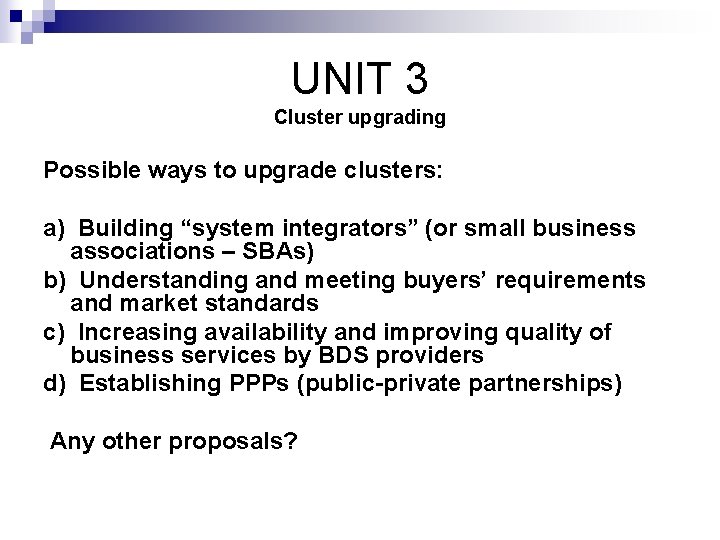
UNIT 3 Cluster upgrading Possible ways to upgrade clusters: a) Building “system integrators” (or small business associations – SBAs) b) Understanding and meeting buyers’ requirements and market standards c) Increasing availability and improving quality of business services by BDS providers d) Establishing PPPs (public-private partnerships) Any other proposals?
Time for reflection Consider the case of cocoa bean producers in Madagascar. Imagine that you have identified specific “gaps” (or bottlenecks) in the chain. n Sum up those gaps. n What needs to be done? n What can be done to enhance value chain upgrading?
Final reflection time n What are three most important lessons that you have learned today?