
Cluster Coordination Performance Monitoring What is the CCPM

- Slides: 16
Cluster Coordination Performance Monitoring
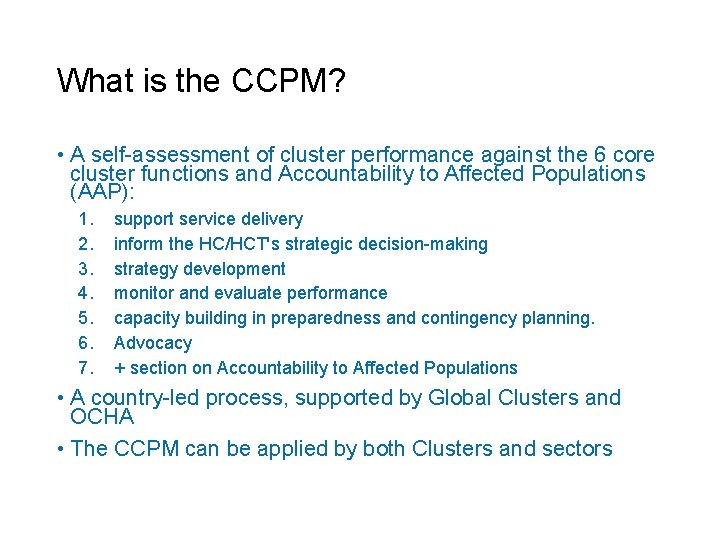
What is the CCPM? • A self-assessment of cluster performance against the 6 core cluster functions and Accountability to Affected Populations (AAP): 1. 2. 3. 4. 5. 6. 7. support service delivery inform the HC/HCT's strategic decision-making strategy development monitor and evaluate performance capacity building in preparedness and contingency planning. Advocacy + section on Accountability to Affected Populations • A country-led process, supported by Global Clusters and OCHA • The CCPM can be applied by both Clusters and sectors
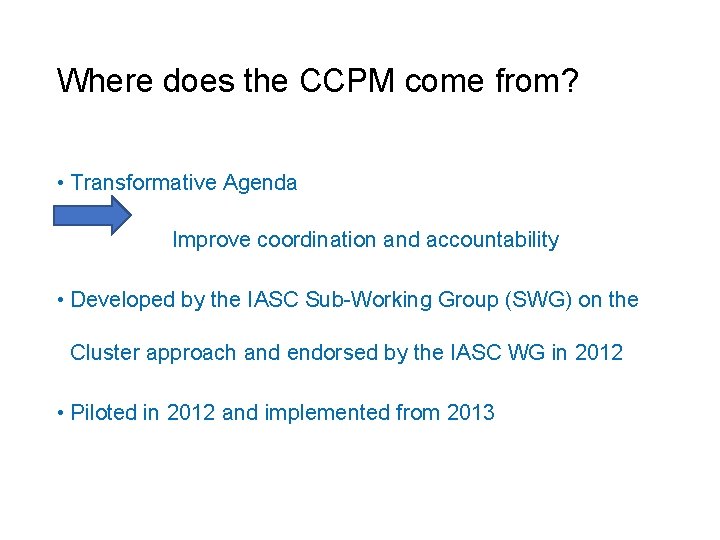
Where does the CCPM come from? • Transformative Agenda Improve coordination and accountability • Developed by the IASC Sub-Working Group (SWG) on the Cluster approach and endorsed by the IASC WG in 2012 • Piloted in 2012 and implemented from 2013
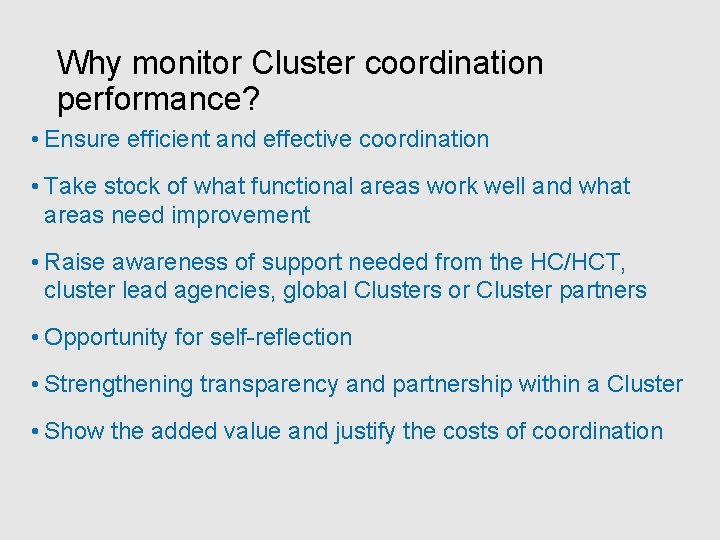
Why monitor Cluster coordination performance? • Ensure efficient and effective coordination • Take stock of what functional areas work well and what areas need improvement • Raise awareness of support needed from the HC/HCT, cluster lead agencies, global Clusters or Cluster partners • Opportunity for self-reflection • Strengthening transparency and partnership within a Cluster • Show the added value and justify the costs of coordination
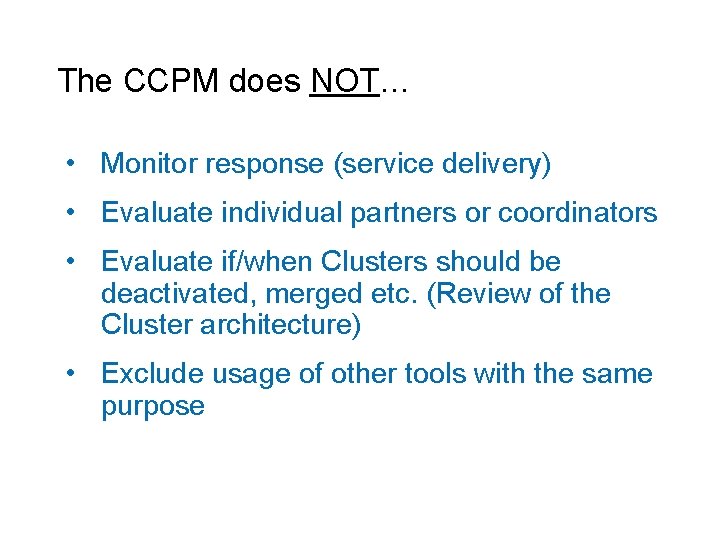
The CCPM does NOT… • Monitor response (service delivery) • Evaluate individual partners or coordinators • Evaluate if/when Clusters should be deactivated, merged etc. (Review of the Cluster architecture) • Exclude usage of other tools with the same purpose
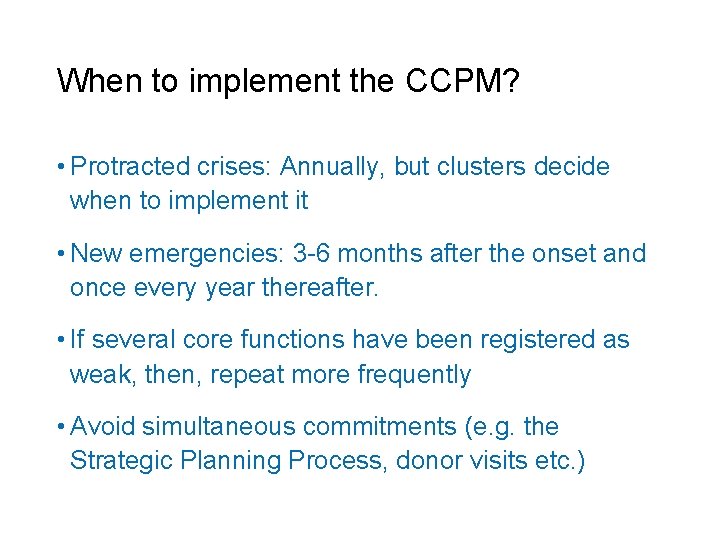
When to implement the CCPM? • Protracted crises: Annually, but clusters decide when to implement it • New emergencies: 3 -6 months after the onset and once every year thereafter. • If several core functions have been registered as weak, then, repeat more frequently • Avoid simultaneous commitments (e. g. the Strategic Planning Process, donor visits etc. )
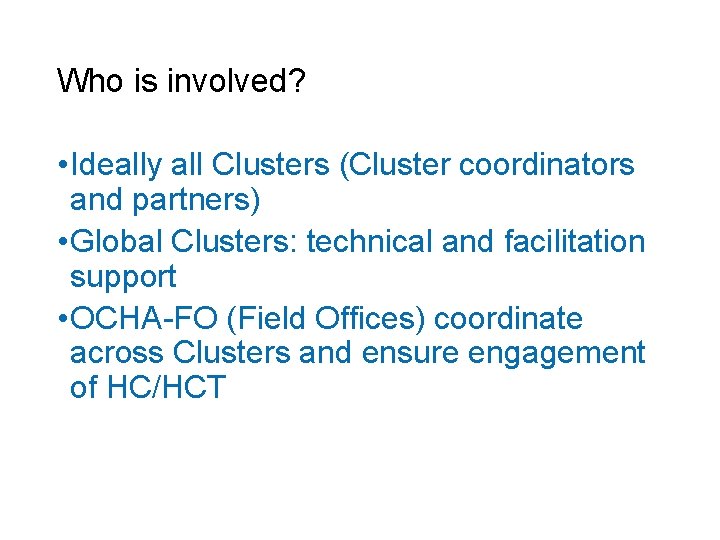
Who is involved? • Ideally all Clusters (Cluster coordinators and partners) • Global Clusters: technical and facilitation support • OCHA-FO (Field Offices) coordinate across Clusters and ensure engagement of HC/HCT
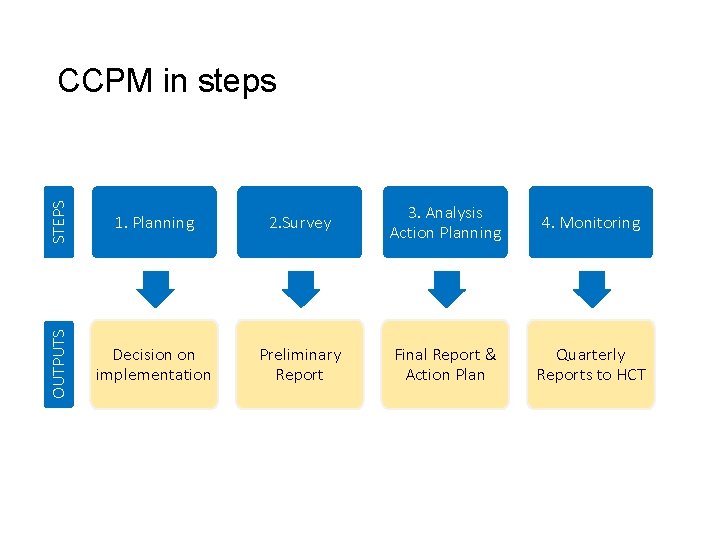
STEPS 1. Planning 2. Survey 3. Analysis Action Planning 4. Monitoring OUTPUTS CCPM in steps Decision on implementation Preliminary Report Final Report & Action Plan Quarterly Reports to HCT
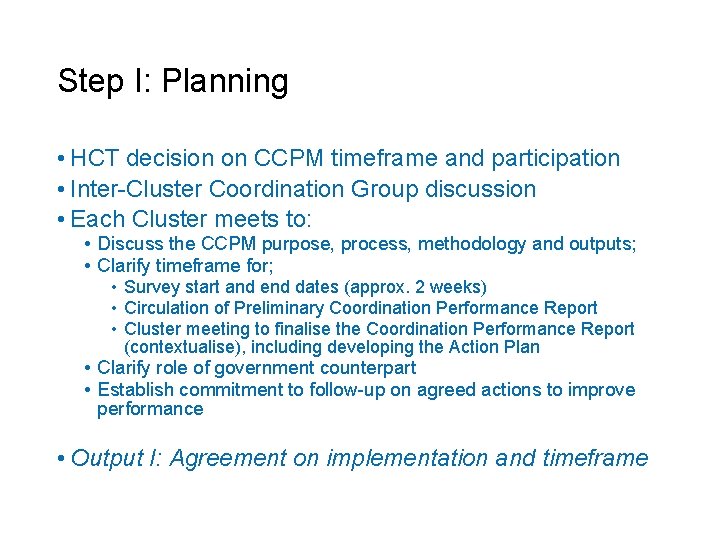
Step I: Planning • HCT decision on CCPM timeframe and participation • Inter-Cluster Coordination Group discussion • Each Cluster meets to: • Discuss the CCPM purpose, process, methodology and outputs; • Clarify timeframe for; • Survey start and end dates (approx. 2 weeks) • Circulation of Preliminary Coordination Performance Report • Cluster meeting to finalise the Coordination Performance Report (contextualise), including developing the Action Plan • Clarify role of government counterpart • Establish commitment to follow-up on agreed actions to improve performance • Output I: Agreement on implementation and timeframe
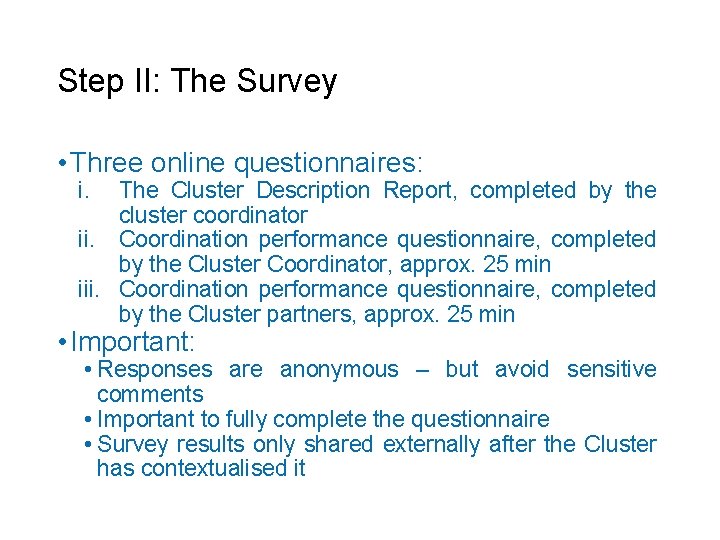
Step II: The Survey • Three online questionnaires: i. The Cluster Description Report, completed by the cluster coordinator ii. Coordination performance questionnaire, completed by the Cluster Coordinator, approx. 25 min iii. Coordination performance questionnaire, completed by the Cluster partners, approx. 25 min • Important: • Responses are anonymous – but avoid sensitive comments • Important to fully complete the questionnaire • Survey results only shared externally after the Cluster has contextualised it
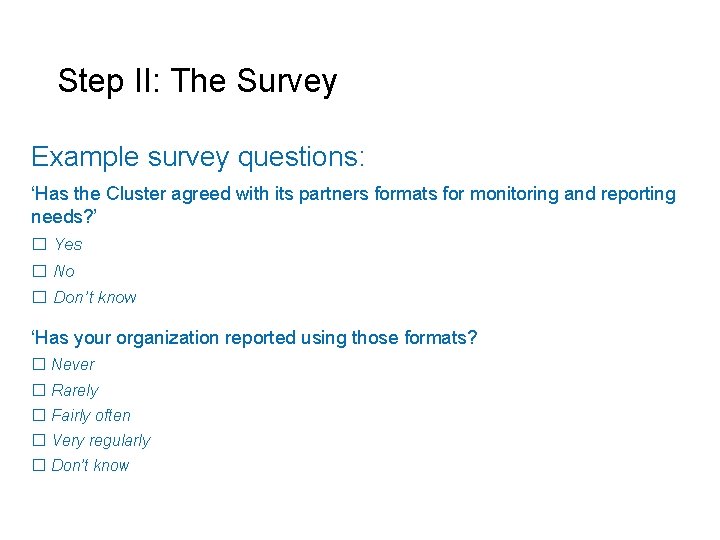
Step II: The Survey Example survey questions: ‘Has the Cluster agreed with its partners formats for monitoring and reporting needs? ’ ☐ Yes ☐ No ☐ Don’t know ‘Has your organization reported using those formats? ☐ Never ☐ Rarely ☐ Fairly often ☐ Very regularly ☐ Don’t know
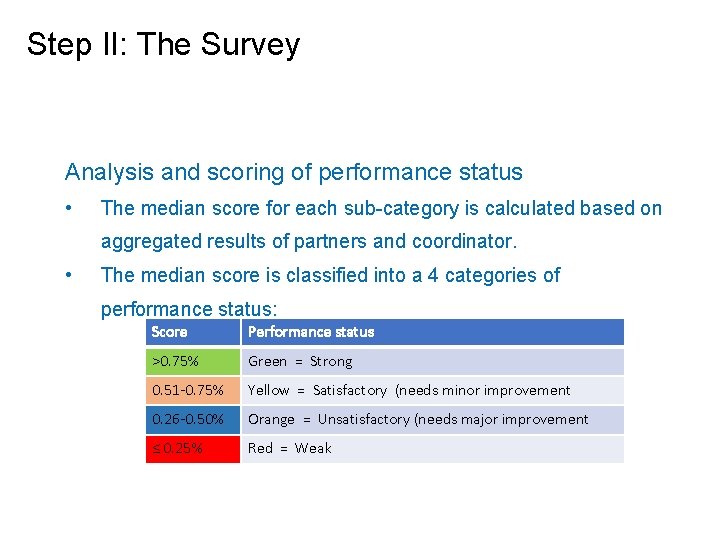
Step II: The Survey Analysis and scoring of performance status • The median score for each sub-category is calculated based on aggregated results of partners and coordinator. • The median score is classified into a 4 categories of performance status: Score Performance status >0. 75% Green = Strong 0. 51 -0. 75% Yellow = Satisfactory (needs minor improvement 0. 26 -0. 50% Orange = Unsatisfactory (needs major improvement ≤ 0. 25% Red = Weak
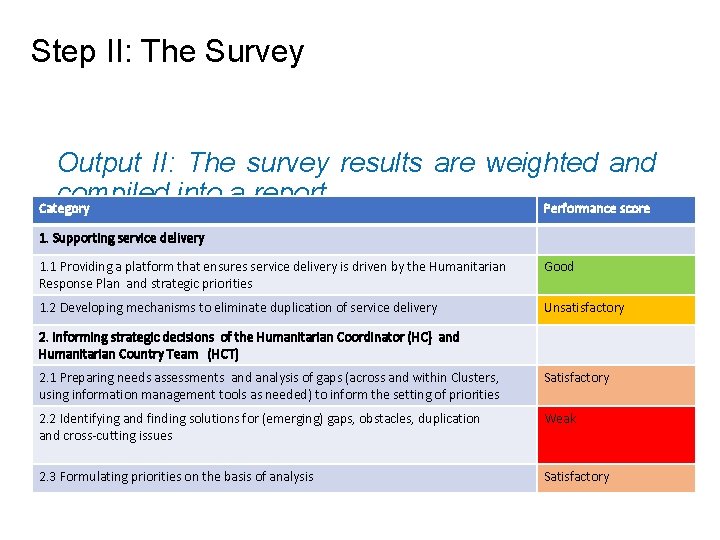
Step II: The Survey Output II: The survey results are weighted and compiled into a report Category Performance score 1. Supporting service delivery 1. 1 Providing a platform that ensures service delivery is driven by the Humanitarian Response Plan and strategic priorities Good 1. 2 Developing mechanisms to eliminate duplication of service delivery Unsatisfactory 2. Informing strategic decisions of the Humanitarian Coordinator (HC) and Humanitarian Country Team (HCT) 2. 1 Preparing needs assessments and analysis of gaps (across and within Clusters, using information management tools as needed) to inform the setting of priorities Satisfactory 2. 2 Identifying and finding solutions for (emerging) gaps, obstacles, duplication and cross-cutting issues Weak 2. 3 Formulating priorities on the basis of analysis Satisfactory
Step III: Cluster analysis and action planning • Review/amend the Preliminary Report • Explain/contextualize findings • Identify actions for improvement (focus on weak and unsatisfactory performance), timeframe and responsible for follow-up • Pinpoint support requirements
Step III: Cluster analysis and action planning Output III: Final CCPM and Action Plan • Actions for improvement, timeframe and responsible for follow-up • Awareness of support requirements (HC/HCT, Cluster Lead Agencies, Partners, OCHA, Global Clusters and national authorities) • Shared with the HC/HCT and Global Cluster and, if applicable, the national authorities
Step IV: Follow-up & Monitoring Follow-up: • ICC: Review of Reports/Action Plans identify common weaknesses to be addressed systematically. • HCT: Presentation of Reports/Action Plans and discussion of support requirements Monitoring: • Take stock of progress at monthly cluster meetings • Quarterly progress reporting to the HCT Output IV: Quarterly reports to HCT