
CLT Conference Heerlen Does Cognitive Load Theory account


- Slides: 27
CLT Conference Heerlen Does Cognitive Load Theory account for the beneficial effects of worked examples in tutored problem solving? Ron Salden, Ken Koedinger, Vincent Aleven, & Bruce Mc. Laren (Carnegie Mellon University, Pittsburgh, USA)
Worked examples and tutored problem solving • Worked examples mostly investigated in untutored problem solving environments • Cognitive Tutor is Intelligent Tutoring System provides step-by-step guidance during complex problem solving practice
Worked examples and tutored problem solving • Cognitive Tutor provides a tougher control condition of tutored problem solving – It is this tutored part that in our view reduces extraneous load – And, sometimes, increases germane load
Cognitive Tutors • Longstanding tradition in improving students’ learning • Grounded in cognitive theory (ACT-R, Anderson & Le. Bière, 1998) • Methods for reducing WM load – Scaffolding or prompting of sub-goals – Step by step feedback & hints (i. e. , guided learning) • Use cognitive model of student thinking • Many full-year classroom evaluations show improved math competence (Koedinger & Aleven, 2007)
Cognitive Tutors Elements that reduce extraneous cognitive load.
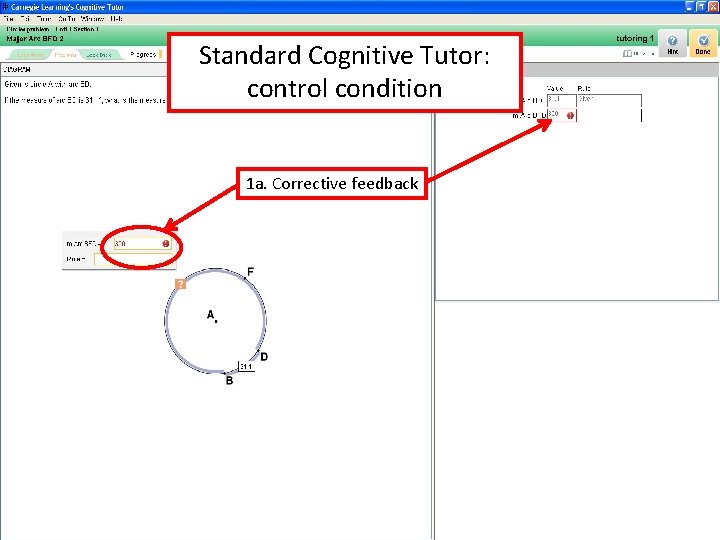
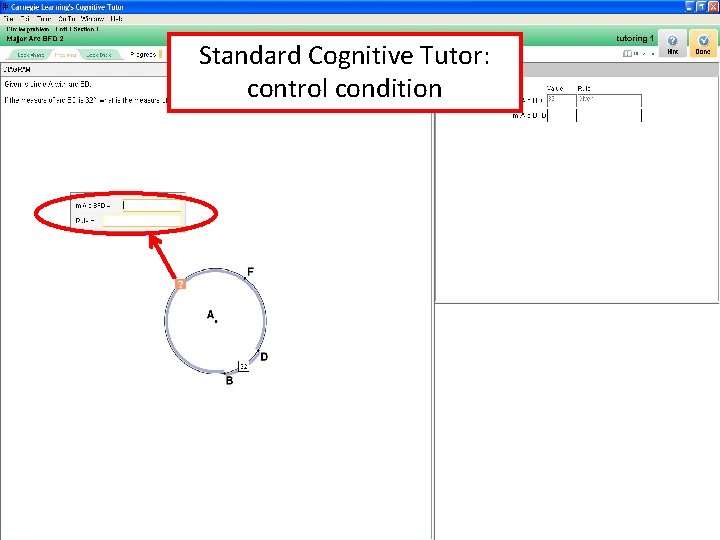
Standard Cognitive Tutor: control condition 1 a. Corrective feedback 9/30/2020 Pittsburgh Science of Learning Center 6
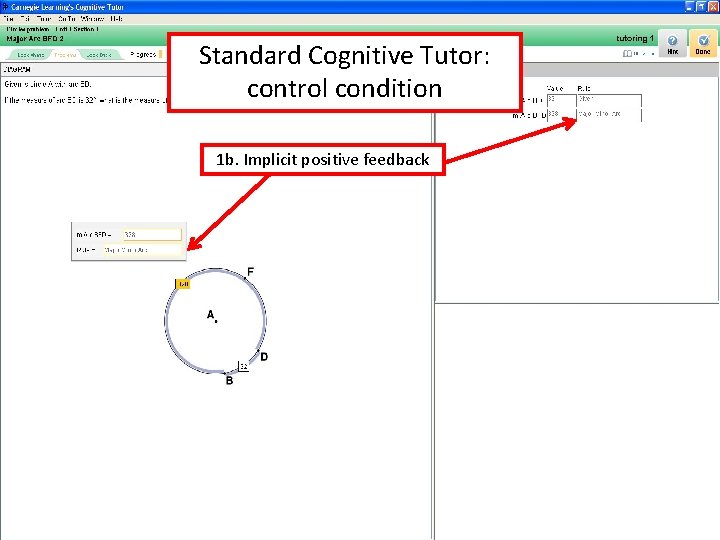
Standard Cognitive Tutor: control condition 1 b. Implicit positive feedback 9/30/2020 Pittsburgh Science of Learning Center 7
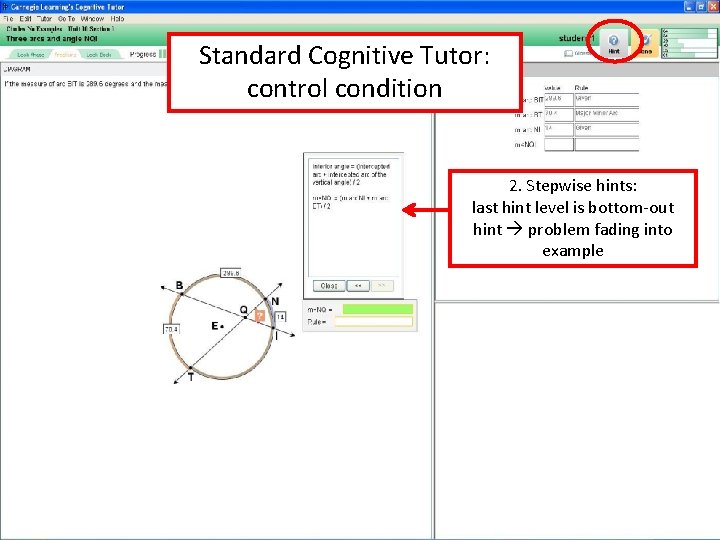
Standard Cognitive Tutor: control condition 2. Stepwise hints: last hint level is bottom-out hint problem fading into example
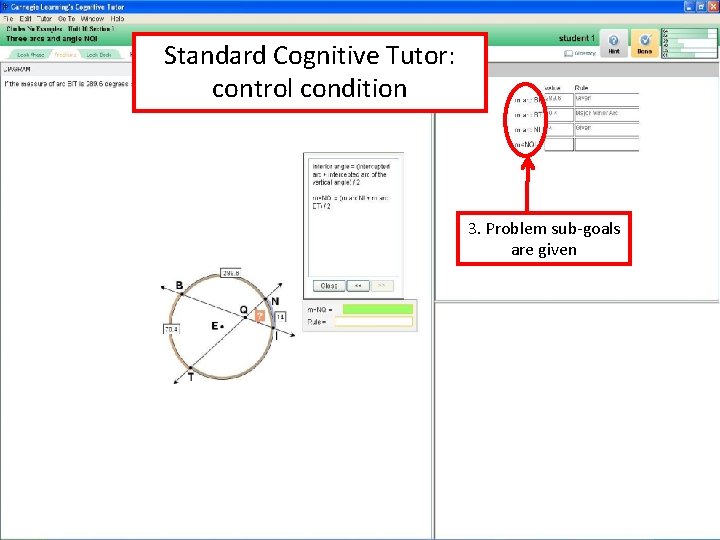
Standard Cognitive Tutor: control condition 3. Problem sub-goals are given
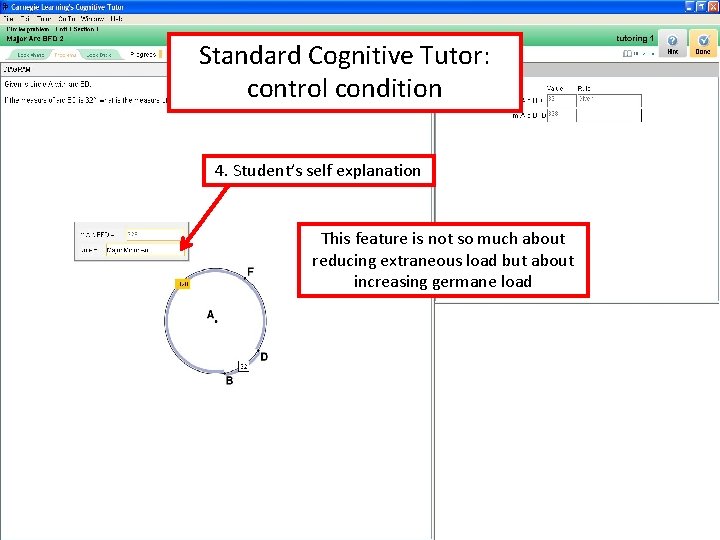
Standard Cognitive Tutor: control condition 4. Student’s self explanation This feature is not so much about reducing extraneous load but about increasing germane load 9/30/2020 Pittsburgh Science of Learning Center 10
Studies • Shih et al (Geometry) • Mc. Laren et al (Chemistry) • Salden et al (Geometry) Not addressed in this talk • Anthony et al (Algebra) obtained similar results as the other three studies Does Cognitive Load Theory explain beneficial effects of examples in tutored problem solving?
Shih et al • Study: re-analyzing prior study (Aleven & Koedinger, 2002) – Logged response data on bottom-out hint usage • One type of “Gaming the system” behavior – Can be hint abuse due to students skipping abstract hints to obtain the concrete answer – Can also be helpful when bottom-out hints act as worked examples
Shih et al • Developed a model to distinguish between good student use of bottom-out hints from bad student use of bottom-out hints • Two key elements of model are time spent on: – Reflecting about prior step (after bottom-out hint) – Thinking about next step (prior to next action) • Subtraction method to isolate reflection (selfexplanation) time – Use other data, when bottom-hints are not requested, to estimate next step time
Shih et al results • High correlation of time spent reflecting on bottom-out hint with learning (pre-to-post gain) • Spending time on hints is beneficial to learning for all students • Difference between students’ hint usage: – Good usage = spending more time on bottom-out hint – Bad usage = spending less time on bottom-out hint • Thus students who study bottom-out hint as worked example obtain higher learning gains
Mc. Laren et al • Conducted three studies comparing – Tutored Alone vs. Worked Examples + Tutored • Examples are alternated with isomorphic problems
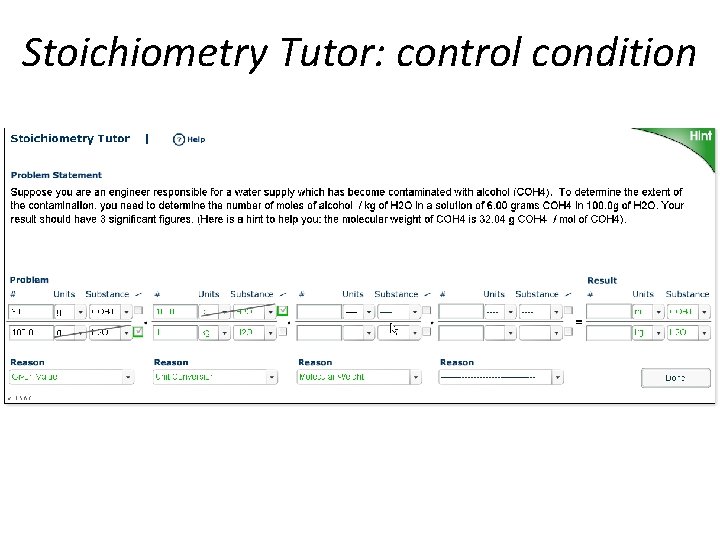
Stoichiometry Tutor: control condition
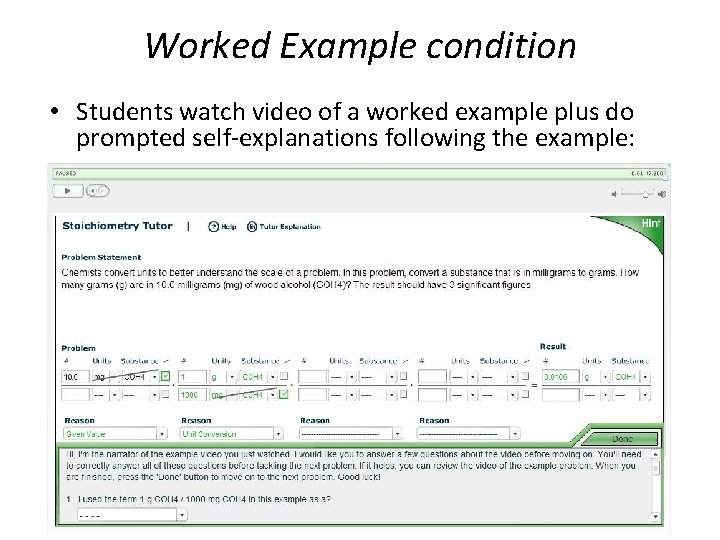
Worked Example condition • Students watch video of a worked example plus do prompted self-explanations following the example:
Mc. Laren et al results • No differences on posttest performance • BUT, students in Examples condition did learn more efficiently, using 21% less time to finish same problem set
Salden et al • Conducted lab and classroom study comparing: – Tutored problem solving – Fixed example fading – Adaptive example fading • Adaptive fading based on students’ selfexplanations of the example steps – Students who self explain well receive fewer examples than students who self explain poorly
Standard Cognitive Tutor: control condition 9/30/2020 Pittsburgh Science of Learning Center 20
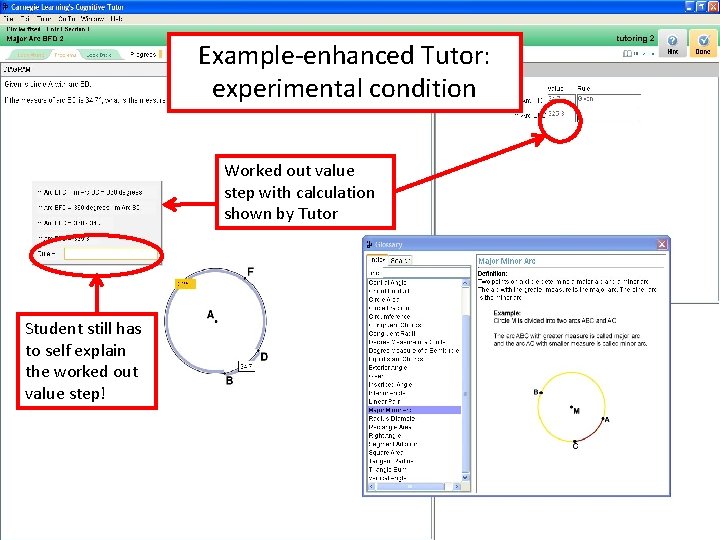
Example-enhanced Tutor: experimental condition Worked out value step with calculation shown by Tutor Student still has to self explain the worked out value step!
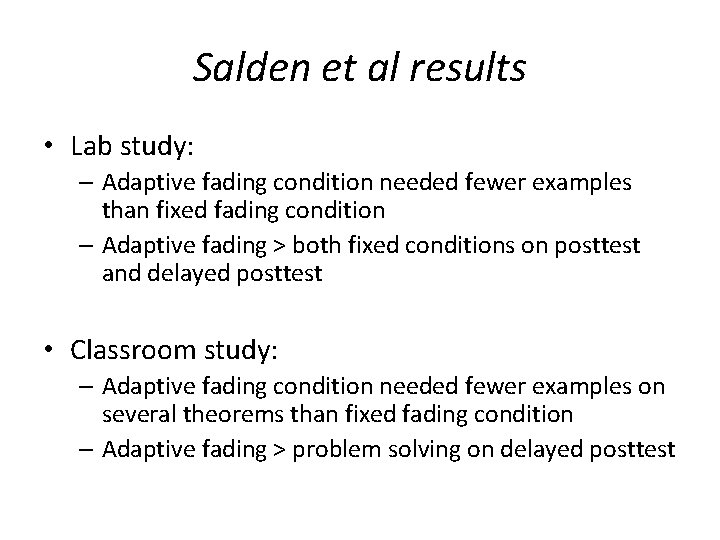
Salden et al results • Lab study: – Adaptive fading condition needed fewer examples than fixed fading condition – Adaptive fading > both fixed conditions on posttest and delayed posttest • Classroom study: – Adaptive fading condition needed fewer examples on several theorems than fixed fading condition – Adaptive fading > problem solving on delayed posttest
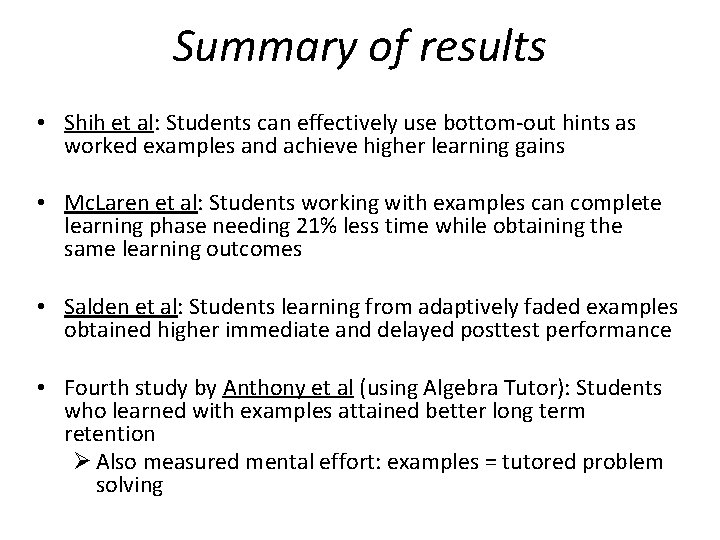
Summary of results • Shih et al: Students can effectively use bottom-out hints as worked examples and achieve higher learning gains • Mc. Laren et al: Students working with examples can complete learning phase needing 21% less time while obtaining the same learning outcomes • Salden et al: Students learning from adaptively faded examples obtained higher immediate and delayed posttest performance • Fourth study by Anthony et al (using Algebra Tutor): Students who learned with examples attained better long term retention Ø Also measured mental effort: examples = tutored problem solving
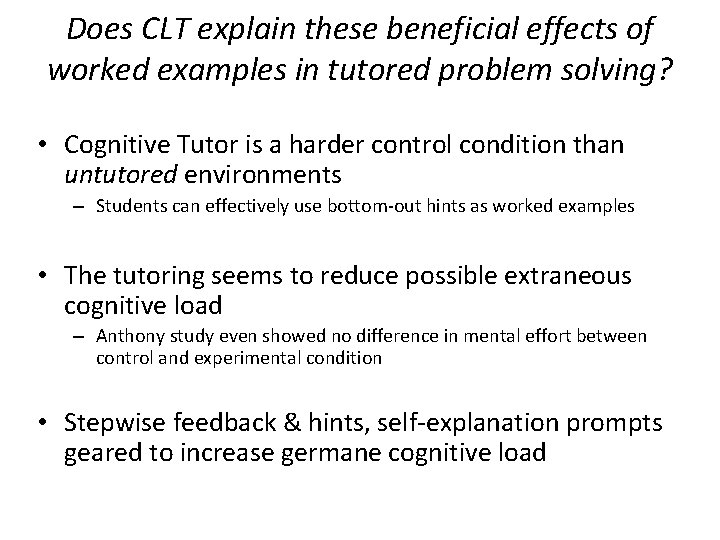
Does CLT explain these beneficial effects of worked examples in tutored problem solving? • Cognitive Tutor is a harder control condition than untutored environments – Students can effectively use bottom-out hints as worked examples • The tutoring seems to reduce possible extraneous cognitive load – Anthony study even showed no difference in mental effort between control and experimental condition • Stepwise feedback & hints, self-explanation prompts geared to increase germane cognitive load
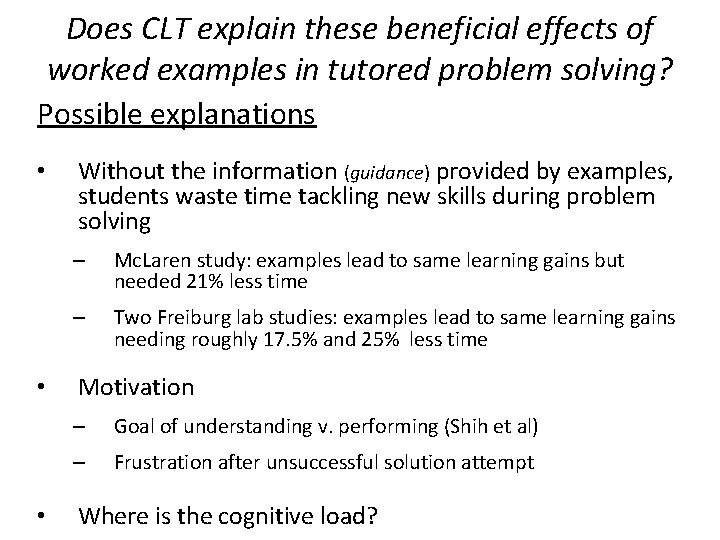
Does CLT explain these beneficial effects of worked examples in tutored problem solving? Possible explanations • • • Without the information (guidance) provided by examples, students waste time tackling new skills during problem solving – Mc. Laren study: examples lead to same learning gains but needed 21% less time – Two Freiburg lab studies: examples lead to same learning gains needing roughly 17. 5% and 25% less time Motivation – Goal of understanding v. performing (Shih et al) – Frustration after unsuccessful solution attempt Where is the cognitive load?
Questions?