
Clouds radiation and atmospheric circulation in the present
- Slides: 1
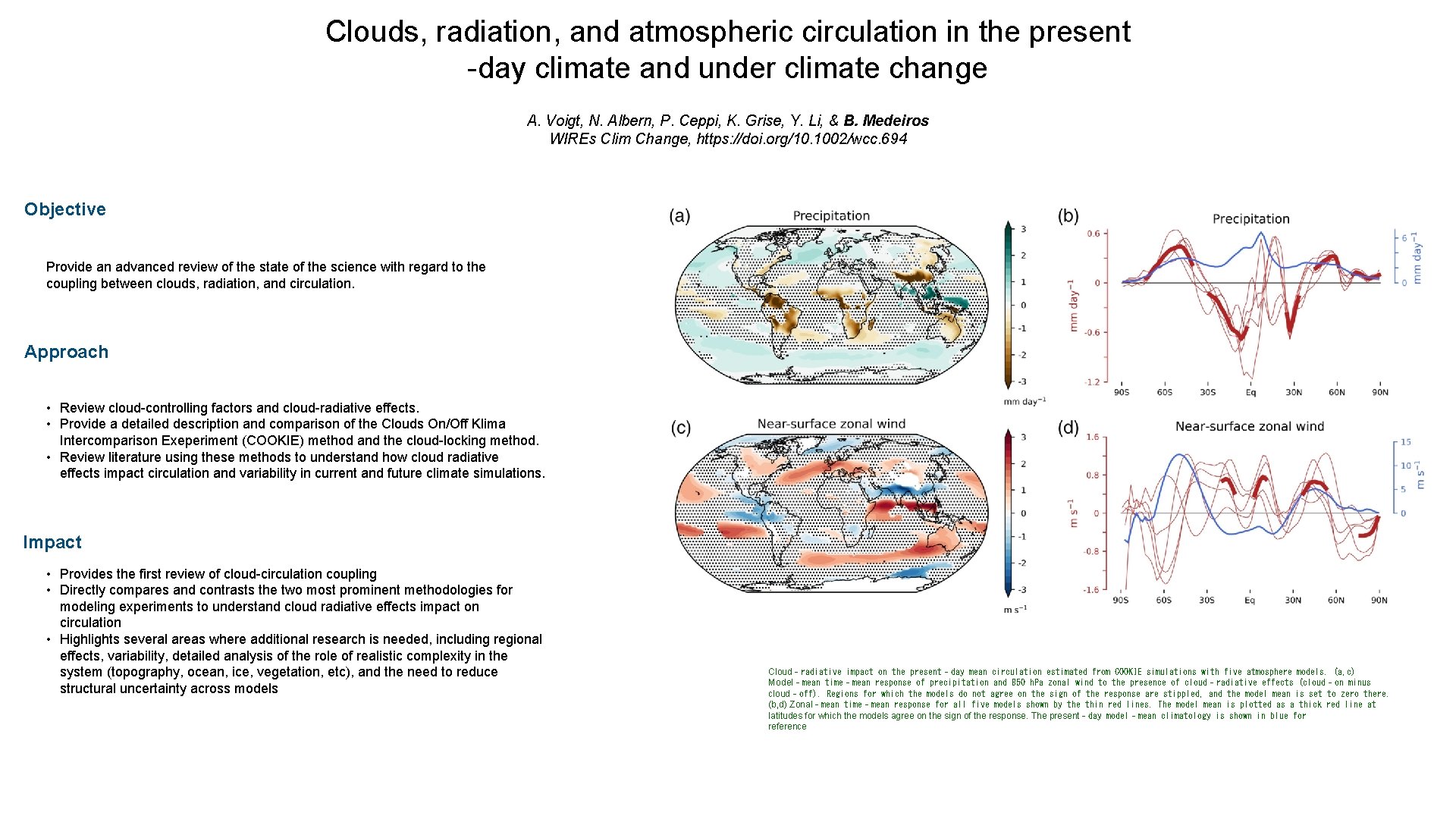
Clouds, radiation, and atmospheric circulation in the present -day climate and under climate change A. Voigt, N. Albern, P. Ceppi, K. Grise, Y. Li, & B. Medeiros WIREs Clim Change, https: //doi. org/10. 1002/wcc. 694 Objective Provide an advanced review of the state of the science with regard to the coupling between clouds, radiation, and circulation. Approach • Review cloud-controlling factors and cloud-radiative effects. • Provide a detailed description and comparison of the Clouds On/Off Klima Intercomparison Exeperiment (COOKIE) method and the cloud-locking method. • Review literature using these methods to understand how cloud radiative effects impact circulation and variability in current and future climate simulations. Impact • Provides the first review of cloud-circulation coupling • Directly compares and contrasts the two most prominent methodologies for modeling experiments to understand cloud radiative effects impact on circulation • Highlights several areas where additional research is needed, including regional effects, variability, detailed analysis of the role of realistic complexity in the system (topography, ocean, ice, vegetation, etc), and the need to reduce structural uncertainty across models Cloud‐radiative impact on the present‐day mean circulation estimated from COOKIE simulations with five atmosphere models. (a, c) Model‐mean time‐mean response of precipitation and 850 h. Pa zonal wind to the presence of cloud‐radiative effects (cloud‐on minus cloud‐off). Regions for which the models do not agree on the sign of the response are stippled, and the model mean is set to zero there. (b, d) Zonal‐mean time‐mean response for all five models shown by the thin red lines. The model mean is plotted as a thick red line at latitudes for which the models agree on the sign of the response. The present‐day model‐mean climatology is shown in blue for reference