
Cloud Service Placement via Subgraph matching Bo Zong
Cloud Service Placement via Subgraph matching Bo Zong (UCSB) Ramya Raghavendra (IBM T. J. Watson) Mudhakar Srivatsa (IBM T. J. Watson) Xifeng Yan (UCSB) Ambuj K. Singh (UCSB) Kang-Won Lee (IBM T. J. Watson) 1
Cloud datacenters • Datacenters shared by multiple customers • Popular cloud datacenters • Provider: Amazon EC 2, Microsoft Azure, Rackspace, etc • Customers: renting virtual machines for their services • Profitable business • In 2013, Microsoft Azure sold $1 billion services • By 2015, Amazon web services worth ~$50 billion 2
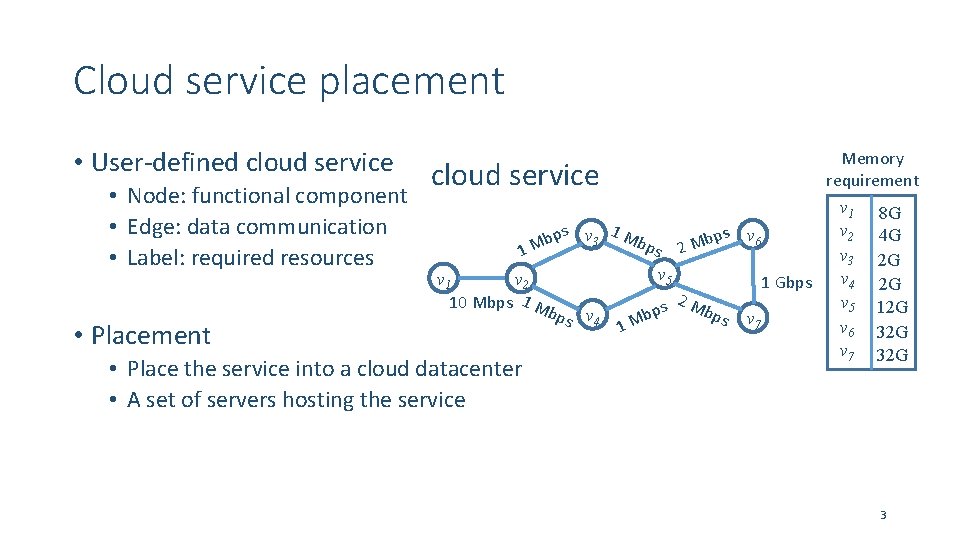
Cloud service placement • User-defined cloud service • Node: functional component • Edge: data communication • Label: required resources • Placement cloud service ps v 3 1 Mb b bps v 6 M p M s 2 1 v 5 v 1 v 2 1 Gbps 2 M 10 Mbps 1 Mb s bps v p b ps v 4 M 7 1 • Place the service into a cloud datacenter • A set of servers hosting the service Memory requirement v 1 v 2 v 3 v 4 v 5 v 6 v 7 8 G 4 G 2 G 2 G 12 G 32 G 3
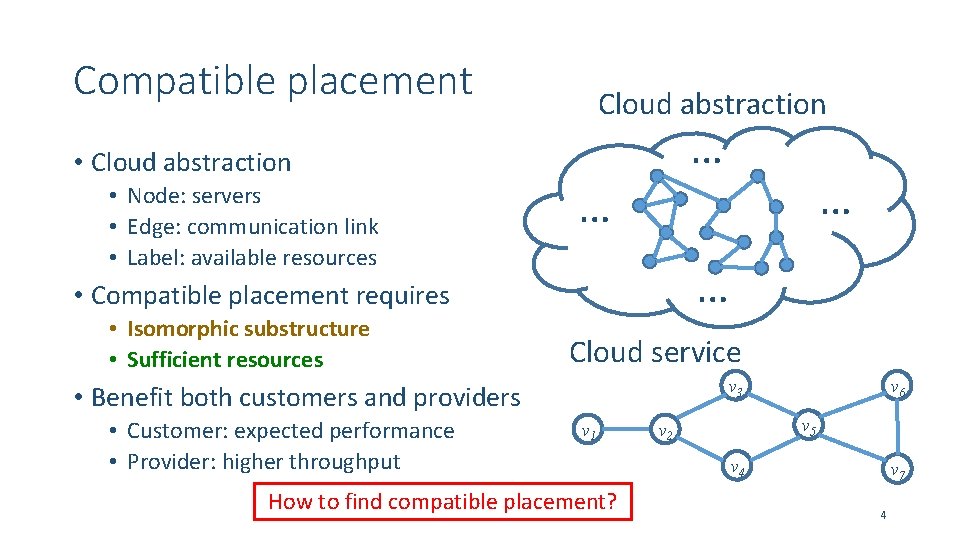
Compatible placement • Cloud abstraction • Node: servers • Edge: communication link • Label: available resources Cloud abstraction … … • Compatible placement requires • Isomorphic substructure • Sufficient resources Cloud service v 3 • Benefit both customers and providers • Customer: expected performance • Provider: higher throughput … … v 1 How to find compatible placement? v 6 v 5 v 2 v 4 v 7 4
Outline • Introduction • Problem statement • Gradin • Graph index for frequent label updates • Accelerate fragment join • Experiment results 5
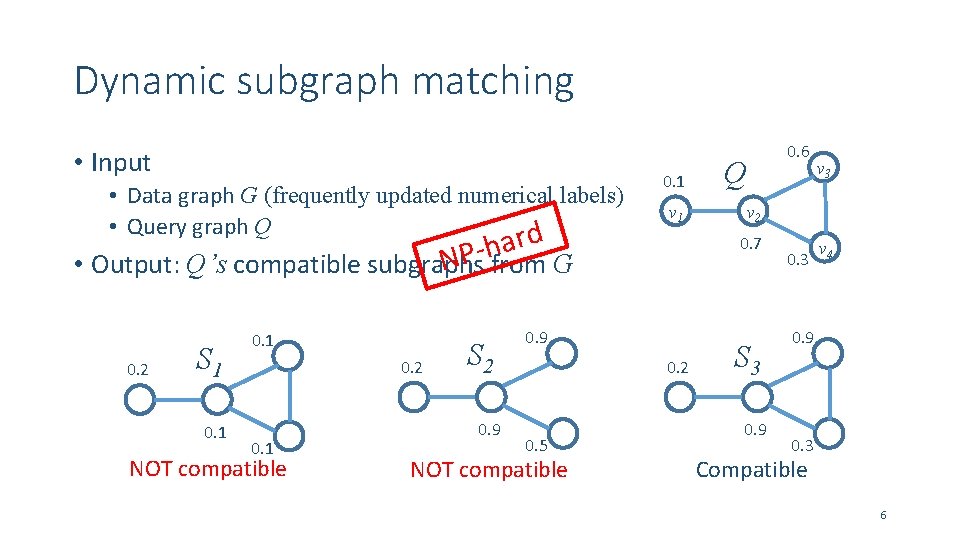
Dynamic subgraph matching • Input • Data graph G (frequently updated numerical labels) • Query graph Q d r a h NP from G • Output: Q’s compatible subgraphs 0. 2 S 1 0. 2 0. 1 NOT compatible S 2 0. 9 0. 1 v 1 0. 2 NOT compatible v 3 v 2 0. 7 0. 9 0. 5 Q 0. 6 S 3 0. 9 0. 3 v 4 0. 9 0. 3 Compatible 6
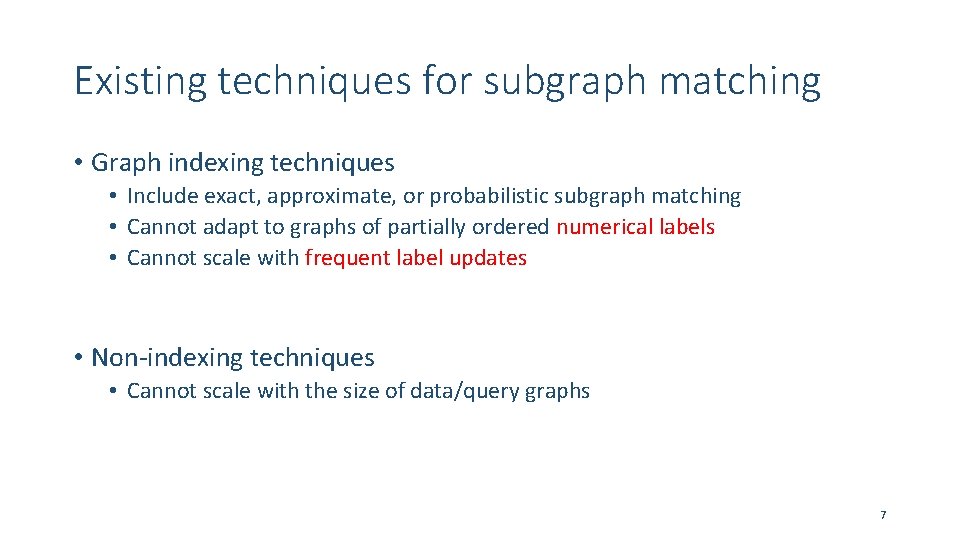
Existing techniques for subgraph matching • Graph indexing techniques • Include exact, approximate, or probabilistic subgraph matching • Cannot adapt to graphs of partially ordered numerical labels • Cannot scale with frequent label updates • Non-indexing techniques • Cannot scale with the size of data/query graphs 7
Outline • Introduction • Problem statement • Gradin • Graph index for frequent label updates • Accelerate fragment join • Experiment results 8
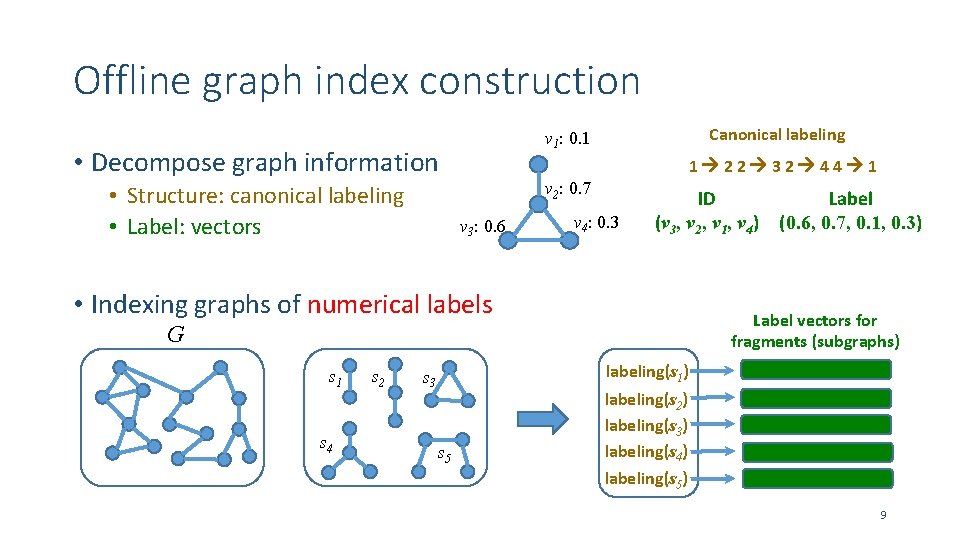
Offline graph index construction • Decompose graph information • Structure: canonical labeling • Label: vectors Canonical labeling v 1: 0. 1 1 22 32 44 1 v 2: 0. 7 v 3: 0. 6 v 4: 0. 3 ID (v 3, v 2, v 1, v 4) • Indexing graphs of numerical labels Label vectors for fragments (subgraphs) G s 1 s 4 s 2 Label (0. 6, 0. 7, 0. 1, 0. 3) labeling(s 1) s 3 s 5 labeling(s 2) labeling(s 3) labeling(s 4) labeling(s 5) 9
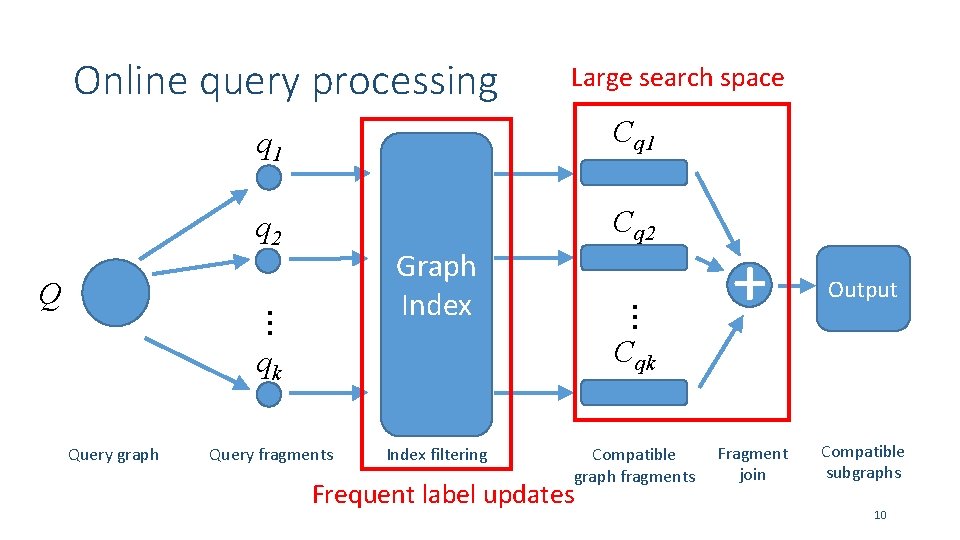
Online query processing q 1 Cq 1 q 2 Cq 2 . . . Graph Index . . . Q Large search space Output Cqk qk Query graph + Query fragments Index filtering Compatible graph fragments Frequent label updates Fragment join Compatible subgraphs 10
Outline • Introduction • Problem statement • Gradin • Graph index for frequent label updates • Accelerate fragment join • Experiment results 11
Frequent label updates • Where are the label updates from? • Cloud services come and go • Upgrade hardware in datacenters • 30% of node labels are updated in a 3000 -node data graph • > 5 M graph fragments will be updated • State-of-the-art R-tree variant takes > 5 minutes • Inverted index scans all fragments for searching • Frac. Filter • Fast fragment searching • Fast index updating 12
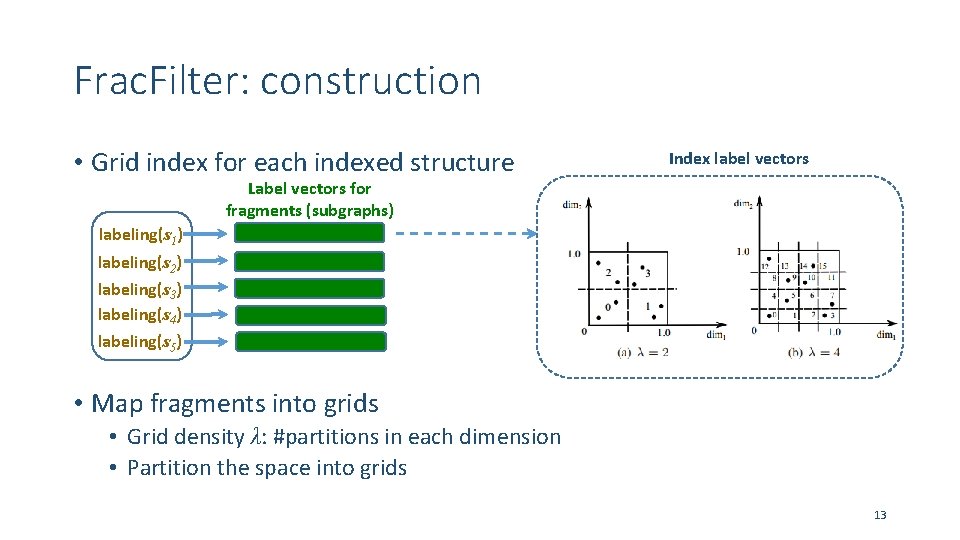
Frac. Filter: construction • Grid index for each indexed structure Index label vectors Label vectors for fragments (subgraphs) labeling(s 1) labeling(s 2) labeling(s 3) labeling(s 4) labeling(s 5) • Map fragments into grids • Grid density λ: #partitions in each dimension • Partition the space into grids 13
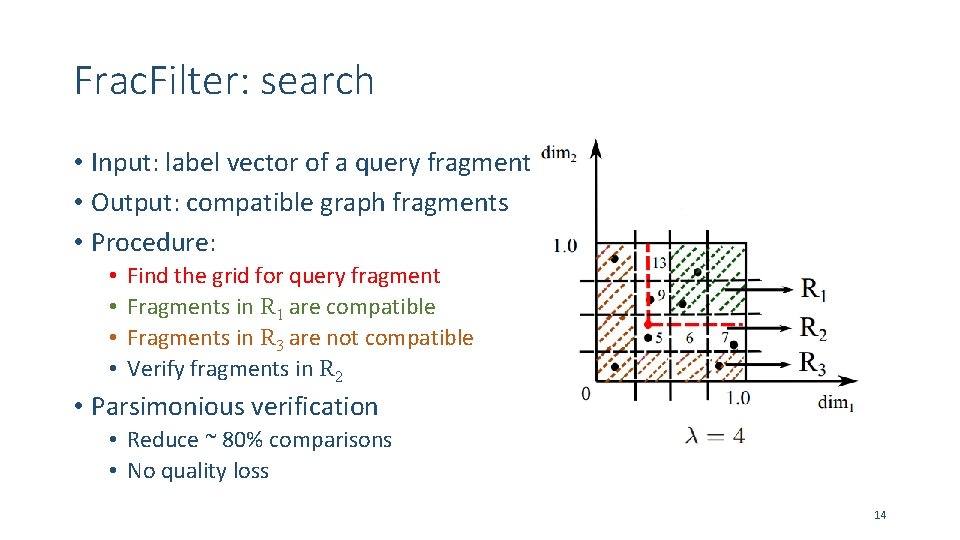
Frac. Filter: search • Input: label vector of a query fragment • Output: compatible graph fragments • Procedure: • • Find the grid for query fragment Fragments in R 1 are compatible Fragments in R 3 are not compatible Verify fragments in R 2 • Parsimonious verification • Reduce ~ 80% comparisons • No quality loss 14
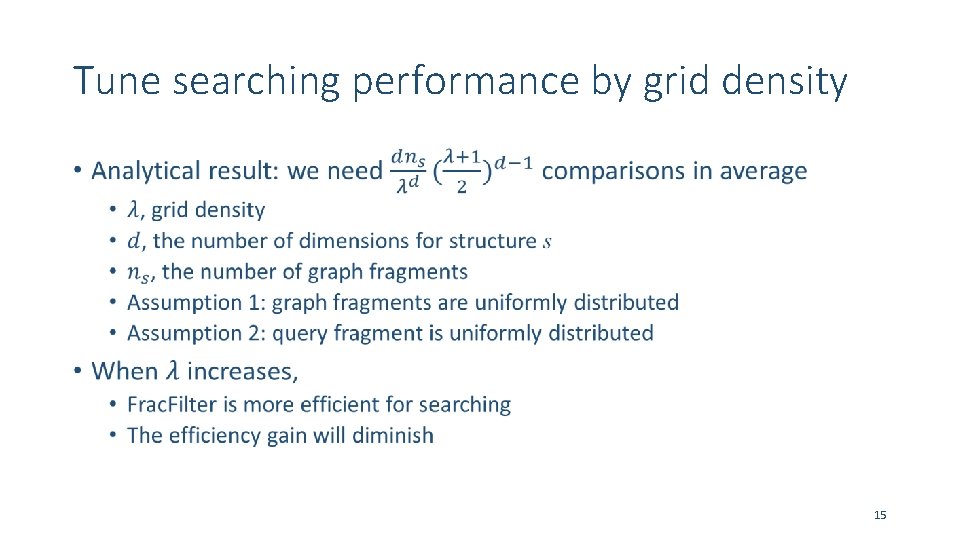
Tune searching performance by grid density • 15
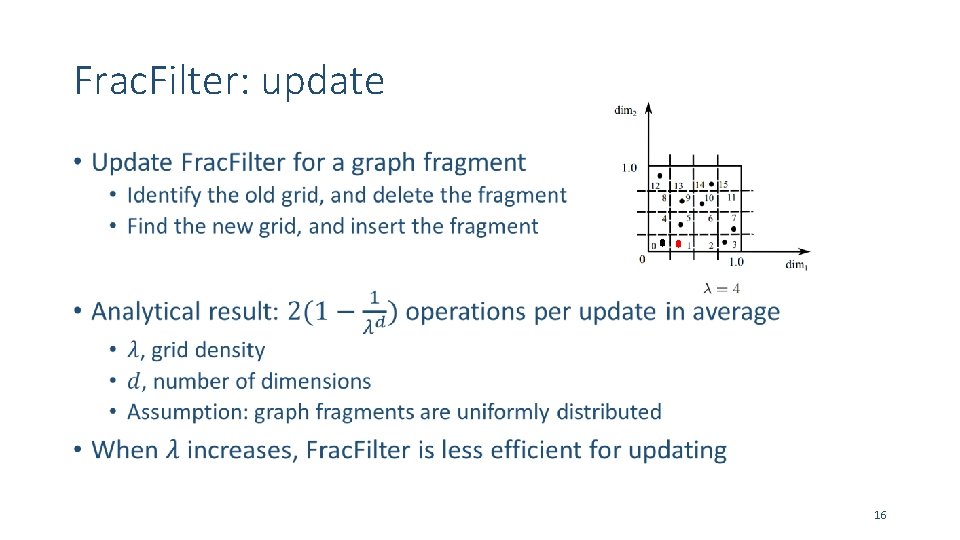
Frac. Filter: update • 16
Outline • Introduction • Problem statement • Gradin • Graph index for frequent label updates • Accelerate fragment join • Experiment results 17
Large search space • A small query graph can have many query fragments • A 10 -star query has 720 3 -star query fragments • Only need some of them to cover the query graph • Which query fragments do we need? Minimum fragment cover 18
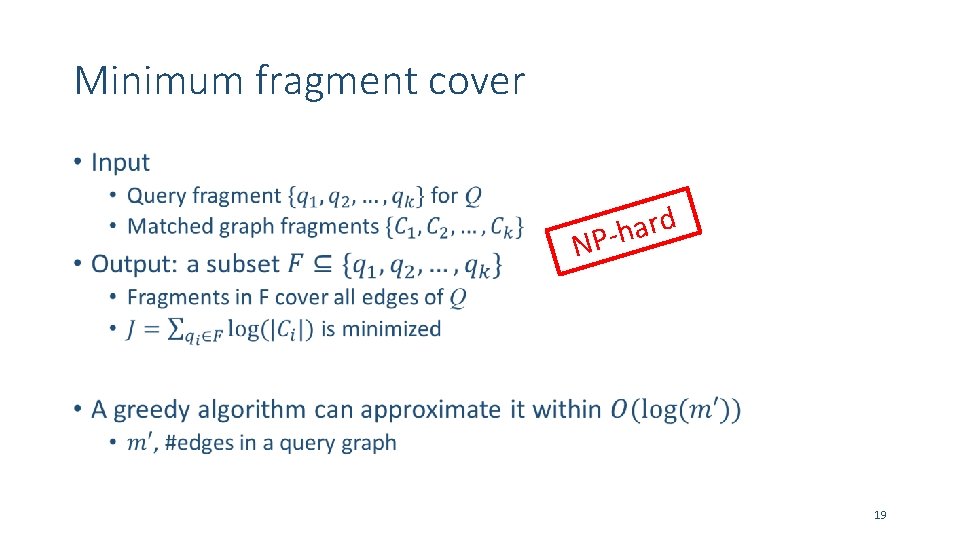
Minimum fragment cover • d r a h NP- 19
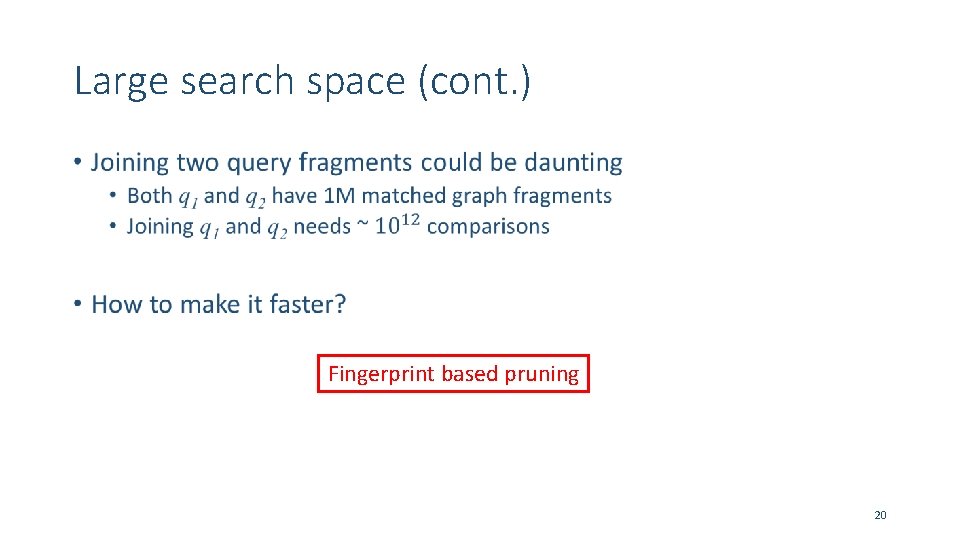
Large search space (cont. ) • Fingerprint based pruning 20
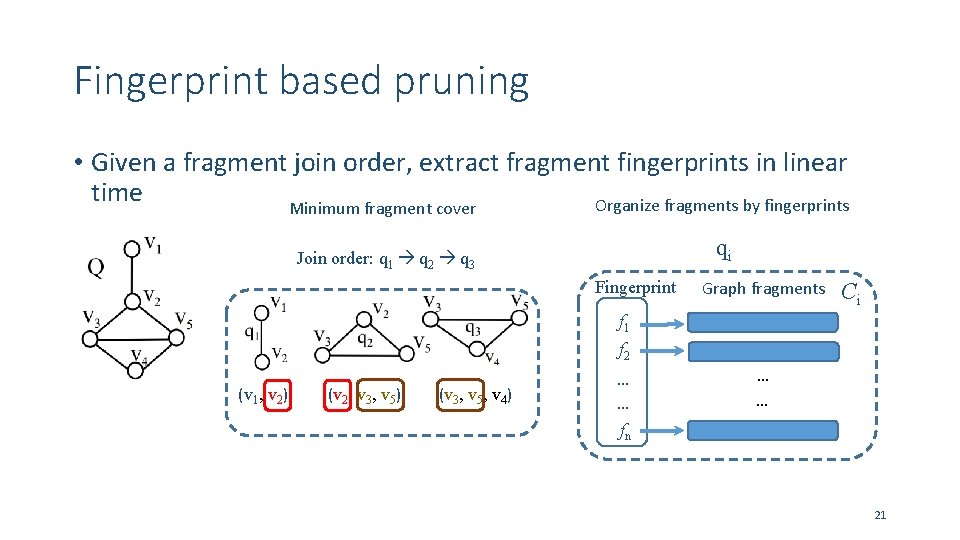
Fingerprint based pruning • Given a fragment join order, extract fragment fingerprints in linear time Organize fragments by fingerprints Minimum fragment cover qi Join order: q 1 q 2 q 3 Fingerprint Graph fragments Ci f 1 f 2 (v 1, v 2) (v 2, v 3, v 5) (v 3, v 5, v 4) … … fn … … 21
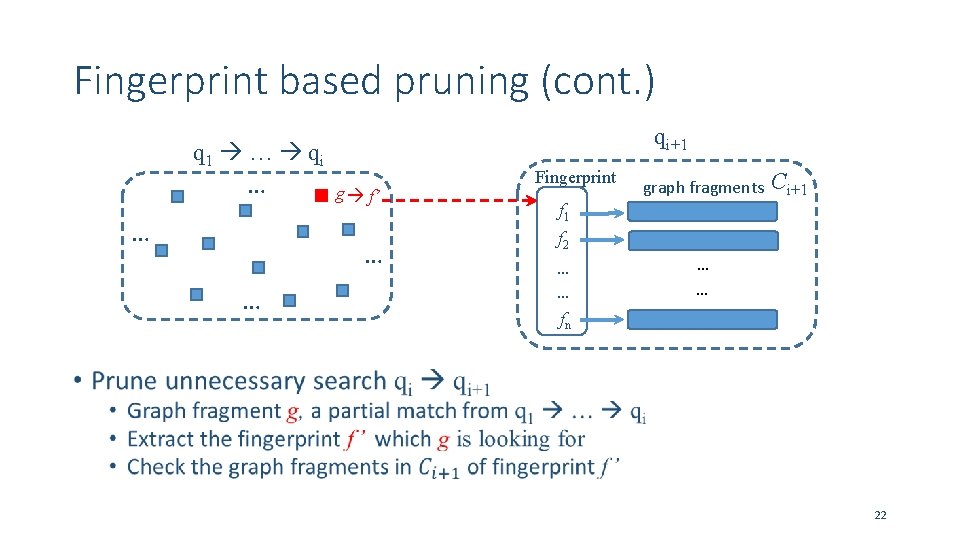
Fingerprint based pruning (cont. ) qi+1 q 1 … qi • … … g f’ … … Fingerprint graph fragments Ci+1 f 2 … … fn … … 22
Outline • Introduction • Problem statement • Gradin • Graph index for frequent label updates • Accelerate fragment join • Experiment results 23
Setup • Data graph • BCUBE: 3000 ~ 15000 nodes, average degree 18~20 • CAIDA: 26475 nodes, 106762 edges • Numerical labels and updates • Label generator derived from Cluster. Data • Query graph • All possible graphs of no more than 10 edges • Generate Labels from Uniform(0, 1) • Baselines: VF 2, Upd. All, Upd. No, Naive. Grid, and Naive. Join 24
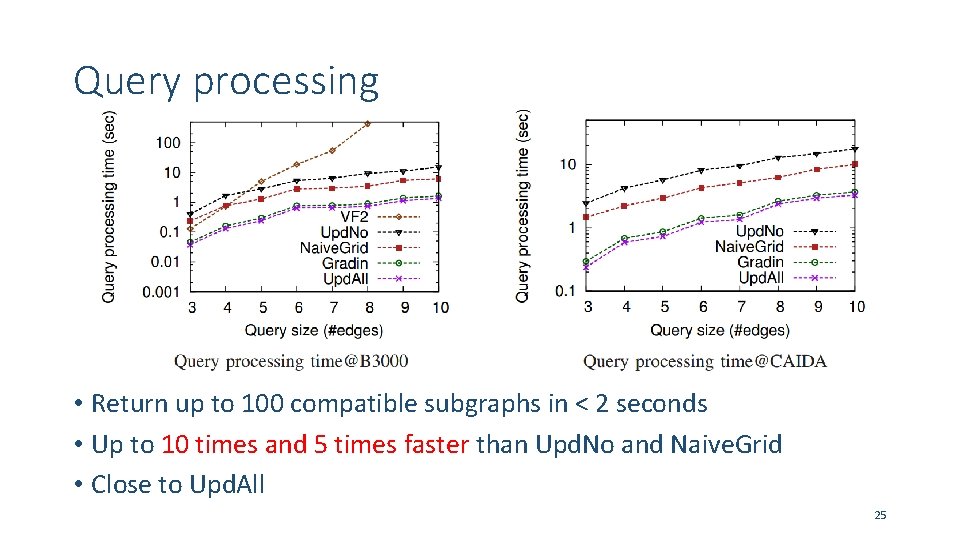
Query processing • Return up to 100 compatible subgraphs in < 2 seconds • Up to 10 times and 5 times faster than Upd. No and Naive. Grid • Close to Upd. All 25
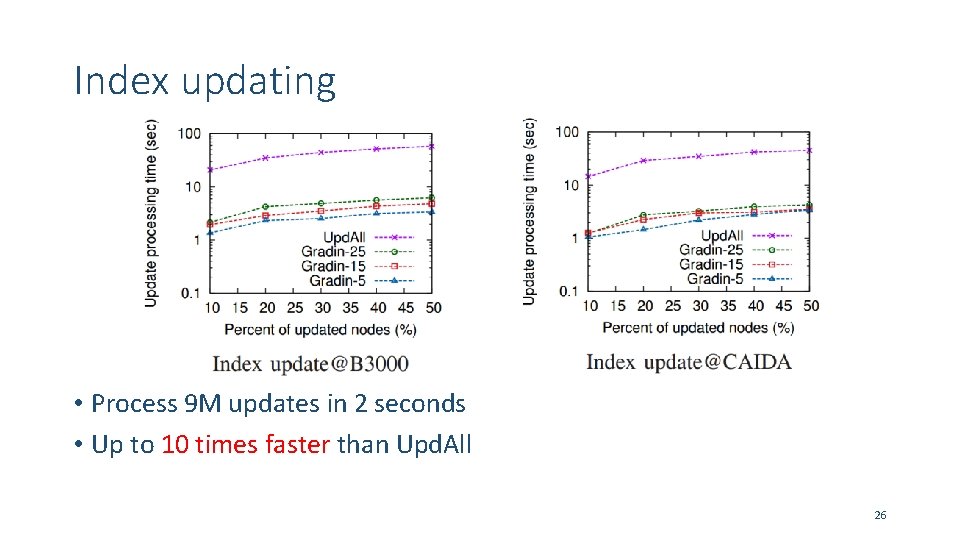
Index updating • Process 9 M updates in 2 seconds • Up to 10 times faster than Upd. All 26
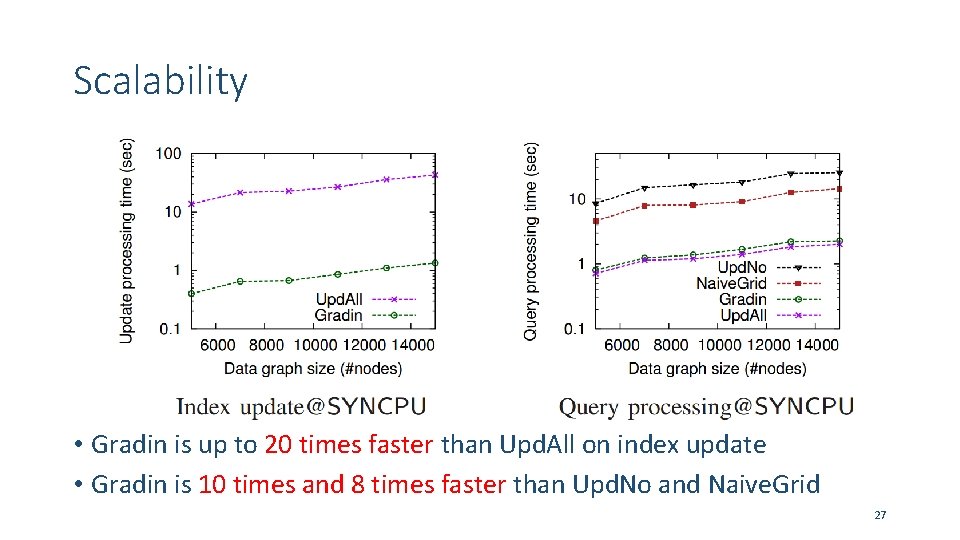
Scalability • Gradin is up to 20 times faster than Upd. All on index update • Gradin is 10 times and 8 times faster than Upd. No and Naive. Grid 27
Conclusion • Cloud service placement via subgraph matching • Gradin • Indexing graphs of numerical labels • Fast query processing • Fast index updating • Gradin outperforms the baseline algorithms on query processing and index updating. 28

Thank you 29
- Slides: 29