
Cloud Operating Systems Milad Jalalimehr Advanced Topics in

![References [1] F. Pianese, P. Bosch, A. Duminuco, N. Janssens, T. Stathopoulos, M. Steiner,](https://slidetodoc.com/presentation_image_h2/656ae414d83637294fb9f31a4f127392/image-16.jpg "References [1] F. Pianese, P. Bosch, A. Duminuco, N. Janssens, T. Stathopoulos, M. Steiner,")
![References (Continued) [8] E. M. Maximilien, A. Ranabahu, R. Engehausen, and L. C. Anderson,](https://slidetodoc.com/presentation_image_h2/656ae414d83637294fb9f31a4f127392/image-17.jpg "References (Continued) [8] E. M. Maximilien, A. Ranabahu, R. Engehausen, and L. C. Anderson,")
- Slides: 18
Cloud Operating Systems Milad Jalalimehr Advanced Topics in Information Systems Mazandaran University of Science and Technology milad. jalalimehr@gmail. com Supervisor : Mr. Hadi Salimi February, 2011
Agenda Introduction Definitions Cloud Operating Systems Paradigm Architecture Challenges Current Cloud Operating Systems (Samples) Conclusion References Milad Jalalimehr – Operating System for Clouds Mazandaran University of Science and Technology (MUST) 2 / 18
Introduction Definitions: Distributed System (DS) Cloud What is a Cloud OS? Milad Jalalimehr – Operating System for Clouds Mazandaran University of Science and Technology (MUST) 3 / 18
Why Do You Need A Cloud Operating System? Proceed in use of computing services. Clouds have the potential to provide novel compute capacity to the average user. Also provides more facilities for IT professionals. Milad Jalalimehr – Operating System for Clouds Mazandaran University of Science and Technology (MUST) 4 / 18
Why Do You Need A Cloud Operating System? (Continued) In order for the user to effectively control all of this computational power, We need an operating system for these new hardware platforms. Milad Jalalimehr – Operating System for Clouds Mazandaran University of Science and Technology (MUST) 5 / 18
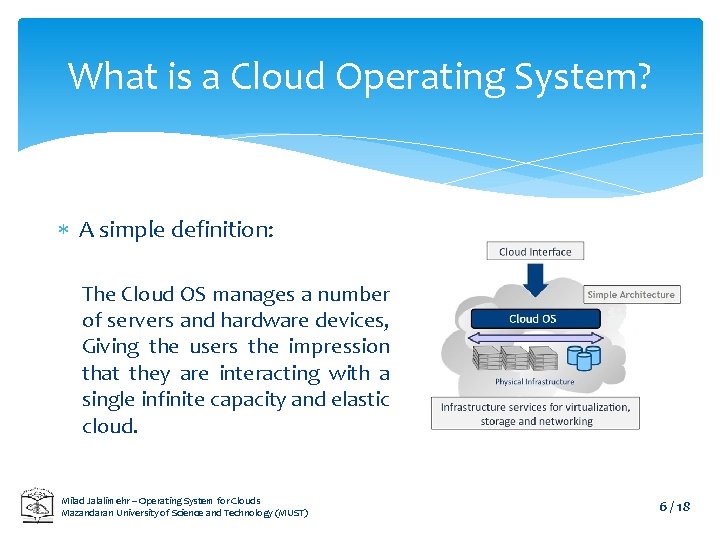
What is a Cloud Operating System? A simple definition: The Cloud OS manages a number of servers and hardware devices, Giving the users the impression that they are interacting with a single infinite capacity and elastic cloud. Milad Jalalimehr – Operating System for Clouds Mazandaran University of Science and Technology (MUST) 6 / 18
Paradigm used in Cloud Operating System: Object Thread Object-Thread Model Milad Jalalimehr – Operating System for Clouds Mazandaran University of Science and Technology (MUST) 7 / 18
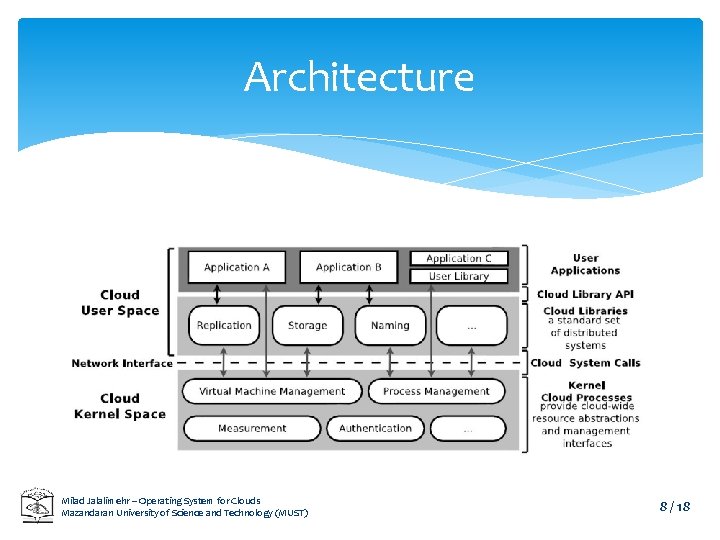
Architecture Milad Jalalimehr – Operating System for Clouds Mazandaran University of Science and Technology (MUST) 8 / 18
Common Challenges Cloud computing infrastructure presents many common challenges with respect to the operating system. Such as: Scalability Elasticity of Demand Faults Milad Jalalimehr – Operating System for Clouds Mazandaran University of Science and Technology (MUST) 9 / 18
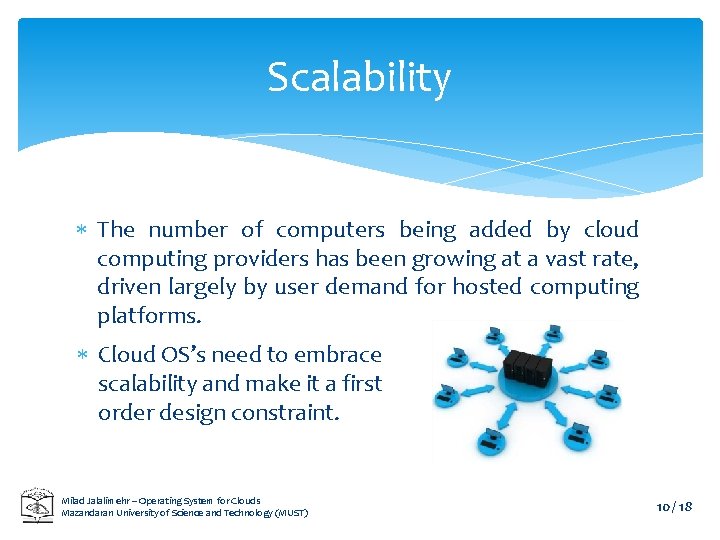
Scalability The number of computers being added by cloud computing providers has been growing at a vast rate, driven largely by user demand for hosted computing platforms. Cloud OS’s need to embrace scalability and make it a first order design constraint. Milad Jalalimehr – Operating System for Clouds Mazandaran University of Science and Technology (MUST) 10 / 18
Elasticity of Demand A major commonality between clouds is that the demand is not static. Furthermore, the variability of demand is much higher than in previous systems and the amount of available resources can be varied over a much broader range. Milad Jalalimehr – Operating System for Clouds Mazandaran University of Science and Technology (MUST) 11 / 18
Faults Cloud applications usually share cloud resources with other users and applications in the cloud. The likelihood of software faults in clouds are high, Due to the inherent difficulty of writing multithreaded applications. Milad Jalalimehr – Operating System for Clouds Mazandaran University of Science and Technology (MUST) 12 / 18
Current Cloud Operating Systems Available Cloud Operating Systems: VMware v. Sphere 4 Ubuntu Enterprise OS And Web-Based Cloud Operating Systems Milad Jalalimehr – Operating System for Clouds Mazandaran University of Science and Technology (MUST) 13 / 18
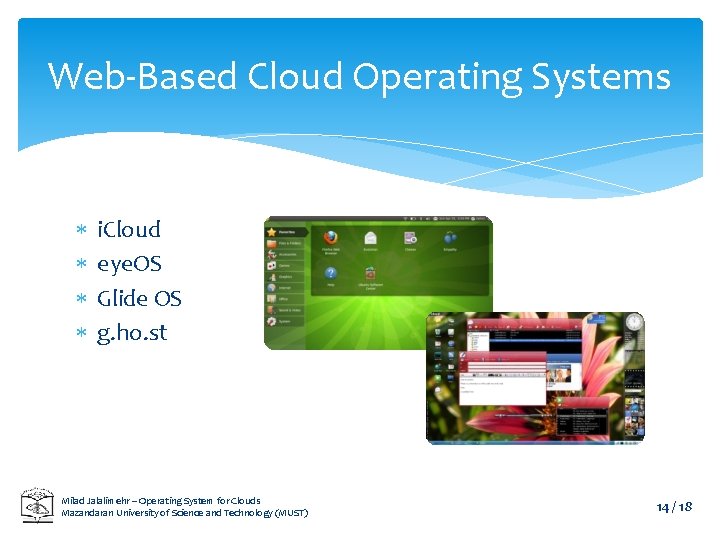
Web-Based Cloud Operating Systems i. Cloud eye. OS Glide OS g. ho. st Milad Jalalimehr – Operating System for Clouds Mazandaran University of Science and Technology (MUST) 14 / 18
Conclusion Design goals and chief design features: Support for object-thread computational model Network-transparent object invocation Persistent storage Sharing via objects Automatic load balancing Milad Jalalimehr – Operating System for Clouds Mazandaran University of Science and Technology (MUST) 15 / 18
References [1] F. Pianese, P. Bosch, A. Duminuco, N. Janssens, T. Stathopoulos, M. Steiner, “ Toward a Cloud Operating System, ” Network Operations and Management Symposium Workshops (NOMS Wksps), 2010. [2] I. Foster, C. Kesselman, J. M. Nick, and S. Tuecke, “The physiology of the grid: An open grid services architecture for distributed systems integration, ” in Open Grid Service Infrastructure WG, Global Grid Forum, 2002. [3] “Amazon EC 2. ” [Online] http: //aws. amazon. com/ec 2. [4] D. Nurmi, R. Wolski, C. Grzegorczyk, G. Obertelli, S. Soman, L. Youseff, and D. Zagorodnov, “The eucalyptus open-source cloud-computing system, ” in Proc. of Cloud Computing and Its Applications, Oct. 2008. [5] F. Chang, J. Dean, S. Ghemawat, W. C. Hsieh, D. A. Wallach, M. Burrows, T. Chandra, A. Fikes, and R. E. Gruber, “Bigtable: A distributed storage system for structured data, ” in 7 th USENIX Symposium on Operating Systems Design and Implementation (OSDI), 2006. [6] S. J. Mullender, G. van Rossum, A. S. Tanenbaum, R. van Renesse, and H. van Staveren, “Amoeba: A distributed operating system for the 1990 s, ” IEEE Computer, vol. 23, no. 5, pp. 44– 53, 1990. [7] E. V. Hensbergen, N. P. Evans, and P. Stanley-Marbell, “A unified execution model for cloud computing, ” in In Proc. of the 3 rd ACM SIGOPS International Workshop on Large Scale Distributed Systems and Middleware (LADIS), 2009. Milad Jalalimehr – Operating System for Clouds Mazandaran University of Science and Technology (MUST) 16 / 18
References (Continued) [8] E. M. Maximilien, A. Ranabahu, R. Engehausen, and L. C. Anderson, “Toward cloud-agnostic middlewares, ” in Proceedings of OOPSLA ’ 09, (New York, NY, USA), pp. 619– 626, ACM, 2009. [9] E. K. Lua, J. Crowcroft, M. Pias, R. Sharma, and S. Lim, “A survey and comparison of peer-to-peer overlay network schemes, ” IEEE Communications Survey and Tutorial, vol. 7, pp. 72– 93, March 2004. [10] SETI@Home. [Online] http: //setiathome. berkeley. edu. [11] G. Fox, D. Gannon, S. -H. Ko, S. Lee, S. Pallickara, M. Pierce, X. Qiu, X. Rao, A. Uyar, M. Wang, and W. Wu, Peer-to-Peer Grids. John Wiley and Sons Ltd, 2003. [12] I. Foster and A. Iamnitchi, “On death, taxes, and the convergence of peer-to-peer and grid computing, ” in In 2 nd International Workshop on Peer-to-Peer Systems (IPTPS), pp. 118– 128, 2003. [13] N. Drost, R. van Nieuwpoort, and H. Bal, “Simple locality-aware coallocation in peer-to-peer supercomputing, ” in Proceedings of the 6 th IEEE/ACM CCGrid Symposium, 2006. [14] J. Ritter, “Why gnutella can’t scale. No, really. ” [Online] http: //www. darkridge. com/ jpr 5/doc/gnutella. html. , Feb 2001. [15] J. Albrecht, R. Braud, D. Dao, N. Topilski, C. Tuttle, A. C. Snoeren, and A. Vahdat, “Remote Control: Distributed Application Configuration, Management, and Visualization with Plush, ” in Proceedings of the Twenty-first USENIX LISA Conference, November 2007. Milad Jalalimehr – Operating System for Clouds Mazandaran University of Science and Technology (MUST) 17 / 18
Thanks. . Any Question?