
Cloud Formation Mr Fetchs Earth Science Classroom What


- Slides: 10
Cloud Formation Mr. Fetch’s Earth Science Classroom
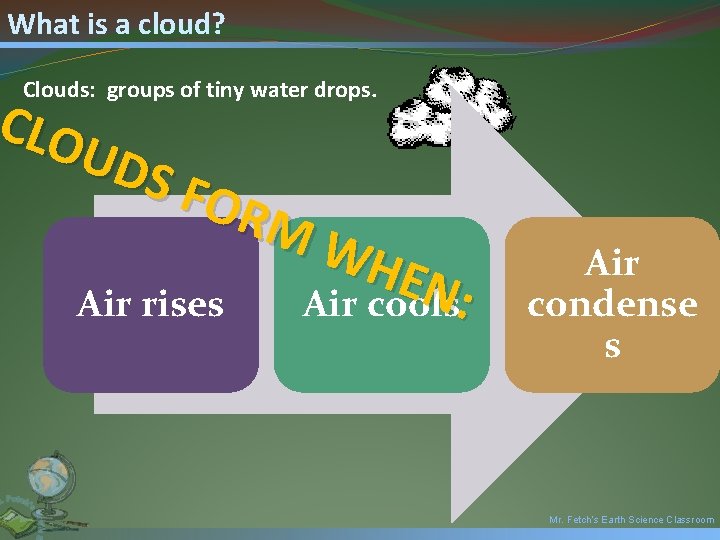
What is a cloud? Clouds: groups of tiny water drops. CLO UDS FOR MW HEN Air rises Air cools: Air condense s Mr. Fetch’s Earth Science Classroom
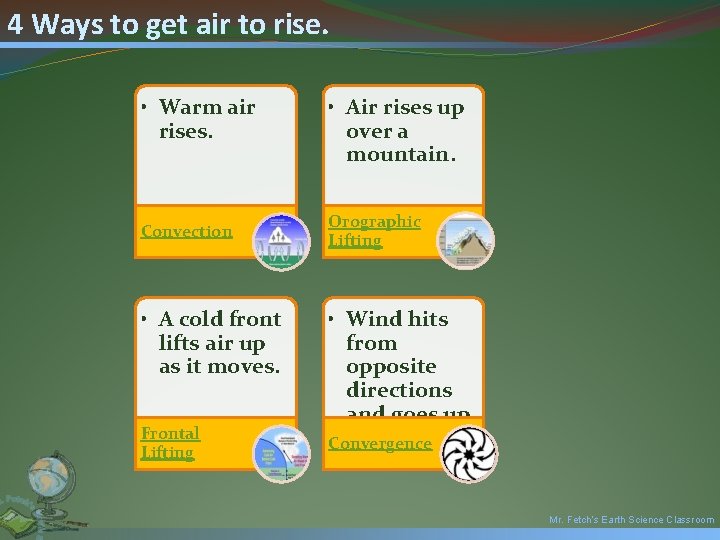
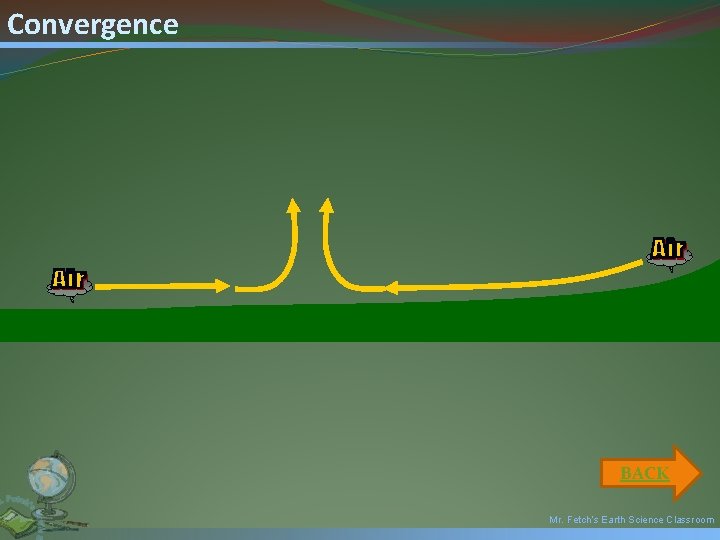
4 Ways to get air to rise. • Warm air rises. Convection • A cold front lifts air up as it moves. Frontal Lifting • Air rises up over a mountain. Orographic Lifting • Wind hits from opposite directions and goes up. Convergence Mr. Fetch’s Earth Science Classroom
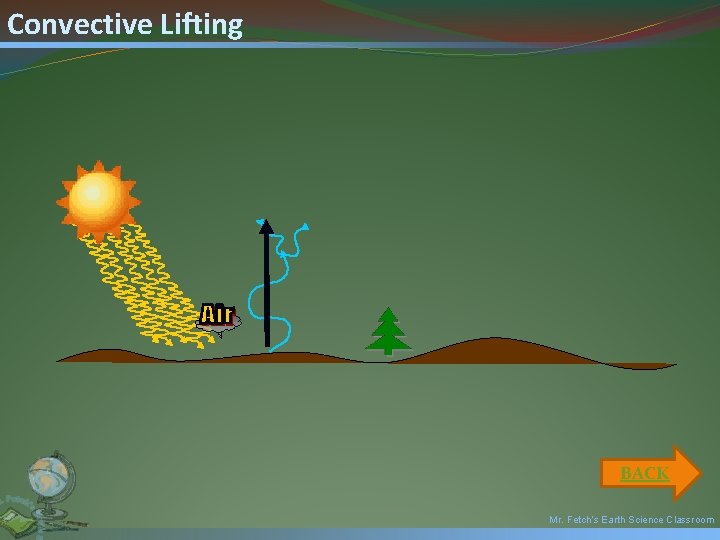
Convective Lifting BACK Mr. Fetch’s Earth Science Classroom
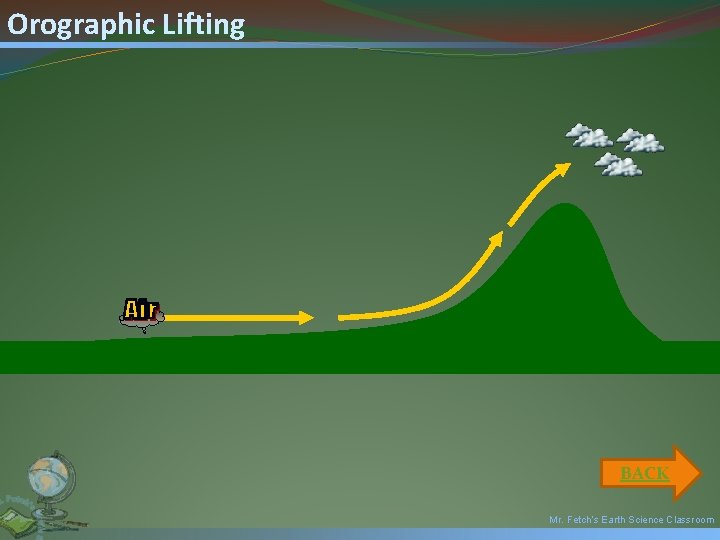
Orographic Lifting BACK Mr. Fetch’s Earth Science Classroom
Frontal Lifting BACK Mr. Fetch’s Earth Science Classroom
Convergence BACK Mr. Fetch’s Earth Science Classroom
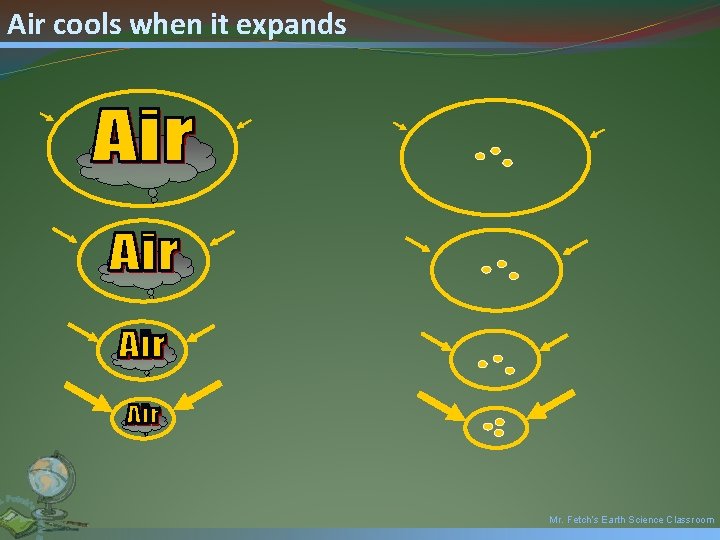
Air cools when it expands Mr. Fetch’s Earth Science Classroom
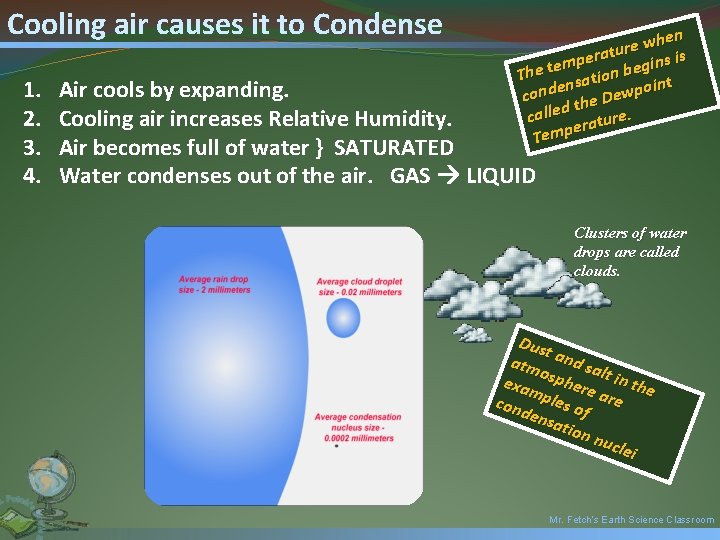
Cooling air causes it to Condense 1. 2. 3. 4. hen w e r u erat gins is p m e The t sation be t n in conde he Dewpo t called rature. e Temp Air cools by expanding. Cooling air increases Relative Humidity. Air becomes full of water } SATURATED Water condenses out of the air. GAS LIQUID Clusters of water drops are called clouds. Dus t atm and sa l o exa sphere t in the m con ples o are den f sati on n ucle i Mr. Fetch’s Earth Science Classroom
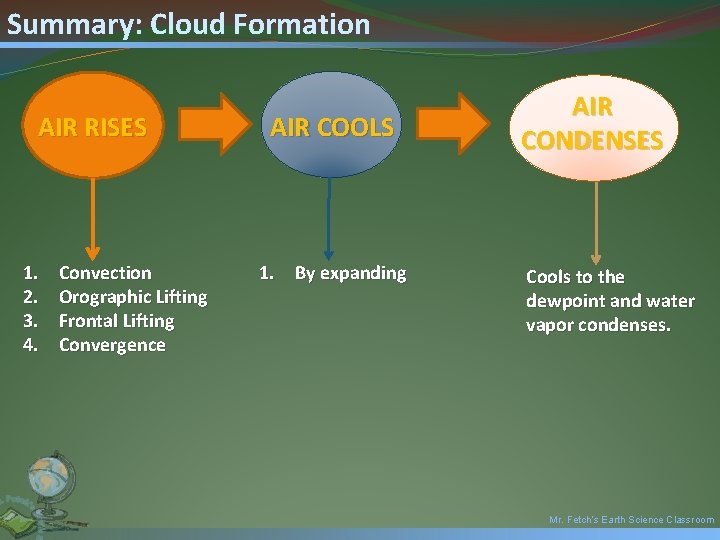
Summary: Cloud Formation AIR RISES 1. 2. 3. 4. Convection Orographic Lifting Frontal Lifting Convergence AIR COOLS 1. By expanding AIR CONDENSES Cools to the dewpoint and water vapor condenses. Mr. Fetch’s Earth Science Classroom