
Cloud Formation and Air Masses Clouds Dew pointtemperature
- Slides: 14
Cloud Formation and Air Masses
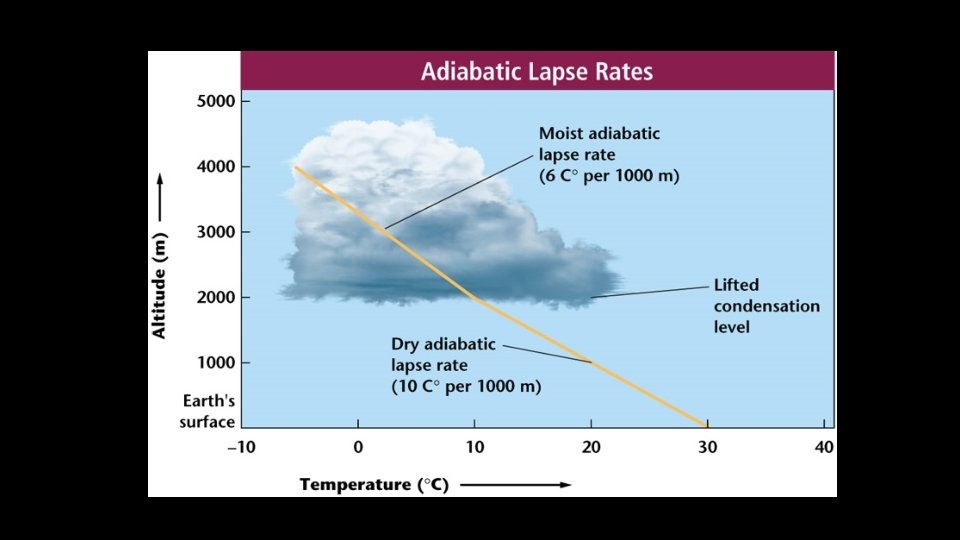
Clouds • Dew point-temperature at which air must be cooled to reach saturation. • Condensation-phase change from gas to liquid; only occurs at saturation. • Lifted Condensation Level-LCL; point at which condensation occurs.
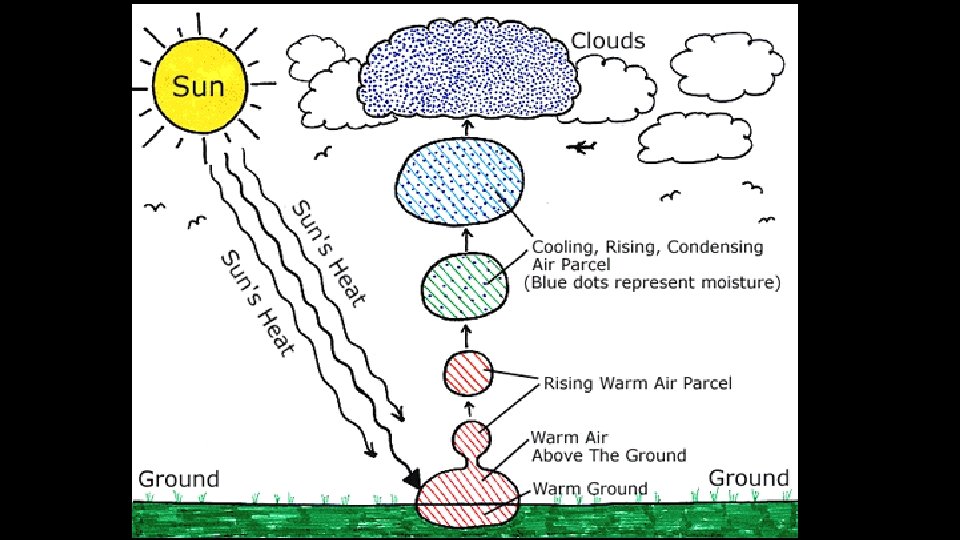
Cloud Formation • Air masses of different temperatures collide. • The less dense, warmer air mass rises over the more dense, colder air mass. • As the warm air rises, it cools, and once it reaches the LCL, water vapor will condense around condensation nuclei to become a cloud, if the density of condensation nuclei is great enough. • Condensation nuclei-particles in the air around which cloud droplets can form.
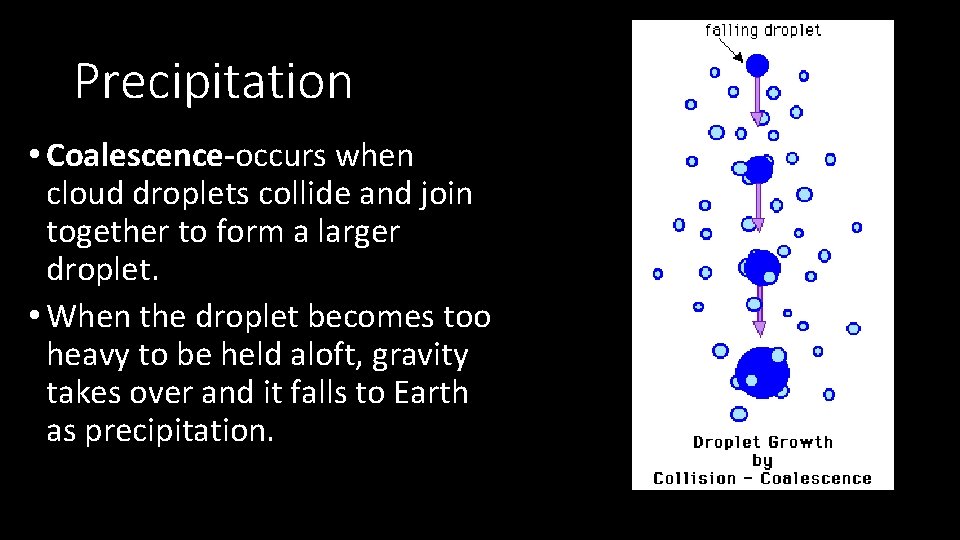
Precipitation • Coalescence-occurs when cloud droplets collide and join together to form a larger droplet. • When the droplet becomes too heavy to be held aloft, gravity takes over and it falls to Earth as precipitation.
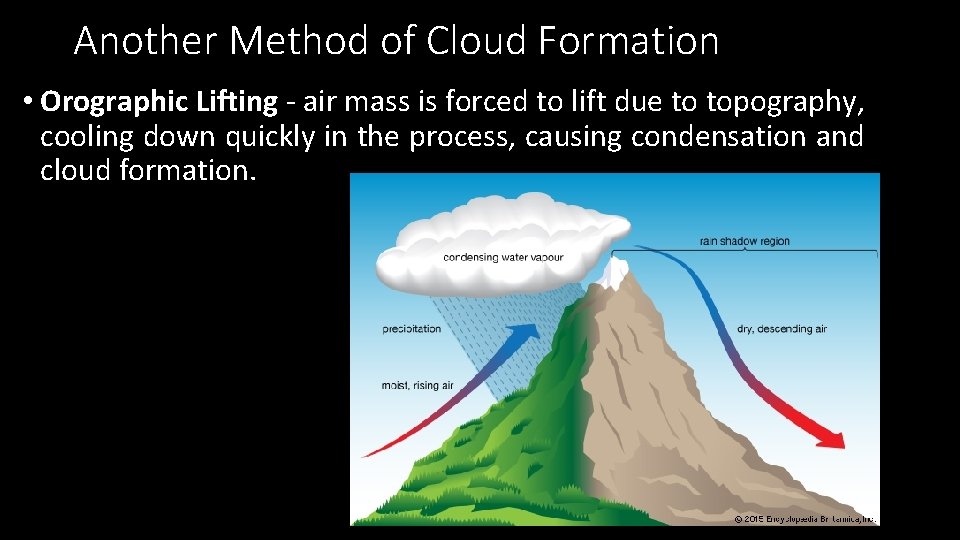
Another Method of Cloud Formation • Orographic Lifting - air mass is forced to lift due to topography, cooling down quickly in the process, causing condensation and cloud formation.
Meteorology • Weather-current state of the atmosphere. • Climate- describes the average weather over a long period of time
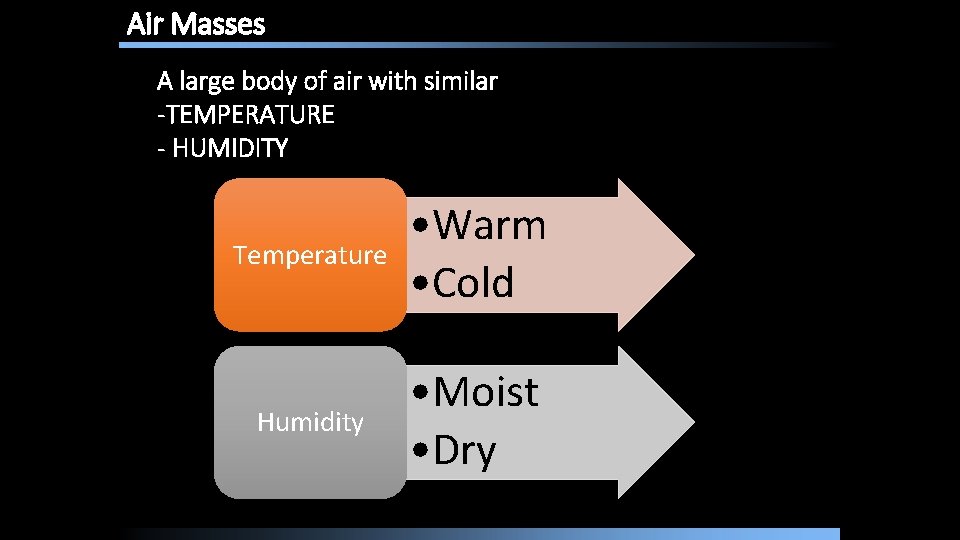
Air Masses A large body of air with similar -TEMPERATURE - HUMIDITY Temperature • Warm • Cold Humidity • Moist • Dry
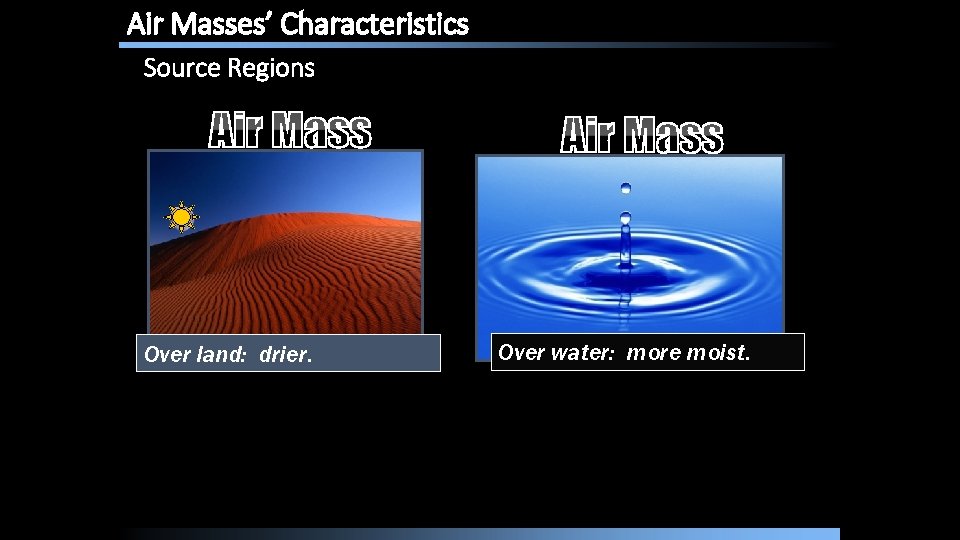
Air Masses’ Characteristics Source Regions Over land: drier. Over water: more moist.
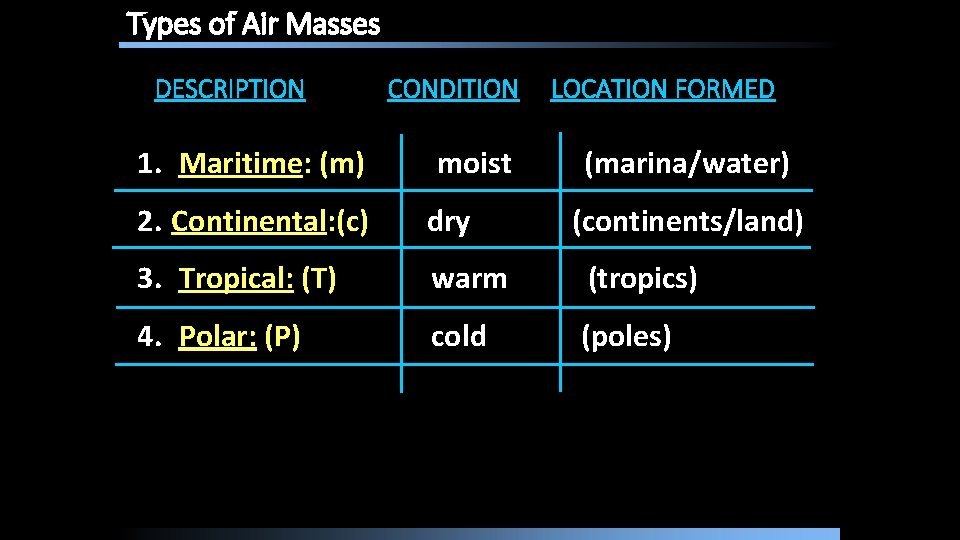
Types of Air Masses DESCRIPTION 1. Maritime: (m) CONDITION moist LOCATION FORMED (marina/water) 2. Continental: (c) dry 3. Tropical: (T) warm (tropics) 4. Polar: (P) cold (poles) (continents/land)
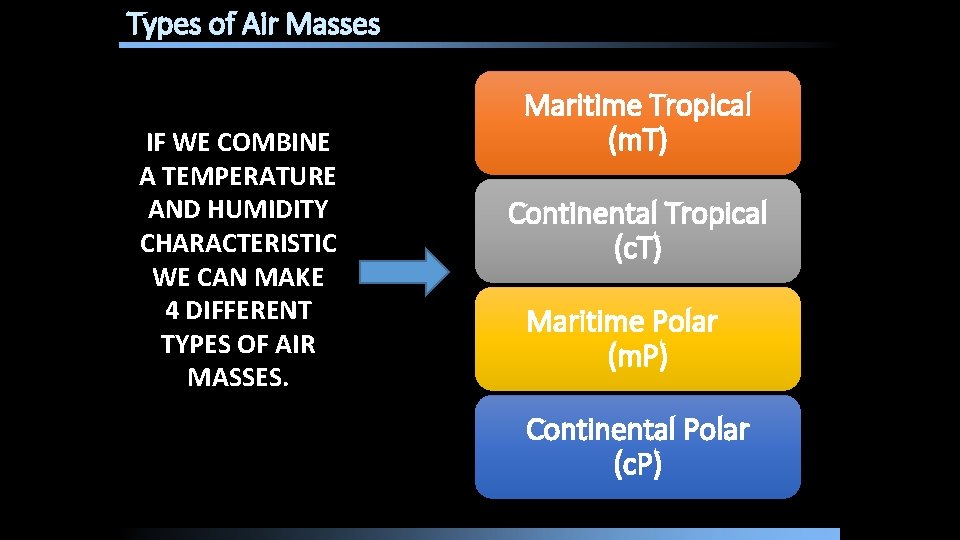
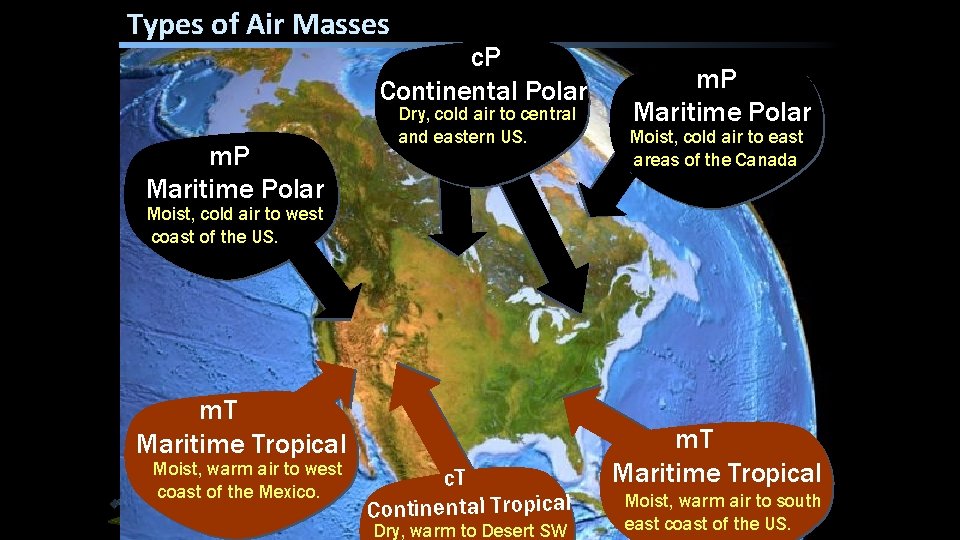
Types of Air Masses IF WE COMBINE A TEMPERATURE AND HUMIDITY CHARACTERISTIC WE CAN MAKE 4 DIFFERENT TYPES OF AIR MASSES. Maritime Tropical (m. T) Continental Tropical (c. T) Maritime Polar (m. P) Continental Polar (c. P)
Types of Air Masses c. P Continental Polar m. P Maritime Polar Dry, cold air to central and eastern US. m. P Maritime Polar Moist, cold air to east areas of the Canada Moist, cold air to west coast of the US. m. T Maritime Tropical Moist, warm air to west coast of the Mexico. c. T Continental Tropical Dry, warm to Desert SW m. T Maritime Tropical Moist, warm air to south Mr. Fetch’s Earth Science Classroom east coast of the US.
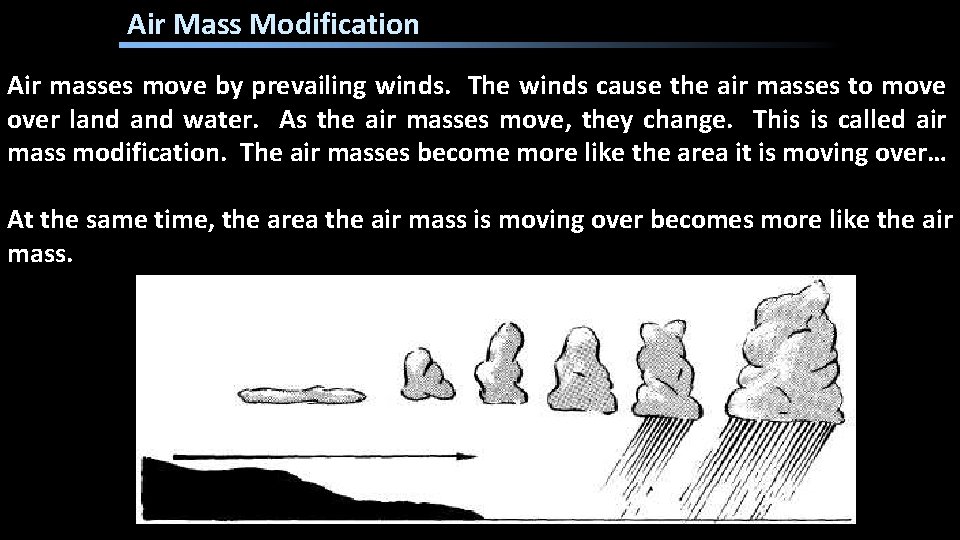
Air Mass Modification Air masses move by prevailing winds. The winds cause the air masses to move over land water. As the air masses move, they change. This is called air mass modification. The air masses become more like the area it is moving over… At the same time, the area the air mass is moving over becomes more like the air mass.