
Cloud Computing RealMachine CheRung Lee 2021228 NTHU CS
- Slides: 41
Cloud Computing Real-Machine Che-Rung Lee 2021/2/28 NTHU CS 5421 Cloud Computing 1
Outline v Computer System § Computer System Hardware § Instruction Set Architecture (ISA) § Operating System Organization v Program execution v Memory management v Input / Output control
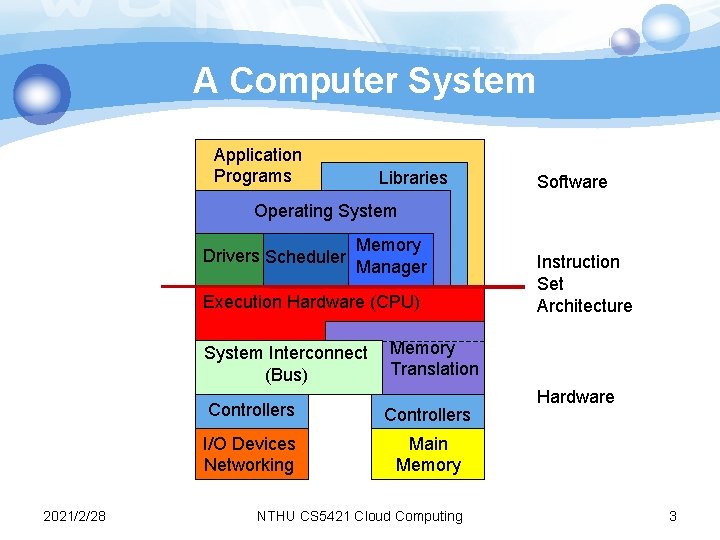
A Computer System Application Programs Libraries Software Operating System Drivers Scheduler Memory Manager Execution Hardware (CPU) System Interconnect (Bus) 2021/2/28 Instruction Set Architecture Memory Translation Controllers I/O Devices Networking Main Memory NTHU CS 5421 Cloud Computing Hardware 3
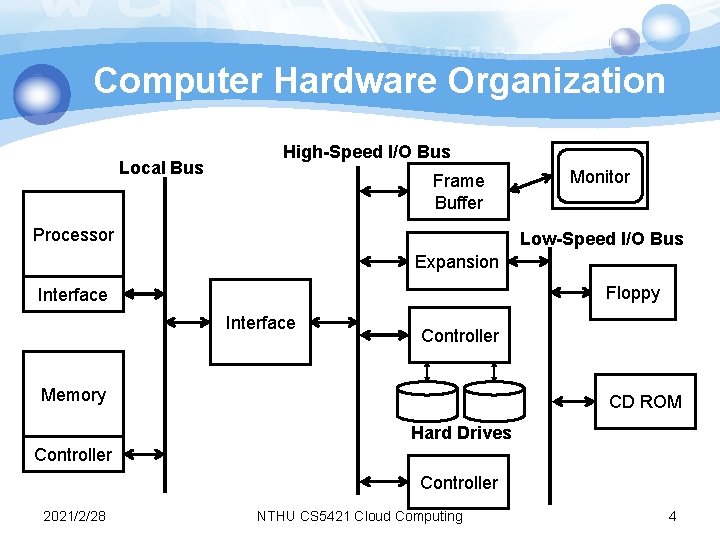
Computer Hardware Organization Local Bus High-Speed I/O Bus Frame Buffer Processor Monitor Low-Speed I/O Bus Expansion Floppy Interface Controller Memory CD ROM Hard Drives Controller 2021/2/28 NTHU CS 5421 Cloud Computing 4
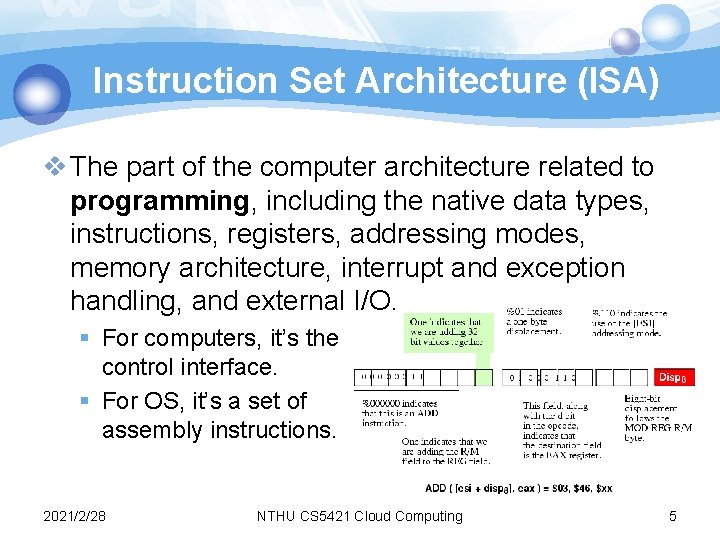
Instruction Set Architecture (ISA) v The part of the computer architecture related to programming, including the native data types, instructions, registers, addressing modes, memory architecture, interrupt and exception handling, and external I/O. § For computers, it’s the control interface. § For OS, it’s a set of assembly instructions. 2021/2/28 NTHU CS 5421 Cloud Computing 5
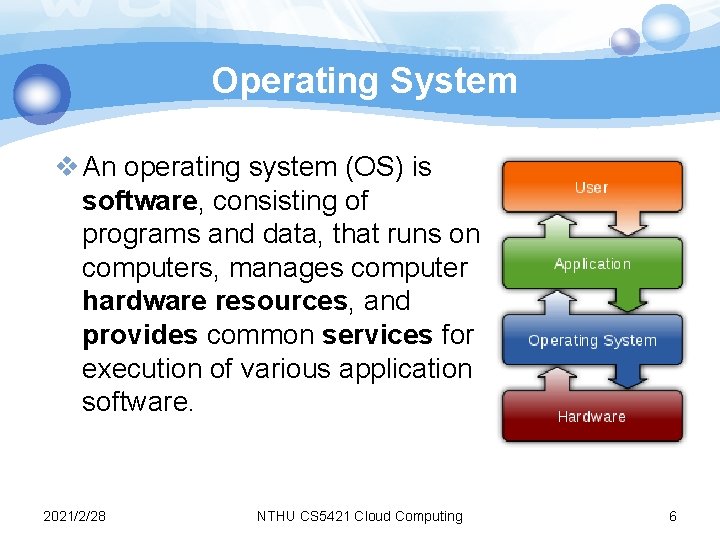
Operating System v An operating system (OS) is software, consisting of programs and data, that runs on computers, manages computer hardware resources, and provides common services for execution of various application software. 2021/2/28 NTHU CS 5421 Cloud Computing 6
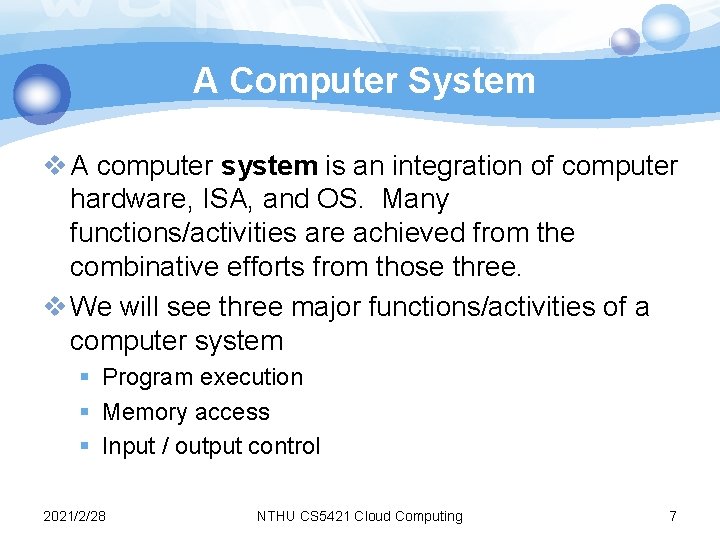
A Computer System v A computer system is an integration of computer hardware, ISA, and OS. Many functions/activities are achieved from the combinative efforts from those three. v We will see three major functions/activities of a computer system § Program execution § Memory access § Input / output control 2021/2/28 NTHU CS 5421 Cloud Computing 7
Outline v Computer System § Computer System Hardware § Instruction Set Architecture (ISA) § Operating System Organization v Program execution v Memory management v Input / Output control
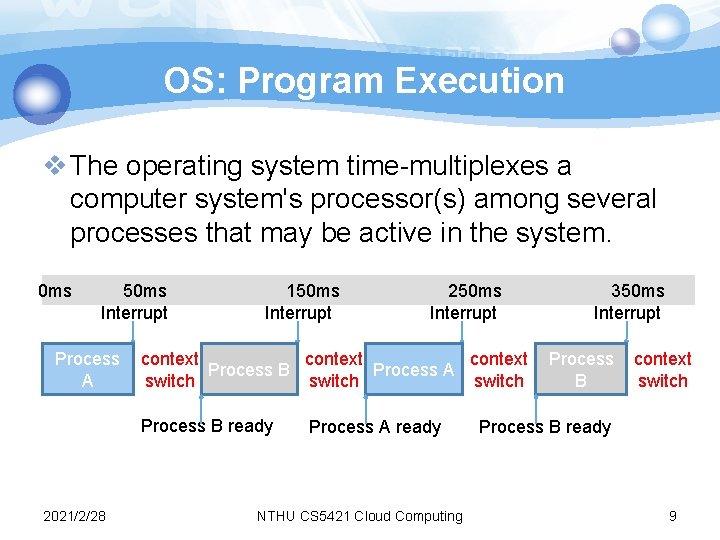
OS: Program Execution v The operating system time-multiplexes a computer system's processor(s) among several processes that may be active in the system. 0 ms 50 ms Interrupt Process A 150 ms Interrupt context Process B Process A switch Process B ready 2021/2/28 250 ms Interrupt Process A ready NTHU CS 5421 Cloud Computing 350 ms Interrupt Process B context switch Process B ready 9
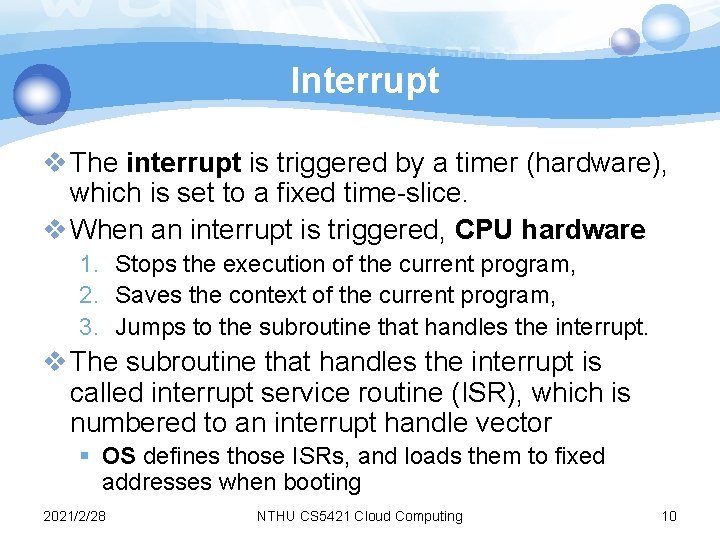
Interrupt v The interrupt is triggered by a timer (hardware), which is set to a fixed time-slice. v When an interrupt is triggered, CPU hardware 1. Stops the execution of the current program, 2. Saves the context of the current program, 3. Jumps to the subroutine that handles the interrupt. v The subroutine that handles the interrupt is called interrupt service routine (ISR), which is numbered to an interrupt handle vector § OS defines those ISRs, and loads them to fixed addresses when booting 2021/2/28 NTHU CS 5421 Cloud Computing 10
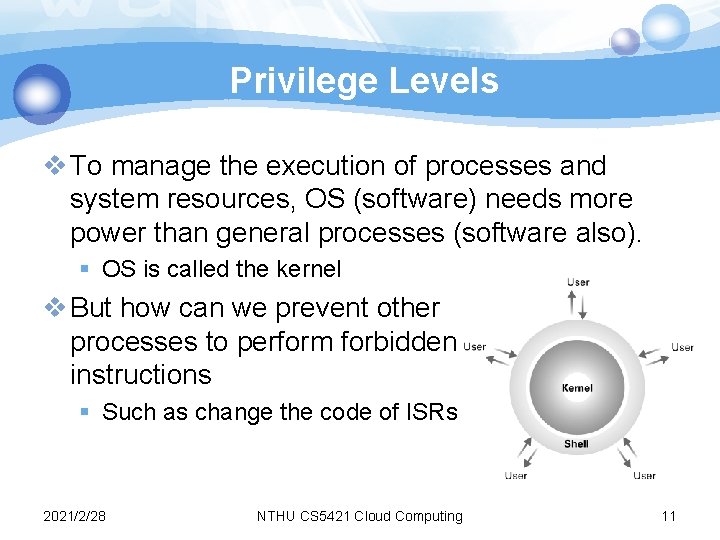
Privilege Levels v To manage the execution of processes and system resources, OS (software) needs more power than general processes (software also). § OS is called the kernel v But how can we prevent other processes to perform forbidden instructions § Such as change the code of ISRs 2021/2/28 NTHU CS 5421 Cloud Computing 11
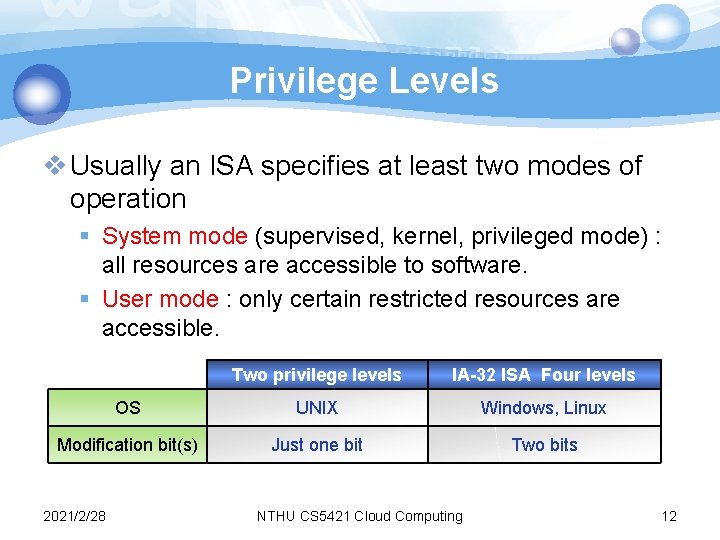
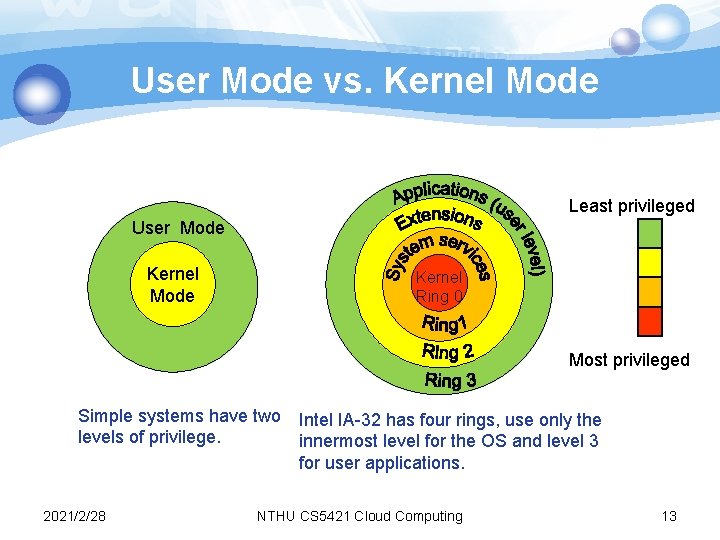
Privilege Levels v Usually an ISA specifies at least two modes of operation § System mode (supervised, kernel, privileged mode) : all resources are accessible to software. § User mode : only certain restricted resources are accessible. Two privilege levels IA-32 ISA Four levels OS UNIX Windows, Linux Modification bit(s) Just one bit Two bits 2021/2/28 NTHU CS 5421 Cloud Computing 12
User Mode vs. Kernel Mode Least privileged User Mode System Kernel Ring 0 Mode Kernel Mode Most privileged Simple systems have two levels of privilege. 2021/2/28 Intel IA-32 has four rings, use only the innermost level for the OS and level 3 for user applications. NTHU CS 5421 Cloud Computing 13
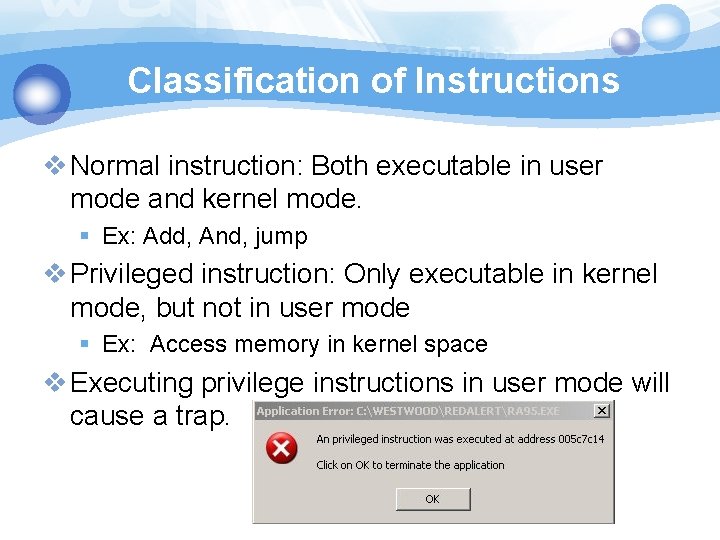
Classification of Instructions v Normal instruction: Both executable in user mode and kernel mode. § Ex: Add, And, jump v Privileged instruction: Only executable in kernel mode, but not in user mode § Ex: Access memory in kernel space v Executing privilege instructions in user mode will cause a trap.
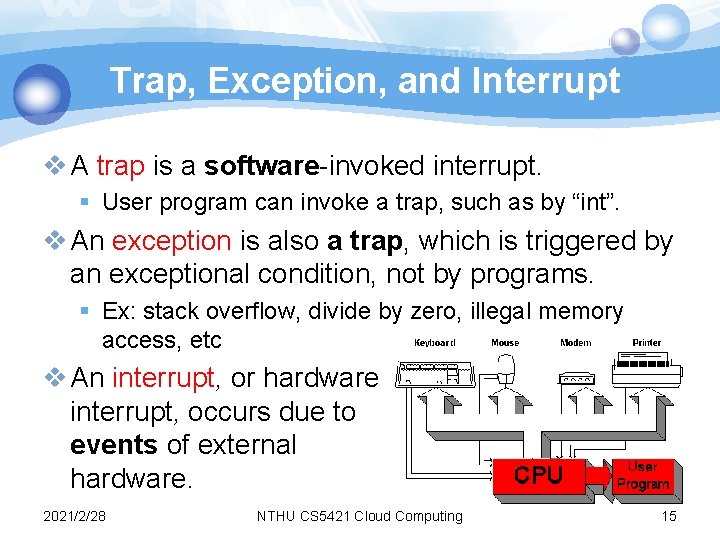
Trap, Exception, and Interrupt v A trap is a software-invoked interrupt. § User program can invoke a trap, such as by “int”. v An exception is also a trap, which is triggered by an exceptional condition, not by programs. § Ex: stack overflow, divide by zero, illegal memory access, etc v An interrupt, or hardware interrupt, occurs due to events of external hardware. 2021/2/28 NTHU CS 5421 Cloud Computing 15
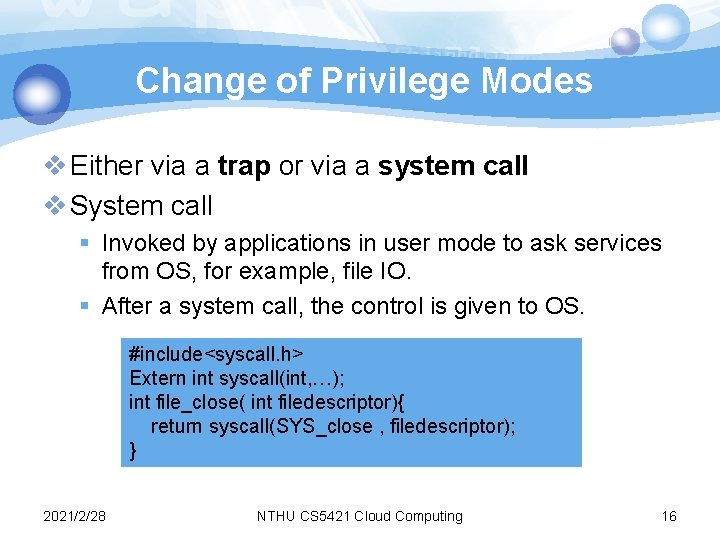
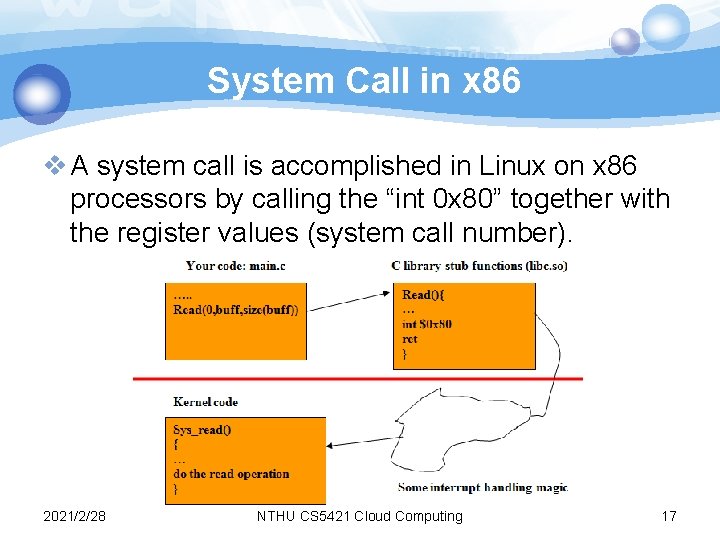
Change of Privilege Modes v Either via a trap or via a system call v System call § Invoked by applications in user mode to ask services from OS, for example, file IO. § After a system call, the control is given to OS. #include<syscall. h> Extern int syscall(int, …); int file_close( int filedescriptor){ return syscall(SYS_close , filedescriptor); } 2021/2/28 NTHU CS 5421 Cloud Computing 16
System Call in x 86 v A system call is accomplished in Linux on x 86 processors by calling the “int 0 x 80” together with the register values (system call number). 2021/2/28 NTHU CS 5421 Cloud Computing 17
Outline v Computer System § Computer System Hardware § Instruction Set Architecture (ISA) § Operating System Organization v Program execution v Memory management v Input / Output control
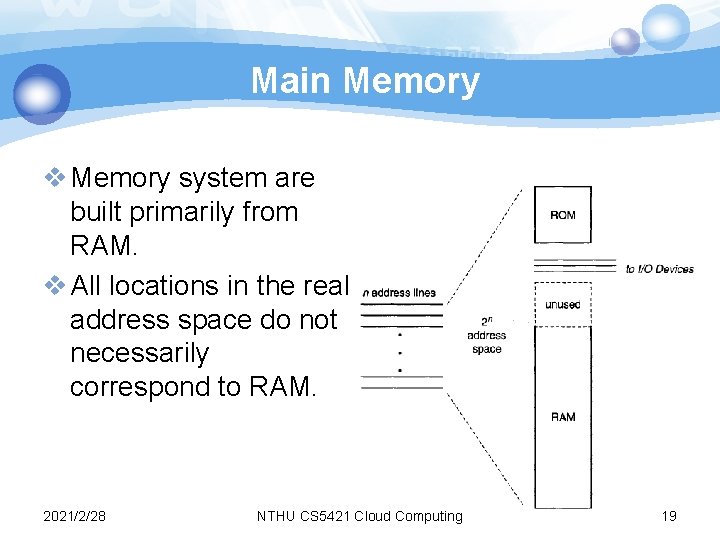
Main Memory v Memory system are built primarily from RAM. v All locations in the real address space do not necessarily correspond to RAM. 2021/2/28 NTHU CS 5421 Cloud Computing 19
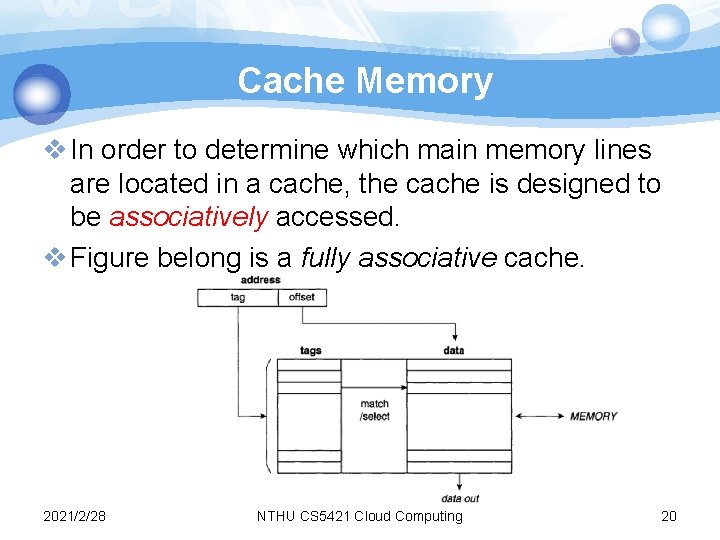
Cache Memory v In order to determine which main memory lines are located in a cache, the cache is designed to be associatively accessed. v Figure belong is a fully associative cache. 2021/2/28 NTHU CS 5421 Cloud Computing 20
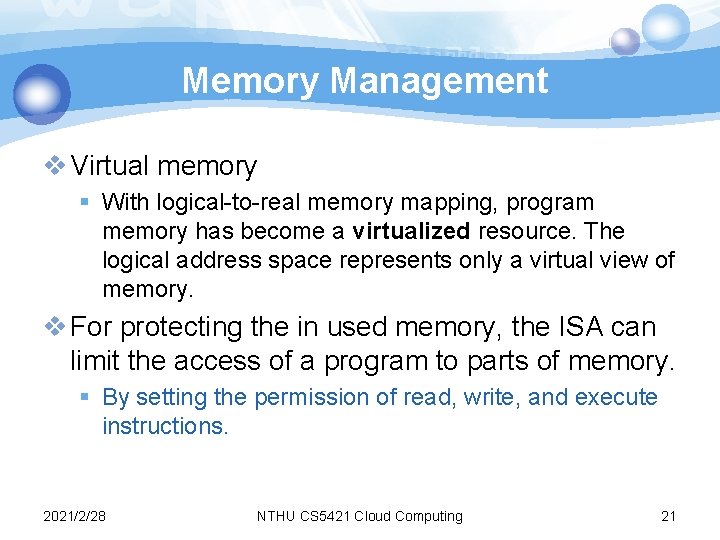
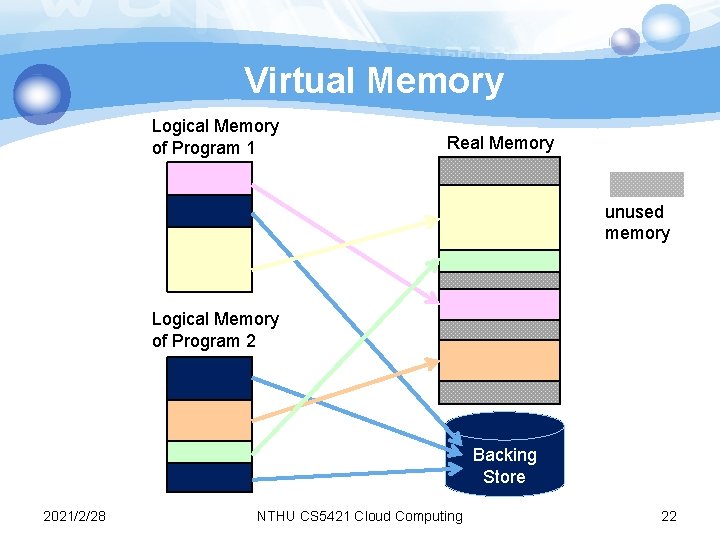
Memory Management v Virtual memory § With logical-to-real memory mapping, program memory has become a virtualized resource. The logical address space represents only a virtual view of memory. v For protecting the in used memory, the ISA can limit the access of a program to parts of memory. § By setting the permission of read, write, and execute instructions. 2021/2/28 NTHU CS 5421 Cloud Computing 21
Virtual Memory Logical Memory of Program 1 Real Memory unused memory Logical Memory of Program 2 Backing Store 2021/2/28 NTHU CS 5421 Cloud Computing 22
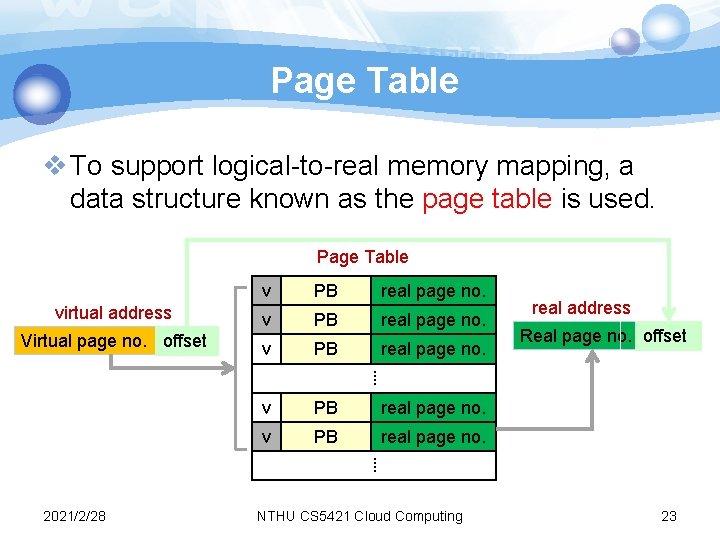
Page Table v To support logical-to-real memory mapping, a data structure known as the page table is used. Page Table v PB real page no. virtual address v PB real page no. Virtual page no. offset v PB real page no. real address Real page no. offset ⁞ v PB real page no. ⁞ 2021/2/28 NTHU CS 5421 Cloud Computing 23
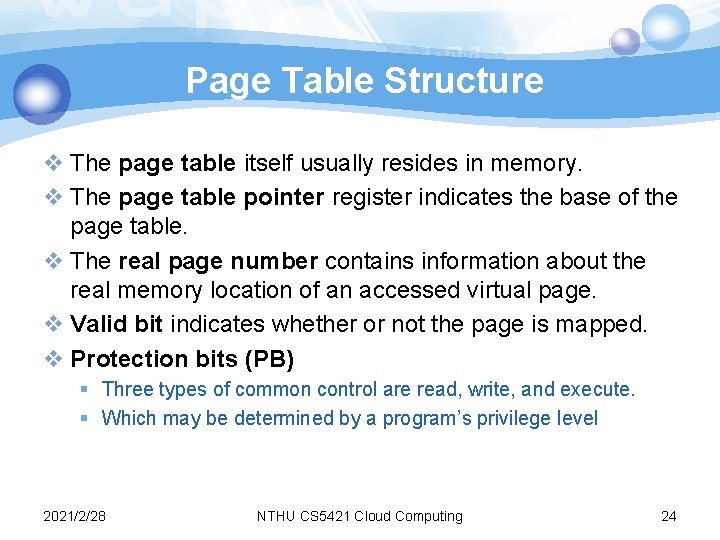
Page Table Structure v The page table itself usually resides in memory. v The page table pointer register indicates the base of the page table. v The real page number contains information about the real memory location of an accessed virtual page. v Valid bit indicates whether or not the page is mapped. v Protection bits (PB) § Three types of common control are read, write, and execute. § Which may be determined by a program’s privilege level 2021/2/28 NTHU CS 5421 Cloud Computing 24
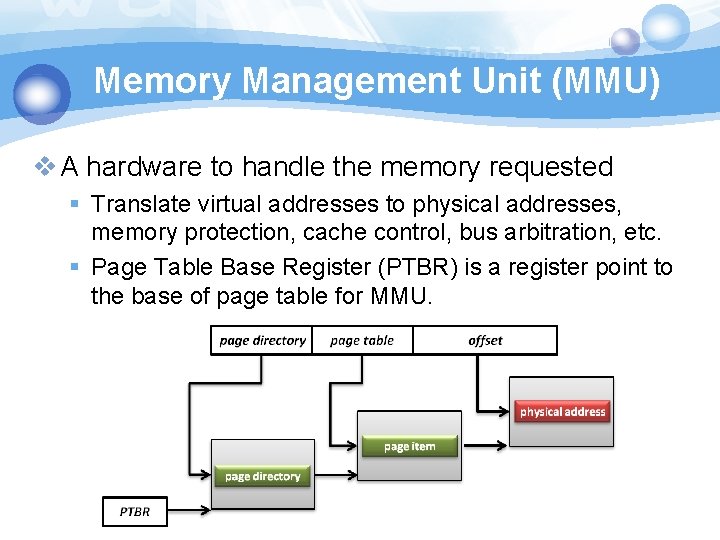
Memory Management Unit (MMU) v A hardware to handle the memory requested § Translate virtual addresses to physical addresses, memory protection, cache control, bus arbitration, etc. § Page Table Base Register (PTBR) is a register point to the base of page table for MMU.
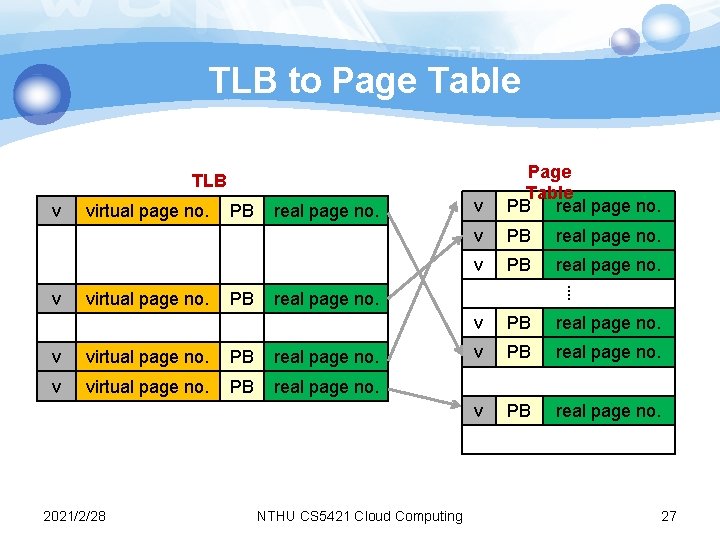
Translation Lookaside Buffer v To make memory accesses much faster, a small associative memory structure called a translation lookaside buffer (TLB) is used for caching recent address translations. v Three possibilities § TLB hit § Entry is match, but protection bit does not allow § TLB miss 2021/2/28 NTHU CS 5421 Cloud Computing 26
TLB to Page Table v Page Table PB real page no. v PB real page no. TLB v v virtual page no. PB PB real page no. v virtual page no. PB real page no. 2021/2/28 ⁞ real page no. NTHU CS 5421 Cloud Computing v PB real page no. 27
OS: Virtual Memory Process v When a process generates a page or TLB fault, the OS takes over § Updates the TLB from the page table if the TLB is architected. § Or handles the fault by scheduling a disk I/O operation to the backing store (hard disk) to retrieve the page. 2021/2/28 NTHU CS 5421 Cloud Computing 28
Outline v Computer System § Computer System Hardware § Instruction Set Architecture (ISA) § Operating System Organization v Program execution v Memory management v Input / Output control
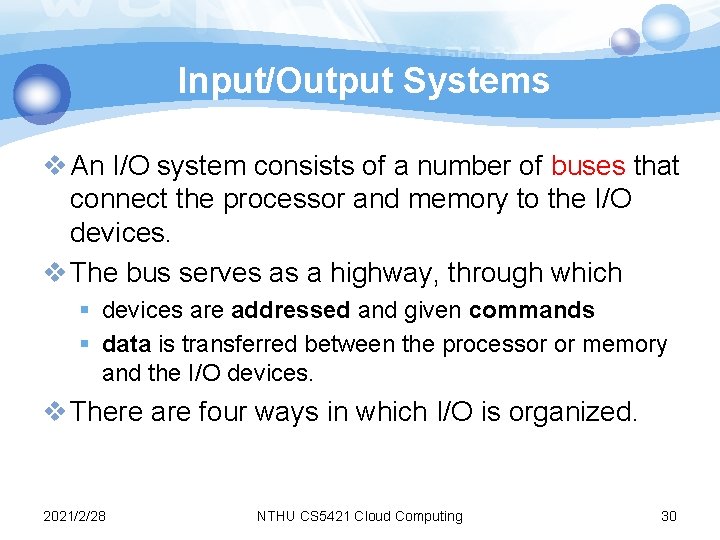
Input/Output Systems v An I/O system consists of a number of buses that connect the processor and memory to the I/O devices. v The bus serves as a highway, through which § devices are addressed and given commands § data is transferred between the processor or memory and the I/O devices. v There are four ways in which I/O is organized. 2021/2/28 NTHU CS 5421 Cloud Computing 30
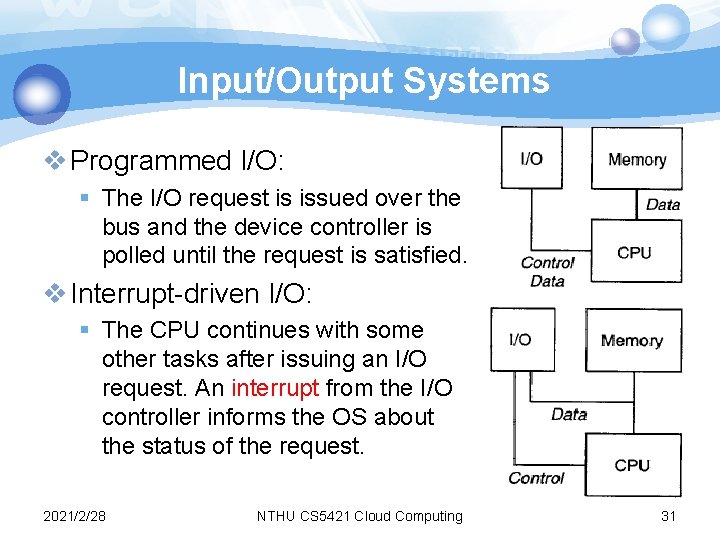
Input/Output Systems v Programmed I/O: § The I/O request is issued over the bus and the device controller is polled until the request is satisfied. v Interrupt-driven I/O: § The CPU continues with some other tasks after issuing an I/O request. An interrupt from the I/O controller informs the OS about the status of the request. 2021/2/28 NTHU CS 5421 Cloud Computing 31
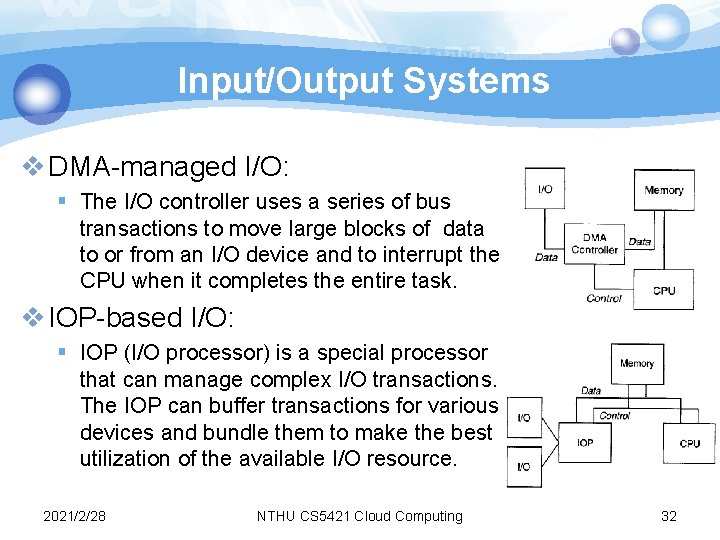
Input/Output Systems v DMA-managed I/O: § The I/O controller uses a series of bus transactions to move large blocks of data to or from an I/O device and to interrupt the CPU when it completes the entire task. v IOP-based I/O: § IOP (I/O processor) is a special processor that can manage complex I/O transactions. The IOP can buffer transactions for various devices and bundle them to make the best utilization of the available I/O resource. 2021/2/28 NTHU CS 5421 Cloud Computing 32
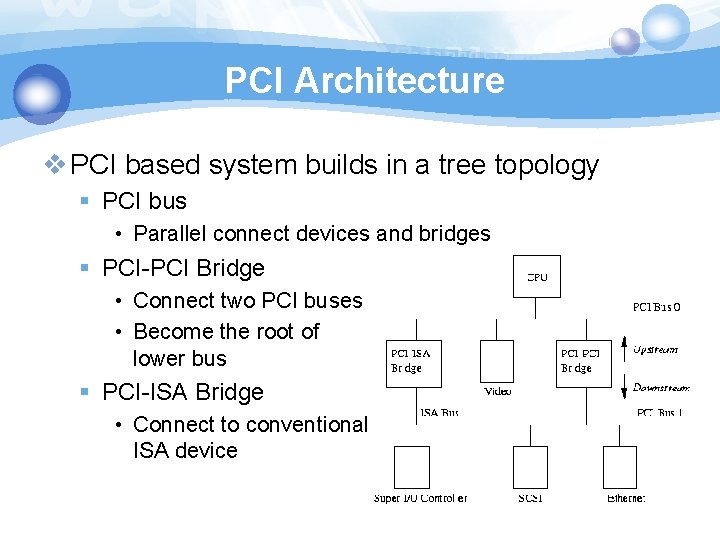
PCI Architecture v PCI based system builds in a tree topology § PCI bus • Parallel connect devices and bridges § PCI-PCI Bridge • Connect two PCI buses • Become the root of lower bus § PCI-ISA Bridge • Connect to conventional ISA device
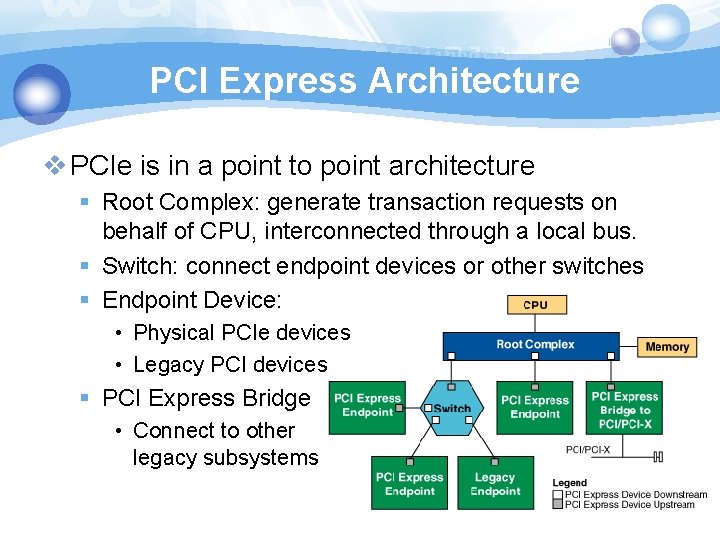
PCI Express Architecture v PCIe is in a point to point architecture § Root Complex: generate transaction requests on behalf of CPU, interconnected through a local bus. § Switch: connect endpoint devices or other switches § Endpoint Device: • Physical PCIe devices • Legacy PCI devices § PCI Express Bridge • Connect to other legacy subsystems
Input/Output Resources v It is more appropriate to deal with the specifics of I/O in software, particularly in the OS software. v The ISA needs to provide only a mechanism for addressing I/O devices and to transfer information to and from the devices. v Two types of addressing mechanisms § Specific I/O instructions § Memory mapped I/O 2021/2/28 NTHU CS 5421 Cloud Computing 35
Input/Output Instructions v I/O Instructions § The addresses are completely separate from main memory addresses. § The execution needs signals to activated the corresponding I/O instruction. v Instructions are usually privileged and can only be invoked by the operating system. 2021/2/28 NTHU CS 5421 Cloud Computing 36
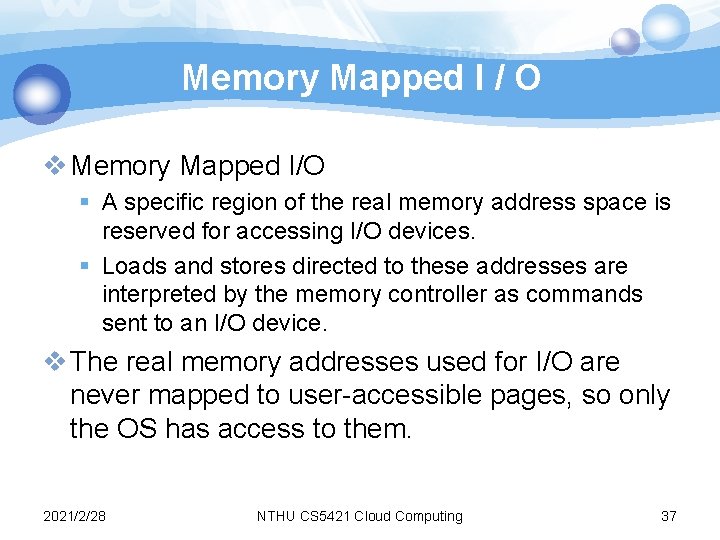
Memory Mapped I / O v Memory Mapped I/O § A specific region of the real memory address space is reserved for accessing I/O devices. § Loads and stores directed to these addresses are interpreted by the memory controller as commands sent to an I/O device. v The real memory addresses used for I/O are never mapped to user-accessible pages, so only the OS has access to them. 2021/2/28 NTHU CS 5421 Cloud Computing 37
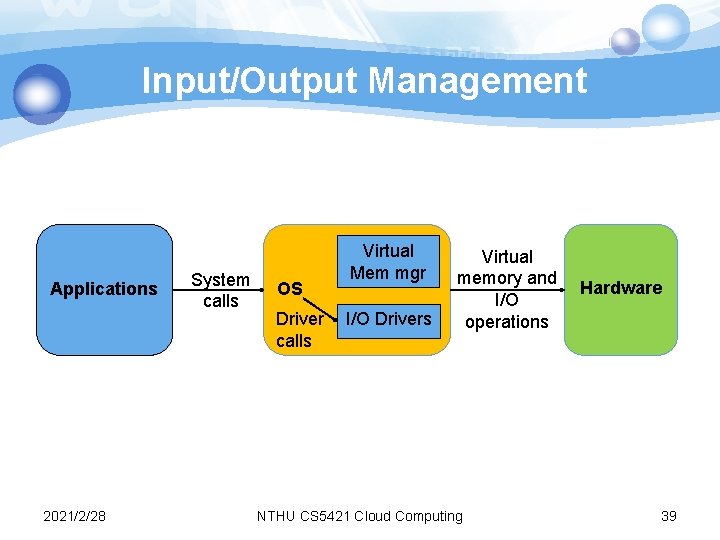
Input/Output Management v OS abstracts most of the details of devices and makes I/O devices accessible through welldefined system calls. v Processes invoke I/O by using system calls, which transfers control to the OS. v The OS uses an interface to a set of software routines that convert generic hardware requests into specific commands to hardware devices. 2021/2/28 NTHU CS 5421 Cloud Computing 38
Input/Output Management Applications 2021/2/28 System calls OS Driver calls Virtual Mem mgr I/O Drivers Virtual memory and I/O operations NTHU CS 5421 Cloud Computing Hardware 39
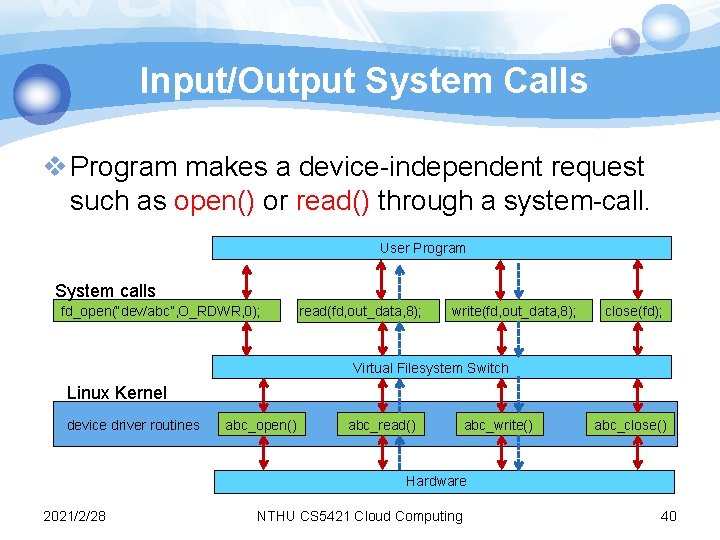
Input/Output System Calls v Program makes a device-independent request such as open() or read() through a system-call. User Program System calls fd_open(“dev/abc”, O_RDWR, 0); read(fd, out_data, 8); write(fd, out_data, 8); close(fd); Virtual Filesystem Switch Linux Kernel device driver routines abc_open() abc_read() abc_write() abc_close() Hardware 2021/2/28 NTHU CS 5421 Cloud Computing 40
References v Appendix A of “Virtual Machines: Versatile Platforms for Systems and Processes”, by Jim Smith and Ravi Nair v Many figures are from Internet 2021/2/28 NTHU CS 5421 Cloud Computing 41