
CLOUD COMPUTING IN LIBRARIES Basic concepts and library
CLOUD COMPUTING IN LIBRARIES Basic concepts and library applications Marshall Breeding Independent Consult, Author, Founder and Publisher, Library Technology Guides www. librarytechnology. org/ twitter. com/mbreeding August 2, 2012 Library Services in the Cloud
Summary Explore the use of cloud computing in a library setting Practical examples for general business automation Strategic library products offered through cloud technologies

Cloud Computing for Libraries Book Image Publication Info: Volume 11 in The Tech Set Published by Neal. Schuman / ALA Tech. Source ISBN: 781555707859 http: //www. nealschuman. com/ccl
Cloud computing as marketing term Cloud computing used very freely, tagged to almost any virtualized environment Any arrangement where the library relies on some kind of remote hosting environment for major automation components Includes almost any vendor-hosted product offering
Cloud computing – characteristics Web-based Interfaces Externally hosted Pricing: subscription or utility Highly abstracted computing model Provisioned on demand Scaled according to variable needs Elastic – consumption of resources can contract and expand according to demand
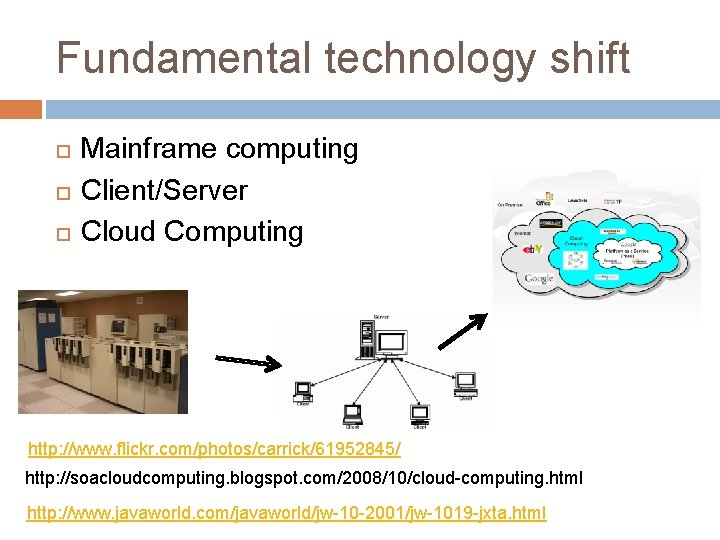
Fundamental technology shift Mainframe computing Client/Server Cloud Computing http: //www. flickr. com/photos/carrick/61952845/ http: //soacloudcomputing. blogspot. com/2008/10/cloud-computing. html http: //www. javaworld. com/javaworld/jw-10 -2001/jw-1019 -jxta. html
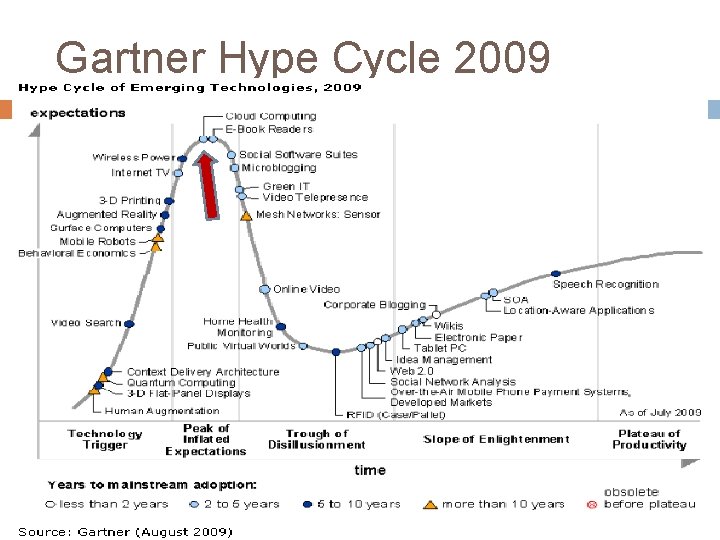
Gartner Hype Cycle 2009
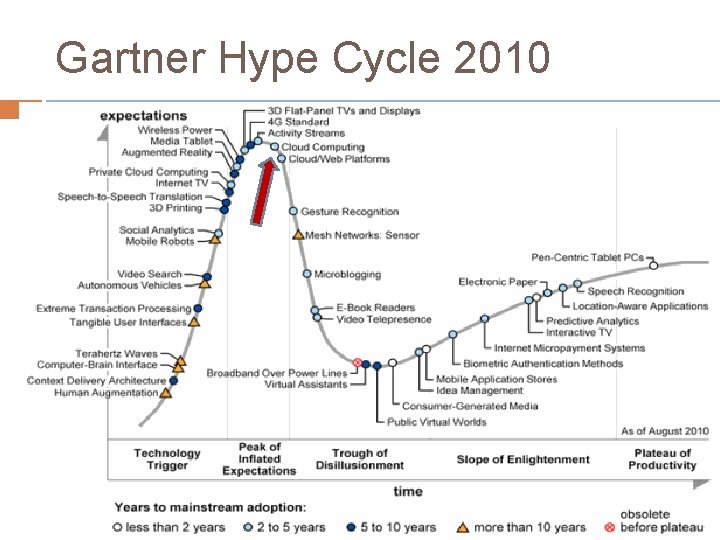
Gartner Hype Cycle 2010
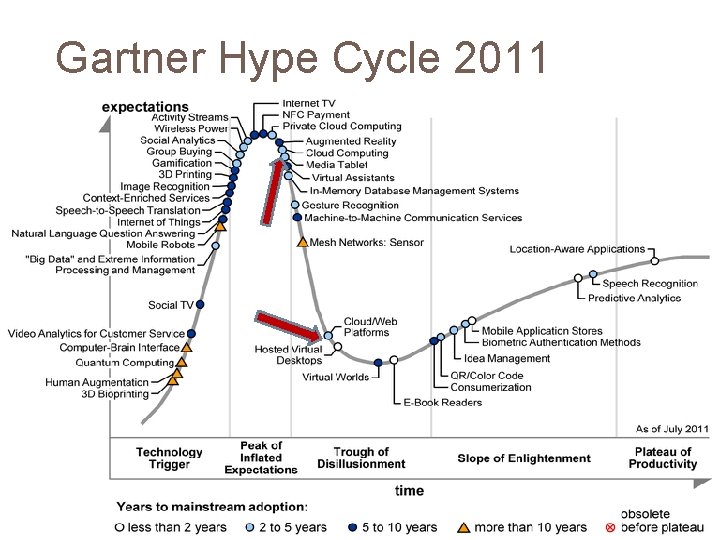
Gartner Hype Cycle 2011
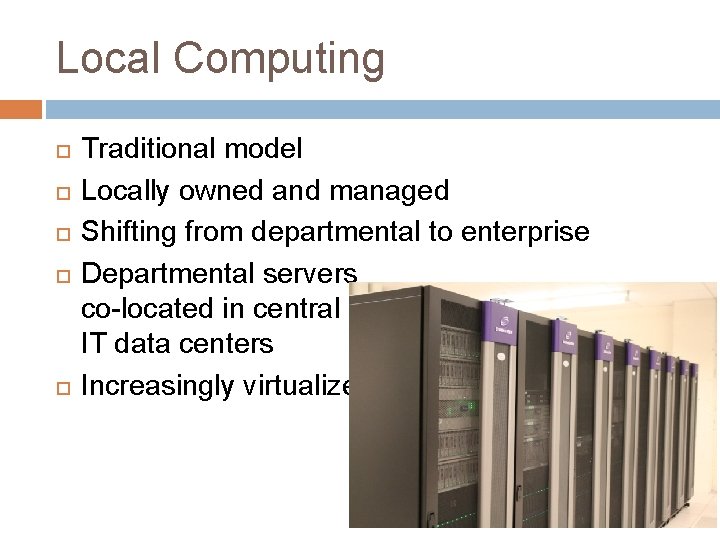
Local Computing Traditional model Locally owned and managed Shifting from departmental to enterprise Departmental servers co-located in central IT data centers Increasingly virtualized
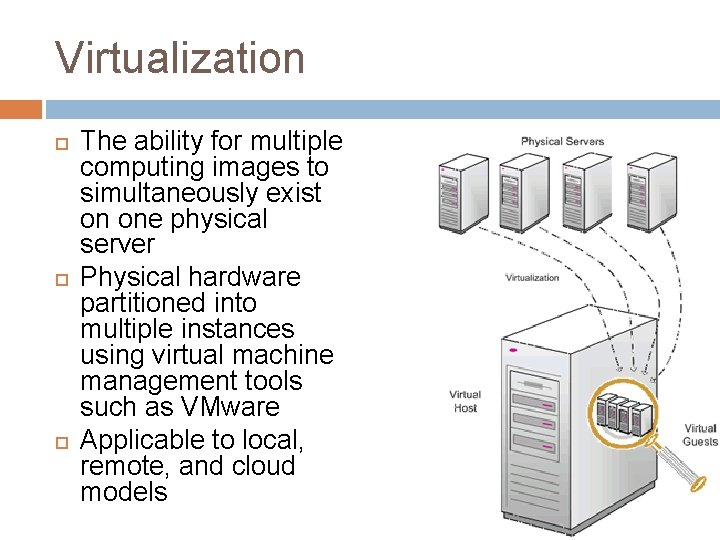
Virtualization The ability for multiple computing images to simultaneously exist on one physical server Physical hardware partitioned into multiple instances using virtual machine management tools such as VMware Applicable to local, remote, and cloud models
Infrastructure-as-a-service Provisioning of Equipment Servers, storage � Virtual server provisioning Examples: Amazon Elastic Compute Cloud (EC 2) Amazon Simple Storage Service (S 3) Rackspace Cloud www. rackspacecloud. com/) EMC 2 Atmos (www. atmosonline. com/)
Amazon EC 2 Amazon Machine Instances (AMI) � Red Hat Enterprise Linux � Debian � Fedora � Ubuntu Linux � Open Solaris � Windows Server 2003/2008
Software-as-a-Service Complete software application, customized for customer use Software delivered through cloud infrastructure, data stored on cloud Eg: Salesforce. com—widely used business infrastructure Multi-tenant: all organizations that use the service share the same instance (codebase, hardware resources, etc) � Often partitioned to separate some groups of subscribers
Application service provider Legacy business applications hosted by software vendor Standalone application on discrete or virtualized hardware Staff and public clients accessed via the Internet Same user interfaces and functionality as if installed locally Established as a deployment model in the 1990’s Can be implemented through Infrastructure-as-a Service � Individual instances of legacy system hosted in EC 2
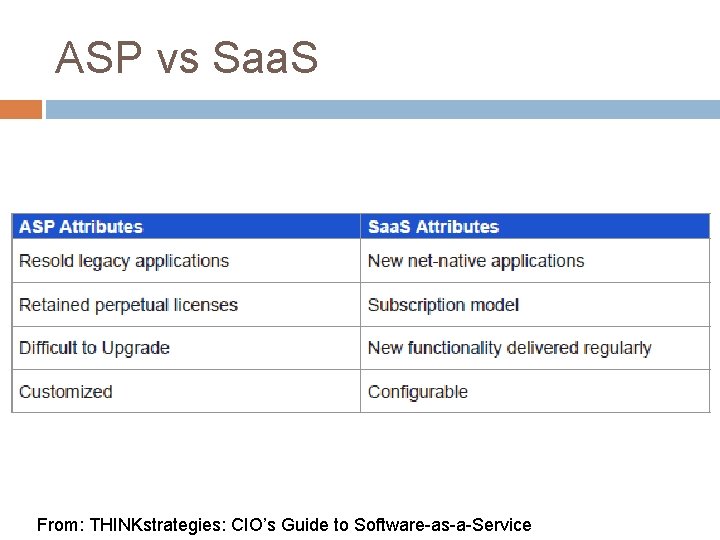
ASP vs Saa. S From: THINKstrategies: CIO’s Guide to Software-as-a-Service
Storage-as-a-Service Provisioned, on-demand storage Bundled to, or separate from other cloud services
Common Library Examples Cloud computing in action
Cloud computing trends for libraries Increased migration away from local computing toward some form of remote / hosted / virtualized alternative Cloud computing especially attractive to libraries with few technology support personnel Adequate bandwidth will continue to be a limiting factor
Operation of a library’s Web site Fewer libraries choosing to operate their Web sites on local servers Simple sites: Web hosting services Intermediate sites: Hosted CMS � Drupal consulting firm + hosting service Complex sites � Custom programming � EC 2 or other Infrastructure as a service
Mail and Calendaring Many libraries just use individual accounts on Gmail or similar services A more sophisticated approach uses mail services from Google, Microsoft, or others institutionally � � Same interface, but e-mail addresses carry the institutional domain name � � Google Apps for Businesses Microsoft Exchange Online Free or low-cost for small organizations Professional levels for larger organizations Supplemental services: � � � No advertising Back-up and recovery services Service Level agreement
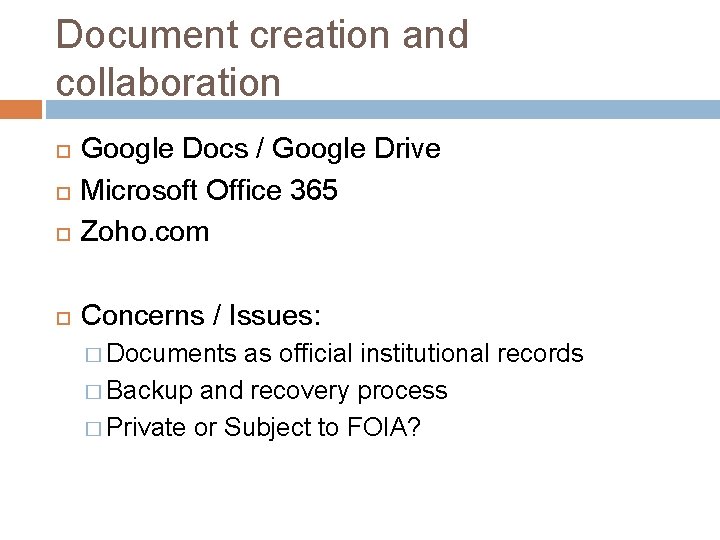
Document creation and collaboration Google Docs / Google Drive Microsoft Office 365 Zoho. com Concerns / Issues: � Documents as official institutional records � Backup and recovery process � Private or Subject to FOIA?
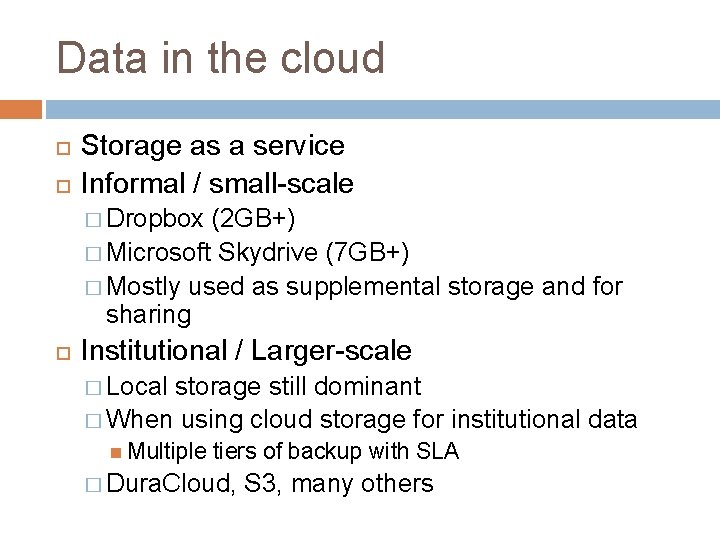
Data in the cloud Storage as a service Informal / small-scale � Dropbox (2 GB+) � Microsoft Skydrive (7 GB+) � Mostly used as supplemental storage and for sharing Institutional / Larger-scale � Local storage still dominant � When using cloud storage for institutional data Multiple tiers of backup with SLA � Dura. Cloud, S 3, many others
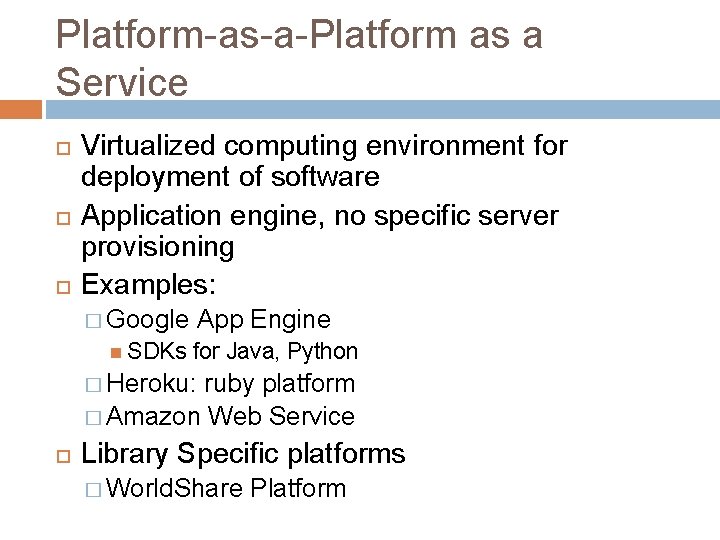
Platform-as-a-Platform as a Service Virtualized computing environment for deployment of software Application engine, no specific server provisioning Examples: � Google SDKs App Engine for Java, Python � Heroku: ruby platform � Amazon Web Service Library Specific platforms � World. Share Platform
Library automation through Saa. S Almost all library automation products offered through hosted options Saa. S or ASP?
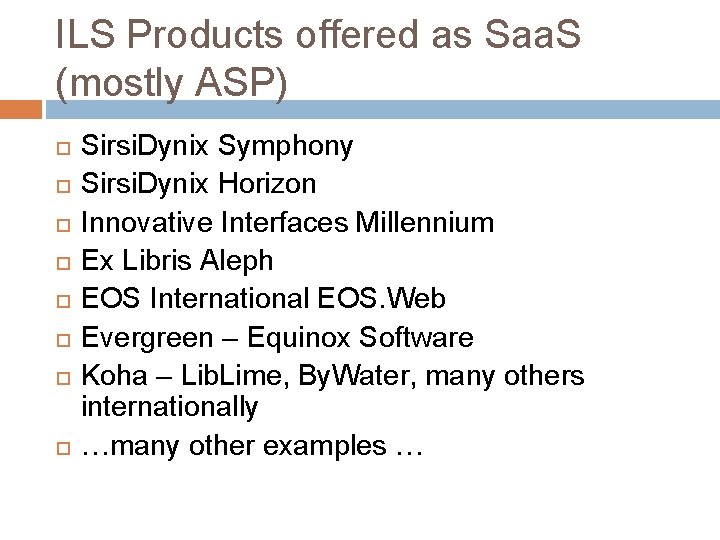
ILS Products offered as Saa. S (mostly ASP) Sirsi. Dynix Symphony Sirsi. Dynix Horizon Innovative Interfaces Millennium Ex Libris Aleph EOS International EOS. Web Evergreen – Equinox Software Koha – Lib. Lime, By. Water, many others internationally …many other examples …
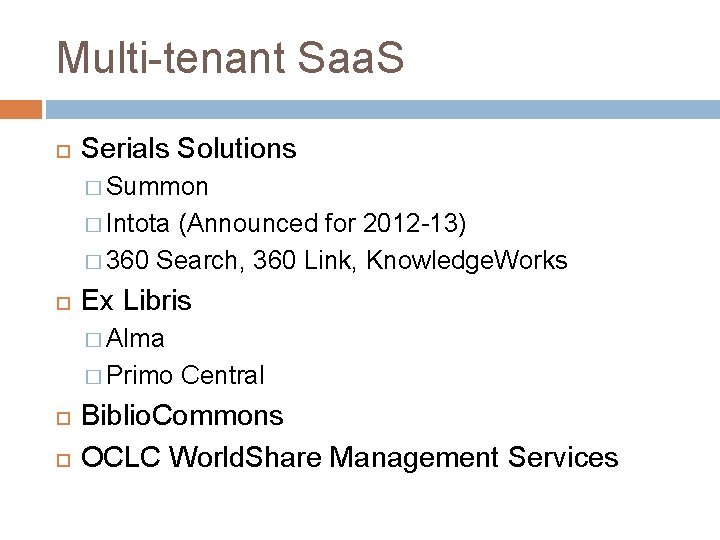
Multi-tenant Saa. S Serials Solutions � Summon � Intota (Announced for 2012 -13) � 360 Search, 360 Link, Knowledge. Works Ex Libris � Alma � Primo Central Biblio. Commons OCLC World. Share Management Services
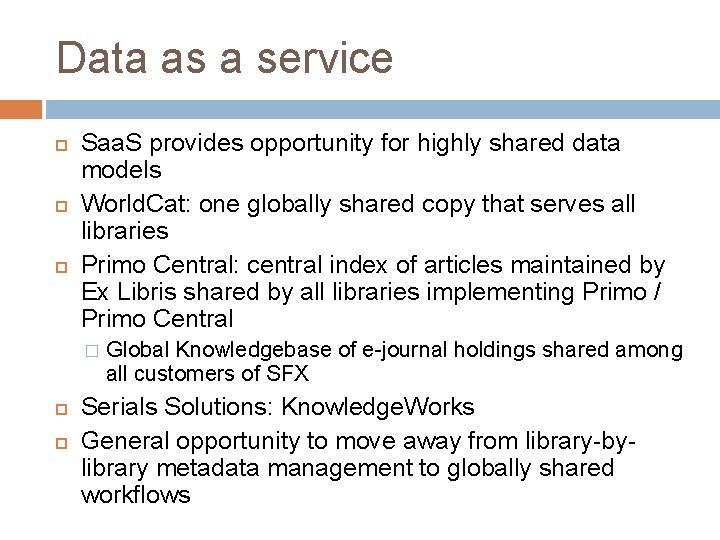
Data as a service Saa. S provides opportunity for highly shared data models World. Cat: one globally shared copy that serves all libraries Primo Central: central index of articles maintained by Ex Libris shared by all libraries implementing Primo / Primo Central � Global Knowledgebase of e-journal holdings shared among all customers of SFX Serials Solutions: Knowledge. Works General opportunity to move away from library-bylibrary metadata management to globally shared workflows
Platform as a Service OCLC World. Share Platform � World. Share Management Services � World. Share License Manager � Library-created applications
Repositories in the cloud Dspace – institutional repository application Fedora – generalized repository platform Dura. Space – organization now over both Dspace and Fedora Dura. Cloud – shared, hosted repository platform Pilot since 2009, production in early 2011 � www. duraspace. org/duracloud. php �
Caveats and concerns with Saa. S Libraries must have adequate bandwidth to support access to remote applications without latency Quality of service agreements that guarantee performance and reliability factors Configurability and customizability limitations Access to API’s Ability to interoperate with 3 rd party applications � Eg: Connect Saa. S ILS with discovery product from another vendor
Preserve your brand! Be sure that your services delivered through your own URL Most cloud services support domain aliases Accomplished through DNS configuration � Implemented by your network administrator � Create CNAME entry to redirect cloud service to a subdomain associated with your library: � S 3. mylibrary. org = s 3. amazonaws. com.
Cost implications Total cost of ownership Do all cost components result in increased or decreased expense � Personnel costs – need less technical administration � Hardware – server hardware eliminated � Software costs: subscription, license, maintenance/support � Indirect costs: energy costs associated with power and cooling of servers in data center Iaa. S: balance elimination of hardware investments for ongoing usage fees � Especially attractive for development and prototyping
Risks and concerns Privacy of data � Policies, Ownership of data � Avoid regulations, jurisdictions vendor lock-in Integrity of Data � Backups and disaster recovery
Security issues Most providers implement stronger safeguards beyond the capacity of local institutions Virtual instances equally susceptible to poor security practices as local computing
Increased pressure Library automation vendors promoting Saa. S offerings � Some companies already exclusively Saa. S Software pricing increasingly favorable to Saa. S
Caveat Technologies promoted by companies and organizations have a vested interest in their adoption Critically assess viability of the technology and its appropriateness for your organization Start with low-risk projects before making strategic commitments
Questions and Discussion
- Slides: 38