
Cloud Attenuation Modelling for Satellite Network Links Performance
![Figure 6: OTA [CU] CLOUD COVER AND THE CORROBORATING SATELLITES OVER IT](https://slidetodoc.com/presentation_image_h2/09e838a6fc04c5dbe2d2dd02db313b05/image-19.jpg "Figure 6: OTA [CU] CLOUD COVER AND THE CORROBORATING SATELLITES OVER IT")
![References [1] [2] [3] [4] [5] [6] Das S, Chakraborty S and Maitra A,](https://slidetodoc.com/presentation_image_h2/09e838a6fc04c5dbe2d2dd02db313b05/image-38.jpg "References [1] [2] [3] [4] [5] [6] Das S, Chakraborty S and Maitra A,")
- Slides: 39
Cloud Attenuation Modelling for Satellite Network Links Performance Improvement O. M. Adewusi, T. V. Omotosho, M. L. Akinyemi, O. O. Ometan, S. A. Akinwunmi and A. A. Umar Fo. SC 2017 Department of Physics Lagos State University
OUTLINE § • § § § § Introduction Scenario Illustration Comparisons of The Foundation Cloud Models Station Cloud Cover Station Radiometric Data Acquisition and Analysis Cloud Attenuation Modelling Conclusion Future Work References
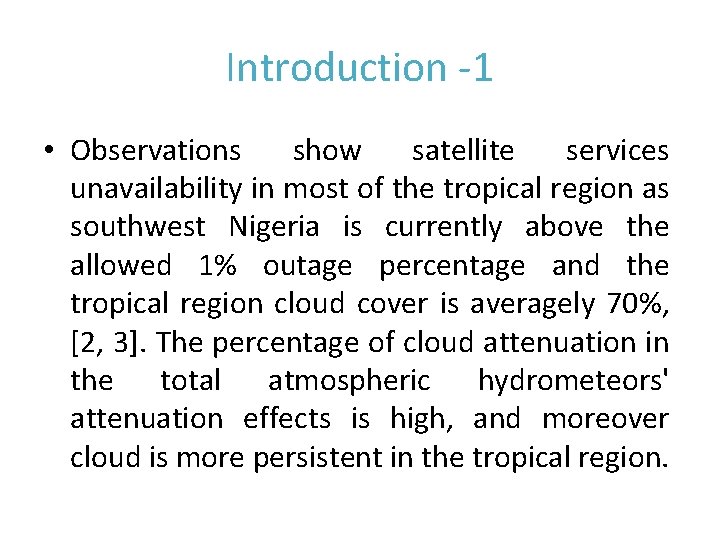
Introduction -1 • Observations show satellite services unavailability in most of the tropical region as southwest Nigeria is currently above the allowed 1% outage percentage and the tropical region cloud cover is averagely 70%, [2, 3]. The percentage of cloud attenuation in the total atmospheric hydrometeors' attenuation effects is high, and moreover cloud is more persistent in the tropical region.
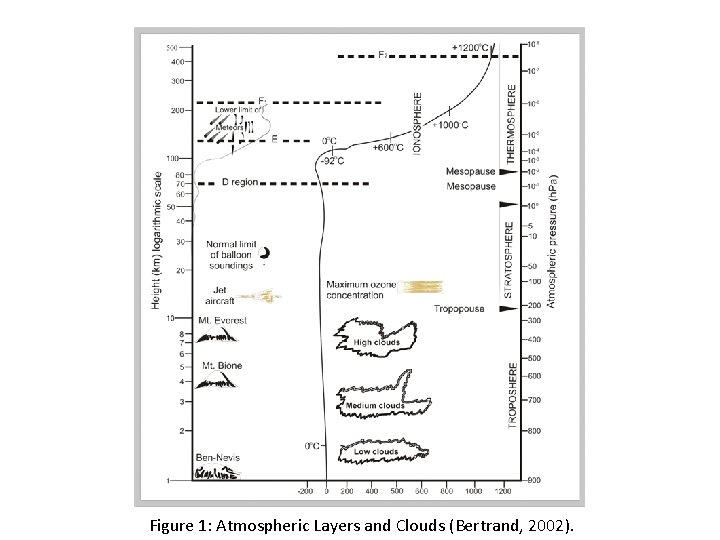
Figure 1: Atmospheric Layers and Clouds (Bertrand, 2002).
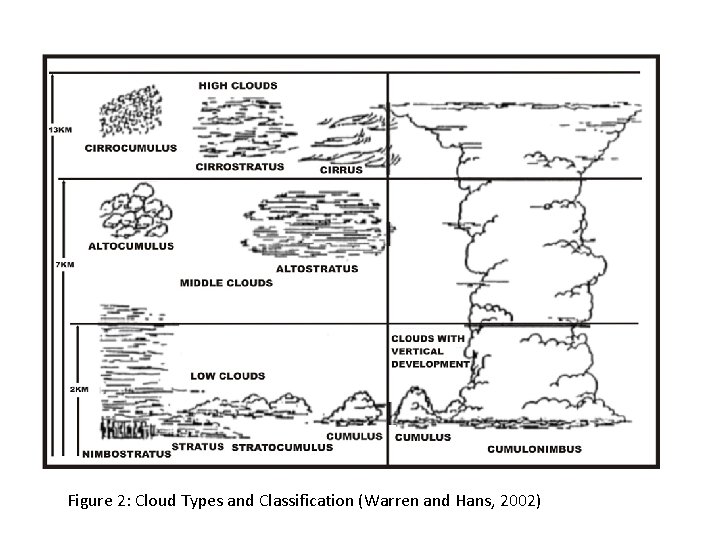
Figure 2: Cloud Types and Classification (Warren and Hans, 2002)
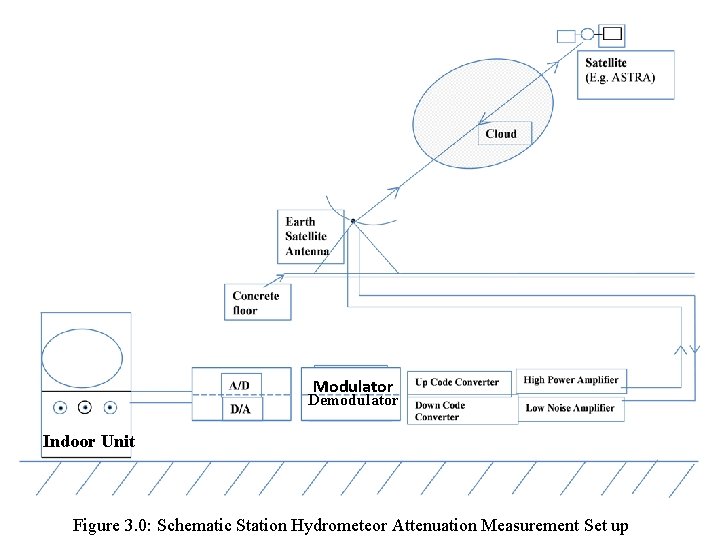
Modulator Demodulator Indoor Unit Figure 3. 0: Schematic Station Hydrometeor Attenuation Measurement Set up
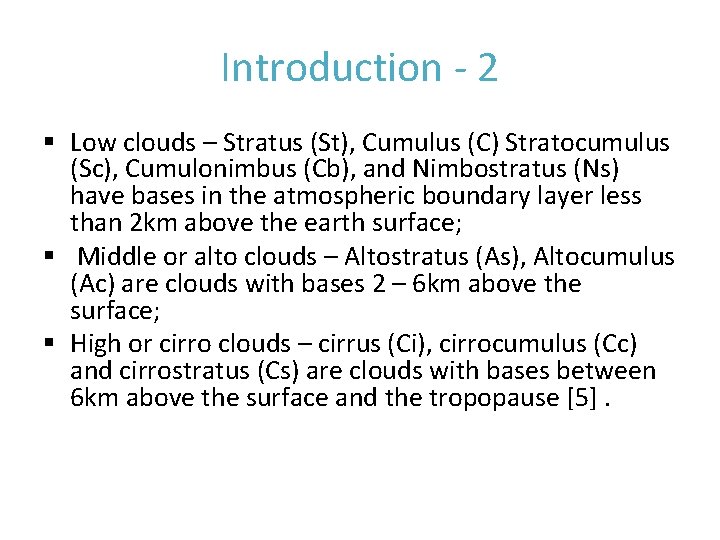
Introduction - 2 § Low clouds – Stratus (St), Cumulus (C) Stratocumulus (Sc), Cumulonimbus (Cb), and Nimbostratus (Ns) have bases in the atmospheric boundary layer less than 2 km above the earth surface; § Middle or alto clouds – Altostratus (As), Altocumulus (Ac) are clouds with bases 2 – 6 km above the surface; § High or cirro clouds – cirrus (Ci), cirrocumulus (Cc) and cirrostratus (Cs) are clouds with bases between 6 km above the surface and the tropopause [5].
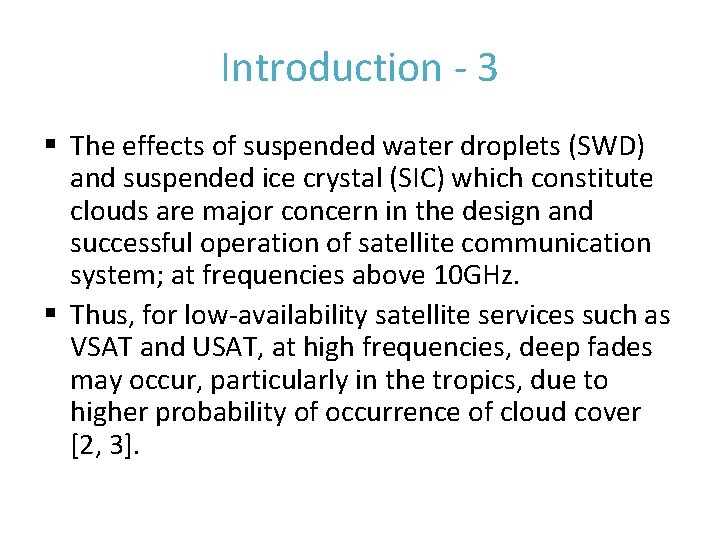
Introduction - 3 § The effects of suspended water droplets (SWD) and suspended ice crystal (SIC) which constitute clouds are major concern in the design and successful operation of satellite communication system; at frequencies above 10 GHz. § Thus, for low-availability satellite services such as VSAT and USAT, at high frequencies, deep fades may occur, particularly in the tropics, due to higher probability of occurrence of cloud cover [2, 3].
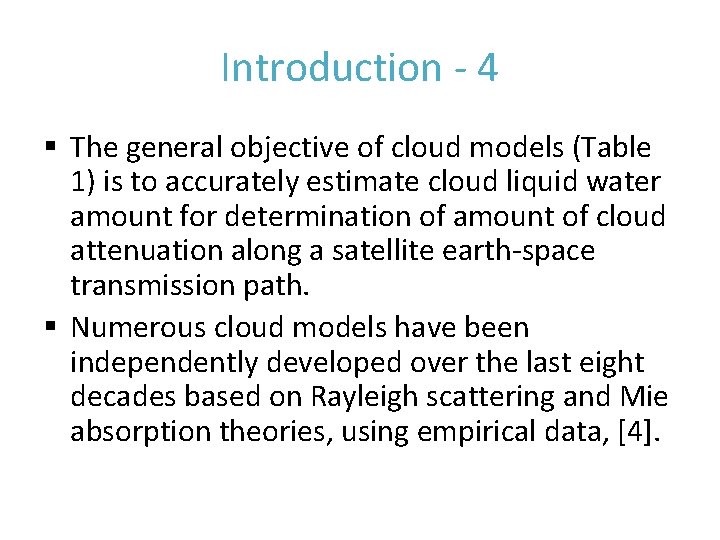
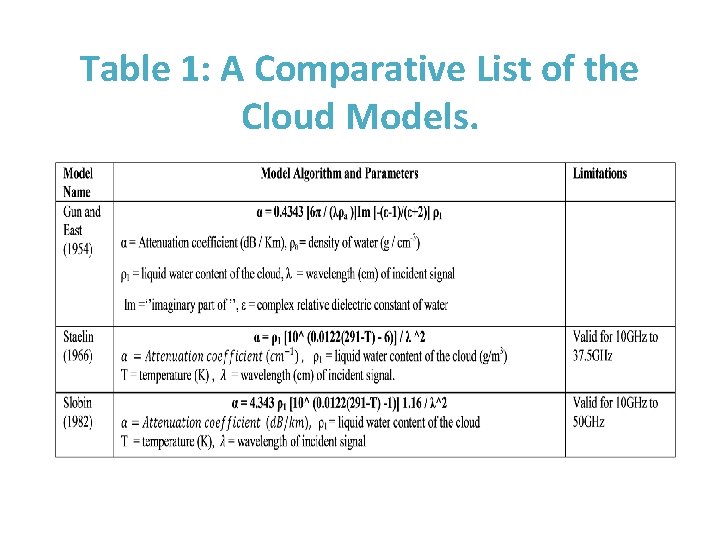
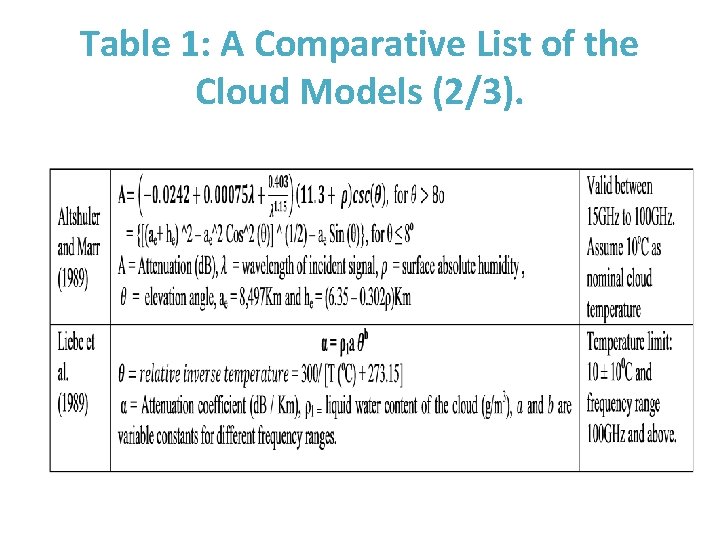
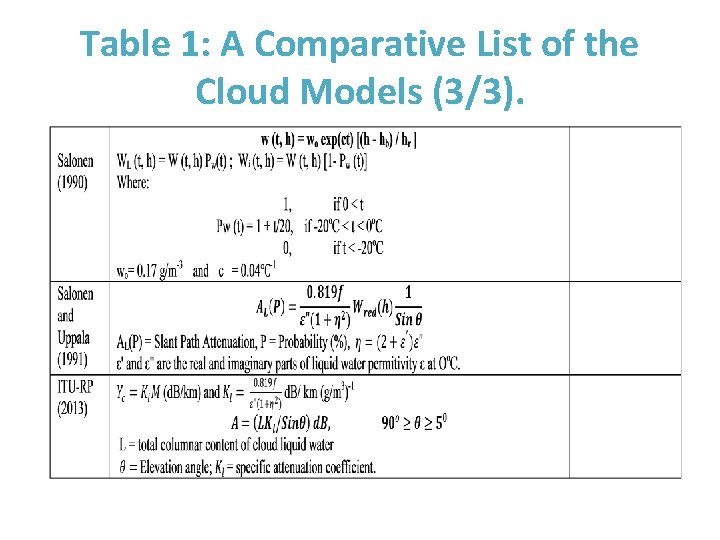
Introduction - 4 § The general objective of cloud models (Table 1) is to accurately estimate cloud liquid water amount for determination of amount of cloud attenuation along a satellite earth-space transmission path. § Numerous cloud models have been independently developed over the last eight decades based on Rayleigh scattering and Mie absorption theories, using empirical data, [4].
Table 1: A Comparative List of the Cloud Models.
Table 1: A Comparative List of the Cloud Models (2/3).
Table 1: A Comparative List of the Cloud Models (3/3).
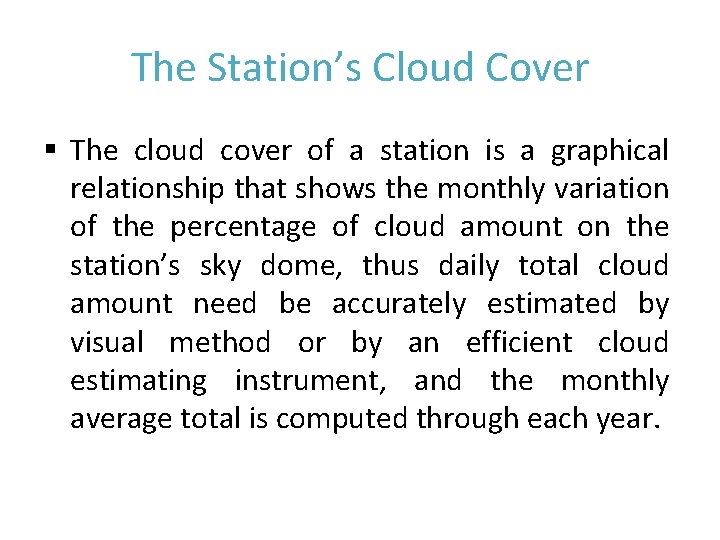
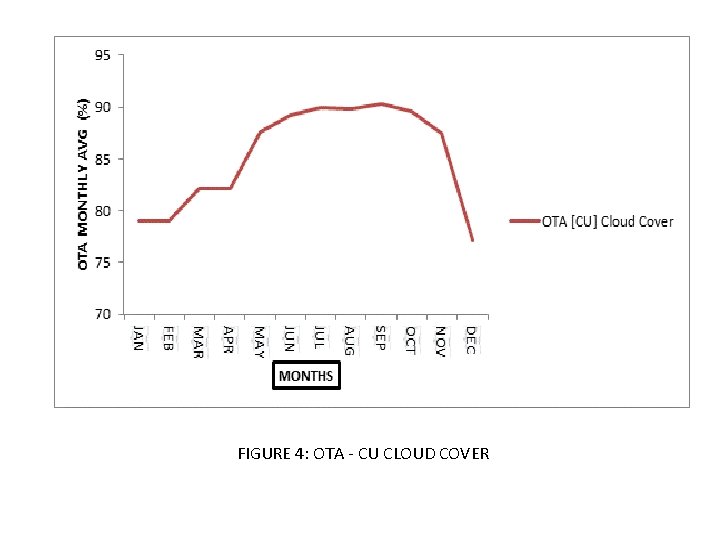
The Station’s Cloud Cover § The cloud cover of a station is a graphical relationship that shows the monthly variation of the percentage of cloud amount on the station’s sky dome, thus daily total cloud amount need be accurately estimated by visual method or by an efficient cloud estimating instrument, and the monthly average total is computed through each year.
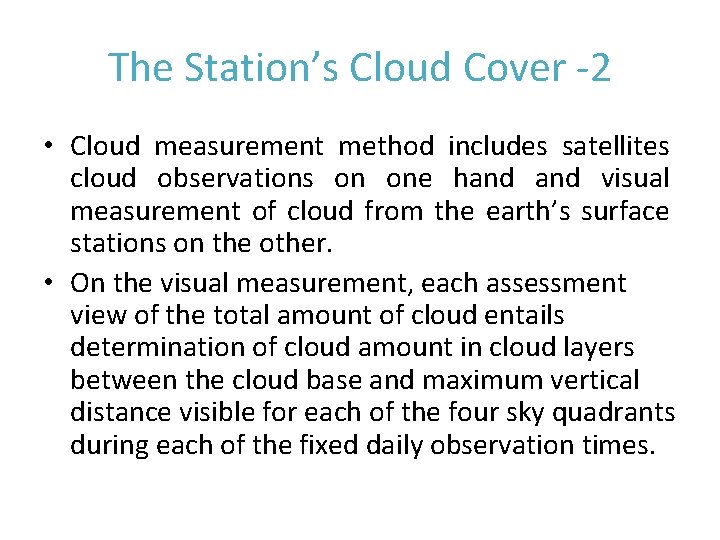
The Station’s Cloud Cover -2 • Cloud measurement method includes satellites cloud observations on one hand visual measurement of cloud from the earth’s surface stations on the other. • On the visual measurement, each assessment view of the total amount of cloud entails determination of cloud amount in cloud layers between the cloud base and maximum vertical distance visible for each of the four sky quadrants during each of the fixed daily observation times.
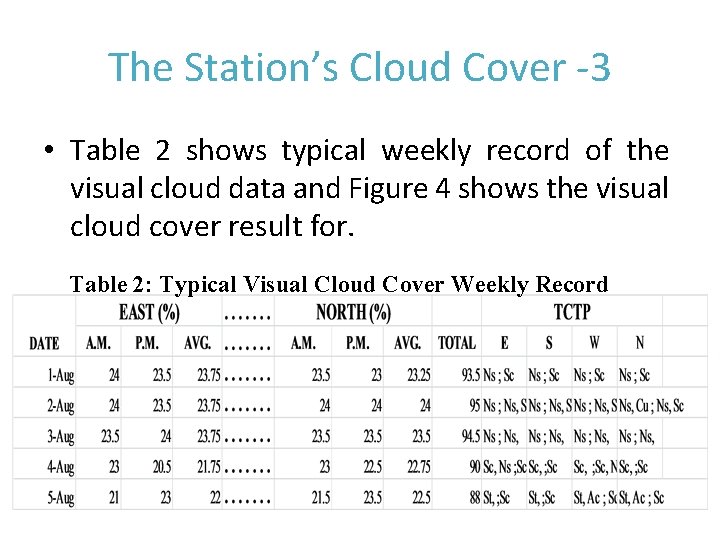
The Station’s Cloud Cover -3 • Table 2 shows typical weekly record of the visual cloud data and Figure 4 shows the visual cloud cover result for. Table 2: Typical Visual Cloud Cover Weekly Record
FIGURE 4: OTA - CU CLOUD COVER
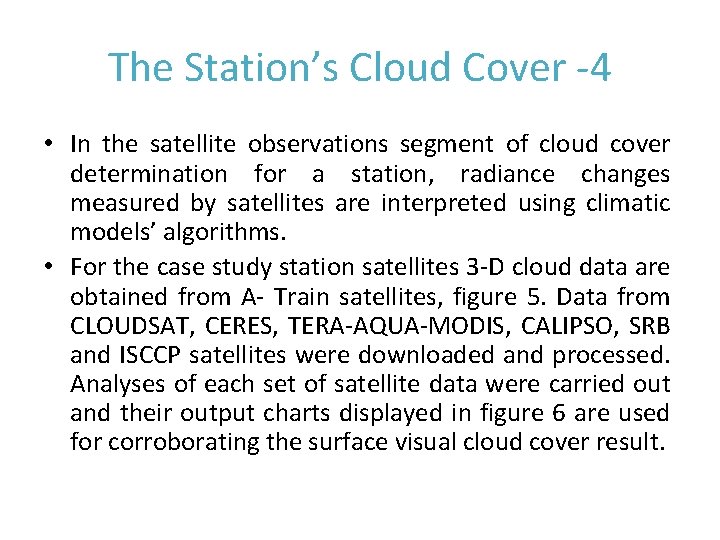
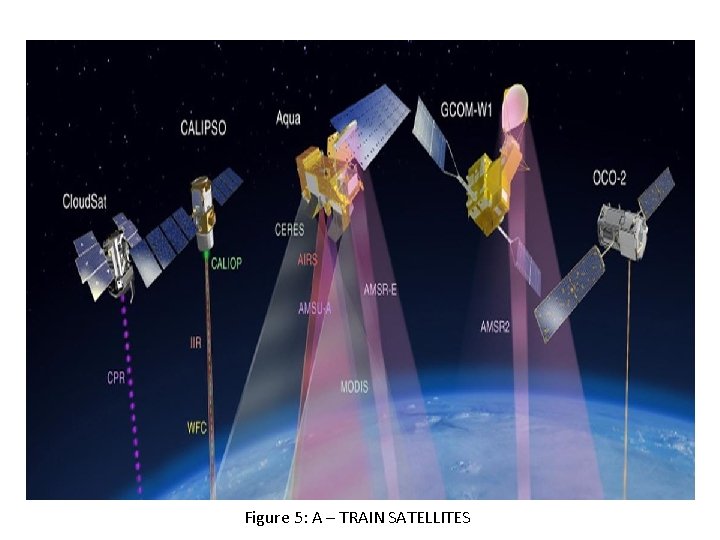
The Station’s Cloud Cover -4 • In the satellite observations segment of cloud cover determination for a station, radiance changes measured by satellites are interpreted using climatic models’ algorithms. • For the case study station satellites 3 -D cloud data are obtained from A- Train satellites, figure 5. Data from CLOUDSAT, CERES, TERA-AQUA-MODIS, CALIPSO, SRB and ISCCP satellites were downloaded and processed. Analyses of each set of satellite data were carried out and their output charts displayed in figure 6 are used for corroborating the surface visual cloud cover result.
Figure 5: A – TRAIN SATELLITES
Figure 6: OTA [CU] CLOUD COVER AND THE CORROBORATING SATELLITES OVER IT
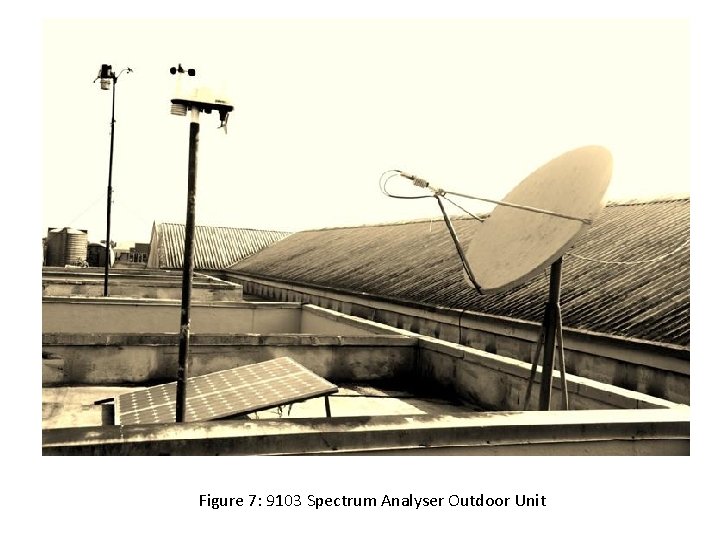
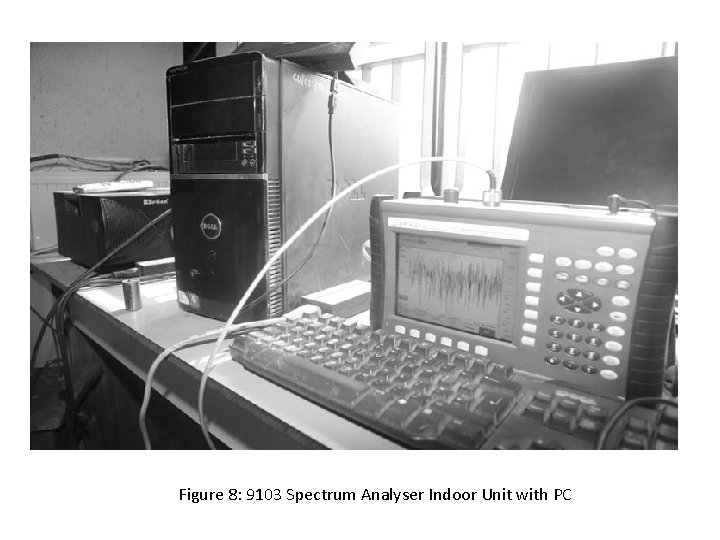
Station Radiometric Data Acquisition • In an observation station at least one radiometer will be required for radiometric data collection, and radiosonde data or satellite radiometric data will be needed for corroboration. • In the Ota – CU station case study, 9103 Spectrum Analyser is in use; fifty - three years radiosonde observations data was acquired, filtered and extracted to obtain each cloud layer’s values for the required primary parameters – pressure (h. Pa), temperature (K) and calculated geopotential height (m).
Figure 7: 9103 Spectrum Analyser Outdoor Unit
Figure 8: 9103 Spectrum Analyser Indoor Unit with PC
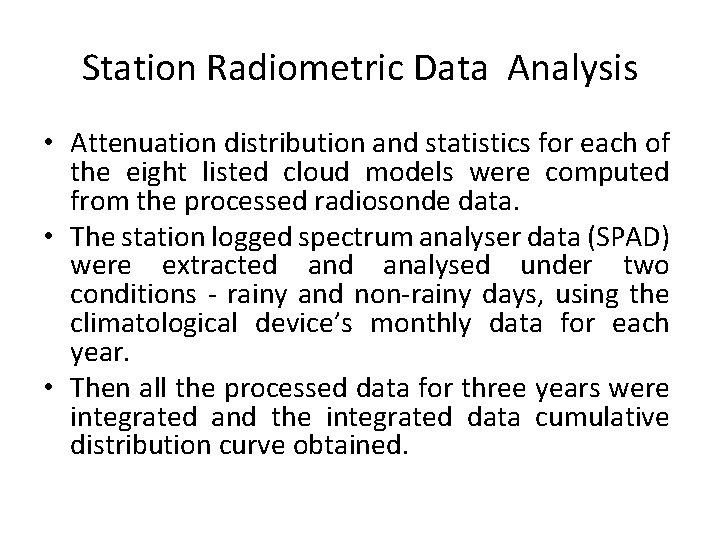
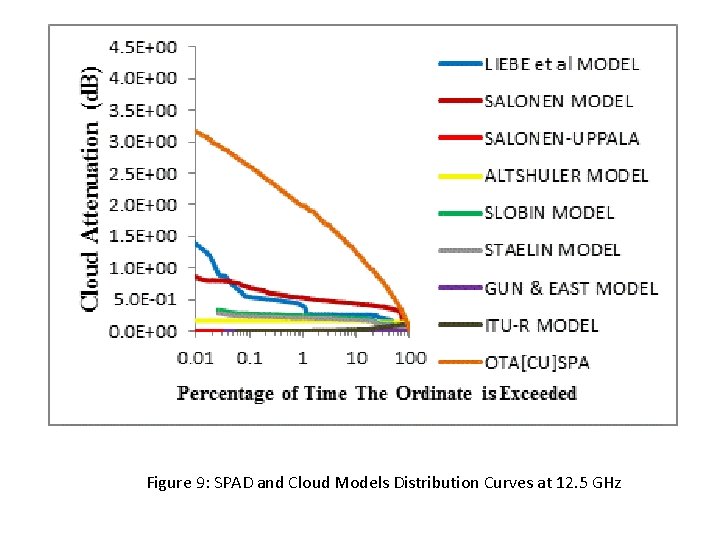
Station Radiometric Data Analysis • Attenuation distribution and statistics for each of the eight listed cloud models were computed from the processed radiosonde data. • The station logged spectrum analyser data (SPAD) were extracted analysed under two conditions - rainy and non-rainy days, using the climatological device’s monthly data for each year. • Then all the processed data for three years were integrated and the integrated data cumulative distribution curve obtained.
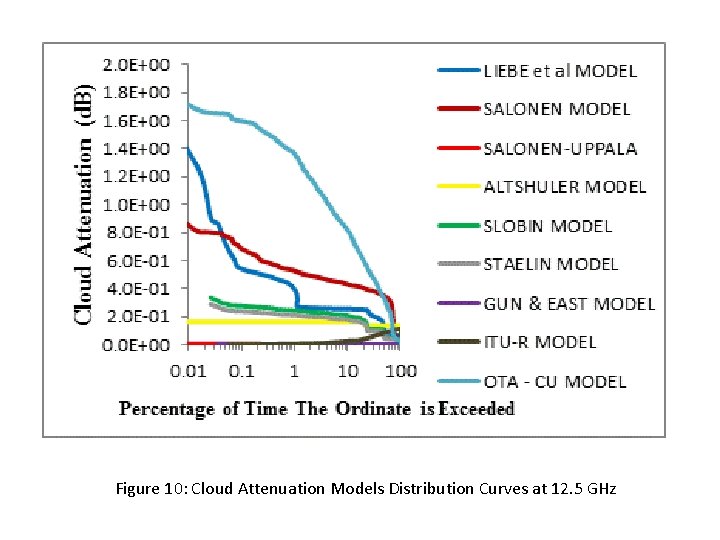
Station Radiometric Data Analysis - 2 • Each distribution curve is a result of raw data processing using electronic spread sheet programming to implement several layers of required station conditions such as geographic, climatic and spectra conditions. The resulting cloud attenuation cumulative distribution curves at 12. 5 GHz for each of the existing cloud models and that for the spectrum analyser data (SPAD) were compared in figure 9.
Figure 9: SPAD and Cloud Models Distribution Curves at 12. 5 GHz
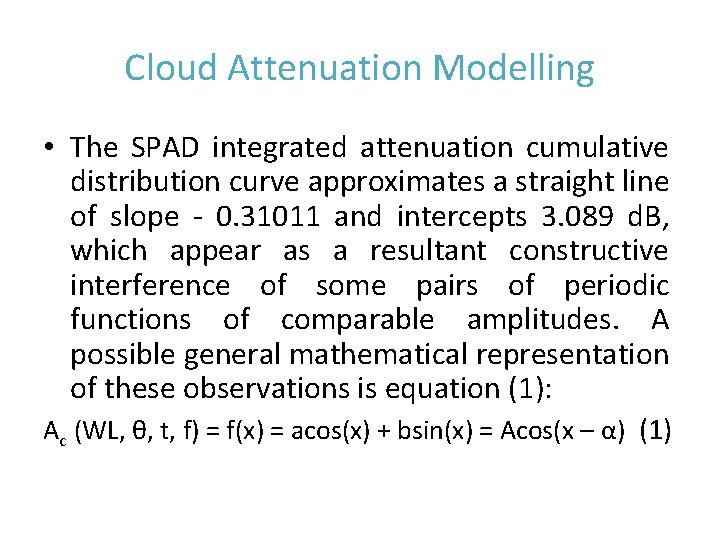
Cloud Attenuation Modelling • The SPAD integrated attenuation cumulative distribution curve approximates a straight line of slope - 0. 31011 and intercepts 3. 089 d. B, which appear as a resultant constructive interference of some pairs of periodic functions of comparable amplitudes. A possible general mathematical representation of these observations is equation (1): Ac (WL, θ, t, f) = f(x) = acos(x) + bsin(x) = Acos(x – α) (1)
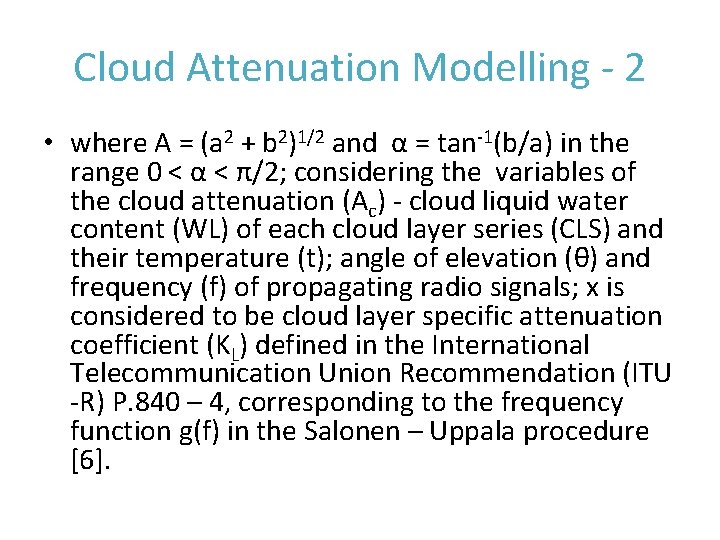
Cloud Attenuation Modelling - 2 • where A = (a 2 + b 2)1/2 and α = tan-1(b/a) in the range 0 < α < π/2; considering the variables of the cloud attenuation (Ac) - cloud liquid water content (WL) of each cloud layer series (CLS) and their temperature (t); angle of elevation (θ) and frequency (f) of propagating radio signals; x is considered to be cloud layer specific attenuation coefficient (KL) defined in the International Telecommunication Union Recommendation (ITU -R) P. 840 – 4, corresponding to the frequency function g(f) in the Salonen – Uppala procedure [6].
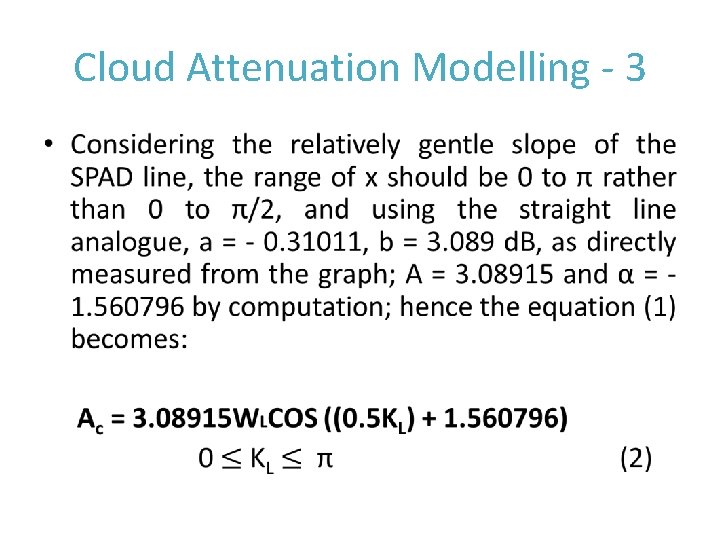
Cloud Attenuation Modelling - 3 •
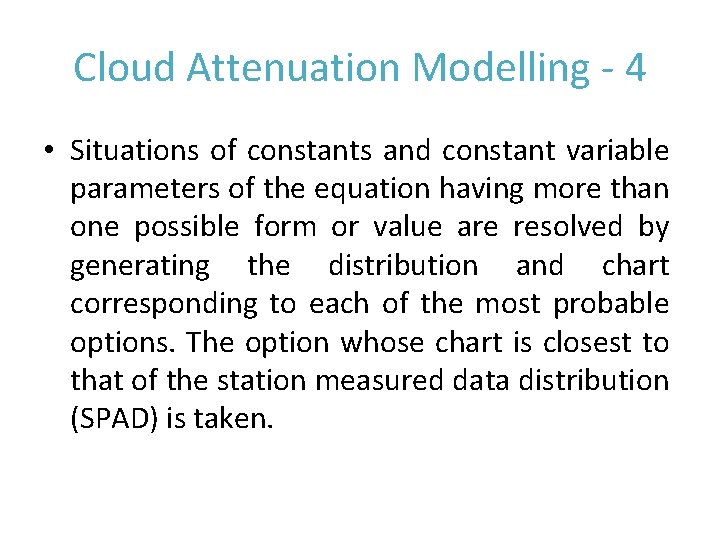
Cloud Attenuation Modelling - 4 • Situations of constants and constant variable parameters of the equation having more than one possible form or value are resolved by generating the distribution and chart corresponding to each of the most probable options. The option whose chart is closest to that of the station measured data distribution (SPAD) is taken.
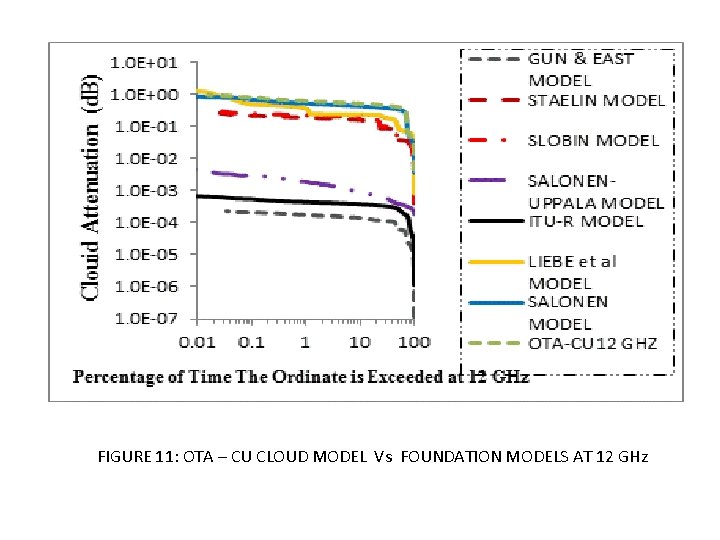
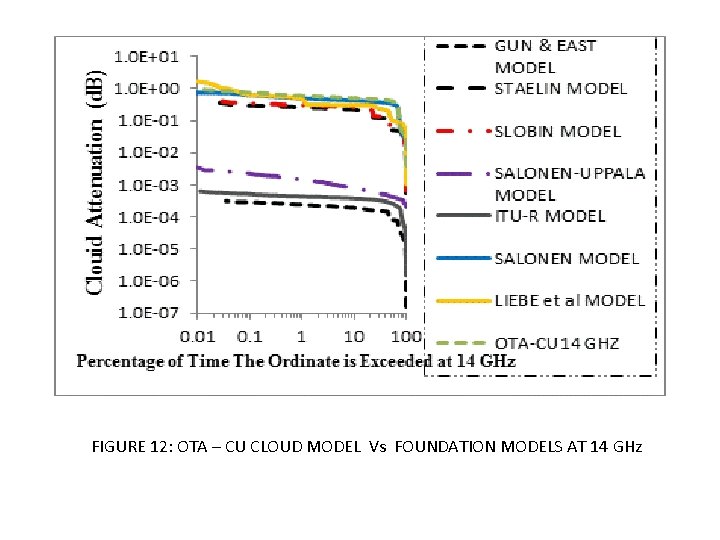
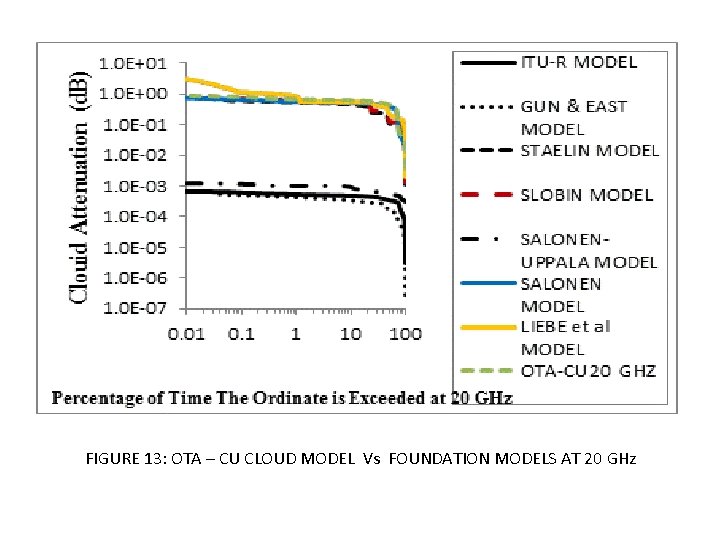
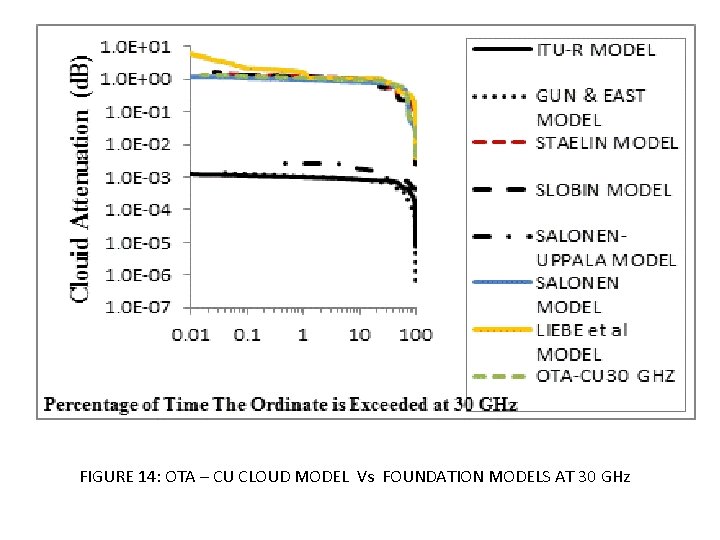
Cloud Attenuation Modelling - 5 • Then the proposed model i. e. equation (2) is tested by comparing its performance with those of the standard cloud models at the station as shown in Figures 10 – 14.
Figure 10: Cloud Attenuation Models Distribution Curves at 12. 5 GHz
FIGURE 11: OTA – CU CLOUD MODEL Vs FOUNDATION MODELS AT 12 GHz
FIGURE 12: OTA – CU CLOUD MODEL Vs FOUNDATION MODELS AT 14 GHz
FIGURE 13: OTA – CU CLOUD MODEL Vs FOUNDATION MODELS AT 20 GHz
FIGURE 14: OTA – CU CLOUD MODEL Vs FOUNDATION MODELS AT 30 GHz
Cloud Attenuation Modelling - 6 • Hence equation (2) represents the cloud attenuation model for the station having shown considerable geometric pattern agreement with the foundation models at various frequencies.
Future Work § Radiometric measurements, cloud visual data and climatological data acquisition need to start and continue in every climatic zone of Nigeria, i. e. about every state of the federation, particularly in high tele-density areas as Lagos state, to enable development of relevant hydrometeors’ models and corresponding cloud attenuation statistics. § However, a single global satellite based climatic model is desirable, where modular algorithm would be used to integrate the various climatic zones models.
References [1] [2] [3] [4] [5] [6] Das S, Chakraborty S and Maitra A, (2013): Radiometric measurements of cloud attenuation at a tropical location in India; Journal of Atmospheric and Solar-Terrestrial Physics, (105 -106): 97 -100. Eva R I, Gustavo A S, Jose M R, and Pedro G P, (2015): Atmospheric Attenuation in Wireless Communication Systems at Millimeter and THz Frequencies; IEE Antenna and Propagation Magazine, 57 (1): 4861. Omotosho T V, Mandeep J S and Mardina A, (2013): Cloud Attenuation Studies of the Six Major Climatic Zones of Africa for Ka and V Satellite System Design; Annals of Geophysics; 56 (6): 1 -2. Gerace G C and Smith E K, (1990): A Comparison of Cloud Models; IEEE Antennas and Propagation Magazine. Warren, S. G. and Hahn, C. J. (2002): Climatology; Encyclopedia of Atmospheric Sciences, Academic Press. Salonen, E. and Uppala, S. (1991): New prediction method of cloud attenuation; Electron, Lett 27, 1106 -1108.
THANKS