
Cloud Adoption Framework for Azure Governance Agenda Governance




- Slides: 33
Cloud Adoption Framework for Azure Governance
Agenda Governance methodology overview Governance as actionable model Defining your initial governance state Take action Resources
Principle of governance = Achieve balance. Deliver modernization. Control & Stability Align business, people and technology strategy. Achieve business goals with actionable, efficient, and comprehensive guidance. Deliver fast results with control and stability. Speed & Results
Why is governance important? Who is responsible for monitoring? support? And operations? Transformation Risk mitigation Which services should be migrated to Azure? What roles & responsibilities must be defined? What security measures should I consider? What are the core processes needed for service management? • Maintaining full compliance • Creating better cost visibility and control • Improving security posture • Being agile—to support scale How do I ensure a balance between innovation, cost and agility? What organizational changes are needed? What key capabilities I must develop? Azure governance building blocks?
Governance methodology overview
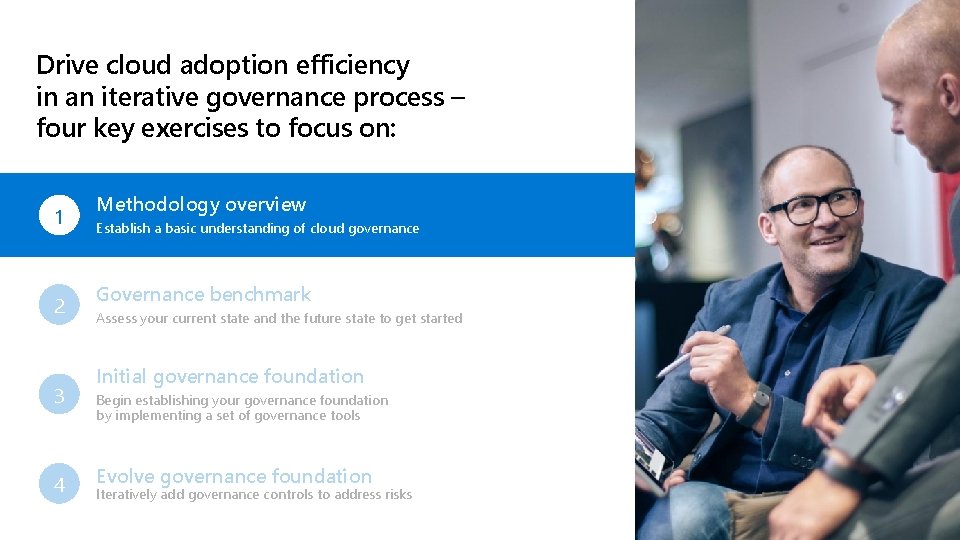
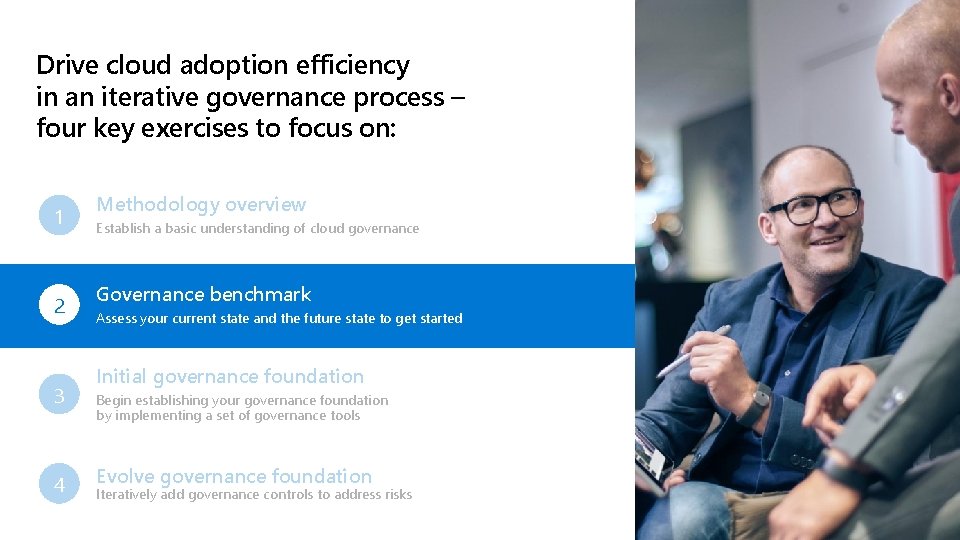
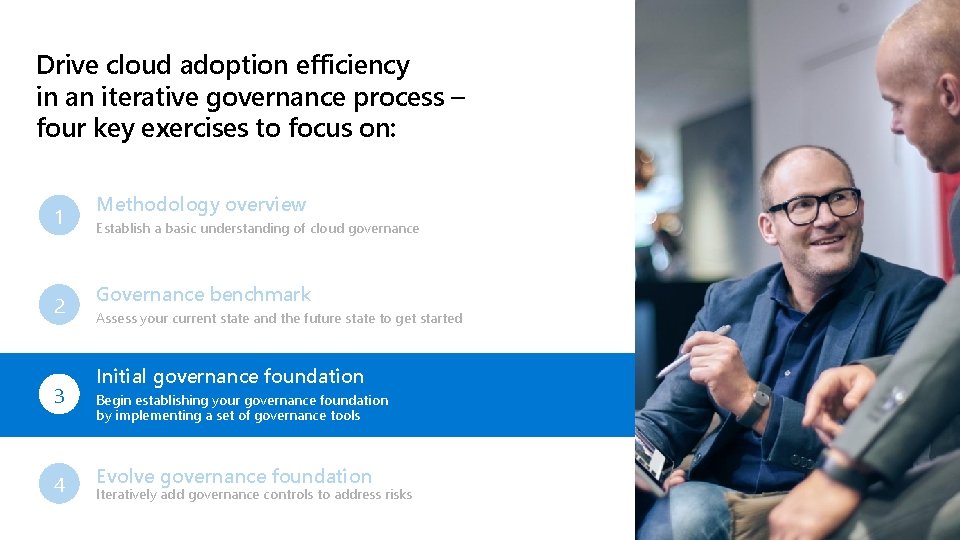
Drive cloud adoption efficiency in an iterative governance process – four key exercises to focus on: 1 2 3 4 Methodology overview Establish a basic understanding of cloud governance Governance benchmark Assess your current state and the future state to get started Initial governance foundation Begin establishing your governance foundation by implementing a set of governance tools Evolve governance foundation Iteratively add governance controls to address risks
Governance methodology Envision an end state – and incrementally build trust and confidence. Govern Define corporate policy Business risks Policy & compliance Process Document evolving business risks and the business’ tolerance for risk, based on data classification and application criticality Convert risk decisions into policy statements to establish cloud adoption boundaries Establish processes to monitor violations and adherence to corporate policies. Five disciplines of cloud governance Cost management Security baseline Resource consistency Identity baseline Deployment acceleration Evaluate & monitor costs, limit IT spend, scale to meet need, create cost accountability Ensure compliance with IT security requirements by applying a security baseline to all adoption efforts Ensure consistency in resource configuration. Enforce practices for on-boarding, recovery, and discoverability Ensure the baseline for identity and access are enforced by consistently applying role definitions and assignments Accelerate deployment through centralization, consistency, and standardization across deployment templates Governance funnels corporate policy changes into five actionable disciplines – enabling your organization to modernize and reach business goals. https: //aka. ms/adopt/Gov
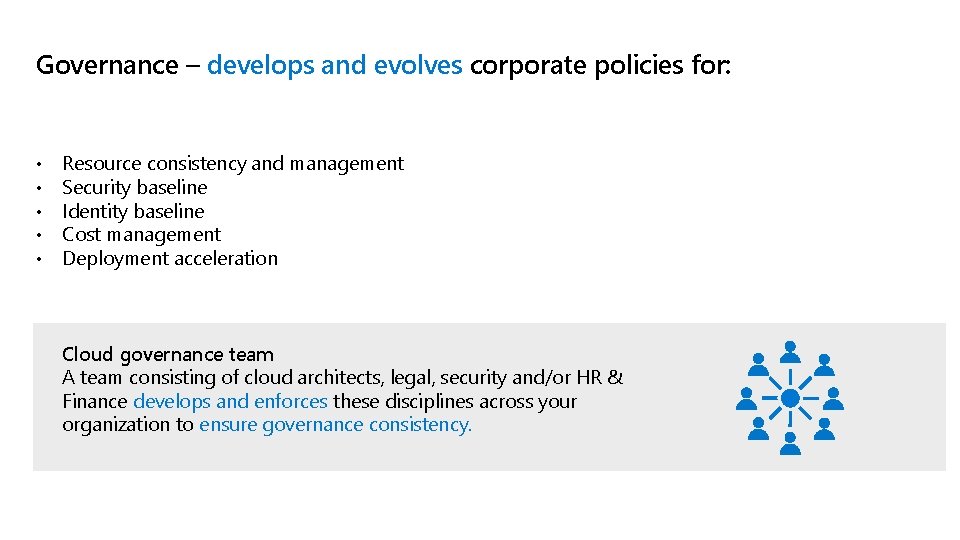
Governance – develops and evolves corporate policies for: • • • Resource consistency and management Security baseline Identity baseline Cost management Deployment acceleration Cloud governance team A team consisting of cloud architects, legal, security and/or HR & Finance develops and enforces these disciplines across your organization to ensure governance consistency.
Cloud governance team
Cloud governance team A cloud governance team evaluates and manages risk tolerance, identifies high-risk areas for business, and converts risks into governing corporate policies. Determine necessity of cloud governance team. Align with other teams to: Cloud governance team functions • Review your company's strategy and plan template with members of the cloud strategy team to understand motivations, metrics, and strategy. • Review your company's cloud adoption plan template with members of the cloud adoption team to understand timelines and prioritization. • Review the operation team's operations management workbook to understand the operational requirements and commitments that have been established with the business. Establish cadence with teams that aligns with: • Release and planning cycles. • The cloud strategy team to review risks of the next wave of adoption and gauge the team's level of tolerance for risks. • Review and iterate. Ensures cloud-adoption risks and risk tolerance are properly evaluated and managed. Identifies risks that can't be tolerated by the business, and it converts risks into governing corporate policies.
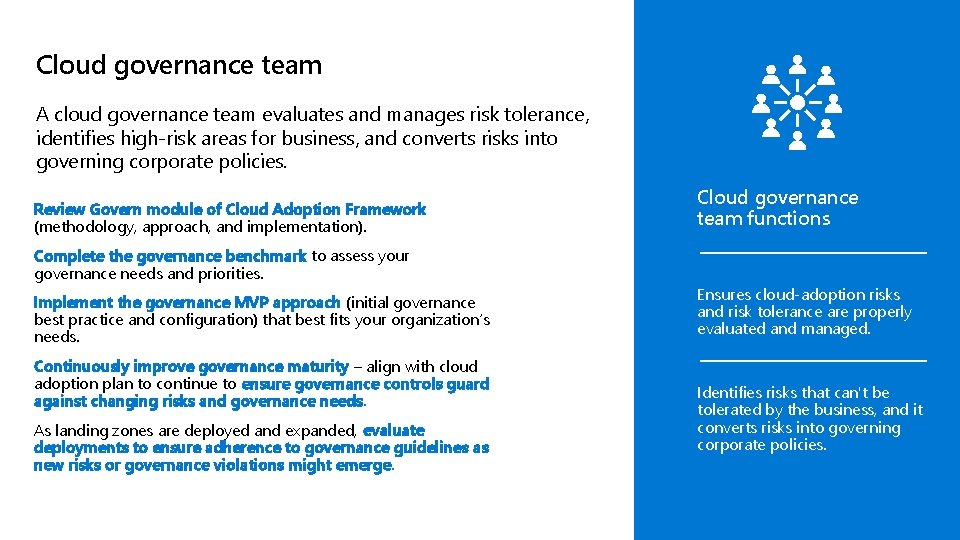
Cloud governance team A cloud governance team evaluates and manages risk tolerance, identifies high-risk areas for business, and converts risks into governing corporate policies. Review Govern module of Cloud Adoption Framework (methodology, approach, and implementation). Complete the governance benchmark to assess your governance needs and priorities. Implement the governance MVP approach (initial governance best practice and configuration) that best fits your organization’s needs. Continuously improve governance maturity – align with cloud adoption plan to continue to ensure governance controls guard against changing risks and governance needs. As landing zones are deployed and expanded, evaluate deployments to ensure adherence to governance guidelines as new risks or governance violations might emerge. Cloud governance team functions Ensures cloud-adoption risks and risk tolerance are properly evaluated and managed. Identifies risks that can't be tolerated by the business, and it converts risks into governing corporate policies.
Governance as actionable model
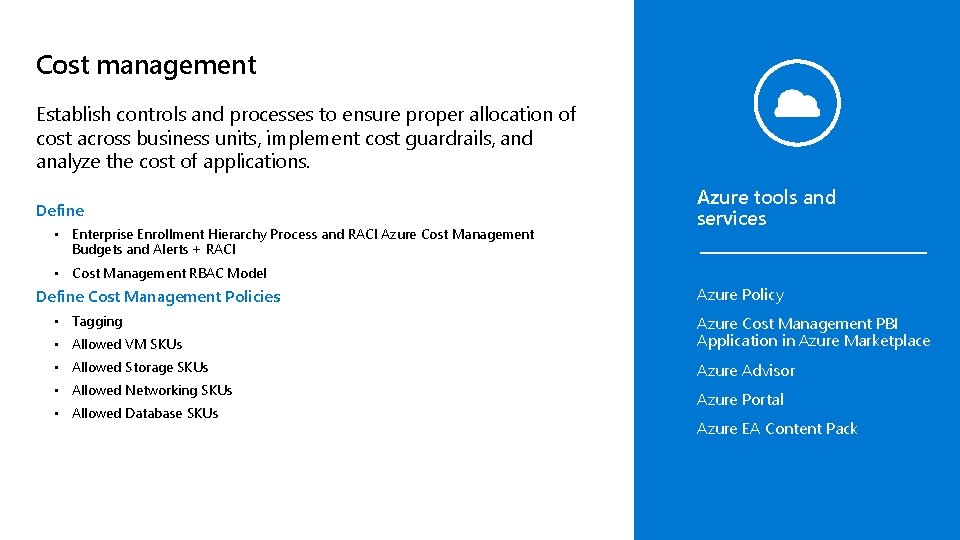
Cost management Establish controls and processes to ensure proper allocation of cost across business units, implement cost guardrails, and analyze the cost of applications. Define • Enterprise Enrollment Hierarchy Process and RACI Azure Cost Management Budgets and Alerts + RACI Azure tools and services • Cost Management RBAC Model Define Cost Management Policies • Tagging Azure Policy • Allowed VM SKUs Azure Cost Management PBI Application in Azure Marketplace • Allowed Storage SKUs Azure Advisor • Allowed Networking SKUs • Allowed Database SKUs Azure Portal Azure EA Content Pack
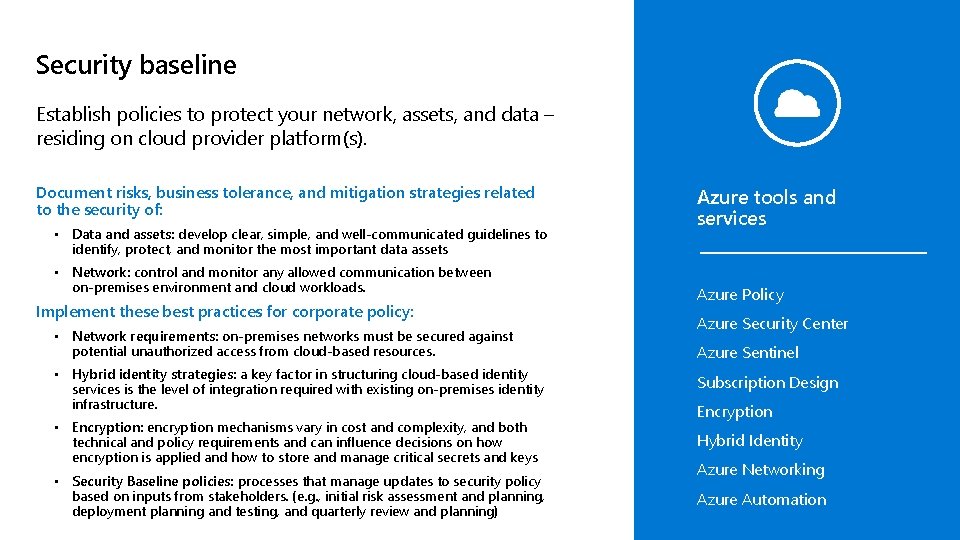
Security baseline Establish policies to protect your network, assets, and data – residing on cloud provider platform(s). Document risks, business tolerance, and mitigation strategies related to the security of: • Data and assets: develop clear, simple, and well-communicated guidelines to identify, protect, and monitor the most important data assets • Network: control and monitor any allowed communication between on-premises environment and cloud workloads. Implement these best practices for corporate policy: • Network requirements: on-premises networks must be secured against potential unauthorized access from cloud-based resources. Azure tools and services Azure Policy Azure Security Center Azure Sentinel • Hybrid identity strategies: a key factor in structuring cloud-based identity services is the level of integration required with existing on-premises identity infrastructure. Subscription Design • Encryption: encryption mechanisms vary in cost and complexity, and both technical and policy requirements and can influence decisions on how encryption is applied and how to store and manage critical secrets and keys Hybrid Identity • Security Baseline policies: processes that manage updates to security policy based on inputs from stakeholders. (e. g. , initial risk assessment and planning, deployment planning and testing, and quarterly review and planning) Encryption Azure Networking Azure Automation
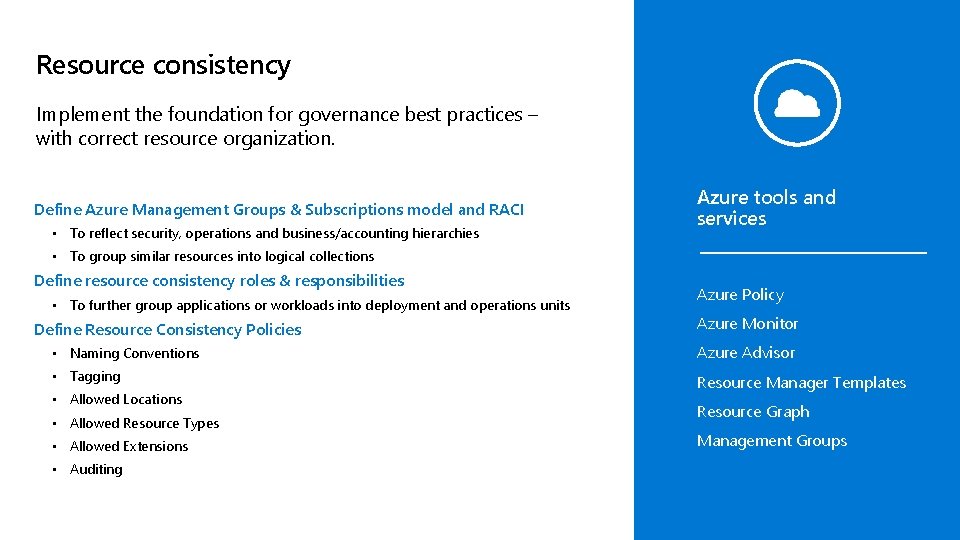
Resource consistency Implement the foundation for governance best practices – with correct resource organization. Define Azure Management Groups & Subscriptions model and RACI • To reflect security, operations and business/accounting hierarchies Azure tools and services • To group similar resources into logical collections Define resource consistency roles & responsibilities • To further group applications or workloads into deployment and operations units Define Resource Consistency Policies Azure Policy Azure Monitor • Naming Conventions Azure Advisor • Tagging Resource Manager Templates • Allowed Locations • Allowed Resource Types • Allowed Extensions • Auditing Resource Graph Management Groups
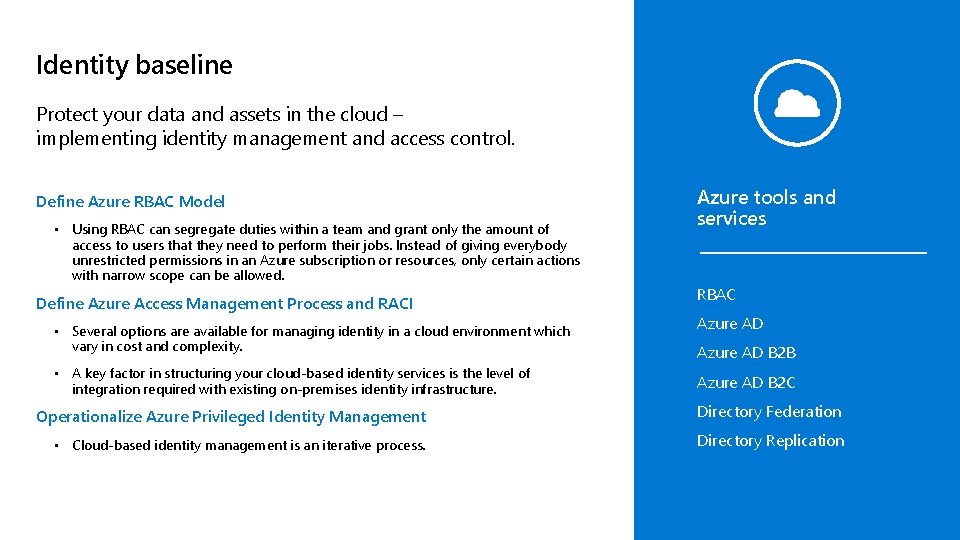
Identity baseline Protect your data and assets in the cloud – implementing identity management and access control. Define Azure RBAC Model • Using RBAC can segregate duties within a team and grant only the amount of access to users that they need to perform their jobs. Instead of giving everybody unrestricted permissions in an Azure subscription or resources, only certain actions with narrow scope can be allowed. Define Azure Access Management Process and RACI • Several options are available for managing identity in a cloud environment which vary in cost and complexity. • A key factor in structuring your cloud-based identity services is the level of integration required with existing on-premises identity infrastructure. Azure tools and services RBAC Azure AD B 2 B Azure AD B 2 C Operationalize Azure Privileged Identity Management Directory Federation • Cloud-based identity management is an iterative process. Directory Replication
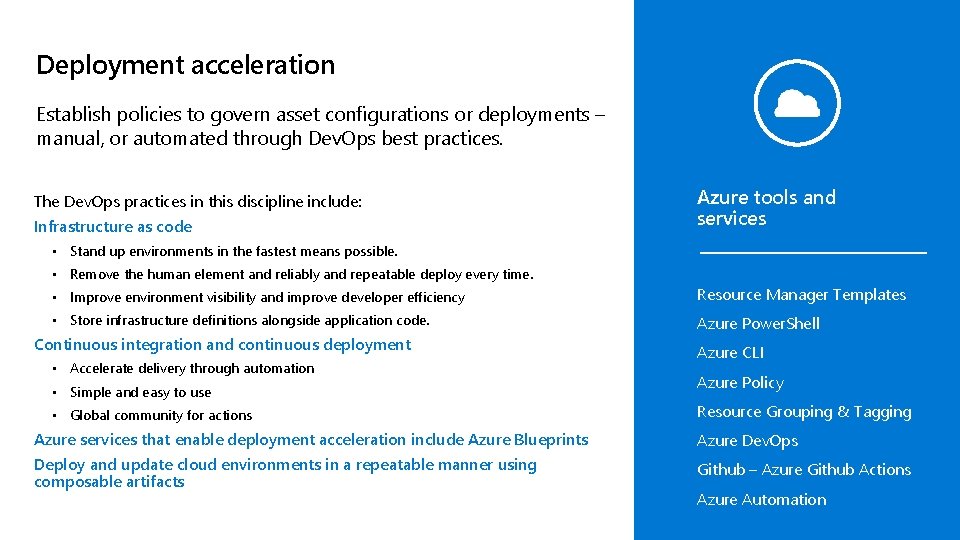
Deployment acceleration Establish policies to govern asset configurations or deployments – manual, or automated through Dev. Ops best practices. The Dev. Ops practices in this discipline include: Infrastructure as code Azure tools and services • Stand up environments in the fastest means possible. • Remove the human element and reliably and repeatable deploy every time. • Improve environment visibility and improve developer efficiency Resource Manager Templates • Store infrastructure definitions alongside application code. Azure Power. Shell Continuous integration and continuous deployment • Accelerate delivery through automation • Simple and easy to use • Global community for actions Azure CLI Azure Policy Resource Grouping & Tagging Azure services that enable deployment acceleration include Azure Blueprints Azure Dev. Ops Deploy and update cloud environments in a repeatable manner using composable artifacts Github – Azure Github Actions Azure Automation
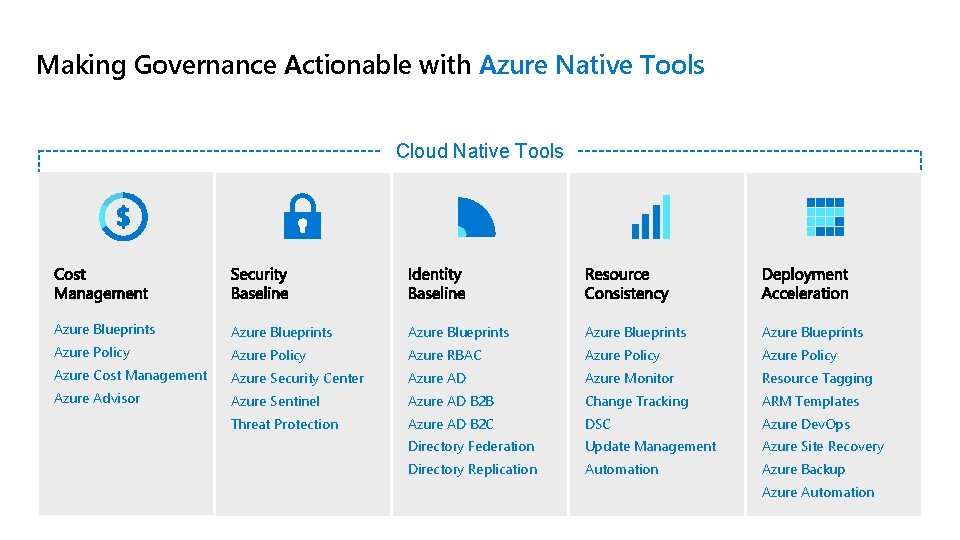
Making Governance Actionable with Azure Native Tools Cloud Native Tools Azure Blueprints Azure Blueprints Azure Policy Azure RBAC Azure Policy Azure Cost Management Azure Security Center Azure AD Azure Monitor Resource Tagging Azure Advisor Azure Sentinel Azure AD B 2 B Change Tracking ARM Templates Threat Protection Azure AD B 2 C DSC Azure Dev. Ops Directory Federation Update Management Azure Site Recovery Directory Replication Automation Azure Backup Azure Automation
Define your initial governance state – leverage the Governance benchmark assessment
Drive cloud adoption efficiency in an iterative governance process – four key exercises to focus on: 1 2 3 4 Methodology overview Establish a basic understanding of cloud governance Governance benchmark Assess your current state and the future state to get started Initial governance foundation Begin establishing your governance foundation by implementing a set of governance tools Evolve governance foundation Iteratively add governance controls to address risks
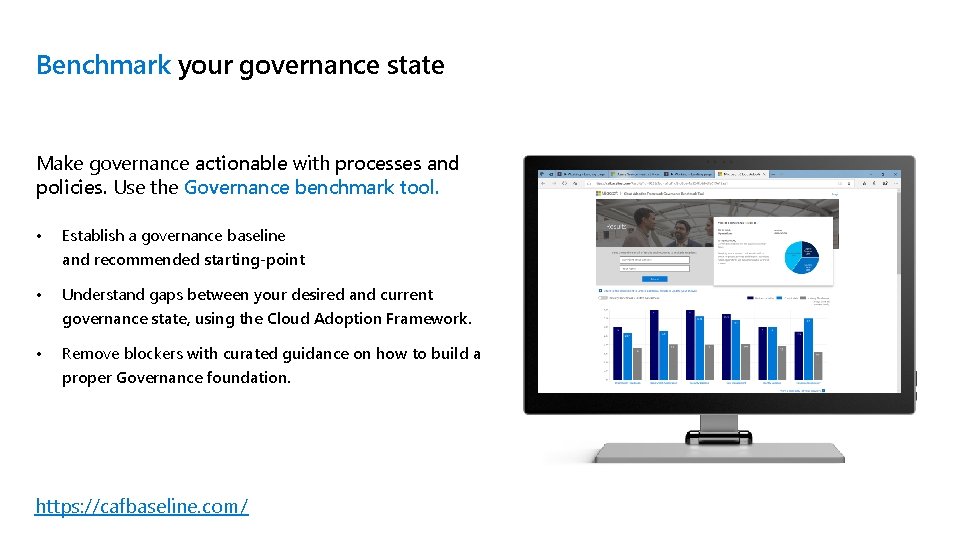
Benchmark your governance state Make governance actionable with processes and policies. Use the Governance benchmark tool. • Establish a governance baseline and recommended starting-point • Understand gaps between your desired and current governance state, using the Cloud Adoption Framework. • Remove blockers with curated guidance on how to build a proper Governance foundation. https: //cafbaseline. com/
Take action and set up your initial governance foundation
Drive cloud adoption efficiency in an iterative governance process – four key exercises to focus on: 1 2 3 4 Methodology overview Establish a basic understanding of cloud governance Governance benchmark Assess your current state and the future state to get started Initial governance foundation Begin establishing your governance foundation by implementing a set of governance tools Evolve governance foundation Iteratively add governance controls to address risks
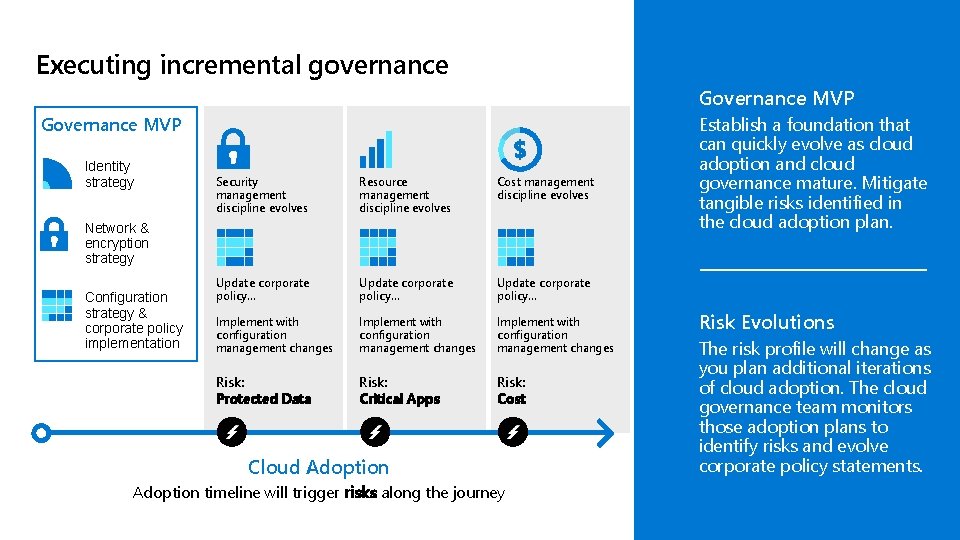
Executing incremental governance Governance MVP Identity strategy Security management discipline evolves Resource management discipline evolves Cost management discipline evolves Update corporate policy… Implement with configuration management changes Risk: Protected Data Risk: Critical Apps Risk: Cost Network & encryption strategy Configuration strategy & corporate policy implementation Cloud Adoption timeline will trigger risks along the journey Establish a foundation that can quickly evolve as cloud adoption and cloud governance mature. Mitigate tangible risks identified in the cloud adoption plan. Risk Evolutions The risk profile will change as you plan additional iterations of cloud adoption. The cloud governance team monitors those adoption plans to identify risks and evolve corporate policy statements.
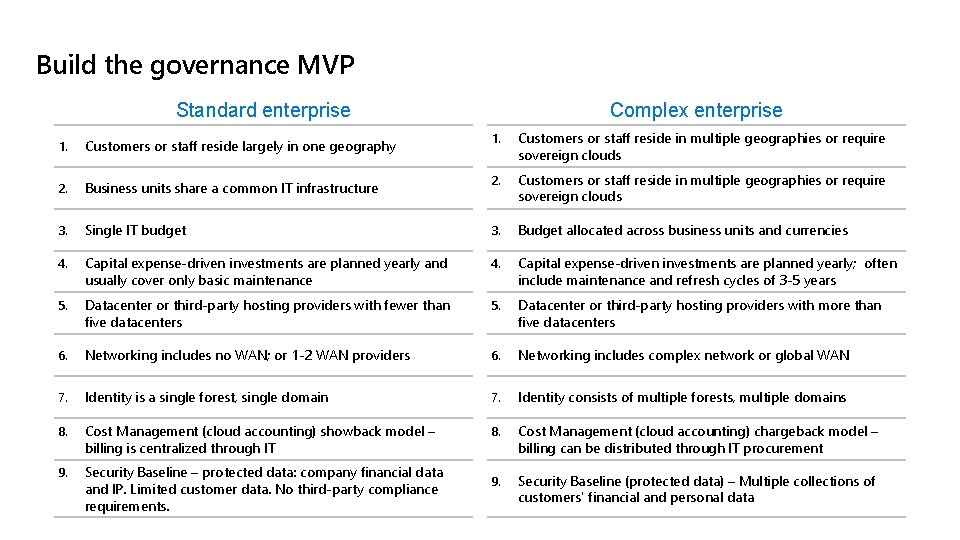
Build the governance MVP Standard enterprise Complex enterprise 1. Customers or staff reside in multiple geographies or require sovereign clouds 2. Customers or staff reside in multiple geographies or require sovereign clouds Single IT budget 3. Budget allocated across business units and currencies 4. Capital expense-driven investments are planned yearly and usually cover only basic maintenance 4. Capital expense-driven investments are planned yearly; often include maintenance and refresh cycles of 3 -5 years 5. Datacenter or third-party hosting providers with fewer than five datacenters 5. Datacenter or third-party hosting providers with more than five datacenters 6. Networking includes no WAN; or 1 -2 WAN providers 6. Networking includes complex network or global WAN 7. Identity is a single forest, single domain 7. Identity consists of multiple forests, multiple domains 8. Cost Management (cloud accounting) showback model – billing is centralized through IT 8. Cost Management (cloud accounting) chargeback model – billing can be distributed through IT procurement 9. Security Baseline – protected data: company financial data and IP. Limited customer data. No third-party compliance requirements. 9. Security Baseline (protected data) – Multiple collections of customers' financial and personal data 1. Customers or staff reside largely in one geography 2. Business units share a common IT infrastructure 3.
Resources Learn more about the Microsoft Cloud Adoption Framework and cloud management. Microsoft Cloud Adoption Framework for Azure: Documentation https: //docs. microsoft. com/azure/cloud-adoption-framework/ Governance in the Cloud Adoption Framework https: //docs. microsoft. com/en-us/azure/cloud-adoption-framework/govern/methodology Governance benchmark assessment aka. ms/adopt/assess/govern Azure Enablement show | Governance assessment video Microsoft learn Governance module | http: //aka. ms/adopt/learn/govern
Thank you
Appendix
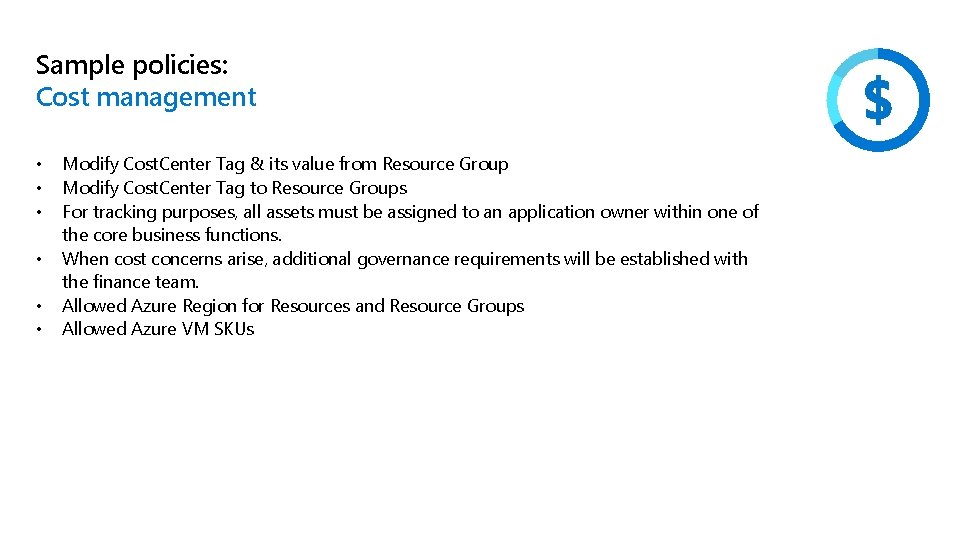
Sample policies: Cost management • • • Modify Cost. Center Tag & its value from Resource Group Modify Cost. Center Tag to Resource Groups For tracking purposes, all assets must be assigned to an application owner within one of the core business functions. When cost concerns arise, additional governance requirements will be established with the finance team. Allowed Azure Region for Resources and Resource Groups Allowed Azure VM SKUs
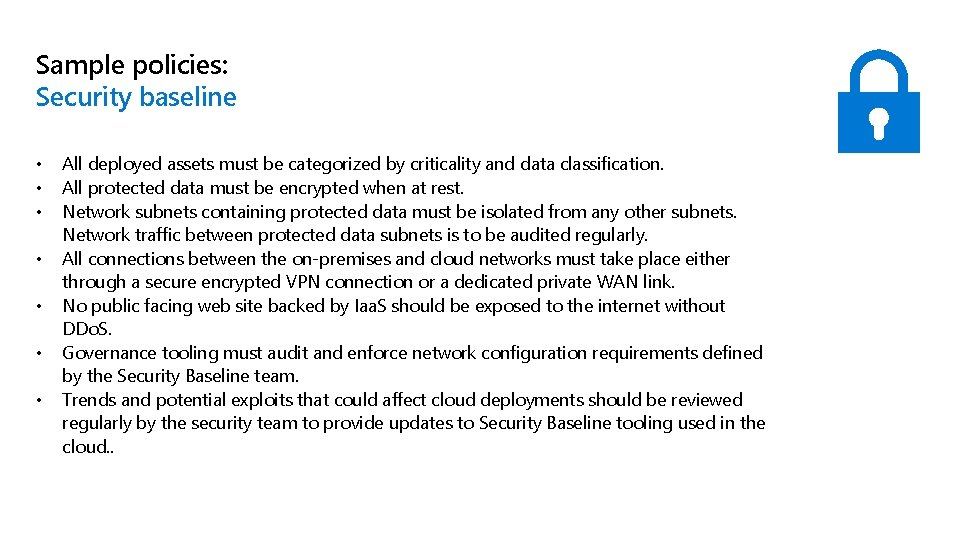
Sample policies: Security baseline • • All deployed assets must be categorized by criticality and data classification. All protected data must be encrypted when at rest. Network subnets containing protected data must be isolated from any other subnets. Network traffic between protected data subnets is to be audited regularly. All connections between the on-premises and cloud networks must take place either through a secure encrypted VPN connection or a dedicated private WAN link. No public facing web site backed by Iaa. S should be exposed to the internet without DDo. S. Governance tooling must audit and enforce network configuration requirements defined by the Security Baseline team. Trends and potential exploits that could affect cloud deployments should be reviewed regularly by the security team to provide updates to Security Baseline tooling used in the cloud. .
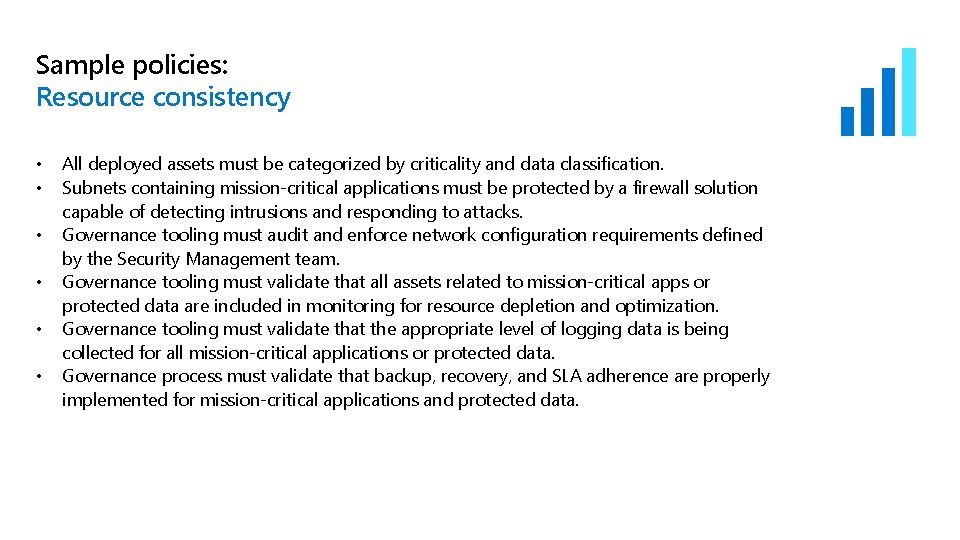
Sample policies: Resource consistency • • • All deployed assets must be categorized by criticality and data classification. Subnets containing mission-critical applications must be protected by a firewall solution capable of detecting intrusions and responding to attacks. Governance tooling must audit and enforce network configuration requirements defined by the Security Management team. Governance tooling must validate that all assets related to mission-critical apps or protected data are included in monitoring for resource depletion and optimization. Governance tooling must validate that the appropriate level of logging data is being collected for all mission-critical applications or protected data. Governance process must validate that backup, recovery, and SLA adherence are properly implemented for mission-critical applications and protected data.
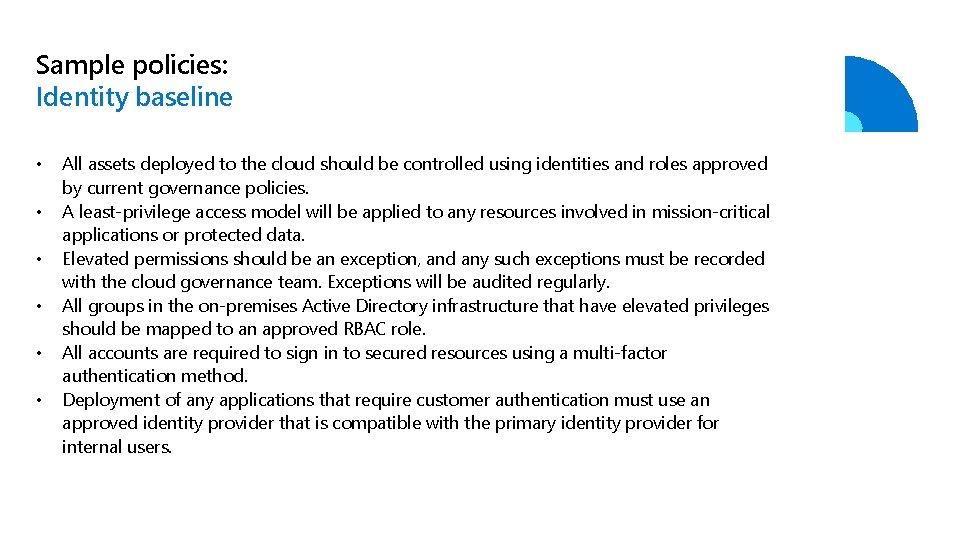
Sample policies: Identity baseline • • • All assets deployed to the cloud should be controlled using identities and roles approved by current governance policies. A least-privilege access model will be applied to any resources involved in mission-critical applications or protected data. Elevated permissions should be an exception, and any such exceptions must be recorded with the cloud governance team. Exceptions will be audited regularly. All groups in the on-premises Active Directory infrastructure that have elevated privileges should be mapped to an approved RBAC role. All accounts are required to sign in to secured resources using a multi-factor authentication method. Deployment of any applications that require customer authentication must use an approved identity provider that is compatible with the primary identity provider for internal users.
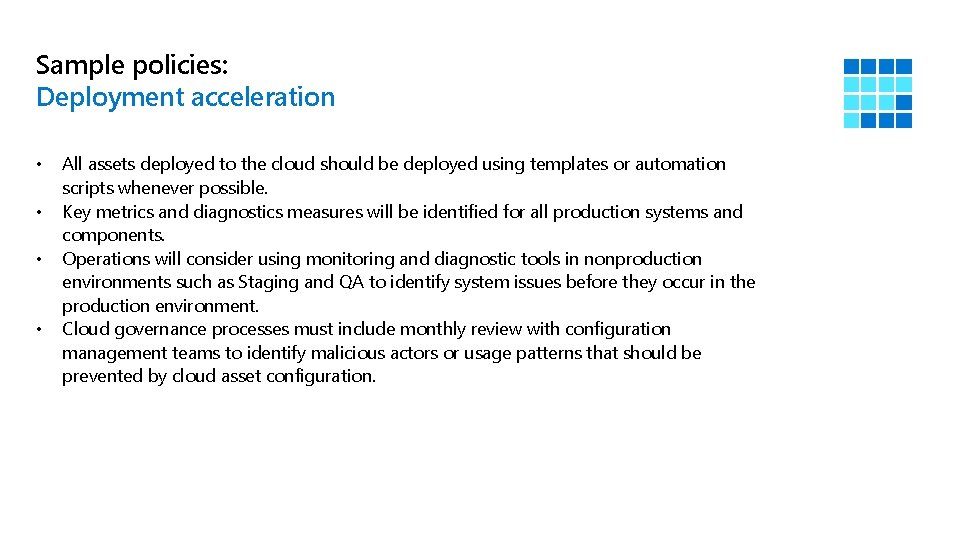
Sample policies: Deployment acceleration • • All assets deployed to the cloud should be deployed using templates or automation scripts whenever possible. Key metrics and diagnostics measures will be identified for all production systems and components. Operations will consider using monitoring and diagnostic tools in nonproduction environments such as Staging and QA to identify system issues before they occur in the production environment. Cloud governance processes must include monthly review with configuration management teams to identify malicious actors or usage patterns that should be prevented by cloud asset configuration.