
Clothes Make the Man Do clothes make the

- Slides: 68
Clothes Make the Man
Do clothes make the man or not? The tailor makes the man. n 人靠衣装, 佛靠金装。 n Fine feathers make fine birds. n 人在衣衫马在鞍。 n Manners make the man. n 初次见面, 仪表取人。 n
Never judge by appearance. n 不要以貌取人。 n The cowl does not make the monk. n 穿袈裟的不一定就是和尚;人不可貌相。 n Don’t judge a book by its cover. n 不要以书的封皮判断书的内容,勿以貌取 人。 n Things are seldom what they seem. n All that glitters is not gold. n
Meaning of the title: One become what he wears/ what we defines us as people.
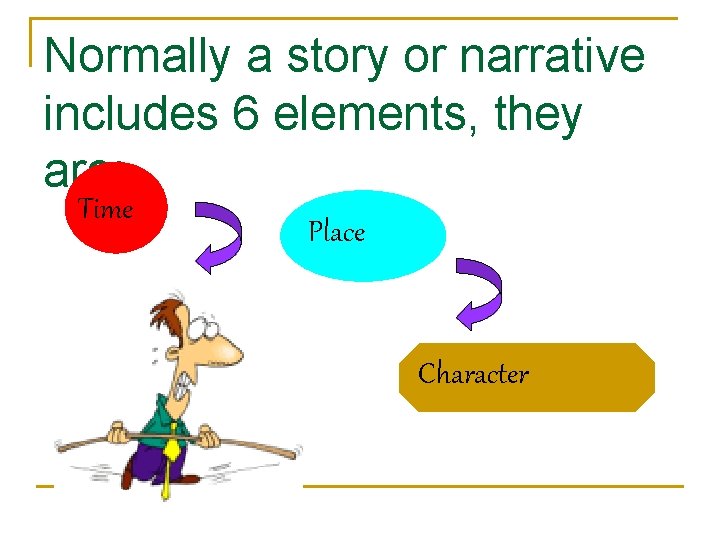
Normally a story or narrative includes 6 elements, they are: Time Place Character
Beginning process ending
In what order is the story developed? 1. When, once, at the same time, now, while, then, before, after, next, all the time, suddenly, soon; 2. To the street, down the sidewalk, at the corner, halfway down the block
In temporal and spatial order. The story took place in 6 scenes, in each scene, Tango’s feelings change dramatically, try to find those expressions.
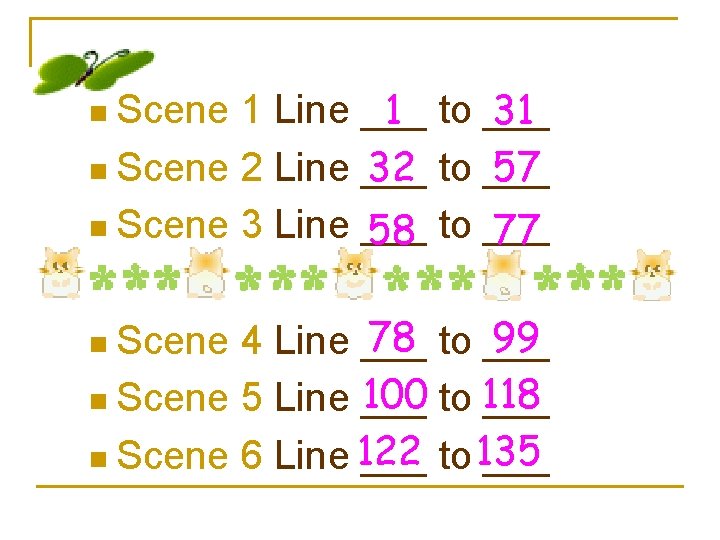
1 Line ___ 1 to ___ 31 n Scene 2 Line ___ 32 to ___ 57 n Scene 3 Line ___ 58 to ___ 77 n Scene 78 to ___ 99 4 Line ___ 100 to 118 n Scene 5 Line ___ n Scene 6 Line 122 ___ to 135 ___ n Scene
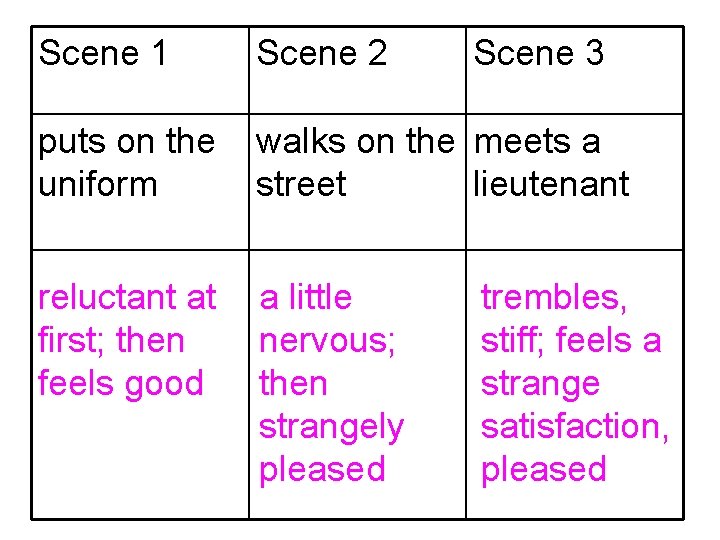
Scene 1 Scene 2 Scene 3 puts on the uniform walks on the meets a street lieutenant reluctant at first; then feels good a little nervous; then strangely pleased trembles, stiff; feels a strange satisfaction, pleased
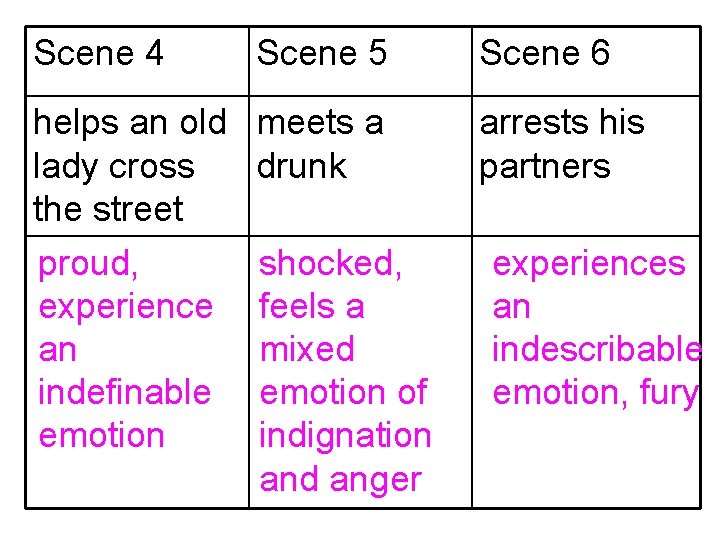
Scene 4 Scene 5 Scene 6 helps an old lady cross the street proud, experience an indefinable emotion meets a drunk arrests his partners shocked, feels a mixed emotion of indignation and anger experiences an indescribable emotion, fury
I don't like it, " Tango complained again. "I won't feel right, walking up and down in that. " "Shut up and put it on, " Mireault told him, and so, of course, Tango obeyed. Mireault was half his size but he was clever. If Tango had a tail, he would have put it between his legs when Mireault spoke.
L 5 If…had done…, …would have done… Subjunctive mood. Q: With such a description what would make you think of? What is the relationship between Tango and Mireault?
"Now, see? " Mireault said. "What did I tell you? It looks good, doesn't it? See, you've even got a whistle. ” L 7 -8 1 st “see”: understand. 2 nd “see”: look
"Not bad, " Tango had to admit, looking at himself in the mirror. He pushed out his mighty chest and threw back his broad shoulders. L 10 push out: 把. . . 推出去, (使)突出 throw back扔回, 阻止, 反射
Even the Eel, the quick silent one who was Mireault's working partner and who rarely opened his mouth, was stirred to speech. "Boy, ain't he handsome!" he said. L 11 quick: moving fast silent: speaking very little, not talking much
L 13 ain’t= am not, is not, are not, have not, has not (infml use) Ex: I am your friend, _______ ? aren’t I ain’t I am I not
There was no doubt about it, Tango was an impressive sight. The policeman's uniform might have been cut to his measure by the best tailor in Paris. His little eyes looked brighter beneath the visor of the cap; they almost looked intelligent.
L 14 a sight: (colloq) persons or things that excite ridicule or unfavorable comment What a sight she looks in that old dress. ( 怪里怪气) How to translate the underlined sentence? Tango was an impressive sight.
L 15 might have been cut to his measure Subjunctive mood.
"Stop staring at yourself and wipe that stupid grin off your face, "Mireault said impatiently, "and listen. This is so simple a half-wit could do it, so maybe if you try hard you can too. “ L 18 wipe…off: remove, get rid of Stop grinning stupidly.
With regret Tango turned away from the mirror. His broad forehead wrinkled in the painful expression that meant he was concentrating. The words can show that how much Tango was attracted by himself in the mirror. Q: Why did Tango feel painful?
"All you do is walk up and down the street, " Mireault said. "Easy and slow, like a real cop on his beat. Then if anyone hears us working in the house they won't get suspicious, seeing you. Keep walking until we come out, then hang around a few minutes until we're out of sight.
L 24“All you do is walk up and down the street, ” Bare infinitive. e. g. I can do nothing but wait. I have no choice but to wait. L 27 hang around/about: to wait or stay near or (in) a place often without purpose or activity.
That's all there is to it. We'll meet back here. Now do you understand? " "Sure, " Tango said, his eyes wandering to the mirror. "Then get going!" Mireault said sharply. L 28 Q: What’s the meaning of this sentence? That’s all that you have to do. / There is nothing else.
his eyes wandering to the mirror Absolute construction. n. + participle He lay on his back, his hands crossed under his head. n. + adj. He entered the room, his nose red with cold. n. +infinitive Here are the first volumes, the third one to come out next month.
n. +prep. phrase After killing the enemies, the two soldiers ran away, rifle in hand. n. + adv. He put on his socks, wrong side out. Find other examples of absolute construction in the text.
L 31 get going: get moving /started (infml) (cause to) begin to be active, working Let’s get going, or we’ll be late. It is difficult to get the car going on a cold morning. Getting a business going in these hard times is almost impossible.
Q: What kind of work would they be doing there? What kind of job would Tango do? They were going to steal from the house. Tango was persuaded to disguise himself as a policeman and stand guard while his partners were committing the robbery.
Tango was a little nervous walking to the street that Mireault and the Eel had picked out, but nothing happened. It was a prosperous section and in the dim glow of the street lights Tango could see what handsome houses they were, solemn, solid, well cared for. The house where the job was to be pulled was in the middle of the block, behind a garden wall.
L 35 pull: (sl) perform The house they were going to rob was in the middle of the block.
Mireault and the Eel had cased it thoroughly; 保险箱 there was an old-fashioned wall safe upstairs with a very comfortable load inside. Apparently the Family didn't believe in banks. Maybe they would, Mireault had said, after tonight. L 38 case: (sl) examine it carefully. Find the jargon in Chinese.
Paraphrase “with a comfortable load inside” L 39 With a lot of treasure, money… in it
Tango wondered what it would be like to live in so fine a house, but the effort of imagination was beyond him. He had seldom seen a street slumone. He worked in the such. L 45 as this poor quarters of Paris--a little pursesnatching, a little shoplifting; he even panhandled. Yes, he was good at panhandling. L 45 Pay attention to the function of these 3
L 43 beyond: to a degree that is past the understanding, reach, or scope of: 超出(理解、范围、眼界)之上 • an evil beyond remedy • This work is beyond my grasp. • Understanding this article is beyond my capacity. • It's quite beyond me why she married such a heavy smoker.
L 47 Paybusinessmen money immediately Timid usually came right across when Tango's huge shoulders towered over them; they looked fearfully at the massive hands and reached into their pockets for whatever change they had. Translate sentence in the bracket, and focus on the word “tower”.
He walked unhurriedly down the sidewalk, turned at the corner and came back. Halfway, he saw the two shadowy figures slip over the garden wall and disappear. Mireault and the Eel were at work.
Tango fell to thinking of how he had looked in the mirror. With the impressive image vivid in his mind he straightened his shoulders and threw out his chest again. Standing L 55 Push erect, he tried a salute. It felt good. He grinned, strangely pleased, and walked on. L 57 What does “it” mean? Next
L 54 fall to sth. /doing sth. : begin They fell to work. fall to sb. : to be the (esp. unpleasant) duty of It fell to me to bring the bad news to her.
L 55 With the impressive image vivid in his mind… Absolute construction. “With”和一复合结构构成状语 He was sitting in a chair with his hands folded.
It was while he was turning at the other comer that he saw the police lieutenant. Such a sight was usually enough to send him travelling as rapidly as his feet would move. He stared in horror. He imagined that the lieutenant, approaching, was gazing at him curiously.
L 60 send…doing…: use force to cause sb. or sth. move sharply or rapidly Mind how you go—you nearly sent me flying.
Tango's body was rigid; his palms were sweating. With a tremendous description effort he restrained the wild impulse to rush away. He trembled. Then, stiffly, with the lieutenant no more than a few feet from him, he raised his arm and saluted. The lieutenant casually returned the salute and passed by. L 67 return one’s call return one’s favor
Tango stood looking after him. After a moment he felt a strange satisfaction. "Say!" he said to himself. "Say, did you see that? I salute, and he salutes right back. Say, that— that's pretty fine!" It was extraordinary, the pleasure it gave him. He threw back his description shoulders straighter than ever and, erect and proud, walked down sidewalk. L 73 the Adverbial of manner
At the comer he paused and rocked on his heels a moment as all policemen do. "I guess I looked good to him, " he told himself. "I guess he doesn't see many cops who look so good. " L 74 Explain this sentence. “swayed regularly back and forth一会 踮
L 78几趟 After a few more trips, he found an old lady hesitating on the comer. He saw her make two or three false starts to get across and each time nervously come back. L 79 Paraphrase this sentence. The old lady had tried to get across the road
Tango did not even notice the fatlooking purse in her hand! He stopped in front of her, saluted, and offered his arm. She looked at him with a sweet smile. "Oh, thank you, officer!" she said. There was no traffic visible, but Tango held up his other arm majestically, as if he were halting a crowd of roaring trucks.
With infinite dignity they crossed to the other side. It was a pretty picture indeed. L 85 What is tone here? "Thank you so much officer!” she said. "Please, madam, " Tango said, “ don't mention it. " He paused. "That's what we're here for, you know, " he added. And he saluted again. L 89 similar expressions: not at all/ my pleasure/ you’re
L 92逐渐远去的背影 He stood proudly watching her retreating figure. Before she had quite disappeared, she glanced back to regard him with another smile. Tango stood so straight the cloth strained across his chest. With a flourish, he saluted once more. L 95 挥舞 L 93 regard: look closely at I stood back a little and regarded him coldly.
L 96 at times 每隔一段时间 He went down the saluting at L 96 block indescribable intervals. An indefinable emotion was stirring in him. In all Paris there could have been no more perfect example of the calm, strong, resourceful guardian of law and order. L 97 Subjunctive mood. You could not have found a better model for a policeman in the entire city of Paris.
An untidy figure came weaving toward him out of the shadows. It L 101 was a man, waving his lifeless arms aggressively. His glassy eyes fell upon Tango and he frowned. "Yah!" he cried "Lousy L 104 interj. cop!“ call sb’s attention or A express deep sense of shock ran annoyance through L 105 Tango. go"Here! away Here!" he said. "Get along, get along. “ Next
weave (weaved) to make (a path or way) by winding in and out or from side to side • weaved our way through the heavy traffic在车水马龙中迂回行进 (woven) weave a basket weave a tale
"Lousy cop!" the drunk shouted. L 106 windbag 夸夸其谈的人 "Bigthe bag of wind in athe uniform! bully weak and fear strong Beat up the little fellow and let the big crooks go! Thass all y' good for— beat up the little fellows and — “ A mixed emotion of indignation and anger grew in Tango. A flush rose to his face. 身披老虎皮, 口吹大牛皮, 专把 小民欺, 坏蛋不敢理.
Thass all y' good for (nonstandard English) That’s all you are good for 口音反映一个人的出身, 家世, 教育, 交 游, 社会地位等。
"I spit. L 111 on you!" interj. the 呸! drunk declared scornfully. "Bah! There!“ he What. And action? suited the action to the words. Something burst in Tango's head. His face was purple. He seized the other with one mighty hand, shook him savagely, and, without any clear idea description of what he was going to do with him, dragged him off down the street.
Frightened and shaken out of his wits, the drunk was now passive and silent. But Tango was beside himself, and when, halfway down the block, two figures came skimming over the garden wall and landed on the sidewalk near him, he was in no mood to stop.
L 117 Adverbial of cause Phrases about “wit”: The explosion frightened me out of my wits. (very much) He is scared out of his wits. It is beyond the wit of John to solve this problem. at one’s wits’ end不知所措
L 118 beside oneself lose one’s selfcontrol beside oneself with excitement得意忘形 ~ with joy 欣喜若狂 ~ with anger愤怒得发狂
"You fool, what are you doing!" Mireault said in a furious whisper. Do you want to ruin the whole job. L 124 blockhead!" slap Tango on the he face. Let go of him, And struck Tango across the cheek. L 123 Let sb/sth go=let go of sb/sth Don’t let the rope go. ~ let go of the rope.
L 125 to rotate or spin rapidly Indescribable emotions whirled 急速旋转或回旋 in Tango's head. He remembered the lieutenant answering his salute; he remembered the old lady's look of gratitude and admiration; he remembered the splendid figure in the mirror. And he remembered what the drunk had said. Parallelism: his intense mental activities
He rose to the full pitch of a mighty fury. While Mireault and the Eel stared at him in paralyzed horror, he stuck the shiny whistle in his mouth and blew a blast loud and long enough to bring all the police in Paris. He became angry to the fullest extent. fly into a fury
L 131 stick to put, thrust, or push放置;伸出 He stuck a flower in his buttonhole. sticking her head out the window.
L 132 blast a sudden loud sound 巨响 • a piercing blast from the steam whistle • He gave a blast on his trumpet. • The blast from the bomb blew out all the windows in the area. 炸弹爆炸的冲击波震破了这个地区的所有 窗户。
"Crooks, robbers!" he shouted. "I arrest you! I arrest you in the name of the law!" By now, the police uniform gave Tango some different feeling and his experience of acting as a policeman changed him into quite a different person.
After-class questions: n 1. The author makes a point of highlighting the appearance and the personal background of Tango. Why does he emphasize these details? n 2. How would you describe the tone of the story?
n 3. So far, we have had the knowledge of the characters, setting, tone, etc of the story, what is the conflict in this story? n 4. Effective writing depends on the inclusion of specific details. Throughout the story, the author provide a number of vivid details. Try to pick out the descriptive details from the text.