
Clostridium difficile Management in Healthcare Facilities Gail Bennett
Clostridium difficile Management in Healthcare Facilities Gail Bennett, RN, MSN, CIC 1
Clostridium difficile Infection (CDI) Objectives n n n Describe the changing epidemiology of Clostridium difficile. State two differences between acute care and long term care in managing patients/residents with C. difficile infection. List three important strategies for preventing transmission of C. difficile within healthcare facilities. 2
Primary References for Presentation n n APIC Guide to the Elimination of Clostridium difficile Infections in Healthcare Settings CDC, Clostridium difficile Infections Toolkit Clinical Practice Guidelines for Clostridium difficile Infection in Adults: 2010 Update by the Society for Healthcare Epidemiology of America (SHEA) and the Infectious Diseases Society of America (IDSA) Note: these documents were developed prior to approval of EPA registered disinfectants with kill claims against spores. Therefore they still recommend use of a bleach product for disinfection. 3

http: //www. apic. org/Content/Navigation. Menu/Practice. Guidance/ APICElimination. Guides/C. diff_Elimination_guide_logo. pdf

Clostridium difficile Infection (CDI) n n n Antibiotic induced diarrhea May cause approximately 30% of all cases of healthcare associated diarrhea Most common cause of acute infectious diarrhea in nursing homes Disease may be a nuisance or cause life threatening pseudomembranous colitis Increasing numbers of cases n n Cases tripled in US hospitals from 2000 until 2005 Increasing disease severity and mortality 5
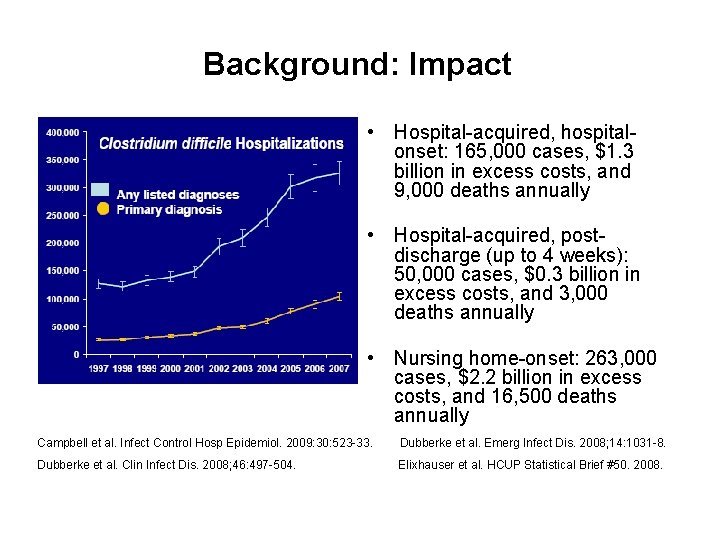
Background: Impact • Hospital-acquired, hospitalonset: 165, 000 cases, $1. 3 billion in excess costs, and 9, 000 deaths annually • Hospital-acquired, postdischarge (up to 4 weeks): 50, 000 cases, $0. 3 billion in excess costs, and 3, 000 deaths annually • Nursing home-onset: 263, 000 cases, $2. 2 billion in excess costs, and 16, 500 deaths annually Campbell et al. Infect Control Hosp Epidemiol. 2009: 30: 523 -33. Dubberke et al. Emerg Infect Dis. 2008; 14: 1031 -8. Dubberke et al. Clin Infect Dis. 2008; 46: 497 -504. Elixhauser et al. HCUP Statistical Brief #50. 2008.
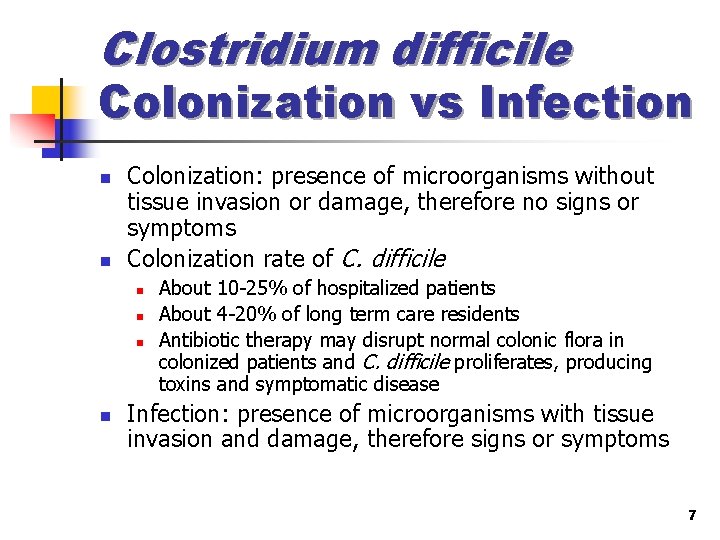
Clostridium difficile Colonization vs Infection n n Colonization: presence of microorganisms without tissue invasion or damage, therefore no signs or symptoms Colonization rate of C. difficile n n About 10 -25% of hospitalized patients About 4 -20% of long term care residents Antibiotic therapy may disrupt normal colonic flora in colonized patients and C. difficile proliferates, producing toxins and symptomatic disease Infection: presence of microorganisms with tissue invasion and damage, therefore signs or symptoms 7
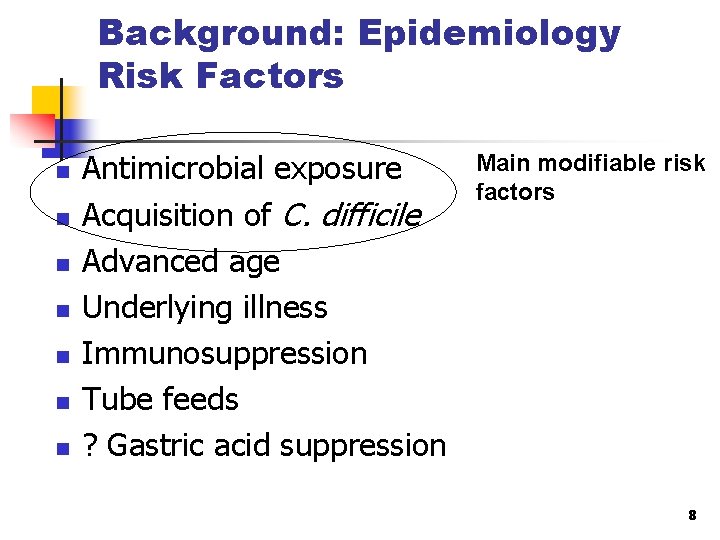
Background: Epidemiology Risk Factors n n n n Antimicrobial exposure Acquisition of C. difficile Advanced age Underlying illness Immunosuppression Tube feeds ? Gastric acid suppression Main modifiable risk factors 8
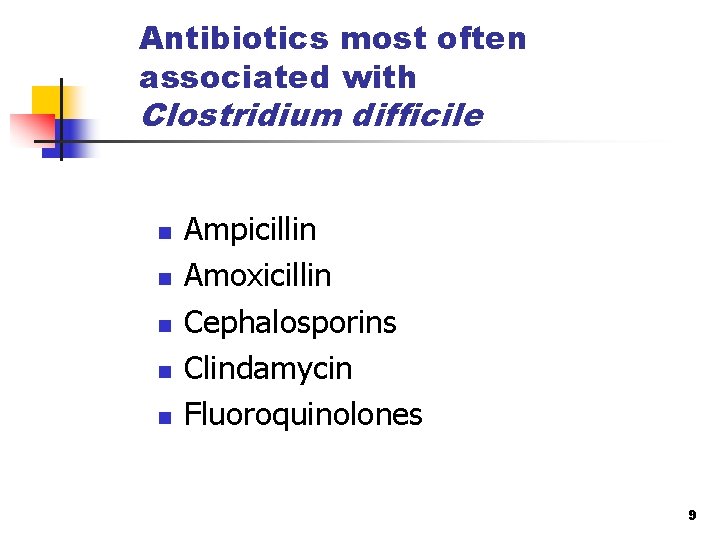
Antibiotics most often associated with Clostridium difficile n n n Ampicillin Amoxicillin Cephalosporins Clindamycin Fluoroquinolones 9
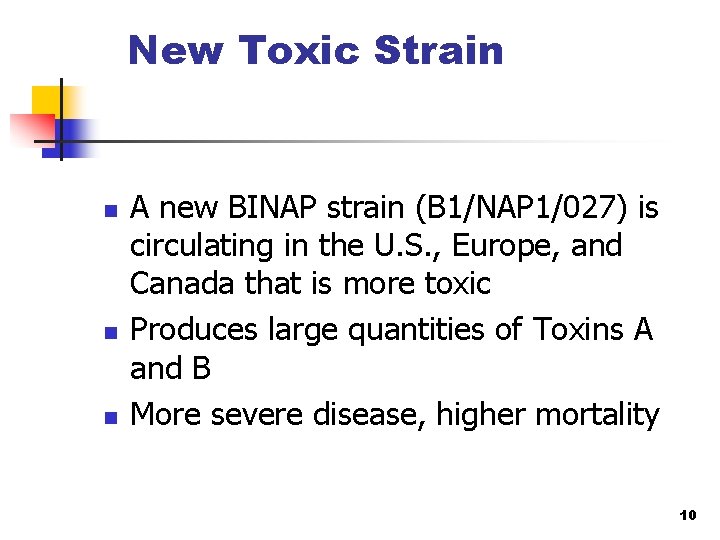
New Toxic Strain n A new BINAP strain (B 1/NAP 1/027) is circulating in the U. S. , Europe, and Canada that is more toxic Produces large quantities of Toxins A and B More severe disease, higher mortality 10

Testing for Clostridium difficile n Toxin testing n n Stool culture n n Quick – same day Takes 48 -96 hours Testing for C. difficile should be done on unformed (liquid) stool only unless ileus is suspected 11
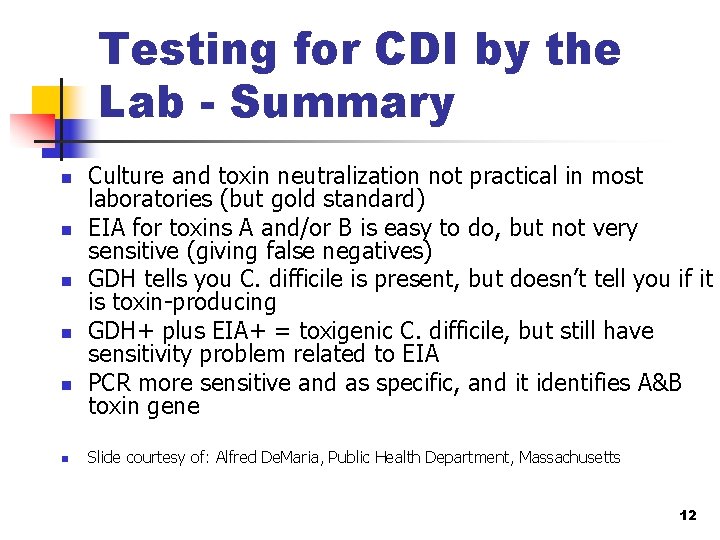
Testing for CDI by the Lab - Summary n n n Culture and toxin neutralization not practical in most laboratories (but gold standard) EIA for toxins A and/or B is easy to do, but not very sensitive (giving false negatives) GDH tells you C. difficile is present, but doesn’t tell you if it is toxin-producing GDH+ plus EIA+ = toxigenic C. difficile, but still have sensitivity problem related to EIA PCR more sensitive and as specific, and it identifies A&B toxin gene Slide courtesy of: Alfred De. Maria, Public Health Department, Massachusetts 12
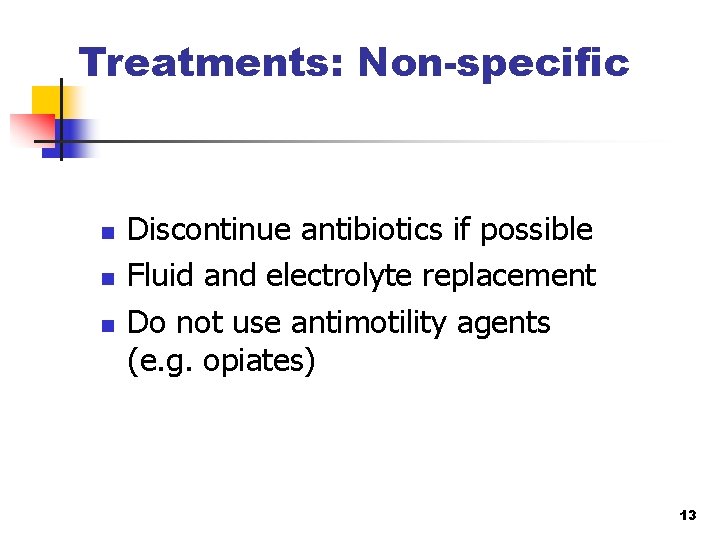
Treatments: Non-specific n n n Discontinue antibiotics if possible Fluid and electrolyte replacement Do not use antimotility agents (e. g. opiates) 13
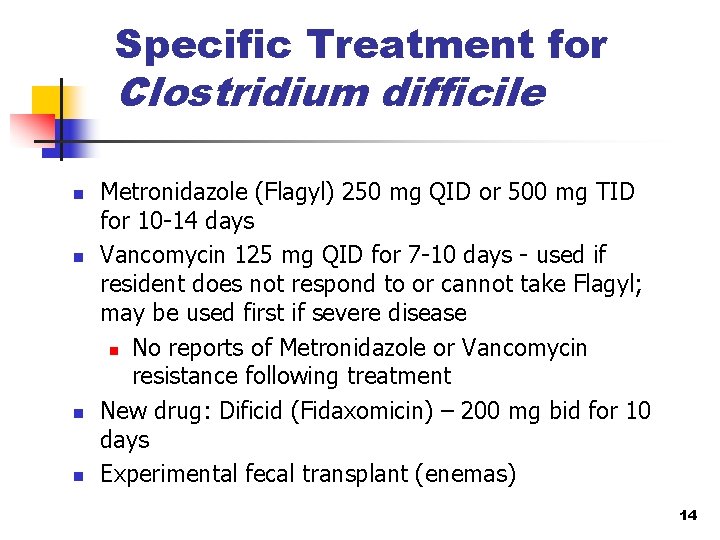
Specific Treatment for Clostridium difficile n n Metronidazole (Flagyl) 250 mg QID or 500 mg TID for 10 -14 days Vancomycin 125 mg QID for 7 -10 days - used if resident does not respond to or cannot take Flagyl; may be used first if severe disease n No reports of Metronidazole or Vancomycin resistance following treatment New drug: Dificid (Fidaxomicin) – 200 mg bid for 10 days Experimental fecal transplant (enemas) 14
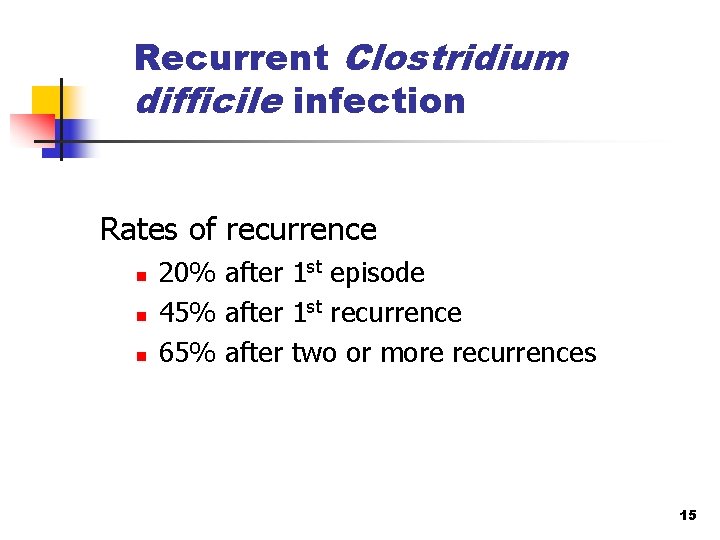
Recurrent Clostridium difficile infection Rates of recurrence n n n 20% after 1 st episode 45% after 1 st recurrence 65% after two or more recurrences 15
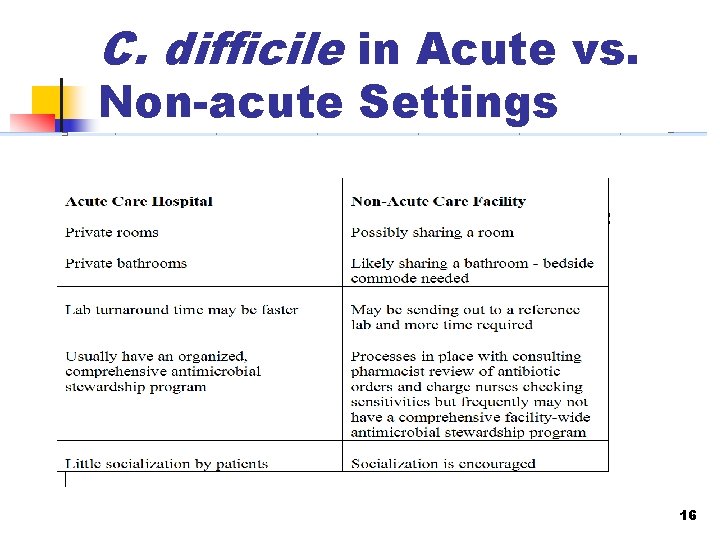
C. difficile in Acute vs. Non-acute Settings 16
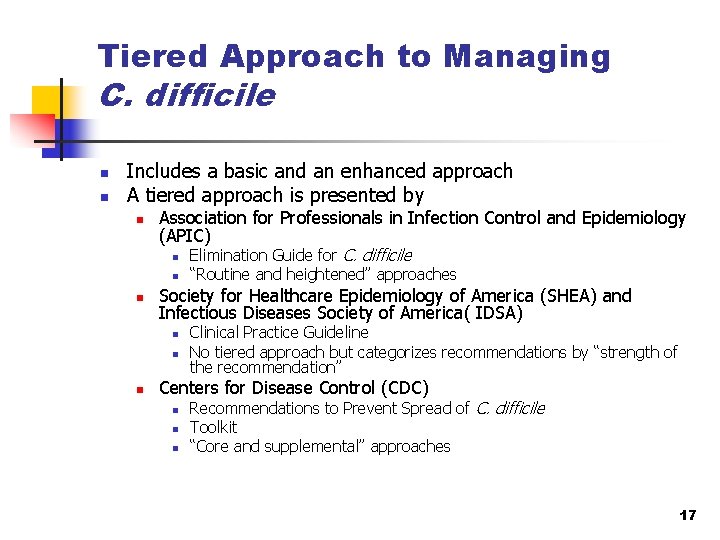
Tiered Approach to Managing C. difficile n n Includes a basic and an enhanced approach A tiered approach is presented by n Association for Professionals in Infection Control and Epidemiology (APIC) n n n Society for Healthcare Epidemiology of America (SHEA) and Infectious Diseases Society of America( IDSA) n n n Elimination Guide for C. difficile “Routine and heightened” approaches Clinical Practice Guideline No tiered approach but categorizes recommendations by “strength of the recommendation” Centers for Disease Control (CDC) n n n Recommendations to Prevent Spread of C. difficile Toolkit “Core and supplemental” approaches 17
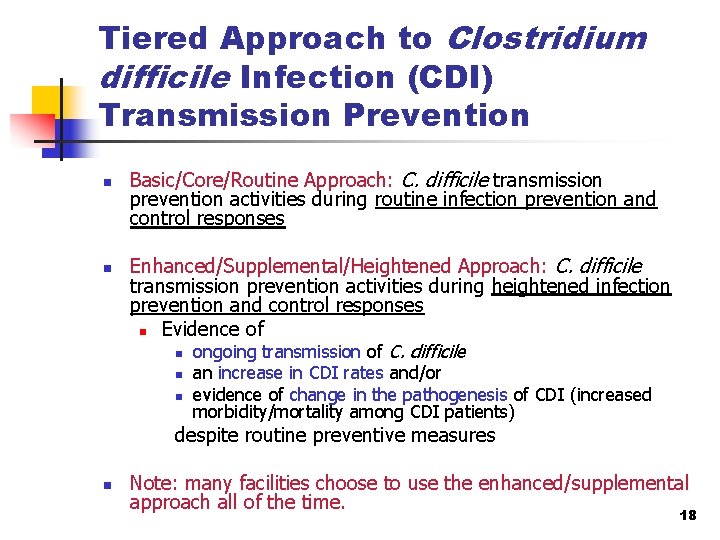
Tiered Approach to Clostridium difficile Infection (CDI) Transmission Prevention n n Basic/Core/Routine Approach: C. difficile transmission prevention activities during routine infection prevention and control responses Enhanced/Supplemental/Heightened Approach: C. difficile transmission prevention activities during heightened infection prevention and control responses n Evidence of n ongoing transmission of C. difficile n n an increase in CDI rates and/or evidence of change in the pathogenesis of CDI (increased morbidity/mortality among CDI patients) despite routine preventive measures n Note: many facilities choose to use the enhanced/supplemental approach all of the time. 18
Why Would Enhanced Strategies be Needed? n What we are currently doing is failing!! 19
Infection Prevention Strategies n n n Hand hygiene Contact precautions Identification of cases Environmental disinfection Appropriate use of antibiotics 20
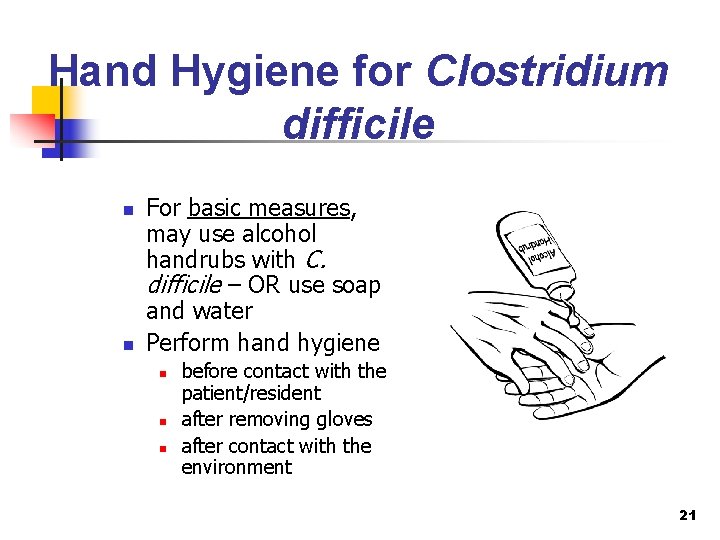
Hand Hygiene for Clostridium difficile n n For basic measures, may use alcohol handrubs with C. difficile – OR use soap and water Perform hand hygiene n n n before contact with the patient/resident after removing gloves after contact with the environment 21
Hand Hygiene – Soap vs. Alcohol gel n n n Alcohol not effective in eradicating C. difficile spores However, one hospital study found that from 2000 -2003, despite increasing use of alcohol hand rub, there was no concomitant increase in CDI rates Discouraging alcohol gel use may undermine overall hand hygiene program with untoward consequences for HAIs in general Boyce et al. Infect Control Hosp Epidemiol 2006; 27: 479 -83.
CDC adds: n n Because alcohol does not kill Clostridium difficile spores, use of soap and water is more efficacious than alcohol-based hand rubs. However, early experimental data suggest that, even using soap and water, the removal of C. difficile spores is more challenging than the removal or inactivation of other common pathogens. 23
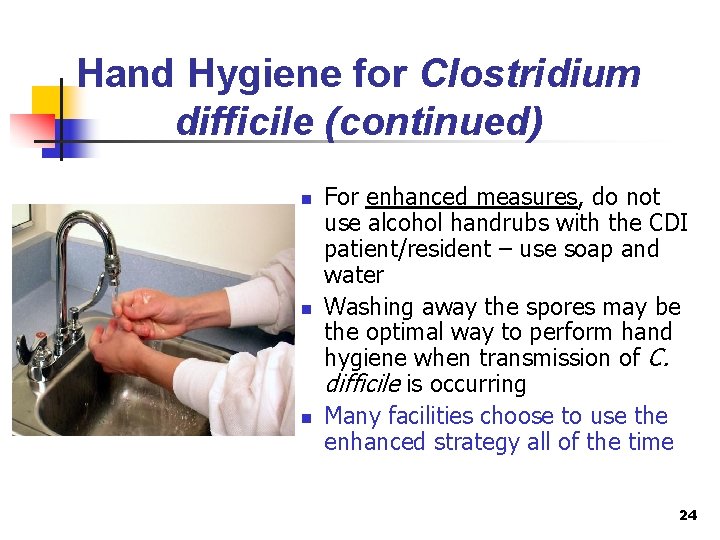
Hand Hygiene for Clostridium difficile (continued) n n n For enhanced measures, do not use alcohol handrubs with the CDI patient/resident – use soap and water Washing away the spores may be the optimal way to perform hand hygiene when transmission of C. difficile is occurring Many facilities choose to use the enhanced strategy all of the time 24
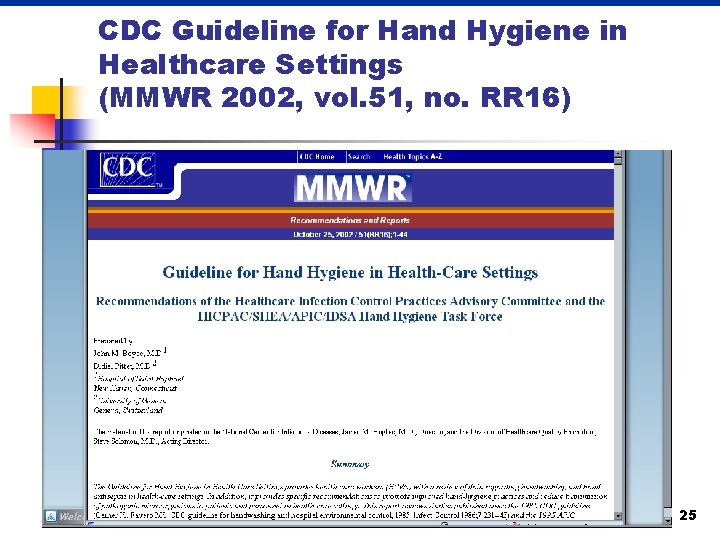
CDC Guideline for Hand Hygiene in Healthcare Settings (MMWR 2002, vol. 51, no. RR 16) 25
Conversation and Questions n n n What has worked for you? If you have alcohol handrubs mounted in each room, how do you prevent its use with C. diff? Questions?
Infection Prevention Strategies n n n Hand hygiene Contact precautions Identification of cases Environmental disinfection Appropriate use of antibiotics 27
Contact Precautions n n n Designed to reduce the risk of transmission of microorganisms by direct or indirect contact Direct contact n skin-to-skin contact n physical transfer (turning patients/residents, bathing patients, other patient/resident care activities) Indirect contact n Contaminated objects n n n Equipment Linens High touch surfaces 28
Contact Precautions Patient or Resident placement n Private room preferred n 2 nd option: Cohorting with other patient/resident with C. difficile n n 3 rd option: In LTCFs, consider infectiousness and residentspecific risk factors to determine rooming with a low risk roommate and socializing outside the room n Consider: n Clean n Contained n Cooperative n Cognitive Patient care equipment dedicated to single patient/resident if possible. If not, disinfect equipment prior to leaving the room. 29
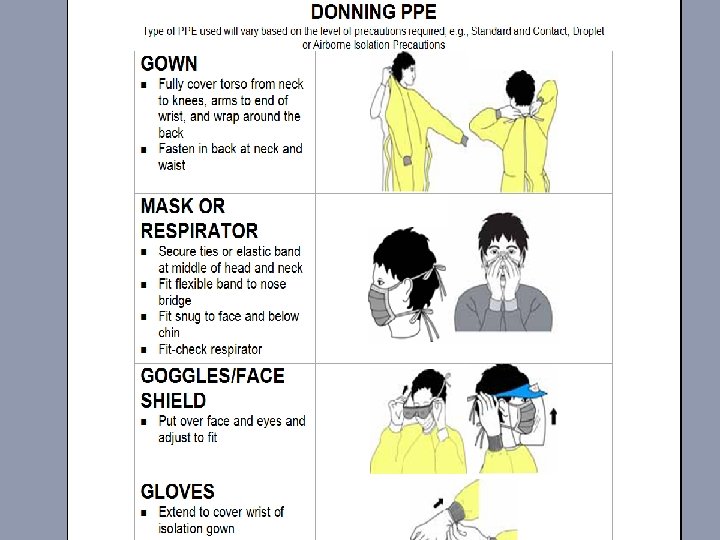
Tiered Approach for Contact Precautions: Basic n n n Contact Precautions - gloves and gowns to enter room or cubicle Do not re-use gowns Supplies outside the room 30
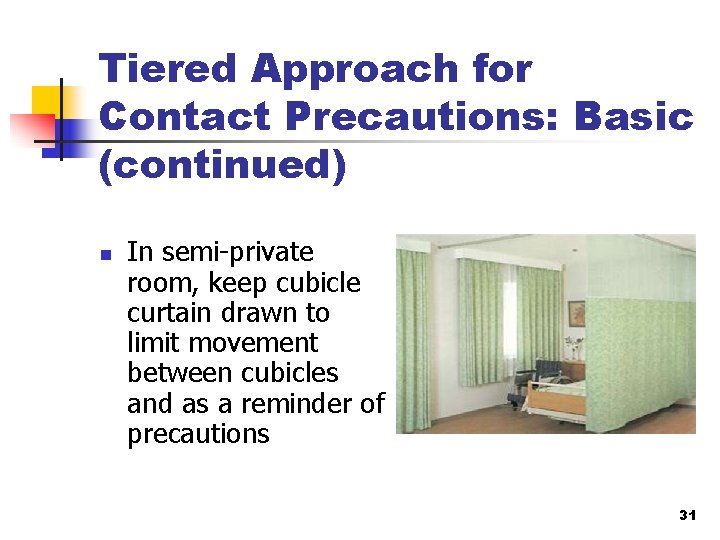
Tiered Approach for Contact Precautions: Basic (continued) n In semi-private room, keep cubicle curtain drawn to limit movement between cubicles and as a reminder of precautions 31
Contact Precautions: Basic (Continued) n n n Use dedicated equipment; if not feasible – decontaminate prior to use on another patient/resident Maintain adequate supplies for contact precautions Do not isolate asymptomatic carriers 32
Contact Precautions: Basic (Continued) n n n May discontinue precautions when diarrhea ceases (may consider 48 hours without loose stool) Do not do a toxin “for cure” once diarrhea has stopped Lab should not accept stool for toxin if the stool is formed 33
From the Horse’s Mouth: CDC’s Web Site After treatment, repeat C. difficile testing is not recommended if the patient’s symptoms have resolved, as patients may remain colonized. http: //www. cdc. gov/ncidod/dhqp/id_Cdiff. FAQ_HCP. html 34
Tiered Approach for Contact Precautions: Enhanced n n n May consider alternative signage to ensure staff awareness Evaluate current system for patient/resident placement Consider contact precautions for all patients/residents that develop diarrhea until CDI is ruled out Increase monitoring of isolation precautions and hygiene Extend use of contact precautions even when diarrhea stops 35
Why contact precautions for C. difficile? ? n Environmental contamination 36
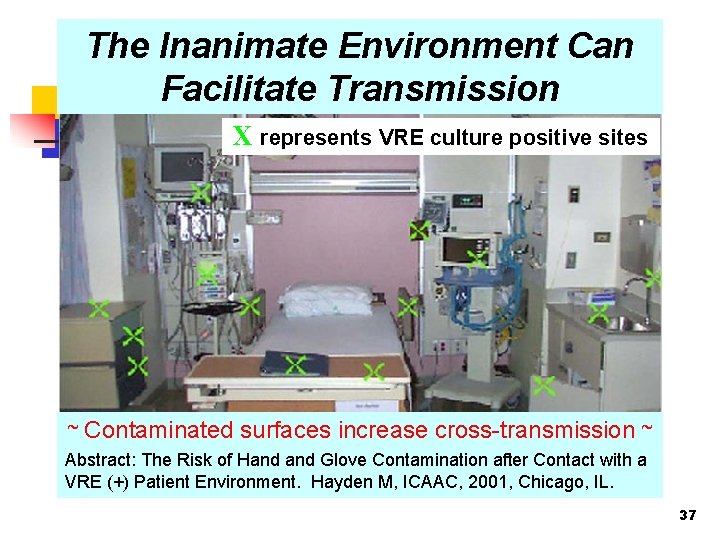
The Inanimate Environment Can Facilitate Transmission X represents VRE culture positive sites ~ Contaminated surfaces increase cross-transmission ~ Abstract: The Risk of Hand Glove Contamination after Contact with a VRE (+) Patient Environment. Hayden M, ICAAC, 2001, Chicago, IL. 37
38
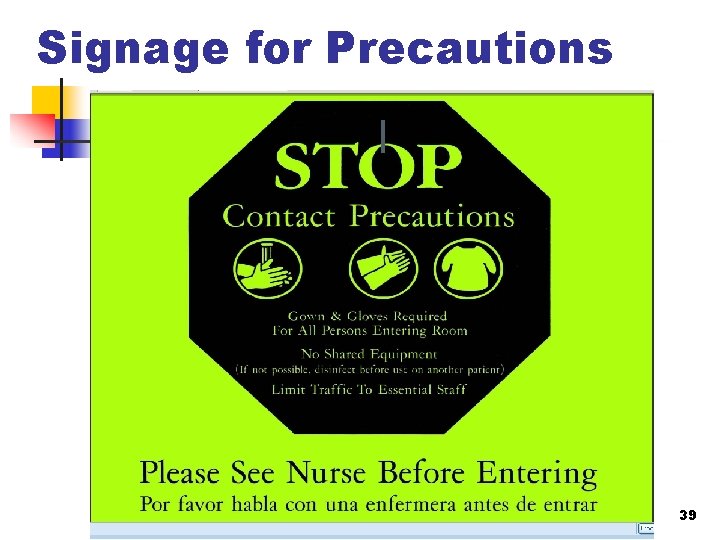
Signage for Precautions 39
Infection Prevention Strategies n n n Hand hygiene Contact precautions Identification of cases Environmental disinfection Appropriate use of antibiotics 40
Identification of Cases Colonization or asymptomatic fecal carriage of C. difficile n n May be common in healthcare facilities Do we care? C. difficile infection n Acute diarrhea 41
CDI Collaborative Definition (see separate handout) n n A case of C. difficile is defined as a case with the symptom of diarrhea without other known etiology The stool sample will yield a positive result for laboratory assay for C. difficile toxin A and/or B For this collaborative, CDI is limited to lab confirmed cases Will track healthcare associated CDI 42
CDI Collaborative Definition of Healthcare Associated n n This collaborative will track laboratory confirmed cases of Health Care Facility C. difficile. A laboratory confirmed case of C. difficile is defined as a patient with diarrhea characterized by unformed stool, without other known etiology, and associated with a positive laboratory assay for C. difficile toxin A and/or B on the stool. Count each case of CDI only once Episode of CDI that occurs eight weeks or less after the onset of a previous episode, provided the symptoms from the prior episode resolved. 43
Definition (continued) HAI-CDI (INDEX FACILITY) n A patient classified as having a case of healthcare facility associated C. difficile attributable to YOUR facility is defined as a patient who develops diarrhea on or after the 4 th day of admission. n OR n A patient classified as having any symptoms that develop on or before the 4 th day after your discharge to another healthcare facility. n OR n A patient discharged to home with lab confirmed C. diff. within 28 days from the day of discharge and no intervening admissions. (Day of discharge counts as day 1) Also counts if C. diff is identified on readmission to your facility within that 28 day period. 44
Definition (continued) HAI-CDI (OTHER FACILITY) n A patient classified as having a case of healthcare facility associated C. difficile attributable to another health care facility is defined as a patient who develops diarrhea before the 4 th day of admission n n after transfer from another health care facility OR: within 28 days of discharge from another health care facility 45
48 hours - example n n n Admission = day 1 – Monday Day 2 - Tuesday Day 3 - Wednesday Day 4 - Thursday at 12: 01 a. m. is the cutoff. After Thursday at 12: 01, it counts for your facility. Prior to that time, it is considered “community acquired” which includes any location other than your facility. Exception – home care – 28 days 46
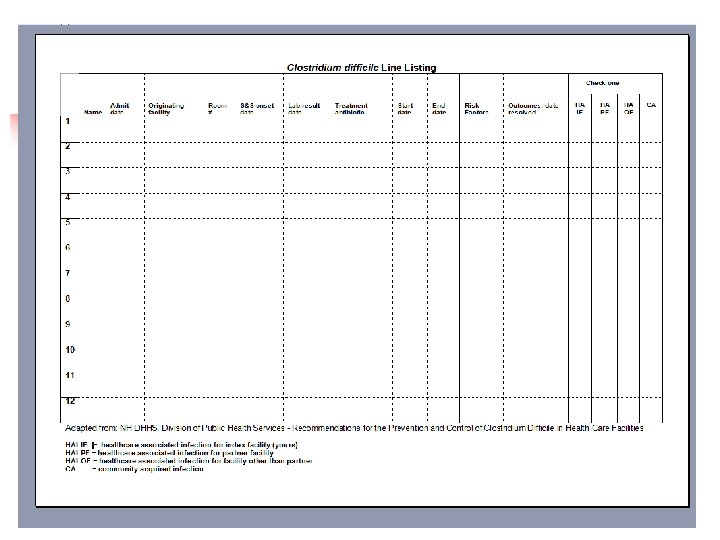
Facility Healthcare Associated CDI Rate n # of HA CDI cases divided by patient/resident days X 10, 000 = ___ HA CDI per 10, 000 patient/resident days Example: n 3 cases HA CDI divided by 3, 585 patient/resident days =. 0008368 X 10, 000 =8. 368 or 8. 4 cases of HA CDI per 10, 000 patient/resident days 47
48
Identification of Cases Basic Strategy: n With cases of diarrhea, consider C. difficile n n Take a detailed history for risk factors Norovirus, dietary changes, medications, and other things may also be causes of diarrhea Notify physician Watch for dehydration 49
Identification of Cases Enhanced Strategy: n Automatic contact precautions for all patients/residents with orders for C. difficile labs AND for all patients/residents with a known history of CDI n Consider allowing nurses to initiate the lab order and contact precautions 50
Conversation and Questions How does this show up in your facility? n What are you doing? What are you worried about? n Questions? n
Infection Prevention Strategies n n n Contact precautions Hand hygiene Identification of cases Environmental disinfection Appropriate use of antibiotics 52
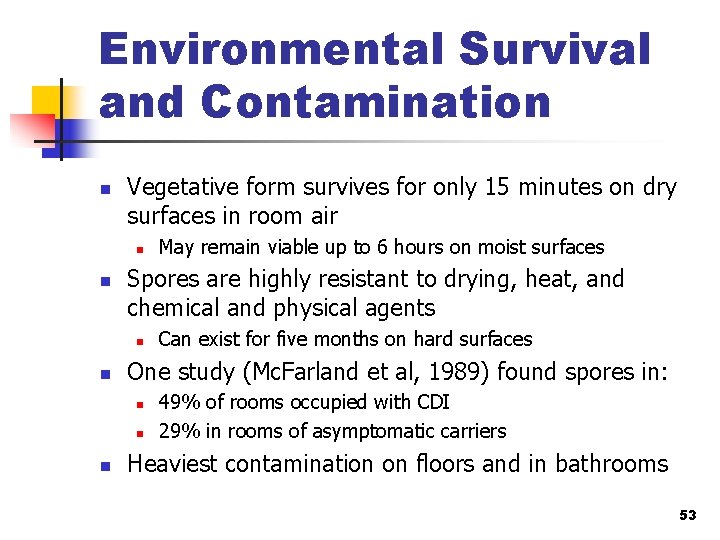
Environmental Survival and Contamination n Vegetative form survives for only 15 minutes on dry surfaces in room air n n Spores are highly resistant to drying, heat, and chemical and physical agents n n Can exist for five months on hard surfaces One study (Mc. Farland et al, 1989) found spores in: n n n May remain viable up to 6 hours on moist surfaces 49% of rooms occupied with CDI 29% in rooms of asymptomatic carriers Heaviest contamination on floors and in bathrooms 53
Environmental Survival and Contamination (continued) n n Spores have been isolated from the air and aerosol dissemination may, in part, account for widespread environmental contamination The frequency of positive personnel hand culture has been strongly correlated with the intensity of environmental contamination 54
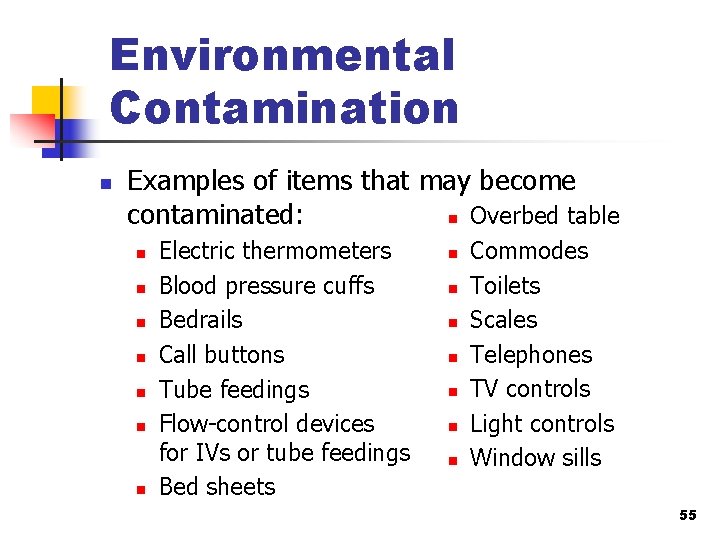
Environmental Contamination n Examples of items that may become contaminated: n Overbed table n n n n Electric thermometers Blood pressure cuffs Bedrails Call buttons Tube feedings Flow-control devices for IVs or tube feedings Bed sheets n n n n Commodes Toilets Scales Telephones TV controls Light controls Window sills 55
Evidence of the role of environmental transmission n Frequency of C. difficile acquisition has been linked with the level of environmental contamination Patients admitted to a room previously occupied by a patient with C. difficile have a higher risk for C. difficile acquisition Improved room disinfection has led to decreased rates of C. difficile infection 56
Environmental Disinfection: Tiered Approach Basic: Use EPA approved germicide for routine disinfection during nonoutbreak situations Ensure staff training and contact time Disinfect shared items between patients/residents Monitor environmental cleaning Enhanced: Use 10% sodium hypochlorite (bleach) for disinfecting room and equipment (or use EPA registered sporicidal agent) In outbreak, consider bleach solution for cleaning all rooms Use bleach wipes as an adjunct to cleaning Monitor and enforce adherence for cleaning
Disinfectants n n Commonly used disinfectants are not sporicidal n Some may actually encourage sporulation (the changing of the organism to the spore state) Sporicidal disinfectants: n Chlorine-based disinfectants n High-concentration, vaporized hydrogen peroxide n Recently approved EPA registered disinfectants that kill C. diff spores 58
Disinfectants n n Chlorine-based disinfectants - disadvantages: n Can be corrosive to equipment or surfaces over time n Can cause respiratory or other health problems in workers using them n May cause bleaching/fading APIC states use of chlorine-based disinfectants should be limited to outbreak situations and when high rates of CDI have been documented n In these situations (outbreaks and/or high rates), chlorinebased products have demonstrated benefit when used with other control measures n In other situations, routine use of chlorine-based products has not been evaluated n Physical motion of cleaning + use of routine germicides = removal and dilution of spore concentration for non-outbreak situations 59
Disinfectants n 10% sodium hypochlorite solution n n One part household chlorine bleach mixed with nine parts water Must be mixed fresh daily 60
Pre-mixed Hypochlorite Solution: Advantages and Disadvantages n Advantages: n n Commercially available solutions include detergent base Cleaning as well as disinfection Eliminates dilution errors Disadvantages of pre-mixed solutions: n n n Solutions expire over time May be hard to store May be more costly 61
Bleach and water: mixing your own solution n n Cleaning and disinfection is a two-step process (must clean first, then disinfect) Contact time of ten minutes required for disinfection (Rutala, 2008) n n Thorough wetting of the surface, allowed to air dry Note: pre-mixed EPA registered hypochlorite solutions provide cleaning and disinfection in one step 62
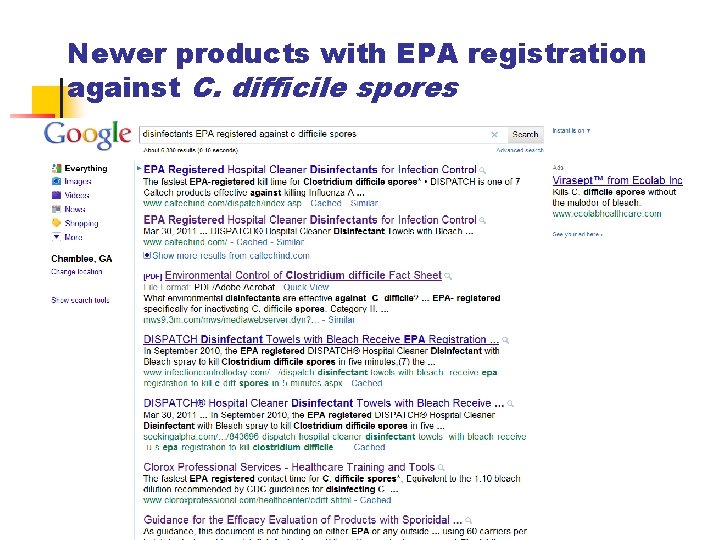
Newer products with EPA registration against C. difficile spores n Several on the market now 63
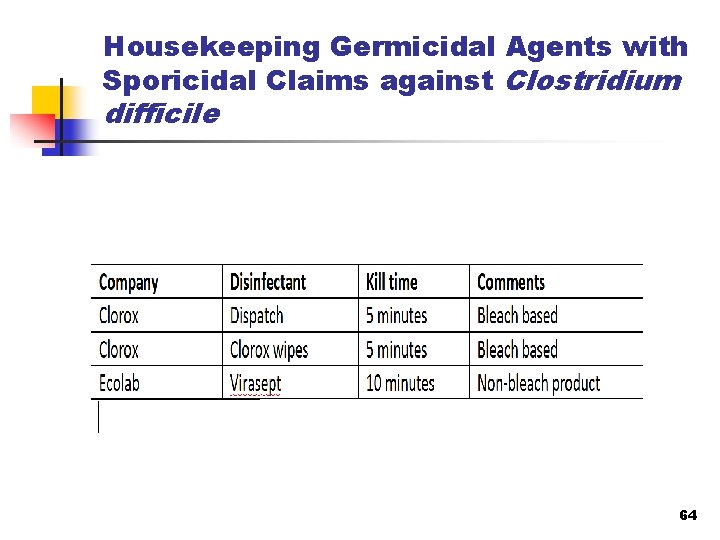
Housekeeping Germicidal Agents with Sporicidal Claims against Clostridium difficile 64
Floor decontamination n Consider cleaning the C. difficile room as the last room of the day Alternately, change the bucket, solution, and mop head after cleaning the C. difficile room and before cleaning another room All cleaning equipment and supplies should be decontaminated prior to use on another room 65
Germicidal Wipes n If wipes are used: n n n The wipe must wet the surface being disinfected for the correct contact time as noted on label Use the right wipes for the right type of job The user should: n n Know the contact time for the germicide used Know the ability of the wipe to maintain contact time for the task for it will be used Be involved in selection of the right type of wipes Staff must be trained to use the wipes appropriately 66
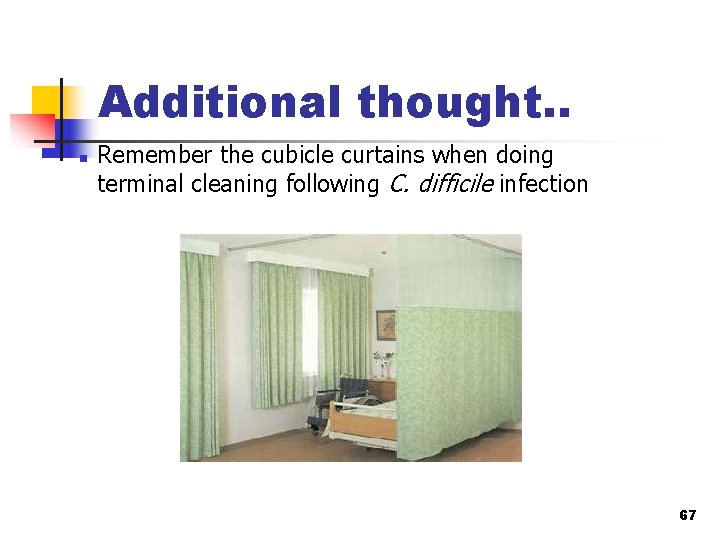
Additional thought. . n Remember the cubicle curtains when doing terminal cleaning following C. difficile infection 67
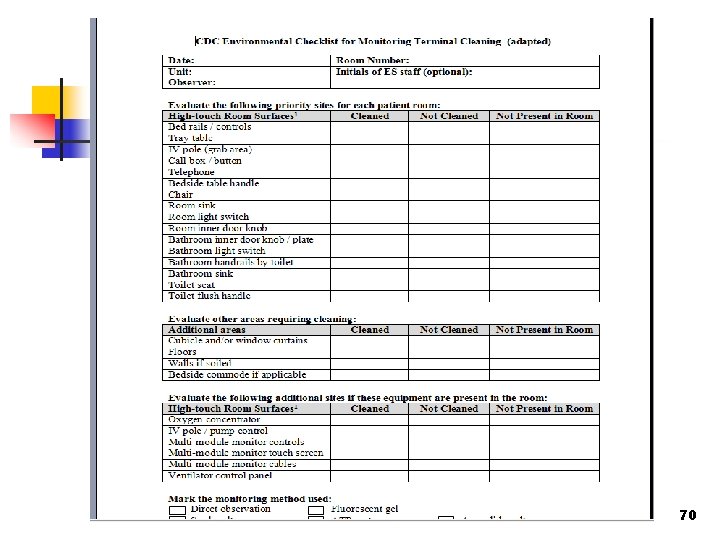
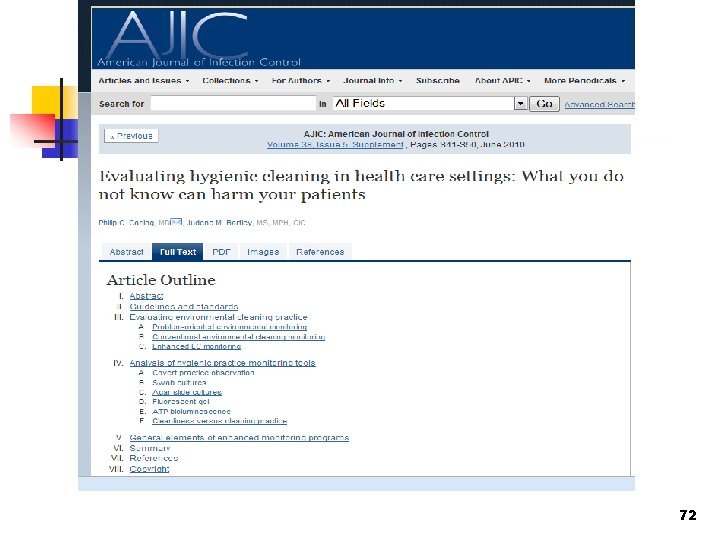
Monitoring Environmental Cleaning n Consistency with recommended cleaning and disinfection procedures should be routinely monitored. n n Include all surfaces and items near the patient Staff performing cleaning should use checklists n n Confirm that each critical area has been cleaned and disinfected Each item must be checked off as it is completed n No need for routine environmental sampling for n If there is ongoing transmission: Clostridium difficile n n May indicate non-compliance Thorough cleaning and disinfection of the environment must be done 68
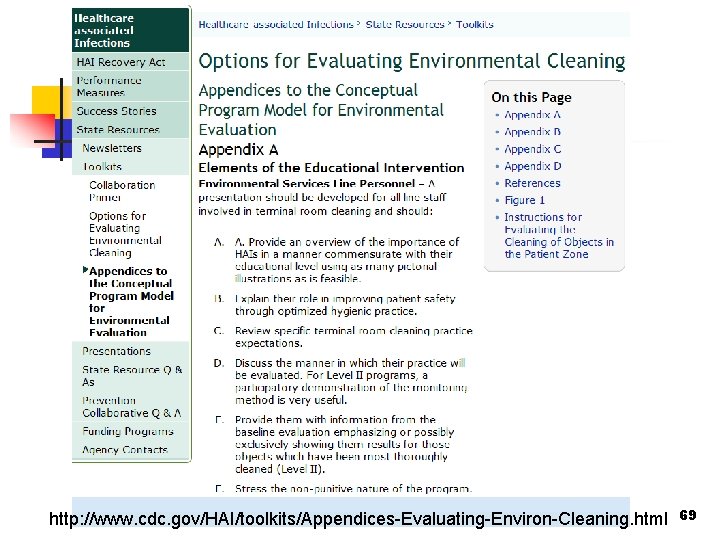
http: //www. cdc. gov/HAI/toolkits/Appendices-Evaluating-Environ-Cleaning. html 69
70
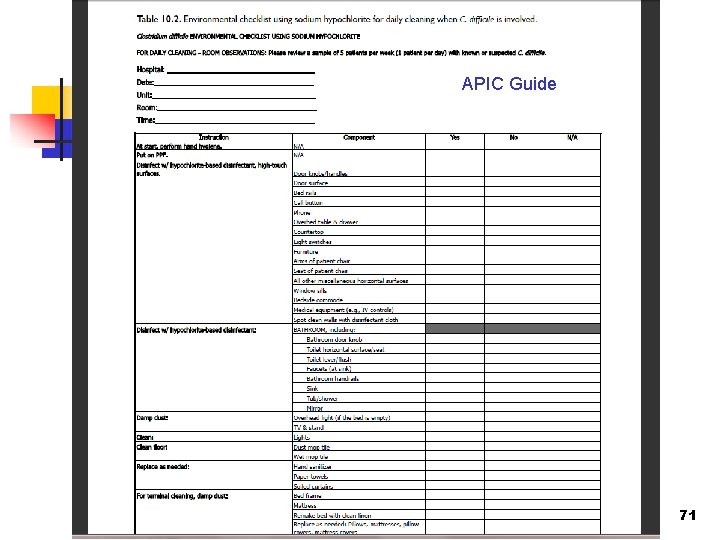
APIC Guide 71
72
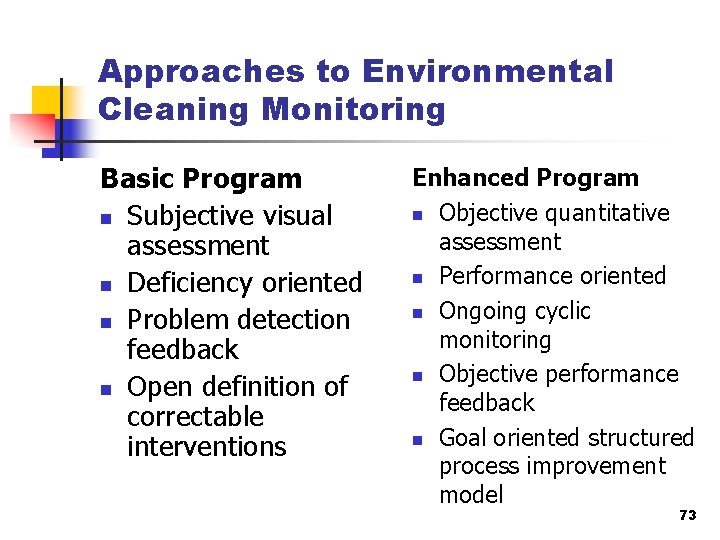
Approaches to Environmental Cleaning Monitoring Basic Program n Subjective visual assessment n Deficiency oriented n Problem detection feedback n Open definition of correctable interventions Enhanced Program n Objective quantitative assessment n Performance oriented n Ongoing cyclic monitoring n Objective performance feedback n Goal oriented structured process improvement model 73
Environmental Services Training n n Because of the high turnover of staff, educate personnel on proper cleaning technique frequently. Ensure that education is provided in the personnel’s native language. 74
Infection Control Strategies n n n Contact precautions Hand hygiene Identification of cases Environmental disinfection Appropriate use of antibiotics 75

Appropriate Use of Antibiotics: just a few thoughts 76
Antimicrobial Stewardship: definition n Antimicrobial (or antibiotic) stewardship programs are interventions designed to ensure that hospitalized patients receive the right antibiotic, at the right dose, at the right time, and for the right duration (CDC definition) 77
Methods to Improve Antimicrobial Use §Prescriber education §Standardized antimicrobial order forms §Formulary restrictions §Prior approval to start/continue 78
Methods to Improve Antimicrobial Use §Pharmacy substitution or switch §Multidisciplinary drug utilization evaluation (DUE) §Provider/unit performance feedback §Computerized decision support/on-line ordering 79
Antimicrobial Stewardship 80
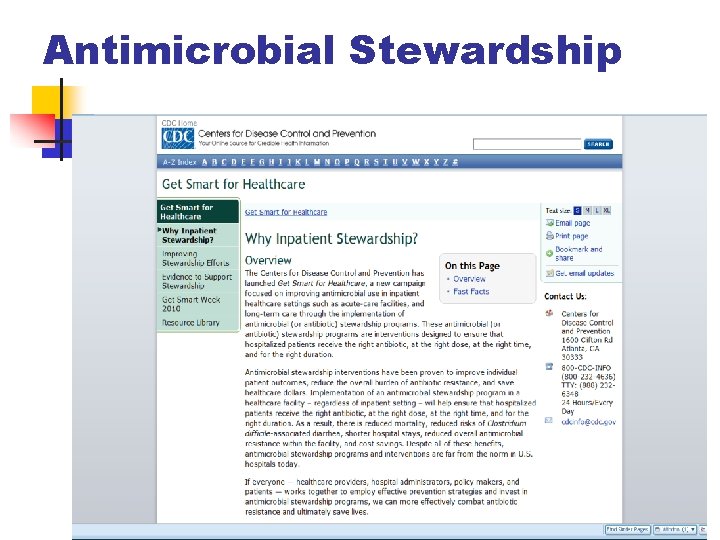
CDC Fast Facts n n n Antibiotic overuse contributes to the growing problems of Clostridium difficile infection and antibiotic resistance in healthcare facilities. Improving antibiotic use through stewardship interventions and programs improves patient outcomes, reduces antimicrobial resistance, and saves money. Interventions to improve antibiotic use can be implemented in any healthcare setting—from the smallest to the largest. Improving antibiotic use is a medication-safety and patient-safety issue. http: //www. cdc. gov/getsmart/healthcare/inpatient-stewardship. html 81
Antibiotic Review for Long Term Care Facilities F 441: Because of increases in MDROs, review of the use of antibiotics is a vital aspect of the infection prevention and control program. An area of increased surveyor focus - an area where you need to assess if you are meeting the surveyor guidance 82
From Surveyor Guidance 42 CFR § 483. 25(l), F 329, Unnecessary Drugs n Determine if the facility has reviewed with the prescriber the rationale for placing the resident on an antibiotic to which the organism seems to be resistant or when the resident remains on antibiotic therapy without adequate monitoring or appropriate indications, or for an excessive duration n 83
Antibiotic Monitoring and Review n n What most likely exists currently in your program: n Comparison of prescribed antibiotics with available susceptibility reports (charge nurse and infection preventionist) n Review of antibiotics prescribed to specific residents during regular medication review by consulting pharmacist What may be needed: n Antibiotic stewardship program in the facility (CDC recommendation – 2006 MDRO guideline) n Broader overview of antibiotic use in your facility with reporting to quality assurance/infection control committee Right drug - Right dosage - Right monitoring - Feedback of data to MDs 84
Monitoring of practices is crucial! n n n We must observe to see that our policies and recommended processes are being done and done correctly Educate staff or use other appropriate measures when you see non-compliance n She doesn’t know n She doesn’t care n It won’t work Enforce that all staff must follow the rules for contact precautions and hygiene 85

Be cautious! n If you don’t look, you don’t know!
Conversation and Questions Thinking about your cleaning processes: n What do you think is working well? n Where could you use help? n Questions? n
References n Clinical Practice Guidelines for Clostridium difficile Infection in Adults: 2010 Update by the Society for Healthcare Epidemiology of America (SHEA) and the Infectious Diseases Society of America (IDSA) http: //azdhs. gov/phs/oids/epi/disease/cdif/documents/Clinical%20 Practice%20 Guidelines%20 for%20 C%20 Diff%20 Infection%20 %202010%20 update%20 by%20 SHEA-IDSA. pdf 88
References n APIC Guide to the Elimination of Clostridium difficile Infections in Healthcare Settings. http: //www. apic. org/Content/Navigation. Menu/Practice. Guidance/ APICElimination. Guides/C. diff_Elimination_guide_logo. pdf n SHEA: Clostridium difficile in Long Term Care Facilities for the Elderly http: //www. sheaonline. org/Assets/files/position_papers/SHEA_Cdiff. pdf 89
References (continued) n n Spotlight on Clostridium difficile Infection: An Educational Resource for Pharmacists David P. Nicolau , Pharm. D, FCCP, FIDSA https: //secure. pharmacytimes. com/lessons/200902 -02. asp 90
CDI Toolkit – CDC n Clostridium difficile (CDI) Infections Toolkit (pdf) n CDI Toolkit http: //www. cdc. gov/hai/organisms/cdiff_infect. html n available in Power. Point format on the CDC website n Clostridium Difficile Infection (CDI) Baseline n http: //www. cdc. gov/HAI/recoveryact/state. Resources/toolkits. html Prevention Practices Assessment Tool For States Establishing HAI Prevention Collaboratives Using ARRA Funds Using Recovery Act Funds 91
Clostridium difficile Infection (CDI) Objectives n n n Describe the changing epidemiology of Clostridium difficile. State two differences between acute care and long term care in managing patients/residents with C. difficile infection. List three important strategies for preventing transmission of C. difficile within healthcare facilities. 92
Prevention IS PRIMARY! Protect patients…protect healthcare personnel… promote quality healthcare! Thank you! gailbennett@icpassociates. com 93
- Slides: 93