
Clostridium botulinum General Description Large rod shaped Spore
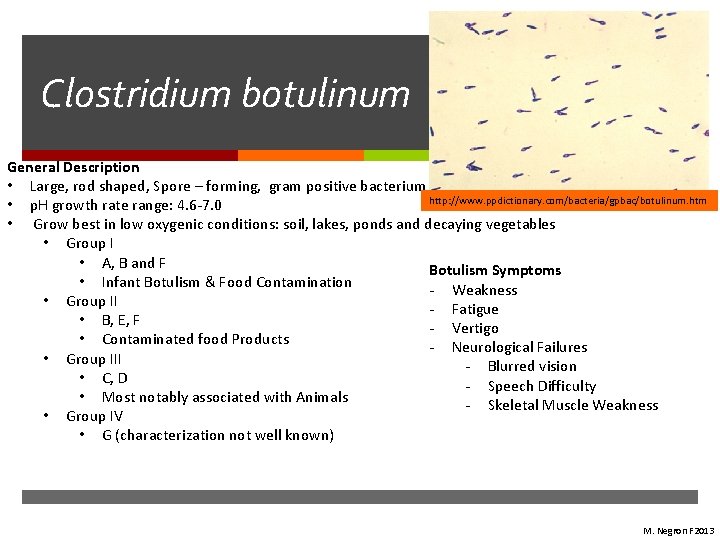
Clostridium botulinum General Description • Large, rod shaped, Spore – forming, gram positive bacterium http: //www. ppdictionary. com/bacteria/gpbac/botulinum. htm • p. H growth rate range: 4. 6 -7. 0 • Grow best in low oxygenic conditions: soil, lakes, ponds and decaying vegetables • Group I • A, B and F Botulism Symptoms • Infant Botulism & Food Contamination - Weakness • Group II - Fatigue • B, E, F - Vertigo • Contaminated food Products - Neurological Failures • Group III - Blurred vision • C, D - Speech Difficulty • Most notably associated with Animals - Skeletal Muscle Weakness • Group IV • G (characterization not well known) M. Negron F 2013
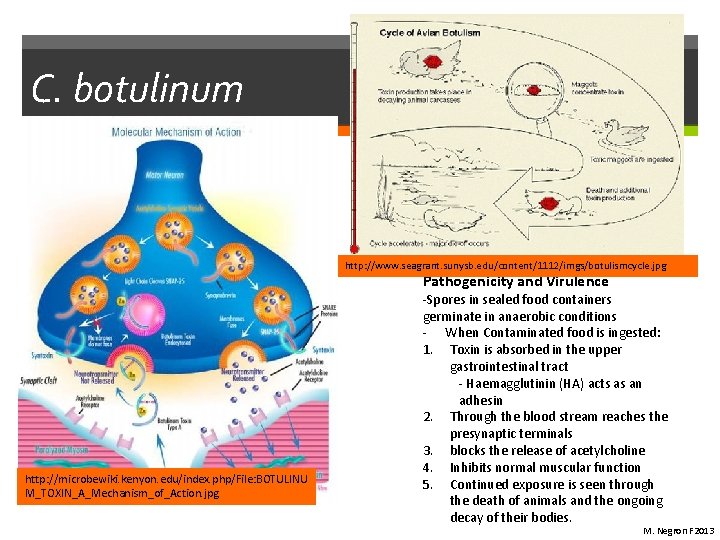
C. botulinum http: //www. seagrant. sunysb. edu/content/1112/imgs/botulismcycle. jpg Pathogenicity and Virulence http: //microbewiki. kenyon. edu/index. php/File: BOTULINU M_TOXIN_A_Mechanism_of_Action. jpg -Spores in sealed food containers germinate in anaerobic conditions - When Contaminated food is ingested: 1. Toxin is absorbed in the upper gastrointestinal tract - Haemagglutinin (HA) acts as an adhesin 2. Through the blood stream reaches the presynaptic terminals 3. blocks the release of acetylcholine 4. Inhibits normal muscular function 5. Continued exposure is seen through the death of animals and the ongoing decay of their bodies. M. Negron F 2013
- Slides: 2