
Closing the Fusion Fuel Cycle Tritium Breeding Blanket
Closing the Fusion Fuel Cycle: Tritium Breeding Blanket R&D Paul Humrickhouse Town Hall Meeting: The Future of Fusion. Transitioning to Energy Production 28 th Symposium on Fusion Engineering June 4, 2019
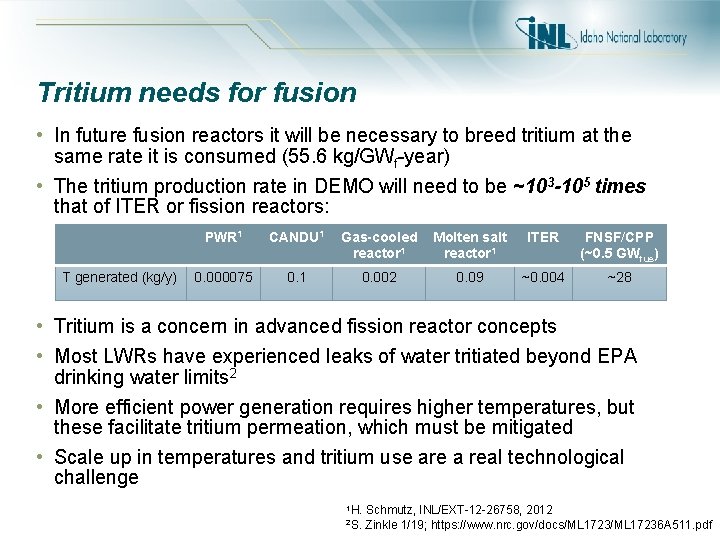
Tritium needs for fusion • In future fusion reactors it will be necessary to breed tritium at the same rate it is consumed (55. 6 kg/GWf-year) • The tritium production rate in DEMO will need to be ~103 -105 times that of ITER or fission reactors: T generated (kg/y) PWR 1 CANDU 1 Gas-cooled reactor 1 Molten salt reactor 1 ITER FNSF/CPP (~0. 5 GWfus) 0. 000075 0. 1 0. 002 0. 09 ~0. 004 ~28 • Tritium is a concern in advanced fission reactor concepts • Most LWRs have experienced leaks of water tritiated beyond EPA drinking water limits 2 • More efficient power generation requires higher temperatures, but these facilitate tritium permeation, which must be mitigated • Scale up in temperatures and tritium use are a real technological challenge 1 H. 2 S. Schmutz, INL/EXT-12 -26758, 2012 Zinkle 1/19; https: //www. nrc. gov/docs/ML 17236 A 511. pdf

Tritium Supply • Tritium for ITER will be obtained from Ontario Power Generation, using tritium produced within CANDU nuclear power stations • Available tritium for subsequent reactors will likely to come from Canadian, Korean, and Romanian CANDUs and availability depends on their future operation • Other sources theoretically possible: Lithium absorbers in LWRs, D-D tokamak operation ($2 B/kg 1) • Breeding blankets can’t be put off indefinitely! • Necessary startup T inventory depends on: – Burnup fraction in plasma (low, ~1%) – Processing time in exhaust system 1 M. Kovari, Nuclear Fusion 58 (2018) 026010
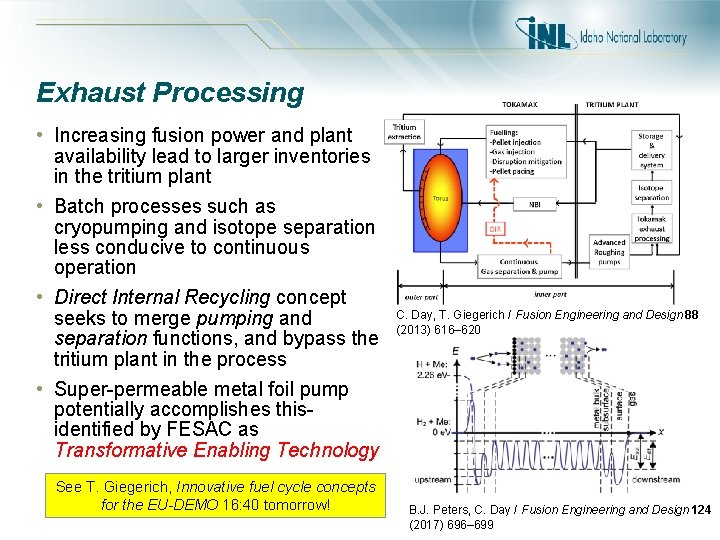
Exhaust Processing • Increasing fusion power and plant availability lead to larger inventories in the tritium plant • Batch processes such as cryopumping and isotope separation less conducive to continuous operation • Direct Internal Recycling concept seeks to merge pumping and separation functions, and bypass the tritium plant in the process • Super-permeable metal foil pump potentially accomplishes thisidentified by FESAC as Transformative Enabling Technology See T. Giegerich, Innovative fuel cycle concepts for the EU-DEMO 16: 40 tomorrow! C. Day, T. Giegerich / Fusion Engineering and Design 88 (2013) 616– 620 B. J. Peters, C. Day / Fusion Engineering and Design 124 (2017) 696– 699

Functions of the blanket • Assure tritium self-sufficiency: a tritium breeding ratio (TBR) > 1 – Li breeder: • 6 Li + n -> 4 He + T + 4. 78 Me. V • 7 Li + n -> 4 He + T + n -2. 47 Me. V – Pb or Be multiplier • Highest (n, 2 n) cross sections with low parasitic absorption • Maximize the net efficiency of the power plant – Push toward high coolant temperatures- limited by material operating windows and compatibility with coolants • Act as a radiation barrier • Act as structural barrier to limit dispersion of the tritium and potential activation products suspended in the coolant – A pressure vessel with high incident 14 Me. V neutron flux – A tritium partial pressure vessel, through which permeation can occur (especially at high temperature)

Tritium Extraction • Tritium bred in the blanket must be extracted for subsequent use as fuel • Highly efficient extraction, as near to the blanket as possible, minimizes unwanted tritium permeation elsewhere – Reduces burden on or obviates the need for permeation barriers • Solid breeders: tritium removed • Liquid breeders: rely on liquid/gas (or vacuum) contact or from He purge gas via hydrogen highly permeable membranes swamping and catalyzed isotope exchange from HTO and hydrocarbon impurities, followed by permeation through Pd-Ag membrane (PERMCAT) F. Okino, FED 109 -111 (2016) 1748 -1753 Transformative Enabling Technology D. Demange et al. , Catalysis Today 156 (2010) 140 -145.
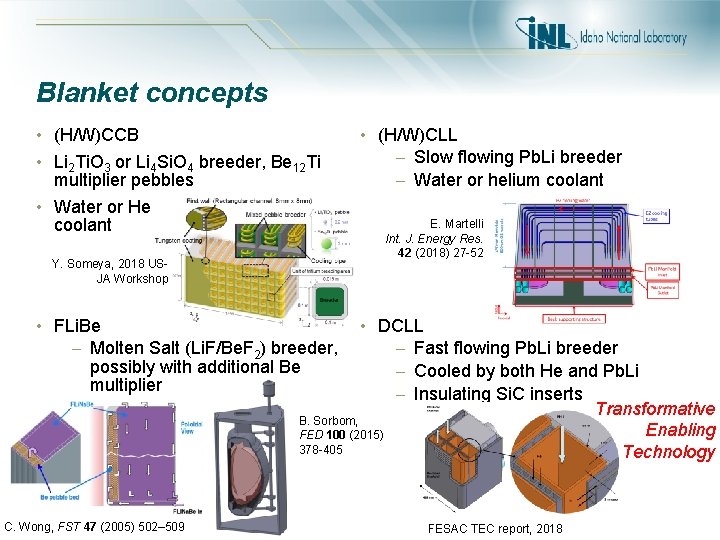
Blanket concepts • (H/W)CCB • Li 2 Ti. O 3 or Li 4 Si. O 4 breeder, Be 12 Ti multiplier pebbles • Water or He coolant Y. Someya, 2018 USJA Workshop • (H/W)CLL – Slow flowing Pb. Li breeder – Water or helium coolant E. Martelli Int. J. Energy Res. 42 (2018) 27 -52 • FLi. Be – Molten Salt (Li. F/Be. F 2) breeder, possibly with additional Be multiplier • DCLL – Fast flowing Pb. Li breeder – Cooled by both He and Pb. Li – Insulating Si. C inserts Transformative B. Sorbom, Enabling FED 100 (2015) 378 -405 Technology C. Wong, FST 47 (2005) 502– 509 FESAC TEC report, 2018
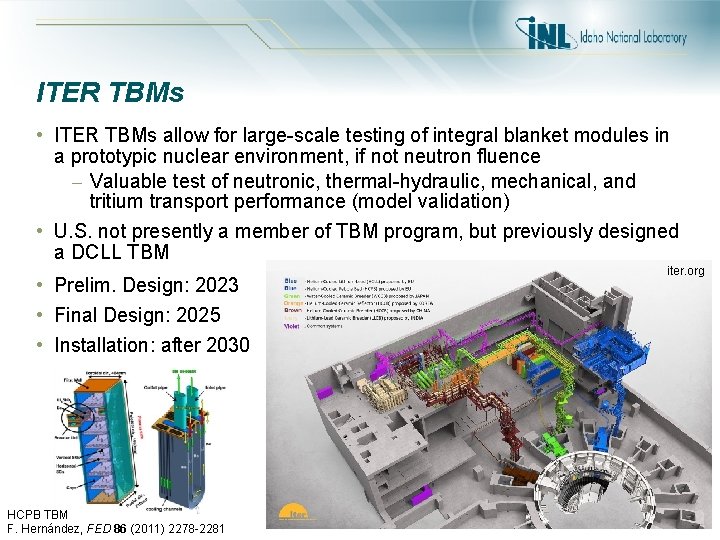
ITER TBMs • ITER TBMs allow for large-scale testing of integral blanket modules in a prototypic nuclear environment, if not neutron fluence – Valuable test of neutronic, thermal-hydraulic, mechanical, and tritium transport performance (model validation) • U. S. not presently a member of TBM program, but previously designed a DCLL TBM • Prelim. Design: 2023 • Final Design: 2025 • Installation: after 2030 HCPB TBM F. Hernández, FED 86 (2011) 2278 -2281 iter. org
The NAS report and Compact Pilot Plant • The NAS report endorses an electricity mission and outlines a strategic plan leading to a Compact Pilot Plant to realize it • In the NAS report, the Compact Pilot Plant: – Produces fusion power comparable to ITER in a smaller machine • Employs high-temperature superconducting magnets • Minimizes capital cost – Produces net electricity from fusion – Is the only US nuclear fusion reactor prior to commercialization – Operates in two phases: • Phase 1: Demonstrate electricity production for ~minutes, assess performance, PMI, tritium pumping, limited breeding and extraction • Phase 2: – Operate at high fusion power for long periods of time (weeks) – Full fuel cycle, integrated blanket testing
What the NAS report says about blankets • “… are at a very low technical readiness level, and significant fusion nuclear science and technology research is needed to provide the technological foundation required for the design and construction of a compact fusion pilot plant • “U. S. DOE needs to significantly expand the U. S. research program in fusion nuclear technology, advanced materials, safety, and tritium and blanket technologies to fully enable fusion energy” • Recommends creating a new division within DOE-SC OFES to execute technology mission • Recognizes that there are risks to the compact approach, and that a sustained technology R&D program (and some new facilities) are needed to retire these…
Necessary Facilities • Non-nuclear testing of blanket thermo-fluid and solid mechanics with surface and volumetric heating; hydrogen/deuterium migration and extraction – Fission reactor can provide volumetric tritium source for extraction system testing • Fusion prototypic neutron source for understanding behavior of structural materials under irradiation – Accelerator-based, small volume? • There is a significant gap from small-volume irradiation specimens to CPP phase 2 (pre-commercial demonstration)… NAS report mentions some possibilities for larger volume irradiations: – Beam-driven plasma source – Gas dynamic trap – Beam-driven tokamak – Re-join ITER TBM program • What is “limited breeding” in CPP phase 1? Can TBM-like testing occur? • This aspect of strategic plan requires some input
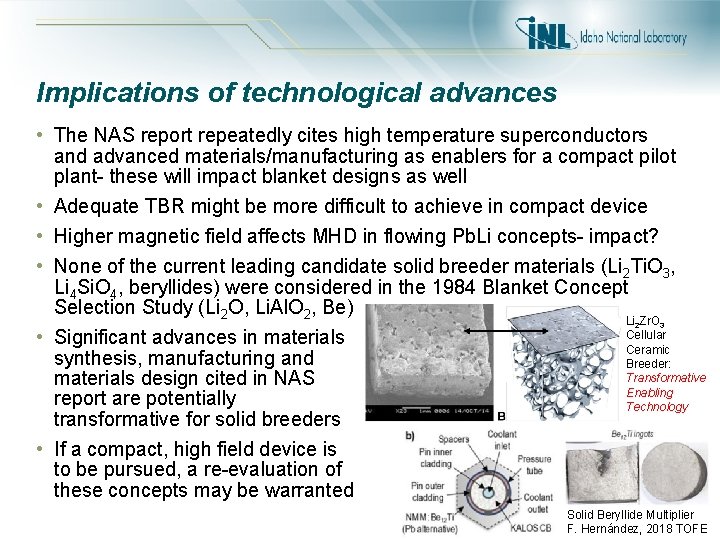
Implications of technological advances • The NAS report repeatedly cites high temperature superconductors and advanced materials/manufacturing as enablers for a compact pilot plant- these will impact blanket designs as well • Adequate TBR might be more difficult to achieve in compact device • Higher magnetic field affects MHD in flowing Pb. Li concepts- impact? • None of the current leading candidate solid breeder materials (Li 2 Ti. O 3, Li 4 Si. O 4, beryllides) were considered in the 1984 Blanket Concept Selection Study (Li 2 O, Li. Al. O 2, Be) Li Zr. O Cellular • Significant advances in materials Ceramic synthesis, manufacturing and Breeder: Transformative materials design cited in NAS Enabling report are potentially Technology transformative for solid breeders • If a compact, high field device is to be pursued, a re-evaluation of these concepts may be warranted 2 3 Solid Beryllide Multiplier F. Hernández, 2018 TOFE
- Slides: 12