
Closing Balances and the Trial Balance Whats Inside

Closing Balances and the Trial Balance
What’s Inside ? Learning Objectives hink Corner Balancing the account Trial Balance uiz Corner Balancing the account Trial Balance
Learning Objectives After reading this chapter, you will be able to: Close accounts at the end of a month. Close accounts at the end of a financial year. Prepare accounts using the running balance method. Prepare a trial balance and state its uses and disadvantages.
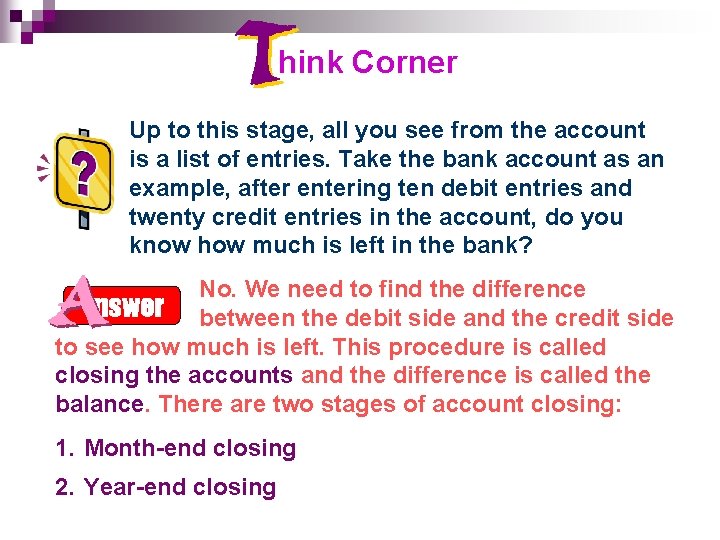
hink Corner Up to this stage, all you see from the account is a list of entries. Take the bank account as an example, after entering ten debit entries and twenty credit entries in the account, do you know how much is left in the bank? No. We need to find the difference nswer between the debit side and the credit side to see how much is left. This procedure is called closing the accounts and the difference is called the balance. There are two stages of account closing: 1. Month-end closing 2. Year-end closing
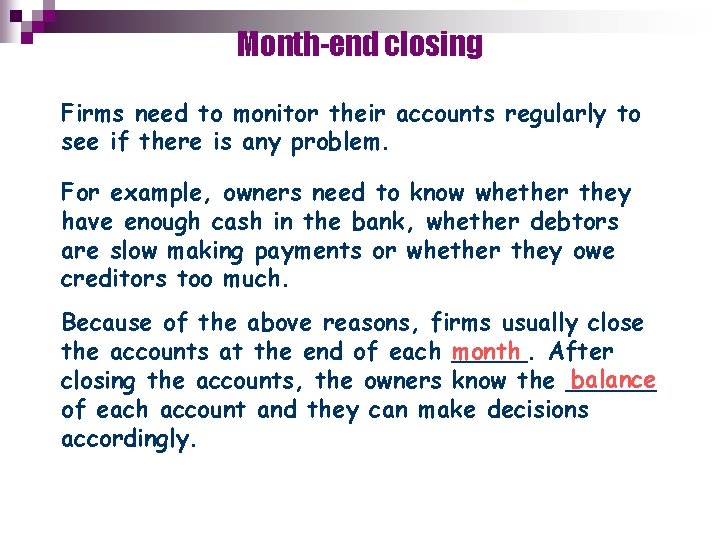
Month-end closing Firms need to monitor their accounts regularly to see if there is any problem. For example, owners need to know whether they have enough cash in the bank, whether debtors are slow making payments or whether they owe creditors too much. Because of the above reasons, firms usually close month After the accounts at the end of each _____. balance closing the accounts, the owners know the ______ of each account and they can make decisions accordingly.
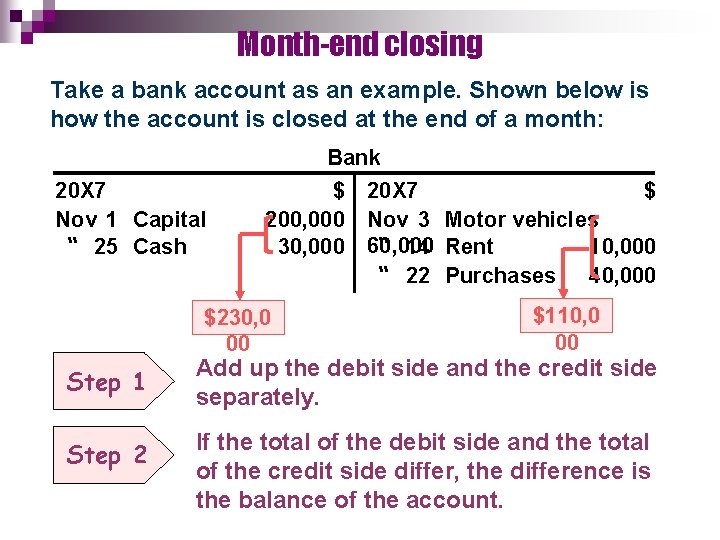
Month-end closing Take a bank account as an example. Shown below is how the account is closed at the end of a month: Bank 20 X 7 Nov 1 Capital “ 25 Cash $ 200, 000 30, 000 $230, 0 00 20 X 7 $ Nov 3 Motor vehicles 60, 000 “ 14 Rent 10, 000 “ 22 Purchases 40, 000 $110, 0 00 Step 1 Add up the debit side and the credit side separately. Step 2 If the total of the debit side and the total of the credit side differ, the difference is the balance of the account.
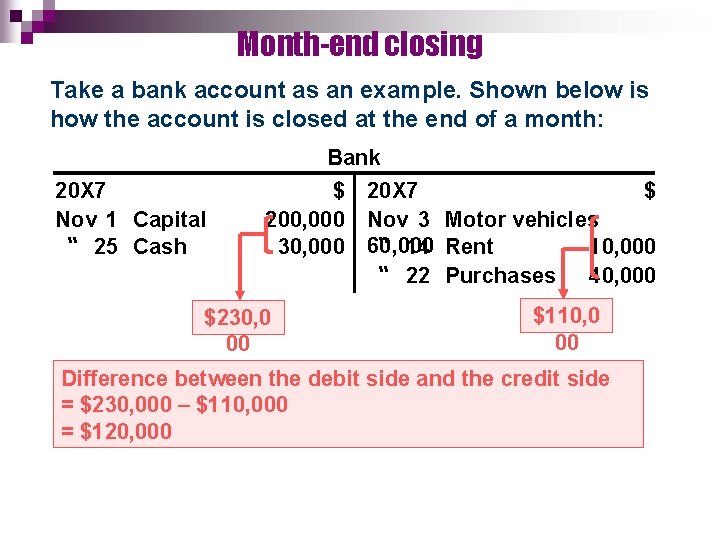
Month-end closing Take a bank account as an example. Shown below is how the account is closed at the end of a month: Bank 20 X 7 Nov 1 Capital “ 25 Cash $ 200, 000 30, 000 $230, 0 00 20 X 7 $ Nov 3 Motor vehicles 60, 000 “ 14 Rent 10, 000 “ 22 Purchases 40, 000 $110, 0 00 Difference between the debit side and the credit side = $230, 000 – $110, 000 = $120, 000
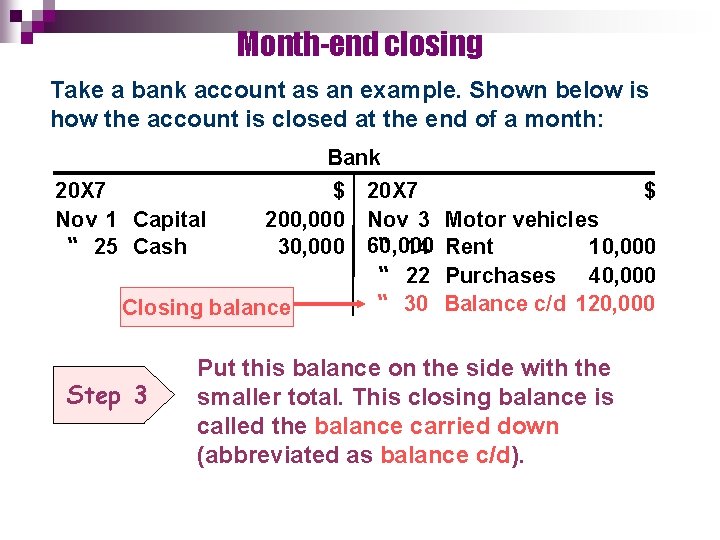
Month-end closing Take a bank account as an example. Shown below is how the account is closed at the end of a month: Bank 20 X 7 Nov 1 Capital “ 25 Cash $ 200, 000 30, 000 Closing balance Step 3 20 X 7 Nov 3 60, 000 “ 14 “ 22 “ 30 $ Motor vehicles Rent 10, 000 Purchases 40, 000 Balance c/d 120, 000 Put this balance on the side with the smaller total. This closing balance is called the balance carried down (abbreviated as balance c/d).
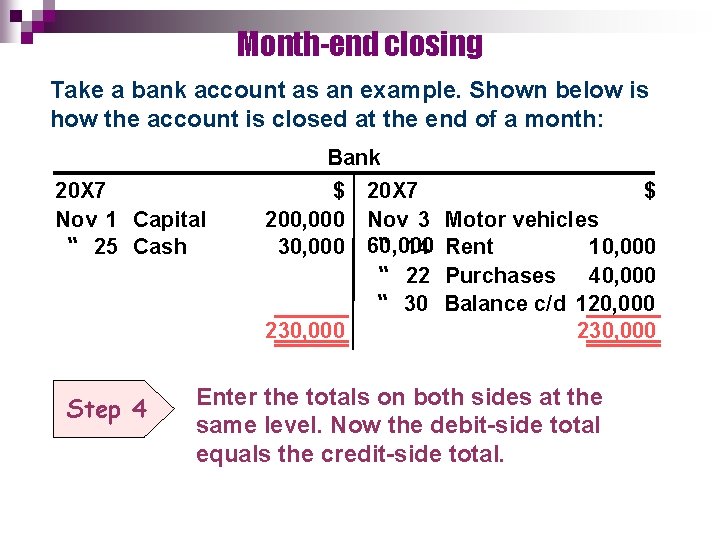
Month-end closing Take a bank account as an example. Shown below is how the account is closed at the end of a month: Bank 20 X 7 Nov 1 Capital “ 25 Cash $ 200, 000 30, 000 230, 000 Step 4 20 X 7 Nov 3 60, 000 “ 14 “ 22 “ 30 $ Motor vehicles Rent 10, 000 Purchases 40, 000 Balance c/d 120, 000 230, 000 Enter the totals on both sides at the same level. Now the debit-side total equals the credit-side total.

Month-end closing Take a bank account as an example. Shown below is how the account is closed at the end of a month: Bank 20 X 7 Nov 1 Capital “ 25 Cash $ 200, 000 30, 000 230, 000 Dec 1 Balance b/d 120, 000 Step 5 20 X 7 Nov 3 60, 000 “ 14 “ 22 “ 30 $ Motor vehicles Rent 10, 000 Purchases 40, 000 Balance c/d 120, 000 230, 000 Opening balance The closing balance of the current month is the opening balance of the next month. This is called the balance brought down (abbreviated as balance b/d).
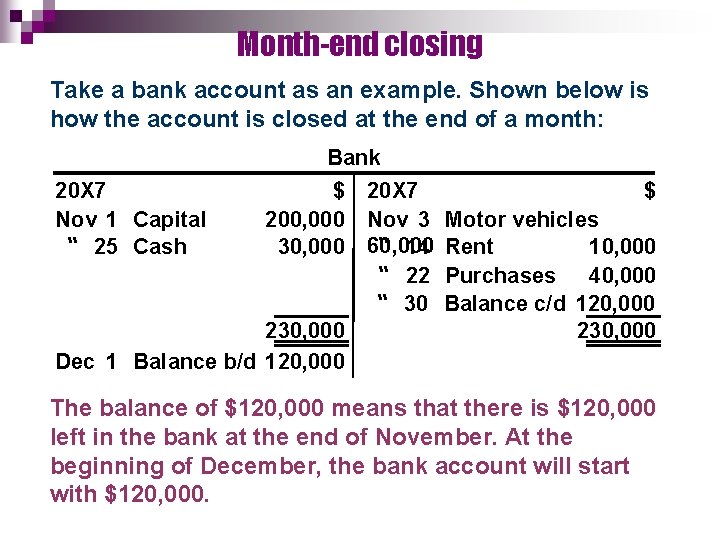
Month-end closing Take a bank account as an example. Shown below is how the account is closed at the end of a month: Bank 20 X 7 Nov 1 Capital “ 25 Cash $ 200, 000 30, 000 230, 000 Dec 1 Balance b/d 120, 000 20 X 7 Nov 3 60, 000 “ 14 “ 22 “ 30 $ Motor vehicles Rent 10, 000 Purchases 40, 000 Balance c/d 120, 000 230, 000 The balance of $120, 000 means that there is $120, 000 left in the bank at the end of November. At the beginning of December, the bank account will start with $120, 000.

Month-end closing From the above example, the balance c/d is on the credit side of the bank account. This means that the debit total is greater than the credit total. We call debit balance this balance a ______. $ $ When the credit total is greater than the debit total, the balance c/d would be on the debit side. balance This is a credit ______. $ $

Month-end closing When the debit total is equal to the credit total, balance there would be no balance c/d. This is a zero _____. $ $ Debit total > Credit total Debit total < Credit total Debit balance Credit balance Debit total = Credit total Zero balance Note: Assets and expenses accounts usually have debit balances. Capital, liabilities and revenues accounts usually have credit balances. Learning Objectives uiz Corner
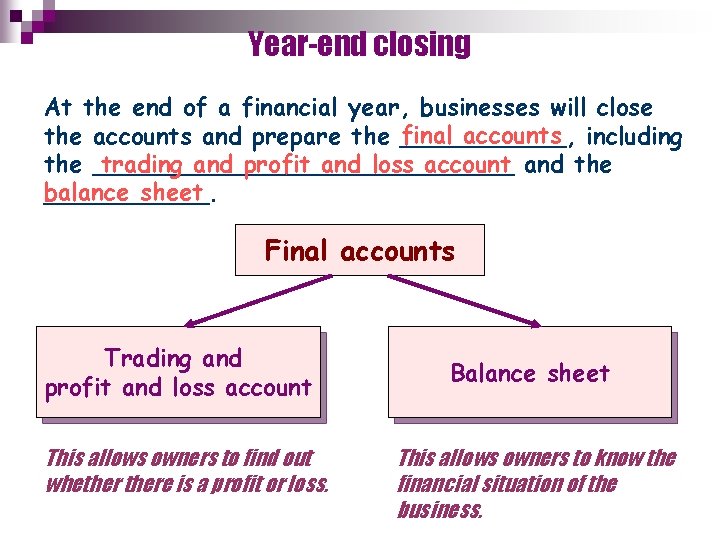
Year-end closing At the end of a financial year, businesses will close final accounts including the accounts and prepare the ______, trading and profit and loss account and the ______________ balance sheet ______. Final accounts Trading and profit and loss account This allows owners to find out whethere is a profit or loss. Balance sheet This allows owners to know the financial situation of the business.
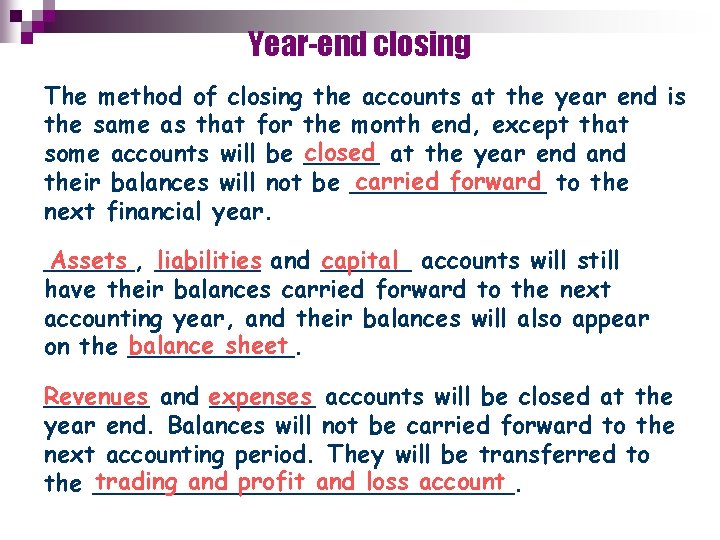
Year-end closing The method of closing the accounts at the year end is the same as that for the month end, except that closed at the year end and some accounts will be _____ carried forward to their balances will not be _______ next financial year. ______, Assets _______ liabilities and ______ capital accounts will still have their balances carried forward to the next accounting year, and their balances will also appear balance sheet on the ______. Revenues _______ and expenses _______ accounts will be closed at the year end. Balances will not be carried forward to the next accounting period. They will be transferred to trading and profit and loss account the ______________.

Year-end closing for revenues and expenses At the year end, the sales and purchases accounts will be closed and their balances will be transferred to the trading account while other revenues and expenses _______, accounts will be closed and their balances transferred profit and loss account to the _________. Example 1: JC Company’s financial year ended on 31 December 20 X 8. The sales account and the electricity account on that date would appear as:
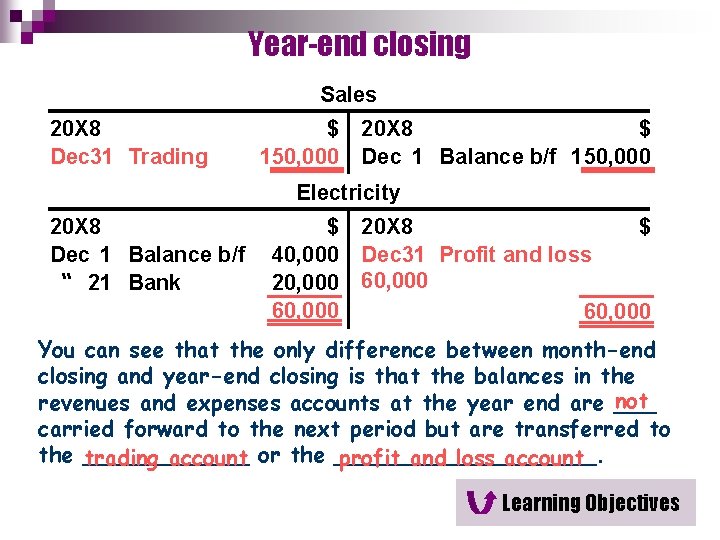
Year-end closing Sales 20 X 8 Dec 31 Trading $ 150, 000 20 X 8 $ Dec 1 Balance b/f 150, 000 Electricity 20 X 8 Dec 1 Balance b/f “ 21 Bank $ 40, 000 20, 000 60, 000 20 X 8 $ Dec 31 Profit and loss 60, 000 You can see that the only difference between month-end closing and year-end closing is that the balances in the not revenues and expenses accounts at the year end are ___ carried forward to the next period but are transferred to the ______ trading account or the __________. profit and loss account Learning Objectives

Computerised account When accounting records are kept on computers, the accounts are usually drawn up in three columns instead of in debit entries one for _____ credit T form: one column for ______, and the last one for the ______. entries balance Using this kind of account, the balance is calculated after running balance each entry. Therefore, it is called the _______ method ______. Example: Sally Tong 20 X 7 $ 20 X 7 Sep 15 Bank 15, 000 Sep 1 Purchases “ 18 Returns outwards 5, 000 “ 7 Purchases “ 30 Balance c/f 20, 000 “ 25 Purchases 40, 000 $ 10, 000 20, 000 10, 000 40, 000
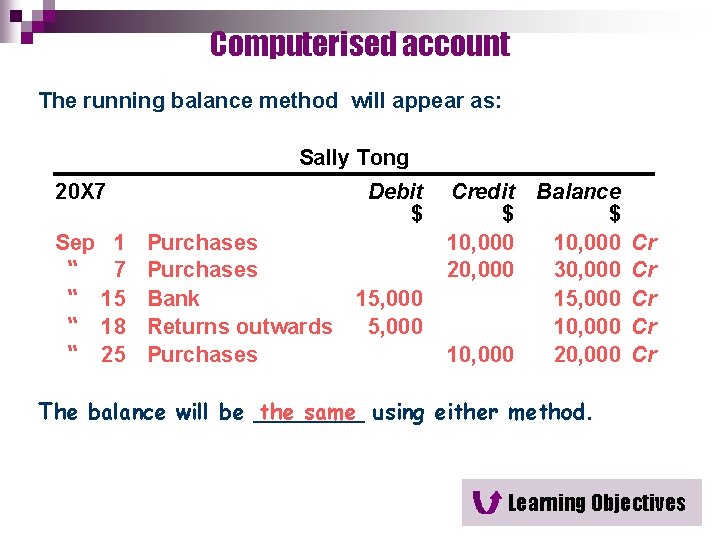
Computerised account The running balance method will appear as: Sally Tong 20 X 7 Sep 1 “ 7 “ 15 “ 18 “ 25 Debit $ Purchases Bank 15, 000 Returns outwards 5, 000 Purchases Credit $ 10, 000 20, 000 10, 000 Balance $ 10, 000 30, 000 15, 000 10, 000 20, 000 Cr Cr Cr The balance will be ____ the same using either method. Learning Objectives
hink Corner After the year-end closing, businesses will prepare their final accounts. Should we do this immediately after closing the accounts? Or should we do something else before preparing the final accounts? nswer We should prepare a trial balance after closing the accounts at the year end and before preparing the final accounts. A trial balance is a list of all debit balances and credit balances in the books. It is used to check the accuracy of entries in the accounts and identify errors in the books.
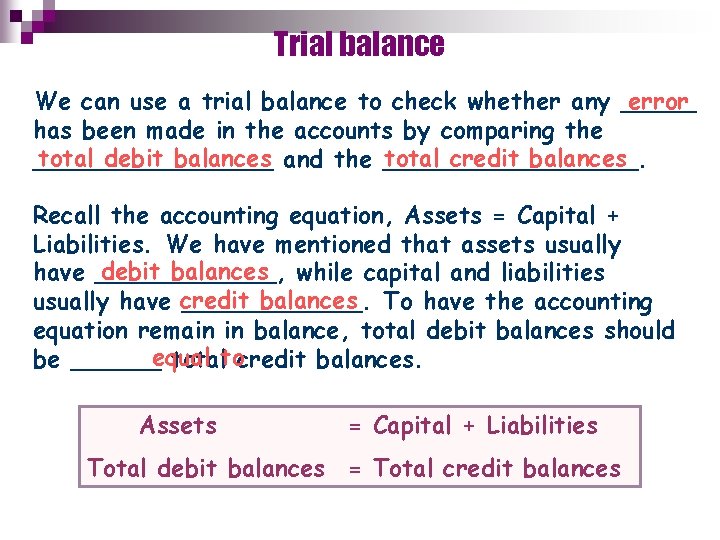
Trial balance We can use a trial balance to check whether any _____ error has been made in the accounts by comparing the total debit balances and the _________. total credit balances ________ Recall the accounting equation, Assets = Capital + Liabilities. We have mentioned that assets usually debit balances while capital and liabilities have ______, balances To have the accounting usually have credit ______. equation remain in balance, total debit balances should be ______equal totaltocredit balances. Assets = Capital + Liabilities Total debit balances = Total credit balances
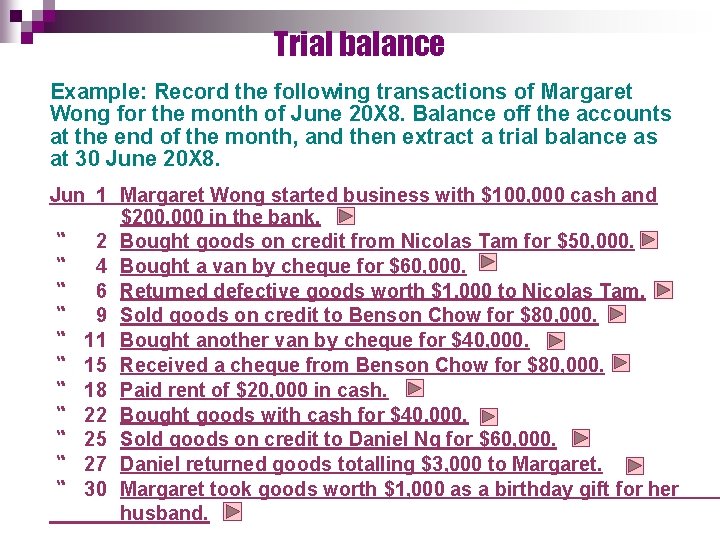
Trial balance Example: Record the following transactions of Margaret Wong for the month of June 20 X 8. Balance off the accounts at the end of the month, and then extract a trial balance as at 30 June 20 X 8. Jun 1 Margaret Wong started business with $100, 000 cash and $200, 000 in the bank. “ 2 Bought goods on credit from Nicolas Tam for $50, 000. “ 4 Bought a van by cheque for $60, 000. “ 6 Returned defective goods worth $1, 000 to Nicolas Tam. “ 9 Sold goods on credit to Benson Chow for $80, 000. “ 11 Bought another van by cheque for $40, 000. “ 15 Received a cheque from Benson Chow for $80, 000. “ 18 Paid rent of $20, 000 in cash. “ 22 Bought goods with cash for $40, 000. “ 25 Sold goods on credit to Daniel Ng for $60, 000. “ 27 Daniel returned goods totalling $3, 000 to Margaret. “ 30 Margaret took goods worth $1, 000 as a birthday gift for her husband.
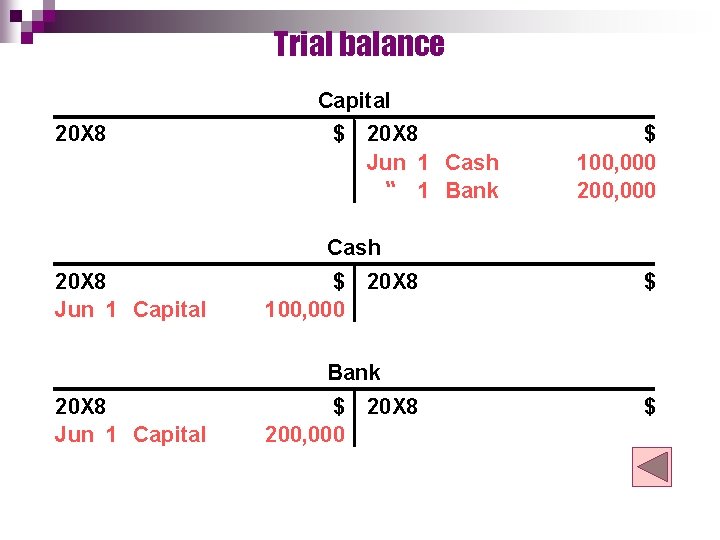
Trial balance Capital 20 X 8 $ 20 X 8 Jun 1 Cash “ 1 Bank $ 100, 000 200, 000 Cash 20 X 8 Jun 1 Capital $ 100, 000 20 X 8 $ Bank 20 X 8 Jun 1 Capital $ 200, 000 20 X 8 $
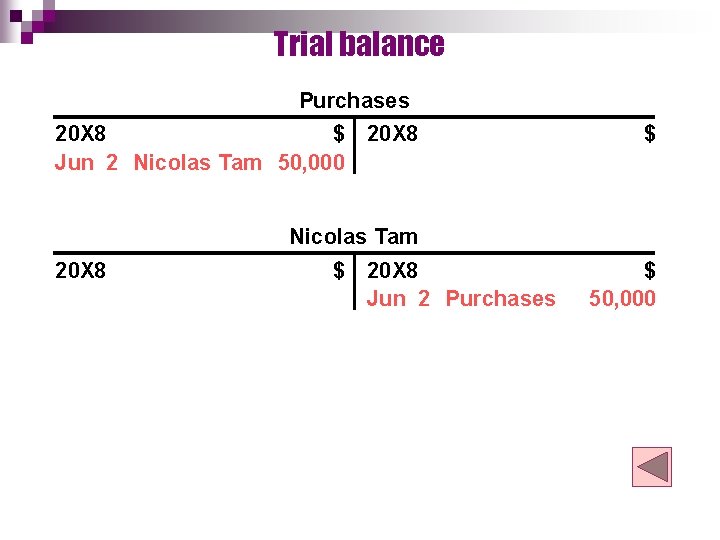
Trial balance Purchases 20 X 8 $ Jun 2 Nicolas Tam 50, 000 20 X 8 $ Nicolas Tam 20 X 8 $ 20 X 8 Jun 2 Purchases $ 50, 000
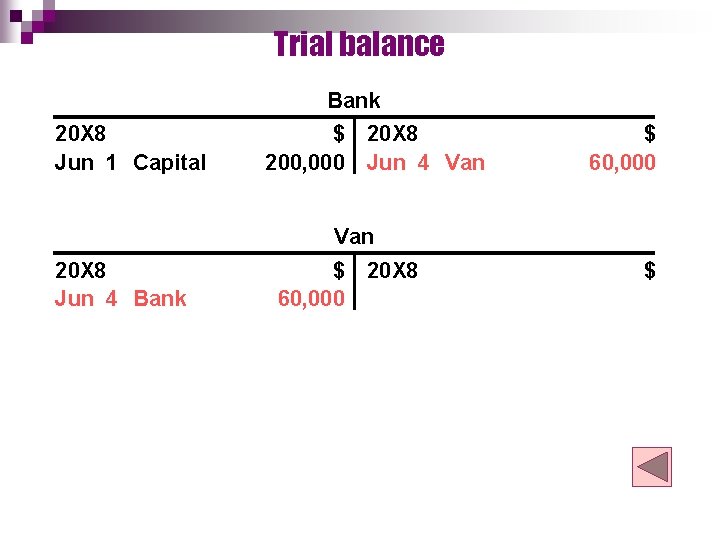
Trial balance Bank 20 X 8 Jun 1 Capital $ 200, 000 20 X 8 Jun 4 Van $ 60, 000 Van 20 X 8 Jun 4 Bank $ 60, 000 20 X 8 $
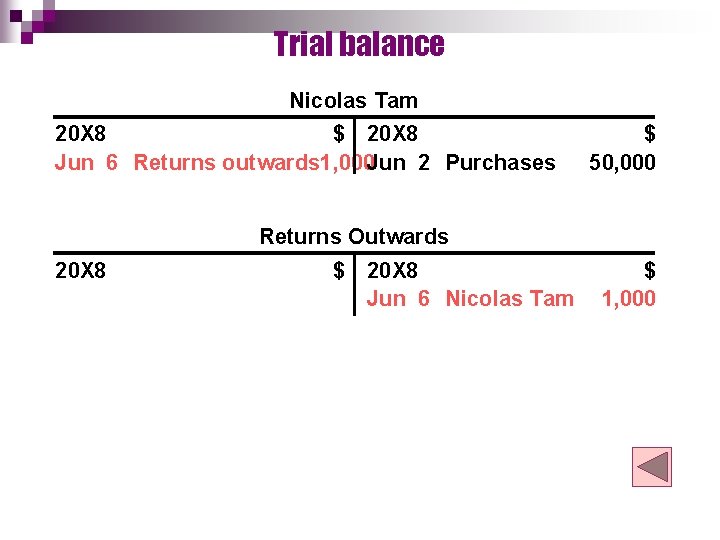
Trial balance Nicolas Tam 20 X 8 $ 20 X 8 Jun 6 Returns outwards 1, 000 Jun 2 Purchases $ 50, 000 Returns Outwards 20 X 8 $ 20 X 8 Jun 6 Nicolas Tam $ 1, 000
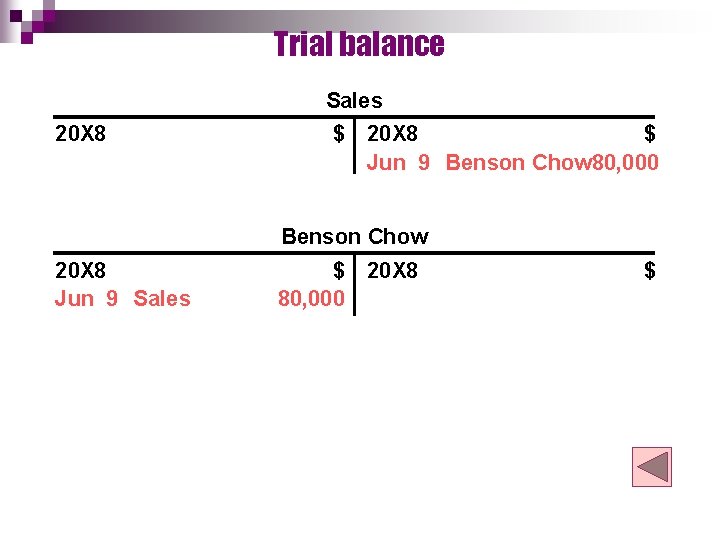
Trial balance Sales 20 X 8 $ Jun 9 Benson Chow 80, 000 Benson Chow 20 X 8 Jun 9 Sales $ 80, 000 20 X 8 $
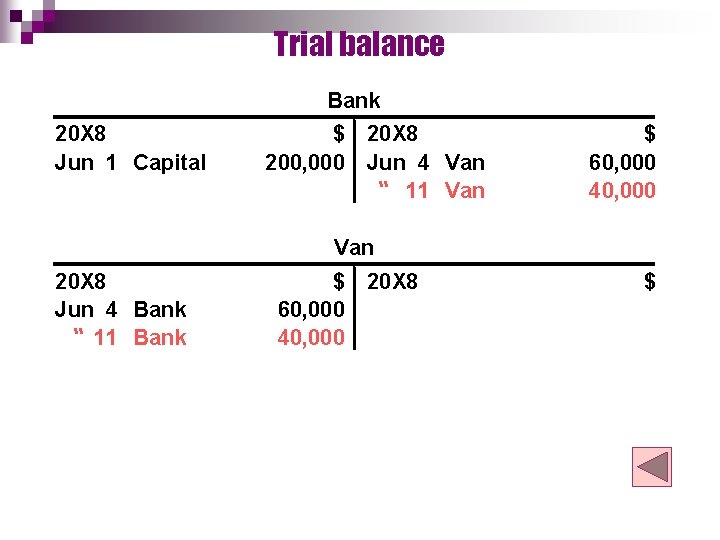
Trial balance Bank 20 X 8 Jun 1 Capital $ 200, 000 20 X 8 Jun 4 Van “ 11 Van $ 60, 000 40, 000 Van 20 X 8 Jun 4 Bank “ 11 Bank $ 60, 000 40, 000 20 X 8 $
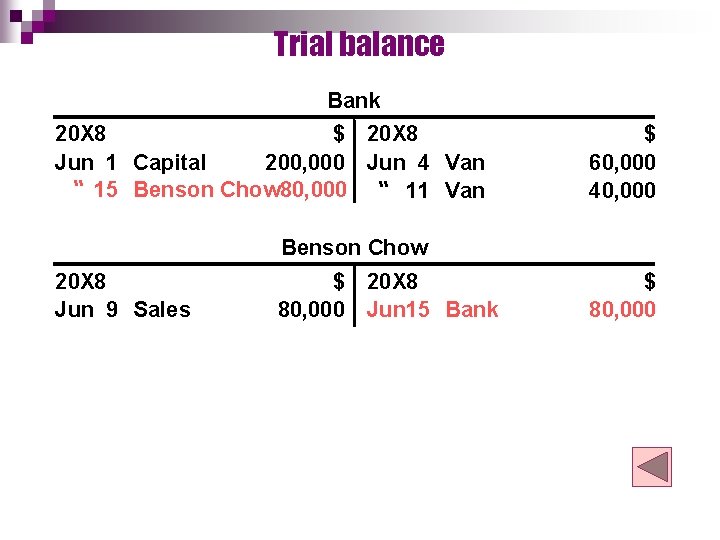
Trial balance Bank 20 X 8 $ 20 X 8 Jun 1 Capital 200, 000 Jun 4 Van “ 15 Benson Chow 80, 000 “ 11 Van $ 60, 000 40, 000 Benson Chow 20 X 8 Jun 9 Sales $ 80, 000 20 X 8 Jun 15 Bank $ 80, 000
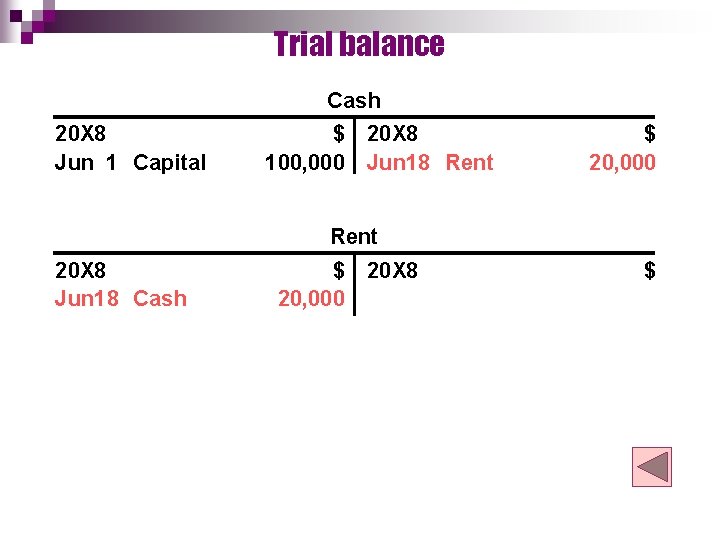
Trial balance Cash 20 X 8 Jun 1 Capital $ 100, 000 20 X 8 Jun 18 Rent $ 20, 000 Rent 20 X 8 Jun 18 Cash $ 20, 000 20 X 8 $
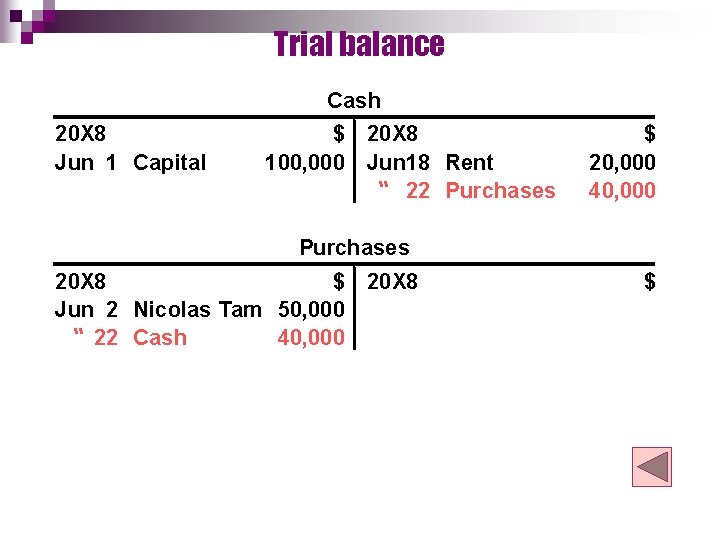
Trial balance Cash 20 X 8 Jun 1 Capital $ 100, 000 20 X 8 Jun 18 Rent “ 22 Purchases $ 20, 000 40, 000 Purchases 20 X 8 $ Jun 2 Nicolas Tam 50, 000 “ 22 Cash 40, 000 20 X 8 $
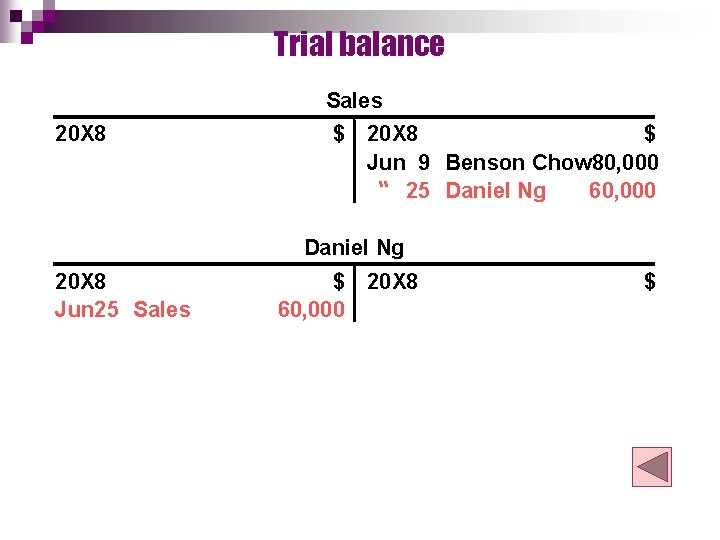
Trial balance Sales 20 X 8 $ Jun 9 Benson Chow 80, 000 “ 25 Daniel Ng 60, 000 Daniel Ng 20 X 8 Jun 25 Sales $ 60, 000 20 X 8 $
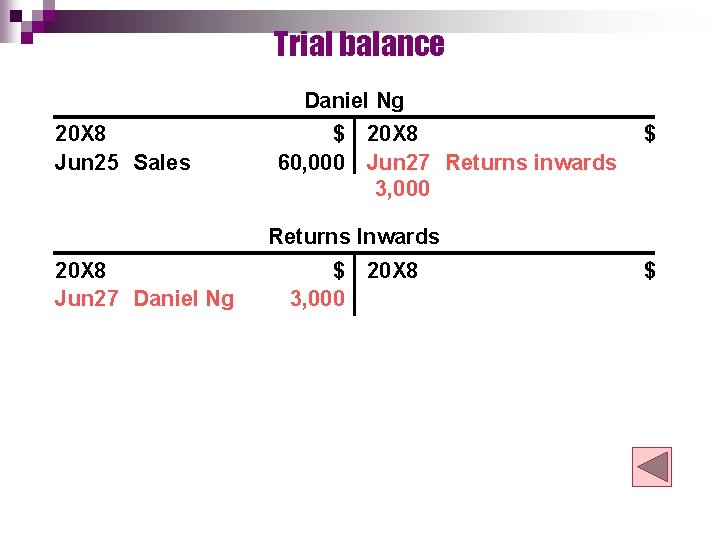
Trial balance Daniel Ng 20 X 8 Jun 25 Sales $ 60, 000 20 X 8 Jun 27 Returns inwards 3, 000 $ Returns Inwards 20 X 8 Jun 27 Daniel Ng $ 3, 000 20 X 8 $
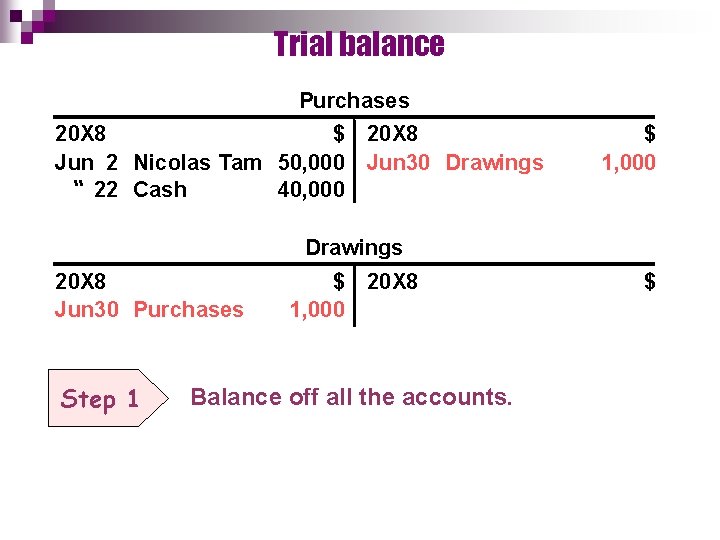
Trial balance Purchases 20 X 8 $ Jun 2 Nicolas Tam 50, 000 “ 22 Cash 40, 000 20 X 8 Jun 30 Drawings $ 1, 000 Drawings 20 X 8 Jun 30 Purchases Step 1 $ 1, 000 20 X 8 Balance off all the accounts. $
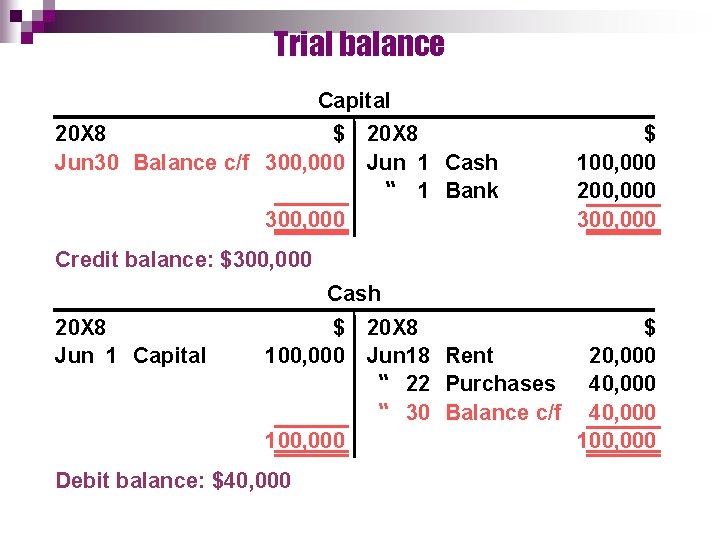
Trial balance Capital 20 X 8 $ Jun 30 Balance c/f 300, 000 20 X 8 Jun 1 Cash “ 1 Bank 300, 000 $ 100, 000 200, 000 300, 000 Credit balance: $300, 000 Cash 20 X 8 Jun 1 Capital $ 100, 000 Debit balance: $40, 000 20 X 8 Jun 18 Rent “ 22 Purchases “ 30 Balance c/f $ 20, 000 40, 000 100, 000
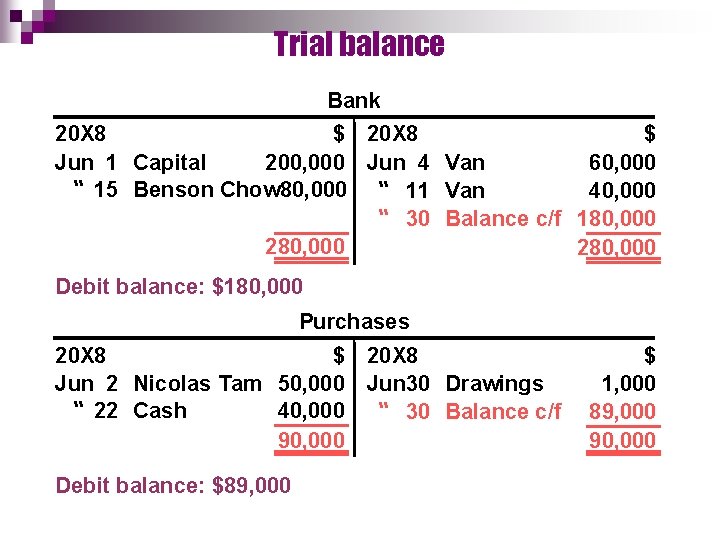
Trial balance Bank 20 X 8 $ Jun 1 Capital 200, 000 Jun 4 Van 60, 000 “ 15 Benson Chow 80, 000 “ 11 Van 40, 000 “ 30 Balance c/f 180, 000 280, 000 Debit balance: $180, 000 Purchases 20 X 8 $ Jun 2 Nicolas Tam 50, 000 “ 22 Cash 40, 000 90, 000 Debit balance: $89, 000 20 X 8 Jun 30 Drawings “ 30 Balance c/f $ 1, 000 89, 000 90, 000
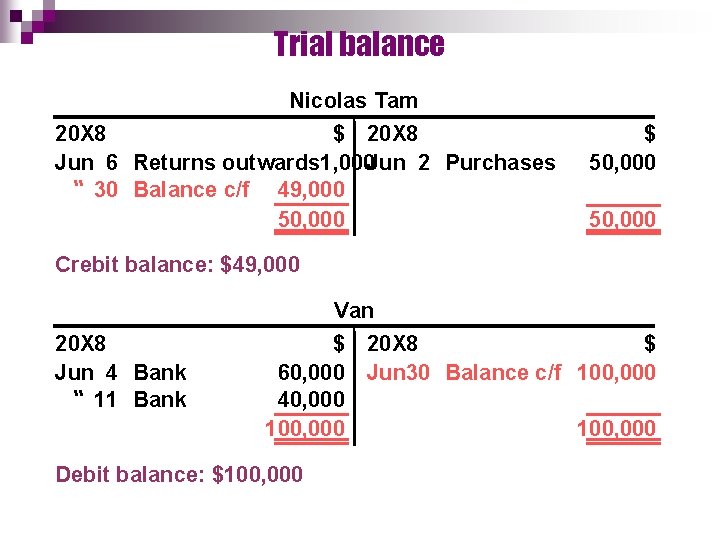
Trial balance Nicolas Tam 20 X 8 $ 20 X 8 Jun 6 Returns outwards 1, 000 Jun 2 Purchases “ 30 Balance c/f 49, 000 50, 000 $ 50, 000 Crebit balance: $49, 000 Van 20 X 8 Jun 4 Bank “ 11 Bank $ 60, 000 40, 000 100, 000 Debit balance: $100, 000 20 X 8 $ Jun 30 Balance c/f 100, 000

Trial balance Returns Outwards 20 X 8 Jun 30 Balance c/f $ 1, 000 20 X 8 Jun 6 Nicolas Tam $ 1, 000 Crebit balance: $1, 000 Sales 20 X 8 $ Jun 30 Balance c/f 140, 000 Crebit balance: $140, 000 20 X 8 $ Jun 9 Benson Chow 80, 000 “ 25 Daniel Ng 60, 000 140, 000
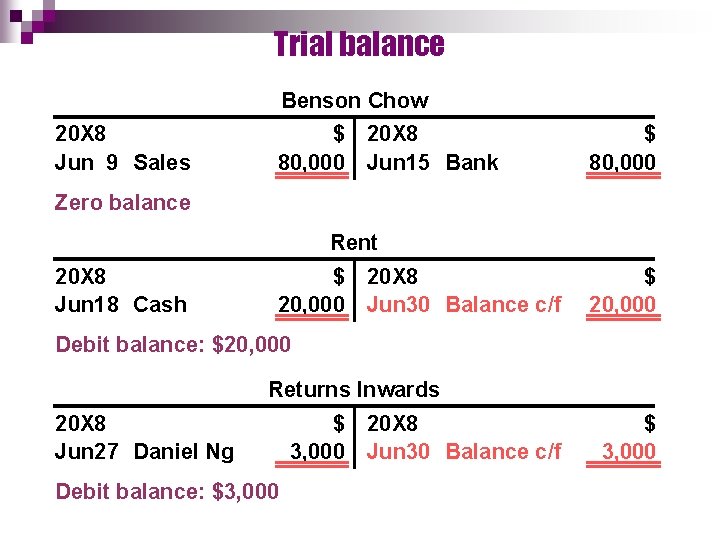
Trial balance Benson Chow 20 X 8 Jun 9 Sales $ 80, 000 20 X 8 Jun 15 Bank $ 80, 000 Zero balance Rent 20 X 8 Jun 18 Cash $ 20, 000 20 X 8 Jun 30 Balance c/f $ 20, 000 Debit balance: $20, 000 Returns Inwards 20 X 8 Jun 27 Daniel Ng Debit balance: $3, 000 $ 3, 000 20 X 8 Jun 30 Balance c/f $ 3, 000
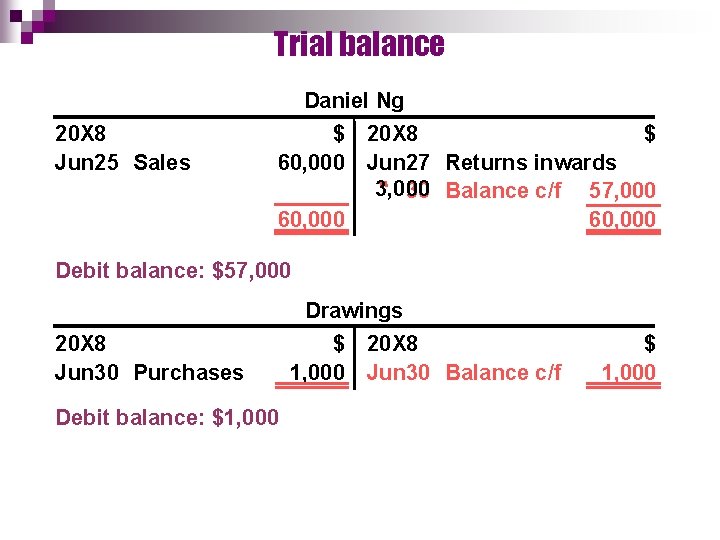
Trial balance Daniel Ng 20 X 8 Jun 25 Sales $ 60, 000 20 X 8 $ Jun 27 Returns inwards 3, 000 “ 30 Balance c/f 57, 000 60, 000 Debit balance: $57, 000 Drawings 20 X 8 Jun 30 Purchases Debit balance: $1, 000 $ 1, 000 20 X 8 Jun 30 Balance c/f $ 1, 000

Trial balance Step 2 List all debit balances and credit balances separately. Margaret Wong Trial Balance as at 30 June 20 X 8 Capital Cash Bank Purchases Nicolas Tam Van Returns outwards Sales Rent Daniel Ng Returns inwards Drawings Dr $ 40, 000 180, 000 89, 000 100, 000 20, 000 57, 000 3, 000 1, 000 Cr $ 300, 000 49, 000 140, 000

Trial balance Step 3 Find the total of debit balances and the total of credit balances and see if they are equal. Margaret Wong Trial Balance as at 30 June 20 X 8 Capital Cash Bank Purchases Nicolas Tam Van Returns outwards Sales Rent Daniel Ng Returns inwards Drawings Dr $ 40, 000 180, 000 89, 000 100, 000 20, 000 57, 000 3, 000 1, 000 490, 000 Cr $ 300, 000 49, 000 140, 000 490, 000
Trial balance Uses of a trial balance: 1. As a basis from which the final accounts are prepared. 2. To identify error(s) in the books. 3. To check whether the total debit balances and the total credit balances are equal. Disadvantage of a trial balance: Some errors may still exist even if the trial balance agrees. uiz Corner
- Slides: 43