
Closer to Fair Social Justice in Mathematics Math
![Gini in the News “…income inequality where [the US] ranks worse than the Ivory](https://slidetodoc.com/presentation_image_h2/6c3a0bad6bf7e5ed2a52a85e3e27edf8/image-50.jpg "Gini in the News “…income inequality where [the US] ranks worse than the Ivory")
- Slides: 60
Closer to Fair: Social Justice in Mathematics Math for Social Justice Dr. David Kung St. Mary's College of Maryland (Notes/slides/activites – on my webpage soon!)
A Talk in Two Acts: 1. 2. Social Justice in Mathematics for Social Justice
Imagine this is the first day of Calculus. The students wander in talking/laughing, and then sit down. You start class. Five minutes later, a student walks. Where does the student sit? Copyright David Kung, 2012. Do not use without permission.
What if… … the student is: n n n your strongest student – everyone knows it? an African-American male, the only black student in the class? female President of the Math Club? a female Mexican immigrant with a strong accent? a female 35 -year old returning student? Copyright David Kung, 2012. Do not use without permission.
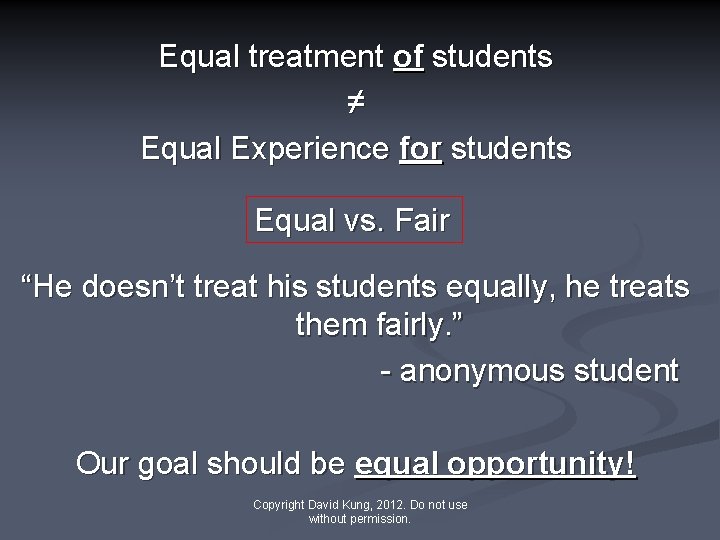
Equal treatment of students ≠ Equal Experience for students Equal vs. Fair “He doesn’t treat his students equally, he treats them fairly. ” - anonymous student Our goal should be equal opportunity! Copyright David Kung, 2012. Do not use without permission.
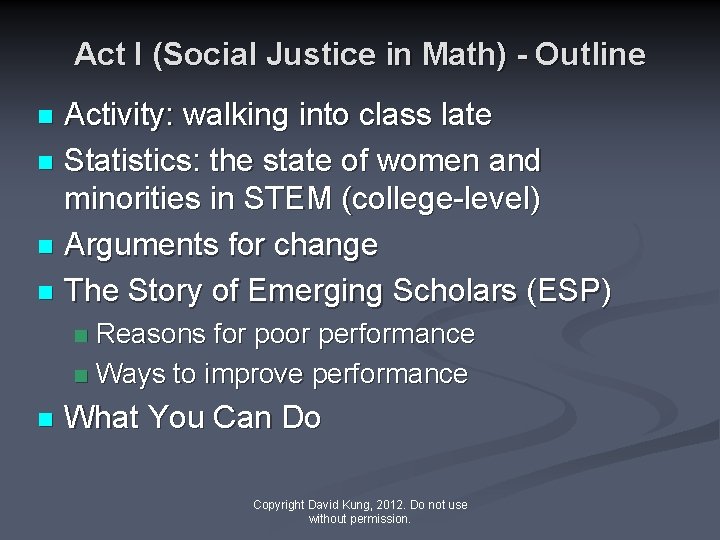
Act I (Social Justice in Math) - Outline Activity: walking into class late n Statistics: the state of women and minorities in STEM (college-level) n Arguments for change n The Story of Emerging Scholars (ESP) n Reasons for poor performance n Ways to improve performance n n What You Can Do Copyright David Kung, 2012. Do not use without permission.
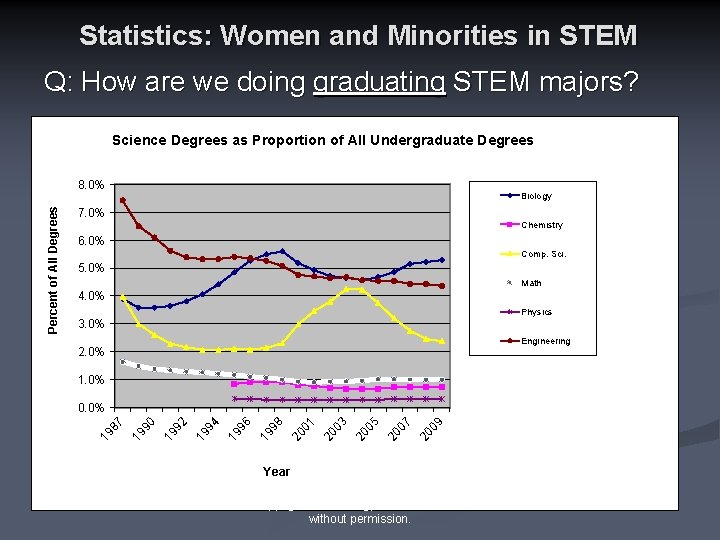
Statistics: Women and Minorities in STEM Q: How are we doing graduating STEM majors? Science Degrees as Proportion of All Undergraduate Degrees Source: NSF Bachelor's degrees awarded, by field, citizenship, and 8. 0% 7. 0% race/ethnicity of recipients: 6. 0% http: //www. nsf. gov/statistics/degrees/ Chemistry Comp. Sci. 5. 0% Math 4. 0% Physics 3. 0% Engineering 2. 0% 1. 0% 09 20 07 20 05 20 03 20 01 20 98 19 96 19 94 19 92 19 90 19 87 0. 0% 19 Percent of All Degrees Biology Year Copyright David Kung, 2012. Do not use without permission.
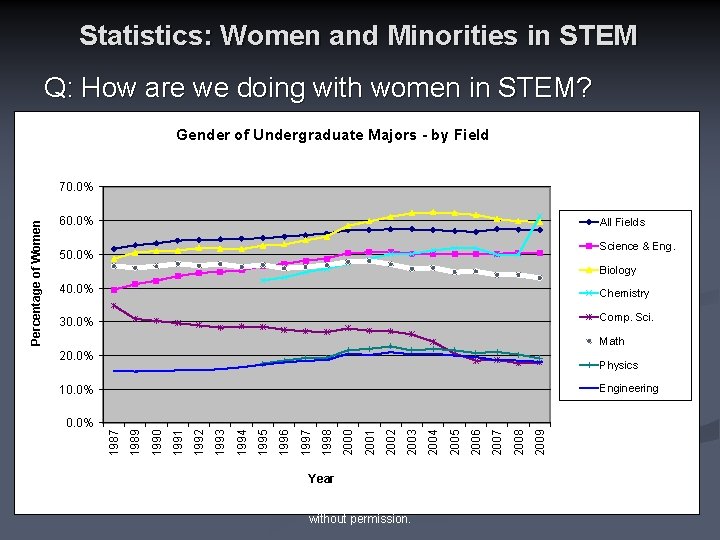
Statistics: Women and Minorities in STEM Q: How are we doing with women in STEM? Gender of Undergraduate Majors - by Field 60. 0% All Fields Science & Eng. 50. 0% Biology 40. 0% Chemistry 30. 0% Comp. Sci. Math 20. 0% Physics Engineering Year Copyright David Kung, 2012. Do not use without permission. 2009 2008 2007 2006 2005 2004 2003 2002 2001 2000 1998 1997 1996 1995 1994 1993 1992 1991 1990 0. 0% 1989 10. 0% 1987 Percentage of Women 70. 0%
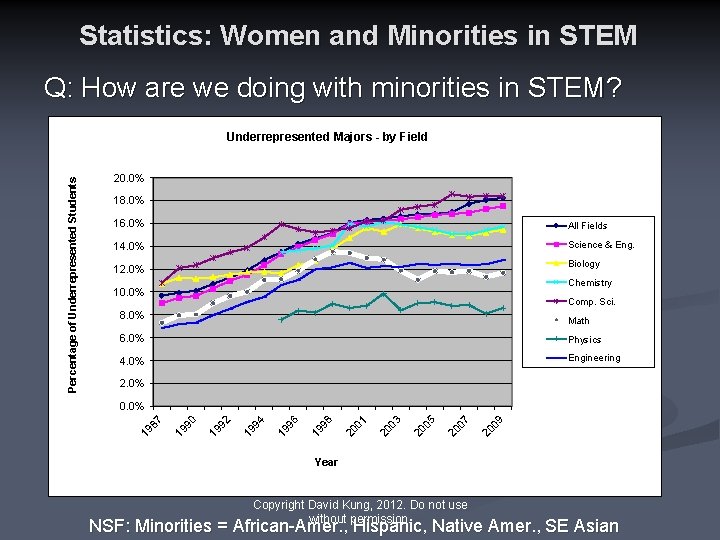
Statistics: Women and Minorities in STEM Q: How are we doing with minorities in STEM? 20. 0% 18. 0% 16. 0% All Fields 14. 0% Science & Eng. Biology 12. 0% Chemistry 10. 0% Comp. Sci. 8. 0% Math 6. 0% Physics 4. 0% Engineering 2. 0% 09 20 07 20 05 20 03 20 01 20 98 19 96 19 94 19 92 19 90 19 87 0. 0% 19 Percentage of Underrepresented Students Underrepresented Majors - by Field Year Copyright David Kung, 2012. Do not use without permission. NSF: Minorities = African-Amer. , Hispanic, Native Amer. , SE Asian
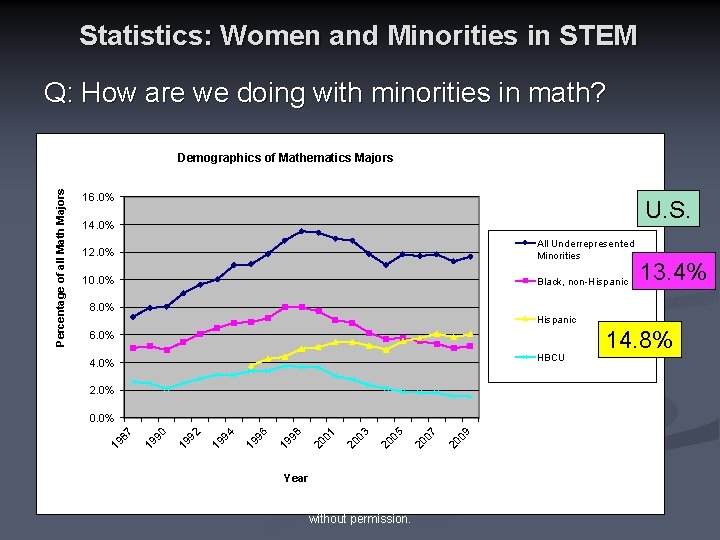
Statistics: Women and Minorities in STEM Q: How are we doing with minorities in math? 16. 0% U. S. 14. 0% 12. 0% All Underrepresented Minorities 10. 0% Black, non-Hispanic 8. 0% 13. 4% Hispanic 6. 0% HBCU 4. 0% 2. 0% 9 20 0 7 20 0 5 20 0 3 20 0 1 20 0 8 19 9 6 19 9 4 19 9 2 19 9 0 19 9 7 0. 0% 19 8 Percentage of all Math Majors Demographics of Mathematics Majors Year Copyright David Kung, 2012. Do not use without permission. 14. 8%
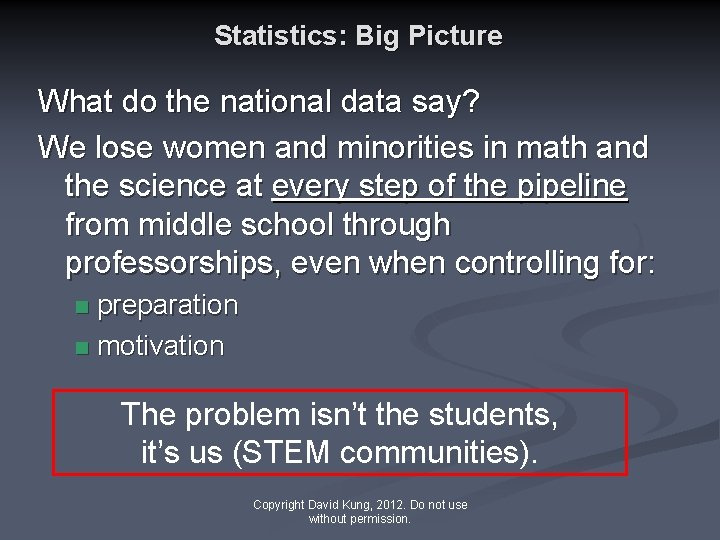
Statistics: Big Picture What do the national data say? We lose women and minorities in math and the science at every step of the pipeline from middle school through professorships, even when controlling for: preparation n motivation n The problem isn’t the students, it’s us (STEM communities). Copyright David Kung, 2012. Do not use without permission.
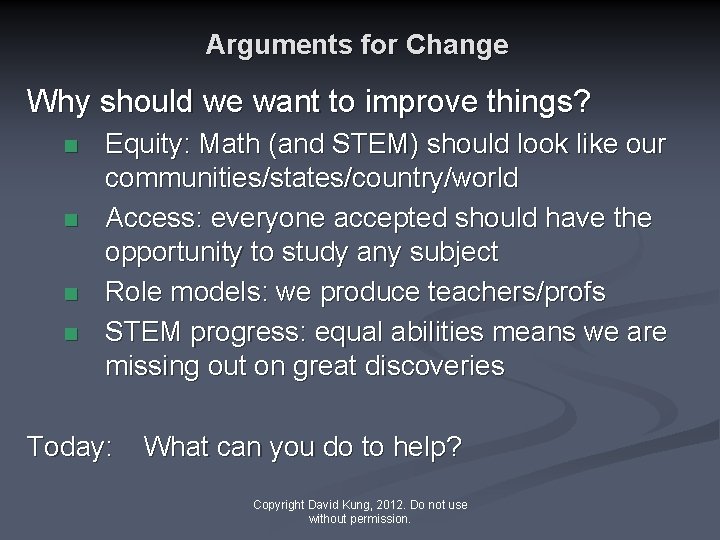
Arguments for Change Why should we want to improve things? n n Equity: Math (and STEM) should look like our communities/states/country/world Access: everyone accepted should have the opportunity to study any subject Role models: we produce teachers/profs STEM progress: equal abilities means we are missing out on great discoveries Today: What can you do to help? Copyright David Kung, 2012. Do not use without permission.
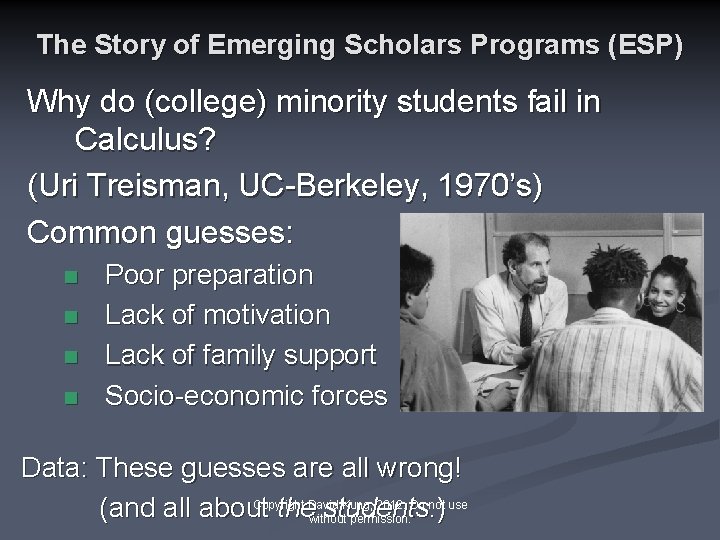
The Story of Emerging Scholars Programs (ESP) Why do (college) minority students fail in Calculus? (Uri Treisman, UC-Berkeley, 1970’s) Common guesses: n n Poor preparation Lack of motivation Lack of family support Socio-economic forces Data: These guesses are all wrong! Copyright David Kung, 2012. Do not use (and all about thewithout students. ) permission.
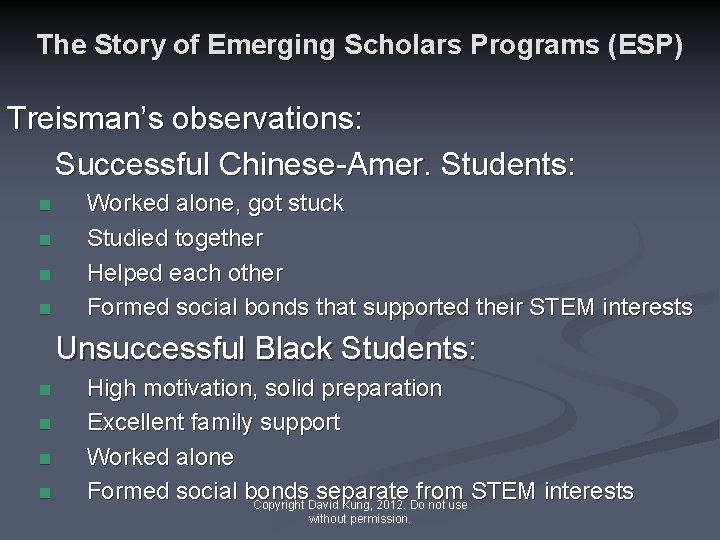
The Story of Emerging Scholars Programs (ESP) Treisman’s observations: Successful Chinese-Amer. Students: n n Worked alone, got stuck Studied together Helped each other Formed social bonds that supported their STEM interests Unsuccessful Black Students: n n High motivation, solid preparation Excellent family support Worked alone Formed social bonds separate from STEM interests Copyright David Kung, 2012. Do not use without permission.
The Story of Emerging Scholars Programs (ESP) Treisman’s idea: Put students in positions where n they are challenged (not remediated) n they build social networks that support their interests in mathematics n they get “the good stuff” Copyright David Kung, 2012. Do not use without permission.
Research supporting ESPs Stereotype Threat (Steele & Aronson) Q: What affects underrepresented students’ performance? A: The thought that they are underrepresented. Replicated in sciences, math for minorities, women… Antidote: “This test doesn’t differentiate by race, gender, etc. ” Copyright David Kung, 2012. Do not use without permission.
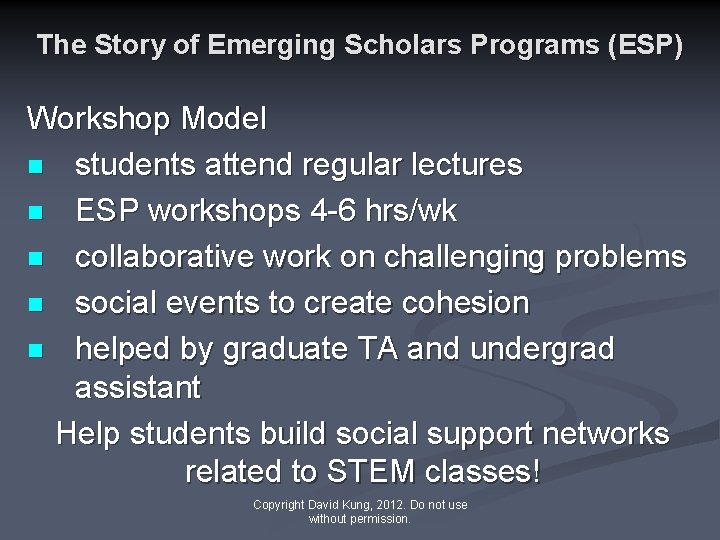
The Story of Emerging Scholars Programs (ESP) Workshop Model n students attend regular lectures n ESP workshops 4 -6 hrs/wk n collaborative work on challenging problems n social events to create cohesion n helped by graduate TA and undergrad assistant Help students build social support networks related to STEM classes! Copyright David Kung, 2012. Do not use without permission.
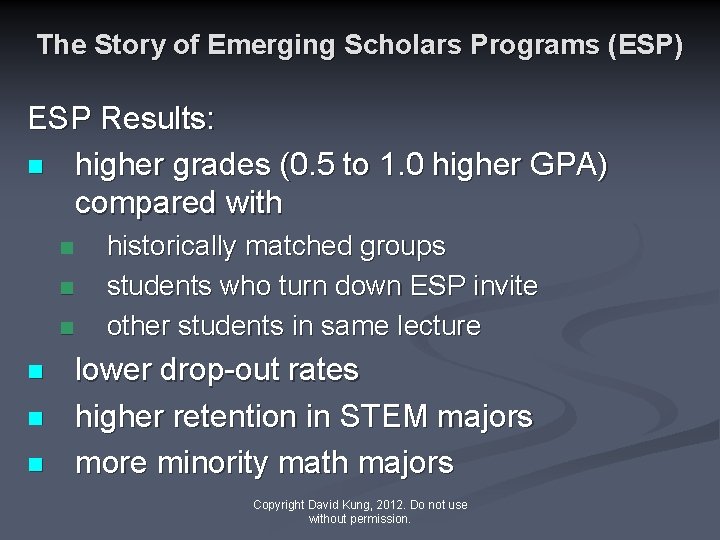
The Story of Emerging Scholars Programs (ESP) ESP Results: n higher grades (0. 5 to 1. 0 higher GPA) compared with n n n historically matched groups students who turn down ESP invite other students in same lecture lower drop-out rates higher retention in STEM majors more minority math majors Copyright David Kung, 2012. Do not use without permission.
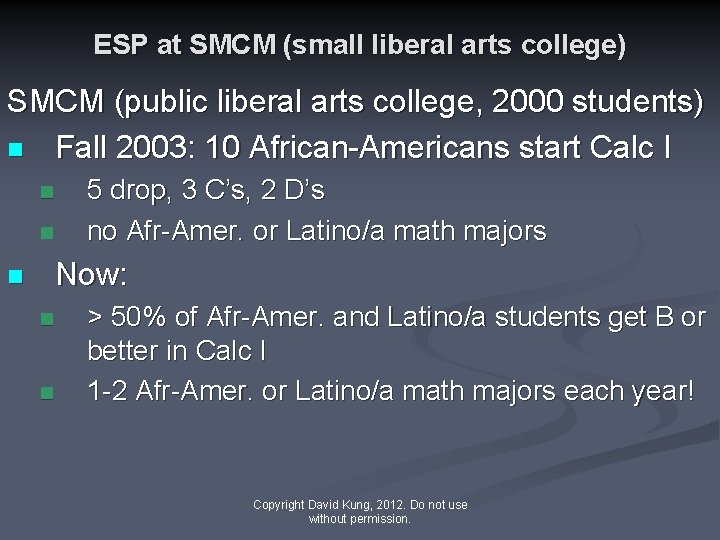
ESP at SMCM (small liberal arts college) SMCM (public liberal arts college, 2000 students) n Fall 2003: 10 African-Americans start Calc I n n 5 drop, 3 C’s, 2 D’s no Afr-Amer. or Latino/a math majors Now: n n n > 50% of Afr-Amer. and Latino/a students get B or better in Calc I 1 -2 Afr-Amer. or Latino/a math majors each year! Copyright David Kung, 2012. Do not use without permission.
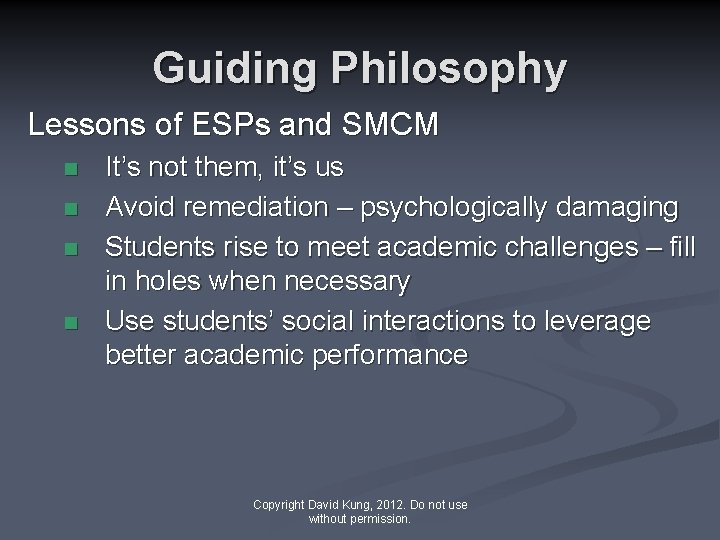
Guiding Philosophy Lessons of ESPs and SMCM n n It’s not them, it’s us Avoid remediation – psychologically damaging Students rise to meet academic challenges – fill in holes when necessary Use students’ social interactions to leverage better academic performance Copyright David Kung, 2012. Do not use without permission.
What You Can Do Work to level the playing field by …. n n n Providing support to underrepresented students Structuring social interactions (in and out of class) to help all students build supportive social networks Find opportunities for your (underrepresented) students (like the ESP-REU @ SMCM) What’s the goal? Closer to fair! Copyright David Kung, 2012. Do not use without permission.
End of Act I (Social Justice in Mathematics) You: (applause) Dave: Thanks, we’re going to take a short intermission, but before we go to Act II, are there any questions on Act I? You: Dave, this is interesting, but I have a question … (ad lib)
Intermission Ellie (now 15 months) Copyright David Kung, 2012. Do not use without permission.
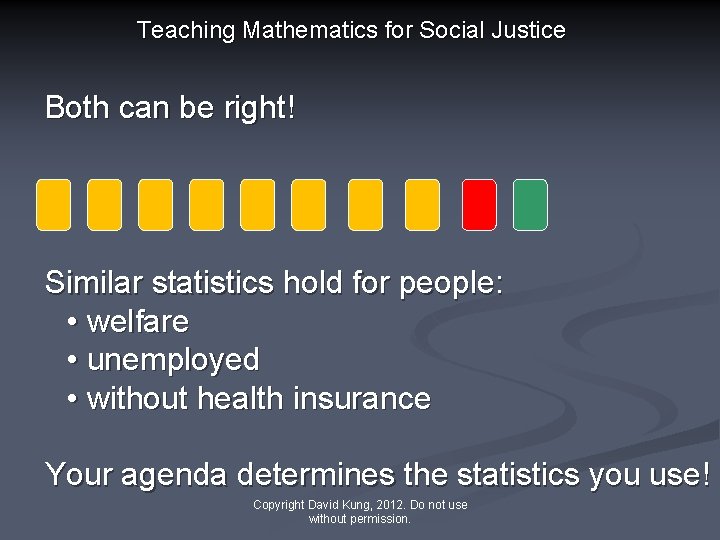
Teaching Mathematics for Social Justice Act II: Mathematics for Social Justice Sample Activity: Annual Hospital Report Administrator: 90% of patients who spend the night check out within a week. Nurses: 80% of the patients who stayed last night have been here over a year! Q: Can they both be right? Copyright David Kung, 2012. Do not use without permission.
Teaching Mathematics for Social Justice Both can be right! Similar statistics hold for people: • welfare • unemployed • without health insurance Your agenda determines the statistics you use! Copyright David Kung, 2012. Do not use without permission.
Teaching Mathematics for Social Justice Act II – Outline n Sample Activity: Hospital Admin. n What our students need vs. What we give them n Description of Math for Social Justice courses (mine and others) Example Activities: n Occupy Math (inequality & Gini coeffs. ) n Critical Thinking (wind energy/percentages) n Obesity in Schools (correlations) Copyright David Kung, 2012. Do not use without permission.
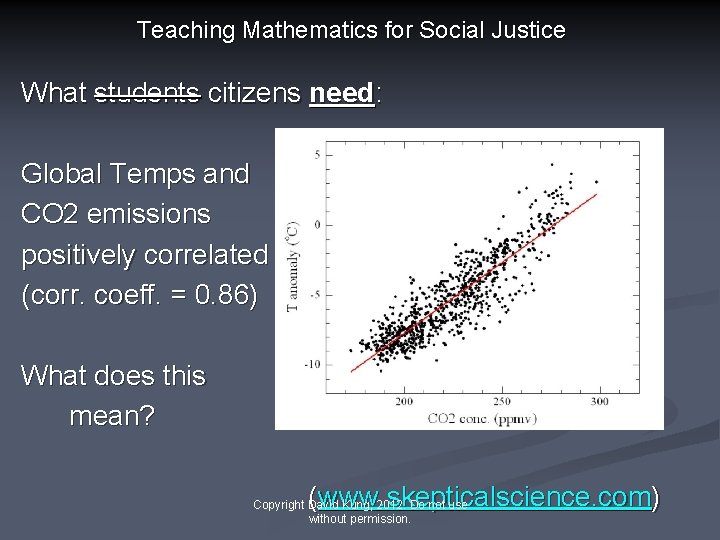
Teaching Mathematics for Social Justice What students citizens need: Global Temps and CO 2 emissions positively correlated (corr. coeff. = 0. 86) What does this mean? ( www. skepticalscience. com) Copyright David Kung, 2012. Do not use without permission.
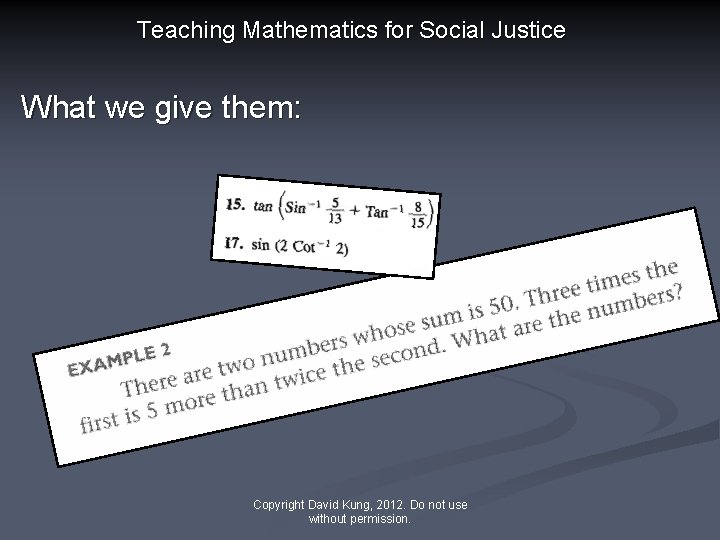
Teaching Mathematics for Social Justice What we give them: Copyright David Kung, 2012. Do not use without permission.
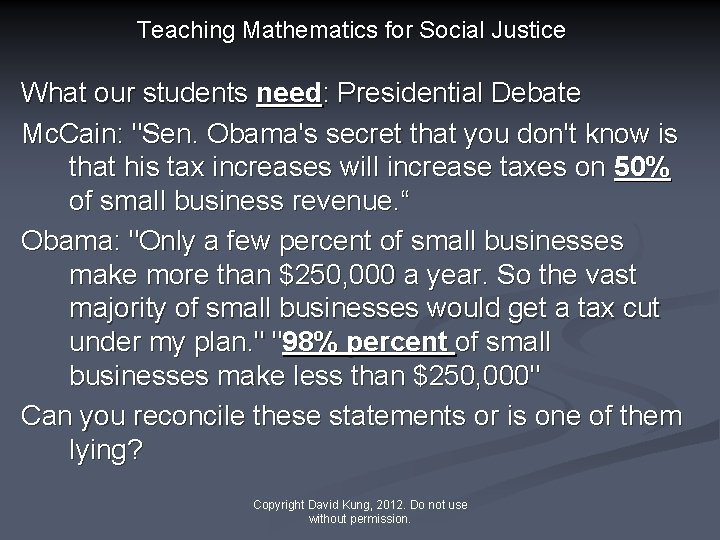
Teaching Mathematics for Social Justice What our students need: Presidential Debate Mc. Cain: "Sen. Obama's secret that you don't know is that his tax increases will increase taxes on 50% of small business revenue. “ Obama: "Only a few percent of small businesses make more than $250, 000 a year. So the vast majority of small businesses would get a tax cut under my plan. " "98% percent of small businesses make less than $250, 000" Can you reconcile these statements or is one of them lying? Copyright David Kung, 2012. Do not use without permission.
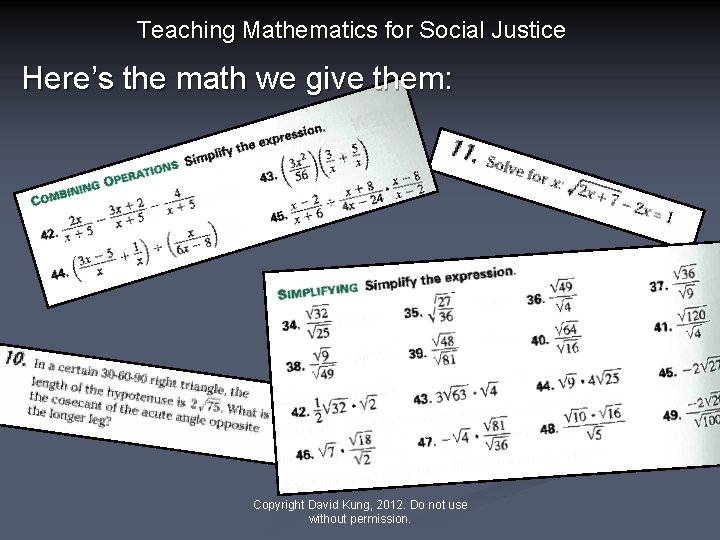
Teaching Mathematics for Social Justice Here’s the math we give them: Copyright David Kung, 2012. Do not use without permission.
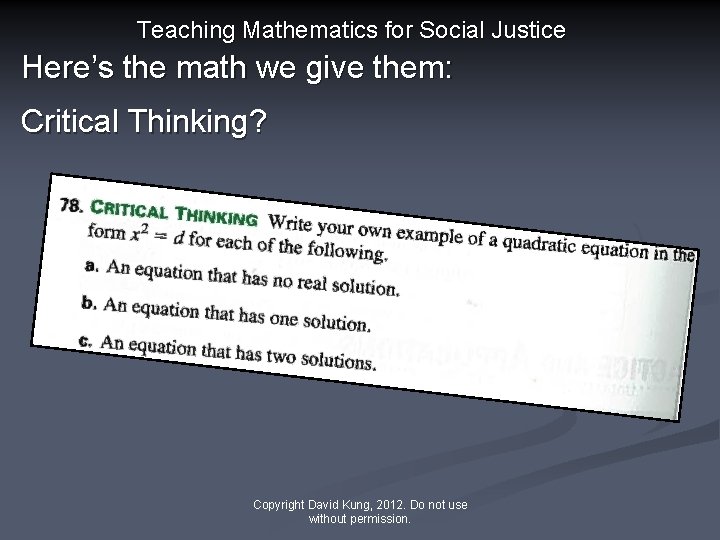
Teaching Mathematics for Social Justice Here’s the math we give them: Critical Thinking? Copyright David Kung, 2012. Do not use without permission.
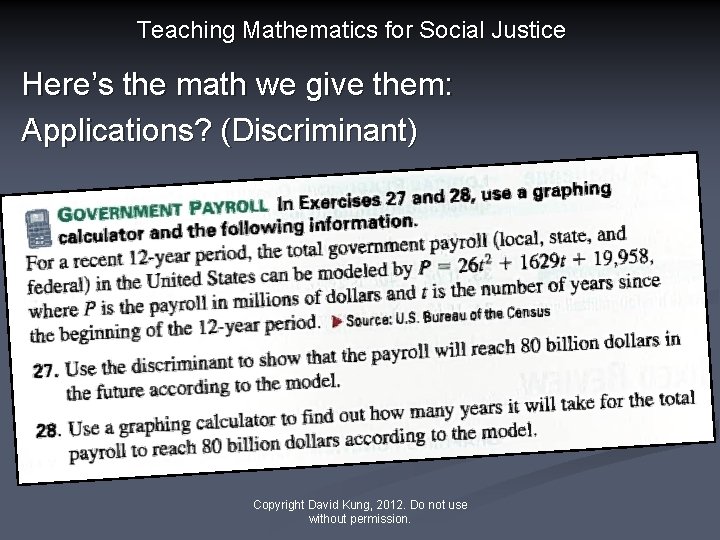
Teaching Mathematics for Social Justice Here’s the math we give them: Applications? (Discriminant) Copyright David Kung, 2012. Do not use without permission.
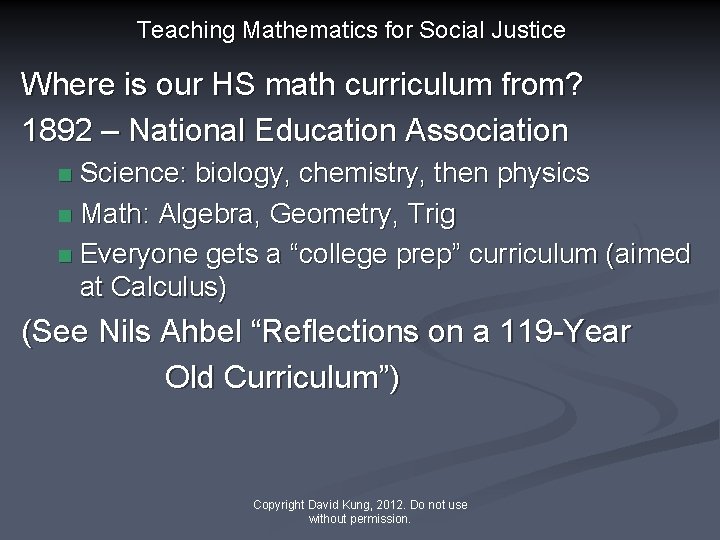
Teaching Mathematics for Social Justice Where is our HS math curriculum from? 1892 – National Education Association Science: biology, chemistry, then physics n Math: Algebra, Geometry, Trig n Everyone gets a “college prep” curriculum (aimed at Calculus) n (See Nils Ahbel “Reflections on a 119 -Year Old Curriculum”) Copyright David Kung, 2012. Do not use without permission.
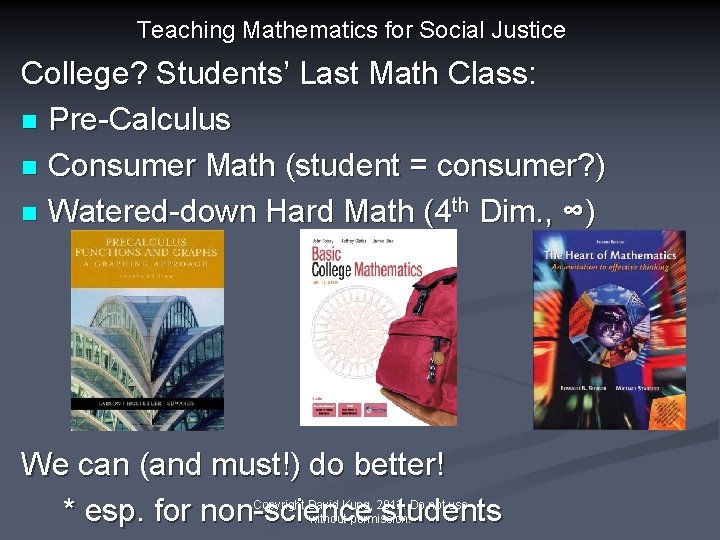
Teaching Mathematics for Social Justice College? Students’ Last Math Class: n Pre-Calculus n Consumer Math (student = consumer? ) n Watered-down Hard Math (4 th Dim. , ∞) We can (and must!) do better! * esp. for non-science students Copyright David Kung, 2012. Do not use without permission.
Teaching Mathematics for Social Justice Math for Social Justice – different models Service learning, First Year Seminar Rob Root, Lafayette College n Focus on education n Readings: What the Numbers Say, Algebra Project (Bob Moses) n Service learning (tutoring middle school students Copyright David Kung, 2012. Do not use without permission.
Teaching Mathematics for Social Justice Math for Social Justice – different models Statistics Lily Khadjavi, Loyola Marymount Univ. n Structure course around meaningful data n LAPD traffic stop data (over 900, 000 traffic stops) n Main question: does the LAPD have racially biased practices? n Driving While Black in the City of Angels Copyright David Kung, 2012. Do not use without permission.
Teaching Mathematics for Social Justice Math for Social Justice – different models Sustainability Tom Pfaff, Ithaca College n adding sustainability issues in Calculus n Statistics (Google “Pfaff Sustainability”) n Copyright David Kung, 2012. Do not use without permission.
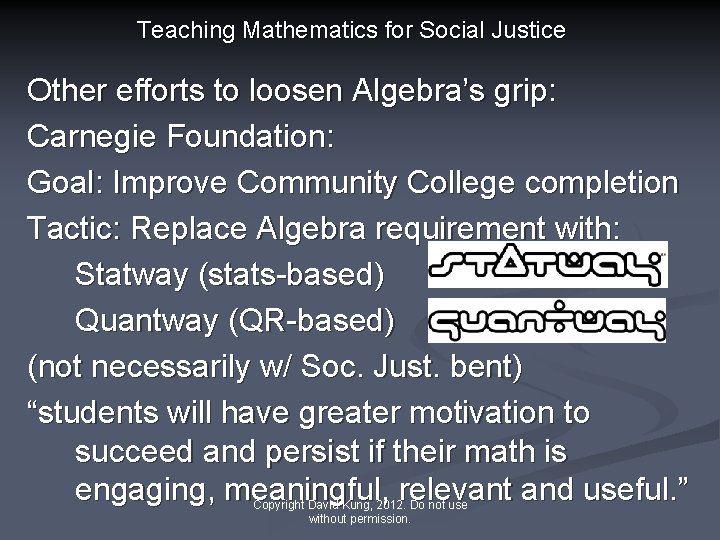
Teaching Mathematics for Social Justice Other efforts to loosen Algebra’s grip: Carnegie Foundation: Goal: Improve Community College completion Tactic: Replace Algebra requirement with: Statway (stats-based) Quantway (QR-based) (not necessarily w/ Soc. Just. bent) “students will have greater motivation to succeed and persist if their math is engaging, meaningful, relevant and useful. ” Copyright David Kung, 2012. Do not use without permission.
Teaching Mathematics for Social Justice Math 131 - Survey of Mathematics: Mathematics for Social Justice (TR, 10 am, Kung) In this section of Survey we will use mathematics to better understand justice, fairness, and equality. Then we will use that new knowledge to improve the world. Audience: non-science majors in their last math class…ever. Copyright David Kung, 2012. Do not use without permission.
Teaching Mathematics for Social Justice Email to class: In this class, you will be expected to change the world. If you aren't interested in doing any world-changing, I believe that the other section of Survey will involve much less. Happy with the world as it is (seriously? ) or signed up for this section only because it fit your schedule? You might want to consider switching classes. Copyright David Kung, 2012. Do not use without permission.
Teaching Mathematics for Social Justice Math for Social Justice goals: n n n Develop the ability to question numbers Develop the inclination to question numbers Knowledgably participate in our democracy Be an effective activist Positive last math course Copyright David Kung, 2012. Do not use without permission.
Teaching Mathematics for Social Justice Math for Social Justice course topics: n n n n Quantitative literacy Large Numbers & Estimation Percentages Statistics Distributions (wealth, health care spending, etc. ) Surveys Voting Financial mathematics Copyright David Kung, 2012. Do not use without permission.
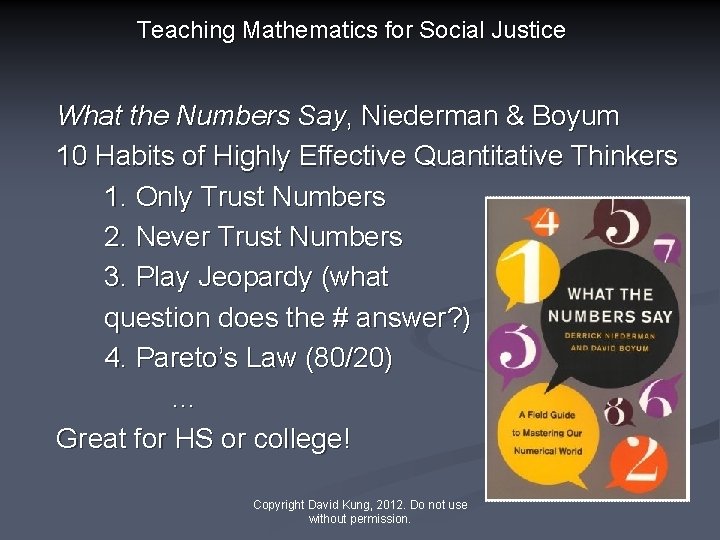
Teaching Mathematics for Social Justice What the Numbers Say, Niederman & Boyum 10 Habits of Highly Effective Quantitative Thinkers 1. Only Trust Numbers 2. Never Trust Numbers 3. Play Jeopardy (what question does the # answer? ) 4. Pareto’s Law (80/20) … Great for HS or college! Copyright David Kung, 2012. Do not use without permission.
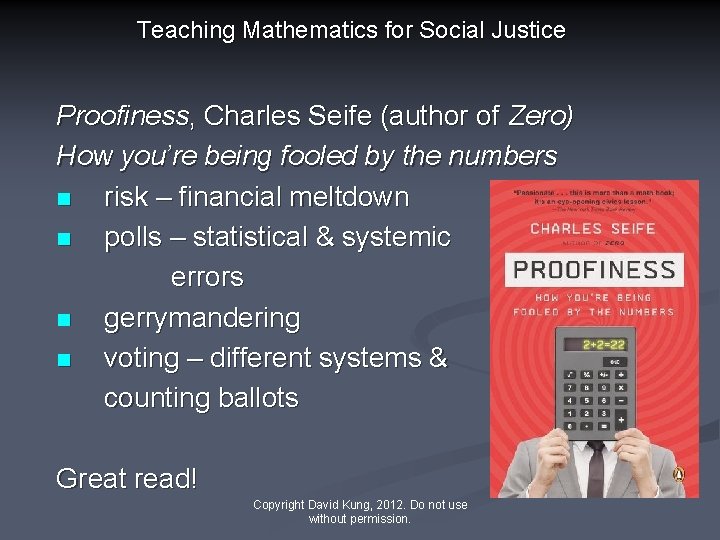
Teaching Mathematics for Social Justice Proofiness, Charles Seife (author of Zero) How you’re being fooled by the numbers n risk – financial meltdown n polls – statistical & systemic errors n gerrymandering n voting – different systems & counting ballots Great read! Copyright David Kung, 2012. Do not use without permission.
Teaching Mathematics for Social Justice Reading the News – discussion boards Idea: practice questioning numbers (inclination) Early in Semester: n A’s: post article, highlight numbers n B’s: post questions about the numbers End of the Semester: n A’s: post article, questions n B’s: use outside resources to answer those questions Copyright David Kung, 2012. Do not use without permission.
Teaching Mathematics for Social Justice Semester Projects: Use Math to Improve the World Proposal: each student proposes a project, pitches it to the class Voting: students rank top 10 Groups of 2 -4 carry out project, write paper, present work. Copyright David Kung, 2012. Do not use without permission.
Teaching Mathematics for Social Justice Semester Project Examples: n solar water heating on dorms (solving linear equations) n n n accessible student housing free trade products in coffee shop campus composting program fair funding of public schools video game about credit cards shortening student shower times Copyright David Kung, 2012. Do not use without permission.
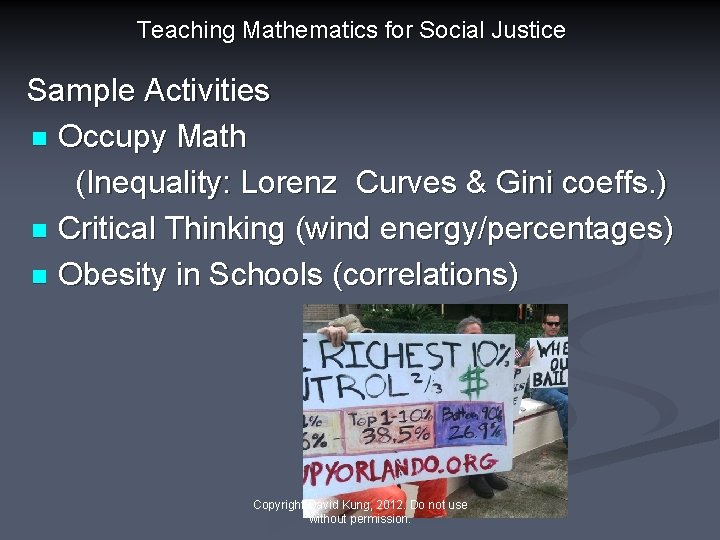
Teaching Mathematics for Social Justice Sample Activities n Occupy Math (Inequality: Lorenz Curves & Gini coeffs. ) n Critical Thinking (wind energy/percentages) n Obesity in Schools (correlations) Copyright David Kung, 2012. Do not use without permission.
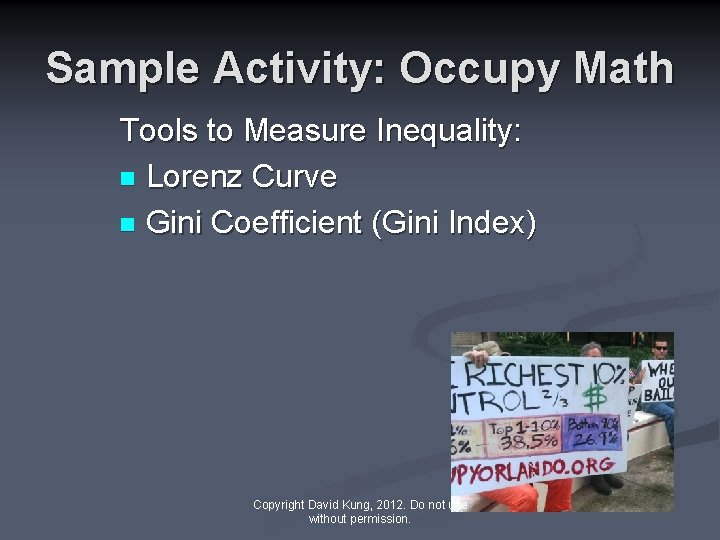
Sample Activity: Occupy Math Tools to Measure Inequality: n Lorenz Curve n Gini Coefficient (Gini Index) Copyright David Kung, 2012. Do not use without permission.
Gini in the News “…income inequality where [the US] ranks worse than the Ivory Coast, worse than Cameroon. Copyright David Kung, 2012. Do not use without permission. 64 th – In your face, Uruguay, Jamaica & Uganda!”
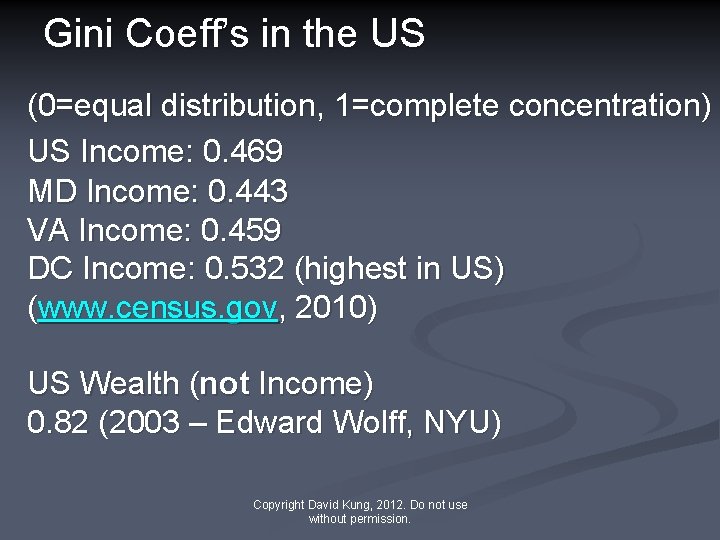
Gini Coeff’s in the US (0=equal distribution, 1=complete concentration) US Income: 0. 469 MD Income: 0. 443 VA Income: 0. 459 DC Income: 0. 532 (highest in US) (www. census. gov, 2010) US Wealth (not Income) 0. 82 (2003 – Edward Wolff, NYU) Copyright David Kung, 2012. Do not use without permission.
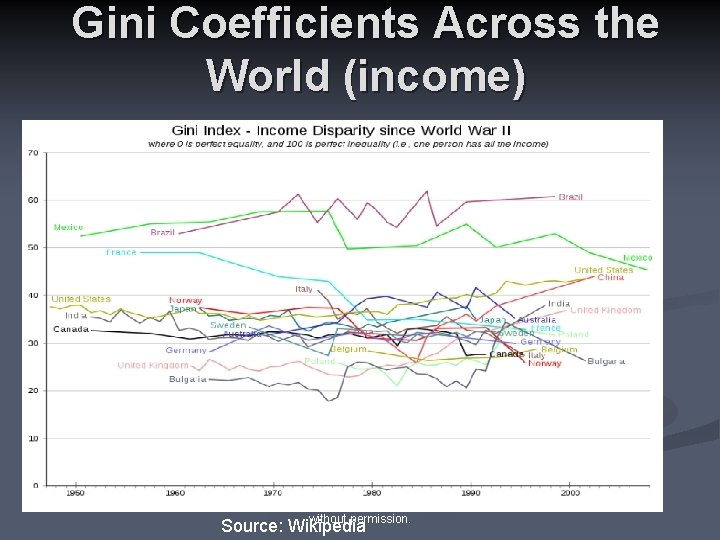
Gini Coefficients Across the World (income) Copyright David Kung, 2012. Do not use without permission. Source: Wikipedia
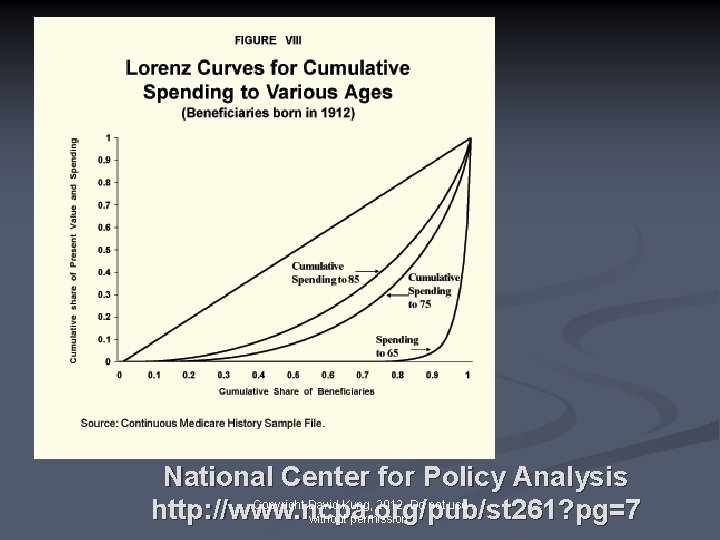
National Center for Policy Analysis Copyright David Kung, 2012. Do not use http: //www. ncpa. org/pub/st 261? pg=7 without permission.
Sample Activity: Critical Thinking (%) Goal: Critical Thinking & Facility with Percentages US Wind Energy Production (see handout) Copyright David Kung, 2012. Do not use without permission.
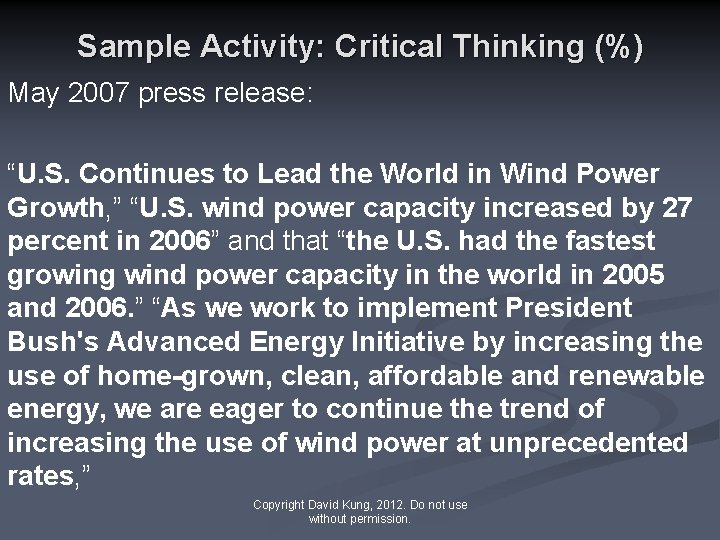
Sample Activity: Critical Thinking (%) May 2007 press release: “U. S. Continues to Lead the World in Wind Power Growth, ” “U. S. wind power capacity increased by 27 percent in 2006” and that “the U. S. had the fastest growing wind power capacity in the world in 2005 and 2006. ” “As we work to implement President Bush's Advanced Energy Initiative by increasing the use of home-grown, clean, affordable and renewable energy, we are eager to continue the trend of increasing the use of wind power at unprecedented rates, ” Copyright David Kung, 2012. Do not use without permission.
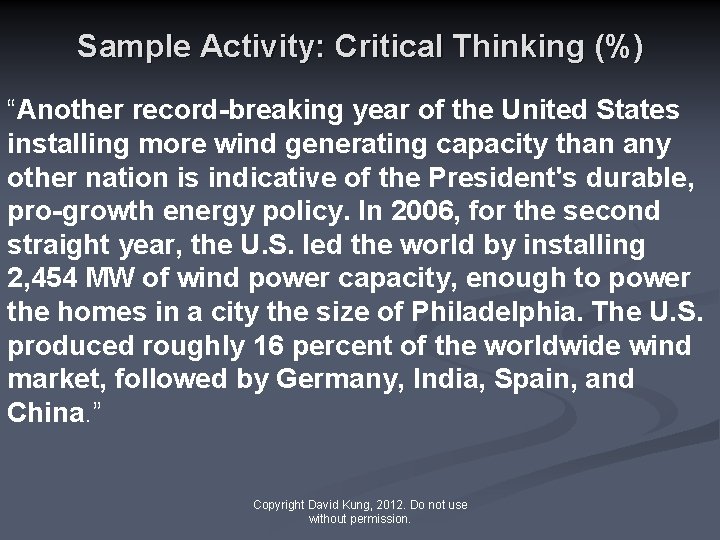
Sample Activity: Critical Thinking (%) “Another record-breaking year of the United States installing more wind generating capacity than any other nation is indicative of the President's durable, pro-growth energy policy. In 2006, for the second straight year, the U. S. led the world by installing 2, 454 MW of wind power capacity, enough to power the homes in a city the size of Philadelphia. The U. S. produced roughly 16 percent of the worldwide wind market, followed by Germany, India, Spain, and China. ” Copyright David Kung, 2012. Do not use without permission.
Sample Activity: Fast Food & Obesity Goal: Critical Thinking & Understanding Correlation (see handout) Copyright David Kung, 2012. Do not use without permission.
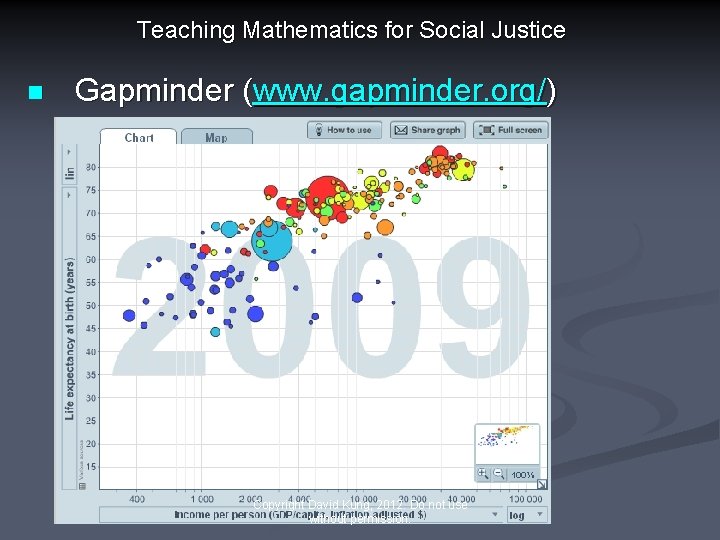
Teaching Mathematics for Social Justice n Gapminder (www. gapminder. org/) Copyright David Kung, 2012. Do not use without permission.
Teaching Mathematics for Social Justice Takehome message: Move away from Calculus to math students can – and will – use as citizens. n engaging! n interesting! n sparks critical thinking! n ties math together with other subjects! Make the world a better, more just place. Closer to Fair Copyright David Kung, 2012. Do not use without permission.
Closer to Fair: Mathematics & Social Justice (curtains close – End of Act II) You: (applause) Dave: Thanks, really you’ve been a great group. Thanks for all of your fantastic questions and comments. Drop me a note anytime. You: [ad lib as needed] Contact: dtkung@smcm. edu Copyright David Kung, 2012. Do not use without permission.