
Close Reading The art and craft of analysis
- Slides: 15
Close Reading The art and craft of analysis
Suzanne Berne article Premise—her visit to World Trade Center—Ground Zero, several months after 9/11 ¡ Appeared in NY Times travel section in April 2002 ¡ Her trouble getting a ticket to the official viewing platform ¡
Berne article discussion Use the rhetoric triangle ¡ Now we can look at her style: ¡ l Choices she makes at the word and sentence levels
Analyzing Style Tone, sentence structure and vocabulary make up an author’s style ¡ Style contributes to the meaning, purpose and effect of a text, whether visual or written ¡
Berne ¡ ¡ ¡ Why is the first paragraph one sentence? In that paragraph, why does Berne call the empty space “the disaster”? Why does the third sentence begin with Gathered rather than firefighters? What examples of fig. language appear in the fourth paragraph? Does the word huddled in the fourth paragraph remind you of anything else? What is the effect of the dashes in the final sentence?
Style ¡ ¡ ¡ When we talk about an author’s word choice, we mean diction When we look at an author’s sentence structure, we mean syntax Style is a matter of tropes and schemes l l Tropes=artful diction-metaphor, simile, personification, hyperbole Scheme=artful syntax-parallelism, juxtaposition, antithesis
Diction Analysis Look at important words in the passage—verbs, nouns, adjectives, and adverbs—general or abstract: specific or concrete ¡ Important words—informal, colloquial or slang ¡ Non-literal or figurative language ¡
Syntax Analysis ¡ ¡ Look at order of the parts of the sentence —subject, verb, object, or is it inverted What part of speech is more prominentnouns or verbs What are the sentences like? Periodicmoving to something important at the end or Cumulative-adding details that support an important idea in the beginning of the sentence How does the sentence connect its words, phrases, and clauses
Practice Read Joan Didion’s passage about California’s Santa Ana winds ¡ Look at word choice and sentence structure. ¡
Annotation ¡ Requires reading with a pen or pencil to mark the text. l l If you cannot write in the book, because it is not yours, then use post-it notes or a reader’s notebook. Identify the main idea-thesis statement and main points-also look for imagery and details.
Dialectical Journal ¡ Also called a double-entry notebook l l l Represents a visual conversation between the text and the reader Note taking para Note making Collecting these bits of information from the text and considering their impression on you prepares you to attack the text and pick it apart
Assignment ¡ Bring in an advertisement to analyze.
JFK Inaugural address 1961 Read the first time to gather information ¡ On the second reading-conversation with the address ¡ Use the rhetorical triangle and appeals ¡ Answer questions on board about diction and syntax ¡
Assignment: ¡ Do the same activity for Obama’s inaugural address 2009
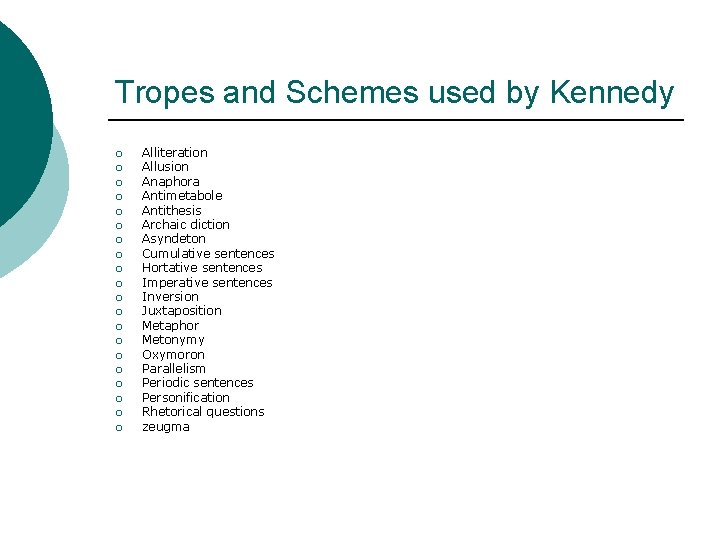
Tropes and Schemes used by Kennedy ¡ ¡ ¡ ¡ ¡ Alliteration Allusion Anaphora Antimetabole Antithesis Archaic diction Asyndeton Cumulative sentences Hortative sentences Imperative sentences Inversion Juxtaposition Metaphor Metonymy Oxymoron Parallelism Periodic sentences Personification Rhetorical questions zeugma