
Close Reading Evaluation Questions Nat 5 Learning Intentions

- Slides: 37
Close Reading Evaluation Questions Nat 5
Learning Intentions – To understand how to express your personal opinion in evaluation questions Success Criteria To understand how effectively a writer has presented their ideas
I can …. . • Express how effectively a writer has expressed their ideas • Discuss my personal opinion I know …. • How to answer evaluation questions
Introduction • To answer Evaluation questions, you must consider how effectively the writer has presented his information. • You must express your personal response to the text. • You might get this across by using the pronoun ‘I’ as in ‘I particularly liked the simile in line. . . as I felt it expressed…. ’
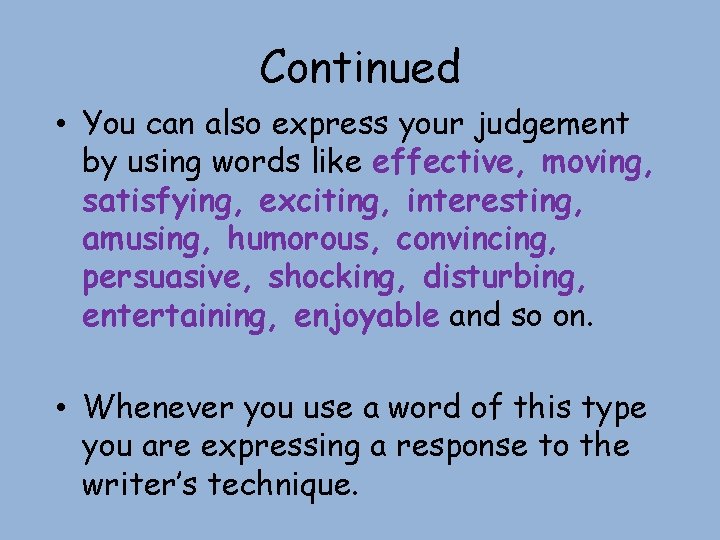
Continued • You can also express your judgement by using words like effective, moving, satisfying, exciting, interesting, amusing, humorous, convincing, persuasive, shocking, disturbing, entertaining, enjoyable and so on. • Whenever you use a word of this type you are expressing a response to the writer’s technique.
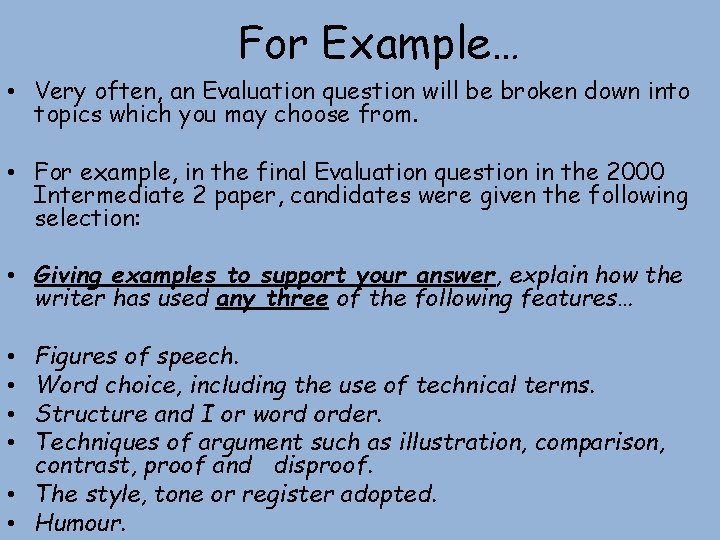
For Example… • Very often, an Evaluation question will be broken down into topics which you may choose from. • For example, in the final Evaluation question in the 2000 Intermediate 2 paper, candidates were given the following selection: • Giving examples to support your answer, explain how the writer has used any three of the following features… Figures of speech. Word choice, including the use of technical terms. Structure and I or word order. Techniques of argument such as illustration, comparison, contrast, proof and disproof. • The style, tone or register adopted. • Humour. • •
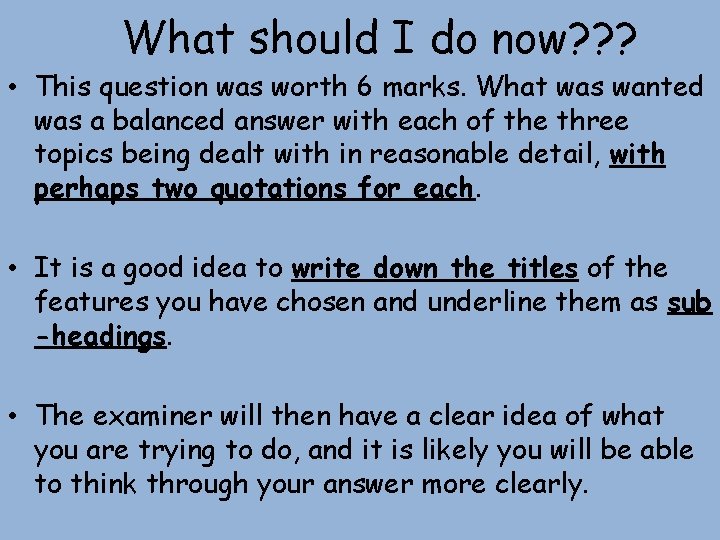
What should I do now? ? ? • This question was worth 6 marks. What was wanted was a balanced answer with each of the three topics being dealt with in reasonable detail, with perhaps two quotations for each. • It is a good idea to write down the titles of the features you have chosen and underline them as sub -headings. • The examiner will then have a clear idea of what you are trying to do, and it is likely you will be able to think through your answer more clearly.
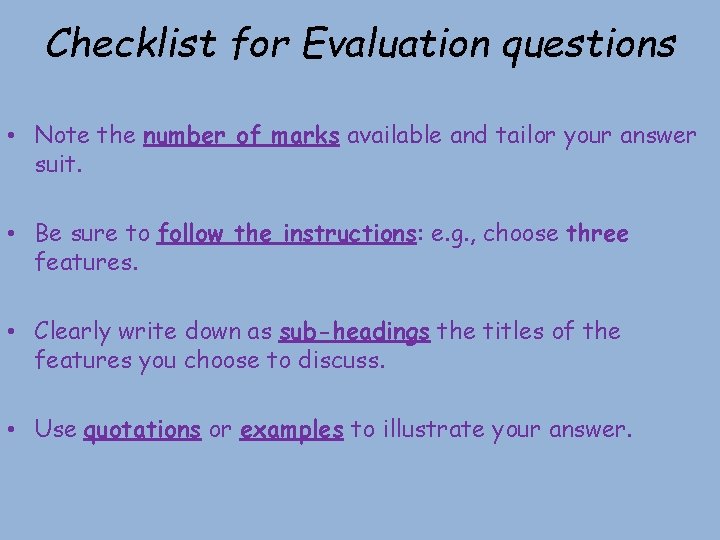
Checklist for Evaluation questions • Note the number of marks available and tailor your answer suit. • Be sure to follow the instructions: e. g. , choose three features. • Clearly write down as sub-headings the titles of the features you choose to discuss. • Use quotations or examples to illustrate your answer.
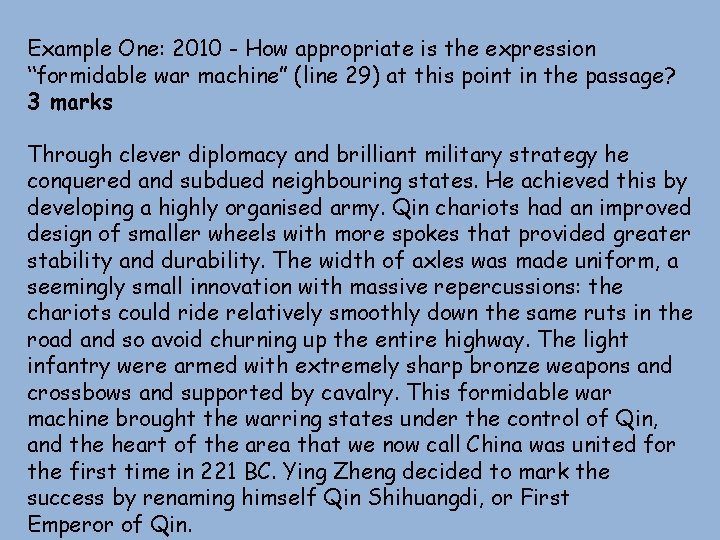
Example One: 2010 - How appropriate is the expression “formidable war machine” (line 29) at this point in the passage? 3 marks Through clever diplomacy and brilliant military strategy he conquered and subdued neighbouring states. He achieved this by developing a highly organised army. Qin chariots had an improved design of smaller wheels with more spokes that provided greater stability and durability. The width of axles was made uniform, a seemingly small innovation with massive repercussions: the chariots could ride relatively smoothly down the same ruts in the road and so avoid churning up the entire highway. The light infantry were armed with extremely sharp bronze weapons and crossbows and supported by cavalry. This formidable war machine brought the warring states under the control of Qin, and the heart of the area that we now call China was united for the first time in 221 BC. Ying Zheng decided to mark the success by renaming himself Qin Shihuangdi, or First Emperor of Qin.
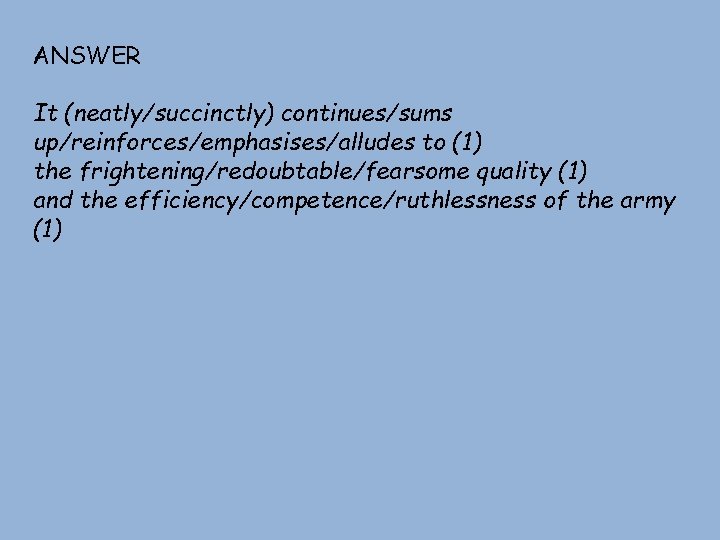
ANSWER It (neatly/succinctly) continues/sums up/reinforces/emphasises/alludes to (1) the frightening/redoubtable/fearsome quality (1) and the efficiency/competence/ruthlessness of the army (1)
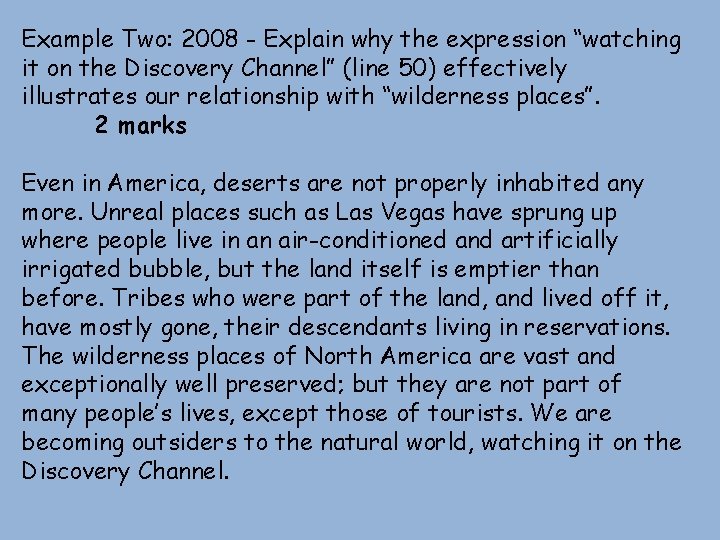
Example Two: 2008 - Explain why the expression “watching it on the Discovery Channel” (line 50) effectively illustrates our relationship with “wilderness places”. 2 marks Even in America, deserts are not properly inhabited any more. Unreal places such as Las Vegas have sprung up where people live in an air-conditioned and artificially irrigated bubble, but the land itself is emptier than before. Tribes who were part of the land, and lived off it, have mostly gone, their descendants living in reservations. The wilderness places of North America are vast and exceptionally well preserved; but they are not part of many people’s lives, except those of tourists. We are becoming outsiders to the natural world, watching it on the Discovery Channel.
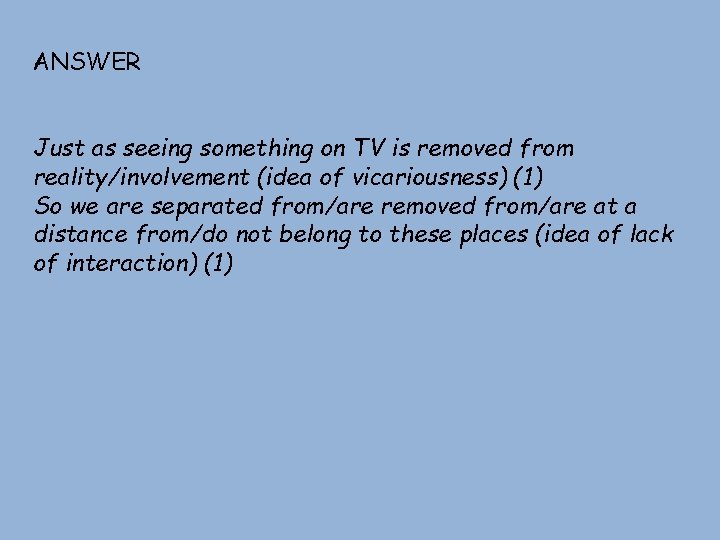
ANSWER Just as seeing something on TV is removed from reality/involvement (idea of vicariousness) (1) So we are separated from/are removed from/are at a distance from/do not belong to these places (idea of lack of interaction) (1)
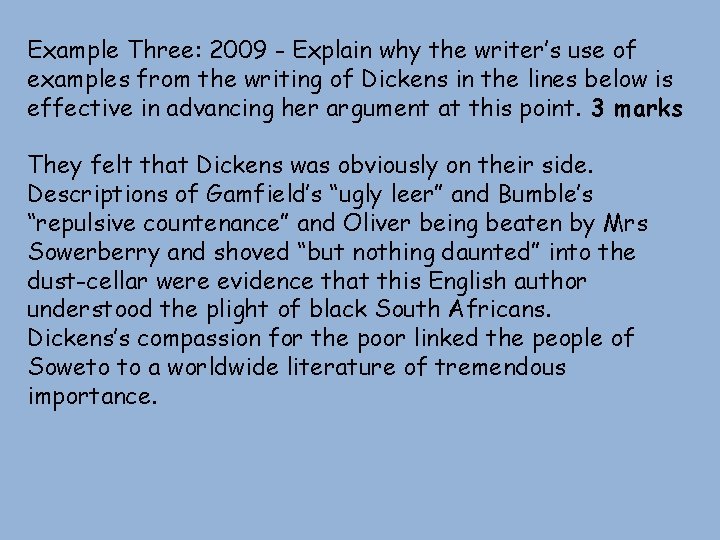
Example Three: 2009 - Explain why the writer’s use of examples from the writing of Dickens in the lines below is effective in advancing her argument at this point. 3 marks They felt that Dickens was obviously on their side. Descriptions of Gamfield’s “ugly leer” and Bumble’s “repulsive countenance” and Oliver being beaten by Mrs Sowerberry and shoved “but nothing daunted” into the dust-cellar were evidence that this English author understood the plight of black South Africans. Dickens’s compassion for the poor linked the people of Soweto to a worldwide literature of tremendous importance.
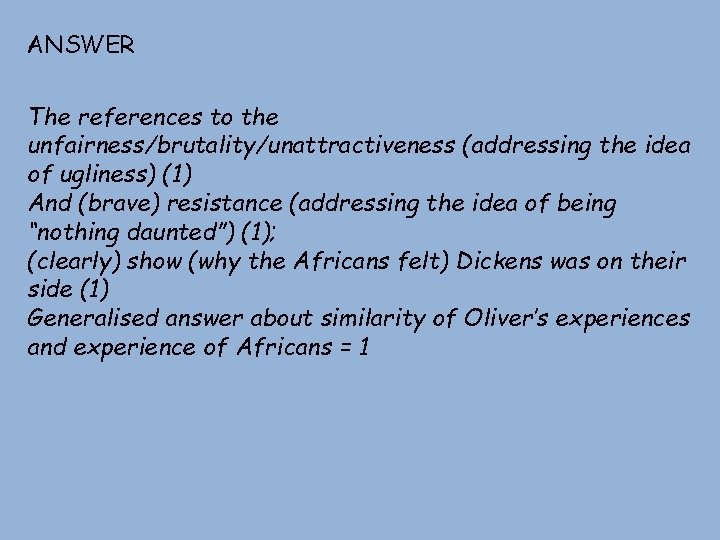
ANSWER The references to the unfairness/brutality/unattractiveness (addressing the idea of ugliness) (1) And (brave) resistance (addressing the idea of being “nothing daunted”) (1); (clearly) show (why the Africans felt) Dickens was on their side (1) Generalised answer about similarity of Oliver’s experiences and experience of Africans = 1
Example Four: 2011 - Explain how effective you find the author’s inclusion of the names of Dickens, Twain, Scott and Lawrence (line 42). 2 marks Texters use deviant spellings—and they know they are deviant. But they are by no means the first to use such nonstandard forms as “cos” for “because” or “wot” for “what”. Several of these are so much part of English literary tradition that they have been given entries in the Oxford English Dictionary. “Cos” is there from 1828 and “wot” from 1829. Many can be found in the way dialect is written by such writers as Charles Dickens, Mark Twain, Walter Scott and D. H. Lawrence.
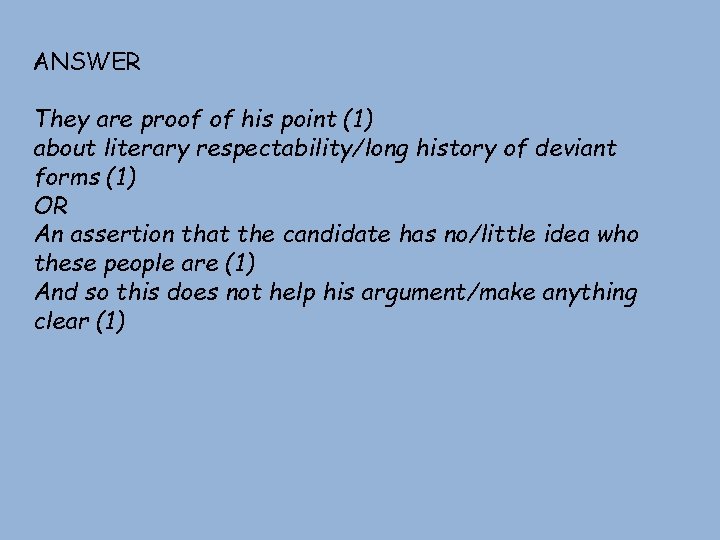
ANSWER They are proof of his point (1) about literary respectability/long history of deviant forms (1) OR An assertion that the candidate has no/little idea who these people are (1) And so this does not help his argument/make anything clear (1)
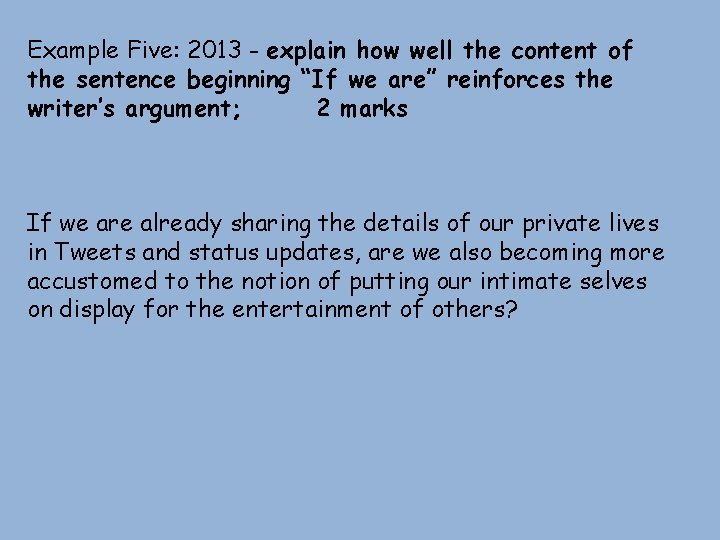
Example Five: 2013 - explain how well the content of the sentence beginning “If we are” reinforces the writer’s argument; 2 marks If we are already sharing the details of our private lives in Tweets and status updates, are we also becoming more accustomed to the notion of putting our intimate selves on display for the entertainment of others?
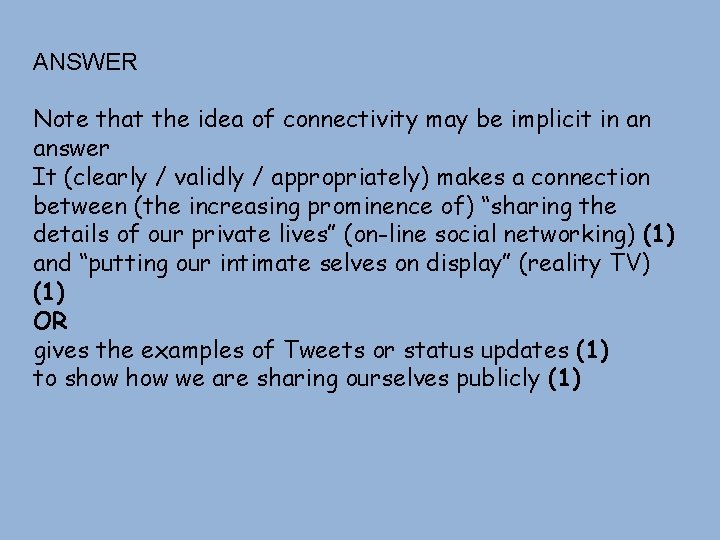
ANSWER Note that the idea of connectivity may be implicit in an answer It (clearly / validly / appropriately) makes a connection between (the increasing prominence of) “sharing the details of our private lives” (on-line social networking) (1) and “putting our intimate selves on display” (reality TV) (1) OR gives the examples of Tweets or status updates (1) to show we are sharing ourselves publicly (1)
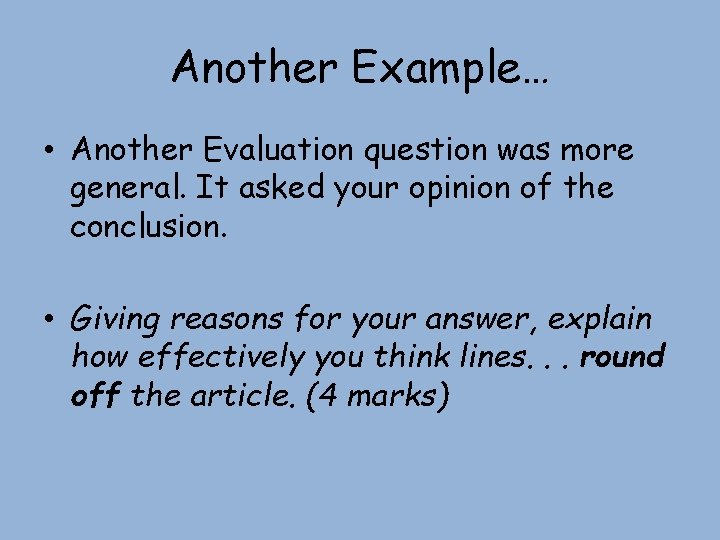
Another Example… • Another Evaluation question was more general. It asked your opinion of the conclusion. • Giving reasons for your answer, explain how effectively you think lines. . . round off the article. (4 marks)
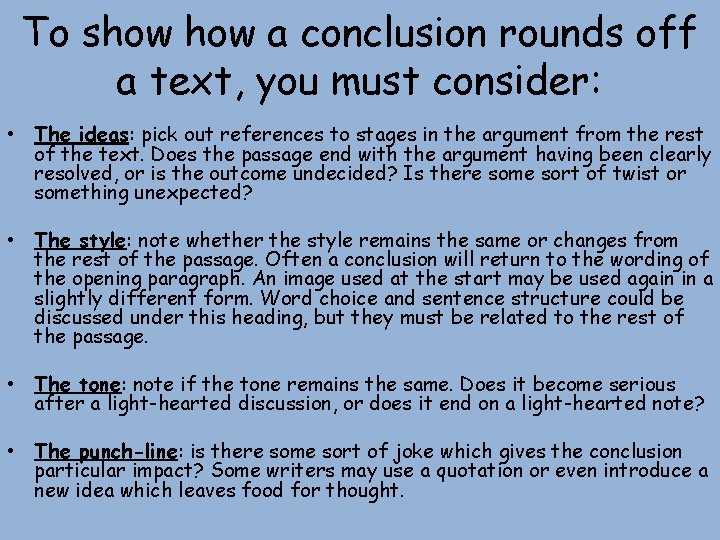
To show a conclusion rounds off a text, you must consider: • The ideas: pick out references to stages in the argument from the rest of the text. Does the passage end with the argument having been clearly resolved, or is the outcome undecided? Is there some sort of twist or something unexpected? • The style: note whether the style remains the same or changes from the rest of the passage. Often a conclusion will return to the wording of the opening paragraph. An image used at the start may be used again in a slightly different form. Word choice and sentence structure could be discussed under this heading, but they must be related to the rest of the passage. • The tone: note if the tone remains the same. Does it become serious after a light-hearted discussion, or does it end on a light-hearted note? • The punch-line: is there some sort of joke which gives the conclusion particular impact? Some writers may use a quotation or even introduce a new idea which leaves food for thought.
You will need to have a copy of the full article in front of you to answer the following questions. 2007, 2008, 2009, 2011 & 2013
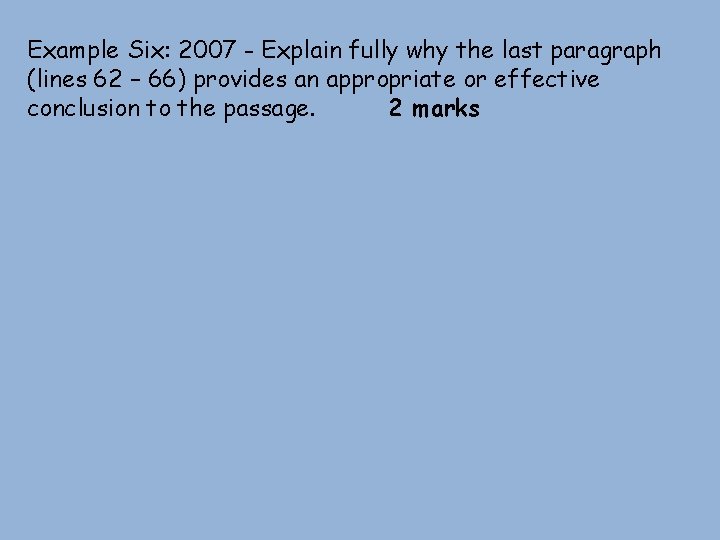
Example Six: 2007 - Explain fully why the last paragraph (lines 62 – 66) provides an appropriate or effective conclusion to the passage. 2 marks
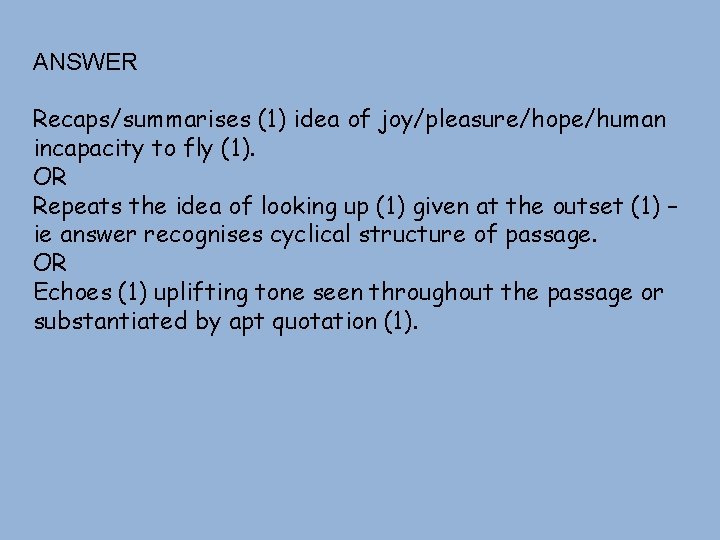
ANSWER Recaps/summarises (1) idea of joy/pleasure/hope/human incapacity to fly (1). OR Repeats the idea of looking up (1) given at the outset (1) – ie answer recognises cyclical structure of passage. OR Echoes (1) uplifting tone seen throughout the passage or substantiated by apt quotation (1).
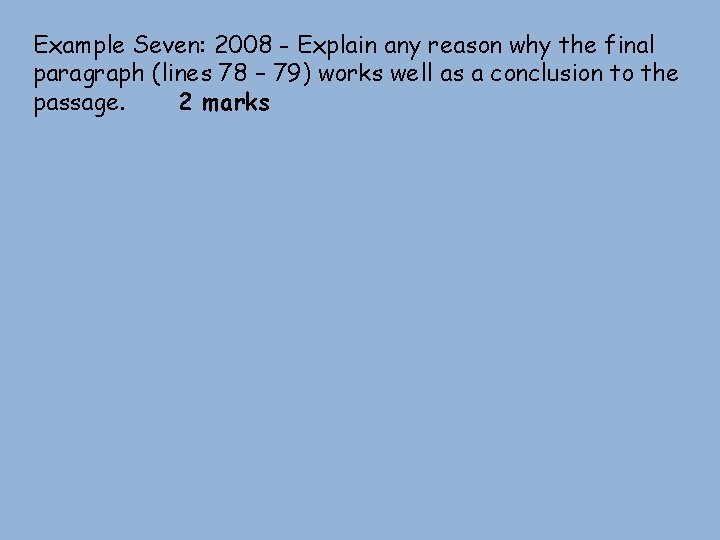
Example Seven: 2008 - Explain any reason why the final paragraph (lines 78 – 79) works well as a conclusion to the passage. 2 marks
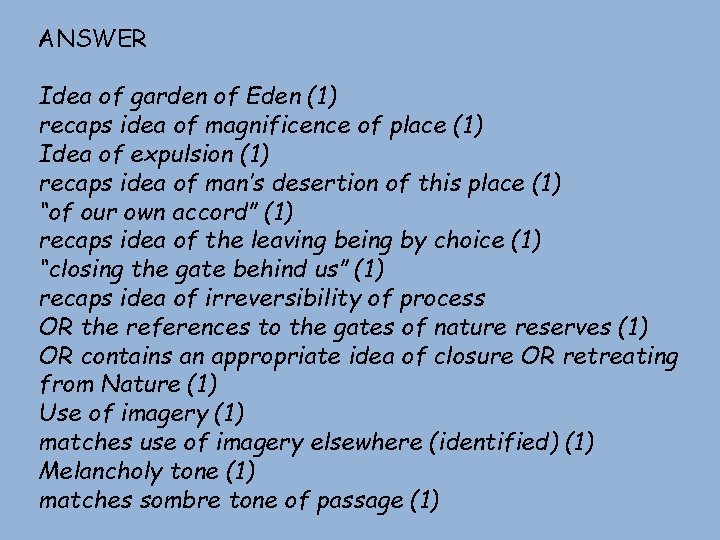
ANSWER Idea of garden of Eden (1) recaps idea of magnificence of place (1) Idea of expulsion (1) recaps idea of man’s desertion of this place (1) “of our own accord” (1) recaps idea of the leaving being by choice (1) “closing the gate behind us” (1) recaps idea of irreversibility of process OR the references to the gates of nature reserves (1) OR contains an appropriate idea of closure OR retreating from Nature (1) Use of imagery (1) matches use of imagery elsewhere (identified) (1) Melancholy tone (1) matches sombre tone of passage (1)
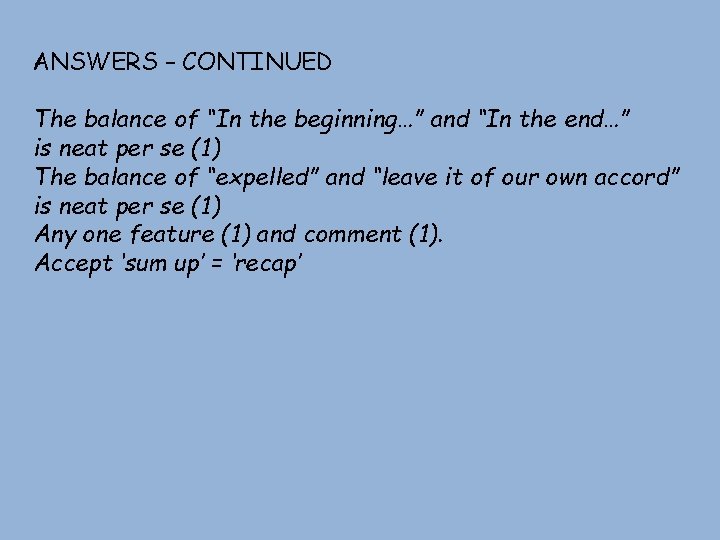
ANSWERS – CONTINUED The balance of “In the beginning…” and “In the end…” is neat per se (1) The balance of “expelled” and “leave it of our own accord” is neat per se (1) Any one feature (1) and comment (1). Accept ‘sum up’ = ‘recap’
Example Eight: 2009 - Look at the last paragraph of the passage (lines 60 – 64). Explain fully why this provides an effective conclusion to the passage. 2 marks
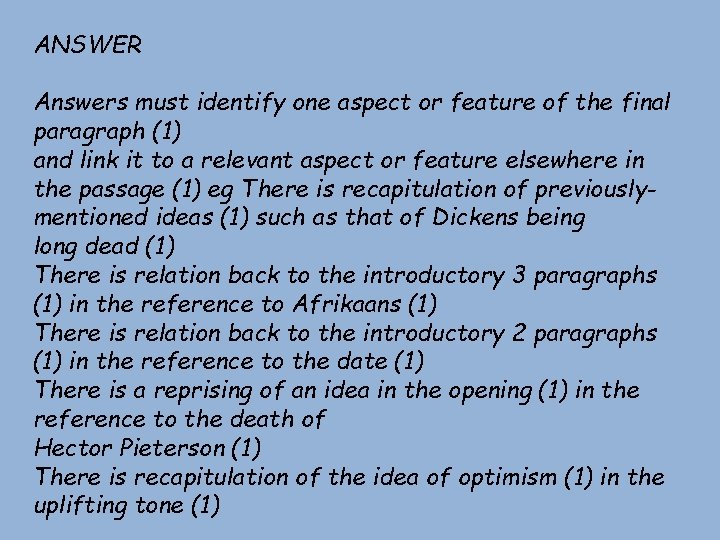
ANSWER Answers must identify one aspect or feature of the final paragraph (1) and link it to a relevant aspect or feature elsewhere in the passage (1) eg There is recapitulation of previouslymentioned ideas (1) such as that of Dickens being long dead (1) There is relation back to the introductory 3 paragraphs (1) in the reference to Afrikaans (1) There is relation back to the introductory 2 paragraphs (1) in the reference to the date (1) There is a reprising of an idea in the opening (1) in the reference to the death of Hector Pieterson (1) There is recapitulation of the idea of optimism (1) in the uplifting tone (1)
Example Nine - 2011 - Look at the final paragraph (lines 71 – 76), and then explain how well you feel this paragraph works as a - conclusion to the passage as a whole. 2 marks
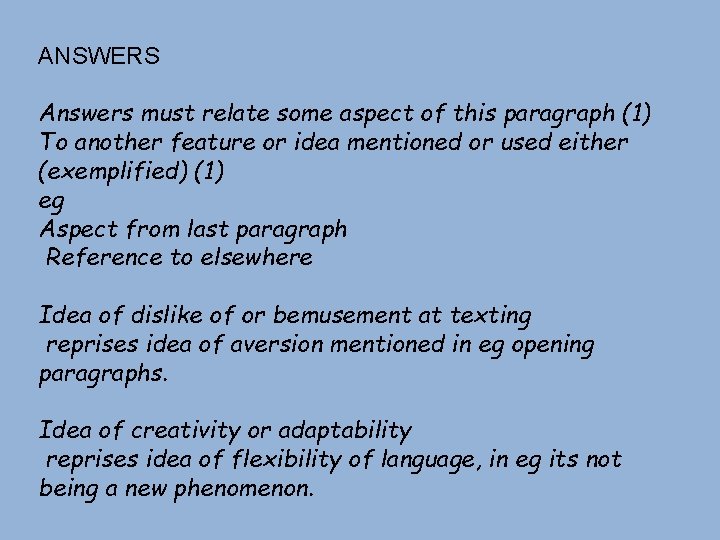
ANSWERS Answers must relate some aspect of this paragraph (1) To another feature or idea mentioned or used either (exemplified) (1) eg Aspect from last paragraph Reference to elsewhere Idea of dislike of or bemusement at texting reprises idea of aversion mentioned in eg opening paragraphs. Idea of creativity or adaptability reprises idea of flexibility of language, in eg its not being a new phenomenon.
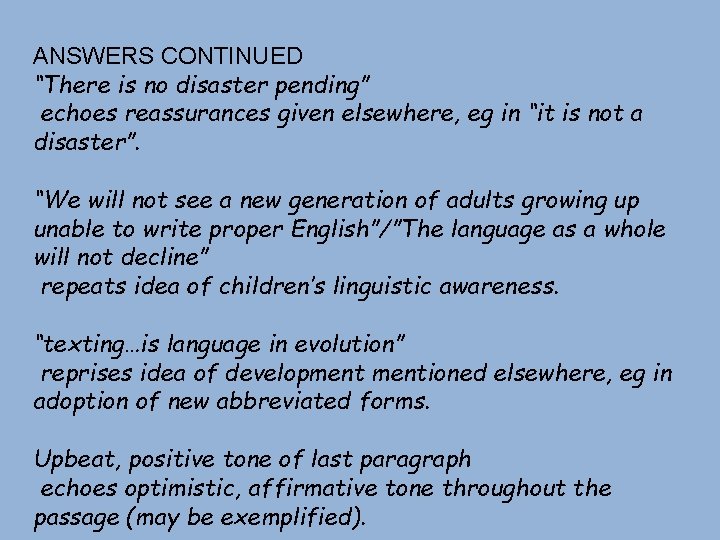
ANSWERS CONTINUED “There is no disaster pending” echoes reassurances given elsewhere, eg in “it is not a disaster”. “We will not see a new generation of adults growing up unable to write proper English”/”The language as a whole will not decline” repeats idea of children’s linguistic awareness. “texting…is language in evolution” reprises idea of developmentioned elsewhere, eg in adoption of new abbreviated forms. Upbeat, positive tone of last paragraph echoes optimistic, affirmative tone throughout the passage (may be exemplified).
Example Ten: 2012 - How effective do you find any aspect of the final paragraph (lines 78 – 79) as a conclusion to the passage? Your answer might deal with such features as word choice or tone. 2 marks
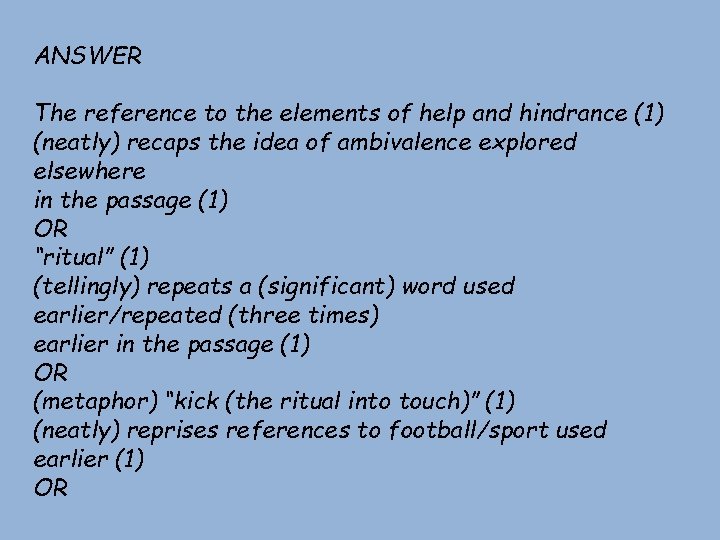
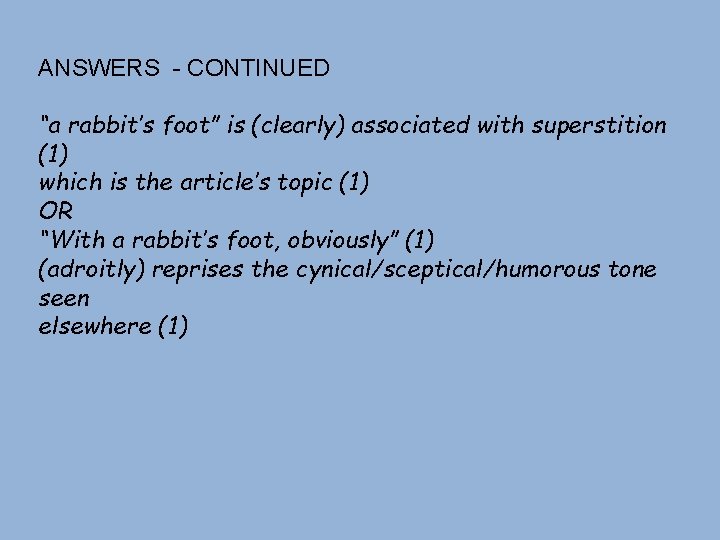
ANSWER The reference to the elements of help and hindrance (1) (neatly) recaps the idea of ambivalence explored elsewhere in the passage (1) OR “ritual” (1) (tellingly) repeats a (significant) word used earlier/repeated (three times) earlier in the passage (1) OR (metaphor) “kick (the ritual into touch)” (1) (neatly) reprises references to football/sport used earlier (1) OR
ANSWERS - CONTINUED “a rabbit’s foot” is (clearly) associated with superstition (1) which is the article’s topic (1) OR “With a rabbit’s foot, obviously” (1) (adroitly) reprises the cynical/sceptical/humorous tone seen elsewhere (1)
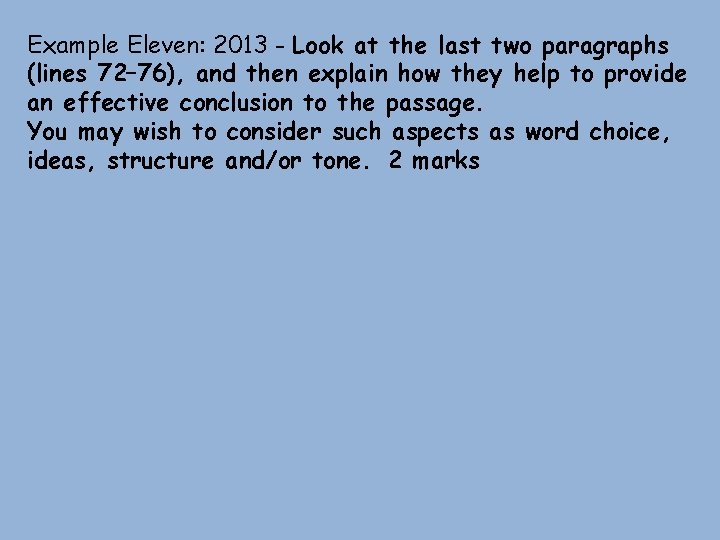
Example Eleven: 2013 - Look at the last two paragraphs (lines 72– 76), and then explain how they help to provide an effective conclusion to the passage. You may wish to consider such aspects as word choice, ideas, structure and/or tone. 2 marks
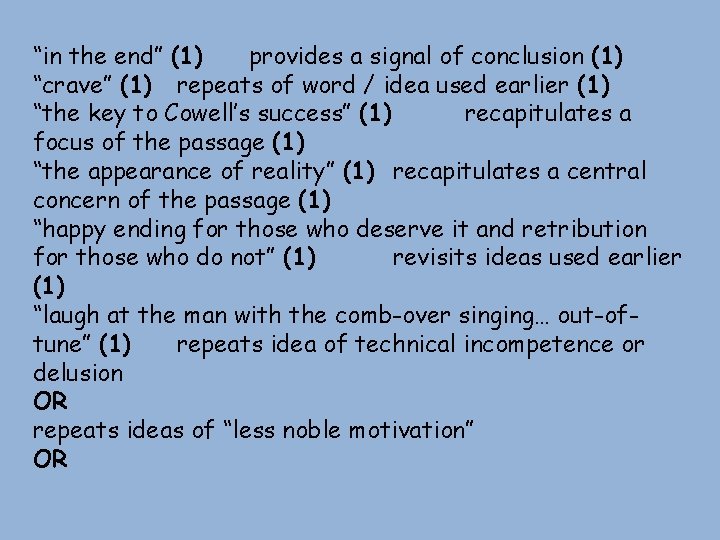
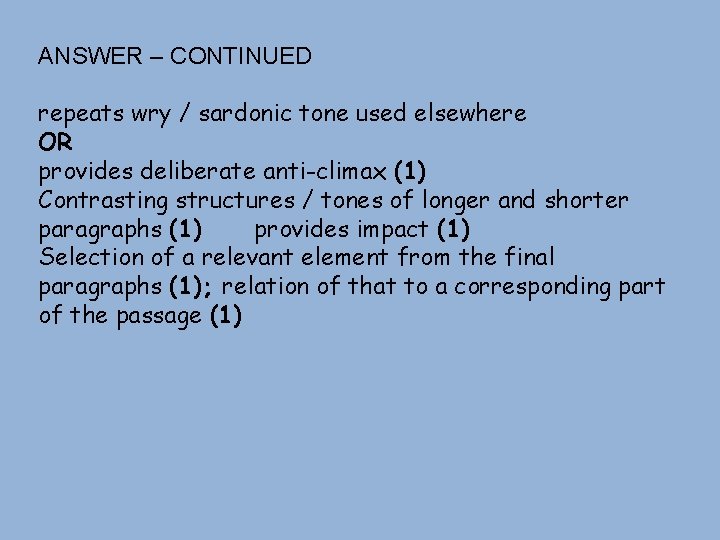
“in the end” (1) provides a signal of conclusion (1) “crave” (1) repeats of word / idea used earlier (1) “the key to Cowell’s success” (1) recapitulates a focus of the passage (1) “the appearance of reality” (1) recapitulates a central concern of the passage (1) “happy ending for those who deserve it and retribution for those who do not” (1) revisits ideas used earlier (1) “laugh at the man with the comb-over singing… out-oftune” (1) repeats idea of technical incompetence or delusion OR repeats ideas of “less noble motivation” OR
ANSWER – CONTINUED repeats wry / sardonic tone used elsewhere OR provides deliberate anti-climax (1) Contrasting structures / tones of longer and shorter paragraphs (1) provides impact (1) Selection of a relevant element from the final paragraphs (1); relation of that to a corresponding part of the passage (1)